27 October 2026
How to Pay Influencers: Methods, Terms and Paperwork 2026
A creator campaign can be ready to publish while the finance team is still chasing invoices, bank details and confirmation of what each creator received. The cleanest way to pay influencers is to match every fee, product, commission and expense to the agreed work, then release payment against a clear contract trigger.
For a marketer handling several creators, the task is more than sending money. The record needs to show what was promised, what went live, whether the advertising disclosure was checked and what the creator received.
Choose a Payment Method for Each Creator
Choose the payment method from the deal terms, because each method creates different paperwork. Write down the method for each creator before drafting a contract.

| Method | What the creator receives | Paperwork to keep | Watch for |
|---|---|---|---|
| Flat fee | Fixed sum for agreed deliverables | Invoice, agreed rate, signed brief | Fee paid for a post that never goes live, unless the contract says otherwise |
| Commission | Percentage of sales or a fixed amount per sale | Tracking link or promo code report, commission terms, payment date | Attribution disputes when tracking is weak |
| Product or gifting | Free goods, sometimes sent with a brief | Item, retail value, delivery record, note on whether posting is expected | Creator may treat the item as income |
| Mixed package | Fee plus product, commission, event access or a loan | One schedule itemising every element and its value | Total consideration is easy to understate |
| Royalty | Ongoing share of revenue or usage | Royalty statement, reporting period, right to check the figures | Hard to verify without shared sales data |
A flat fee is simple to budget, but it still needs an agreed rate and an invoice. Commission needs clear terms for attribution, a report from the tracking link or promo code, and a stated date for payment. A royalty needs a reporting period and a way to check the revenue figures.
Product gifting is often missed because no cash changes hands. If a product is sent with a brief or tied to a post, record the item, its retail value and delivery date. The agreement should say whether posting is expected. For UK tax, HMRC's tax rules for content creators say the value of gifts a creator receives for promoting products counts as their income.
Mixed packages create the most reconciliation gaps. The ASA's influencer guidance treats money, commission, free products or services, loans and other incentives as payment. In a news report on the ASA's findings, the ASA said a post must be clearly marked as an ad when the creator is paid in any form, including gifts, trips or products, and the brand shares control over the content. For a fee plus a product plus affiliate commission, use one schedule: list each element, its agreed value, who records it and how it is paid or delivered, then total the creator's consideration.
The disclosure check belongs in the same paperwork process. In its 2024 monitoring of more than 50,000 Instagram and TikTok posts, the Advertising Standards Authority's report found that approximately 57% of influencer advertisements were adequately disclosed, while 34% had no disclosure and a further 9% used unclear wording. The agreement should specify the label, its placement, who checks it and what happens if the post needs correction or removal.
For a pricing reference when comparing quotes with the planned deliverables, use this Instagram influencer payment guide. Set the method for each creator before drafting the contract, so the payment trigger is clear.
When to Pay Creators and Why Most Wait for the Post
Payment timing decides who carries the risk while the post is still fixable.
| Timing | When money moves | Who carries the risk | Usual fit |
|---|---|---|---|
| On signing | Full fee when the contract is signed | Brand pays before any post exists | Rarely advised for creators the brand hasn't worked with |
| Split | Part on signing, part after the post is live and checked | Risk is shared | Larger fees or longer schedules |
| On going live | Full fee once the post is public | Brand can't review the wording before paying | Short, low-value posts with pre-approved scripts |
| On live and checked | Full fee after the post is live and checked against the brief and disclosure | Creator waits longer for payment | Most paid influencer posts |
For paid influencer posts, most brands settle on the last row, because the content may still need edits, may be removed, or may be missing the required disclosure. Paying on signing puts the whole risk on the brand. Paying at publication means the brand has not checked what the audience can see.
A split schedule can balance production costs with verification. Tie instalments to objective checkpoints: accepted brief, compliant draft, approved post, and delivery of analytics or usage files. If a campaign includes whitelisting, Spark Ads or Meta partnership ads, give the licence its own line in the schedule, with duration, territory, channels and takedown rights, so it reconciles separately from the organic post fee.
The ASA's advice on influencer marketing says payment includes money and free gifts, and may also include discounts, referral code payments and other benefits such as event tickets. It applies two tests, payment and editorial control, and a post that meets both must be clear that it is an ad. The sensible trigger is therefore the disclosure check, not the invoice date.
For a comparison of when product gifting may suit a campaign and when a paid arrangement is clearer, see this guide to gifted and paid influencer campaigns.
A failed trigger looks like this: the contract releases payment “on publication”, the post goes live on time, the label is missing, and the brand has already paid for content it must now chase the creator to correct. Write the trigger as “post live with the agreed disclosure confirmed against the brief”, and the fee, the label and the published post reconcile to the same record before money moves.
Contract Terms to Agree Before Work Starts
Write the contract as the reconciliation record for the post: fee, gifted product, commission, usage rights and live URL should point to one agreed version before any money moves. A creator contract template can organise those terms before work starts.
- Deliverables: State the number of posts, platform, format, length and live-date window. A Reel, a Story set and a TikTok Shop video carry different production effort and different value.
- Exclusivity: Name the competing brands or category and the period covered. A broad restriction can change the value of the deal.
- Usage rights: Specify channels, territory and duration. State whether whitelisting, Spark Ads or paid amplification needs a separate fee from the organic post.
- Timelines: Set dates for the brief, draft, approval, revisions and publication. Identify who can approve and what counts as an accepted draft.
- Rate and currency: Record the agreed amount, the payment currency and who absorbs transfer or conversion costs. The influencer rate calculator gives a starting point to test against the creator's audience and deliverables, not a fixed price.
- Disclosure: Name the exact label, where it must appear, who checks it before release and what happens if it is wrong. The same ASA guidance says an upfront “Ad” label is the easiest route and expects disclosure through an ongoing commercial relationship and in relevant content for 12 months afterwards.
- Correction and takedown rights: Set the notice route, the correction window and when content may need to be removed.
- Payment triggers: Tie each instalment to a defined checkpoint, such as an approved compliant post or delivery of agreed usage files. Count the due date from that checkpoint rather than the invoice date.
Set the money terms with the same precision: due date, currency, disputed-amount process and what is paused while a post is corrected. For adjacent freelance work, teams can compare milestone and hourly billing.
A clause that earns its place is specific: “If the agreed label is missing or misplaced, the creator corrects it within 48 hours of notice; if it remains missing, the brand may withhold the related instalment and require removal.” A creator agreement template helps a team record those terms consistently across creators.
Tax Forms and Invoices to Collect First
Before the first payment, collect an invoice for the agreed fee and the tax information required in the creator's country. The forms depend on the payee and the nature of the work, so the brand should not infer a tax outcome from the payment method alone.
For a US payee, the IRS says Form W-9 collects the payee's name, address and taxpayer identification number. Keep the completed form securely with the creator's payment record. The IRS explains on its page about Form 1099-NEC which payments to non-employees it reports, so check whether the campaign payments fall within those rules.
For a UK creator, HMRC's page on working for yourself explains how self-employed income is reported. Check whether the creator's promotional work counts as self-employed income in their case.
HMRC says creators must include the value of gifts they receive for promoting products when they work out their income. So record each item and its agreed value, even if it had no cash cost to the brand.
An invoice should contain the creator's name and address, invoice number and date, a description of the services, amount and currency, and a VAT number if the creator is registered. A payment record should also capture expenses, product valuation, commission terms, VAT status where relevant, any withholding arrangements and payment date. For US reporting context, this resource on 1099 filing deadlines and thresholds can help identify questions to take to a tax professional.
Tax rules may set thresholds and deadlines, which aren't stated here. Check the relevant official page for the creator's case and speak to an accountant before filing.
How to Send the Money and What Each Route Needs
A bank transfer is the most direct route when a creator has a business bank account. A payment service can suit a creator who has a verified account with that service.
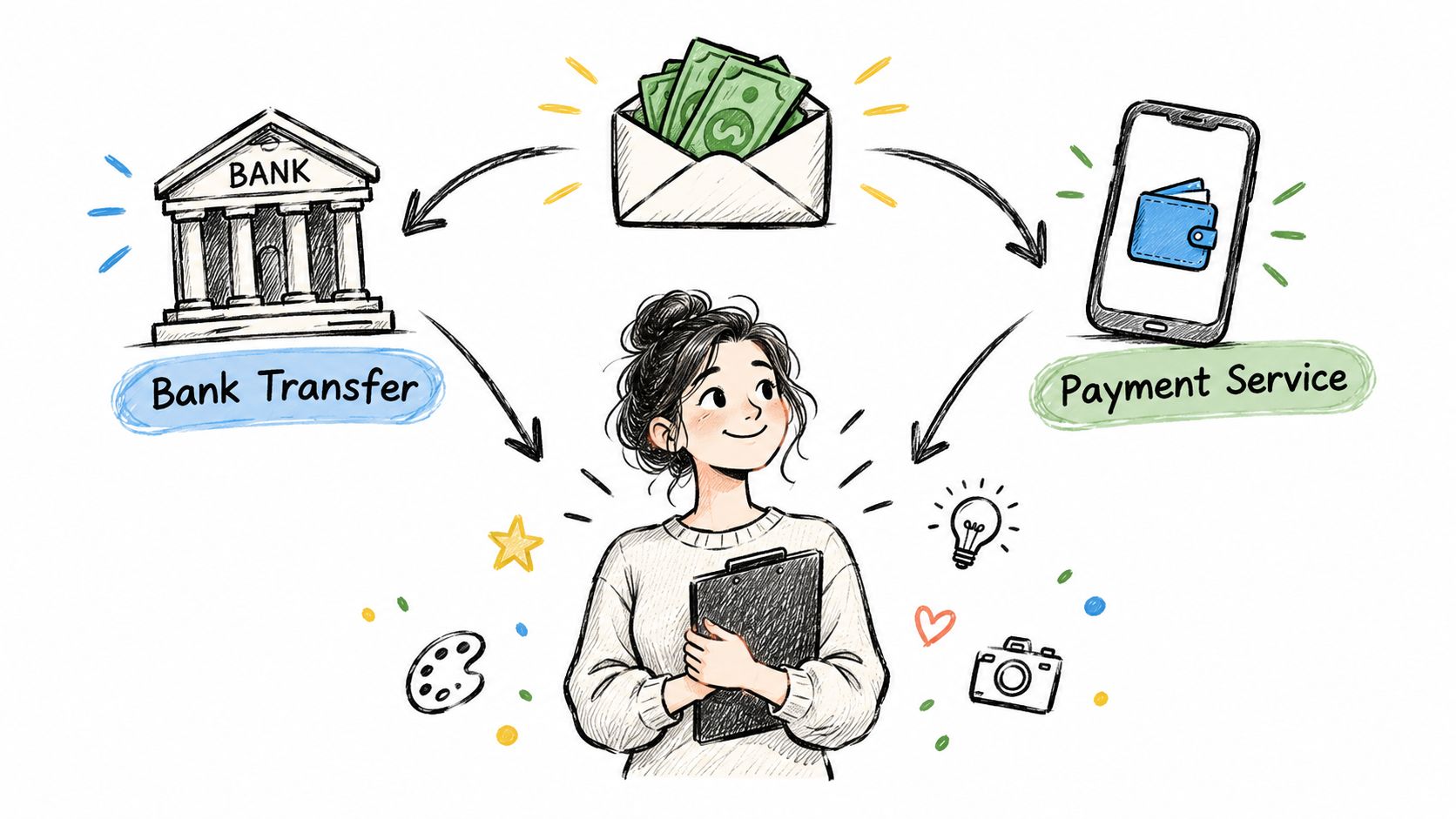
| Route | What the creator provides | Currency and fees | Record kept |
|---|---|---|---|
| Bank transfer, UK | Sort code, account number and business account name | Check whether the sending or receiving bank charges a fee | Bank statement line with the payment reference |
| Bank transfer, overseas | IBAN and BIC or SWIFT code, and the account holder name | Check bank and currency fees before agreeing the amount | Statement showing the currency and rate used |
| Payment service | Verified account on the service and identity checks | Check the service's fee schedule and currency-conversion terms | Transaction report for each creator |
Before an overseas payment, confirm three things in writing. First, agree which currency the creator invoices in. Second, state who pays transfer and conversion fees. Third, say whether the exchange rate is fixed when the contract is signed or taken on the payment date.
Many overseas accounts need an IBAN and a BIC or SWIFT code. The account holder name should match the payment details, so a transfer isn't delayed by a mismatch. The creator's tax residency can also change which forms apply and whether tax must be withheld. Ask an accountant to check the withholding rules in the creator's country before the first overseas payment.
Pick the route before the first brief, confirm the creator's bank details in writing, and check them again before the first transfer.
Keep One Record and Test the Process
A creator payment is complete only when one record proves the whole transaction: the fee, any gifted product value, any commission or royalty basis, and the published post with its disclosure. Tie every line to the final post URL, and set the payment trigger after the disclosure check rather than the invoice date.
| Record | What it holds | Why it matters |
|---|---|---|
| Signed agreement | Terms, rate, deliverables, usage rights, disclosure label and payment trigger | Shows what was agreed |
| Approval record | Brief, drafts, approval dates and requested edits | Shows the checks made before publishing |
| Compensation record | Cash fee, gifted item and retail value, plus any commission or royalty basis | Puts every form of value on one line |
| Payment evidence | Transfer reference, date, amount and currency | Matches the money out to the record |
| Final post URL | Live link and a capture of the disclosure wording | Proves what was published |
The approval record and final URL show what the brand checked. Keep the published link with a capture of the disclosure, because a link alone may not preserve the wording that appeared when the post went live. Hold tax form and invoice details in the paperwork checklist collected before work starts; in this record, they only need to show as present.
A UK law firm's guide to influencer marketing law reports that the ASA received 3,566 complaints about influencer ads that were not disclosed in 2024.
A simple reconciliation routine keeps omissions visible:
- Match the lines: Match each payment to the cash fee, product value, commission or royalty basis, approval and live post.
- Hold the trigger: Release payment only after the disclosure capture is filed; the invoice date starts admin, not payment.
- Flag missing items: At the end of each payment run, list any missing approval, product record, disclosure capture or payment evidence.
- Review the template: Check the record template against the payment run once a month, and update it when the process misses a field.
Before scaling, run one live post through the full chain: contract, approval, compensation value, disclosure capture, payment evidence and final URL. Pay the next creator once that record closes cleanly.
An in-house process can work when one owner can chase contracts, approvals, paperwork and reconciliation. If that ownership is split across clients or markets, a managed service can run sourcing, negotiation, contracting, payment and tracking while the brand keeps the brief, creative direction and approvals. Agencies can use white-label influencer marketing for agencies to do this under their own name. To have the payments handled for you, start a creator campaign with Sup.
More on recruitment
See how many creators post about you and your competitors
Type in your brand's Instagram handle and we count the creators who post about you and about your five closest competitors. It takes about a minute and it is free. Or request a demo and we will show you the creators in your niche and walk you through the dashboard.
 Book a call