Platform · Contracts

Influencer contracts, written, sent and signed for you

An influencer contract is the written agreement between a creator and the brand or agency that hires them. It sets what the creator makes, when drafts are approved, what the brand may do with the content and when the fee is paid. Our team writes it from the deal, sends it, collects both signatures and files the signed copy. Below is the agreement our creators sign, with a note on each clause.

99
creator agreements signed since June 2026

Brands and agencies signed 23 more with us.

24 hours
from sending the link to both signatures

The median. 49 of 97 were done within 24 hours.

72 of 73
agreements allow two rounds of changes

Counted where the agreement states a number.

The agreement

What our creators sign, clause by clause

These are the clauses that decide how a campaign runs, in the agreement’s own words. A field that changes from deal to deal is in square brackets. This is our agreement, written for a team that contracts creators on behalf of brands. It is not legal advice.

Statement of work · the parties

Who signs

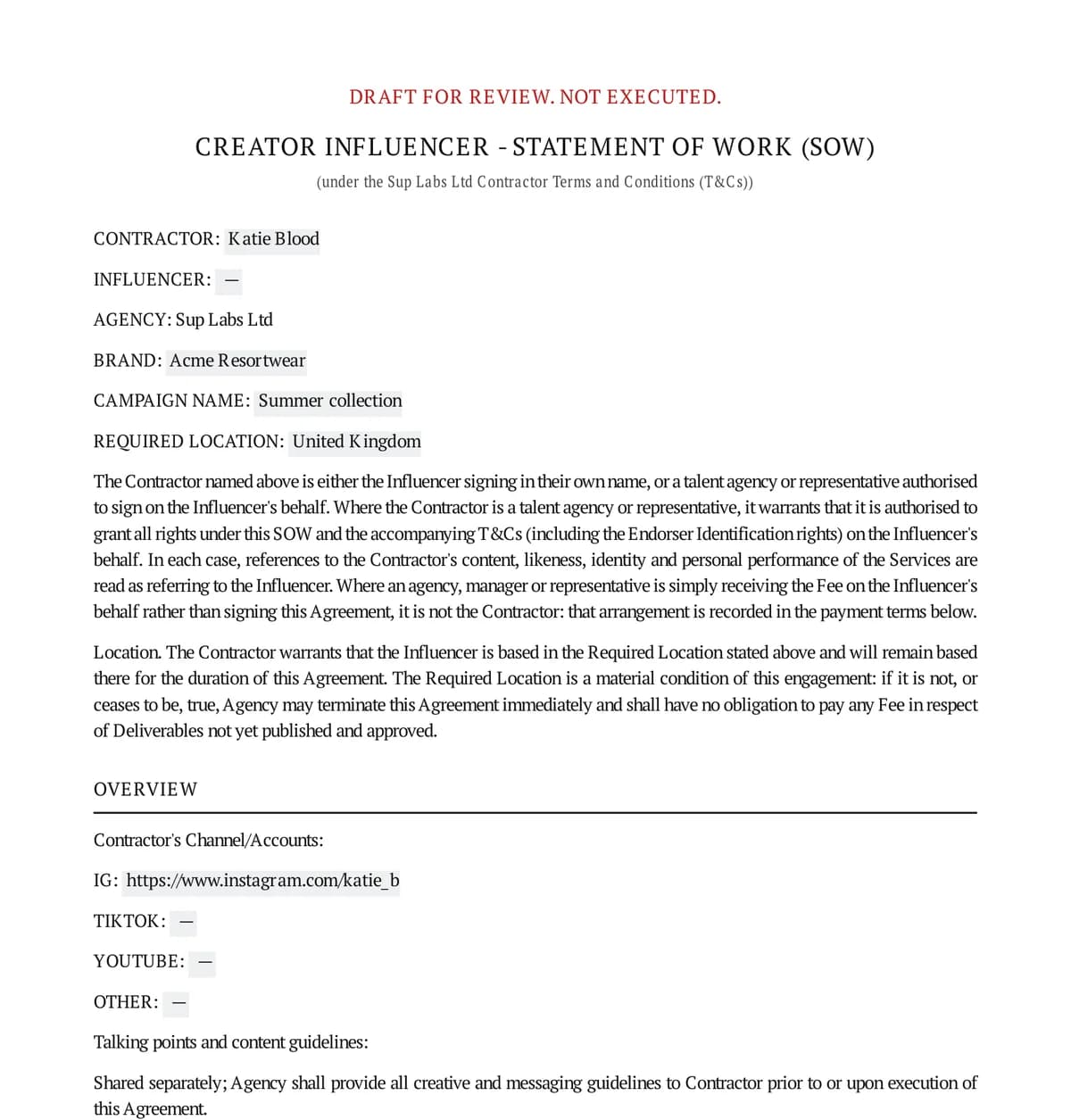
The Contractor named above is either the Influencer signing in their own name, or a talent agency or representative authorised to sign on the Influencer’s behalf. Where the Contractor is a talent agency or representative, it warrants that it is authorised to grant all rights under this SOW and the accompanying T&Cs (including the Endorser Identification rights) on the Influencer’s behalf.

In plain words

A creator can sign, or their manager can sign for them. If a manager signs, the manager promises they have the creator’s permission to grant the rights. A manager who only receives the money does not sign: that goes in the payment terms.


Statement of work · deliverables

What the brand may do with the content

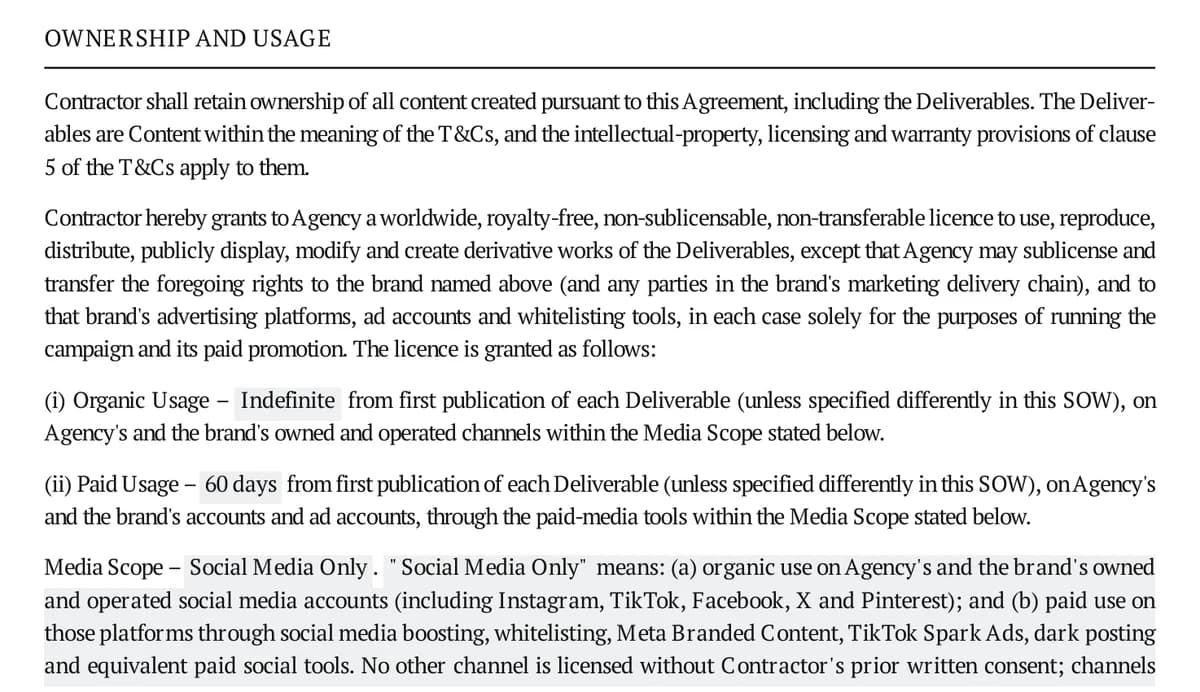
Paid usage rights for [paid usage term] from first publication of each Deliverable (unless specified differently in this SOW), and [organic usage term] organic usage rights from first publication of each Deliverable (unless specified differently in this SOW), in each case within the Media Scope stated in this SOW. Licence is non-sublicensable, non-transferable, except that Agency may sublicense and transfer to the brand named above and any parties in the brand’s marketing delivery chain, and to that brand’s advertising platforms, ad accounts and whitelisting tools (including post boosting, whitelisting, Meta Branded Content, TikTok Spark Ads and dark posting), solely for the purposes of running the campaign and its paid promotion.

In plain words

Two clocks start when the post goes live. One is for the brand’s own channels. The other is for running the post as an ad. The rights pass from us to the brand and its ad accounts, and to nobody else, and only for this campaign.

Statement of work · disclosure

The post is marked as an ad

#PaidPartnership must be at the front of the caption. If this post is a giveaway, the giveaway Terms and Conditions must be linked in bio before posting.

In plain words

The label goes first, where nobody has to open the caption to see it. It is written into the contract, so a missing label is a breach and not a matter of opinion.

Statement of work · approvals

Drafts, replies and rounds of changes

Contractor shall submit the Deliverables to Agency for approval. Agency shall respond within two (2) business days of receiving the Deliverables for review. Failure by Agency to respond shall not relieve Agency of its payment obligations under this Agreement. […] Agency may request up to [rounds] of reasonable edits to the Deliverables.

In plain words

Both sides have a duty here. The creator sends a draft before posting. We answer within two working days, and a slow answer from us does not cost the creator their fee. The number of rounds is fixed before work starts.

Statement of work · approvals

When the fee is earned

Publication of the Deliverables shall occur on dates set by Agency in coordination with Contractor. […] Contractor shall not publish without Agency’s express written instruction. Fees become payable to Contractor only upon publication and Agency approval of the Deliverables.

In plain words

Nothing is posted until we say so, and nothing is owed until an approved post is live. This clause is why a brand on Sup pays only for posts that go live.

Statement of work · ownership and usage

The creator keeps the content

Contractor shall retain ownership of all content created pursuant to this Agreement, including the Deliverables. […] Each usage term shall commence on the date Contractor publishes the Deliverables. Agency shall use best efforts to credit Contractor in all uses of the Deliverables.

In plain words

The creator owns what they make. The brand gets a licence for a set time, not the content itself.

Statement of work · ownership and usage

Access to run the post as an ad

Whitelisting and Platform Access. Contractor agrees to grant Agency or Agency’s designated representative the technical access required for whitelisted boosting (Meta Branded Content Manager, TikTok Spark Ads, and equivalent) for the duration of the paid usage period. Contractor will respond to reasonable access requests within two (2) business days.

In plain words

A right to run an ad is no use without the ad code. This clause makes the creator hand over the access, and gives them two working days to do it.

Statement of work · ownership and usage

Music that is cleared for ads

Music Clearance. Contractor warrants that any music, audio, visual assets, locations or third-party appearances incorporated in the Deliverables are cleared for use in paid advertising on all intended platforms. Contractor shall not use audio from platform-provided music libraries unless the specific track is confirmed as commercially cleared for paid promotion.

In plain words

A trending sound is licensed for a creator’s own post, not for an ad. A post with the wrong track cannot be run as an ad, so the agreement asks for cleared music from the start.

Statement of work · fees and payment terms

What has to be in before we pay

Fees will become payable to Contractor once all Deliverables have been completed and approved by Agency, and any ad or whitelisting codes and performance insights required under this Agreement have been provided (no payment will be issued for partial completion or delivery).

In plain words

The fee waits for three things: the approved post, the ad codes and the creator’s own numbers for the post. In return we pay promptly.

Statement of work · fees and payment terms

How the creator is paid

Contractor will be paid on a [payment term] basis. Once the Deliverables are approved, Sup Labs sends Contractor a secure payment link to provide their payment details (and their invoice, where one is requested); for Contractor’s security, payment details are only accepted through that link and never by email or message.

In plain words

Bank details never travel by email. A message that asks someone to "send your details again" is a common way for a payment to be stolen, so the contract rules it out.

Statement of work · other terms

One line of contact

No Direct Contact with Brand: Contractor shall not initiate or respond to direct communications with the brand regarding campaign matters, fees, future opportunities, or extensions, without Agency’s prior written consent. All communications shall route through Agency.

In plain words

The brand gets one set of notes from one place, and no creator receives two different instructions. The fee is confidential under a clause beside this one.

Terms and conditions · clause 9

Ending the deal

Either Party may terminate this Agreement without cause by giving at least thirty (30) days’ written notice. In the event Sup terminates for convenience, Sup shall pay Contractor for any pre-approved expenses incurred and one hundred percent (100%) of the fee if the Contractor has created and delivered all content. […] If either Party commits a material breach not cured within five (5) business days of written notice, the non-breaching Party may terminate immediately.

In plain words

If we cancel after the work is done, the creator is paid in full. If either side breaks the agreement, the other gives five working days to put it right.

What is usual

The terms creators agree to

Most guides tell you which clauses to include. None tells you what number goes in them. These are the terms in the 99 creator agreements signed with us.

When the creator is paid

  • Net 307581%
  • Net 71718%
  • Net 211%

Rounds of changes

  • 2 rounds7299%
  • 3 rounds11%

Paid use: running the post as an ad

  • 60 days5373%
  • 90 days1318%
  • 12 months68%
  • 45 days11%

Organic use: the brand’s own channels

  • 60 days5373%
  • 90 days1318%
  • Indefinite57%
  • 12 months11%
  • 6 months11%

Content made for a brand to run itself (UGC) is licensed for longer: 25 of 26 UGC agreements give 12 months. The posting window in an influencer agreement is 8 days at the median. Instagram is named in 79 agreements and TikTok in 33.

How we counted. From the terms written into each creator agreement signed through our signing tool since June 2026. A term left blank on an agreement is not counted, so the totals differ from chart to chart. No fee is shown. Read on 5 October 2026.

Negotiation

What creators push back on, and what we accept

10 of the 111 creators we sent an agreement to came back with changes to the wording, some of them through a manager. 9 of them signed. These are the changes we see most, and our answer to each.

They ask forOur answerWhy
One round of changes, not twoWe keep twoA second round is the safety net when a draft misses the brief. We do accept a reshoot fee that applies only when the first draft followed the brief.
The post taken down after 45 daysIt stays on the feedA post published with the brand as a collaborator sits on the brand’s feed too. We agree a limit on reposting and reusing it, often 12 months.
Payment before sending their insightsInsights firstThe creator’s own numbers for the post are part of the work. In return we pay promptly.
Full fee if we cancel after the work is doneYesIt is fair, and it is already in our terms.
The no-contact rule to end with the campaignYesThe rule exists so the brand gets one set of notes while the campaign runs.
A fee for any use beyond the agreed termYesMore use is worth more. We would rather agree the price up front.

From the redlines creators and their managers have sent us. On a small deal we accept most changes as written and hold only the first three.

Done for you

From the deal to a signed copy

Half of our creator agreements are signed by both sides within 24 hours of the link going out. Once a creator opens the form, both signatures are in place in a median of 1 hours.

  1. 01

    We write it from the deal

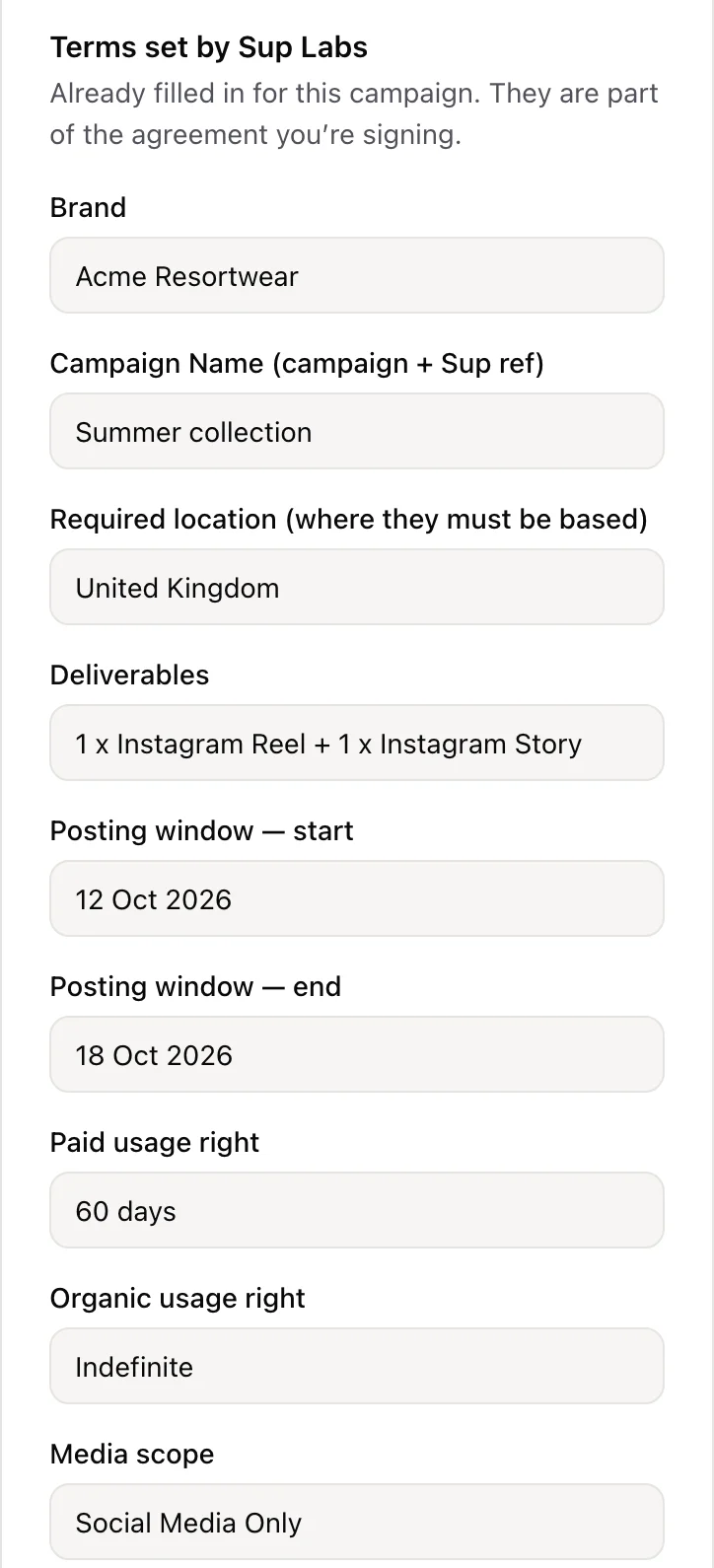
    The deliverables, the dates, the usage terms and the fee you approved go into the statement of work. You do not draft anything.

    Who:
    Our team
    You:
    Approve the fee first
  2. 02

    The creator signs on their phone

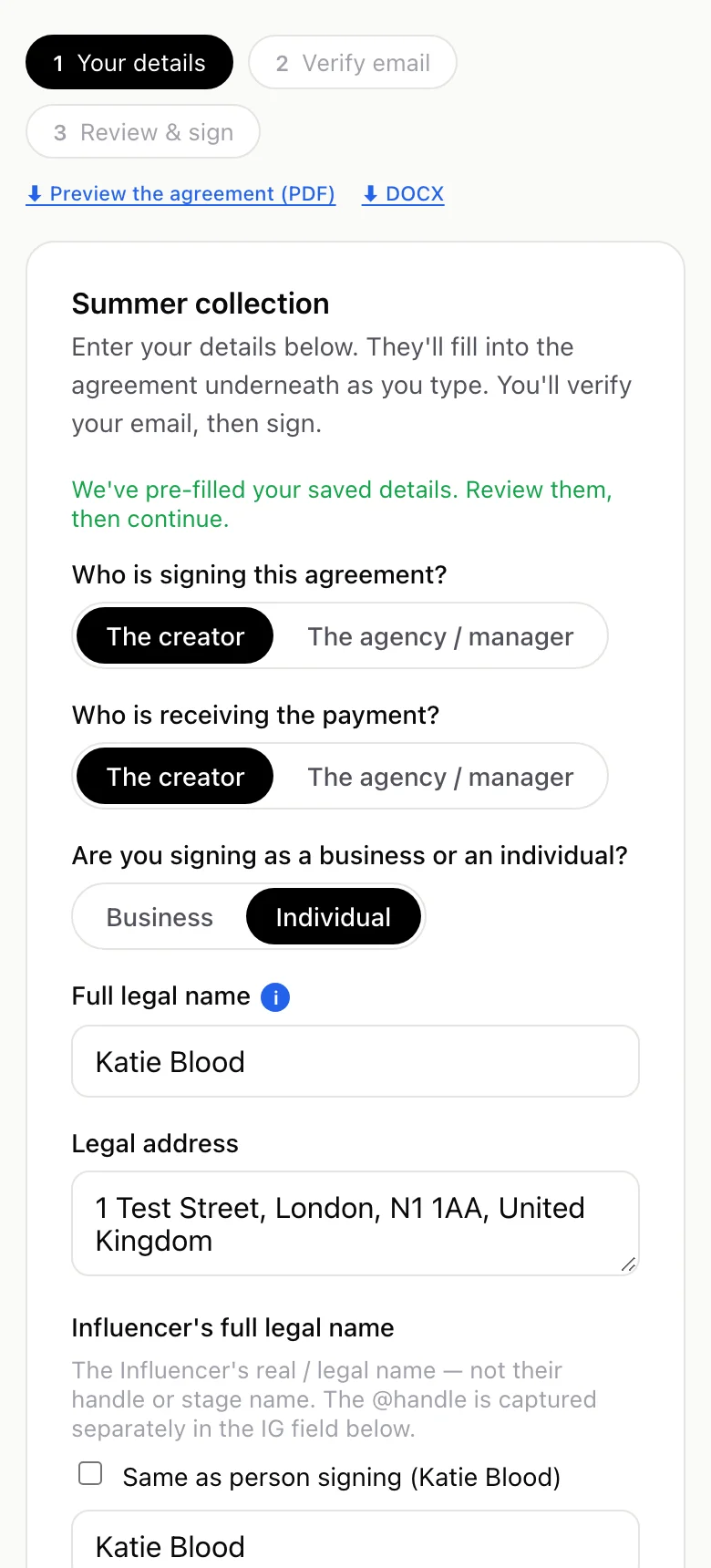
    They open a link, confirm their email address with a code, read the agreement and sign. No account and no app.

    Who:
    The creator
    How long:
    1 hours at the median
  3. 03

    We countersign and file it

    Both sides get the signed PDF by email. The tool records a fingerprint of the file, so a signed copy cannot be changed later without it showing.

    Who:
    Our team
  4. 04

    Tax details are collected at signing

    A creator in the United States gives the details a W-9 asks for as part of signing. 68 have so far. Nobody chases a form at the end of the year.

    Who:
    The creator
  5. 05

    A manager can sign for a creator

    10 agreements were signed or paid through a talent agency or a manager. The agreement records who has authority and who is paid.

    Who:
    The manager
  6. 06

    A change of terms is signed too

    If a deal grows after signing, for example one more video, the creator accepts a short add-on. The fee never changes by email.

    Who:
    Our team and the creator

How we counted. From the 97 creator agreements with a recorded link time in our signing tool. "Link to both signatures" starts when we make the link, so it includes the wait before the creator opens it: 71 of 97 were complete within 72 hours. Read on 5 October 2026.

For agencies

Who signs when an agency runs the campaign

The creator signs with us, not with the brand. In the agreement Sup is the agency, the brand is named, and the licence passes from the creator to us and on to the brand for that campaign only. So a brand never has to contract each creator one by one.

If you are an agency, your client signs nothing with creators either. You sign one master agreement with us and a short statement of work for each campaign. Brands and agencies have signed 23 of those since June 2026. The creator’s fee stays confidential under the agreement, and creators do not contact your client directly.

Want the document only? The free influencer contract template writes a short agreement from your answers. Send it with a brief from the brief template, and read how approval works on the briefs and approvals page.

Matt Greenwell

Written by

Matt Greenwell, Co-Founder and CEO of Sup

Matt started Sup in 2024 with Hassan Munir. Before Sup he co-founded Storefront, the marketplace for booking pop-up retail space. Before that he worked at Goldman Sachs.

The agreement text is Sup’s own. The figures are counted from our signing tool, and no creator or fee is named. Updated 5 October 2026.

FAQ

Influencer contract questions

It is the written agreement between a creator and the brand or agency that hires them. It sets what the creator makes, when drafts are approved, how the post is marked as an ad, what the brand may do with the content and for how long, and when the fee is paid. It is also called an influencer agreement.

Have something in writing, even if it is short. A gifted post is still advertising, so the disclosure clause applies. You also want it agreed in advance if you plan to repost the content or run it as an ad, because a gift alone gives you no right to do either.

Two is usual. 72 of the 73 creator agreements signed on Sup that state a number allow two rounds. One round leaves no room when a creator misses the brief. More than two means the brief was not clear enough.

Net 30 after the post is approved is the most common term in our agreements (75 of 93). A shorter term such as Net 7 helps when you want a creator to choose your campaign over another. Whatever you write, pay on it.

In our agreement the creator owns it and grants a licence for a set time and a set purpose. That is the usual arrangement for a paid post. If a brand needs to own the content outright, the contract has to say so in clear words, and creators charge more for it.

Write three things into the contract: a paid use term, the platforms and tools it covers (Meta partnership ads, TikTok Spark Ads) and a duty on the creator to hand over the ad code within a set number of days. Without the third, you can hold a right you cannot use.

Regulators can hold both the brand and the creator responsible. In the United States the FTC says the brand should give clear instructions and check that they are followed. In the United Kingdom the ASA and the CMA take the same view. So the label belongs in the contract, and someone has to check the live post.

Under our agreement no fee is owed, because the fee is earned only when an approved post is live. Nothing is paid for part of the work. That is also why a brand on Sup pays only for posts that go live.

Not a new set of terms. Our agreement has two parts: standing terms and conditions, and a statement of work for the campaign with the deliverables, the dates, the usage terms and the fee. Only the statement of work changes from one campaign to the next.

No. The agreement on this page is the one Sup uses, shown so you can see what a working contract says. The law differs by country and by state. Ask a lawyer to check any contract before you rely on it.

What is an influencer contract?

It is the written agreement between a creator and the brand or agency that hires them. It sets what the creator makes, when drafts are approved, how the post is marked as an ad, what the brand may do with the content and for how long, and when the fee is paid. It is also called an influencer agreement.

Do I need a contract for a gifted post?

Have something in writing, even if it is short. A gifted post is still advertising, so the disclosure clause applies. You also want it agreed in advance if you plan to repost the content or run it as an ad, because a gift alone gives you no right to do either.

How many rounds of changes should a contract allow?

Two is usual. 72 of the 73 creator agreements signed on Sup that state a number allow two rounds. One round leaves no room when a creator misses the brief. More than two means the brief was not clear enough.

What payment terms are fair?

Net 30 after the post is approved is the most common term in our agreements (75 of 93). A shorter term such as Net 7 helps when you want a creator to choose your campaign over another. Whatever you write, pay on it.

Who owns the content?

In our agreement the creator owns it and grants a licence for a set time and a set purpose. That is the usual arrangement for a paid post. If a brand needs to own the content outright, the contract has to say so in clear words, and creators charge more for it.

How do I get the right to run a creator’s post as an ad?

Write three things into the contract: a paid use term, the platforms and tools it covers (Meta partnership ads, TikTok Spark Ads) and a duty on the creator to hand over the ad code within a set number of days. Without the third, you can hold a right you cannot use.

Who is responsible if the creator leaves out the ad label?

Regulators can hold both the brand and the creator responsible. In the United States the FTC says the brand should give clear instructions and check that they are followed. In the United Kingdom the ASA and the CMA take the same view. So the label belongs in the contract, and someone has to check the live post.

What happens if the creator does not post?

Under our agreement no fee is owed, because the fee is earned only when an approved post is live. Nothing is paid for part of the work. That is also why a brand on Sup pays only for posts that go live.

Do I need a new contract for every campaign?

Not a new set of terms. Our agreement has two parts: standing terms and conditions, and a statement of work for the campaign with the deliverables, the dates, the usage terms and the fee. Only the statement of work changes from one campaign to the next.

Is this legal advice?

No. The agreement on this page is the one Sup uses, shown so you can see what a working contract says. The law differs by country and by state. Ask a lawyer to check any contract before you rely on it.

The rest of the platform

One team does all six

Contracting more than a few creators?

Sup writes, sends and files every agreement in a campaign, and creators sign in a median of 24 hours. You approve each step, and you only pay for posts that go live.