United Kingdom · Influencer marketing agency
Influencer marketing for UK brands, run for you
Sup does the work of an influencer marketing agency for UK brands. Our team and our AI agents find UK creators, agree the fee, write the contract, check every draft and pay the creator. There is no monthly fee. You pay for posts that go live.
- A live search across 350 million creators on Instagram and TikTok, narrowed to the UK
- The UK’s ad label rules, written into every brief and checked on every post
- A creator agreement that can name the United Kingdom as its governing law
- 350M
- creators searched live on Instagram and TikTok
- 6 hours
- from your brief to a shortlist of UK creators
- £0
- monthly fee
Narrowed to the UK by city, subject and size.
You say yes or no to each one.
You pay for a creator only when their post is live.
UK creators
Creators found by city, not from a roster
An agency’s roster is the creators it already knows. We search Instagram and TikTok live, across 350 million creators, by subject, place and size. A person then checks where each creator is based, so the shortlist is built for your brief and your cities.
- A creator in any niche, in any UK town or city
- Each one checked by a person before you see the list
- You say yes or no to every creator

Katie Blood
@katie_b · Instagram · 362K followers
UK ad rules
The ad label is in the brief, and checked on the post
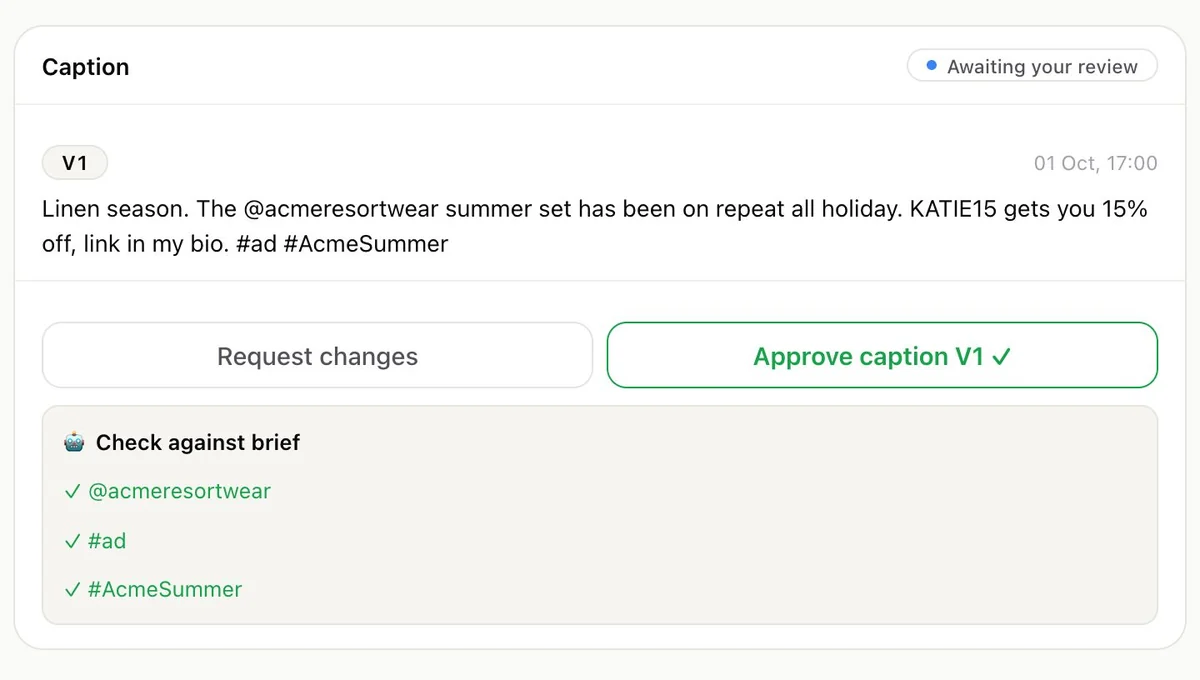
In the UK the brand is responsible for the ad label as well as the creator. So we put the label in the brief. Our AI agents then check the draft caption for it, and we check the live post before you sign it off.
- A clear label at the start, as the ASA and the CMA expect
- Gifted posts labelled too: a free product counts as payment
- The paid partnership label is checked on the live post
Contracts and payment
A UK agreement, signed on a phone
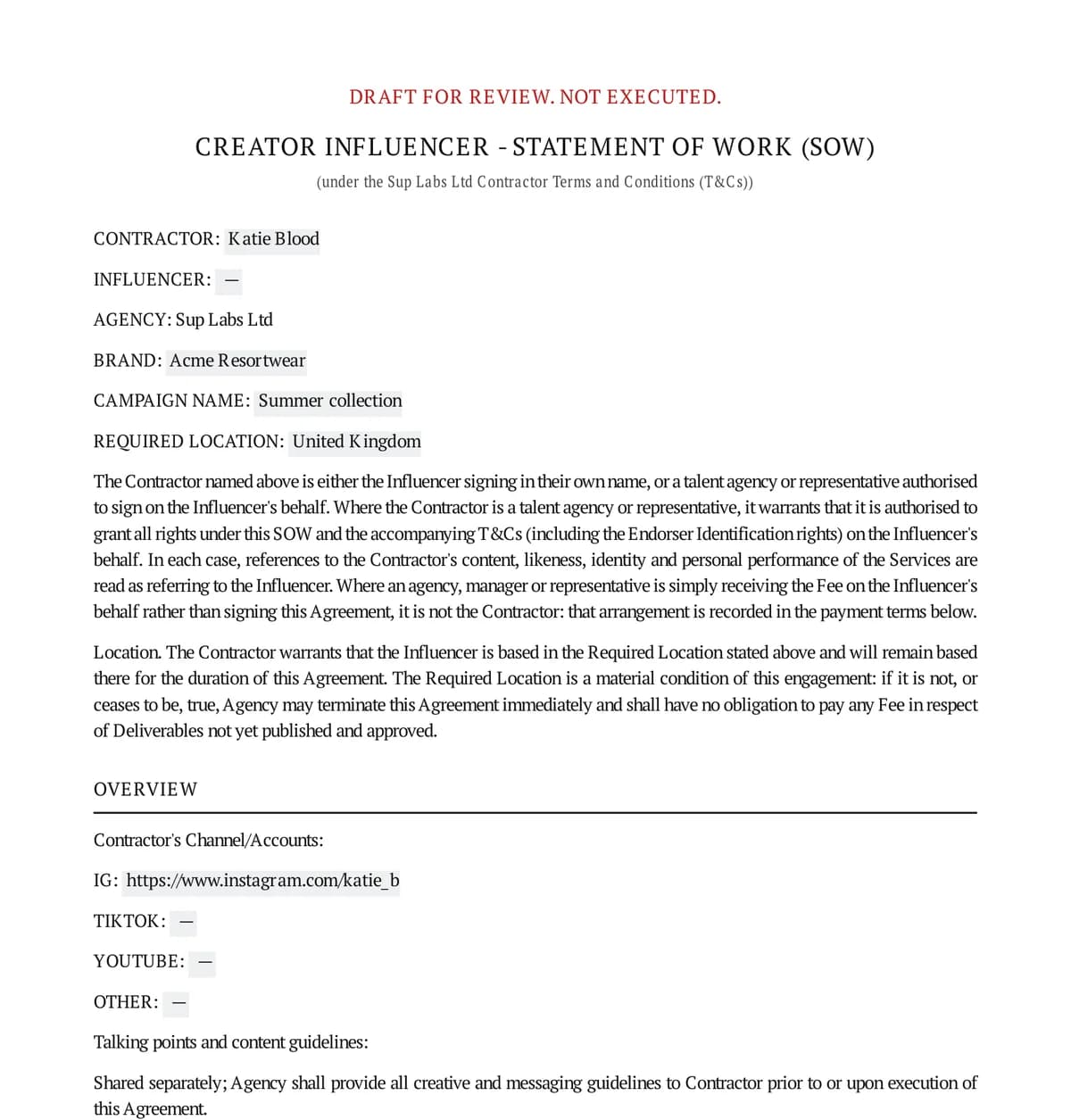
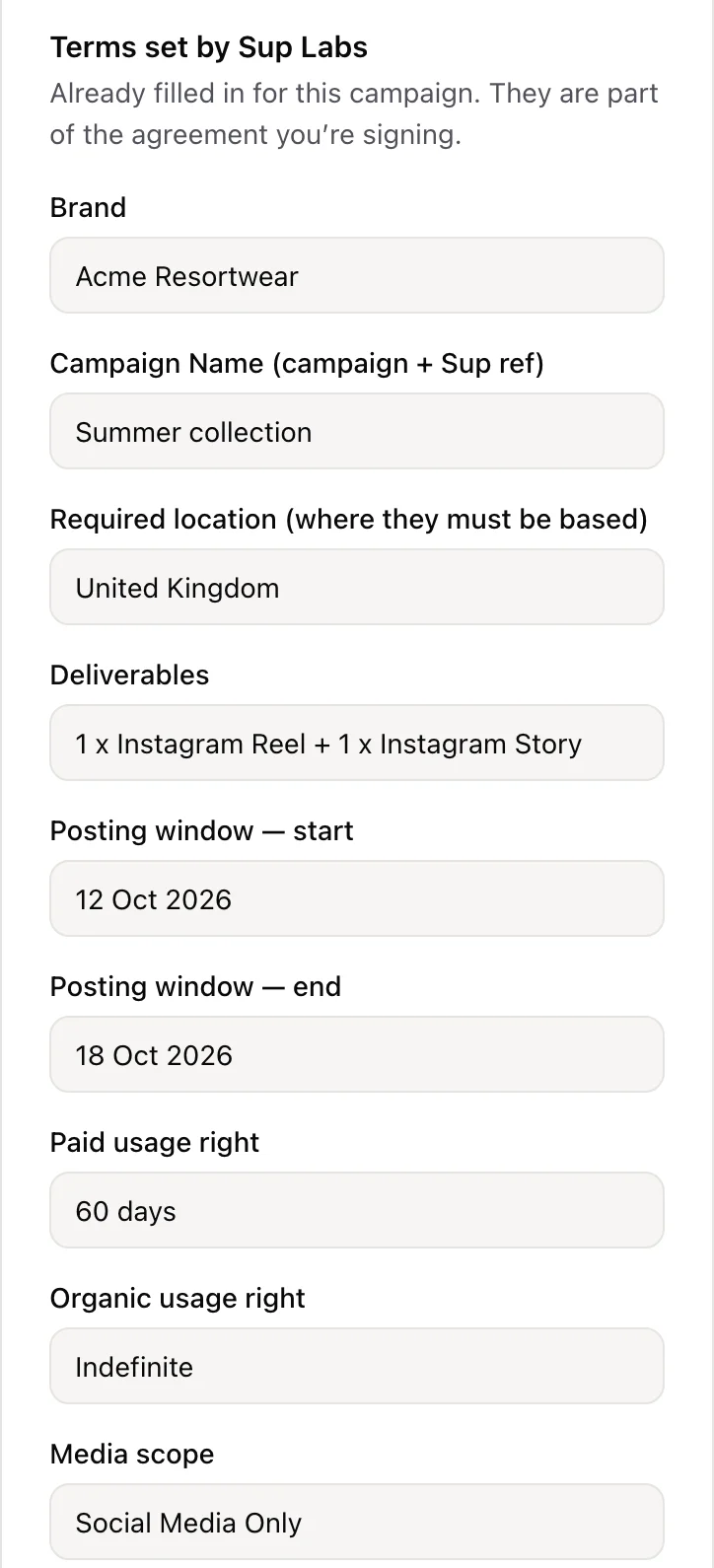
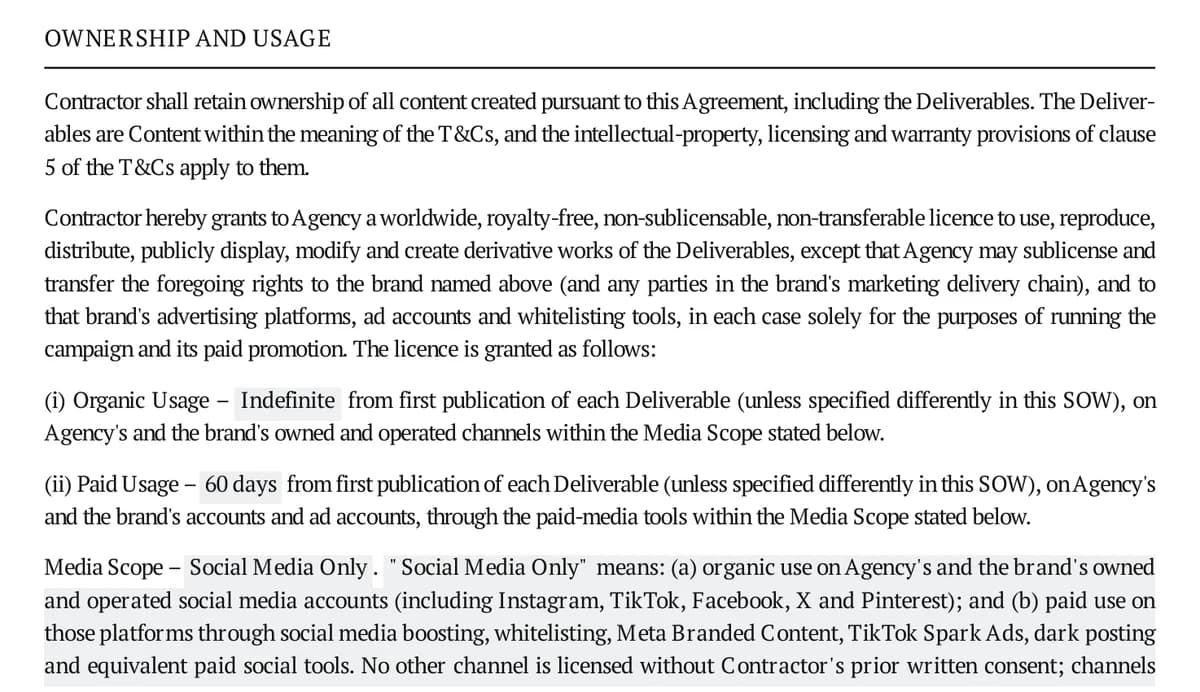
Each creator signs an agreement that names the brand, the deliverables, the posting dates and how long you may use the content. It can require the creator to be based in the United Kingdom and name the United Kingdom as its governing law.
- Usage rights as a length of time, for organic use and for paid use
- You pay Sup once. We pay each creator by bank transfer
- A creator is paid only when an approved post is live
How it works
From a brief to live posts from UK creators
- 01
You send a brief
The product, who buys it, which UK cities matter and what you want made.
- 02
A shortlist in 6 hours
UK creators with their numbers and recent posts. You say yes or no to each.
- 03
We contract and brief them
The agreement, the brief and the ad label, before anyone films.
- 04
You approve, they post
You pay for posts that go live. We pay the creators.
The difference
Running a UK campaign on your own, or through Sup
Finding UK creators
On your own
Searching Instagram by hand, or a list that is months old
With Sup
A live search of Instagram and TikTok, run for your brief
The fee
On your own
A separate negotiation with each creator
With Sup
Agreed inside your budget, then approved by you
The contract
On your own
A template you edit for each creator
With Sup
Written from the deal and signed on a phone
Ad labels
On your own
Left to each creator
With Sup
In the brief, then checked on the draft and the live post
Paying creators
On your own
An invoice and a transfer for each one
With Sup
One invoice from Sup
The detail
Our UK record, and the UK’s rules
An influencer marketing agency plans and runs a brand’s work with creators: it finds them, agrees fees and contracts, manages the content and reports the results. The rest of this page gives what UK agency pages leave out: where we find UK creators, one UK campaign with its numbers, and the UK’s rules on ad labels with their source.
UK creators
Creators in any UK city, on any subject
The live search runs across 350 million creators on Instagram and TikTok. It holds no fixed list, so a brief can name any UK town or city and any subject. We narrow the search to the place, and a person checks where each creator is based.
- 350M
- creators searched live on Instagram and TikTok
- 35.5M
- Instagram users in the UK at the end of 2025
- 26.8M
- TikTok users aged 18 and over in the UK at the end of 2025
We narrow it to the UK for your brief.
About half the population.
Nearly half of UK adults.
The two UK figures count the people who use each platform, not creators. They are from Digital 2026: The United Kingdom, DataReportal, 5 November 2025, which takes them from each platform’s own advertising tools. Read on 6 October 2026.
UK creators by city
UK creators by subject
Each link opens a list from our creator directory, with the largest creators first. A campaign’s shortlist comes from the live search, so it is not limited to these lists.
A UK campaign
 Moco Museum, London: 16 months of creator posts
Agency pages show client logos. This is one UK campaign with what it produced. It is a gifting campaign: more than 200 creators were given a museum visit in place of a fee, and posted about it. The same programme also ran in Amsterdam and Barcelona.
- 16 months
- from the first tracked post to the last
- 1.3M
- views on the creators’ posts
- £0
- in creator fees
From 14 September 2024 to 22 January 2026.
The public count on each post.
Each creator was given a visit to the museum.
A gifting campaign has no creator fee, so it has no cost per view to report. For how gifting works and when it suits a brand, see gifting and seeding. For paid posts, see influencer posts.
How we counted. From Sup’s own campaign reporting, which reads each tracked post’s public counts. Views are rounded down. Read on 25 September 2026.
The rules
The UK’s ad label rules, and where we apply them
The Advertising Standards Authority, the Committee of Advertising Practice and the Competition and Markets Authority publish one guide for creator posts. It is written for creators, and it says it is also useful for brands and agencies. These are its main points, in its own words.
| The question | What the guide says | What we do |
|---|---|---|
| When is a post an ad? | “If you’ve received payment or any other incentive from a brand, or you are otherwise personally or commercially connected to the brand, any related content will need to make clear that it’s advertising.” | Every paid and every gifted post is briefed as an ad |
| Does a free product count? | Yes: “any incentive, even if it’s not money, counts as a ‘payment’ for any resulting content”. | Gifting briefs carry the label too |
| Who is responsible? | “Both you, the brand and any agents involved in creating or publishing the content are responsible for ensuring that it’s clear when content is advertising.” | The label is checked before you sign off |
| Where does the label go? | “People should be able to recognise immediately when content is advertising, without having to click or otherwise interact with it.” | The brief asks for it at the start of the caption |
| What about discount codes and links? | A link or a code that pays the creator for clicks or sales “counts as advertising because it is ‘affiliate marketing’”. | Posts with a code are labelled |
| How long does it last? | Creators are “expected to disclose throughout any ongoing relationship and in relevant content for a period of 12 months after”. | Ambassador briefs keep the label on every post |
What the CMA asks of the brand
The Competition and Markets Authority also publishes a guide written for brands. It asks for three things, and each one is a step we already run.
| The CMA’s guide for brands says | Where it sits in our process |
|---|---|
| “Where content is published on your behalf, you may be held responsible if it is misleading or otherwise non-compliant.” | So the label is our job and yours, not only the creator’s |
| Work with the creator, in the contract, so they understand they must “disclose upfront and clearly that any content they post for your brand is an ad”. | The agreement and the brief both say it, before anyone films |
| “You should check content that refers to your brand or business yourself to ensure it is properly identified as advertising.” | The draft caption and the live post are both checked |
| “If you identify content that hasn’t been labelled correctly, you should not ignore it.” | A post without the label goes back to the creator before sign-off |
Labels the guide gives as clear
#Ad, #Advert, #Advertising, #Advertisement, #AdvertisementFeature.
The guide adds that a “#” is not needed, provided the label “is prominent and clearly separate from any other content”. A platform’s own tool, such as Instagram’s paid partnership label, “may be sufficient if the label is upfront, clear, and prominent”.
Labels the guide advises against
Supported by, Funded by, In association with, In partnership with, Thanks to [brand] for making this possible, Gift, Gifted, Sponsorship, Sponsored, Spon, Sp, Affiliate, Aff, Af, Afflink, Collab, iworkwith, brandambassador, and tagging the brand with no label.
The reason it gives: a label must be understood by consumers and make immediately clear that the content is advertising.
Source: Influencers’ guide to making clear that ads are ads, ASA, CAP and CMA, third edition, 23 March 2023, and Social media endorsements: guidance for brands, CMA, updated 28 August 2025. Both read on 6 October 2026. This is general information and not legal advice. For the labels US rules ask for, see the contracts page.
Contracts and payment
What a UK creator signs, and how they are paid
The agreement and the payment steps are the same in every country. These are the parts a UK brand asks about.
The agreement
It names the brand, the campaign, the deliverables, the posting dates, the usage rights and the payment term. The governing law is chosen when it is written, and the United Kingdom is one of the two choices.
Where the creator is based
The agreement can require the creator to be based in the United Kingdom for the length of the campaign. That matters when the product is sold only in UK shops.
Payment
You pay Sup once. We pay each creator by bank transfer after their approved post is live. A payout can be in pounds, dollars or euros.
Bank details
Each creator types their own details on a secure page, after confirming their email address with a code. We take none by email or message.
The full agreement, clause by clause, is on the contracts page. How a payout is made is on the payments page.

Written by
Matt Greenwell, Co-Founder and CEO of Sup
Matt started Sup in 2024 with Hassan Munir. Before Sup he co-founded Storefront, the marketplace for booking pop-up retail space. Before that he worked at Goldman Sachs.
The campaign figures are from Sup’s own reporting. The rules are quoted from the regulators’ guides. The UK audience figures are DataReportal’s. No creator is named. Updated 5 October 2026.
FAQ
UK influencer marketing questions
What does an influencer marketing agency do?
It plans and runs a brand’s work with creators. It finds the creators, agrees the fees, writes the contracts, manages the content and reports the results. Sup does each of those jobs. The difference is the price: there is no monthly fee, and you pay for posts that go live.
How much does an influencer marketing agency cost in the UK?
Most agencies charge a monthly retainer, a share of the campaign budget, or both, and few publish either. Sup has no monthly fee. You pay the price you approve for each creator, when their post is live, and we take our fee from creators. A gifting-only campaign pays £19 per gift as our fee.
Is Sup a UK company?
Yes. Sup’s legal name is Sup Labs Ltd, UK company number 15889484. We run campaigns for brands and agencies in the UK and in other countries.
How do you find UK creators?
We search Instagram and TikTok live, across 350 million creators, at the time of your brief. We narrow the search to the UK by city, subject and size. A person on our team then checks where each creator is based before they reach your shortlist.
Can you find creators in one UK city?
Yes. A shop, a restaurant or a venue needs creators who can walk in. We find creators by where they post from, and check where each one is based before they reach the shortlist.
Do creator posts need an ad label in the UK?
Yes, where the creator was paid or given anything, or has a commercial link to the brand. The guide from the ASA, CAP and the CMA says people should be able to recognise an ad immediately, and that the brand is responsible as well as the creator. It expects a clear label such as “Ad” at the start. This is general information and not legal advice.
Does a gifted product count as payment?
Yes. The UK guide says any incentive counts as payment, even if it is not money, and it lists free products, services, trips, hotel stays and event invitations. A post about a gifted product needs the same clear label as a paid post.
Can UK creators be paid in pounds?
Yes. We pay creators by bank transfer, in pounds, dollars or euros. A UK creator enters a sort code and an account number on a secure page, and the payout goes to that account.
How is a campaign measured?
By what each post did. Every post’s views, likes, comments, shares and saves are read from the public post three times a day and listed in one report, with the creator cost per 1,000 views for the campaign. A view count includes views from ads run on the post. Sales are counted only where a code or a link can count them.
Which law governs the creator agreement?
You choose when the agreement is written. The creator agreement can name the United Kingdom as its governing law, and it sets the creator’s required location, the deliverables, the posting dates and the usage rights before the creator opens it.
Related
Where to go next
UK creators
UK creators in our directory, by city and by subject.
London creators
Creators in London, with their numbers.
The campaigns we run
UGC, gifting, paid posts, ambassador programs, Spark Ads and TikTok.
Shopper marketing
Local creators send shoppers to the shelf, and a receipt proves the purchase.
Hire UGC creators
UGC creators found, briefed, contracted and paid for you, with the rights to run the videos as ads.
For agencies
We run the work, and you keep the client.
Running a creator campaign in the UK?
Send a brief. A shortlist of UK creators comes back in 6 hours. You say yes or no to each creator, we do the rest, and you only pay for posts that go live.
 Book a call