22 September 2026
Influencer Agreement Template: Key Clauses for 2026
You've agreed the fee, the creator has started filming, and someone in finance asks the question nobody can answer quickly: what exactly are we buying, where can we use it, and what happens if the post goes live without an advert disclosure? That's the point at which a casual brief stops being enough.
A strong influencer agreement template gives your team a repeatable commercial framework. It should separate deliverables, usage rights, exclusivity and compliance, then flex through gifting, paid content, retainers and affiliate campaigns without forcing you to redraft the agreement every time. Treat it as a practical drafting tool, not a substitute for legal advice.
Why You Need an Influencer Agreement Template in 2026
The template you need is not a decorative PDF with blanks for a name and fee. It's a working agreement with a core contract, a deliverables schedule, a usage rights schedule, an exclusivity schedule and a compliance schedule. Download or build that modular version, then tailor the schedules to each campaign.
If you're drafting from a blank page, read this guide as a build sequence. Start with the parties and definitions, then lock down the operational scope before negotiating rights, payment and restrictions. If you're amending a contract inherited from a predecessor or template library, use it as an audit path. Mark every clause against the four products you're buying.
- Deliverables, the content, dates, platforms and approval process.
- Usage rights, the licence, channels, territory, term and amplification permissions.
- Exclusivity, the protected category, geography, platforms and restricted window.
- Compliance, disclosure, claims, approvals, monitoring and takedown duties.
That separation matters because two recurring failures sit at opposite ends of the relationship. Oral deals often collapse during renewals because nobody can prove what the original fee included. Overreaching rights clauses create the opposite problem, a brand appears protected but later discovers that generic wording doesn't properly authorise whitelisting, paid amplification or edited reuse.
Practical rule: If a clause doesn't identify what is being delivered, licensed, restricted or evidenced, it isn't finished.
Use the template to make each commercial decision visible. Then ask UK counsel to review the version your business will sign.
What the UK Creator Economy Now Demands from Contracts
Creator partnerships now sit inside serious media budgets. IAB UK reported that one in four people in the UK are creators in some guise, and forecast the UK creator economy to reach $2.6 billion by 2030, with annual growth of up to 40%. The same source forecast advertiser investment in UK creator partnerships to pass £1 billion in 2026, reaching £1.2 billion, after estimating that creator partnerships contributed £966 million to the UK digital advertising market in 2025. That represented around 2.4% of the official £40.5 billion UK adspend total, as reported by IAB UK's creator marketing analysis.
The commercial implication is straightforward. As spend grows, brands negotiate harder over scope, licensing and category conflicts, while creators have more influence over how their identity and content are reused. A one-page brief can't carry those decisions reliably.
| Milestone | Commercial pressure on contracts |
|---|---|
| Creator participation has become widespread in the UK | Parties need clear entity, payment and responsibility terms |
| The creator economy is forecast to reach $2.6 billion by 2030 | Brands need scalable templates rather than bespoke informal deals |
| Creator partnership investment is forecast to reach £1.2 billion in 2026 | Usage rights and amplification need separate pricing and permissions |
| Creator partnerships contributed £966 million to UK digital advertising in 2025 | Ambiguous deliverables create material budget and media risk |
Compliance adds another layer. The Advertising Standards Authority administers the advertising rules applied through the CAP Code, while the Competition and Markets Authority focuses on consumer protection and transparent commercial relationships. Your template must translate those responsibilities into instructions a creator can follow, evidence your team can monitor and remedies both parties understand.
Cross-border payments make the same discipline necessary on the finance side. A contract should identify the payee, currency, tax information, invoice route and responsibility for transfer or VAT treatment before the creator delivers content.
Drafting the Parties, Definitions and Term Block
Begin with the legal entities, not the creator's display name. Name the creator's trading entity, whether that's a personal limited company or sole trader, alongside the registered address, company or tax details, notice email and authorised signatory. If a talent manager negotiates the deal, state whether the manager is an agent, an invoicing intermediary or merely a representative.
Add an ultimate beneficial owner field where your KYC and payment process requires one. This gives finance and compliance a clear record of who sits behind the payee, rather than leaving that question to an email thread after signature.
Keep the clocks separate
The engagement term and the content licence term are different commercial clocks. The campaign may end after the final post, while the brand's right to use an approved asset continues under a defined licence. Put the dates in separate fields so nobody assumes that ending the partnership automatically ends, or extends, the licence.
A definitions schedule prevents repeated negotiation with talent managers. Define:
- Deliverables, the specific content the creator must create, submit or publish.
- Campaign Period, the dates governing production, approvals and organic publication.
- Net Revenue, the revenue base used for any affiliate or royalty calculation, with deductions stated plainly.
- Confidential Information, including unreleased products, campaign strategy, rates and performance data.
Define “delivered”, “approved”, “live”, “usage”, “paid amplification” and “competitor” in the same schedule. Clear definitions reduce redlines because later clauses can point to one agreed meaning.
Deliverables, Timelines and Acceptance Criteria
Deliverables, deadlines and acceptance rules belong in one operational schedule. A line that says “one social post” is not a deliverable. It leaves open the platform, format, length, caption, link, disclosure, revision process and publication date.
Use a worked scope such as this:
- Day 7: one Instagram Reel and one TikTok video, each a 15-second vertical video.
- Day 10: two Stories showing behind-the-scenes photos.
- Day 14: one blog post, an 800-word review with three images.
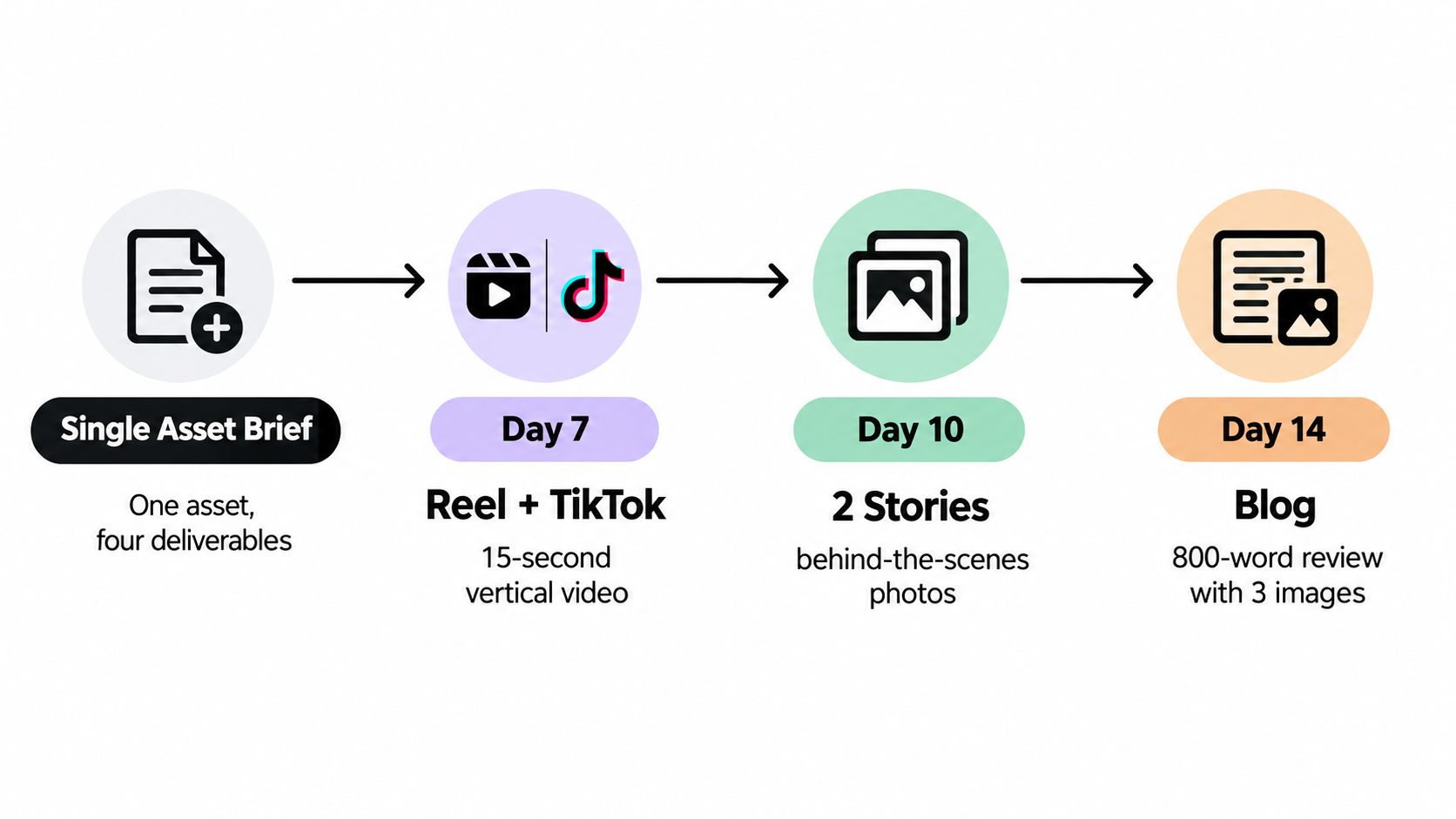
That schedule exposes scope creep immediately. The creator isn't delivering one asset. They're producing four formats, across multiple platforms, with separate approval and reporting requirements.
Make the dates enforceable
Set a written submission date for drafts, an acceptance window of three to five business days, and a revision cap of two rounds. State what happens if the brand misses approval, including whether the go-live date moves or a kill fee becomes payable. Do not let “approval” remain a vague courtesy. Identify who approves, where feedback is recorded and when silence counts, if it counts at all.
Use a 30-day campaign schedule with actual milestone fields:
| Milestone | Contract requirement |
|---|---|
| Day 1 | Brief and product information supplied |
| Day 4 | Draft Reel and TikTok submitted |
| Day 7 | Approved Reel and TikTok live |
| Day 10 | Two approved Stories live |
| Day 14 | Blog post live |
| Day 30 | Final analytics and post URLs supplied |
Define delivered, approved and live separately. Require the creator to return each platform handle and post URL within 48 hours of publication. Schedule organic go-live separately from paid amplification, because a brand may approve content for organic use without having permission to place it behind media spend.
Usage Rights and Licensing Without the Perpetual Trap
Usage rights are a separate commercial product. Price them by duration, geography and channel, rather than hiding them inside the content fee. A creator's work can be perfectly delivered while the brand still lacks permission to edit, repost, run as an advert or place it on an ecommerce page.
Legal Lens warns against three drafting traps in its guidance on UK influencer contract templates: generic “all media, in perpetuity, worldwide” language, indefinite terms that overpay for a limited campaign, and wording that conflates organic posting with paid amplification. Those phrases don't give your media buyer the precision they need. They also make the creator negotiate the entire rights package instead of pricing each use sensibly.
Use a rights schedule with named channels:
| Usage type | Channels | Duration | Territory | Uplift fee |
|---|---|---|---|---|
| Organic reposting | Brand Instagram, TikTok, website | Fixed initial term | UK | Agreed in schedule |
| Paid social | Meta and TikTok advertising accounts | Fixed initial term | UK and specified markets | Separate licence fee |
| Ecommerce use | Product pages and campaign landing pages | Fixed initial term | Named markets | Separate licence fee |
| Out-of-home | Approved print and display placements | Fixed initial term | Named territory | Bespoke fee |
Separate organic reposting, creator-authorised advertising, whitelisting, Spark Ads and creator-boosted media. State whether the brand may crop, subtitle, translate, resize or combine the asset with supplied product claims. Include an approval process for material edits and prohibit the brand from implying an endorsement beyond the agreed campaign.
If your team needs a practical reference before drafting, find video repurposing licences and compare how each permission is scoped. You can also review how to get influencer content rights for your marketing before finalising the rights schedule.
For renewals, set a fixed initial window, such as six or twelve months where commercially appropriate, then document an extension fee. The exact uplift belongs in the schedule. The principle is more important than the label: pay for the additional use, record the new end date and never let a temporary campaign become perpetual.
Payment, Fees and the Single-Invoice Payment Rail
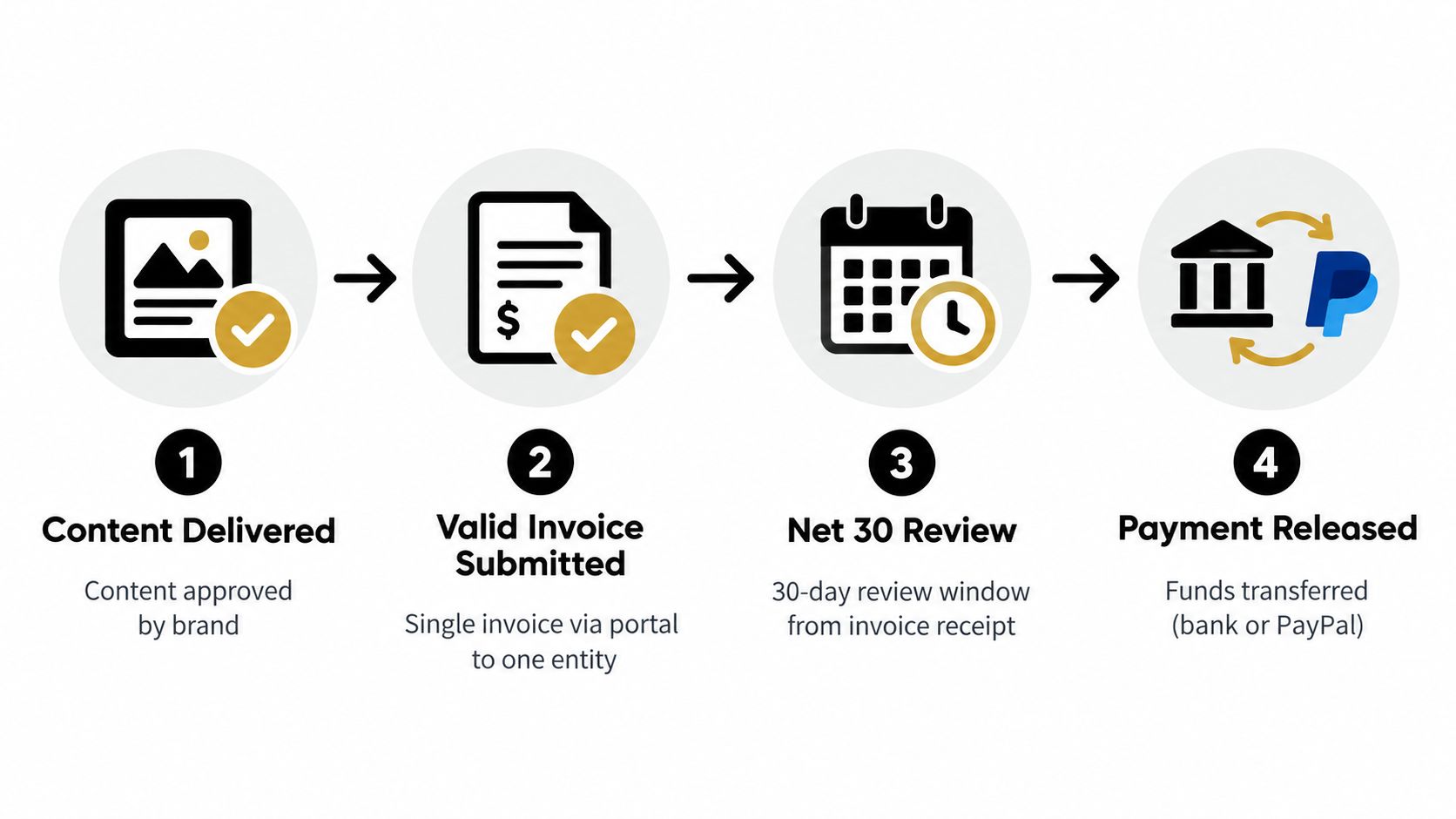
Payment clauses should be usable by finance without a separate interpretation call. Put every fee component in the schedule, including the flat fee, per-deliverable fee, usage uplift, approved expenses cap and any commission. Tie invoicing to the final deliverable going live, not to contract signature, and state that payment is Net 30 from receipt of a valid invoice.
Use one invoice route through one contracting or payment entity. The invoice should identify the campaign, approved deliverables, currency, VAT treatment, bank details and any agreed deductions. For UK and international creators, state whether the fee is in GBP, USD or EUR, and identify the conversion date where the invoice currency differs from the contract currency.
Cover non-cash and performance compensation
A gifting-only schedule should state the retail value of the product seeded, whether the creator must post, whether they may keep or return it, and whether any further compensation is owed. Don't call a product “free” if the creator has an obligation attached to receiving it.
For TikTok Shop or Amazon Associates work, define the commission percentage, attribution window, eligible transactions, refunds, returns, exclusions and payment date. Define Net Revenue before the campaign starts so the creator isn't paid on one calculation while finance uses another.
Required payee information may include sort code, IBAN and relevant US tax forms such as W-8BEN or W-9. Include late-payment interest where your policy permits it, but don't bury basic payment mechanics in an annex nobody signs.
Exclusivity, Non-Compete and Category Carve-Outs
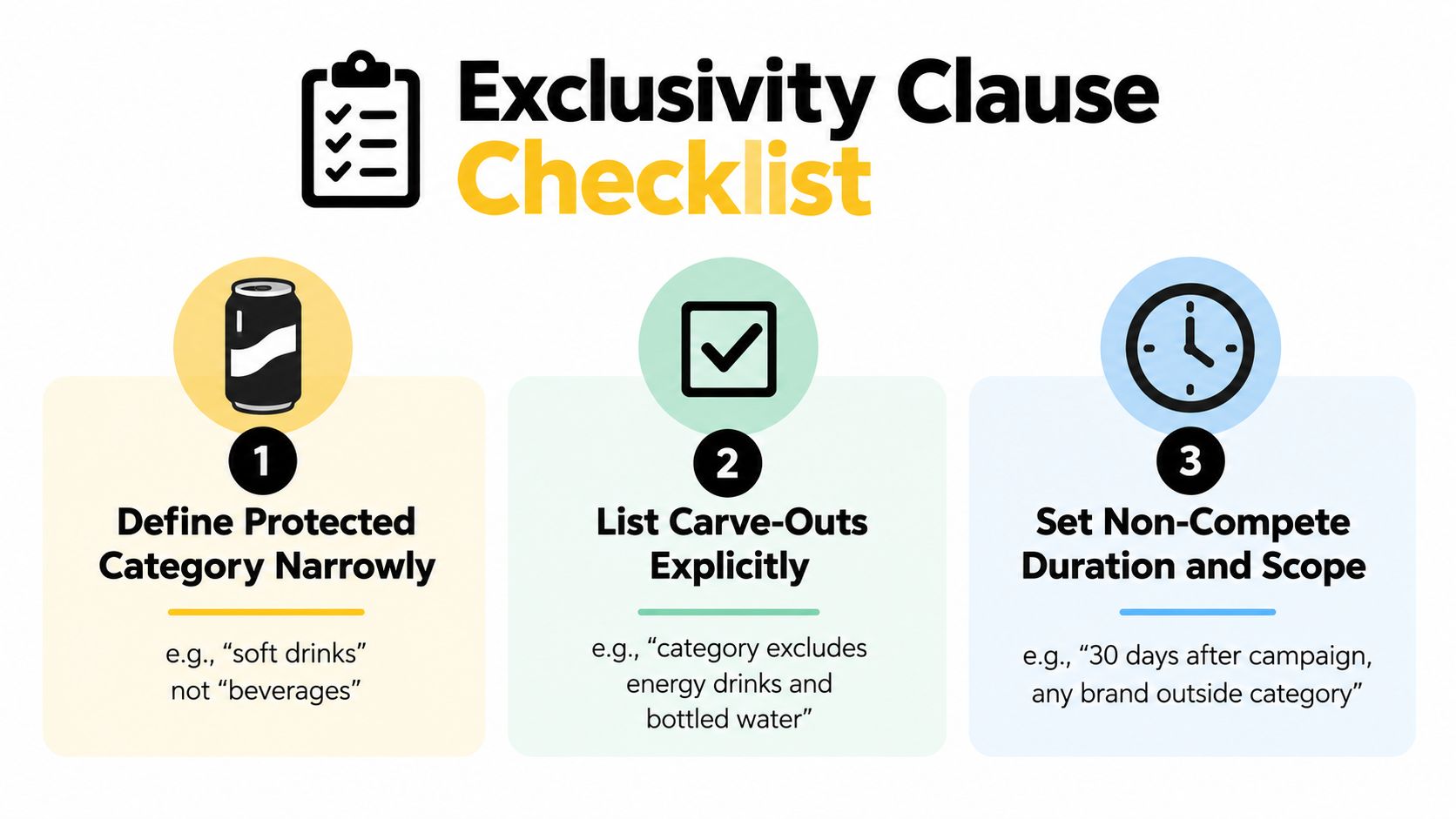
Exclusivity is a negotiation lever, not a default clause. Define the protected category narrowly. “Soft drinks” is workable. “Beverages” may capture products the brand doesn't compete with and can unnecessarily restrict the creator's livelihood.
Tie the restriction to the campaign flight and a defined tail period. The agreement should identify:
- Category, with named competitors and exclusions.
- Geography, such as the UK, EEA or global markets.
- Platforms, if the restriction applies only to specified channels.
- Group scope, stating whether parent and sister companies are included.
- Duration, covering the campaign and the agreed post-publication window.
List carve-outs for adjacent categories, existing partnerships, creator-owned businesses and family-member businesses where appropriate. A competitive conflict schedule lets the creator disclose existing commitments before signature. Give the brand a process to pre-approve category-adjacent work instead of forcing every borderline opportunity into a breach dispute.
Use a liquidated remedy or agreed fee structure that reflects the commercial harm and can be applied without proving an impossible loss. Have counsel check enforceability and proportionality under the chosen governing law.
FTC, ASA and CMA Disclosure Compliance
For a UK campaign, disclosure is a contractual warranty, not a polite request. The ASA applies the advertising rules under the CAP Code, while the CMA focuses on consumer protection and whether commercial relationships are clear to audiences. UK industry guidance also stresses that brands should document briefings, monitoring and compliance systems, as set out in the BCMA Influencer Marketing Guidelines and Best Practice.
Your clause should cover paid partnerships, gifted products, affiliate arrangements, free or loaned items, discount codes and other incentives. Require disclosure to be obvious, prominent, upfront, timely and unambiguous. Specify the approved wording for each platform and require the caption to show it before any truncation or “read more” cut-off.
| Platform | Required disclosure | Placement | Spoken or written |
|---|---|---|---|
| “Ad” and the paid partnership label where applicable | At the start of the caption and in the content | Written, with visible label | |
| TikTok | “Ad” label and clear commercial wording | Prominently at the start of the caption or overlay | Written, plus video overlay where required |
| YouTube | “Includes paid promotion” disclosure | At the start of the video and platform disclosure area | Spoken and written |
| Gifting or seeding | Clear “gifted” wording where applicable | Prominently in the caption or content | Written, with video overlay where relevant |
For video, mandate a spoken disclosure and on-screen overlay at the start, not buried in the caption. Treat native platform labels as supplementary, not a substitute. The creator should warrant compliance, keep evidence of approvals and correct a defective post within the contract's cure period. Add audit and monitoring rights, plus an indemnity covering breach-related claims, reposting costs and media already committed to non-compliant content.
Organic disclosure doesn't automatically solve paid amplification. Add a separate rule for whitelisted or creator-authorised advertising, including who controls the ad, who checks the final version and who can request a takedown. For a wider operational reference, use this influencer marketing compliance guide.
Termination, Indemnity and Governing Law
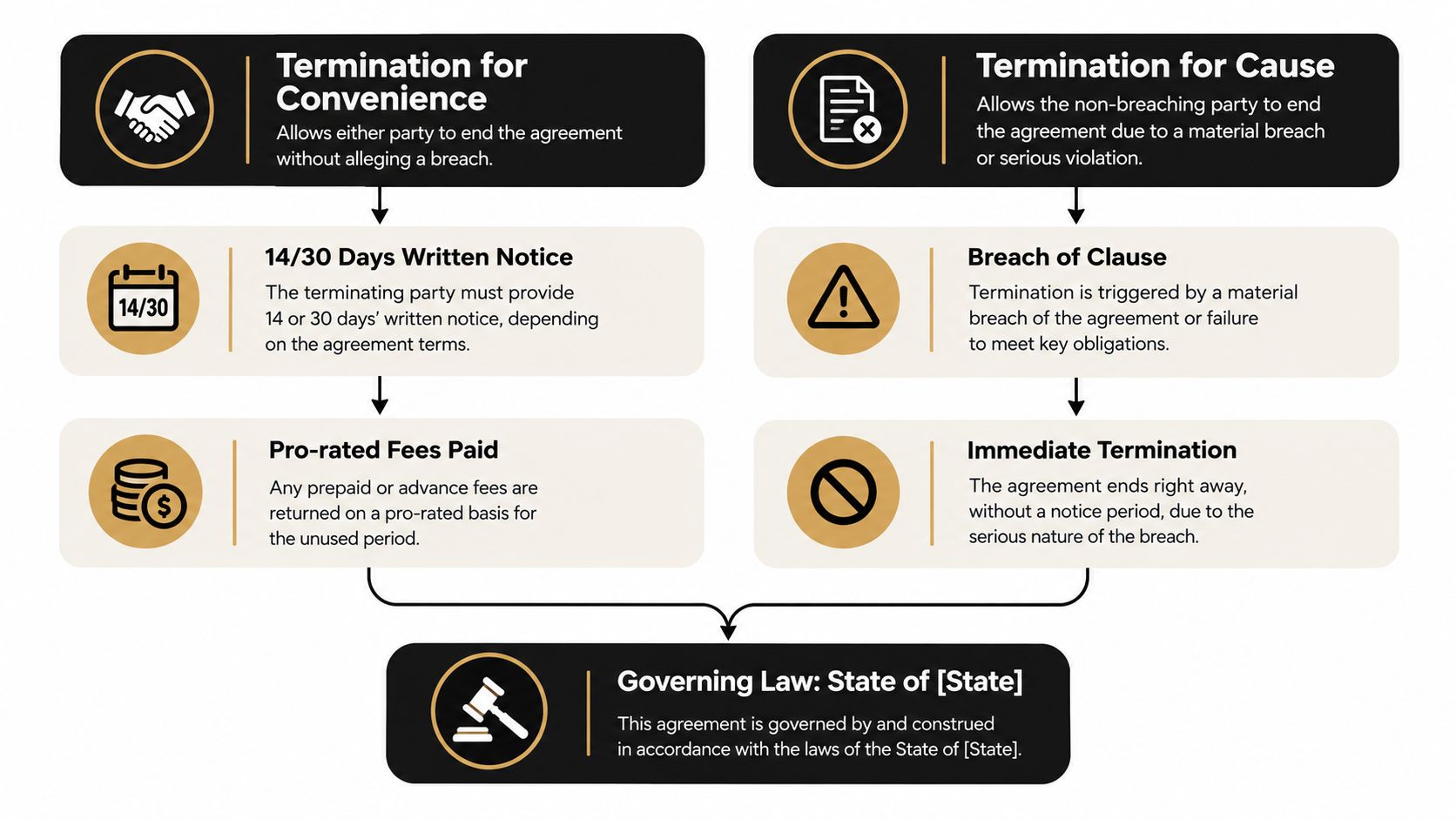
Keep termination for convenience separate from termination for cause. Either party may have a right to exit on 14 or 30 days' written notice, with pro-rated payment for accepted work and a stated kill fee for contracted but undelivered posts. The schedule should explain what happens to unused products, drafts, approved assets and live posts after notice.
Cause triggers must be specific. Include material breach that remains uncured after seven days, insolvency, criminal conviction, a serious reputational event and repeated disclosure failures. Give the brand an immediate takedown right where continued publication creates legal or platform risk.
Indemnity should be mutual but commercially asymmetrical. The brand should cover product liability and infringement in brand-supplied assets. The creator should cover breach of warranty, disclosure failures and third-party claims arising from creator-controlled content, music, images or statements.
Cap ordinary liability at the contract value, subject to counsel's review, while excluding fraud, wilful misconduct and intellectual property infringement if that matches your risk position. English law and the courts of England and Wales are a sensible default for a UK brand. For cross-border work, add a negotiation or mediation escalation through LCIA or CEDR before litigation, and confirm the final position with counsel.
Adapting the Template by Campaign Type
The efficient approach is one base agreement with modular schedules. Don't create a separate contract for every campaign model. Switch clauses on and off, then attach the schedule that matches the commercial product.
| Campaign type | Deliverables | Usage rights | Payment | Exclusivity | Compliance add-ons |
|---|---|---|---|---|---|
| Gifting and seeding | Optional post or no-post obligation | Usually off unless separately licensed | Product value and return terms | Usually off | Gifted disclosure and product claims |
| UGC for paid ads | Content files, not necessarily organic posts | Paid Meta and TikTok licence schedule | Production fee plus licence fee | Narrow category restriction if needed | Ad approval, takedown and claims controls |
| Spark Ads and whitelisting | Published creator content plus ad authorisation | Account access, term, territory and spend permissions | Content fee plus amplification fee | Platform and category scope | Creator authorisation and ad-level disclosure |
| Always-on retainer | Monthly content bank and rolling approvals | Renewing licence schedule | Monthly fee, expenses and usage uplifts | Rolling campaign windows | Ongoing reporting and review process |
| TikTok Shop affiliate | Product videos, storefront activity and links | Platform-specific reuse if agreed | Commission, refunds and payment rules | Product-category scope | Affiliate disclosure and storefront permissions |
For gifting, add a Product Loan Schedule if the item must be returned, and turn off paid deliverable fees unless the creator accepts a posting obligation. For UGC, expand the licence for paid advertising and keep organic publication separate.
Spark Ads and whitelisting need an account-access sub-schedule. State the account owner, permission period, spend limits, creative approval, withdrawal process and post-term access removal. Retainers need a content bank, rollover rules and rolling exclusivity windows. TikTok Shop campaigns need storefront permissions, commission calculations and product disclosure triggers.
Before agreeing a creator, use a practical influencer identification guide to document the account, handle and relevant audience fit. Then attach that identity record to the contracting workflow.
Tracking Performance Against the Contract
A contract should tell your team what evidence to collect after publication. Map every deliverable to a reporting obligation, not just a creative description.
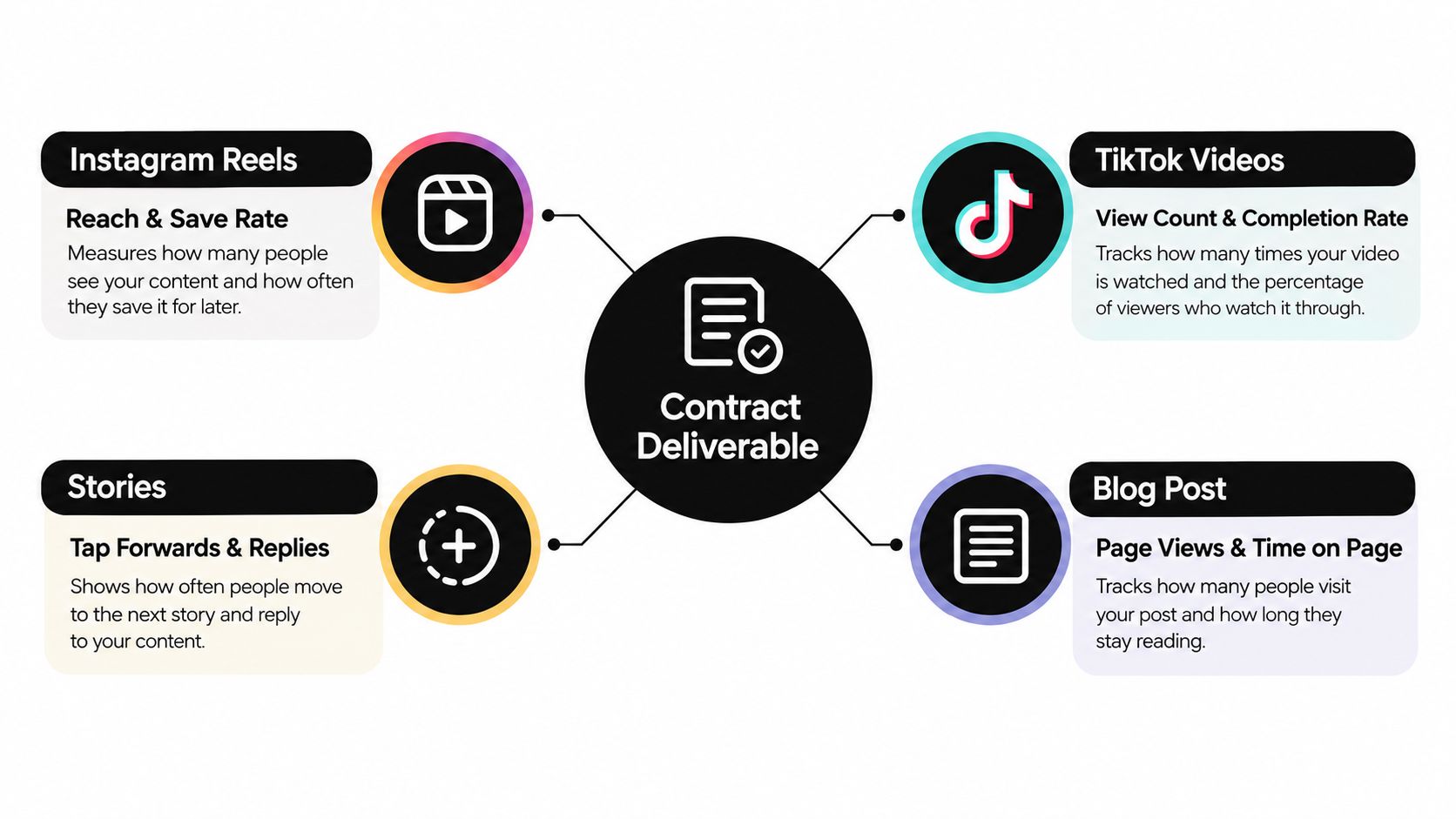
An Instagram Reel may require reach and save-rate reporting. A TikTok video may require views, completion and profile visits. Stories may require tap-throughs, replies and completion. A blog post may require page views and time on page. Paid UGC should be measured inside Meta Ads Manager or TikTok's advertising environment, using the metrics relevant to the media objective.
Build attribution into the schedule
Give each creator the tracking assets before publication:
- UTM parameters for destination links and campaign grouping.
- Unique promo codes tied to the creator or campaign.
- Bitly links where a shorter, trackable URL suits the platform.
- TikTok Shop storefront IDs for affiliate attribution.
- Post-level analytics, supplied within a defined reporting window.
The contract should require creators to preserve tracking pixels and approved links in whitelisted ads. It should also give the brand access to Spark Ads metrics for the licence term, subject to platform permissions and privacy requirements.
Use a dashboard that connects the signed deliverable to its URL, code, clicks, redemptions, attributed revenue and media results. A reporting workflow such as this campaign reporting template helps your team keep the evidence attached to the relevant agreement instead of scattered across screenshots and chat threads.
Don't promise a creator a renewal based on metrics you haven't defined. State which platform dashboard controls, what date range applies and how refunds or cancelled orders affect revenue attribution.
Pre-Send Checklist and Common Drafting Gaps
Run the completed agreement through the four-product test before sending it to the creator or manager.
Compliance
- Disclosure wording: Confirm the approved ASA and CMA-facing wording appears in the schedule.
- Video placement: Require the disclosure as visible overlay and spoken content at the start where applicable.
- Claims evidence: Confirm the brand has a reasonable basis for every product claim supplied to the creator.
- Takedown process: Name the contact, response route and cure process for an ASA or platform request.
Rights
- Bounded licence: State term, territory, channels and permitted edits.
- Paid amplification: Separate organic reposting from whitelisting, Spark Ads and creator-boosted media.
- Signed sub-schedules: Attach and sign the rights and account-access schedules before publication.
Payment
- Single invoice rail: Identify the invoicing entity and valid-invoice requirements.
- Net 30 mechanics: Tie payment to valid invoice receipt and define late-interest treatment.
- Currency and tax: Confirm GBP, USD or EUR treatment, VAT handling and conversion date.
- Expenses: Set an approval process and a clear cap.
Operations
- Quantified scope: List formats, platforms, dates, approval windows and revision limits.
- Narrow exclusivity: Define the category, geography, platforms, group scope and carve-outs.
- Termination symmetry: Mirror notice periods, cause triggers, cure rights and payment outcomes.
- Creator warranties: Cover original work, music and image clearance, truthful claims and compliance.
The omissions that cause the most renegotiation are predictable: no social handle ownership or access process after termination, no creator warranty for third-party IP, no procedure for a regulatory takedown and unsigned exhibits attached as if they were binding. Fix those before the agreement leaves the draft folder.
Sup offers managed creator programme execution covering live Instagram and TikTok sourcing, outreach, negotiation, contracts, usage rights, compliance, payments and tracking. Visit Sup if you want one workflow for campaign schedules, rights schedules, creator approvals and reporting rather than another disconnected influencer agreement template.
More on relationships
See how many creators post about you and your competitors
Type in your brand's Instagram handle and we count the creators who post about you and about your five closest competitors. It takes about a minute and it is free. Or request a demo and we will show you the creators in your niche and walk you through the dashboard.