26 March 2026
How to Get Influencer Content Rights for Your Marketing
So, you’ve collaborated with an influencer and they’ve created some absolutely brilliant content for your brand. What now? Getting the rights to that content means you can legally use it across all your marketing channels, turning what might have been a one-off post into a valuable, long-term asset.
This is all about securing legal permission, either through a licence or by taking full ownership, so you can repurpose that content far beyond the creator's initial post.
Why Securing Influencer Content Rights Is Non-Negotiable
When you work with an influencer, you're not just paying for a single post. You're investing in authentic, high-quality content that truly connects with your target audience. But here’s the catch: without the proper rights, that investment has a very short lifespan.
From the moment a creator takes a photo or records a video, they own the copyright. This means you can't just take that amazing Reel and turn it into a paid ad, or grab a stunning photo for your website, without their clear, written permission.
Trying to bypass this step isn't just a missed opportunity. It's a massive legal and financial risk. Using content without a solid agreement can lead straight to copyright infringement claims. At best, you'll be forced to pull your campaigns; at worst, you could face hefty fines. Getting to grips with the legal side of this, often called intellectual property protection, is fundamental for any brand running influencer campaigns.
From Campaign Expense to Valuable Asset
When you secure content rights, you're fundamentally changing the nature of your investment. It’s no longer a one-time campaign expense. It becomes a lasting business asset.
Think of it like this: instead of just paying for a single mention on social media, you're acquiring a fantastic piece of creative that can fuel your entire marketing ecosystem. This mindset shift is all about maximising your return on that initial investment.
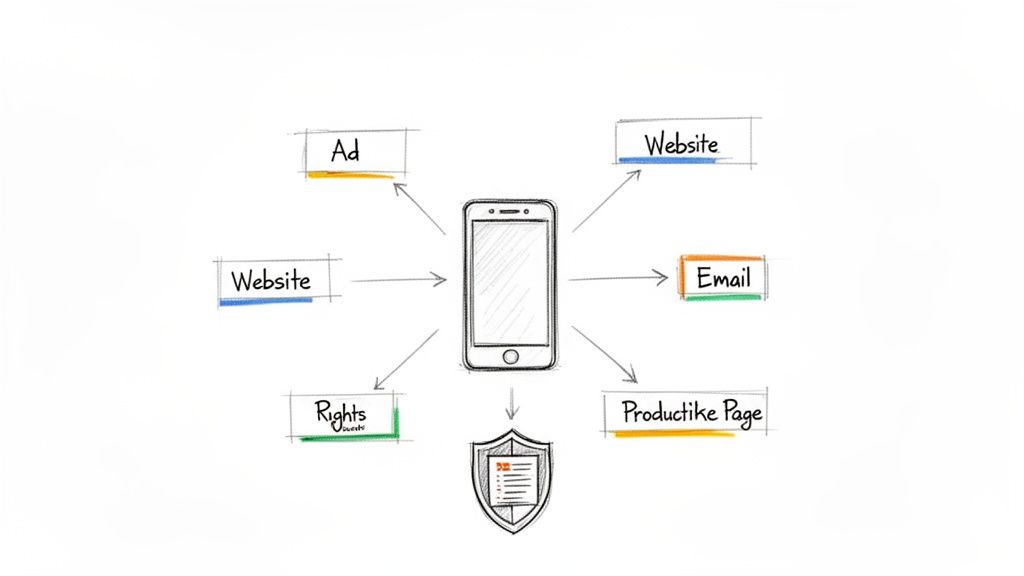
A single piece of influencer-generated content (IGC) can be a powerhouse, repurposed for:
- Paid Social Ads: Authentic creator content is gold for boosting ad performance on platforms like Meta and TikTok.
- Website Visuals: Liven up your product pages, homepage, and landing pages with content from real customers.
- Email Marketing: Drop some IGC into your newsletters to increase engagement and click-through rates.
- Organic Social Posts: Keep your content calendar full with a steady supply of high-quality visuals.
For a real-world example, just look at how restaurants use influencer content as paid ad creative, turning glowing guest posts into powerful, revenue-driving campaigns.
Securing rights is no longer optional. It's the core of a scalable and efficient influencer marketing strategy. It allows you to build a rich library of proven content that you can deploy anytime, anywhere, without repeated costs or legal headaches.
The Rise of Micro-Influencers and Content Rights
Here in the UK, the influencer marketing industry ballooned to £1.45 billion in 2023, and a smart content rights strategy has become central to success. It's fascinating to see how the market has evolved.
An incredible 93% of UK marketers now say they prefer collaborating with micro-influencers: those with follower counts between 10,000 and 100,000. Why? Because their engagement rates are often two to five times higher than their macro counterparts.
On top of that, their content rights are usually more straightforward and affordable to negotiate. This trend has made acquiring valuable, authentic content more accessible than ever for brands of all sizes.
Crafting Your Influencer Agreement: The Clauses That Count
Let’s be honest, handshake deals just don’t cut it anymore. Moving to a formal influencer agreement isn’t about being difficult; it’s about being professional. It’s the only real way to build a partnership on a foundation of clarity, protecting both your brand and the creator you’re working with. This document is where you officially lock down the influencer content rights that will fuel your marketing.
A solid contract spells everything out, leaving no room for crossed wires. When that brilliant piece of content lands in your inbox, you need to know exactly what you can do with it, for how long, and on which platforms. Without a contract, you’re essentially guessing, and that’s a risky game to play.
I’ve seen it time and again: disputes almost always stem from fuzzy usage rights. In the UK, a staggering 22% of campaign disagreements come back to this single issue. With the influencer market here set to explode from USD 3.1 billion in 2025 to an eye-watering USD 28.3 billion by 2034, you can’t afford these kinds of preventable fallouts. This is where a platform like Sup becomes invaluable, by centralising the entire process and saving brands up to 95% of the time they'd otherwise spend on admin.
Getting Specific on Usage Rights
This is the heart of your agreement, and vagueness is your enemy. A phrase like "permission to use content" is a recipe for disaster. You need to get granular.
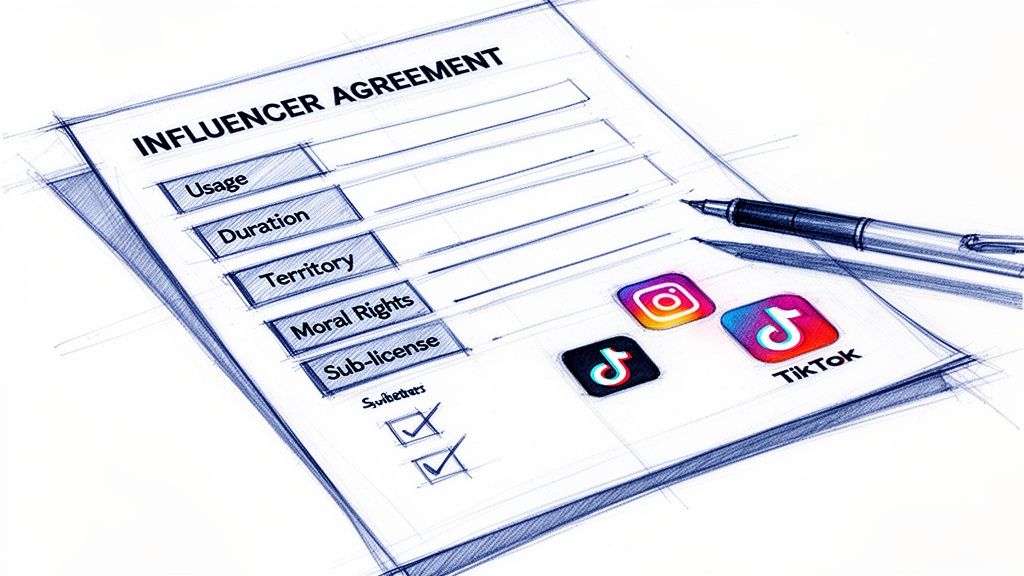
Drill down into three key areas:
- Platform: Where will you use the content? Be exhaustive. Think "the brand’s Instagram feed and Stories, TikTok profile, paid advertisements on Meta platforms, and our weekly customer email newsletter."
- Duration: How long can you use it? This can be anything from a short-term, 3-month licence to perpetual rights (forever).
- Territory: Where in the world can you show the content? Is it UK-only, across Europe, or Worldwide? The broader the territory, the higher the cost will likely be.
A well-drafted clause might look something like this: "Creator grants the Brand a non-exclusive, worldwide licence to use, reproduce, and display the content on the Brand's owned and operated digital channels, including social media and website, for a period of 12 months."
Those Tricky (But Essential) Legal Clauses
Beyond the basics of usage, a couple of other clauses are commercially vital. They might sound like intimidating legal jargon, but their purpose is actually very practical.
First up is the waiver of moral rights. Under UK law, creators have a "moral right" to be named as the author of their work and to object if it's treated in a way that could harm their reputation. By asking for a waiver, you gain the freedom to edit the content. This means you can crop an image for an Instagram Story, add a text overlay for a paid ad, or colour-grade a video to match your campaign aesthetic, all without needing to get fresh approval for every single tweak.
Key Takeaway: A moral rights waiver isn't about disrespecting a creator’s work. It’s a practical tool that gives your marketing team the flexibility to adapt content for different formats and get the most out of your investment.
The second crucial clause is the right to sub-licence. This gives you permission to grant usage rights to others. For example, you might have a PR agency running your media outreach or a major retail partner who wants to feature the content on their own product pages. Without a sub-licence, your hands are tied, and that brilliant content can't travel beyond your own channels.
Imagine your products are sold at Selfridges. A sub-licence clause means you can authorise them to use the influencer’s photo on their e-commerce site, massively amplifying your campaign’s reach. Of course, all of this needs to be tied to fair compensation from the very beginning. For a closer look at getting the numbers right, check out our guide on how much you should pay Instagram influencers.
Negotiating Rights and Fair Compensation
Let’s be clear: negotiating for influencer content rights shouldn't be a battle. The best outcomes I've seen always come from a place of collaboration, not confrontation. You're not trying to squeeze every last drop out of the deal; you're trying to build a partnership that benefits everyone.
Many brands fall into the trap of thinking compensation is just a one-off fee. A much smarter, more sustainable approach is to blend different types of value. This shows creators you respect their craft while tying the collaboration directly to your business goals.
For instance, a solid offer might include gifted products (so they can get a genuine feel for what you sell), a base payment that covers their time and creativity, and a performance bonus linked to metrics like clicks or sales. This gives the creator financial security upfront while also giving them a vested interest in the campaign's success.
A Tiered Approach to Buying Rights
One of the savviest moves you can make is to not ask for everything at once. I always advise brands to propose a tiered rights structure. It gives both you and the creator fantastic flexibility and makes the initial cost much easier to stomach.
Start by securing a licence for your most immediate needs: usually, the rights to use the content organically on your own social channels. A typical starting point is a three to six month window. This lets you populate your content calendar with authentic, creator-generated visuals without a huge financial commitment.
Then, you build in the option to buy more. Your contract can, and should, include pre-agreed fees to expand those rights if the content turns out to be a winner.
Here’s what that looks like in practice:
- Tier 1 (The Basics): The right to repost the content on your brand's Instagram and TikTok channels for three months.
- Tier 2 (The Performance Boost): An agreed-upon fee to license the content for paid digital ads on Meta platforms for another six months.
- Tier 3 (The Full Works): A further fee for worldwide, perpetual rights to use the content on your website, in email marketing, or other digital properties.
This layered method is a brilliant way to de-risk your investment. You only pay for the extra rights on content that has already proven it connects with your audience, which means your ad spend will work much harder for you.
Framing the Conversation for a Win-Win
How you talk about content rights is everything. Don’t make it sound like a dry list of legal demands. Instead, frame it as an exciting opportunity to put their brilliant work on a bigger stage. This simple shift changes the entire dynamic from a transaction to a true collaboration.
When you bring up using their content in paid ads, explain that you want to put a significant marketing budget behind their post because you believe in it. Emphasise that this will get their work in front of a much larger, targeted audience, boosting their own portfolio and credibility in the process.
Instead of asking, "Can we have the rights to use this in ads?" try framing it like this: "Your content is so strong that we'd love to feature it in our next ad campaign. We think it will resonate powerfully with a wider audience, and we have a budget set aside to compensate you for those additional usage rights."
This approach shows you see them as a creative partner, not just a service provider. It acknowledges the value they bring and makes the extra payment feel like a natural reward for creating something exceptional. It builds trust and sets you up for a great long-term relationship, making every future negotiation that much smoother.
Being transparent about your plans is also key. If you know you'll want to use the content for your big Black Friday campaign, say so from the start. This allows the creator to price their work accordingly and avoids any awkward last-minute requests. Honesty and clear communication are your most powerful tools here.
A Simple Rights Management Workflow That Works
So, you’ve got the contract signed. Fantastic. But that’s just the starting line. Securing the rights to influencer content is one thing, but actually managing it is where campaigns either fly or fall flat. Without a solid system, you’re just inviting chaos: lost assets, missed opportunities, and that constant worry you're using something you shouldn't be.
A repeatable workflow is your secret weapon here. This isn't about creating more admin for yourself. It's about building a straightforward, scalable process that makes your life easier and gets the most value out of every single piece of content you’ve paid for.
Create a Centralised Content Library
First things first: you absolutely need a single source of truth. Influencer content can't be left to die in someone's downloads folder, buried in old email threads, or lost in a chaotic Slack channel. For any kind of effective rights management, a centralised content library is non-negotiable.
Think of this library as your command centre for every asset a creator makes for you. Whether you use a proper digital asset management (DAM) tool, a shared cloud drive, or a platform like Sup with this built right in, the aim is total consistency. Every photo, video, and story should land in this central hub as soon as you get it.
This simple habit solves one of the biggest headaches I see: the desperate "where is that photo from the Q2 campaign?" search. It puts an end to lost content and ensures your whole team knows exactly where to find approved assets.
Tag Everything with Rights Information
A library full of untagged files is just a slightly more organised mess. The real power comes from enriching each asset with its specific rights data. This is what turns a basic storage folder into a smart, strategic tool.
You should be able to see the rights status of any piece of content at a glance. I always recommend a clear and consistent tagging system that covers:
- Creator Details: The influencer’s name and social handle.
- Usage Rights Status: What can you actually do with it? Use simple tags like “Organic Social Only,” “Paid Ads Cleared,” or “Website & Email Use.”
- Expiry Date: This one is crucial for avoiding compliance nightmares. When do your rights end? A tag like “Expires 31-Dec-2024” is absolutely essential.
- Campaign Name: Connect the content back to the project it came from (e.g., “Summer Glow ‘24”).
By tagging every asset, you eliminate all the guesswork. Anyone on your team can instantly check if a piece of content is cleared for a new Meta ad or if the rights have expired, preventing some very expensive mistakes.
Track Reuse and Attribute Performance
Your work isn't done once the content is neatly stored and tagged. The final, and arguably most important, step is to track where you're using it and how it’s performing. This is how you directly link your rights management efforts to real business results.
When you turn an influencer’s Reel into a paid ad, make a note of it. If you use a creator’s photo on a product page, track that, too. This builds a clear performance history for each asset, showing you which pieces of content are your true workhorses. Over time, you’ll get a crystal-clear picture of what your audience loves, which helps you negotiate for the right content in future campaigns. For agencies, this kind of granular tracking is a game-changer; you can find out more on how agencies can scale influencer campaigns without hiring.
This diagram breaks down the common elements of a fair deal.
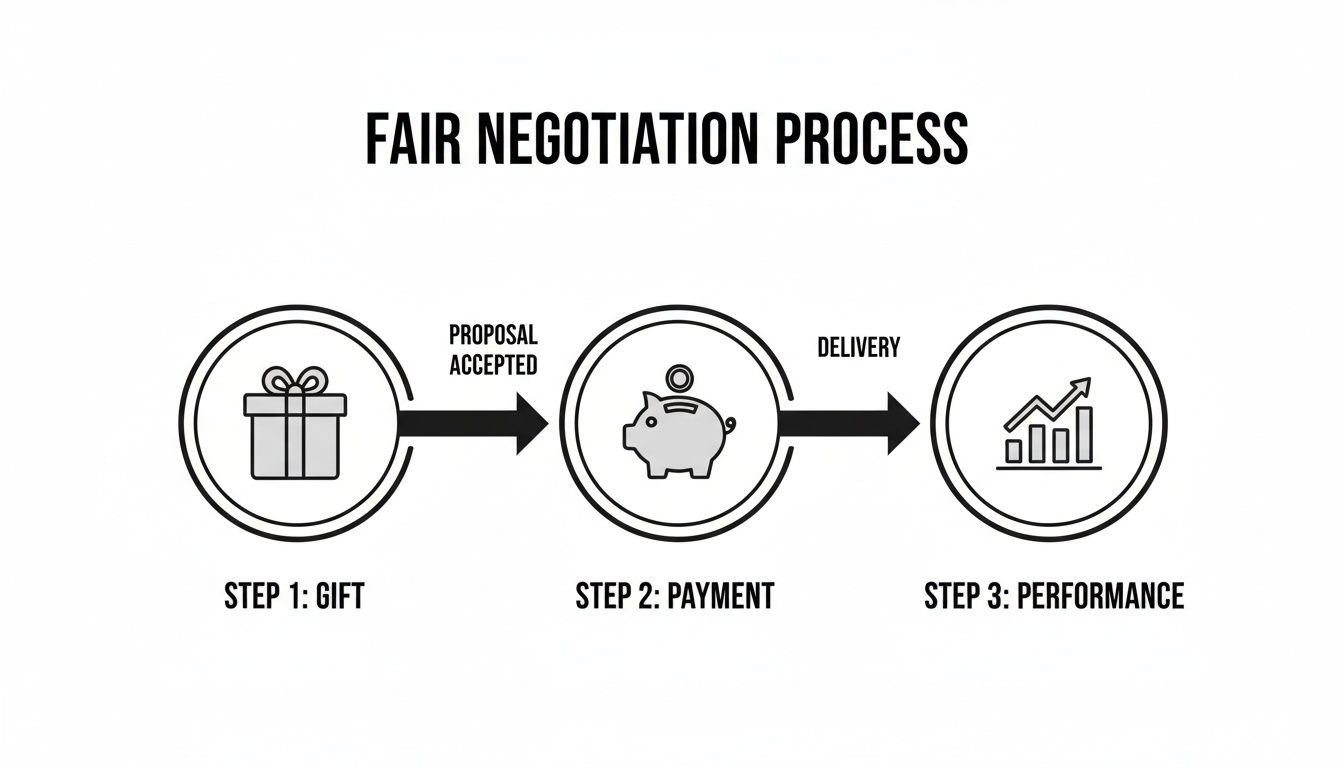
It shows how a mix of gifting, direct payment, and performance-based incentives helps create a well-rounded and appealing package for creators.
The UK's influencer market is growing at an incredible pace, projected to jump from USD 3.1 billion in 2025 to a staggering USD 28.3 billion by 2034. With 69% of UK consumers trusting influencer recommendations, having a bulletproof rights management workflow is more critical than ever. For brands, especially multi-location chains, scaling local creator campaigns and building a library of ad-ready content is the key to turning one-off posts into a reliable engine for growth. You can dive deeper into the booming UK influencer market at imarcgroup.com.
Putting Your Content Rights into Action
So, you’ve done the hard work. You’ve negotiated the contracts and secured the rights to some brilliant influencer content. Now, the real fun begins. It’s time to think bigger than a simple repost on your social feed and start strategically repurposing these assets to squeeze every drop of value from your investment.
Having the rights is like being handed the keys to a brand-new car. Just letting it sit in the garage looks nice, but the real thrill comes from taking it out on the road. Getting the most out of your influencer content means thinking creatively about how and where these authentic assets can make the biggest impact across your entire marketing plan.
Once you have those rights locked in, the goal is to make that content work harder for you. This often means turning a single great post into dozens of different marketing assets, a concept broken down in this definitive guide to repurposing content. The same principles apply here: one fantastic video can easily fuel your campaigns for a whole quarter.
To help you visualise this, here’s a quick cheat sheet showing how different types of businesses can get more mileage out of their influencer content.
Repurposing Content Ideas by Business Type
| Channel/Platform | Ecommerce & DTC Brands | Restaurants & Hospitality | Marketing Agencies (for clients) |
|---|---|---|---|
| Website | Add to product page galleries; use in "Shop the Look" sections; create a dedicated "As Seen On" page. | Embed on the homepage to show atmosphere; add to the "Gallery" page; feature on the booking page. | Build case study pages with client results; create "social proof" sections on landing pages. |
| Paid Ads (Meta/TikTok) | Use as primary creative for retargeting campaigns; test against studio shots for prospecting. | Run geo-targeted ads showcasing dishes or the venue vibe to drive local footfall. | A/B test influencer content vs. brand creative to prove ROI and find winning formats for clients. |
| Email Marketing | Feature in newsletters to announce sales; use in abandoned cart emails to add social proof. | Send "Book Your Table" emails featuring mouth-watering food shots; promote events with creator content. | Include in client newsletters to showcase campaign highlights and successes. |
| Organic Social | Reshare to Stories with shoppable tags; create Reels/Shorts by editing video clips together. | Post to your Google Business Profile; use as cover photos on Facebook; create highlight reels of guest experiences. | Repurpose top-performing content across different client channels to maximise reach. |
| Offline/In-Person | Use in print catalogues or lookbooks; display on in-store digital screens. | Feature on digital menus (via QR codes); use in printed promotional flyers or local ads. | Include in client reports and presentations to visually demonstrate campaign impact. |
This is just the starting point. The more you integrate influencer content across your channels, the more cohesive and authentic your brand will feel to customers.
Creative Repurposing for E-commerce Brands
For e-commerce and direct-to-consumer (DTC) brands, influencer content is pure gold. It provides the social proof that nudges customers along every single stage of their journey, from discovery right through to checkout. Don't just let it sit on your Instagram grid.
Instead, you need to weave it directly into your sales funnel:
- Enrich Your Product Pages: Embed influencer photos and videos directly onto your product detail pages (PDPs). Seeing a real person using and loving your product is far more persuasive than a sterile studio shot. It builds immediate trust and helps customers visualise the item in their own lives.
- Create High-Converting Ads: Use influencer-generated content (IGC) for your Meta and TikTok ad campaigns. This authentic, user-centric creative almost always outperforms polished brand assets because it feels native to the platform and genuinely stops the scroll.
- Supercharge Your Emails: Drop influencer photos into your email newsletters. Announcing a new collection? Use a creator’s unboxing video. Running a sale? Feature a shot of an influencer with the discounted product. It just feels more real.
Imagine a customer on your website, hesitating to buy a dress. Then they see a gallery of five different influencers (all with different body types) looking fantastic in it. That’s the kind of powerful social proof that closes sales.
Driving Footfall for Restaurants and Hospitality
For restaurants, cafés, and hotels, influencer content is all about creating an irresistible desire to visit. Your goal is to make potential customers feel like they're already there, soaking up the atmosphere and tasting the food. The rights you’ve secured allow you to place this content at key decision-making moments.
Here are a few high-impact ideas I've seen work wonders:
- Boost Your Booking Page: Add a carousel of influencer photos to your online reservation page. When a potential diner is about to book, showing them gorgeous shots of your most popular dishes or the vibrant dining room can be the final nudge they need.
- Upgrade Your Digital Menu: Why have a plain text menu when you can have a visual feast? Use QR codes on your physical menus to link to a digital version packed with influencer videos of cocktails being made or steam rising from a freshly served plate.
- Dominate Local Search: Keep your Google Business Profile and other local listings updated with fresh, high-quality influencer photos. When someone searches for "best brunch near me," you want your profile to pop with authentic images that make them choose you over the competition.
Proving ROI with A/B Testing
One of the most powerful things you can do with your influencer content rights is to prove their value with hard data. The best way to do this is by running simple A/B tests in your paid ad campaigns.
It’s straightforward: set up a test that puts your traditional brand-created assets against influencer-generated content. Run two identical ads where the only thing you change is the creative. One ad uses your polished studio photography, and the other uses an influencer's more authentic, lo-fi video or photo.
Then, track the important metrics:
- Click-Through Rate (CTR)
- Cost Per Click (CPC)
- Conversion Rate
- Return On Ad Spend (ROAS)
Time and time again, I see influencer content come out on top, often delivering a 2-3x higher ROAS than slick brand creative. This data is invaluable. It not only justifies your investment in influencer marketing but also ends the internal debate about what "good" creative looks like. You can replace opinions with undeniable performance data.
Common Questions About Influencer Content Rights
Even with the best-laid plans, the world of influencer content rights can be a tricky place. It’s a topic that throws up curveballs for even seasoned marketers. Let's get straight into some of the most common questions we hear and give you the clear, straightforward answers you need.
Do I Still Own the Copyright if an Influencer Creates Content for Me?
This is probably the biggest misconception out there. Here's the bottom line: unless your contract explicitly says otherwise (and it rarely does), the creator always owns the copyright to the photos and videos they produce. It’s their intellectual property the second they create it.
When you're negotiating for "rights," you're not actually buying the content. You're securing a licence to use it under a specific set of conditions.
Think of it like licensing music for a film. The studio doesn't own the song, but they pay for the right to use it in their movie. It’s the exact same principle. You're paying for the right to feature the creator's work in your marketing.
What Does 'In Perpetuity' Really Mean?
"In perpetuity" is legal speak for forever. Securing rights in perpetuity gives a brand the ability to use a piece of content for an unlimited amount of time, with no need to renew the licence or pay any more fees down the line.
It might sound like the holy grail of content rights, but it comes with a hefty price tag. Most creators are, understandably, reluctant to sign away permanent control of their work, so they'll charge a significant premium for it. Honestly, for most campaigns, a 12 to 24-month licence is plenty of time and far more budget-friendly.
Can I Edit Influencer Content?
The short answer is yes, but only if your contract explicitly gives you permission. Under UK copyright law, creators have "moral rights," which include the right to object if their work is altered in a way that could damage their reputation.
This is precisely why a moral rights waiver is a non-negotiable clause in your influencer agreements. Without one, you could land in hot water for something as simple as cropping a photo for an Instagram Story or adding a promotional text overlay for a paid ad.
Always, always include a clause that grants you the "right to edit, adapt, and modify" the content. This gives you the creative freedom to repurpose assets across different channels without having to go back for approval every single time.
How Much Should I Pay for Content Rights?
There's no single, magic number for this. However, the industry standard is to calculate usage fees as a percentage of the influencer's original content creation fee. The final figure will shift based on where and for how long you want to use the content.
Here are some general benchmarks that brands and creators often use as a starting point for negotiation:
- Organic Social Use (3-6 months): Often an additional 20-30% of the base fee.
- Paid Ad Use (3-6 months): This can jump to 50% to over 100% of the base fee, especially if you have a large ad spend planned.
- Website & Email Use (12 months): Typically requires an extra 40-60%.
- Perpetual Rights (Full Buyout): Brace yourself. This can be anywhere from 200% to 500% (or even more) of the original fee.
Remember, these are just guides. Your negotiation skills, the influencer's profile, and how much you really want the content will all play a part in the final cost.
What Happens if a Brand Uses Content After Rights Expire?
Using content after the licence has expired is copyright infringement, plain and simple. It's a serious breach of your agreement that can destroy your relationship with a creator and open you up to legal action.
If this happens, the creator can legally issue a cease-and-desist notice, demanding you remove the content immediately. They can also send you an invoice for the unauthorised use, often at a much higher rate. This is exactly why having a solid rights management system to track expiry dates is so crucial. It protects you from making very costly mistakes.
Ready to stop chasing DMs and start scaling your influencer campaigns with measurable ROI? Sup combines smart technology with a human touch to handle everything from creator sourcing to rights management. See how Sup can save you 95% of your time and drive real results.
More on content & ugc
See how many creators post about you and your competitors
Type in your brand's Instagram handle and we count the creators who post about you and about your five closest competitors. It takes about a minute and it is free. Or request a demo and we will show you the creators in your niche and walk you through the dashboard.
 Book a call