8 October 2026
Influencer Gifting Note Examples You Can Copy
A good influencer gifting note does six things. It names the creator, gives one true reason you chose them, says what is in the parcel, removes any pressure to post, reminds them to say the product was gifted if they do share it, and gives a contact. The 12 examples below follow that pattern, and you can copy and adapt each one.
A note that says "Hi there" and asks for coverage can make a free sample sound like an undeclared deal. So the wording must match the campaign. A no-strings gift should stay separate from an agreed post, a deadline or a usage right. Those terms belong in a written agreement, not in a vague line on a card.
The difference matters for disclosure. In the US, the FTC's Disclosures 101 for Social Media Influencers treats free or discounted products as a connection the creator must make obvious. In the UK, the ASA's influencer marketing advice says payment includes free gifts. Check the rule for your own market before you print the cards. For the full process around the parcel, see this guide to influencer gifting.
1. First gift with no strings
A first parcel should build familiarity, not create an obligation. It suits a creator whose content is a clear fit but who has not worked with the brand before.
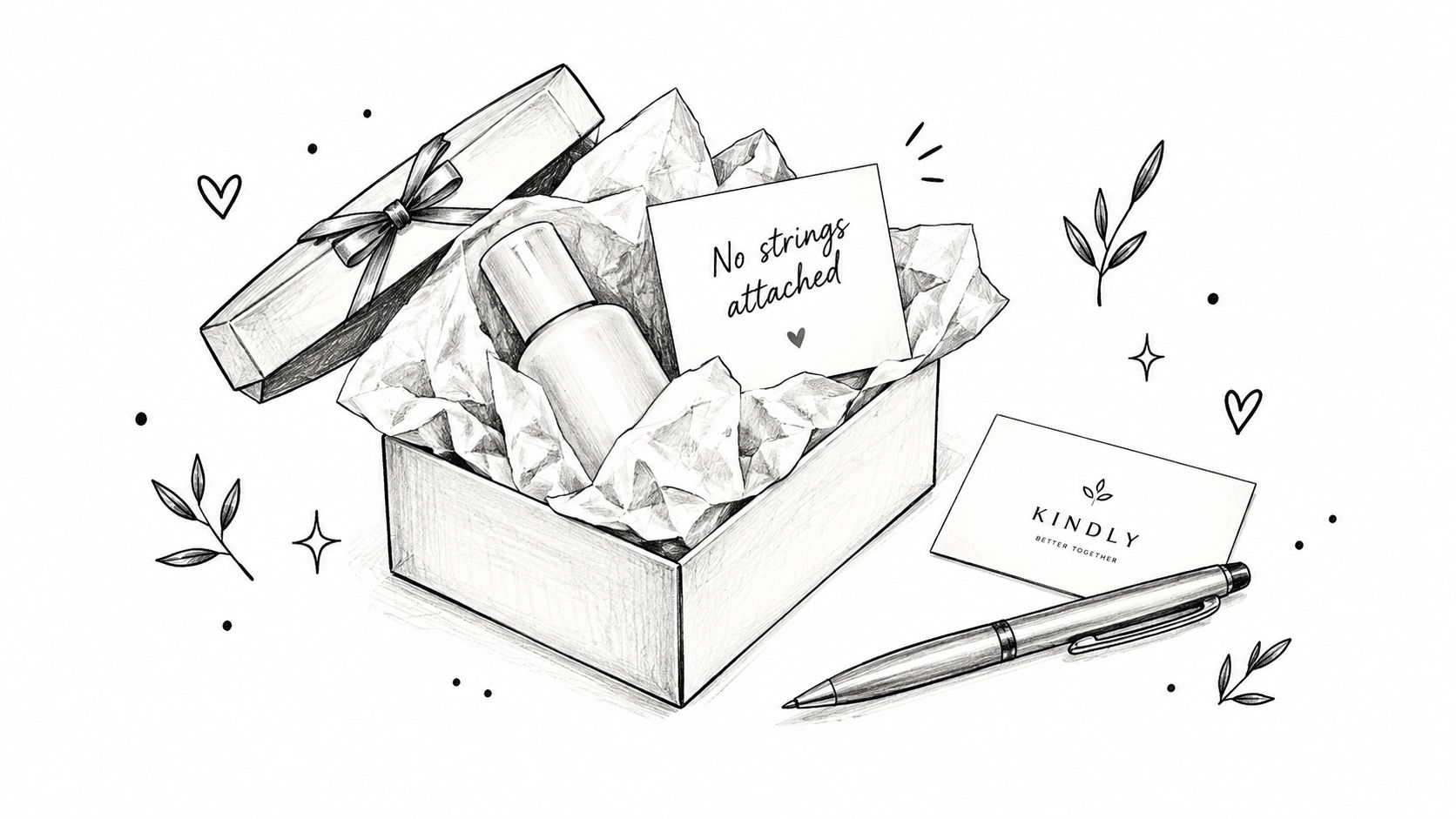
Hi [Creator name], [Specific post or series] made us think of you because [true reason]. Inside is [product and key item]. There's no expectation to post. We hope it's useful, and if you do share it, please make clear that it was gifted. Contact [name] at [email] with any questions. [Sender name], [Brand]
Follow up after delivery, then give the creator time to try the product. Marketers weighing seeding against paid work can use this guide to gifted and paid influencer campaigns. A gift card can even accompany unrelated occasions such as sending wedding photos as a gift, but creator seeding needs especially clear expectations.
2. Product launch
A launch note needs a clear date and a clear boundary around sharing.
Hi [Creator name], We chose you because your [specific content] reflects [relevant quality]. This parcel contains [new product], launching on [date]. Please keep the product and launch details private until [embargo date]. There's no requirement to post, but if you choose to share after that date, please disclose that it was gifted. Contact [name] at [email]. [Brand]
State the embargo plainly, and keep any deliverable, approval process or usage permission in a separate agreement. The same discipline applies to a product launch event checklist.
3. Seasonal gift
Seasonal gifting works when the product fits a real moment in the creator's content. A winter item sent in spring feels like leftover stock.
Hi [Creator name], Your recent [seasonal post or theme] made you the right person for this parcel. Inside is [product], selected for [specific seasonal use]. There's no pressure to post or review it. We hope it fits into [seasonal moment]. If you share it, please disclose that it was gifted. Contact [name] at [email]. Warm wishes, [Brand]
Allow time for shipping, and name the occasion only briefly.
4. Polite ask for a post
Use this note when a creator has already agreed to a post. It confirms the deal without presenting agreed work as an unconditional gift.
Hi [Creator name], We chose you for your [specific content or audience fit]. Inside is [product]. As agreed, the campaign includes [post format] by [date], with [usage or approval term] covered in the written agreement. Please use the agreed gifted or advertising disclosure. The creative direction is in [brief link]. Contact [name] at [email]. [Brand]
Keep the note in line with the agreement. An influencer brief template sets out the format, the deadline and the disclosure in one place. For the first message, see writing influencer outreach emails.
5. Note with a discount code for their followers
A code gives the creator a clear reason to share the product with followers.
Hi [Creator name], We picked you because of your [specific post or audience connection]. Inside is [product] for you to try. If it suits your audience, they can use code [CODE] for [approved offer] until [date]. Sharing is optional. If you do post, please disclose that the product was gifted. Contact [name] at [email] for code details. [Brand]
Make the code unique to the creator and easy to find on the card. Record the code, the expiry date and any commission terms before the parcel ships. This in-post promo code guidance covers the measurement.
6. Thank you after they posted
A thank-you note should recognise work already done. It should not turn into another request.
Hi [Creator name], Thank you for sharing [specific post or video]. The way you [specific detail from the content] gave the product useful context. The team appreciated the care you put into it. This parcel contains [thank-you item]. There's no new post attached to it. If future work feels like a fit, contact [name] at [email]. [Brand]
A specific reference proves that someone watched the content.
7. Invitation to a venue
A venue invitation needs practical details first: what the visit includes, who can come, when, and how to confirm.
Hi [Creator name], Your [specific local or venue-related content] makes you a strong fit for [venue]. We'd like to invite you and [number of guests, if agreed] to enjoy [experience or items]. Please contact [name] at [email] to choose a suitable date between [dates]. There is no requirement to post. If you share the visit, please disclose the gifted experience. We hope to welcome you, [Brand]
Before you send it, confirm access, dietary needs, guest arrangements and that the staff know who is coming.
8. Re-engagement with a former creator partner
Show that you have looked at the creator's current work, and do not recycle an old pitch.
Hi [Creator name], The [previous campaign or post] remains a memorable part of our work together, especially [specific detail]. We've been following your recent [content area], and [new product] felt relevant to where your work is now. Inside is a sample to try, with no post required. If a new collaboration suits your plans, contact [name] at [email]. [Brand]
The creator's audience and rates may have changed. Do not assume the old terms still apply.
9. Proposal for an ongoing partnership
The note can introduce the idea. It should not hide a commitment in friendly language.
Hi [Creator name], We selected you because your work on [specific topic] aligns with [brand value or audience]. This parcel contains [products] as an introduction to the range. We'd like to discuss an ongoing partnership involving [broad activity], subject to agreed terms. Nothing is required from this parcel. If interested, contact [name] at [email] and the full proposal can follow. [Brand]
Put the formats, fees, review points, disclosure and usage in a formal agreement.
10. Raising exclusivity
Exclusivity is a commercial restriction, so never slip it into a parcel note. The card can raise the subject and nothing more.
Hi [Creator name], Your work on [specific category] stands out because [true reason]. We've sent [product] so you can experience the range. We'd also like to discuss a possible partnership focused on [category], including any appropriate exclusivity. No restriction applies to this gift. Contact [name] at [email] if a conversation would be useful. [Brand]
The agreement should name the product category, the length of time, the payment and the exceptions.
11. Apology after a mistake
An apology must name the problem. "Sorry for any confusion" leaves the creator unsure whether the brand understands what went wrong.
Hi [Creator name], The [specific mistake] in our previous collaboration was our responsibility. We're sorry for the inconvenience it caused. We've changed [specific process] so the same issue should not happen again. This parcel includes [goodwill gesture]. There's no new expectation attached to it. If you're open to reconnecting, contact [name] at [email]. [Brand]
Match the remedy to the problem, then do what you promised.
12. Request for private feedback
Ask for useful input, and do not disguise a review request as research. Say whether the reply is private and how you will use it.
Hi [Creator name], We chose you because your [specific content] shows a thoughtful understanding of [category or audience need]. Inside is [product]. If you have time, private feedback on [specific points] would help with the next version. There's no requirement to post or review it publicly. Please reply to [name] at [email], and the team will explain how the feedback will be used. [Brand]
Specific questions bring better answers than "What do you think?".
Five things not to write
- A mass greeting. "Hi there" tells the creator that nobody checked who they are.
- A promise of results. No brand can promise reach, sales or engagement from a parcel.
- A hidden expectation to post. It changes what the arrangement is.
- A claim you cannot support. Use the approved product wording.
- Disclosure as an option. Do not present it as something the creator can skip.
Make the note a repeatable step
Before printing, check the creator's name, the reason you chose them, the exact contents, the contact details and the disclosure wording. Record the delivery status, any code, and whether a post was unprompted or agreed.
For product brands, Sup's ecommerce creator campaign service finds the creators, contracts them, pays them and tracks the posts, and it runs influencer gifting for brands that send product in place of a fee. The client approves every creator and every post, and pays only for posts that go live.
Start a creator campaign with Sup.
More on relationships
See how many creators post about you and your competitors
Type in your brand's Instagram handle and we count the creators who post about you and about your five closest competitors. It takes about a minute and it is free. Or request a demo and we will show you the creators in your niche and walk you through the dashboard.