18 March 2026
Gifted vs Paid Influencer Campaigns: When to Use Each for 2026 - A Quick Guide
Deciding between gifted and paid campaigns isn't a matter of one being better than the other. The real question is: which one aligns with what your brand needs to achieve right now?
If you're after genuine brand discovery and a steady stream of user-generated content without a big budget, gifted collaborations are your go-to. But if you need predictable reach, tight control over the message, and clear, measurable ROI, then paid campaigns are the only way forward.
Sup runs both. See how we run influencer gifting and product seeding and paid influencer posts.
Making The Right Call For Your Brand
Choosing between gifted and paid influencer campaigns really comes down to a strategic trade-off: do you want organic buzz or scalable, measurable results? Think of gifted collaborations as the engine of authenticity. They're perfect for helping a new product or a local spot build a real community and gather that all-important social proof.
Paid partnerships, on the other hand, operate more like a traditional marketing channel. They are built to deliver specific, predictable outcomes on a set schedule. To make the right decision, it helps to see the full picture, including the subtle differences between influencer marketing vs affiliate marketing. This wider context helps clarify which structure truly supports your goals.
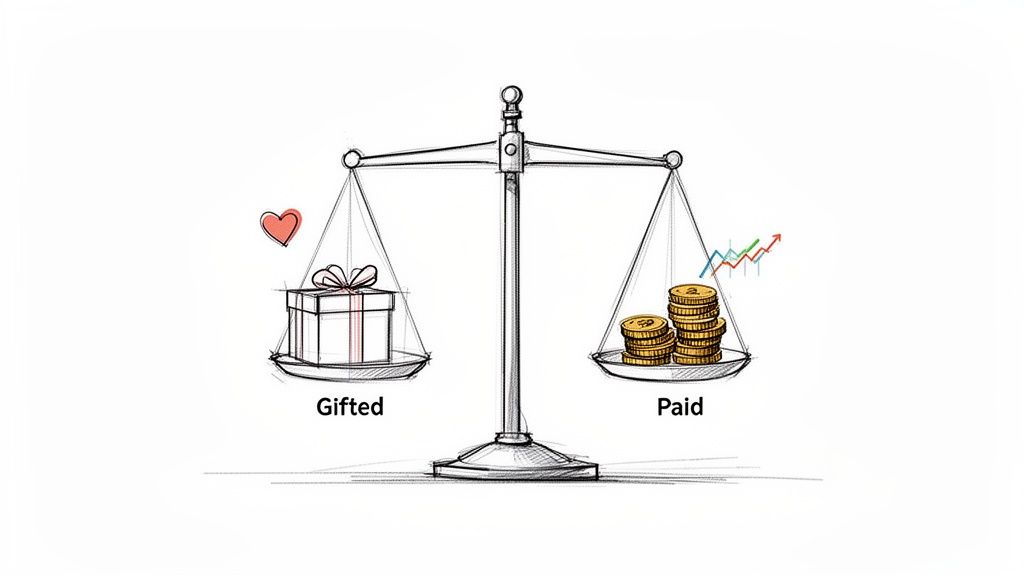
Gifted vs Paid Campaigns At a Glance
Each approach has a distinct role. Gifted campaigns are all about planting the seeds of interest, whereas paid campaigns focus on harvesting measurable returns. This table offers a quick breakdown to help guide your thinking.
| Factor | Gifted Campaigns (Product Seeding) | Paid Campaigns (Sponsored Content) |
|---|---|---|
| Primary Goal | Brand awareness, UGC, community building | Reach, conversions, direct sales |
| Cost | Cost of product + shipping, team time | Flat fee, commission, or performance-based pay |
| Creator Tier | Nano & micro-influencers | Micro, macro, & mega-influencers |
| Content Control | Low (creator has creative freedom) | High (contractual obligations & review process) |
| Ideal For | New brands, local businesses, tight budgets | DTC brands, product launches, scaling revenue |
This quick comparison shows a clear divergence in strategy, and the data backs it up. In the UK, a staggering 93% of brands work with micro-influencers for their authentic feel, often through gifted campaigns. These collaborations can generate engagement rates up to eight times higher than celebrity posts.
Yet, for marketers focused on performance, paid campaigns are essential. It's no surprise that 59% of brands are planning to increase their spend on paid partnerships to track clicks all the way through to sales.
The fundamental difference lies in the expectation. Gifting is a no-strings-attached offer in the hope of a genuine shout-out. Paying is a business transaction with contracted deliverables, designed to achieve a specific, measurable objective.
Ultimately, your choice hangs on your resources and immediate goals. A new café might send free coffee vouchers to local foodies to generate some initial buzz. In contrast, an established ecommerce brand will pay for a campaign with tracked links to measure the exact revenue generated from a new product launch.
Analysing the Real Financial and Strategic Trade-Offs
When you’re weighing up gifted versus paid influencer campaigns, it’s easy to get fixated on the initial price tag. But the real story is much deeper than that. The true cost of either approach is a blend of financial spend, your team's time, and the strategic value you get back, which isn’t always obvious at first glance.
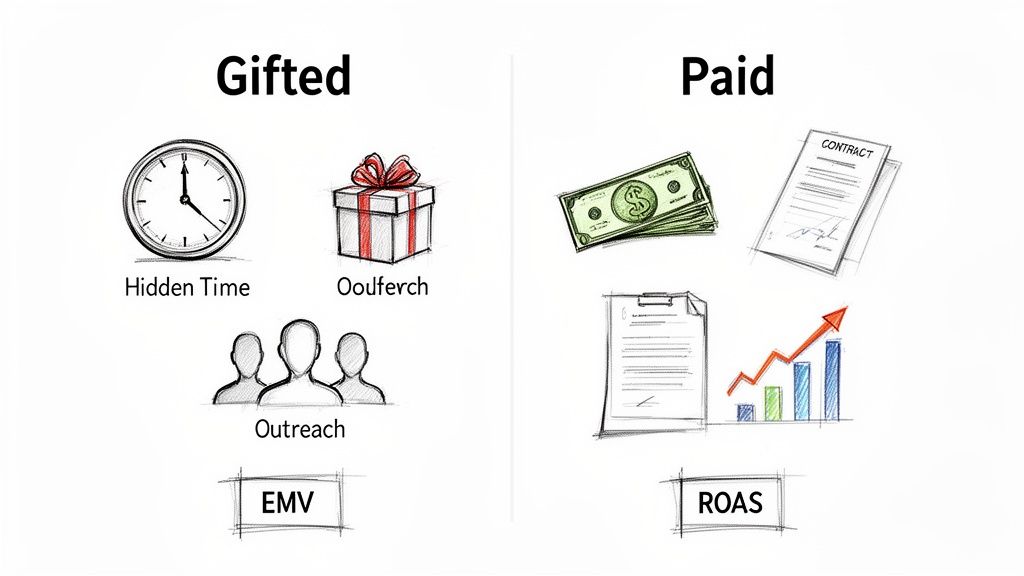
The Hidden Costs of Gifted Campaigns
Gifted campaigns are often tagged as "free," but anyone who has run one knows that’s a bit of a misnomer. The biggest cost isn't money; it's your team's time, which is arguably your most valuable resource. The manual grind of finding creators, crafting personalised outreach, negotiating, shipping products, and then chasing them for the actual posts can easily eat up dozens of hours.
For a small team, this hands-on effort quickly becomes a bottleneck, limiting how big your programme can actually get. All those administrative tasks are the real price you pay for a gifted strategy.
The true cost of a "free" gifted campaign is the sum of all the hours your team spends managing it. If those hours prevent you from working on higher-value activities, the cost becomes substantial.
This is exactly where a platform like Sup proves its worth. By automating the entire workflow (from sourcing verified creators to handling the back-and-forth communication and follow-ups), Sup can slash the time spent on campaign admin by up to 95%. This frees your team to think about strategy instead of spreadsheets, which dramatically lowers the real cost of your gifting efforts.
Unpacking Paid Campaign Economics
Paid campaigns are more straightforward on the financial front, but they demand smart budgeting and a firm grasp of the different payment models out there. To get it right, you need to understand how to pay influencers effectively to make sure your investment actually pays off.
You'll typically run into a few common pricing structures:
- Flat Fees: A fixed payment for a clear set of deliverables, like one Instagram Reel and three Stories. This is the most popular model because it offers predictability for everyone involved.
- Cost Per Mille (CPM): You pay a set rate for every 1,000 views or impressions the content gets. It's a great fit for campaigns purely focused on getting as many eyes as possible on your brand.
- Cost Per Acquisition (CPA): Here, payment is tied directly to performance. You pay based on the number of sales or leads generated from an influencer’s unique link or discount code. It’s a powerful model for tying spend directly to results.
Your budget should always map back to your main goal. For instance, if you're a restaurant trying to drive bookings on a quiet Tuesday night, your budget needs to be specific. Understanding https://sup.co/blog/how-much-does-influencer-marketing-cost-for-restaurants will give you a realistic idea of what it takes to drive local footfall.
EMV vs. ROAS: The Measurement Divide
The financial trade-offs become crystal clear when you look at how success is measured for each type of campaign.
With gifted campaigns, the go-to metric is often Earned Media Value (EMV). This formula gives you an estimate of what the organic exposure would have cost if you'd paid for it as traditional advertising. While it’s a decent way to gauge brand presence, remember that EMV is an estimate, not a direct measure of revenue.
Paid campaigns, on the other hand, are judged by a much harder metric: Return on Ad Spend (ROAS). By arming influencers with unique promo codes and UTM-tracked links, you can attribute sales and revenue directly back to their content. A 4:1 ROAS means for every £1 you spent, you made £4 in sales. It's a concrete, undeniable measure of profitability. Platforms like Sup make this simple by building attribution directly into every campaign, giving you a real-time dashboard to watch revenue and redemptions as they happen.
Balancing Creative Control with Audience Authenticity
One of the trickiest parts of influencer marketing is striking the right balance between creative control for the brand and authenticity for the creator's audience. Your choice between a gifted or paid campaign places you on a spectrum, and it directly impacts the kind of content you’ll get and how well it connects.
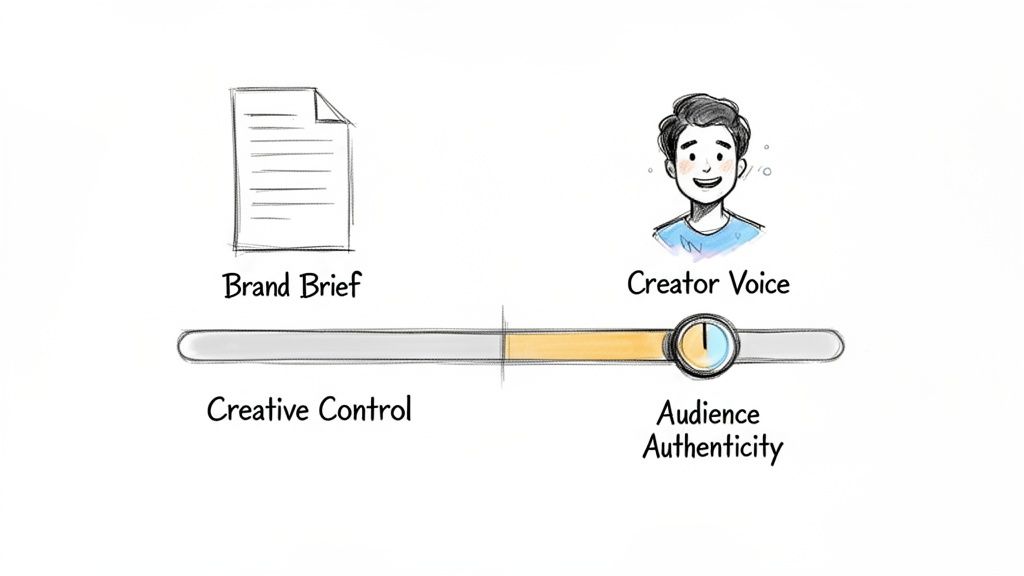
The Freedom of Gifted Campaigns
Gifted campaigns run on genuine enthusiasm. You send your product, and the creator decides if, when, and how they want to talk about it. It’s this total lack of obligation that makes the content feel so real. It’s an honest recommendation, not an ad, and that’s what really resonates with their followers.
Of course, this means you have to give up almost all creative control. You can’t insist on certain talking points, dictate a photography style, or set a firm deadline. Your job is to guide, not to direct.
The heart of a gifted campaign is trust. You're trusting the creator to have a genuine experience with your product and share it in a way that feels completely natural to their audience. That’s where the magic happens.
A 'soft' brief is your best friend here. Instead of a rigid list of demands, give them inspiration. Share your brand’s mission, highlight key product benefits, and maybe put together a mood board. Then, let them run with it. The most believable content often comes from creators who are given the space to be themselves, which is especially true for nano-influencers who thrive on authenticity.
The Structure of Paid Campaigns
Paid campaigns are a different beast entirely. Here, the contract is king. This agreement is where you can lay out the exact deliverables you need, including things like:
- Key Messaging: Making sure specific product benefits or taglines are mentioned.
- Calls-to-Action (CTAs): Requiring the creator to push followers to a specific link or use a unique promo code.
- Content Review Cycles: Building in approval stages before anything goes live.
- Exclusivity Clauses: Stopping the influencer from working with your competitors for a set amount of time.
This structure provides the control and predictability you need for performance-driven goals. But there's a serious risk: over-scripting can lead to content that feels robotic and staged. That's a fast way to turn off an audience that trusts the creator for their genuine voice.
Finding the Authentic Middle Ground
The best paid partnerships feel less like a transaction and more like a true collaboration. Even when you have a contract in place, the aim should be to co-create with the influencer, not just hire them.
Work together to weave your key messages into their natural style. Ask for their ideas on the best way to introduce the product to their followers. This collaborative spirit ensures your brand message gets across while keeping the very authenticity that made you want to partner with them in the first place. You get the control of a paid campaign without losing the trust the influencer has worked so hard to build.
Navigating Legal Disclosures in the UK
No matter which route you take, transparency is not up for debate. The UK’s Advertising Standards Authority (ASA) has very clear rules to make sure consumers know when they're looking at an advertisement.
- Gifted Content: If a brand sends a product with an expectation of a post (even if it's not in a contract), the post must be clearly labelled. Using #gifted signals that the product was received for free.
- Paid Content: Any time money (or an equivalent) changes hands for a post and the brand has some level of control, it's an ad. These posts must be clearly marked with #ad.
Ignoring these guidelines can lead to penalties from the ASA, but more importantly, it can damage your brand's reputation and destroy consumer trust. Honesty is everything in this game.
Matching Your Campaign to Your Business Goals
The question isn't whether to choose a gifted or a paid influencer campaign; it's about what you need to achieve. Your budget is secondary. The real key is aligning the campaign type to your specific business objective, because each approach is a tool designed for a different job.
Think of it this way: gifting is your ground game. It's fantastic for building authentic, grassroots buzz. Paid campaigns are your air support: built for big, immediate impact and hitting precise targets. Knowing when to deploy each is what separates a forgettable campaign from one that genuinely moves the needle.
Getting People Through the Door at Local Businesses
If you run a local restaurant, cafe, or independent shop, your main goal is straightforward: get people to walk in. For this, gifted campaigns with local nano-influencers are incredibly powerful. Your "payment" is a great meal or a new product, and what you get back is genuine content that really connects with the community.
These creators might have smaller followings, but those followers are often highly engaged and live within a few miles. A recommendation from them to "check out this new brunch spot" feels less like an ad and more like a tip from a trusted friend. The aim isn't to get a million views; it's to drive local footfall this week and spark some authentic conversations online.
For instance, a new coffee shop could use a platform like Sup to find 20 local foodies and invite them in for a coffee and pastry on the house. The flurry of Instagram Stories and posts that follows creates instant social proof right where it matters, encouraging their followers to pop in themselves.
Launching a New Product for a DTC Brand
When a national direct-to-consumer (DTC) brand is launching something new, the objective is bigger. You need to create hype, build a library of user-generated content (UGC) for your own channels, and, most importantly, drive online sales. This is where a smart hybrid approach comes into play.
- Phase 1: The Gifting Blitz. Kick things off with a large-scale gifted campaign, sending your new product to hundreds of micro-influencers. The goal here is saturation. You're trading product for a wave of authentic unboxing videos and first-impression posts that build curiosity and fill social feeds.
- Phase 2: The Paid Conversion. Once the buzz is there, follow up with a targeted paid campaign. Cherry-pick the best-performing influencers from your gifting phase: the ones who genuinely love the product and have an audience that listens. Give them tracked affiliate links and unique discount codes so you can measure every sale they drive.
This two-step strategy uses gifting to build an authentic foundation and paid partnerships to deliver a measurable return on investment. The gifted push creates the groundswell, and the paid campaign converts that interest into hard revenue.
Building an 'Always-On' Engine for Agencies and Chains
For marketing agencies managing multiple clients or chains with many locations, the challenge is different. It’s about maintaining a constant, steady presence and a continuous stream of social proof. The answer is an 'always-on' gifted programme, punctuated by bigger, strategic paid campaigns.
An 'always-on' gifted programme, especially when managed through a system like Sup, guarantees a fresh flow of UGC from creators in different areas. This provides a consistent drumbeat of authentic content that can be repurposed across all your marketing, saving you up to 95% of the manual admin time. When you can set up a whole campaign in just 20 minutes, it becomes an incredibly efficient way to operate.
You then layer strategic, paid campaigns on top of this foundation. These are tied to major calendar moments (a new seasonal menu, a Black Friday sale) and are designed to amplify your message and drive serious revenue when it counts.
By combining a consistent, low-cost gifted programme with high-impact paid bursts, brands create a powerful and sustainable influencer marketing engine that supports both long-term brand health and short-term sales goals.
With the UK’s influencer marketing spend projected to hit £930 million in 2024, it’s clear the industry is moving towards more structured, results-focused strategies. And while 93% of UK marketers say they prefer micro-influencers for their engagement, the real winners will be the brands that master both sides of the coin. They use gifting to test the waters and paid campaigns with tracked UTM codes to scale what works, turning one-off collaborations into a reliable growth channel. You can find more data on these trends in detailed industry reports about UK influencer marketing.
Measuring Success and Scaling Your Influencer Programme
Choosing between gifted and paid campaigns is just the beginning. To turn influencer marketing into a genuine growth channel, you need a clear idea of what success looks like for each approach and a solid plan for scaling up.
The truth is, the metrics and growth strategies for gifted versus paid collaborations are worlds apart. A common pitfall is applying the same success criteria across the board, which often leads to disappointment. Focusing on vanity metrics like likes for a gifted campaign completely misses the point; its real value is in the authentic content and community it builds, not in hitting arbitrary engagement numbers.
Defining Success for Gifted Campaigns
With gifted collaborations, success isn't about direct sales attribution. You're trading your product for genuine advocacy and social proof. The return is measured in the quality and volume of authentic content you get back.
Here's what you should actually be tracking:
- Volume of High-Quality User-Generated Content (UGC): The main prize here is the library of on-brand content you acquire. Every piece can be repurposed for your own social media, website, and ad campaigns, saving you a fortune in production costs.
- Audience Growth and Mentions: Keep an eye on the lift in your brand’s follower count and the number of organic mentions you receive. This is a clear signal that the campaign is boosting brand awareness and starting conversations.
- Qualitative Customer Feedback: Don't underestimate the power of a simple comment. Seeing things like, "I saw this on [Creator]'s story and had to try it!" is a powerful sign that your campaign is driving real-world interest.
The real win from a gifted campaign is a library of authentic content and a groundswell of positive feeling around your brand. It’s about building brand love, not just counting clicks.
Tracking ROI for Paid Campaigns
Once money changes hands, the game changes entirely. Paid campaigns demand a performance marketing mindset where every pound spent needs to be accounted for. Success here is defined by a clear and positive return on your investment.
You need to get comfortable with the hard metrics that tie directly to business outcomes:
- Click-Through Rate (CTR): The percentage of people who actually clicked the link in the influencer’s content.
- Conversion Rate: Of those who clicked, how many followed through with a purchase, booking, or sign-up?
- Cost Per Acquisition (CPA): Your total campaign cost divided by the number of new customers it brought in. This tells you exactly what you paid for each conversion.
- Attributed Revenue: The total sales figure generated directly from the campaign’s tracked links and codes.
To track this properly, you absolutely must give your influencers the right tools. Unique discount codes and UTM-tracked links are non-negotiable. They are the only reliable way to connect a creator’s post to a specific sale. You can dive deeper into this by exploring the fundamentals of measuring influencer marketing ROI.
Creating a Scalable, Hybrid Framework
The most sophisticated influencer programmes don't just stick to one lane. They build a hybrid system that blends the strengths of both gifted and paid campaigns to create a predictable and repeatable growth engine.
Here’s a straightforward, scalable framework that works:
- Start with Gifted Seeding: Kick things off with a broad gifted campaign aimed at nano and micro-influencers. It’s a low-risk way to test the waters, see who genuinely connects with your product, and identify those who create brilliant content without a big upfront investment.
- Identify Your Top Performers: Keep a close watch on your gifted campaigns. You're looking for the creators who not only produce stunning UGC but also drive real engagement and glowing comments from their audience. These are your future brand champions.
- Graduate to Paid Partnerships: This is where you scale. Approach your top-performing creators with a proposal for a long-term, paid partnership. Because you’ve already vetted their performance and brand fit, you're investing in a proven relationship, not taking a gamble.
This hybrid model turns influencer marketing from a series of one-off experiments into a core part of your growth strategy. You use gifting as a low-risk discovery tool to build an authentic foundation, then use paid agreements to pour fuel on the fire and drive predictable revenue.
A Practical Checklist for Your Next Influencer Campaign
Choosing between a gifted or paid influencer campaign isn't always straightforward. It really comes down to what you want to achieve. This quick checklist is designed to cut through the noise and give you a clear path forward, based on years of seeing what works.
Before you even think about outreach, take a moment to run through these questions. Your answers will immediately highlight which strategy makes the most sense for your goals and resources right now.
Core Campaign Questions
Be honest with yourself here. The right answer will save you a lot of time and money.
- What’s my main goal? If you’re trying to build genuine brand love, get your hands on authentic user-generated content (UGC), and create a bit of community buzz, then start with gifted. But if you need to drive measurable sales, target a very specific audience, or push a time-sensitive promotion, you'll need the certainty of a paid campaign.
- What’s my budget looking like? When funds are tight, gifted campaigns are your best bet. It’s a low-cost way to get started. If you have a dedicated marketing budget and need to show a clear return on investment (ROI), you should be allocating funds for a paid strategy.
- How much creative control do I really need? If you’re happy to let a creator’s real experience with your product shape the story, a gifted approach is perfect. That’s where the most authentic content comes from. On the other hand, if you need specific messaging, a clear call-to-action, or the ability to review content before it goes live, a paid contract is the only way to go.
This decision tree visualises how you can start with gifted campaigns to test the waters, identify your top performers, and then strategically move them into paid, scalable partnerships.
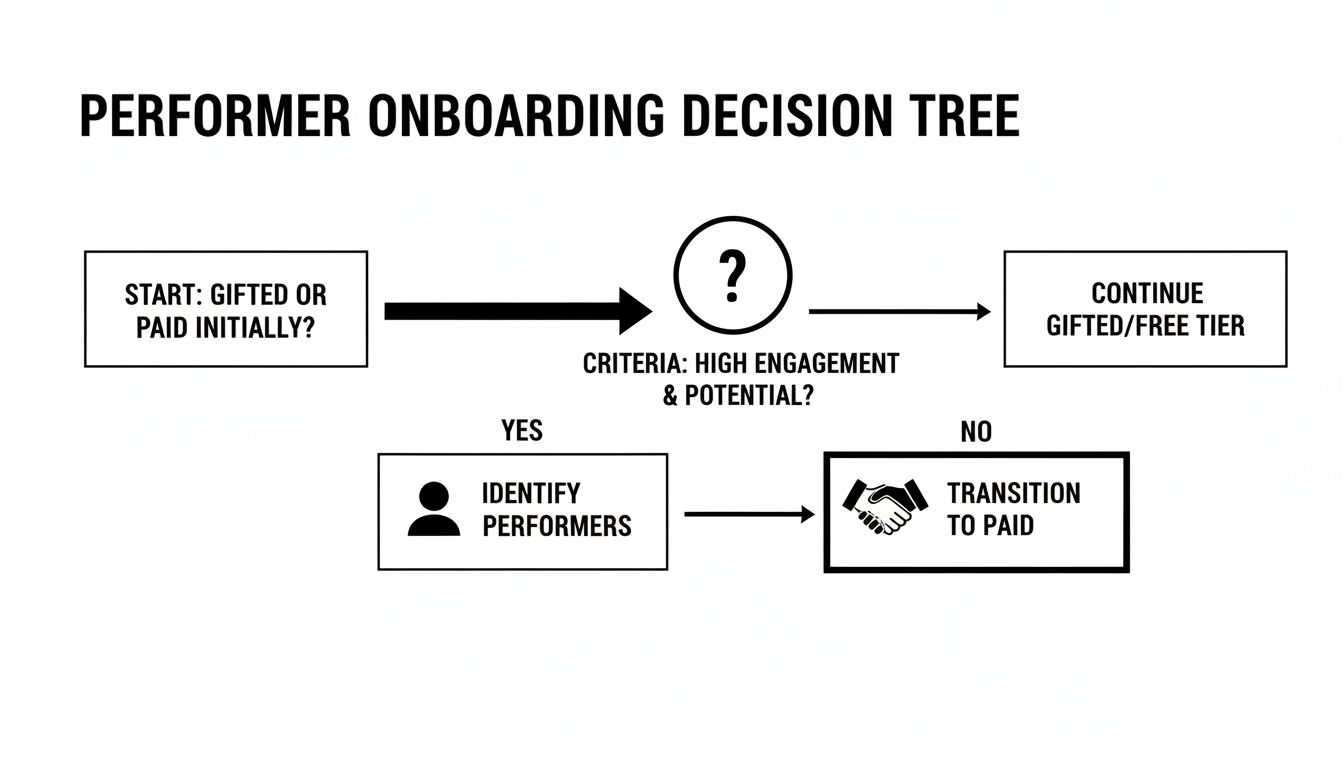
Think of it as a funnel. Use low-risk gifting at the top to discover creators who genuinely vibe with your brand. Once you find those gems, you can formalise the relationship with paid contracts to build a reliable and scalable influencer programme.
The Bottom Line: This isn't a one-time choice. The smartest brands I've worked with run a hybrid model. They use gifted campaigns for authentic discovery and community building, and they use paid partnerships to hit hard targets and drive predictable growth. By using each for what it’s best at, you turn influencer marketing into a sustainable, results-driven engine for your business.
Your Questions, Answered
Getting influencer partnerships right can feel like walking a tightrope. To help you find your balance, here are a few straightforward answers to the questions we hear most often from brands figuring out their strategy.
Can I Ask for Specific Content in a Gifted Campaign?
In short, not really. You can absolutely send over a friendly brief with some creative ideas and key points about your product, but you can't lock a creator into a contract for a gifted exchange. There are no mandatory deliverables, posting times, or specific messages.
The whole point of gifting is to see if they genuinely love your product enough to share it. If you need guaranteed posts, total control over the creative, and specific call-to-actions, you need to be running a paid campaign. That's the only way to make it a formal agreement.
What Influencer Size Is Best for Paid Campaigns?
This completely comes down to what you're trying to achieve.
Chasing massive brand awareness? Macro-influencers (100k+ followers) offer huge reach, but they come with a hefty price tag and sometimes lower engagement.
Looking for targeted sales and a stronger return on investment? Nano (1k-10k) and micro-influencers (10k-100k) are often the answer. They tend to have incredibly engaged communities that trust their recommendations, making them a cost-effective choice for hitting niche audiences. Most brands find their sweet spot with micro-influencers, striking a great balance between solid reach and measurable results.
How Do I Transition a Gifted Partnership to a Paid One?
This is a great position to be in. When a gifted collaboration goes well, it’s the perfect time to build a longer-term relationship.
Simply reach out to the creator directly. Tell them how much you loved the content they made and that you'd like to formalise the partnership. From there, you can propose a paid agreement for a set number of posts or a longer-term ambassadorship. Be sure to clearly outline the compensation, deliverables, and usage rights to turn it into a reliable and scalable marketing channel for your brand.
Ready to turn influencer marketing into a measurable growth engine? Sup combines AI and a human team to source creators, manage campaigns, and track ROI in real-time. Book a demo to see how Sup can save you 95% of your time.
More on relationships
See how many creators post about you and your competitors
Type in your brand's Instagram handle and we count the creators who post about you and about your five closest competitors. It takes about a minute and it is free. Or request a demo and we will show you the creators in your niche and walk you through the dashboard.
 Book a call