26 February 2026
Influencer Marketing ROI: How to Measure What Actually Works in 2026
Measuring the ROI of your influencer marketing isn't about counting likes and comments. It's about meticulously tracking the conversions, sales, and leads that come directly from your creator campaigns.
Real success is calculated by drawing a straight line from an influencer's post (using tools like unique discount codes or tracked links) to a tangible business outcome. When you do this, influencer marketing stops being a hopeful expense and becomes a predictable, performance-driven growth engine for your brand.
Moving Beyond Vanity Metrics
It’s tempting to get swept up in the excitement of a viral post. The likes flood in, the follower count ticks up, and the comments section is buzzing. But these are what we call vanity metrics.
While they might give you a nice little dopamine hit, they don't tell you if that buzz is actually making the tills ring. True influencer marketing ROI isn’t measured in hearts and shares; it’s measured in pounds and pence.
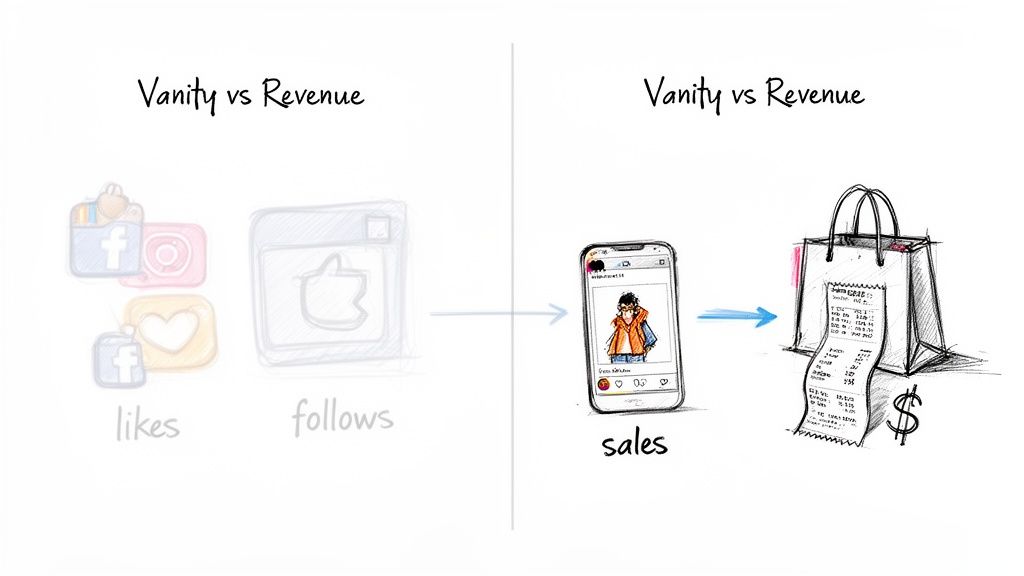
Relying only on engagement is a flawed strategy because it's built on guesswork. I've seen posts with 10,000 likes generate precisely zero sales, while a much smaller, targeted post from a nano-influencer drove dozens of highly qualified leads. The key is forging a clear, undeniable link between an influencer’s content and a customer’s action.
The critical shift for any brand is moving from "How many people saw it?" to "How many people acted on it?". That's where real ROI measurement begins. Without attribution, you're just paying for visibility, not for growth.
The Power of Attribution
Attribution is the bridge connecting an influencer’s content to your business goals. It’s simply the practice of giving credit where credit is due, to the marketing touchpoints that convinced a customer to convert. For influencer campaigns, this means putting simple but powerful tracking mechanisms in place.
Think of it like this: without attribution, you’re throwing a party and just hoping the right people show up. With attribution, you're sending out personalised invitations and checking each one at the door. You know exactly who came from where.
Here are the foundational tools for building that bridge:
- Unique Promo Codes: This is the classic, and for good reason. Assigning a distinct discount code like "CREATOR15" to each influencer is the simplest way to track sales. When a customer uses that code at checkout, you know precisely which creator sent them your way.
- UTM Links: Urchin Tracking Modules (UTMs) are just little tags you add to the end of a URL. When an influencer shares their unique link, your analytics platform can tell you exactly how many clicks, sign-ups, or sales came from their specific post.
By putting these tools to work, you completely change the conversation. You’re no longer just talking about reach; you’re talking about revenue. This data-first approach lets you see with total clarity which partnerships are genuinely profitable and which ones might need another look.
While many brands are drawn to creators with massive followings, it's often the smaller ones that pack the biggest punch. You can learn more about why nano-influencer marketing often drives bigger ROI and how to measure it effectively.
Setting Goals and KPIs That Actually Matter
Before we even get into the nuts and bolts of ROI, we need to ask a brutally honest question: what does a 'win' actually look like for your business? A successful campaign for a new restaurant in Manchester is going to look completely different from one for a national skincare brand. If you don't define what success means from the outset, you’re just measuring noise.
So, where do you start? The simplest way I've found to organise my thinking is around the classic marketing funnel. Are you trying to get new eyeballs on your brand at the top, or are you pushing for sales at the bottom? Both are perfectly valid goals, but they demand completely different ways of measuring success.
This is where I see a lot of brands stumble. They'll say their goal is "growth," but that's far too vague. You've got to be specific. This is the foundation for building an accountable, results-driven influencer strategy.
Top-Funnel vs. Bottom-Funnel Goals: What's the Difference?
Let’s get practical and break down the two main types of campaign objectives. Nailing this distinction is everything when it comes to picking the right metrics and, ultimately, proving your influencer programme is worth the investment.
Top-of-Funnel Goals (All About Awareness and Reach) These campaigns are about introducing your brand to people who’ve likely never heard of you. The immediate goal isn't a sale; it's about planting a seed and building that initial brand recognition.
Think of it as casting a wide net. You're simply trying to capture attention and earn a spot in your potential customer's mind for later.
For these awareness campaigns, you’ll want to keep a close eye on:
- Impressions: The total number of times your content was seen.
- Reach: How many unique people actually saw the content.
- Video Views: A simple count of how many times a video was played (often using benchmarks like 3-second views).
- Brand Mentions: The volume of conversation around your brand, including untagged mentions.
- Follower Growth: A straightforward lift in your brand’s social followers during the campaign.
Bottom-of-Funnel Goals (Driving Conversions and Sales) Right, this is where the rubber meets the road. These campaigns are directly tied to actions that hit your bottom line. Here, success is measured in cold, hard cash.
This is the sharp end of the spear, aimed squarely at driving revenue or generating qualified leads. In the UK, influencer marketing is seriously delivering, with an average ROI of £5.78 for every £1 spent. This makes it a top-tier channel for any business chasing measurable growth. You can explore more UK influencer marketing statistics to get the full picture.
KPIs for conversion-focused campaigns are much more direct and financial:
- Conversion Rate: The percentage of people who bought something (or took another desired action) after clicking an influencer's link.
- Sales Revenue: The total value of sales generated from a unique promo code or affiliate link.
- Cost Per Acquisition (CPA): How much it cost you to get one new customer through that campaign.
- Average Order Value (AOV): The average basket size for customers coming from an influencer referral.
- Lead Form Submissions: For B2B or service businesses, this is a count of how many people filled out a contact or demo request form.
The real magic happens when you blend both. I've found the most effective strategies often use larger creators for that big, top-funnel splash, while partnering with micro-influencers for super-targeted, high-conversion campaigns. The trick is to assign the right KPIs to the right objective.
Matching Campaign Goals to The Right KPIs
This is the crucial part. If you judge an awareness campaign on sales figures, you'll wrongly assume it failed. On the flip side, if you only look at likes for a direct-response campaign, you’re missing the entire point.
To make this crystal clear, I've put together a table that shows exactly how to align your goals with the right KPIs, complete with real-world scenarios you might find yourself in.
| Matching Campaign Goals to The Right KPIs | ||
|---|---|---|
| Campaign Goal | Primary KPIs to Track | Example Scenario |
| Brand Awareness | Impressions, Reach, Engagement Rate, Brand Mentions | A new beverage brand wants to get its name out there in the UK market. They partner with lifestyle influencers to create content showing the drink in everyday situations. |
| Direct Sales | Conversion Rate, Sales Revenue, Average Order Value (AOV), ROAS | A direct-to-consumer fashion brand gives unique 15% discount codes to TikTok creators for a new clothing line launch, tracking every sale from each code. |
| Lead Generation | Cost Per Lead (CPL), Form Submissions, Demo Requests | A B2B software company works with industry experts on LinkedIn to promote a new whitepaper, tracking every download behind a lead-capture form using UTM links. |
| Driving Footfall | Code Redemptions, Geo-tagged Mentions, Bookings | A local restaurant invites food bloggers for a tasting event. They offer a special dish that can only be claimed by mentioning the influencer’s name when booking. |
By defining your goal first, you create a clear framework for success. This isn't about guesswork; it's about a deliberate approach that turns your influencer marketing from a "nice-to-have" into a core part of your growth engine.
Building Your Measurement and Attribution Toolkit
Once your goals are locked in, it’s time to get your hands dirty with the technical setup. This is where you build the toolkit that makes measuring influencer ROI actually possible. Forget fancy, expensive software for a moment; accurate tracking is all about a solid foundation that catches every click, code, and conversion. Without it, you're just guessing, and guesswork won't build a predictable growth engine for your business.
Think of yourself as a detective. To crack a case, you need fingerprints, witnesses, and a clear timeline. In marketing, your tracking tools are your evidence. They provide the undeniable proof linking an influencer’s effort to a genuine business result, turning your programme from a cost centre into a revenue driver.
The process is simpler than you might think: define your goal, pick the right KPIs to track, and then you can measure the ROI.
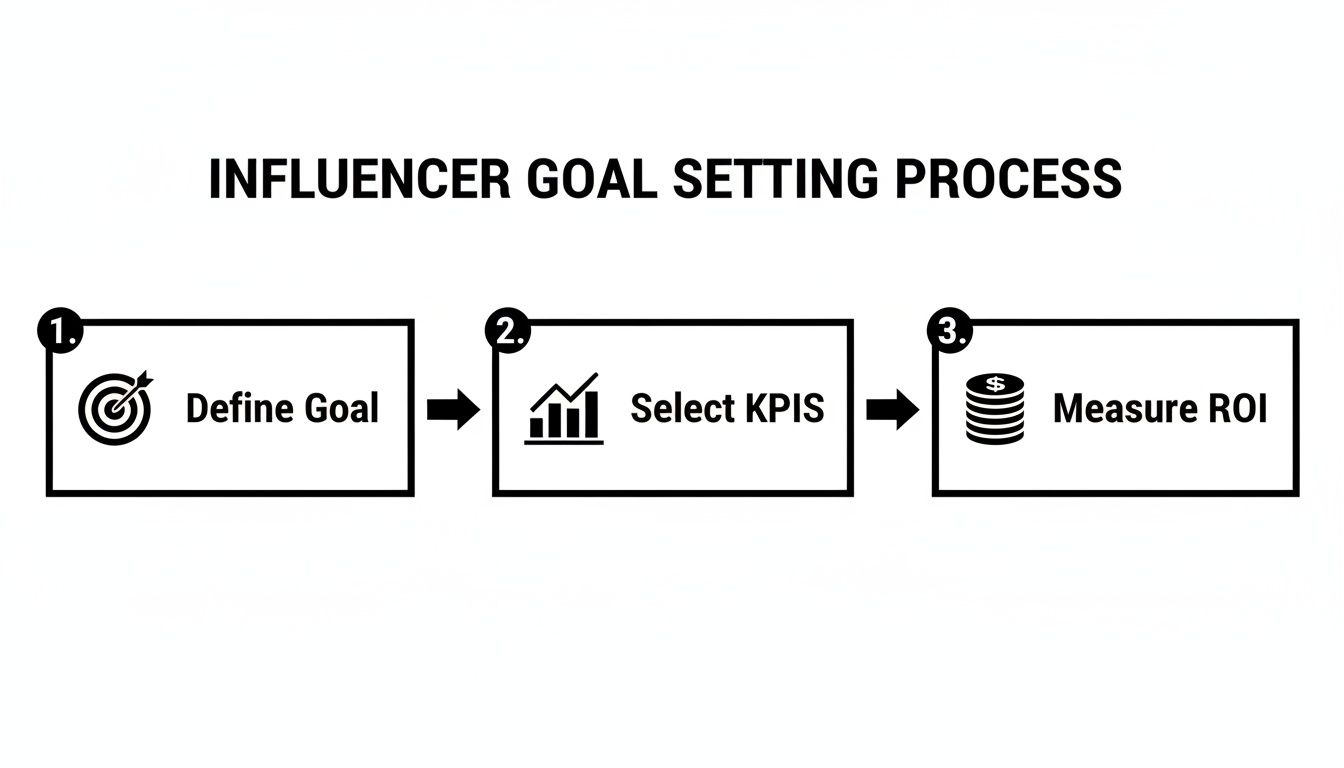
This flow really highlights that tools come second. First, you need a clear goal, which tells you which KPIs matter, which then allows you to calculate the final ROI.
Mastering UTM Parameters for Crystal-Clear Analytics
Urchin Tracking Modules, better known as UTM parameters, are the absolute bedrock of digital attribution. They’re just simple tags you add to the end of a URL that tell analytics platforms like Google Analytics exactly where your traffic is coming from. When an influencer shares their unique link, these tags get to work sorting and labelling every single visitor.
A standard UTM link is made up of a few key parts:
- Source (utm_source): This is the platform, like instagram or tiktok.
- Medium (utm_medium): This defines the marketing channel, such as social or influencer.
- Campaign (utm_campaign): Give your campaign a clear name, for instance, spring_launch_2026.
- Content (utm_content): This is brilliant for telling different links apart within the same campaign. I often use the influencer’s handle here, like creator_name, so I can see performance person by person.
Creating these links isn’t complicated. You can use tools like Google’s Campaign URL Builder to generate properly tagged links in seconds, avoiding any manual errors.
The Undeniable Power of Unique Discount Codes
While UTMs are great for tracking clicks, unique discount codes track the final purchase with absolute certainty. For e-commerce brands, this is often the simplest and most powerful tool in the box. By giving one creator a code like “SARAH15” and another “DAVID15”, you create a direct, undeniable line to a sale.
Every time a code is used at checkout, your e-commerce platform logs it. There’s no ambiguity. You know exactly which influencer drove that sale, which makes calculating their direct revenue impact a piece of cake. This is absolutely fundamental if you want to build a performance-based programme. To learn more, check out our complete guide to influencer marketing for ecommerce and see how top brands put this tactic to work.
Pro Tip: Don't choose between UTMs and discount codes. Use both. A customer might click a UTM link to browse your site, but come back a day later to buy using the code they remembered. Tracking both gives you the full story, from initial discovery right through to the final conversion.
Going Beyond the Click with Conversion Pixels
So, what happens when someone clicks an influencer’s link but doesn't buy straight away? This is where conversion pixels (those little snippets of code from platforms like Meta or TikTok) become incredibly useful. You place them on your website, and they track what users do after they’ve left the social media platform.
This lets you measure a lot more than just sales. You can track all sorts of valuable actions:
- Adding an item to the basket
- Starting the checkout process
- Signing up for your newsletter
- Looking at specific product pages
This data is pure gold. It doesn't just help you understand the full value of an influencer's traffic; it also allows you to build powerful retargeting audiences. Imagine serving follow-up ads specifically to people who visited from an influencer's link but didn't convert. It’s a sure-fire way to boost your overall campaign ROI.
Tying It All Together with a Real-World Scenario
Let's say a local coffee shop in Brighton partners with a food blogger. Measuring ROI in a physical shop might seem tough, but with the right setup, it’s completely manageable.
First, the shop creates a unique QR code for a small sign on their tables, which will only be displayed during the week of the influencer's promotion. This QR code links to a special menu page with a UTM-tagged URL. When customers scan it, the shop’s Google Analytics registers a visit from that specific campaign. Simple.
For an even clearer link to sales, the influencer could give their followers a unique phrase to say at the counter, like "Latte Art Special," to get a free pastry with their coffee. The baristas just need to keep a tally of how many times they hear the phrase. At the end of the week, the owner knows exactly how many clicks their site got and how many people redeemed the offer: a simple, effective, and cheap way to measure real-world attribution.
How to Calculate Your Influencer ROI
You've defined your goals and your tracking is live. Now comes the moment of truth: running the numbers. Calculating your influencer marketing ROI isn't just about ticking a box at the end of a campaign; it's what proves the value of your efforts, justifies the budget, and sharpens your strategy for next time. It’s how a creative idea becomes a measurable business driver.
At its heart, the formula is refreshingly simple.
The Classic ROI Formula: (Return - Investment) / Investment * 100% = Influencer Marketing ROI
So, if you spent £2,000 on a campaign that brought in £10,000 in revenue, you’d be looking at a healthy 400% ROI. The maths is easy. The real skill is in accurately defining what goes into the 'Return' and 'Investment' buckets.
Tallying Up Your Total Investment
To get a true picture of your ROI, you have to look far beyond just the influencer’s fee. Your 'Investment' is the total cost of getting the campaign out the door. If you miss anything here, you'll end up with an inflated ROI that looks great on paper but doesn't reflect reality.
Make sure your total investment accounts for everything:
- Creator Fees: The most obvious one: what you paid the influencer directly.
- Product Costs: The cost of goods sold (COGS) for any products you gifted.
- Shipping & Handling: The cost to get those products into the influencer's hands.
- Platform or Agency Fees: Any commissions or subscriptions you’re paying to manage your programme.
- Team Time: Don't forget this! Estimate the cost of your team's hours spent on everything from outreach to reporting. You can see how these costs stack up in our guide on how much influencer marketing costs for restaurants.
Add all of that up, and you’ve got the true 'I' for your ROI equation.
Calculating the Full Return
The 'Return' side is often more nuanced than just sales. While revenue is fantastic, your campaign generates value in many other ways. A complete calculation needs to recognise all the assets and outcomes you've gained.
Start with the clearest metric: direct revenue. This is the money you can directly attribute to an influencer's efforts, tracked cleanly through their unique discount codes and UTM links.
But the value doesn't stop there. What about the other assets you now own?
- Value of User-Generated Content (UGC): Think about what it would have cost to produce those high-quality photos or videos with a professional crew. This "replacement cost" is a real saving and a tangible part of your return.
- Lead Value: If you’re in B2B or a service-based industry, assign a monetary value to each new lead. You can figure this out based on your historical lead-to-customer conversion rate and your average customer value.
Once you have your KPIs and data in hand, you can get a truly accurate picture of your return. For a deeper dive into the mechanics, it's worth reading up on how to calculate return on investment.
Moving to More Advanced ROI Metrics
The classic ROI formula is a brilliant starting point, but advanced metrics will give you a much deeper understanding of your campaign’s long-term profitability. This is especially true for subscription businesses or any brand focused on customer loyalty.
Two of the most powerful metrics here are Customer Acquisition Cost (CAC) and Lifetime Value (LTV).
- Customer Acquisition Cost (CAC): Simply your total campaign investment divided by the number of new customers acquired. This tells you exactly how much you paid to bring each new person on board.
- Lifetime Value (LTV): This is the total revenue you can reasonably expect from a customer over their entire relationship with your brand.
A sustainable business model is one where LTV is significantly higher than CAC: a 3:1 ratio is a common benchmark to aim for. This proves you aren't just making one-off sales; you're acquiring valuable, long-term customers.
This focus on provable results is fast becoming the industry standard. In fact, UK brands are now shifting to performance-based pricing in 25% of influencer campaigns, demanding proof of sales or sign-ups before paying out. For marketers focused on ROI, this shift is a massive opportunity.
Creating Actionable Reports and Dashboards
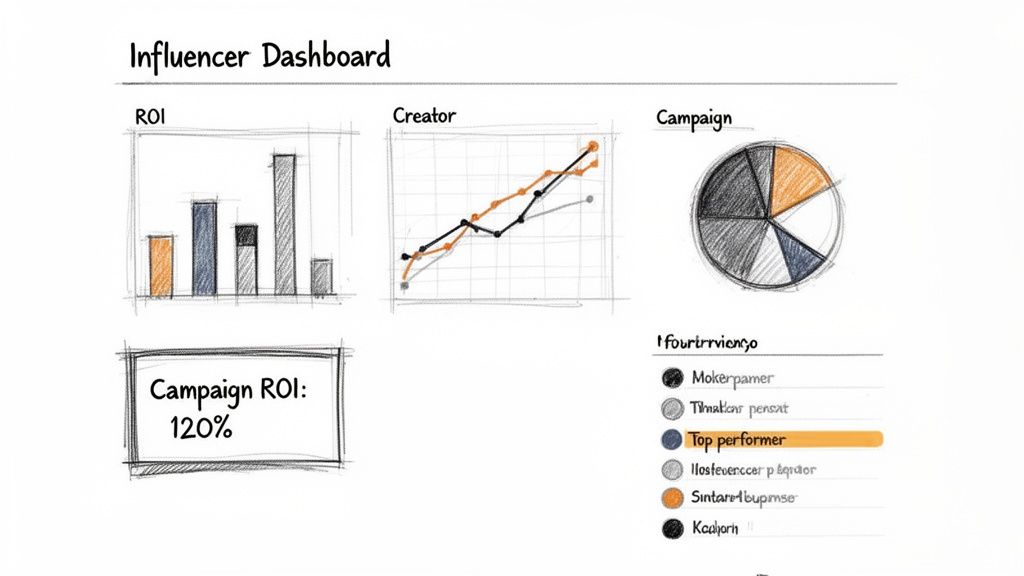
Calculating your influencer marketing ROI once is a great start. But building a system that tracks it continuously? That’s how you turn influencer marketing into a predictable, scalable growth channel.
The goal here is to get out of the weeds of static spreadsheets and one-off reports. You need a dynamic feedback loop where real data drives every single decision you make. This is where a solid dashboard comes into play. It transforms a mountain of raw data (clicks, promo code redemptions, sales figures) into a clear, compelling story. A well-built dashboard becomes your single source of truth, helping you spot what’s working (and what isn’t) at a glance.
Designing Your Influencer ROI Dashboard
You don’t need to invest in a hugely expensive business intelligence tool right away. A well-organised platform like Looker Studio or even a meticulously structured spreadsheet can be incredibly powerful. Honestly, the tool doesn't matter as much as the thinking behind it: the structure and the metrics you choose to display are what count.
Your dashboard should be built to answer your most critical questions instantly, without anyone needing to dig through multiple data sources. The whole point is to make performance obvious. If you're looking for inspiration, checking out a pre-built Influencer Marketing Dashboard can be a great way to see how the pros structure their reports.
The real magic happens when you create visualisations that compare performance across different variables. This comparative view is what sparks the insights that lead to smarter budget allocation and better campaigns.
Essential Metrics and Charts for Your Dashboard
A cluttered dashboard is just as useless as no dashboard at all. You have to prioritise clarity and focus only on the metrics that tie directly back to your campaign goals. Anything else is just noise.
Here are the components I consider non-negotiable for any effective influencer marketing dashboard:
- Overall Campaign ROI: This is your headline figure. Make it big, make it bold. It should be prominently displayed, showing the total return against your total investment for a given period.
- Performance by Creator: This is probably the most important part of the whole dashboard. A simple bar chart or table that ranks influencers by the metric you care about most, whether that’s revenue, new leads, or app installs.
- Cost Per Acquisition (CPA) per Influencer: This metric cuts right through the vanity metrics. Sure, an influencer driving £10,000 in sales looks great on paper, but not if it cost you £9,000 to get there. Comparing CPA reveals your most efficient partners, not just the biggest ones.
- Content Format Performance: Don't just track the creator; track the creative. This is where your diligent UTM setup pays off. By tagging different formats like Instagram Reels, Stories, or static posts, you can see what’s actually moving the needle. A simple pie chart might reveal that Reels drive 80% of your conversions. Now that’s an insight.
By visualising performance at this granular level, you move from broad assumptions to specific, actionable truths. You stop saying "influencer marketing works" and start saying, "Working with lifestyle creators in Manchester on TikTok Reels to promote our lunch special drives a 450% ROI."
Turning Insights into Actionable Next Steps
Look, a dashboard is only valuable if it drives action. Otherwise, it's just a pretty picture. The final, critical step is to establish a routine for reviewing your data and turning it into a concrete plan for what to do next.
Set up a brief, regular review of the dashboard: weekly or bi-weekly works for most teams. During this check-in, your goal is to answer a few simple but powerful questions based on what the data is telling you.
- Who are our top 3 performers? How can we double down on our investment with them? Can we find more creators just like them?
- Who are our bottom 3 performers? Do we pause these collaborations, or should we try a different brief or creative approach with them first?
- Which content format is killing it? How can we encourage more of this type of content across all our partnerships?
- Are there any surprises? Did a small, niche influencer massively outperform a celebrity? Did one discount code convert way better than another?
This systematic process transforms your dashboard from a passive report into an active strategy tool. It ensures your budget is always flowing towards the creators, content, and campaigns that deliver the best possible return, turning your programme into a well-oiled growth machine.
Frequently Asked Questions About Influencer ROI
Even with the best-laid plans, measuring influencer marketing ROI can throw a few curveballs your way. Let's dig into some of the most common questions that pop up, so you can build a measurement strategy that’s genuinely bulletproof.
How Do I Measure ROI for Awareness Campaigns?
This is a classic. When your goal is brand awareness, not direct sales, a promo code isn't going to tell you the whole story. What you’re looking for instead is the campaign's "echo": the ripple effect it has across the digital landscape.
A great place to start is by watching the lift in branded search queries. Pop your brand name into Google Trends and see if searches spike while the campaign is live. If more people are actively looking you up, it's a solid sign the influencer's message is landing.
Beyond that, you should be tracking a few other key indicators:
- Follower Growth: Is your audience on social media growing at a faster clip than usual?
- Brand Mentions: Keep an eye on the volume of conversations about your brand, both tagged and untagged.
- Earned Media Value (EMV): This metric puts a price on the campaign's reach and engagement, estimating what it would have cost to achieve the same results with traditional advertising.
If you want something more concrete, a simple brand lift survey (run before and after the campaign) can give you hard data on shifts in brand awareness, recall, and purchase intent.
What Is the Best Attribution Model to Use?
For most brands dipping their toes into influencer marketing, ‘Last Click’ attribution is the go-to. It’s clean, simple, and gives 100% of the credit for a sale to the very last link a customer clicked. Most analytics platforms handle this out of the box, which makes it easy to get started.
But its simplicity is also its biggest flaw. Last Click completely ignores the influencers who introduced a customer to your brand in the first place. It’s like only giving credit to the striker who scored the goal, ignoring the midfielder who made the crucial pass.
As your programme gets more sophisticated, you’ll want to move toward a ‘Multi-Touch’ model, like a Linear or Time Decay model. These do a much better job of distributing credit across multiple touchpoints, giving you a truer picture of which creators are driving discovery versus those who are closing the deal. My advice? Start with Last Click for simplicity, but always have a plan to evolve.
How Can I Quantify the Value of UGC?
Influencer-generated content (UGC) isn't just a nice-to-have; it's a tangible asset you can and should put a number on. I typically see this done in two ways.
First, think about its replacement cost. What would it have cost you to get that same set of high-quality photos and videos using a professional crew, models, and a studio? That figure represents an immediate cost saving, which directly boosts your campaign's ROI.
Think of it this way: if an influencer campaign costs you £1,000 but delivers content that would have set you back £1,500 to produce yourself, you're already £500 in the green before a single product is sold.
Second, track the performance of that UGC when you put it to work elsewhere. Repurpose it in your paid social ads or on your product pages. Then, compare its click-through and conversion rates against your standard, brand-created assets. Often, the uplift in performance, combined with the lower creative cost, delivers a massive ongoing return from that initial influencer investment.
What Should I Do if My ROI Is Negative?
First off, don't panic. A negative ROI isn't a failure. It's expensive, but incredibly valuable, feedback. It’s the data you need to stop guessing and start building a genuinely profitable strategy.
The first step is to diagnose the problem without emotion. Dive into the data. Was the negative return spread evenly across all influencers, or did one or two just not perform? Take a hard look at the creative itself. Was there a mismatch with the audience? Was the call-to-action buried or unclear? Maybe the offer just wasn't compelling enough.
Once you have a hypothesis, use it to run small-scale A/B tests. Tweak just one variable at a time (the creator, the offer, the content format) to isolate what actually moves the needle. And honestly, a negative ROI is often the clearest signal it's time to shift towards a performance-based payout, like a commission on sales, to de-risk your future campaigns.
Ready to turn influencer marketing into a predictable growth channel? With Sup, you get the AI-powered tools and expert support to launch, manage, and measure creator campaigns that drive real results. Stop the guesswork and start seeing a clear return on your investment.
More on tracking
See how many creators post about you and your competitors
Type in your brand's Instagram handle and we count the creators who post about you and about your five closest competitors. It takes about a minute and it is free. Or request a demo and we will show you the creators in your niche and walk you through the dashboard.
 Book a call