25 February 2026
Nano Influencer Marketing: Why Smaller Creators Drive Bigger ROI for Brands
Nano-influencer marketing drives bigger ROI because smaller creators offer unmatched authenticity, hyper-engaged niche communities, and cost-effective partnerships. Their recommendations feel like advice from a trusted friend, not a paid celebrity, leading to higher conversion rates and genuine brand loyalty.
For those still on the fence, here’s a quick breakdown of why nanos often come out on top for ROI.
Quick Answer: Why Nano Influencers Deliver Superior ROI
| Factor | Nano Influencers (1k-10k Followers) | Macro/Mega Influencers (100k+ Followers) |
|---|---|---|
| Audience Trust | High. Perceived as peers or friends. Recommendations feel genuine and personal. | Lower. Audiences are aware of large sponsorship deals, leading to more scepticism. |
| Engagement Rate | Highest of all tiers. Direct interaction in comments and DMs is common. | Lowest of all tiers. Engagement is often passive (likes) rather than conversational. |
| Niche Authority | Extremely high. Deep expertise and passion for specific topics (e.g., vegan skincare, vintage film cameras). | Broad. Often cover general lifestyle topics, lacking deep specialisation. |
| Cost-Effectiveness | Very high. Lower fees allow brands to partner with many creators for the same budget as one macro. | Low. Can command fees from thousands to hundreds of thousands of pounds per post. |
| Conversion Impact | Strong. Trust and relevance lead to higher purchase intent and direct sales. | Variable. Drives awareness but can struggle to convert due to lack of authenticity. |
In short, the trade-off is clear: with nano influencers, you're swapping mass, often passive, reach for deep, active, and trusted influence. This is the key to unlocking real return on your investment.
The Power Shift in Influencer Marketing
The old marketing playbook is officially out of date. For years, the prevailing wisdom was "bigger is always better," but when it comes to creator collaborations, that’s simply no longer true. The smartest brands are now turning to their secret weapon: nano influencers. These are the everyday content creators with smaller, but incredibly dedicated, communities.
This isn’t just some passing trend. It's a fundamental shift in how people connect with brands, driven by a widespread fatigue with overly polished and transactional advertising. Audiences are tired of celebrity endorsements that feel impersonal and staged. What they really want are genuine recommendations from people they see as one of them.
Think of it this way. Imagine you’re planning a trip. Would you rather get a tip from a global celebrity who dropped into a city for a quick photoshoot, or from a local who lives and breathes its culture? The local’s advice will always feel more trustworthy and useful. Nano influencers are the digital version of that trusted local guide.
From Mass Reach to Meaningful Connection
The real magic of working with nano influencers lies in building authentic connections that actually drive business results. While a mega-influencer can offer massive visibility, their message often gets diluted or lost in the noise. Nano creators, on the other hand, speak directly to tight-knit communities where their voice carries immense weight.
This dynamic is already reshaping marketing budgets. The UK influencer marketing industry is on an explosive growth trajectory, projected to leap from £3.1 billion in 2025 to a staggering £28.3 billion by 2034. A key engine behind this growth is the simple fact that smaller creators deliver better returns. In fact, a recent study showed that 44% of UK brands now actively choose nano-influencers precisely because they generate a higher ROI. You can explore the full market analysis on the growth of UK influencer marketing to see just how quickly this space is evolving.
The core principle is simple: influence is no longer just about the size of an audience, but the strength of the connection with it. A recommendation from a trusted source, no matter how small their following, is far more potent than a sponsored post from a disconnected celebrity.
This move toward authenticity is creating incredible opportunities. By partnering with nano influencers, companies of all sizes can tap into laser-focused, highly engaged audiences and build the kind of brand advocacy that feels earned, not bought. It's a strategy that pays off with both immediate sales and long-term customer loyalty.
How Niche Communities Drive Real Conversions
The real magic of nano-influencer marketing isn't about reach; it's about relevance. While a macro-influencer might shout to a massive, sprawling crowd, a nano-influencer is having an intimate conversation with a small, dedicated group. This completely changes the dynamic, making a recommendation feel less like an ad and more like a tip from a trusted friend.
Think of it like this: you could broadcast a message in a giant stadium, or you could bring it up at a local book club. The stadium has more people, sure, but where do you think the real, meaningful discussions happen? The book club is where opinions are shared, trust is built, and people actually decide to buy the book. Nano-influencers are the enthusiastic leaders of these digital book clubs.
This closeness is what fuels genuine engagement. Followers don't see them as distant celebrities, but as peers who are just as passionate about a specific niche, whether that's vegan skincare in Bristol or independent coffee shops in Glasgow. That shared identity creates a level of trust that someone with millions of followers simply can't replicate.
The Data Behind the Dialogue
This feeling of trust and high engagement isn't just an abstract concept. It’s a measurable advantage. There's a well-documented pattern in influencer marketing: as a creator's follower count goes up, their engagement rate tends to go down. The bigger the audience, the lower the percentage of people who actively like, comment, and share.
A nano-influencer’s value isn't their follower count, but the depth of their connection to that audience. A thousand engaged followers who trust a creator's opinion are far more valuable than a million passive viewers.
This is precisely why working with nano-influencers can deliver such a strong return on investment. You're not just paying for eyeballs; you're investing in authentic advocacy that leads directly to action, from clicks on your website to customers walking through your door.
The chart below shows just how much the UK influencer market is set to grow, a boom largely fuelled by the incredible returns that smaller, highly effective creators deliver.
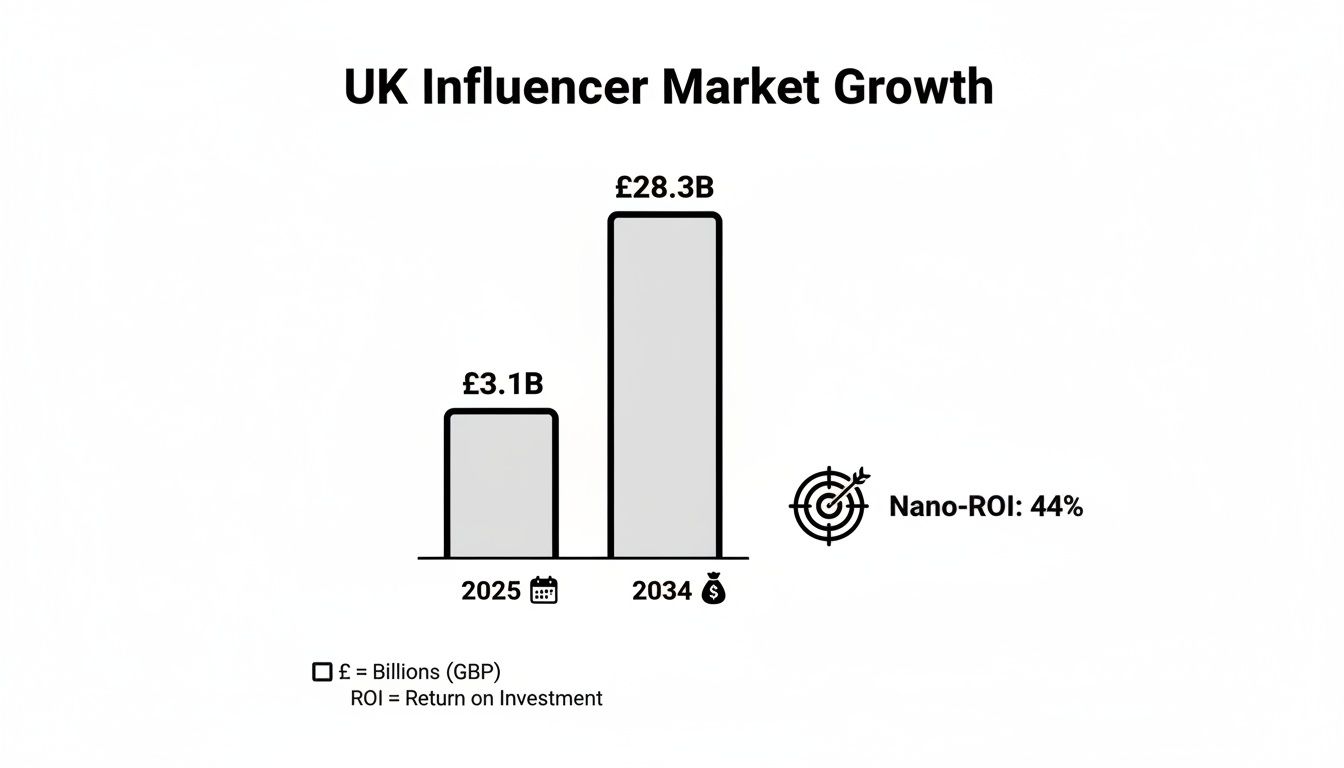
It’s clear from the data that brands are pouring more money into influencer marketing, and they're doing it because creators who offer a high ROI, like nanos, are central to this expansion.
Platform Performance and Niche Power
This engagement gap becomes even more stark when you look at different social media platforms. Nano-influencers consistently outperform bigger names across the board, but their power is especially obvious on platforms like TikTok and Instagram, where niche communities truly thrive. Their content feels real and fits in perfectly, which is exactly what the algorithms are designed to promote.
The numbers speak for themselves. In the UK, nano-influencers hit average engagement rates between 6-9%, easily beating the 3-5% managed by micro-influencers. For even bigger creators, the rate is lower still. On TikTok, that figure can jump to an incredible 15.2%. And on Instagram, where a staggering 76% of all influencers are nanos, they maintain a solid 6.23% engagement rate. This gives brands an amazing pool of talent to find partners who are a perfect fit.
But high engagement isn't just a vanity metric. It's a clear sign that an audience is paying attention, building trust, and is ready to take action. This is a game-changer for local businesses. A recommendation from a local food blogger can drive restaurant bookings and footfall in a way a national celebrity endorsement never could. To learn more about this, take a look at our guide on influencer marketing for restaurants.
At the end of the day, nano-influencers don't just get attention; they inspire action. And that’s the real measure of marketing success.
The Authenticity Advantage That Boosts Your Bottom Line
Let's be honest: authenticity isn't just another marketing buzzword. It's the very foundation of trust with today's consumers. Shoppers, particularly here in the UK, have a finely tuned radar for sponsored content that feels a bit... off. They're increasingly switching off from slick celebrity endorsements and looking for recommendations from people they can actually relate to.
This is exactly where nano-influencers have their superpower. They aren't distant, untouchable figures; they're everyday people. That means their recommendations land with the same weight as a tip from a trusted friend, making their content feel less like an ad and more like a genuine, helpful suggestion.

When a nano-influencer talks about a product, it’s usually because they genuinely use and believe in it. That kind of passion resonates deeply with their small, tight-knit communities, and this unbiased perception is what really drives people to make a purchase.
Turning Trust Into Tangible Returns
The trust these creators cultivate isn't just a fluffy concept; it translates directly into hard business results. For brands, this "authenticity advantage" isn't about creating warm, fuzzy feelings. It's about driving real revenue and attracting better customers. When a follower sees a recommendation from a source they see as truly authentic, they're far more likely to act on it.
The data from the UK market backs this up completely. Authenticity has shot to the top of the list for brands, with 47% of UK marketers now saying it's their number one priority when choosing creators. This shift gives nano-influencers a massive edge, as they are widely seen as more genuine than their macro counterparts.
And the results speak for themselves. An overwhelming 83% of UK brands say influencer marketing works, and 82% report that it generates the highest-quality leads compared to any other channel. With half of all British consumers making purchases based on influencer posts, the commercial impact is impossible to ignore. You can see more UK influencer marketing statistics to get a fuller picture of just how significant this is.
The bottom line is simple: Authentic influence drives higher conversion rates. A follower who trusts the creator is more likely to click, explore, and ultimately buy, leading to a much stronger ROI for the brand.
Case Study: How Authenticity Drove Sales for a Local Coffee Brand
Take "Grind & Co.," a small-batch coffee roaster in Manchester that wanted to grow its online sales and get more people through the door. Instead of blowing their budget on one big-name influencer, they worked with 15 local nano-influencers: students, office workers, and foodies who were already passionate about great coffee. Each creator got a free subscription and a unique discount code to share with their followers.
The results were fantastic and show how this approach builds value both now and for the future:
- Immediate Revenue Lift: In the first month alone, the discount codes brought in over 200 new online subscriptions, all directly tied back to the nano-influencers.
- Increased Footfall: Several creators posted about visiting the roastery's café, leading to a noticeable 15% bump in weekend customers who mentioned seeing the posts on Instagram.
- Rich Content Library: The brand ended up with a collection of over 50 pieces of high-quality, authentic user-generated content (UGC) that felt natural and unscripted.
- Long-Term Loyalty: By building real relationships, Grind & Co. turned these creators into genuine brand advocates who kept posting organically long after the paid campaign was over.
This case is a perfect example of how a nano-influencer strategy built on authentic connections directly boosts the bottom line. It proves that focusing on trust and relatability isn't just good for your brand image. It's fantastic for business.
Building Your First Nano-Influencer Campaign
Alright, let's move from theory to practice. This is where you'll see the real power of nano-influencer marketing unfold. Launching your first campaign might seem like a huge task, but if you break it down with a clear, structured approach, it’s not only manageable but can become a massive growth driver for your brand.
It all starts by getting specific. Before you even think about which creators to contact, you need to know exactly what you’re trying to achieve.
Are you looking to fill your social feeds with authentic, real-world content from actual customers? Do you need to shift units of a new product, and fast? Or perhaps you’re trying to get more people through the doors of your physical shop or restaurant?
Each of these goals will completely change how you build your campaign, from the creators you pick to how you track success. A campaign designed to generate user-generated content (UGC) will need to give creators plenty of creative freedom. On the other hand, one focused on sales is going to lean heavily on things like unique promo codes for solid tracking.
Defining Your Campaign Objectives
Setting clear goals is the foundation of any marketing effort that actually works. Without a finish line, you have no way of knowing if you got a good return on your investment or how to improve next time. For your first go, just pick one or two main objectives to focus on.
Here are a few common goals that work brilliantly with nano-influencers:
- Boost Brand Awareness: Get your brand in front of new, highly targeted niche audiences who are genuinely interested in what you offer.
- Generate High-Quality UGC: Collect a bank of authentic photos and videos that you can then repurpose everywhere: in your social media ads, on your website, and in your emails.
- Drive Website Traffic and Clicks: Send followers to a specific landing page, blog post, or product page using tracked links to see what's working.
- Increase Sales and Conversions: Encourage immediate purchases by combining compelling content with exclusive discount codes for each creator.
- Promote a Physical Location: Get local influencers to share their experience and drive footfall to your café, restaurant, or shop.
Once you’ve settled on a goal, you can build the entire campaign around it. For instance, if driving sales is your number one priority, your call to action will be crystal clear: a unique promo code. If it’s all about awareness, you’ll be paying more attention to metrics like reach and engagement.
Finding and Vetting the Right Creators
With your objectives locked in, it's time to find the right people to bring your campaign to life. Honestly, this is the most critical part of the whole process. The perfect creator isn't just someone with a certain follower count; they're a real fan whose personal style and audience are a natural fit for your brand.
You could start by doing it all manually. This means diving into hashtags, location tags, and seeing who your competitors have been tagged by on platforms like Instagram and TikTok. It definitely takes time, but it can be a great way to find those hyper-local or super-niche creators. If you're hunting for local talent, our guide on how to find local food influencers in your city has some fantastic pointers to get you started.
But let's be realistic: as you grow, searching manually just isn't going to cut it. That's where a good platform can completely change the game.
The best nano-influencer partnerships feel less like a business deal and more like a true collaboration. Always prioritise creators who show genuine excitement for your brand: that passion is something their audience will pick up on immediately.
Modern platforms are built to take the guesswork and endless admin out of finding creators. They use smart search filters and data to help you pinpoint and vet people who are a perfect match for your goals, your niche, and even your specific location.
The screenshot below gives you a glimpse of how a platform like Sup makes this so much simpler, letting you find vetted creators who are ready to collaborate.
This streamlined approach means you can spend less time scrolling and more time actually building relationships. Once you've got a shortlist, reach out with a personalised message. Show them you’ve actually looked at their content and explain why you think they'd be a great partner. That personal touch goes a very long way in creating the strong, authentic partnerships that make nano-influencer marketing so incredibly effective.
Measuring What Matters in Your Nano Campaigns

Proving the value of any marketing activity is crucial, but with influencer collaborations, it can often feel like you’re chasing shadows. High engagement is great, but how does it actually connect to your business goals? To truly understand the power of nano-influencers, you need to look past vanity metrics like likes and views and focus on what genuinely grows your bottom line.
The real goal is to draw a straight line from a creator’s post to a tangible result, whether that’s a click, a sale, or a new lead. This is where a solid tracking system becomes your most important tool. By building a clear attribution model from day one, you transform your influencer programme from a creative experiment into a predictable and measurable growth engine.
The secret is to give every single creator their own unique tracking assets. It’s not as complicated as it sounds, and it's the only way to know with certainty who is driving what.
Building Your Attribution Toolkit
To accurately measure the impact of your nano-influencer campaigns, you need to equip each creator with tools that tie their content directly to customer actions. This simple setup removes all the guesswork and gives you crystal-clear data on performance.
Your two most critical tools are:
- Unique Promo Codes: Assign a distinct discount code to every influencer (e.g., "SARAH15," "TOM10"). This is the easiest and most direct way to track sales and calculate the revenue generated by each partner.
- UTM Links: Use UTM parameters to create trackable URLs for each creator. This lets you see exactly how much website traffic they send, which pages their followers visit, and which links lead to conversions in your analytics.
By implementing both, you get a complete picture of the customer journey, from the initial tap on an Instagram Story to the final purchase on your site. This level of detail is fundamental for calculating your true financial return. For a deeper understanding of how to discover ROI on influencer marketing and maximise your returns, it's worth exploring the proven tactics outlined by industry experts.
Essential Metrics for Measuring Nano-Influencer ROI
Tracking the right KPIs is the difference between guessing and knowing. This table breaks down the essential metrics you should be monitoring to prove the real-world value of your nano-influencer collaborations.
| Metric | What It Measures | How to Track It | Why It Matters for ROI |
|---|---|---|---|
| Promo Code Redemptions | The number of direct sales attributed to an influencer. | Assign a unique code to each creator and track uses in your e-commerce platform. | This is the most direct measure of revenue generated, making ROI calculation straightforward. |
| UTM Link Clicks | The volume of website traffic driven by an influencer’s content. | Google Analytics or your website's analytics platform. | Shows the creator’s ability to drive interest and consideration, even if it doesn't lead to an immediate sale. |
| Conversion Rate (from Clicks) | The percentage of link clicks that result in a desired action (e.g., sale, sign-up). | Track goals/conversions from UTM-tagged traffic in your analytics platform. | Highlights the quality of the traffic a creator sends. High conversions mean a highly relevant audience. |
| Cost Per Acquisition (CPA) | How much it costs to acquire a new customer through a specific influencer. | (Total cost of collaboration) / (Number of new customers acquired). | A core efficiency metric. Lower CPA means a higher return on your investment for that partnership. |
| Engagement Rate | The percentage of an influencer's audience that interacts with their content. | (Likes + Comments + Shares) / (Follower Count) x 100. | While a softer metric, it indicates audience health and authenticity, which correlates with trust and influence. |
By focusing on these concrete metrics, you move the conversation from "Did people like the post?" to "How much value did this partnership create for the business?".
Moving Beyond Spreadsheets
When you’re only working with a handful of creators, tracking these codes and links in a spreadsheet might seem manageable. But as you scale your nano-influencer programme to dozens or even hundreds of partners, that manual approach quickly descends into chaos.
This is where a centralised dashboard becomes non-negotiable. Imagine having a single, real-time view of your entire campaign, where you can see every piece of content, every click, and every sale, all tied back to the specific creator who generated it. This is exactly what modern influencer marketing platforms are built for.
A centralised attribution dashboard takes the chaos out of campaign management. It provides irrefutable proof of what's working and what isn't, enabling you to confidently report on ROI and make smarter decisions about where to invest your budget.
With a dedicated platform, all the crucial data is automatically pulled into one place. You can instantly see which creators are your top performers, which types of content are resonating most, and what your overall return on investment looks like at a glance. This allows you to double down on successful partnerships and refine your strategy without drowning in hours of data entry. To learn more about how this applies to online stores, check out our complete 2026 guide on influencer marketing for ecommerce.
This data-driven approach is what separates good influencer programmes from great ones. It empowers you to prove the value of your work and scale your success with real confidence.
How to Scale Your Success with Nano-Influencers
Working with one or two nano-influencers is simple enough. But what about 50? Or even 200? The real test isn't finding that one perfect creator; it's figuring out how to manage dozens of collaborations at once without drowning in a sea of spreadsheets, DMs, and follow-up emails.
Let's be clear: scaling isn't about working harder, it's about working smarter. It means moving away from those manual, one-by-one tasks and adopting a more systemised, automated approach. Trying to run a large programme by hand is a fast track to burnout and missed opportunities. The secret is putting workflows and tools in place to do the heavy lifting for you.
This frees up your team from mind-numbing admin so they can focus on what actually moves the needle: building genuine relationships and tweaking your campaign strategy for the best possible ROI. Get the right systems in place, and you could cut down your administrative work by as much as 95%.
Automating Your Workflow from Outreach to Reporting
To scale effectively, you need to standardise and automate every part of the campaign journey you possibly can. It’s about creating a repeatable blueprint that you can use for every new creator, which ensures everything runs smoothly and consistently.
A solid workflow for a scaled-up nano-influencer programme should cover:
- Automated Outreach: Use smart templates for your initial messages. You can use personalisation tokens to keep that human feel, ensuring every creator gets a professional and consistent first impression.
- Centralised Communication: Get those conversations out of scattered Instagram DMs and into one organised hub. This stops vital messages from getting lost and gives you a clear, searchable record of every interaction.
- Streamlined Onboarding: Build a simple, standard process for new creators to join a campaign. This is where they’ll accept your terms and get their unique tracking links and discount codes without any fuss.
- Real-Time Reporting: Set up a dashboard that automatically pulls in performance data: clicks, conversions, content posted, and so on. This completely removes the need for manual data entry and gives you instant insights.
By building this operational backbone, you create a powerful engine that can handle hundreds of collaborations at the same time with surprisingly little day-to-day effort.
The real goal of scaling is to make your influencer programme predictable and repeatable. When you have a system that handles the logistics, you can focus your energy on strategy and growth, not just management.
Building a Valuable User-Generated Content Library
One of the biggest wins from working with nano-influencers at scale is the huge amount of authentic user-generated content (UGC) you'll gather. Each collaboration isn't just a one-off post; it's a valuable marketing asset you can reuse across all your channels.
This UGC is absolute gold. Why? Because it’s genuine and trustworthy, showing real people using and loving your products in their own lives. To truly get the most out of it, think about how AI tools can help you make the most of this authentic content style. For instance, you can quickly scale UGC ad production with ShortGenius to create more ads that feel just as real.
By gathering all this incoming content into a central library, you build an incredible resource for:
- Social Media Ads: Repurpose the best-performing UGC in your paid campaigns. You'll often see higher engagement and lower ad costs.
- Website Content: Add creator photos to your product pages and homepage to provide powerful social proof.
- Email Marketing: Feature UGC in your newsletters to share customer stories and foster a sense of community.
This approach stretches the ROI of your initial investment far beyond the original post. It turns every nano-influencer campaign into a content-generating machine that feeds your entire marketing ecosystem.
Your Questions About Nano-Influencer Marketing, Answered
Getting started with nano-influencers often brings up a few practical questions. Let's break down some of the most common ones to give you the confidence to move forward and see just how powerful these smaller creators can be for your brand.
How Much Should I Expect to Pay a Nano-Influencer?
This is where nano-influencers really shine, especially if you're working with a tight budget. They are by far the most affordable tier of creator, making them perfect for dipping your toes into influencer marketing.
In many cases, creators who are just starting out and genuinely love your products are happy to post in exchange for free items. This is often called a 'contra' deal or a 'gifting' campaign.
If you’re running a paid collaboration, you can expect to pay anywhere from £20 to over £150 per post. The final fee really depends on factors like their engagement rates, what you’re asking them to do, and how much content you need. The real beauty here is that you can often partner with a whole squad of nano-influencers for the same price as a single post from one macro-influencer.
How Do I Find the Right Nano-Influencers for My Brand?
Finding the perfect creators is part art, part science. You can always start with a bit of manual digging. Trawl through hashtags on Instagram and TikTok, check out location tags relevant to your business, and even see who your competitors are working with. You can unearth some real hidden gems this way.
But if you want to save time and scale up, you'll want to use a creator discovery platform. These tools are a lifesaver, letting you filter for creators based on their niche, audience demographics, location, and past performance. It takes the guesswork out of the equation and connects you with people who are a genuine fit for your campaign.
The best partnerships are built on shared values. Always prioritise creators who are genuinely enthusiastic about your brand, as their authenticity is what their audience trusts. This genuine connection is the cornerstone of successful nano-influencer marketing.
Does Nano-Influencer Marketing Actually Work for B2B?
Yes, it absolutely does: the strategy just looks a little different. For B2B companies, you’re not chasing lifestyle creators. Instead, you're looking for rising professionals and trusted voices within your specific industry. Think of a junior software developer with a highly engaged LinkedIn or X (formerly Twitter) following, or a marketing manager who consistently shares valuable insights on their personal blog.
Here, the content isn't about unboxings. It’s about thought leadership, professional advice, and industry-specific insights. The aim is to build credibility and spark conversations within a niche professional community, establishing your brand as a go-to authority.
Ready to launch, manage, and scale your influencer campaigns with predictable ROI? Sup combines smart technology with a human touch to connect you with vetted nano and micro-creators, automating outreach, tracking, and reporting. Learn more about how Sup can save you 95% of your time.
More on insights
See how many creators post about you and your competitors
Type in your brand's Instagram handle and we count the creators who post about you and about your five closest competitors. It takes about a minute and it is free. Or request a demo and we will show you the creators in your niche and walk you through the dashboard.
 Book a call