21 February 2026
Influencer Marketing for Restaurants: The Complete 2026 Guide to Grow Bookings
In 2026, if you want to fill your tables, influencer marketing isn't just an option. It's the most powerful strategy you have. It works by sidestepping traditional ads and instead uses trusted creators to share your restaurant's story. This builds genuine excitement and turns social media buzz into real-world bookings and revenue. This guide is your complete walkthrough for getting it right.
Why Influencers Are Your Restaurant's Secret Ingredient
Picture this: a potential customer is scrolling through Instagram. They see a slick, professional ad for a restaurant. The photo is perfect, but it feels distant and corporate. It’s easily forgotten.
A few seconds later, a video pops up from a local food blogger they’ve been following for ages. The blogger is there with friends, laughing, clinking cocktail glasses, and absolutely raving about your new signature pasta dish. That’s not an ad; it’s a recommendation from someone they trust.
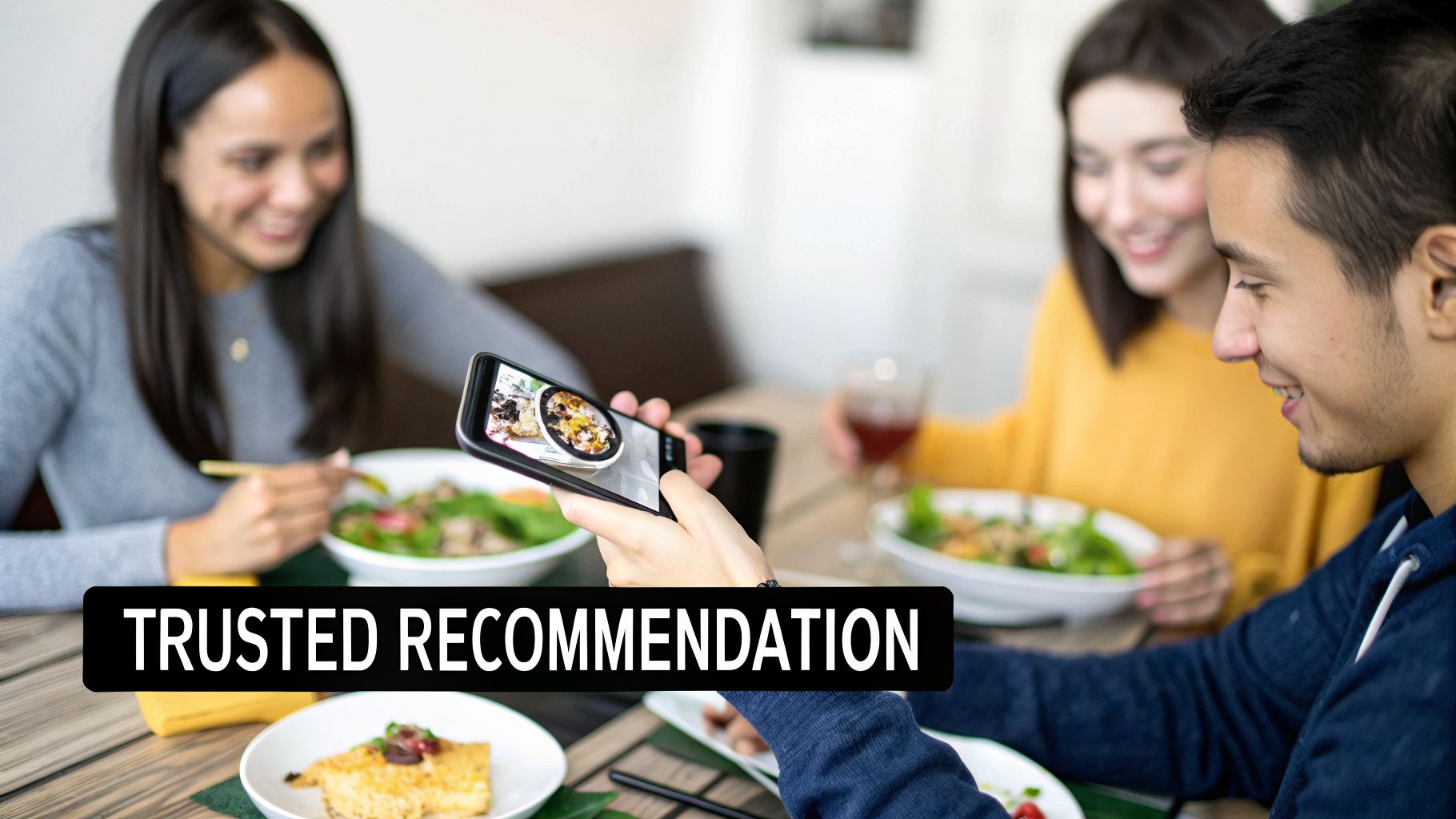
That’s the magic of influencer marketing for restaurants. It’s word-of-mouth, supercharged for the digital age. It creates the kind of authentic social proof that money just can't buy, cutting through the noise and connecting with diners on a personal level.
The Shift from Advertising to Authenticity
Let’s be honest, modern diners are experts at ignoring ads. Billboards, magazine spreads, and even those polished online banners often just wash over them. Why? They’re missing the one thing that truly matters: trust. A local influencer, on the other hand, has already done the hard work of building a relationship with their audience. Their followers genuinely care about their opinions.
When a creator recommends your restaurant, it doesn’t feel like a sales pitch. It feels like a hot tip from a friend. That personal connection is what makes people put down their phones and book a table.
The data backs this up in a big way. The UK influencer marketing scene for restaurants has ballooned into a £2.9 billion industry. People are paying attention. Just look at how diners are making decisions today.
How UK Diners Choose Restaurants in 2026
| Statistic | Impact on Restaurants |
|---|---|
| 69% of UK consumers trust influencer recommendations more than any other marketing channel. | Your most powerful advocate isn't an advert; it's a person. Trust is your biggest asset. |
| 92% of marketers run campaigns on Instagram, with 66% now also active on TikTok. | You need to be where your audience is. A presence on these visual platforms is non-negotiable. |
| 78% of diners have visited a restaurant after seeing it on social media. | Social media content directly translates into footfall. Seeing is believing, and visiting. |
What this table shows is a fundamental change in customer behaviour. Trust has shifted from brands to people, and discovery has moved from traditional media to social feeds.
Turning Buzz into Bookings
The real beauty of this strategy is that it’s not just about creating a vague "buzz." It’s about driving measurable results. Unlike a billboard where you’re guessing the impact, a well-run influencer campaign gives you a clear line of sight from a post to a paying customer.
Working with the right creators helps you hit key business goals:
- Drive Direct Bookings: Give influencers unique booking links or discount codes, and you can track every single reservation they send your way.
- Increase Foot Traffic: "I saw this on Instagram" is something restaurant staff hear every single day. A great Reel or Story creates an immediate urge to visit.
- Generate High-Quality Content: These creators are pros. The photos and videos they produce can be repurposed for your own social media, website, and ads, giving you a constant supply of authentic marketing material.
- Boost Brand Awareness: Partnering with influencers puts your restaurant on the map for thousands of local diners who might never have found you otherwise.
Ultimately, influencer marketing connects your online brand to your physical tables. It gives people a compelling, personal reason to choose you. If you’re looking for a more automated way to manage this, you can see how Sup’s influencer growth engine works for restaurants. This guide will break down exactly how to find the right partners and build campaigns that deliver a real return.
Finding the Right Food Influencers for Your Brand
Choosing an influencer is a bit like hiring a new team member; the right fit is absolutely crucial. It’s easy to get dazzled by a huge follower count, but that number is often a vanity metric that doesn’t actually translate into bums on seats. For restaurants, effective influencer marketing is all about authentic connection, not just sheer reach.
Think of it this way: who would you rather have talking about your restaurant? A famous TV chef who’s never even set foot in your city, or a trusted local food blogger who lives just around the corner? The choice is obvious. You need to partner with people whose followers are your potential customers.
This is precisely why getting to grips with the different tiers of creators is so vital. Each group offers a unique set of benefits for your restaurant.
Micro and Nano-Influencers: Your Local Champions
For almost every restaurant, the real magic happens with micro-influencers (10,000 to 100,000 followers) and nano-influencers (1,000 to 10,000 followers). Their audiences might be smaller, but they are incredibly valuable, often concentrated in your local area and deeply engaged.
A nano-influencer from your neighbourhood has followers who are their friends, family, and colleagues. These are real people who can actually pop in for dinner this weekend. Their recommendations carry serious weight because they feel genuine and personal, not like a slick advertisement. Time and again, data shows that as follower counts go down, engagement rates shoot up.
A recommendation from a local nano-influencer is like a tip from a trusted friend. Their followers don't just see the content; they act on it, making them the most powerful drivers of footfall for a local business.
This laser-focused approach delivers far more bang for your buck than a broad, scattergun campaign ever could. It’s all about quality over quantity.
A Practical Checklist for Vetting Creators
Finding the right partners takes a little bit of detective work. Before you even think about reaching out, run every potential creator through this simple vetting process. It’ll save you a lot of wasted time and money.
- Audience Demographics: Does their audience actually match your ideal customer? Any serious creator can share a breakdown of their followers' age, gender, and, most importantly, location. If you run a brunch spot in Manchester, an influencer whose following is mostly in London is of no use to you.
- Engagement Quality: Look past the likes and dig into the comments. Are people asking questions, tagging friends, and saving the post? A feed full of "Great pic!" is a red flag. What you want to see are comments like, "OMG, we have to try this place!" That signals real interest.
- Content Authenticity and Brand Fit: Do their photos, videos, and tone of voice feel right for your brand? If you’re an upmarket fine-dining restaurant, a creator who mostly reviews fast-food chains probably isn’t the one. Their content should feel like a natural extension of your own.
- Follower Authenticity: Use a free online tool to do a quick audit for fake followers. A high percentage of bots will destroy your campaign's ROI before it even gets started. Sudden, massive jumps in followers or an unusually low engagement rate for their size are big warning signs.
This process helps ensure you’re teaming up with creators who can genuinely encourage their audience to come and visit. To make finding and connecting with the right food influencers easier, you could look at specialised platforms like the saucial app. These tools can help you discover vetted, location-specific creators in a fraction of the time.
Ultimately, great influencer marketing for restaurants is about building real relationships with creators who genuinely love what you do. By focusing on local, engaged partners whose followers look like your ideal customers, you create a powerful, sustainable way to drive bookings and build a loyal community. It’s not about finding the biggest voice, but the right one.
Designing a Campaign That Drives Bookings and Buzz
You've found the right local creators. Now for the exciting part: turning their influence into actual bums on seats and a full reservation book. This is where your strategy gets real and starts to pay dividends. A top-tier influencer campaign isn’t just about trading a free meal for a post; it’s a smart partnership built to create a genuine buzz and, most importantly, results you can see on your bottom line.
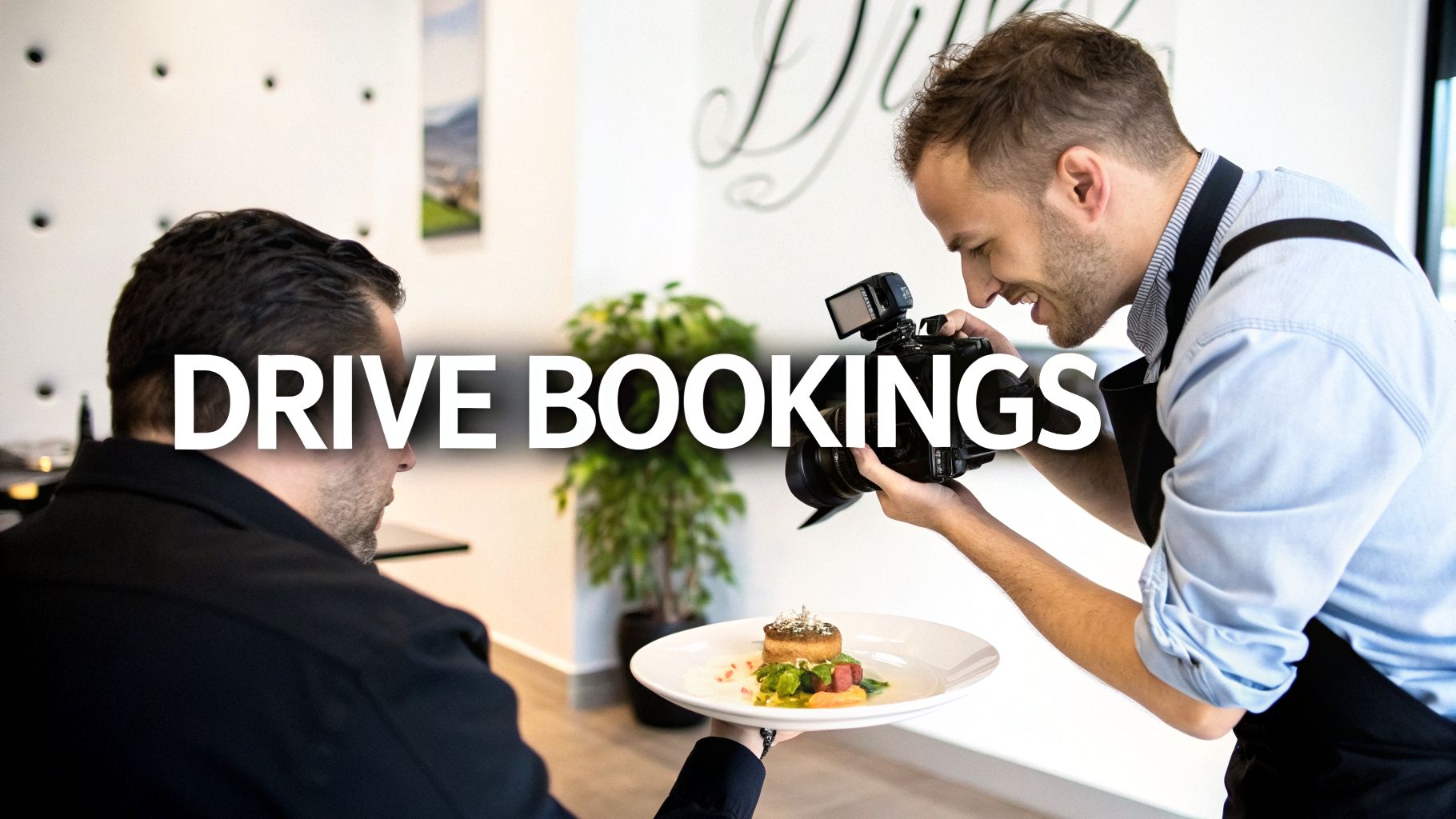
The trick is to think bigger than a one-off post. You need to consider different ways to collaborate that match what you're trying to achieve, whether that's shouting about a new menu, filling tables on a quiet Tuesday night, or building a loyal crew of local fans.
Structuring Your Restaurant Collaborations
Not all collaborations are built the same, and the format you pick should directly feed into your goals. For restaurants, I’ve found three main approaches that consistently get fantastic results.
- The Gifted Experience: This is the classic starting point and for good reason. You invite an influencer for a complimentary meal, and in return, they share an honest review through posts, Stories, or a video. It's incredibly cost-effective and a brilliant way to gather authentic content from real customers.
- Exclusive Events: Think about hosting a special preview night for your new seasonal menu or a cocktail-tasting session just for a hand-picked group of local foodies. This creates an air of exclusivity and can unleash a huge, coordinated wave of content, generating a massive amount of chatter in a very short space of time.
- Long-Term Ambassador Programmes: Found a creator who just gets your brand and has already delivered great results? Lock them in for a longer-term partnership. This could be a monthly visit or even a paid retainer to produce regular content, effectively making them a trusted brand ambassador who recommends you again and again.
No matter which path you choose, the golden rule is this: give them creative freedom. A review that sounds scripted feels like a cheap advert, and their audience will spot it a mile off. You have to trust the creator to tell your story in their own voice. That’s where the magic really happens.
From Content to Conversions: The Technical Essentials
Creating a buzz is great, but knowing how that buzz impacts your takings is what turns influencer marketing into a proper growth engine. If you aren't tracking, you're just guessing. There are two simple tech tools that are absolutely non-negotiable for measuring your actual return on investment.
A post is just a post until it drives an action. The bridge between a viewer’s curiosity and a confirmed booking is built with trackable codes and links. This is how you prove the value of your campaign.
1. Unique Discount Codes Give each influencer their own unique code, something simple like "SOPHIA15". This is your secret weapon. It lets you track every single person who uses that offer in your restaurant, giving you a direct, undeniable link between the influencer's content and a paying customer.
2. Trackable UTM Links If you want to drive online bookings, you need UTM links. These are just special URLs you give the influencer to put in their bio or Stories, and they tell your website's analytics exactly where every visitor came from. You can see precisely how many clicks and, more importantly, how many completed reservations a specific influencer sent your way. For more tips on setting up your marketing funnel, explore our guides on the Sup blog.
The data you get from these is priceless. In the UK, a staggering 40% of diners now pick where to eat based on what they see on social media, and 57% have booked a table directly through these platforms. By using unique codes and UTM links, you can directly measure this journey from a follower's scroll to a customer in your seat. To see the full data on how social media is shaping dining, check out the stats on CropInk.
Pairing fantastic creative content with solid tracking isn't just a good idea. It’s the very heart of modern influencer marketing for restaurants.
Making Your Influencer Campaign Run Like Clockwork
Let’s be honest, managing an influencer campaign can feel like spinning plates during a chaotic Saturday night service. You're juggling DMs, tracking down content, and trying to make sense of a messy spreadsheet. It's the fast track to a major headache.
The secret to a successful campaign (one that gets you brilliant content without the stress) is a solid, repeatable system. Think of it as your kitchen’s operational flow; a clear process from taking the order to the plate hitting the table. Without that system, you get lost tickets, wrong orders, and unhappy customers. The same principle applies here. A well-defined workflow keeps everything professional and on track.
This section will walk you through that exact process. We’ll cover everything from sending that first message to an influencer to giving them feedback on their final post.
The Art of Outreach and Negotiation
Your first message is everything. A lazy, copy-pasted "Hey, wanna collab?" will get you ignored nine times out of ten. Good creators get dozens of these every day. To cut through the noise, you need to be personal, professional, and straight to the point.
Show them you’ve actually done your homework. Your opening message should mention a specific post of theirs you loved and explain why you think they’re a perfect match for your restaurant. Then, be upfront about the offer, whether it's a complimentary meal, a paid partnership, or an invitation to a special event.
Once they’re interested, the real conversation begins. This is where you lock in the details:
- The Deliverables: What content do you actually need? Be specific. For example, one Instagram Reel, one feed post, and three Stories.
- The Timeline: When should they visit? And what’s the deadline for posting the content?
- The Compensation: Lay out the terms clearly. Is it a meal for two on the house? Or a specific fee for their work?
- The Usage Rights: How can you use their photos and videos? Can you repost them on your own social media, or even use them in paid ads?
Getting this all down in writing, even just a simple email, before the visit is non-negotiable. It prevents any awkward misunderstandings later and makes sure everyone is on the same page.
Crafting a Clear and Helpful Creative Brief
With the terms agreed, it's time to send over a creative brief. This isn't a script for them to follow word-for-word; micromanaging is the quickest way to kill authentic, engaging content.
A great brief is a compass, not a map. It points the creator in the right direction but lets them find their own path. This balance is where you get content that feels real and truly connects with their audience.
Your brief should be a simple one-pager that covers the essentials:
- Campaign Goal: What’s the point of all this? (e.g., "Promote our new weekend brunch menu" or "Drive bookings on quiet Tuesday nights").
- Key Messages: Are there one or two things you absolutely need them to mention? (e.g., "All our pasta is made fresh in-house" or "We have a new dog-friendly patio"). Keep it brief!
- Mandatory Bits: This includes any required hashtags (like #gifted or #ad), accounts to tag, and your restaurant’s location tag.
- Inspiration & Vibe: Give them a feel for your brand’s personality. A link to your Instagram profile and a few words on your aesthetic usually does the trick.
- The Do's and Don'ts: Keep this light. Maybe you want them to avoid using filters that make your food look an unnatural colour or mentioning a competitor next door.
A simple document like this aligns everyone from the get-go and sets the stage for a great partnership.
From Content Review to Going Live
After the influencer’s visit, they’ll send over draft content for you to look at. This is your chance to make sure everything is spot on.
When you give feedback, be specific and constructive. Instead of a blunt "I don't like it," try something more helpful, like, "This looks fantastic! Do you think we could swap one of the photos for a shot that shows off more of the restaurant's cosy interior?"
What if an influencer goes quiet? Don't panic. A polite, professional follow-up is all that’s needed; they're often juggling multiple projects. If the content isn't quite right, you can always refer back to the creative brief. It's your single source of truth and the perfect tool for guiding any requested changes.
By following this organised workflow (from personalised outreach to a clear brief and constructive feedback), you can run campaigns that are both smooth and incredibly effective. This systematic approach, which can be automated and simplified with platforms like Sup, takes the admin burden off your shoulders. It frees you up to focus on what you do best: running an amazing restaurant.
Measuring Your Campaign's Return on Investment
A gorgeous Instagram post with thousands of likes feels great, but it doesn't pay the bills. For any restaurant owner, the real question is simple: was it worth it? To get to the truth, you have to look past the flashy numbers and focus on what actually matters to your bottom line: bums on seats, new customers through the door, and cold, hard revenue.
Tracking this journey is like following a breadcrumb trail. It starts the moment a potential customer sees an influencer's post, continues when they click your booking link, and finishes when they use a discount code at your till. This is how you connect social media buzz to actual business results.
Moving Beyond Vanity Metrics
Likes and views are called vanity metrics for a good reason. They look impressive on the surface but tell you almost nothing about whether your campaign actually drove business. A post can get a massive reaction from people on the other side of the country, which does absolutely nothing for your local restaurant.
Instead, we need to focus on metrics with a direct financial impact. These are the numbers that prove your investment is paying off. To really get a grip on this, it's worth understanding how to measure marketing effectiveness in a way that’s practical and results-focused.
The big idea here is to measure actions, not just eyeballs. You need to know:
- How many people actually clicked the booking link in the influencer’s bio?
- How many of those clicks converted into confirmed reservations?
- How many diners came in and used the influencer’s unique discount code?
- And critically, what was the total spend from those customers?
Answering these questions is the only way to calculate a true return on investment (ROI).
Calculating Your True Restaurant ROI
Calculating ROI sounds more complicated than it is. At its core, the formula is straightforward: you’re just comparing what you spent on the campaign against the revenue it brought in.
ROI Formula: (Revenue from Campaign - Cost of Campaign) / Cost of Campaign x 100
Let’s walk through a quick example.
- Cost of Campaign: Let's say you invited a food blogger for a complimentary meal, and the total value came to £100. That's your investment.
- Revenue Generated: You gave them a unique code, "FOODIE15". Over the next month, 20 people use that code, and each spends an average of £50. That’s £1,000 in direct revenue you can attribute to the campaign.
- Calculate ROI: (£1,000 - £100) / £100 = 9. Multiply that by 100 to get a percentage, and you have a 900% ROI.
That simple bit of maths shows you earned £9 back for every £1 you spent. It completely changes the game, turning influencer marketing from a hopeful guess into a predictable, measurable way to grow your restaurant.
This process is built for measurement from the very beginning.
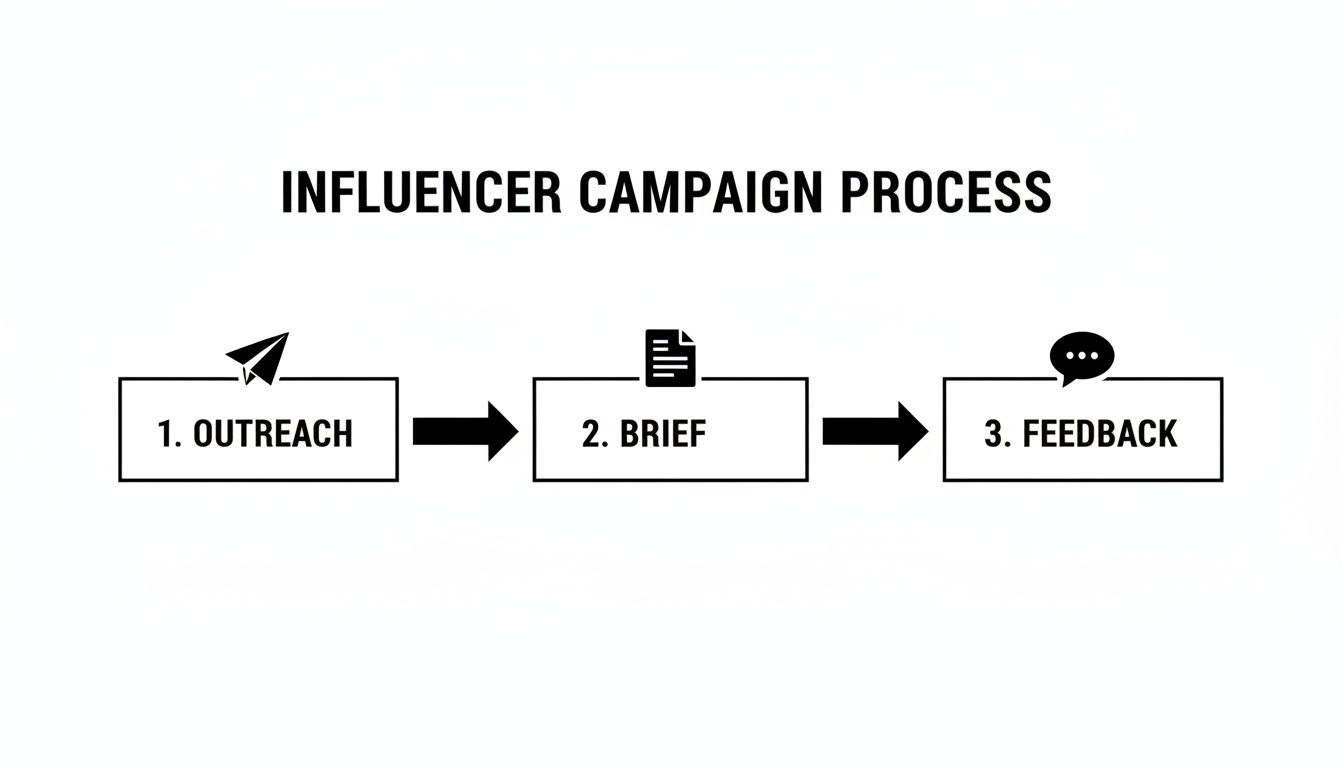
From the initial outreach to the final feedback loop, every step is an opportunity to put tracking in place, making this kind of ROI calculation a breeze.
The Hidden Value of User-Generated Content
Your ROI calculation doesn’t stop with direct sales, either. One of the most valuable things you get from an influencer campaign is the content they create. This high-quality, authentic photography and video is often called user-generated content (UGC), and it's gold dust for your marketing.
Think about it. Instead of hiring a photographer for a pricey, one-off shoot, you suddenly have a library of real, engaging visuals. You can repurpose this content across all your marketing channels for months.
- Share it on your restaurant’s own Instagram and TikTok feeds.
- Use it in email newsletters to tempt your subscribers.
- Feature it on your website’s gallery or booking page.
- Turn the best shots into paid social media ads.
This drastically cuts down your content creation costs and gives you a steady stream of authentic material that truly connects with potential diners. And the numbers back this up. By 2026, 74% of diners are expected to choose where to eat based on social media, with 40% of those decisions influenced directly by creator recommendations. This isn’t just about getting a nice shout-out; it's about building a powerful, long-term asset for your business.
That first successful influencer campaign feels great, doesn't it? But a single win is just that: a one-off. The real magic happens when you turn that initial success into a reliable, constant flow of new faces walking through your doors. True growth isn't about isolated experiments; it’s about making influencer marketing a predictable, core part of how you do business.
The aim is to shift from painstaking, one-by-one collaborations to a smooth, scalable system. We're talking about building an 'always-on' programme that consistently attracts fresh, local creators to your restaurant. This creates a steady drumbeat of authentic buzz that keeps your tables booked and your brand top of mind.
Building Your Repeatable Growth Engine
To scale this effectively, you need a system that works without you having to reinvent the wheel every single time. It's a lot like perfecting a recipe in your kitchen: once you have the process down, you can produce consistent, high-quality results with far less effort. This means systemising every part of the campaign.
First off, your creator discovery needs to become an ongoing habit. Instead of scrambling to find partners right before a campaign, start building a simple database or use a platform to keep a running list of vetted, on-brand local creators. Think of it as your own private talent pool, ready to go.
Next, get your outreach and onboarding sorted. Create template messages, clear briefs, and standard agreements that you can quickly tweak for each new partnership. This not only looks more professional but also saves you countless hours on admin, letting you get campaigns live much faster.
A scalable influencer programme isn’t about doing more work; it’s about making the work you do more efficient. By creating repeatable processes, you build a growth engine that runs in the background, freeing you to focus on what you do best: running your restaurant.
Finally, your measurement has to be consistent. Use the same tracking methods (like UTM links or unique discount codes) for every single campaign. This is the only way you can accurately compare performance over time and see what's really working. That data is gold for refining your strategy and boosting your ROI.
Scaling Across Multiple Locations
If you’re running a restaurant group or a franchise, an always-on programme is even more essential. Juggling campaigns across different cities or even neighbourhoods adds a new layer of complexity. The core principles, however, stay exactly the same. They just need a local touch.
The trick is to empower your local managers while keeping a handle on the bigger picture from a central point. Here’s how you can make that happen:
- Create Local Creator Hubs: Build and maintain separate, approved lists of influencers for each of your locations.
- Provide Centralised Resources: Give every restaurant manager a toolkit with your template briefs, outreach messages, and brand guidelines to ensure consistency.
- Use a Unified Tracking System: A central dashboard showing the results from every location is non-negotiable. It’s the only way to see what's driving growth across the entire business.
This approach nails brand consistency while still leaving room for that all-important local flavour in each campaign. To really dig into managing this for chains, you can learn more about handling influencer marketing for multi-location businesses.
The Future of Finding Influencers
Looking ahead to 2026 and beyond, technology is making all of this far simpler. AI-powered tools are now able to sift through millions of creator profiles in seconds, finding the perfect match for your restaurant based on their audience's location, interests, and even their past performance. It takes the guesswork and the gruelling hours of manual searching out of the equation.
When you combine a repeatable system with smart technology, you transform influencer marketing from a time-sucking chore into a powerful, predictable, and ROI-focused growth channel. This is the blueprint for long-term success.
Got Questions About Restaurant Influencer Marketing? We’ve Got Answers.
Jumping into the world of influencer marketing can feel like a new frontier, and it's natural to have a few questions. We hear the same ones from restaurant owners all the time, so let's clear them up and get you ready to launch your first campaign.
How Much Do I Actually Pay a Food Influencer?
Ah, the million-dollar question. The honest answer? It really depends on the creator.
For nano-influencers (those with around 1,000-10,000 followers), a complimentary meal for them and a plus-one is often the perfect arrangement. At this stage, they're hungry for great content to build their reputation, so a fantastic free experience is a fair exchange.
Once you start working with micro-influencers (10,000-100,000 followers), you're stepping into paid territory. Expect to offer the gifted meal plus a fee. This could be anything from £100 to over £500. The final figure depends on their engagement stats and what you’re asking for: a polished, high-effort Reel will naturally cost more than a few quick Stories. It's all a negotiation, so just be open and clear about your budget from the start.
Is a Formal Contract Really Necessary?
It's a good idea to get something in writing, but the level of formality can change. For a simple gifted collaboration, a detailed email agreement usually does the trick. Just make sure it clearly lists what you expect (e.g., one grid post and three Stories), a rough posting date, and how you’re allowed to use their content afterwards.
But for any collaboration involving money, a proper contract is non-negotiable. It’s your safety net. It protects everyone by setting out the exact deliverables, payment schedules, and content rights, preventing any awkward (and potentially expensive) mix-ups later on.
What Happens if an Influencer Leaves a Bad Review?
First thing's first: don't panic. If an influencer has a genuinely bad time, their feedback, while public, can be a gift. It shines a light on real issues you might have missed.
The key is to handle it with grace. Get in touch with them privately to hear them out and understand what went wrong. Don't get into a public slanging match on social media; it never ends well. Instead, respond calmly and constructively. This shows everyone watching that you value feedback and are serious about great service. You might even turn a critic into a fan.
Ready to stop guessing and start growing? Sup combines smart technology with a dedicated team to find local creators, manage your campaigns, and track every booking and sale. Set up in minutes and turn influencer marketing into your most predictable growth channel. Get started with Sup today.
More on industries
See how many creators post about you and your competitors
Type in your brand's Instagram handle and we count the creators who post about you and about your five closest competitors. It takes about a minute and it is free. Or request a demo and we will show you the creators in your niche and walk you through the dashboard.
 Book a call