12 April 2026
Influencer Marketing Compliance and the FTC: Your 2026 Guide
Your creator has sent over the draft Reel. The footage is strong, the comments will be good, and the offer is clear. Then the compliance question lands at the worst possible moment. Did they disclose the partnership properly? Is the tag enough? Is the affiliate code itself a material connection? If this goes live in the US and gets reused in the UK, are you following the right rule set at all?
That anxiety is normal. It also means the programme relies on ad hoc judgement instead of a working system.
Influencer Marketing Compliance: FTC isn't a side task for legal to mop up after launch. It's part of campaign design, creator briefing, content approval, tracking, reporting, and rights management. Teams that treat it that way move faster because they aren't re-checking every post from scratch or cleaning up preventable mistakes after publication.
Navigating the New Era of Influencer Accountability
A creator sends the final cut at 4:45 p.m. Paid media wants it live tonight. The post looks strong. Then someone asks the question that should have been settled days earlier. Is the disclosure clear enough for the FTC, and if this asset gets reused in the UK, will it meet ASA expectations too?
That pressure point shows why influencer compliance has changed. It is no longer a light review at the end of the campaign. It is a production system.
The market keeps growing, but disclosure discipline still trails behind it. Grand View Research's influencer marketing report shows how large and fast-moving this category has become. The operational gap is what creates risk. Brands are spending serious budget in a channel that still runs on screenshots, scattered briefs, and inconsistent approval habits.
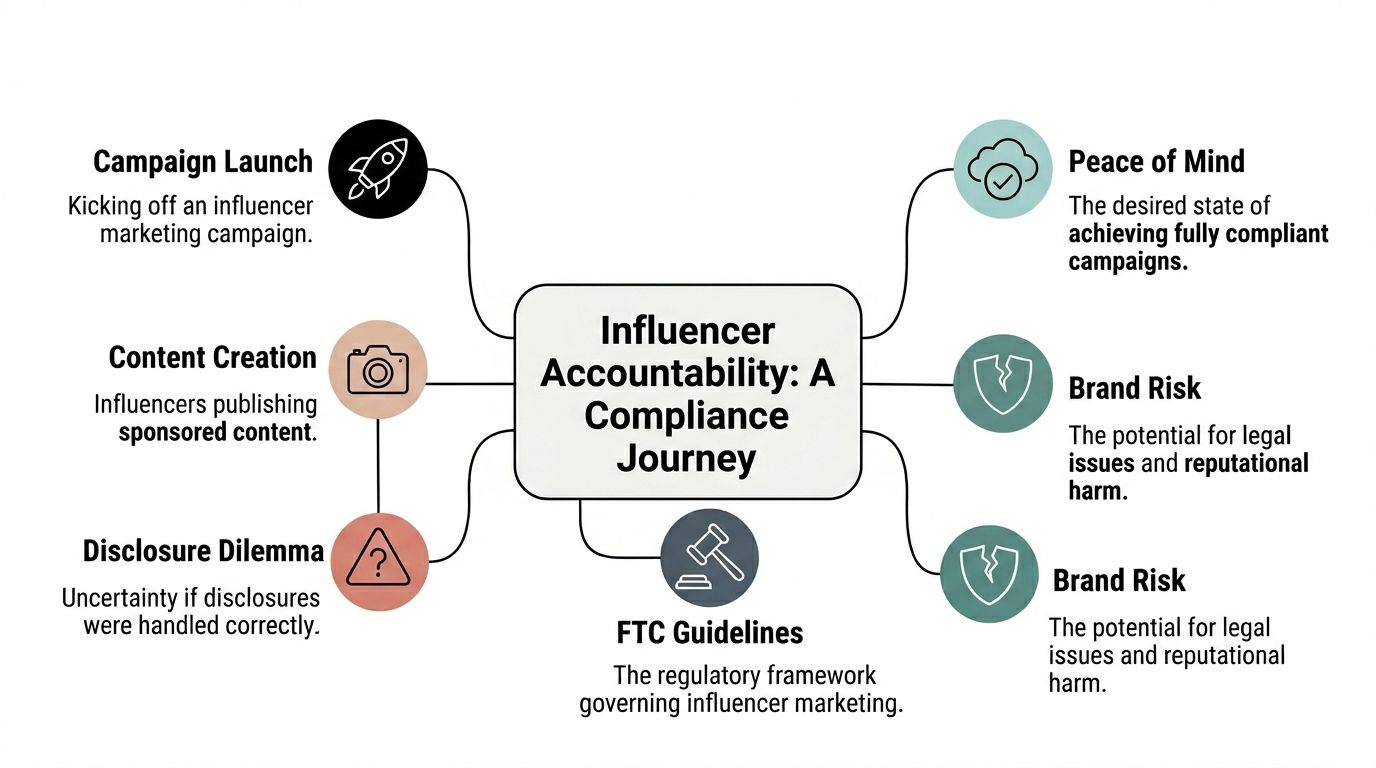
Why this feels harder than it should
The hard part is rarely the rule itself. The hard part is getting the rule to survive contact with the workflow.
Growth teams want speed. Performance teams want trackable links and codes. Brand teams want message control. Legal wants proof that the creator was instructed, the draft was reviewed when needed, and the published post matched approval. Creators want one set of instructions they can apply without guessing what changes between Instagram Stories, TikTok captions, YouTube descriptions, the FTC, and the ASA.
Cross-market campaigns make the problem worse. US teams often assume a platform disclosure tag covers everything. UK teams are used to stricter expectations around ad labeling. If nobody decides which standard applies to which asset, the same piece of content can be acceptable in one market and weak in another.
That is not a legal theory problem. It is an operating model problem.
What good looks like
Strong programs do not rely on a campaign manager remembering to ask for #ad in the final hour. They use controls that are simple enough for busy teams and strict enough to stand up to scrutiny:
- Contract controls: Creator agreements spell out disclosure duties, approval rights, takedown or correction obligations, and territory-specific requirements.
- Brief controls: Briefs include approved disclosure language, placement guidance, and examples by platform and market.
- Approval controls: Higher-risk campaigns, such as health, finance, or child-directed content, get pre-publication review.
- Monitoring controls: Live posts are logged, checked, and corrected quickly if the disclosure is missing, buried, or unclear.
- Measurement controls: Affiliate links, promo codes, and UTM structures are tied to the compliance record so the team can audit both performance and disclosure.
I use a simple test. If the team cannot show what the creator was told, what version was approved, and what went live, the program is exposed.
That is why accountability now sits with operations as much as legal. The brands that scale creator marketing well usually build a repeatable workflow once, then use software to enforce it. A platform like Sup helps by centralizing briefs, approvals, live-post checks, and performance evidence in one place, which reduces rework and makes compliance measurable instead of improvised.
The Core Principles of FTC Endorsement Guides
A creator posts a glowing product review. The caption thanks the brand, the affiliate code is in the first line, and there is no disclosure a viewer can identify in one glance. That creates avoidable risk, especially when a campaign is running across both the US and UK and different teams assume the rules are basically the same.
The FTC's Endorsement Guides are easier to apply once they are treated as operating rules for content, approvals, and monitoring. The standard is simple. If a commercial relationship could change how someone reads the endorsement, disclose it clearly enough that an ordinary viewer will catch it without effort.
Material connection means more than cash
The key concept is material connection. The FTC uses that term to cover any tie between the brand and the person endorsing it that could affect credibility in the eyes of the audience. Payment counts. So do relationships that growth teams often miss during fast-moving campaigns.
Common examples include:
- Free products: Gifting can trigger a disclosure requirement even when no fee is paid.
- Affiliate arrangements: A code, tracked link, or commission creates a financial incentive that should be disclosed.
- Trips or experiences: Travel, hospitality, event access, and other perks can influence the endorsement.
- Employment or ambassador status: If the creator works for the brand or has an ongoing formal relationship, viewers should not have to guess.
The practical mistake is treating disclosure as a media payment issue. It is broader than that. It is a relationship issue, which is why affiliate, PR, creator, and legal teams need to work from the same rules.
US and UK programs also drift apart here. The FTC focuses on whether the material connection is clearly disclosed. In the UK, the ASA and CAP Code push teams to identify ad content clearly as advertising as well. For brands running one creator brief across both markets, the safe approach is to write for the stricter operational standard, not the loosest local interpretation.
Clear and conspicuous is a visibility standard
The FTC's standard is clear and conspicuous. The FTC explains that disclosures should be hard to miss, easy to understand, and placed where people are likely to notice them in context, including on mobile devices and multimedia content, in its guidance on Disclosures 101 for Social Media Influencers.
That standard matters more than the label debate. #ad works because it is short and widely understood. "Paid partnership with Brand X" can also work. A disclosure that appears after a long caption, in tiny Story text, or mixed into a hashtag block does not.
What compliant execution looks like:
- Place the disclosure before the audience has to click, expand, or infer. If the relationship is only visible after "more," after a swipe, or after reading to the end, risk goes up.
- Use plain language. #ad, advertisement, paid partnership, or a direct statement that the creator earns from purchases are clearer than shorthand such as #sp, #spon, or vague terms like #partner.
- Match the disclosure to the format. Video needs an on-screen disclosure that is readable and stays up long enough to register. Audio needs an audible disclosure. Stories need text that contrasts with the background and is not tucked into a corner.
- Do not rely only on platform tools or brand tags. Built-in paid partnership labels can help, but they are a support layer, not a full compliance strategy.
Operational discipline matters here. A disclosure is only useful if a reviewer can verify placement, wording, and visibility before and after the post goes live.
Brand responsibility stays with the brand
The FTC has been explicit that advertisers need to instruct and monitor endorsers, and they can be liable for deceptive endorsements and missing disclosures. The FTC's Endorsement Guides FAQ for marketers makes that point clearly.
That has direct implications for campaign management. A brand cannot hand creators a vague brief, approve content loosely, and later argue the post was solely the influencer's responsibility. If the brand shaped the message, supplied the product, paid for distribution, or benefits from the sale, the brand needs evidence that it gave clear instructions and followed up.
For growth teams, the trade-off is straightforward. More pre-launch control can slow creative turnaround. Less control increases correction work, platform takedowns, and legal exposure later. The right answer is not to review every low-risk post by hand forever. It is to set rules by campaign type, market, and risk category, then use a system that logs what was required, what was approved, and what published.
The practical interpretation
The FTC is not asking for elegant legal wording. It is asking for honest signaling that people can see and understand.
A good internal test is simple. Can a new viewer spot the commercial relationship immediately, on the device they are using, without expanding, scrolling, guessing, or decoding hashtags? If the answer is no, the post needs to be fixed.
That is the standard teams should build into briefs, creator onboarding, review checklists, and monitoring tools. It reduces US FTC risk, creates a cleaner path for UK ASA compliance, and makes the program easier to scale without reinventing disclosure rules for every campaign.
Real-World Examples of Compliant Disclosures
Theory helps. Examples catch mistakes before they go live.
The easiest way to train a team is to show the difference between a disclosure that a reviewer can spot in one second and a disclosure that only appears after scrolling, tapping, or guessing.
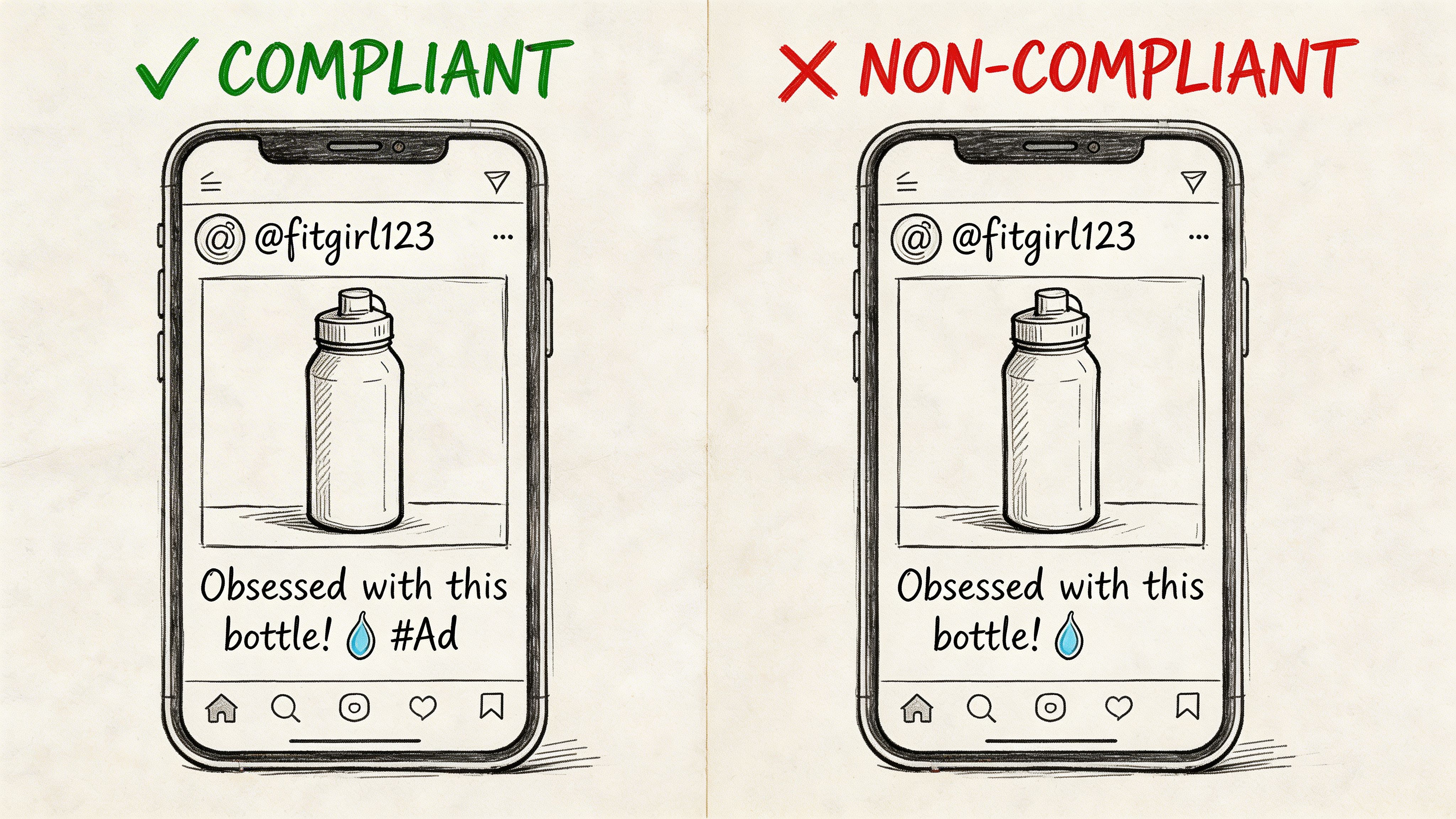
Instagram feed and reels
A compliant Instagram caption puts the disclosure at or near the start of the caption. The commercial relationship is clear before the viewer hits "more".
Compliant example #ad I've been using Brand X's recovery drink after training this week...
Usually non-compliant A long caption about morning routine, product benefits, and personal results, followed by a block of hashtags where #ad appears at the end.
The built-in paid partnership tag can help, but don't treat it as a substitute for clear text if the rest of the post creates ambiguity. The safer approach is both. A visible caption disclosure plus the platform tool creates less room for confusion.
Instagram Stories
Stories move quickly, so small pale text in the corner is a poor habit.
Compliant example A Story frame with Ad with Brand X in a readable font against a contrasting background, placed where it won't blend into the image.
Usually non-compliant A tiny #ad tucked into a cluttered area, overlapped with stickers, GIFs, links, or product tags.
What works here is simplicity. If a disclosure competes with five other visual elements, viewers will miss it.
If your social manager has to zoom in to confirm the disclosure, it needs to be fixed before posting.
TikTok
TikTok compresses attention even more. Users swipe fast, captions are brief, and visual clutter is common.
A good TikTok disclosure does at least one of these clearly:
- Shows on-screen disclosure text early
- States the partnership verbally
- Includes clear caption language such as**#ad**
A weak TikTok disclosure often appears only in a hard-to-see caption, or it uses unclear shorthand that doesn't tell viewers the post is sponsored.
YouTube
Longer content gives you more space, but it also gives teams more chances to hide the disclosure in the wrong place.
Compliant example The creator says early in the video that the segment is sponsored or that they received payment or products from the brand. The description also includes a clear disclosure near the top.
Usually non-compliant Disclosure appears only deep in the description after affiliate links, timestamps, and unrelated copy.
For YouTube, spoken disclosure matters because many viewers won't open the description at all.
Disclosure Placement Quick Guide
| Platform | Compliant Placement | Non-Compliant Placement |
|---|---|---|
| Instagram Feed | At the beginning of the caption, with clear wording such as #ad | Buried after the "more" cut or hidden in a hashtag block |
| Instagram Stories | Readable text on the story frame, easy to notice immediately | Tiny text, low contrast, obscured by stickers or links |
| Instagram Reels | Early caption disclosure and visible on-screen text where needed | Only implied by a tag or buried in caption text |
| TikTok | Early on-screen disclosure, verbal disclosure, or clear caption disclosure | Caption-only shorthand or disclosure that appears too late to catch |
| YouTube | Spoken disclosure early in the video and clear text near the top of the description | Disclosure only in the lower part of the description |
What to tell creators in plain language
Don't send creators policy excerpts. Send instructions they can apply.
For example:
- Use**#ad****clearly:** Put it at the start of the caption or in a very obvious position.
- Say it out loud in video when relevant: Especially for longer-form content.
- Keep it readable: Large enough, strong contrast, and not hidden by platform features.
- Don't improvise disclosure language: Use the approved phrasing from the brief.
The teams that get this right reduce creative friction. Creators don't need a legal interpretation. They need a clear posting standard.
Your Brand's FTC Compliance Implementation Plan
Most compliance issues start long before a post goes live. They start when the brand has no standard contract language, no briefing template, and no review workflow.
That is fixable.
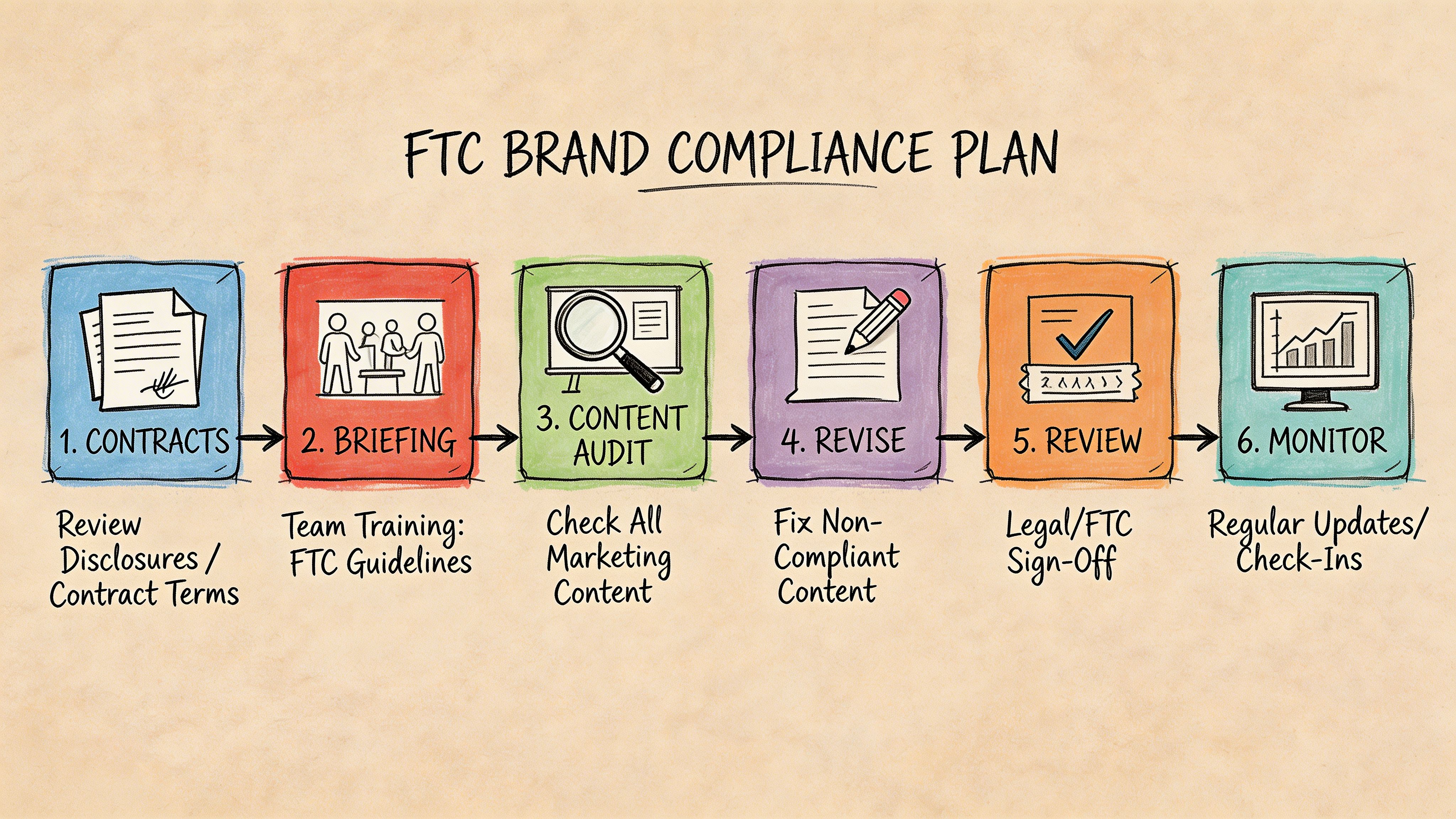
Build the requirement into the contract
If disclosure expectations aren't in the agreement, you create ambiguity at the worst possible point. The contract should say the creator must make all required disclosures, follow brand instructions, and cooperate with edits or removals if the disclosure is missing or unclear.
A simple clause can do a lot of work:
Creator must clearly and conspicuously disclose any material connection with Brand in all sponsored or incentivised content, including where products, services, discounts, affiliate arrangements, or other benefits are provided. Creator must follow applicable advertising rules and Brand's written disclosure instructions. Brand may request edits, re-posting, or removal where disclosure is missing, unclear, or non-compliant.
That isn't the whole agreement, but it establishes a firm standard. If you're revisiting your templates, this guide to influencer agreements is a useful reference point: https://sup.co/blog/the-complete-guide-to-influencer-contracts-and-agreements
Make the brief impossible to misread
A weak brief says, "Please disclose the partnership."
A strong brief shows exactly how.
Include:
- Approved disclosure wording: Give one or two exact options, not ten.
- Placement rules: State where the disclosure must appear for each platform.
- Visual rules: Require readable text and clear contrast for Stories and short-form video.
- Approval rules: Specify whether content needs review before going live.
- Link and code rules: Explain whether promo codes, affiliate links, and trackable URLs must appear with disclosure.
Teams running a wider user generated content strategy should fold these instructions into the same asset pipeline they use for rights, approvals, and repurposing. Compliance works best when it sits inside the content workflow, not next to it.
Review according to risk, not habit
Not every creator post needs the same level of scrutiny. A product seeding campaign in a low-risk category isn't the same as claims-heavy content in wellness, beauty, or supplements.
Use a simple review model:
- High-risk campaigns get pre-approval before posting.
- Medium-risk campaigns get spot checks and rapid correction procedures.
- Lower-risk campaigns still get documented briefing and post-live monitoring.
This keeps the process practical. Over-review slows the team. Under-review exposes the brand. Good operators decide which campaigns need deeper control.
Monitor what went live
The approved draft isn't the final state. Captions change. Creators edit overlays. Platform formatting shifts.
Your monitoring workflow should include:
- Live post capture: Save the final post, caption, and timestamp.
- Disclosure check: Confirm the disclosure stayed visible in the published version.
- Tracking check: Make sure promo codes and UTM links align with the creator and campaign.
- Correction path: If something is wrong, assign one owner to contact the creator and document the fix.
A short explainer on FTC expectations can help align internal reviewers before launch:
Keep an audit trail
The fastest way to calm legal, brand, and performance teams is to keep a clean record.
Store:
- Signed agreements
- Final creator brief
- Draft approvals
- Published links or screenshots
- Correction requests and outcomes
- Performance data tied to the post
Operational note: Documentation doesn't just protect the brand in a dispute. It also shows your team which instructions creators follow consistently.
That's the point many teams miss. Compliance records aren't dead paperwork. They're feedback. They show whether your process is usable at scale.
Enforcement Trends Penalties and Global Headaches
A campaign can look approved on Friday, hit spend on Saturday, and become a legal and reputational problem by Monday. That does not happen because one creator forgot a hashtag. It happens because the brand treated compliance as a checklist instead of a control system.
The FTC has made that point through its recent actions and notices. Enforcement is not limited to celebrity campaigns or Fortune 500 brands. The agency has signaled that endorsements, reviews, and testimonials are an active area of scrutiny, especially where advertisers cannot show they gave clear instructions, supervised claims, and corrected problems. The FTC’s own rule on fake reviews and testimonials also raised the stakes for marketers using creator content in paid media, landing pages, and review-style formats, as outlined in the FTC’s final rule announcement.
That distinction matters. A single bad post is a cleanup task. A weak operating model is a recurring risk.
What enforcement usually points back to
In practice, regulators tend to focus on patterns the brand should have caught. Missing disclosures matter. So do unsupported product claims, edited before-and-after content, disguised testimonials, and creator content that gets reused outside the context where the disclosure originally appeared.
I advise growth teams to ask a harder question than "Did this post include #ad?" Ask whether the program can prove four things:
- the brand told creators what disclosure was required
- the review process checked for disclosure and claim risk before posting
- the team monitored what went live
- someone owned corrections when a post went out wrong
If the answer is unclear, the problem is operational, not just legal.
Teams evaluating tooling should also look beyond creator discovery and pricing. A platform only reduces risk if it supports approvals, post capture, region-specific guidance, and reporting in one workflow. That gap is easy to miss when comparing influencer marketing platforms for restaurant owners and multi-location brands, but it becomes obvious the first time legal asks for evidence instead of intent.
Penalties are only one part of the cost
Fines get executive attention. Internal drag is often more expensive.
Once a campaign raises questions, the team loses time to screenshots, agency emails, creator follow-up, legal review, finance questions, and executive updates. Paid amplification may need to stop. Creative may need to be recut. Affiliate payouts may need to be checked against content that should not have gone live in the first place. Good reporting helps contain that mess, which is why many operators invest in understanding how reports help agencies and brands before they scale spend.
Consumer trust is the second cost. As noted earlier, audiences expect transparency. If a sponsorship looks hidden, performance usually drops before a regulator gets involved. The post feels less credible, comments turn skeptical, and the brand ends up paying for reach that converts worse.
Why US and UK programs break under one shared playbook
International teams get caught here. A US-compliant workflow does not automatically satisfy UK expectations.
In the US, the FTC focuses on whether a material connection is disclosed clearly enough for an ordinary consumer to notice and understand. In the UK, the framework is split across advertising and consumer protection enforcement. The Advertising Standards Authority applies the CAP Code to ads, and the Competition and Markets Authority has also published clear guidance for influencers, brands, and intermediaries on stating when content is advertising or otherwise commercially connected, including gifted arrangements, in the CMA’s influencer disclosure guidance.
For operators, the practical difference is simple:
- US teams often center their review on material connection disclosure.
- UK teams usually need stricter execution on ad labelling, presentation, and gifted content.
- Cross-border campaigns need separate templates, review rules, and escalation paths by market.
That is the trade-off. One universal brief is faster to distribute. It also creates avoidable exposure if your creators post into both jurisdictions.
The safer model is a common operating system with market-specific rules layered on top. One intake process. One approval record. One reporting structure. Different disclosure instructions, claim checks, and remediation standards depending on where the content will run.
How Sup Simplifies Compliance and Proves ROI
A campaign goes live on Friday. By Monday, the growth lead wants revenue by creator, the brand manager wants to confirm every post disclosed properly, and legal wants the approval record for a story that has already expired. If campaign details are split across email, chat, spreadsheets, affiliate tools, and creator DMs, the team is stuck rebuilding the timeline instead of managing the programme.
That is the true cost of fragmented influencer operations. Compliance checks get missed. Attribution breaks. Fixing either problem after posting takes more time than preventing it upstream.
One system is easier to govern than five partial ones
A single operating system gives teams one place to brief creators, review content, issue links and codes, log approvals, and store the final post record. That is how brands reduce manual checking without losing control.
The practical gain is not just speed. It is accountability. If a creator misses a disclosure, uses an old code, or posts an unapproved claim, the team can see what happened, who approved what, and what needs to be corrected.
That matters even more for brands selling across the US and UK. Attribution tools help measure performance, but they do not solve market-specific compliance rules on their own. Teams still need campaign templates, approval criteria, and disclosure instructions set by jurisdiction. Traverse Legal's coverage of influencer compliance issues touches on the risk of agency involvement and cross-market oversight in its FTC influencer guidelines article.
Compliance and measurement should run through the same workflow
Separating compliance from performance creates avoidable failure points. A post with the wrong disclosure is a compliance issue. A post with the wrong link or code is a measurement issue. A post with both problems wastes media spend and creates legal exposure at the same time.
The fix is operational. Put the objects that matter in one workflow:
- Creator record
- Campaign brief
- Disclosure instruction by market
- Asset and caption
- Approval status
- Tracking link
- Promo code
- Live post URL
- Result
That structure gives growth, brand, and legal teams the same source of truth. It also makes reporting more useful. If you are evaluating reporting workflows, understanding how reports help agencies and brands is a useful reference because it shows how centralized reporting supports client review, internal accountability, and campaign analysis.
What a stronger operating model looks like
Sup is most useful when it removes repeatable manual work and makes policy easier to enforce. The goal is simple. Fewer judgment calls in the middle of a live campaign.
In practice, that looks like this:
- Reusable campaign templates: approved disclosure language, claim guardrails, and posting instructions are built in at the start
- Shared review queues: brand, legal, and campaign managers review against the same standard
- Built-in tracking: promo codes and UTMs connect creator activity to clicks, orders, bookings, or revenue
- Central asset storage: approved content is collected in one place for reuse and audit purposes
- Multi-location control: local teams can run creator activity without going back to scattered spreadsheets and message threads
For teams comparing software, especially restaurant groups and multi-location brands, this guide to influencer marketing platforms for restaurant owners is a practical starting point.
The benefit is not convenience alone. It is better control over risk and clearer proof of return. When campaign setup, approvals, disclosures, links, and results live in one system, teams can catch issues early and explain performance without reconstructing the campaign after the fact.
Frequently Asked Questions on FTC Compliance
A creator posts your giveaway on Friday night, tags the brand, drops a discount code, and forgets to mention they were paid. By Monday, the post has strong reach and three internal teams are asking the same question. Can we leave it up, fix it in comments, or pull it down?
That is why FAQ sections matter. The hard part is rarely knowing the rule in theory. The hard part is building repeatable answers your team can apply fast, across creators, platforms, and markets.
Do contests and sweepstakes posts need disclosure
Yes. If the creator receives payment, free product, affiliate commission, contest entry benefits, or any other material value tied to the post, the relationship should be clear in the post itself. Terms and conditions do not solve that problem because viewers often never read them.
The practical rule is simple. If the post helps the brand and the creator gets something in return, require a disclosure where the audience will see or hear it.
Are employees posting about our brand treated differently
They still need to be clear about the relationship. Employment is a material connection.
This gets missed in practice because internal teams assume the audience already knows who works for the company. That assumption breaks down fast once content is shared outside the employee's immediate network. If staff members are posting promotional content, give them a short policy, sample disclosure language, and a review path for higher-risk claims.
Is an affiliate disclosure the same as a sponsored post disclosure
Not always. An affiliate relationship tells the audience the creator may earn money from purchases. A sponsored post disclosure tells the audience the brand paid for or arranged the promotion.
Sometimes both apply. If a creator receives a flat fee and also earns commission through a code or link, the instructions should cover both facts in plain language. Failing to do so allows weak briefs to create avoidable risk. Do not leave creators guessing which relationship matters more.
Can we rely only on platform disclosure tools
No. Platform labels can help, but they should sit alongside clear written or spoken disclosure when the format calls for it.
I treat platform tools as one layer of control, not the whole system. Features change, creators miss steps, and labels are not always prominent enough in every placement. A good operating standard requires both platform-native tools and disclosure language in the content brief.
How should brands handle creators who post in both the US and UK
Treat US and UK campaigns as separate compliance workflows, even when the creator is the same and the content looks similar. That is where teams get into trouble. They assume one disclosure standard travels cleanly across both markets.
It often does not. FTC expectations in the US and ASA and CMA expectations in the UK overlap, but they are not identical in application or enforcement culture. If your team also uses virtual creators or AI-assisted assets, add market-specific labeling checks before approval. Reused content is a common failure point, especially when a post cleared in one market gets repurposed in another without a second review.
A workable setup includes:
- US-specific disclosure instructions for FTC-facing posts
- UK-specific disclosure instructions for ASA and CMA-facing posts
- a market check before reposting, boosting, or localizing content
- extra review for AI-generated or virtual creator content
This is less about legal theory and more about traffic control. One brief for both markets sounds efficient until someone has to clean up the exception.
What if we want to reuse creator content in ads later
Get the rights in writing before the content goes live. Cover organic reuse, paid media rights, whitelisting or creator licensing, editing permissions, term length, and territory.
If the team needs a practical reference, this guide on getting influencer content rights for your marketing is a useful starting point. The compliance angle matters here too. Once content moves from creator post to brand ad, review standards often get stricter, and informal approvals stop being enough.
Start every review with one question. What does the audience need to know right away to understand the commercial relationship behind this post?
Teams that use that standard consistently make better decisions, faster. It keeps creator briefs tighter, approvals cleaner, and cross-market mistakes easier to catch before they become public problems.
More on relationships
See how many creators post about you and your competitors
Type in your brand's Instagram handle and we count the creators who post about you and about your five closest competitors. It takes about a minute and it is free. Or request a demo and we will show you the creators in your niche and walk you through the dashboard.
 Book a call