19 March 2026
The Complete Guide to Influencer Contracts and Agreements: Your 2026 Playbook
An influencer contract is the official blueprint for your campaign, laying out everything from the content you expect to how payments will be handled. It’s what turns a casual chat into a professional, predictable, and legally sound partnership, making sure both you and the creator are completely on the same page. This guide is your playbook for crafting agreements that protect your budget and get you the results you’re paying for.
Why Ironclad Influencer Agreements Are Non-Negotiable

Ever tried to run a campaign on a handshake deal? It can get messy. You risk facing missed deadlines, finding your content used in ways you never agreed to, or paying for posts that never even materialise. This is the chaotic reality of informal collaborations. A proper, formal agreement is the single best tool you have to avoid these headaches.
Think of it like building a house. You wouldn’t let a builder start knocking down walls without a detailed blueprint specifying every material, measurement, and deadline. Your influencer campaign is no different. The contract is your safety net, protecting your investment and ensuring every pound spent delivers real, tangible value.
Setting Clear Expectations From the Start
At its core, a contract is all about eliminating guesswork. It forces both you and the creator to sit down and agree on every critical part of the campaign before a single piece of content is made. Getting this alignment right from the beginning is the bedrock of any successful partnership.
A good contract will nail down the specifics, including:
- Specific Deliverables: What, exactly, will the creator produce? For example, one 60-second Reel and three static Story frames, with clear due dates.
- Content Rights and Usage: How can you use the content, and for how long? Maybe you can use it on your own organic social channels for six months, but not in paid ads.
- Payment Terms: How much are you paying, how will you send the money, and when? A common structure is 50% upfront and 50% on completion.
- Exclusivity Rules: Can the creator work with your direct competitors during the campaign? This needs to be defined.
This level of detail turns vague promises into concrete, enforceable responsibilities. When everyone knows what’s expected of them, the chances of a dispute later on drop dramatically.
A well-crafted contract is really just a structured conversation about expectations. It’s a collaborative process that helps both the brand and the creator feel valued, respected, and protected.
Protecting Your Brand and Investment
The UK’s influencer marketing scene has exploded, hitting £1.45 billion in 2023, and it’s still growing. As brands pour more and more money into this channel, the financial risks of a poorly managed campaign are bigger than ever. Your contract is your first line of defence.
More importantly, a solid agreement gives you legal options if things go south. If a creator simply doesn't deliver what they promised, the breach of contract clause gives you a clear process for sorting it out. To make sure your agreements are fully enforceable, it’s wise to use tools for secure digital signatures for your contracts. This final step makes it a legally binding document, giving your investment a crucial layer of security.
The Core Clauses Every Influencer Contract Needs
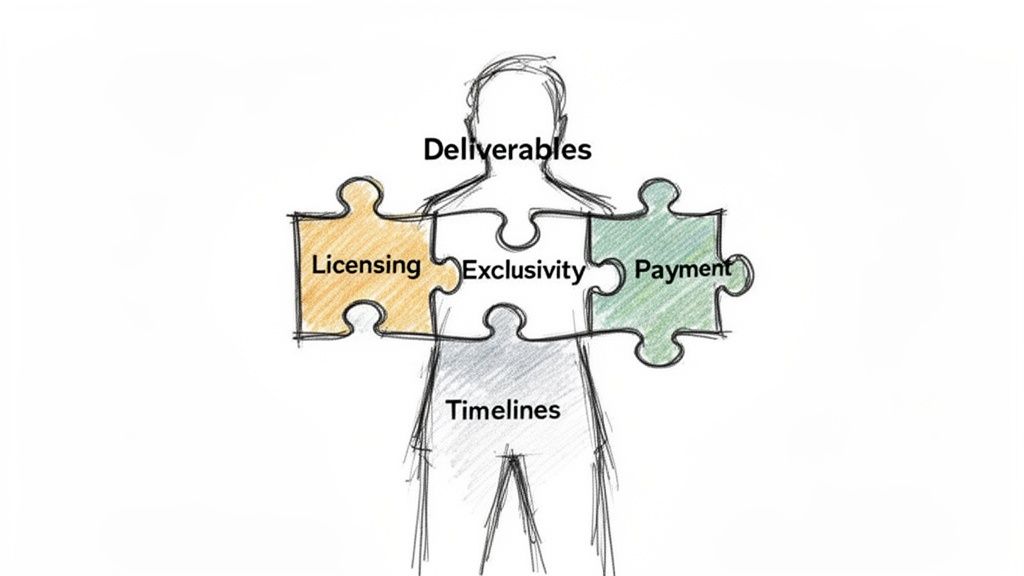
Think of your influencer contract not as a legal formality, but as a shared blueprint for a successful partnership. Each clause is a piece of the puzzle, and when they all slot together correctly, you get a clear, complete picture that protects both you and the creator. Leave a piece out, and you’re inviting ambiguity and potential conflict down the line.
Let's break down the foundational clauses that form the bedrock of any solid influencer agreement. We’re not just talking about dictionary definitions here; we’re diving into the 'why' behind each one, based on real-world campaign experience. Getting these right is the difference between a smooth-running partnership and a logistical headache.
To start, here’s a quick overview of the essential clauses we’ll be exploring.
Key Contract Clauses and Their Purpose
| Clause | What It Is | Why It's Essential |
|---|---|---|
| Scope of Work | A detailed description of the content to be created, including format, quantity, and deadlines. | Eliminates guesswork and ensures you get exactly what you’re paying for. |
| Usage & Licensing | Specifies how, where, and for how long you can use the creator's content. | Defines your rights to repurpose content, preventing copyright issues and extra fees. |
| Exclusivity | Prevents the influencer from working with direct competitors for a set period. | Protects your investment and ensures your brand’s message stands out. |
| Payment Terms | Outlines the compensation amount, payment schedule, and method. | Guarantees clear financial terms, building trust and ensuring timely payment. |
Understanding these elements is crucial for crafting agreements that are fair, clear, and effective for everyone involved.
Scope of Work and Deliverables
This is the absolute heart of your agreement: the "what" and "when" of the campaign. A vague brief like "create content to support the launch" is a recipe for disaster. You need to get granular to ensure your expectations and the creator’s understanding are perfectly aligned.
It’s like ordering a bespoke suit. You wouldn’t just ask for “a suit”; you’d specify the fabric, colour, cut, and measurements. Your contract needs that same precision.
- Content Format: Be explicit. Is it a 60-second Instagram Reel, a five-frame Story with interactive stickers, a polished YouTube video, or a gallery of high-resolution images?
- Quantity: Nail down the exact number. For example: "one (1) Instagram Reel and three (3) static Instagram Story frames." No room for misinterpretation.
- Key Messaging & CTAs: What are the non-negotiables? List any specific phrases, calls-to-action (e.g., "Shop the collection via the link in my bio"), or brand values that must be woven into the content.
- Draft and Final Deadlines: Set clear dates. When do you need to see the first draft for feedback? What is the final, go-live date for the post?
Content Usage Rights and Licensing
Pay close attention here, as this is one of the most important (and most frequently negotiated) clauses in any influencer contract. This section defines how, where, and for how long your brand can use the content the creator produces. The key thing to remember is that the creator almost always retains the copyright to their work. Your brand is simply purchasing a licence to use it.
A common trap brands fall into is assuming that paying for a post gives them carte blanche to use that content forever, wherever they want. Without a specific licence, you could find yourself in hot water for repurposing that fantastic Reel into a paid ad or putting it on your website.
To avoid future disputes and unexpected fees, define your licensing terms with precision:
- Channels: Where, exactly, can you use the content? Be specific: "The brand’s organic social media channels (Instagram, TikTok) and on the brand’s primary e-commerce website (yourwebsite.co.uk)."
- Duration: For how long do you have these rights? A standard term is 6-12 months from the date the content goes live. Anything longer, especially "in perpetuity," will come at a much higher cost.
- Media: Is the licence for organic social media use only? Or does it include paid digital ads, out-of-home advertising (like billboards), or print? Each additional use case needs to be negotiated and will affect the creator’s fee.
Exclusivity Clause
An exclusivity clause is your brand's insurance policy. It temporarily prevents an influencer from posting content for your direct competitors, ensuring your message isn't immediately followed by an ad for a rival product. This protects your investment and gives your campaign room to breathe.
However, be reasonable. Creators are running a business, and an overly broad or lengthy exclusivity period will limit their income and will likely be rejected. Fairness is key.
A well-drafted exclusivity clause will:
- Define the Competitors: Don't use vague terms like "all other skincare brands." Instead, list the 2-3 specific companies you consider direct competitors.
- Set a Clear Timeframe: The exclusivity period should be logical and tied to the campaign's duration. For example, it might run from one week before the first post until 30 days after the final post goes live.
If you need a longer period of exclusivity, be prepared to pay for it. An "exclusivity fee," which is often an additional 15-30% on top of the base rate, is a standard and fair way to compensate a creator for the lost business opportunities.
Payment Terms and Schedule
This clause spells out the financials: how much the creator will be paid, when they will be paid, and how. Absolute clarity here is non-negotiable. It prevents awkward follow-ups and ensures the creator feels valued, which is fundamental to a healthy, long-term relationship.
Given that 55% of UK marketers see engagement as a top KPI and 63% prioritise high-quality content, your payment structure should reflect the value of a job well done. Since most brand collaborations happen on Instagram (used by 92% of brands) and TikTok (used by 80%), your payment schedule should align with the deliverables for these platforms. You can learn more about UK influencer marketing trends and see why these contract details matter so much.
The fairest and most widely accepted payment structure is a 50/50 split:
- 50% Upfront: This deposit is paid when the contract is signed. It secures the creator’s time in their schedule and covers any upfront costs they might have for production.
- 50% Upon Completion: The remaining balance is paid once the final deliverable has been published and meets the agreed-upon requirements.
Try to avoid lengthy payment terms like "Net 60" or "Net 90." Asking a creator (who is often a sole trader or small business) to wait two or three months for payment is unprofessional. A Net 30 term for the final payment is the industry standard and goes a long way in building trust and goodwill.
Understanding Legal Compliance and Disclosures
Once you’ve nailed down the creative and commercial parts of your deal, it’s time to talk about the legal side. This isn’t just about ticking boxes; it’s about building a partnership on solid ground and protecting your brand. Get this bit wrong, and you could be looking at hefty fines and, worse, a serious blow to your reputation.
Here in the UK, the rules of play are set by two main organisations: the Advertising Standards Authority (ASA) and the Competition and Markets Authority (CMA). Their stance is simple: if an influencer receives anything of value from you (be it cash or a free product) the content they create is officially an advertisement and must be clearly labelled as such.
Making Sure Disclosures Are Crystal Clear
Your contract has to be firm on this point. It must legally require the influencer to be completely transparent about your partnership, right from the get-go. There’s no room for fuzzy language here; burying a tag at the end of a post just doesn't cut it anymore.
To stay on the right side of UK regulations, your agreement should insist that the influencer:
- Uses an obvious and unmissable identifier like #ad or #sponsored. This needs to be at the very beginning of a caption or clearly visible as text on a video.
- Steers clear of vague terms. Hashtags like #gifted, #sp, #collab, or "thanks to [brand]" aren't considered clear enough by the ASA.
- Places the disclosure where it can’t be missed. It shouldn't be hidden below the "see more" fold or lost in a sea of other hashtags.
Think of it like this: the disclosure has to be impossible to ignore. If someone has to play detective to figure out if they're looking at an advert, the disclosure has failed. This is a non-negotiable for any professional influencer contract.
And don't forget, the buck stops with you. The CMA has made it plain that brands have the ultimate responsibility for ensuring their marketing is compliant. Your contract is the main tool you have to enforce these rules.
The Indemnification Clause: Your Safety Net
Beyond disclosures, one of the most critical legal protections in your contract is the indemnification clause. It sounds like complex legal jargon, but its job is quite simple: it acts as your brand’s financial safety net.
Let's say an influencer working with you makes a false claim about your product's effectiveness, or they use a popular song in their video without getting the right music licence. If someone decides to sue over it, the indemnification clause sorts out who pays for the mess.
Put simply, a good indemnification clause means the influencer agrees to cover the costs (legal fees, damages, the lot) if their content breaks the law or steps on someone else's rights. It's basically an insurance policy against their mistakes.
How to Write a Protective Indemnification Clause
An entirely one-sided clause might get some pushback from the creator. A more collaborative approach is mutual indemnification, where you both agree to cover each other's backs for specific things. For most brand campaigns, though, it’s vital that the brand is shielded from the risks of what the creator posts.
Here's a simplified breakdown of what this could look like in your agreement:
- Influencer’s Responsibility: “The Influencer agrees to indemnify and hold harmless the Brand against all claims, liabilities, and costs (including reasonable legal fees) that come from their content. This includes, but is not limited to, claims of copyright infringement, defamation, or breaking advertising rules.”
- Brand’s Responsibility: "The Brand agrees to indemnify the Influencer against claims that arise directly from the product itself, as long as the Influencer’s content was accurate and followed all our brand guidelines."
This clause effectively shifts the financial risk of content creation onto the person actually creating it. By locking in clear terms for both disclosure and indemnification, your influencer contract becomes more than just a list of deliverables. It turns into a robust legal shield for your business.
How to Structure Agreements for Micro and Nano Influencers
Dealing with one mega-influencer is a completely different ball game than orchestrating a campaign with 50 micro-influencers. The sheer volume involved in nano and micro-influencer marketing means your whole approach to agreements needs a rethink. A long, lawyer-heavy contract designed for a celebrity just won’t work; trying to use one will quickly bury your team in paperwork and bring your campaign to a grinding halt.
The secret is to shift from one-off, custom documents to a system of templated, flexible agreements. You need something you can send out in minutes, that creators can actually understand, and that’s still strong enough to protect your brand across dozens or even hundreds of collaborations. This is how you build a programme that taps into the amazing content and engagement of smaller creators without creating an operational nightmare.
Simplify and Standardise Your Approach
When you’re working with creators at scale, speed and simplicity are everything. Your contract template should be lean, focusing only on what’s absolutely essential for a smooth partnership. The aim isn’t to predict every weird and wonderful scenario, but to set clear, simple rules of engagement that you can use again and again.
This stripped-back approach should revolve around three key areas:
- Clear Deliverables: Be precise, but don't overcomplicate it. For instance, "One (1) Instagram Reel showing the product in use, plus one (1) set of three Instagram Stories."
- Straightforward Payments: Many micro-influencer partnerships are built on product gifting or a modest flat fee. Your agreement should spell out the value of the gifted product or the exact payment amount and when it will be paid.
- Simplified Usage Rights: Stick to what you really need. A typical term might be a 6-month licence to feature the content on your brand’s own organic social channels.
Getting this right makes the whole process less intimidating for smaller creators, who might not have much experience with legal documents. The easier you make it for them, the more likely they are to want to work with you.
Build for the UK Creator Economy
The reality of marketing in the UK today is that smaller creators are the engine room. In fact, 93% of UK brands now work with micro-influencers (10k-100k followers), and 60% are partnering with nano-influencers (1k-10k followers). With a pool of over 633,000 UK Instagram accounts having more than 1,000 followers, a scalable agreement isn't just a nice-to-have. It’s a necessity. You can see more data on the UK's fragmented creator landscape on ourownbrand.co.
A successful micro-influencer programme runs on efficiency. Your contract process must be as easy as your product is desirable. If your agreement is complicated, you're creating a barrier to entry that will filter out the very creators you want to work with.
To handle this volume, your agreement template has to be ready to go at a moment's notice. Modern influencer platforms can automate much of this, letting you generate and send templated agreements in minutes. This frees up your team to do what they do best: build great relationships with creators, not chase paperwork. We dig into this more in our guide on why nano-influencer marketing delivers such strong ROI.
Prioritise Authentic UGC
One of the biggest wins from working with micro and nano-influencers is the authentic, high-quality user-generated content (UGC) they create. Your agreement needs to be set up to make the most of this fantastic asset. A full buyout of content rights is rarely practical or affordable at this scale, but you absolutely need a clear licence to repurpose their work.
A standard template for micro-influencers should include a clause that gives your brand:
- A Time-Bound Licence: Secure the right to use their content on your own channels (like Instagram, TikTok, or your website) for a fixed period, such as 12 months.
- The Right to Repurpose: Make sure you can use their posts in other marketing, like in your customer email newsletters or on your e-commerce product pages.
- An Option for Paid Usage: Include a simple option to upgrade the licence for paid advertising for an extra, pre-agreed fee.
By standardising these terms in your template, you turn your influencer programme into a content engine that feeds your marketing channels with a steady stream of authentic creator content, all managed through a simple, scalable system.
Integrating Performance Metrics into Your Contracts
A solid influencer contract does more than just list the creative deliverables; it has to connect those posts and stories directly to your business goals. If you want to truly understand the value of a campaign, your agreement must turn influencer marketing from a fuzzy brand awareness play into a performance channel you can actually measure. This means building tracking right into the legal agreement itself.
It’s an old saying, but it’s true: if you can’t measure it, you can’t improve it. The best influencer agreements are built on this idea, ensuring every single piece of content has attribution built in from the start. Your contracts then become engines for real, attributable ROI, letting you follow the customer's journey from a swipe-up to an actual sale.
Mandating Your Tracking Tools
So, how do you actually bake this into your contract? It all starts with a clause that makes using your tracking tools a non-negotiable part of the deal. It isn't enough to simply ask an influencer to use them; it must be a firm contractual obligation. This clause needs to be crystal clear and easy for the creator to follow.
There are three go-to methods for this:
- Unique Promo Codes: This is the classic for a reason. Assign a unique discount code like “SARAH20” to each influencer. It's perfect for tracking direct sales, especially on platforms like TikTok or Instagram Reels where clicking a link isn't always straightforward.
- UTM-Tagged Links: Provide custom URLs packed with UTM parameters. These are incredibly powerful, as they let you see exactly who sent the traffic, how many clicks they drove, and what those users did once they landed on your site, all from within your analytics dashboard.
- Dedicated Landing Pages: For your bigger, tentpole campaigns, consider sending an influencer's audience to a unique landing page. This not only simplifies conversion tracking but also creates a much more seamless experience for the potential customer.
Your contract must spell out that using these tools exactly as specified is a condition for payment. For example, you might have a clause stating that the provided UTM link must be the only link in their bio for the full 24-hour duration of an Instagram Story campaign.
From Vague Metrics to Concrete ROI
By insisting on these tracking methods, you completely change the conversation. You’re no longer focused on vanity metrics like likes and comments. The data you’re collecting is now about revenue, new leads, and customer acquisition costs.
Think of it like this: without tracking, you're flying blind, just hoping the campaign is working. With tracking built into your contracts, you're the pilot with a full dashboard, seeing exactly how much fuel you're burning and how fast you're heading towards your destination.
This data-driven approach is absolutely crucial for optimising your strategy. If one influencer’s promo code generates 50 sales while another drives just five, you’ve got clear, actionable data to guide who you partner with next and where your budget should go. If you're ready to go deeper on this, you can learn more about how to measure influencer marketing ROI effectively.
To help you decide when to use a standardised, templated approach versus a more customised one, consider the volume of your campaigns.
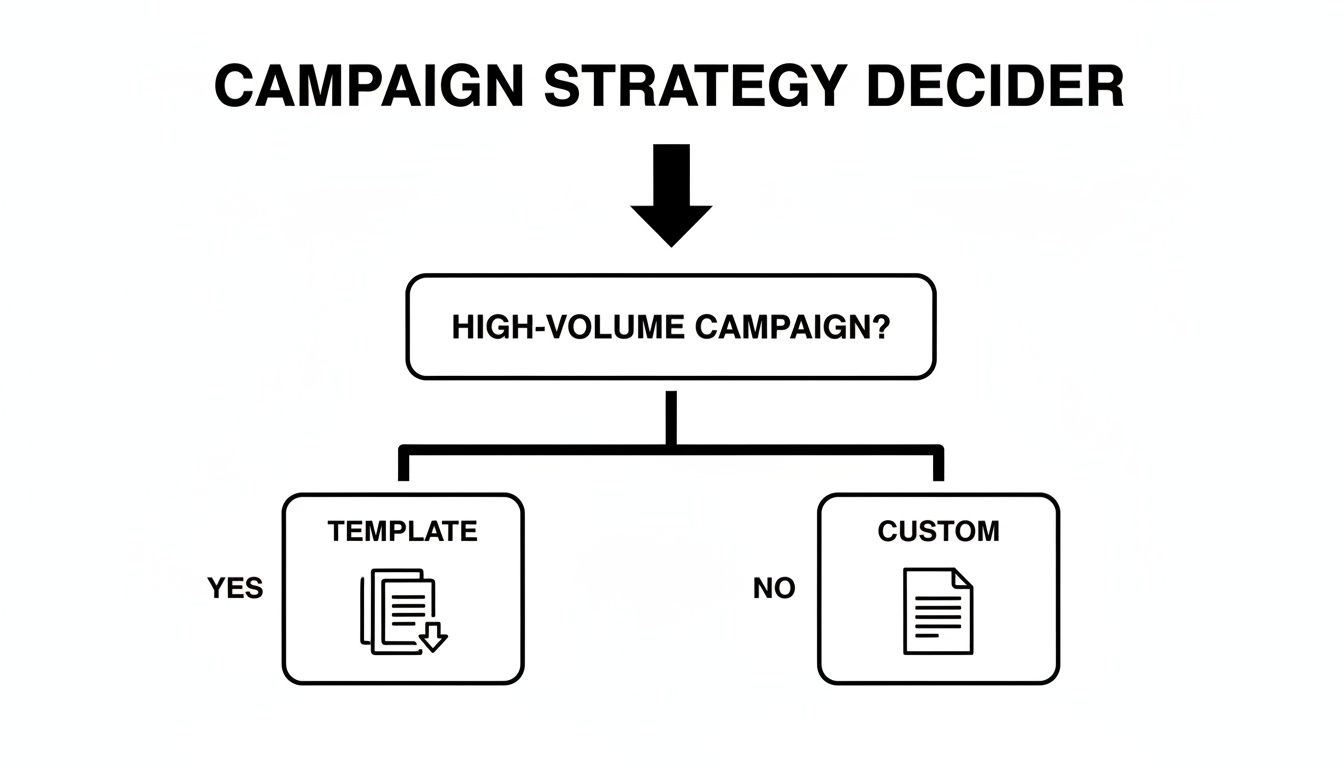
As you can see, high-volume programmes benefit hugely from templated agreements that have these tracking clauses locked in from the get-go. This is a key part of scaling your efforts without losing control.
To give you a clearer picture, here’s a breakdown of the different tracking methods you can and should require in your influencer contracts.
Attribution Methods in Influencer Contracts
| Tracking Method | How It Works | Best For | Key Contract Requirement |
|---|---|---|---|
| Promo Codes | A unique code (e.g., “ALI15”) is given to each influencer, offering their audience a discount. | Tracking direct sales, especially from video content (Reels, TikTok) where links are less practical. | Must specify the exact code and require its prominent mention in captions and verbally in video content. |
| UTM-Tagged Links | A custom URL with parameters that track the source, medium, and campaign in your analytics tool. | Tracking website traffic, click-through rates, and on-site behaviour from specific posts (e.g., link-in-bio, Stories). | Must state that this is the only link to be used for the promotion and specify its exact placement (e.g., link-in-bio). |
| Landing Pages | A dedicated, unique webpage created for a specific influencer or campaign. | Larger campaigns, tracking conversions without relying on codes/links, and providing a cohesive user journey. | Requires the influencer to direct all traffic exclusively to this URL. |
Mandating one or a combination of these methods is the single best way to ensure your influencer programme is truly measurable.
Ultimately, writing performance metrics into your influencer contracts makes your marketing more accountable, easier to scale, and far more profitable. It’s the definitive step to prove your creator partnerships aren’t just generating buzz. They’re actively growing your business.
Streamlining Your Contract Management Process
Getting a contract signed is one thing; managing it effectively is another beast entirely. The real work begins after the ink is dry. As you start working with more and more creators, juggling dozens of agreements can quickly descend into administrative chaos. The goal is to build a repeatable, efficient system that turns your influencer programme into a proper growth engine. This is where you operationalise your agreements.
It all starts with the negotiation. Think of it less as a battle and more as a collaborative chat. The sweet spot is finding a middle ground where both your brand and the creator feel they’ve got a great deal. A creator’s media kit and past campaign results are their negotiating power; your clear, fair contract is yours.
The Shift From Manual Chaos to Automated Clarity
Let’s be honest: trying to manage contracts with a clunky spreadsheet, endless email threads, and a mess of calendar reminders just doesn’t work at scale. It’s a recipe for mistakes. Did that creator post on the right day? Did they remember to use the correct tracking link? Have you paid their invoice yet? Answering these questions for a handful of creators can feel like a full-time job.
This is exactly the problem modern influencer platforms were built to solve. They act as a central hub for all your partnerships, automating the entire lifecycle of an agreement from start to finish. For maximum efficiency, it's worth adopting established Contract Lifecycle Management Best practices into your workflow. This is how you stop chasing individual tasks and start building a scalable marketing channel.
Using Technology to Operationalise Your Agreements
Platforms like Sup are designed to eliminate the manual grind by folding contract management right into your campaign workflow. This creates a single source of truth for every partnership, ensuring nothing ever falls through the cracks. The idea is to make the process so seamless that you can get back to what matters: building relationships and focusing on strategy, not paperwork.
Here’s a practical look at how this technology changes your process:
- Automated Outreach: You can send templated agreements to pre-vetted creators in minutes, not hours.
- Deliverable Tracking: The system automatically checks when content goes live, verifying it against the terms in your contract.
- Payment Management: Once all deliverables are confirmed, invoice processing and payments can be automated.
- Centralised Content Library: All the user-generated content (UGC) from your campaigns is automatically collected and organised, complete with its specific usage rights and expiry dates.
By systemising contract management, you’re not just saving time; you’re building a scalable foundation. Each successful collaboration becomes a blueprint for the next, allowing you to grow your programme with confidence and predictable results.
This structured approach is a game-changer, whether you’re a growing e-commerce brand or a local restaurant trying to get more people through the door. If you’re weighing up your options, our comparison of influencer marketing platforms for restaurants offers some extra insight. Ultimately, turning your influencer contracts and agreements into a well-oiled machine is the final, crucial step in unlocking measurable, long-term growth.
Common Questions About Influencer Contracts
Even with a solid plan, a few tricky questions always seem to pop up when you're dealing with influencer contracts. Let's clear up some of the most common points of confusion so you can move forward with confidence.
Do I Need a Formal Contract for a Gifted Collaboration?
Yes, you absolutely do. It's a common misconception that if no money is changing hands, you don't need a contract. Think again. The gifted product is the payment, and the contract is what guarantees you get something in return.
Without an agreement in place, there’s nothing stopping a creator from taking your product and never posting. Worse, you have no legal grounds to use any content they might create. A simple contract for a 'product-for-post' exchange should clearly state:
- The exact deliverables: For example, one Instagram Reel and three Story frames.
- Posting deadlines: A clear date for when the content needs to go live.
- Usage rights: Where and how you can use their photos or videos (e.g., on your website, in email newsletters).
- Disclosure rules: A commitment to use clear labels like #ad or #gifted, as required by the ASA.
What Is the Difference Between Content Ownership and Usage Rights?
This is easily one of the most critical and misunderstood parts of any influencer agreement. Getting this wrong can lead to some very expensive headaches down the line.
Content Ownership almost always stays with the person who created it: the influencer. As the artist behind the camera, they hold the original copyright to their work.
Many brands fall into the trap of thinking that paying an influencer means they now own the content. This is not the case. You're not buying the photo itself; you're buying a licence to use it in specific ways.
Usage Rights (also called a licence) are the specific permissions you negotiate to use that creator-owned content. Your contract must spell these out in detail, covering:
- Where you can use it: Is it just for organic social media, or can you use it in paid ads, on your website, or in print?
- How long you can use it: Does the licence last for six months, one year, or in perpetuity? (Be warned: perpetual rights are rare and very costly).
- Which regions it covers: Is it for the UK only, across Europe, or worldwide?
Being crystal clear here prevents future disputes and protects you from unexpected bills when you want to reuse a great piece of content.
How Should I Handle Contract Termination?
Every good contract needs an escape hatch. A termination clause explains how you or the influencer can legally end the partnership if things don't go to plan. It’s your safety net.
This clause should cover ending the agreement 'for cause' (if one party breaches the contract) and 'for convenience' (which allows either party to walk away without a specific reason, usually with 30 days' notice). It also needs to outline what happens next, like settling any final payments for work already done and clarifying if the influencer needs to take the posts down.
Ready to stop juggling spreadsheets and start scaling your influencer programme with results you can actually measure? Sup combines smart AI with a dedicated human team to launch, manage, and track your creator campaigns from start to finish. Learn more and see how it works with a demo.
More on relationships
See how many creators post about you and your competitors
Type in your brand's Instagram handle and we count the creators who post about you and about your five closest competitors. It takes about a minute and it is free. Or request a demo and we will show you the creators in your niche and walk you through the dashboard.
 Book a call