27 February 2026
Influencer Marketing Platforms Compared: What Restaurant Owners Actually Need
Let’s be honest, paying for pretty food pictures just isn't filling seats like it used to. If you're a restaurant owner, it’s time to shift your focus from generic posts to authentic, local creators who can drive real-world results. We’re talking bookings and actual foot traffic.
Why Old Influencer Tactics No Longer Work for UK Restaurants
The gap between an influencer's post and your restaurant's bottom line has become a chasm. Social media is still a massive discovery channel for diners, but many of the old-school influencer strategies are simply failing to deliver a measurable return for hospitality businesses.
This isn't just a hunch; it's backed by a fundamental shift in diner behaviour. In the UK, only 11% of consumers now discover new restaurants through influencers, even though 45% of diners find venues on social media overall. That data points to a serious disconnect: your audience is scrolling, but they’ve grown wise to traditional, paid-for endorsements. As a result, 40% of UK restaurant operators are now prioritising other brand collaborations, signalling a clear move towards partnerships that are more authentic and focused on ROI.
The Rise of Authentic Local Voices
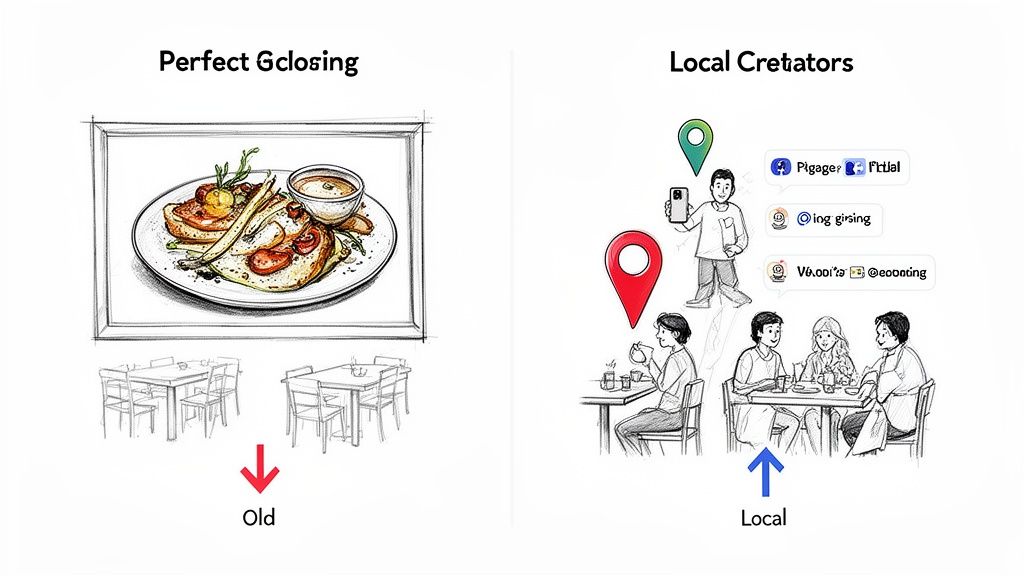
The problem isn't influencer marketing itself, but the outdated way it's often done. Paying a macro-influencer with a huge, non-local following for a single, staged photo is an expensive gamble that rarely pays off. Today's diners crave genuine recommendations from smaller, local creators: the micro and nano-influencers who are actually part of their community.
This guide is built on the idea that restaurants don't just need another platform; they need a specialised growth engine built to solve the unique challenges of hospitality. These challenges include:
- Hyperlocal Targeting: Finding creators in your specific neighbourhood, not just your city.
- Offline Conversion Tracking: Connecting a social media post directly to a booking or a customer walking through your door.
- Multi-Location Management: Scaling campaigns efficiently across different branches without the headache.
The core issue is that generic platforms treat a restaurant in Manchester the same way they treat an online clothing brand. True success in hospitality marketing requires a tool built to understand local nuances and track offline actions, not just online clicks.
To really succeed, restaurants need to move beyond vanity metrics and adopt tools that provide clear, undeniable attribution. Of course, influencer marketing is just one piece of the puzzle. Owners should also build a comprehensive digital strategy, including the effective tactics found in A Simple Guide to SEO for Restaurants.
This guide will help you compare platforms and choose the right partner for measurable growth. For a much deeper dive, check out our complete guide on influencer marketing for restaurants.
The Six Essential Features Your Restaurant Influencer Platform Needs
Picking the right influencer platform isn't about ticking off the most features. It's about finding the one with the right features for your restaurant. So many platforms are built for e-commerce brands, chasing metrics like clicks and conversions that mean very little when your goal is a full dining room.
To make a smart comparison, you need a clear framework. Let's cut through the noise and focus on the six non-negotiable features that tackle the unique challenges of hospitality marketing and actually drive growth.
1. Hyperlocal Creator Discovery
General platforms might let you search for creators by city, but that’s not nearly good enough. A restaurant in Shoreditch needs to connect with influencers who live, work, and socialise in East London, not just anywhere in the capital. True hyperlocal discovery lets you drill down by postcode or set a specific radius around your venue.
This level of precision is crucial. It means you’re partnering with authentic local advocates whose followers are actually within dining distance. Their recommendation feels less like a paid ad and more like a genuine tip from a friend.
2. Automated Campaign Management
The day-to-day reality of running a restaurant leaves zero time for manual outreach, endless follow-ups, and clunky spreadsheets. A platform built for hospitality automates the entire campaign workflow, from the first message to briefing and collecting the content.
The whole point is to remove the admin grind that makes influencer marketing feel like a second full-time job. You need a system that handles the negotiations, scheduling, and reminders for you, so you can focus on running your business, not chasing DMs.
This kind of automation turns influencer marketing from a time-consuming chore into a repeatable, scalable way to grow. If you want to dive deeper into the process, we've broken down exactly how to run a restaurant influencer campaign step-by-step.
3. Direct ROI Attribution
How can you be sure an influencer campaign is actually putting bums on seats? Vanity metrics like likes and views are nice to look at, but they don’t pay the bills. Your platform absolutely must give you a clear line of sight connecting online content to real-world results.
This is where specific tools come into play:
- Unique Promo Codes: Giving each creator their own discount code lets you track every single redemption right at your till.
- Trackable Booking Links: Using UTMs in reservation links tells you exactly which posts are driving people to book a table.
Without this data, you’re just guessing at your return on investment.
4. Integrated Content Rights Management
Great photos and videos from creators are marketing gold. A top-tier platform should have content rights management baked right in, securing your ability to reuse that brilliant user-generated content (UGC) across your own marketing. This means you can use authentic, compelling visuals on your website, social media, and even in paid ads without getting tangled up in messy licensing agreements.
5. Scalability for Multi-Location Venues
If you're running more than one site, trying to manage separate campaigns for each can descend into chaos fast. A scalable platform lets you run everything from a single dashboard. You should be able to find local creators for each specific location, launch coordinated campaigns, and compare performance across your different branches without breaking a sweat.
6. Transparent and Flexible Pricing
Finally, the platform’s pricing has to make sense for the hospitality industry. Steer clear of long, restrictive contracts and look for transparent, flexible plans. A model that fits a restaurant's budget means you can invest in marketing with confidence, knowing the costs are predictable and the potential for a positive return is real.
Comparing the Top Influencer Marketing Platforms for Restaurants
Now that we know what features really count, let's put the big platforms under the microscope. This isn't about finding a single "best" platform, but about understanding which one is the right fit for your restaurant. We'll slice through the sales pitches of tools like Grin, Upfluence, and Sup, our own restaurant-focused engine, to see how they stack up against the realities of the hospitality world.
Think about it this way: a platform built for a global e-commerce brand might have a massive database of creators, but is it any good when your new bistro in Bristol needs to find foodies within a three-mile radius? That's the kind of practical question we're answering here. We’re getting into the nitty-gritty to see which tool genuinely solves the problems restaurant owners face day in, day out.
Hyperlocal Creator Discovery: A Closer Look
For a restaurant, "local" doesn't mean the city. It means the neighbourhood. Finding creators by postcode isn't just a nice-to-have; it's a deal-breaker. This is precisely where many generic platforms stumble.
- Grin: As a powerhouse for e-commerce brands, Grin is brilliant at finding creators for national campaigns. Its filters for audience demographics and engagement are top-notch. The problem? Its location filtering is often stuck at the city level. For a single-location restaurant, that means hours of manual work sifting through profiles to find someone who’s actually local.
- Upfluence: Upfluence does a better job, with a more robust database and more precise location filters. It’s a definite step up. However, it's still built for broader campaigns and can struggle to tell the difference between a creator who genuinely lives nearby and one who just tagged your city on a visit once.
- Sup: This is a completely different approach. Sup was built from the ground up for restaurants, so hyperlocal discovery is its bread and butter. You can search by postcode or draw a tight radius around your restaurant, guaranteeing you connect with foodies whose followers are actually close enough to drop in for dinner. It cuts out all the guesswork.
Campaign Automation and Management
Time is money, especially in a busy restaurant. The hours spent managing a campaign are a hidden cost, and smart automation is what makes influencer marketing profitable instead of a time-sink.
- Grin: Grin provides a fantastic toolkit for managing creator relationships once they're on board, acting like a powerful CRM. But getting them on board (the outreach, the negotiation, the back-and-forth) is still largely a manual slog for your team.
- Upfluence: Much like Grin, Upfluence gives you great tools for tracking deliverables once a partnership is live. But the heavy lifting of initial outreach and follow-up still falls squarely on your shoulders.
- Sup: Here’s where the model flips. Sup automates the whole process, from finding influencers to sending out the initial outreach and campaign brief. It uses proven, customisable templates to handle the contact and negotiations for you. This "done-with-you" system can cut the manual admin work by up to 95%, turning a major time commitment into a few minutes a week.
The real difference is moving from a ‘platform-as-a-tool’ to a ‘platform-as-a-service’. Generic platforms hand you the tools and expect you to do the work. A specialised engine like Sup does the work with you, freeing you up to run your restaurant.
Tracking and Direct ROI Attribution
Likes are nice, but bookings and revenue pay the bills. The UK influencer marketing scene is worth a staggering USD 2.36 billion in 2024, and while the average ROI is a healthy £5.78 for every £1 spent, that figure means nothing if you can't prove it. With nearly 50% of diners using creator content to pick a restaurant, tying campaigns to actual footfall is essential.
This is where discovery, automation, and ROI tracking have to work together perfectly.
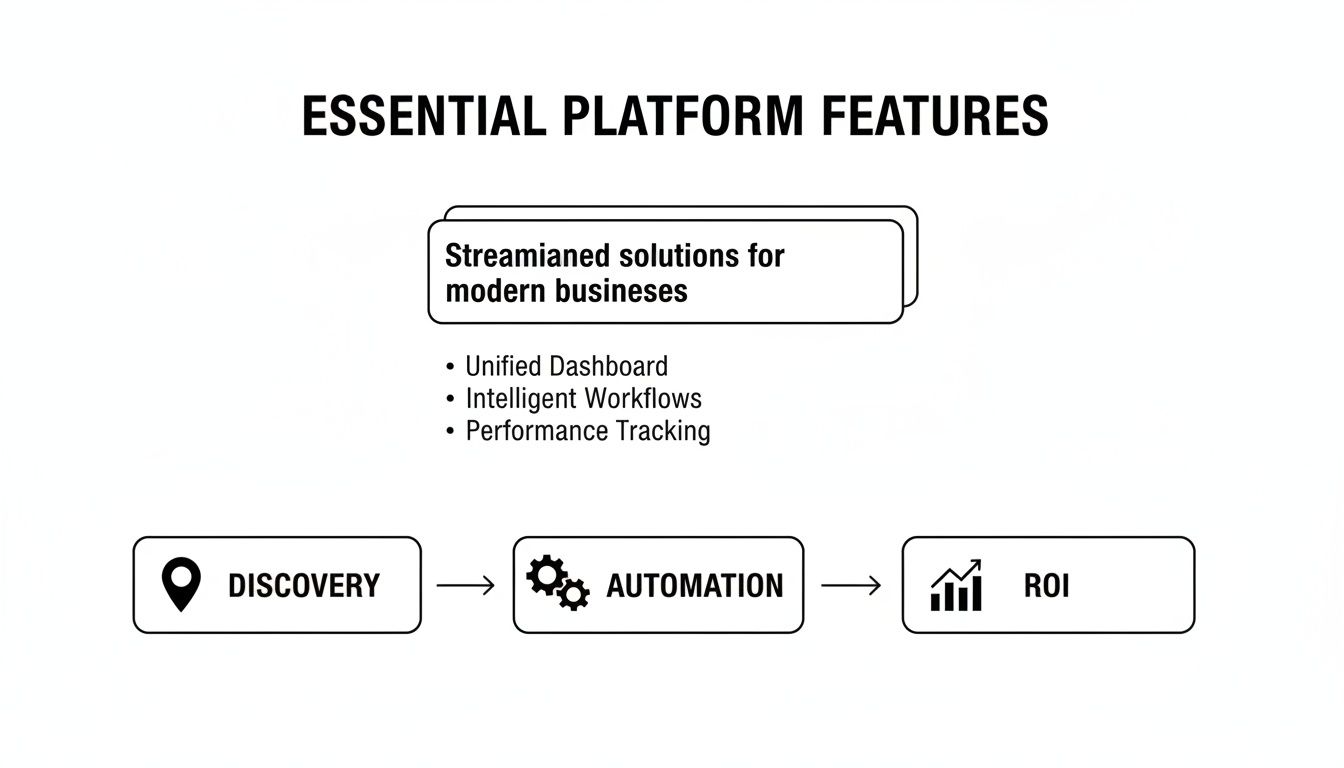
As you can see, a truly effective platform connects the dots between finding local creators, automating the workflow, and showing you the money.
- Grin & Upfluence: Both platforms excel at tracking online metrics like reach, views, and clicks. They can even integrate with e-commerce sites to track sales. But for a restaurant, that’s only half the story. Attributing an in-person visit requires awkward manual workarounds, like trying to match promo codes from your POS system to a spreadsheet.
- Sup: Sup was designed to solve this exact problem. Attribution is baked right in. Every campaign automatically generates unique promo codes and trackable booking links for each creator. All that data flows into a single dashboard, showing you in real-time which influencers are actually driving bookings and revenue. It finally closes the loop on restaurant marketing.
Pricing and Scalability
Lastly, the numbers have to work. The platform's cost model needs to align with the financial realities of the hospitality industry.
- Grin & Upfluence: These are enterprise-level tools, and they come with an enterprise-level price tag. You're typically looking at significant upfront costs and long annual contracts. For a restaurant that doesn't need complex e-commerce integrations, you end up paying for a lot of features you'll never use. For more on this, check out our guide on how much influencer marketing costs for restaurants.
- Sup: We opted for a flexible subscription model built for hospitality budgets. The pricing is clear and scales with you, whether you’re a single independent café or a growing restaurant group. It allows you to treat influencer marketing as a predictable, manageable expense, not a risky, one-off investment.
And remember, influencer marketing is just one part of your online presence. To keep everything in sync, it’s worth looking at the Top 12 Restaurant Reputation Management Tools for 2026 to make sure your customer reviews are as strong as your marketing.
Feature Comparison of Influencer Platforms for Restaurants
To put it all together, here’s a side-by-side evaluation of how these platforms perform on the six essential criteria for restaurant marketing success. This table should make the key differences crystal clear.
| Feature | Generic Platform (e.g. Grin) | Legacy Platform (e.g. Upfluence) | Sup (The Restaurant Growth Engine) |
|---|---|---|---|
| Hyperlocal Discovery | City-level search at best; requires heavy manual work for neighbourhood targeting. | Better geographical filters but not fine-tuned for postcode-level accuracy. | Built for restaurants: AI-driven discovery by postcode and radius to find truly local creators. |
| Campaign Automation | A powerful CRM, but outreach and negotiations are almost entirely manual. | Strong management tools, but the initial campaign setup is very hands-on. | Fully automated workflow from outreach to briefing, managed by the platform to save you time. |
| Direct ROI Attribution | Great for online metrics, but offline tracking needs manual POS data reconciliation. | Good for online tracking, but no integrated, real-time attribution for in-person sales. | Built-in unique promo codes and trackable links with a live dashboard for offline conversions. |
| Content Rights | Usually includes features to manage content licensing and usage. | Offers tools for collecting and managing user-generated content. | Automated content collection with clear usage rights, all stored in a central library. |
| Scalability | Designed for big brands; can be clunky for managing distinct local campaigns. | Can handle multiple campaigns but lacks features designed for multi-location chains. | Built for multi-location management from one dashboard, with location-specific sourcing. |
| Pricing Model | High upfront costs and annual contracts aimed at enterprise-level budgets. | Enterprise pricing with long-term commitments; often too expensive for single restaurants. | A flexible, clear subscription model designed specifically for hospitality budgets. |
Ultimately, the right platform depends on your specific goals. If you're a large brand with a huge marketing team, a generic tool might offer the customisation you need. But for most restaurant owners, success comes from a tool that understands your world: local, fast-paced, and relentlessly focused on the bottom line.
Which Platform Is Best for Your Restaurant Scenario
A simple list of features rarely reveals the full picture. Instead, pinning platforms against the actual struggles and ambitions of your restaurant today shows you which tool truly fits.
By mapping each platform’s strengths to your daily operations, you can avoid the trap of generic comparisons. Below, we unpack three distinct restaurant situations (from the cosy local café to an exclusive fine-dining venue) so you can see exactly which approach aligns with your goals and budget.
Scenario 1: The Independent Local Café
You run a much-loved neighbourhood spot where every marketing pound must count. With no dedicated marketing team and only snippets of free time, you need a system that’s quick to learn, laser-focused on your nearby community and delivers instant, trackable results.
Your top priorities are:
- Cost-Effectiveness: High return on every pound spent.
- Ease of Use: Minimal setup, zero tech headaches.
- Local Impact: Reach customers within a few postcodes, not nationwide.
“For a small café, generic solutions like Grin often feel too bulky and expensive. They lack the postcode-level targeting you need.”
The sweet spot here is a specialised engine like Sup. It offers budget-friendly plans designed for hospitality, an automated “done-with-you” workflow that slashes manual outreach, and postcode-level creator discovery to connect you with genuine local food lovers.
Scenario 2: The Growing Restaurant Chain
You’ve branched out into several sites, possibly in different cities. Now, your main headache is juggling multiple local campaigns while ensuring each one looks and feels like part of the same brand family.
Here’s what you need:
- Scalability: Smoothly roll out campaigns in new locations.
- Centralised Control: Consistent briefs, brand voice and reporting dashboards.
- Local Flexibility: Empower managers to work with creators who know their market.
Legacy players like Upfluence deliver scale, but require heavy administrative effort for every new locale. You’ll still spend hours vetting influencers, setting up spreadsheets and managing DMs.
By contrast, Sup lets you oversee all sites from one dashboard. You source distinct local creators for each branch, deploy pre-approved campaign templates and keep brand standards intact, without endless manual labour.
Scenario 3: The Exclusive Fine-Dining Establishment
Your restaurant is a destination for discerning diners. Mass foot traffic isn’t your goal; you want precisely the right audience: affluent guests who appreciate exquisite cuisine and polished visuals.
Your priorities include:
- Meticulous Creator Vetting: Only influencers who embody your brand’s refinement.
- Premium Content Quality: High-end photography and videography, not casual smartphone snaps.
- Targeted Reach: Engage a niche, high-spending clientele.
In this case, platforms like Grin or Upfluence can shine. Their extensive creator databases and detailed demographic filters support a rigorous selection process. If you’re prepared to invest time in manual vetting and relationship building, the higher costs can be justified by the level of control you gain over every partnership.
Ultimately, the choice hinges on whether you need hands-on precision or prefer an automated, cost-efficient model.
How Sup Works as a Growth Engine for Restaurants
After looking at what different platforms offer, it's pretty clear that tools designed for e-commerce brands just don't get the hospitality world. Sup was built differently from the start. It’s not just another piece of software; it's an engine designed to solve the specific headaches restaurant owners deal with every day. The aim is to turn influencer marketing from a time-sapping gamble into a predictable way to grow your business.
This isn't just a sales pitch. It’s a look at how Sup’s very structure tackles the problems we've talked about. The entire system is organised around one thing: driving real people through your doors and measuring what actually works, not just chasing likes.
Built for Local, Right from the Start
The biggest challenge for most restaurants is finding creators who are genuinely local. Sup cracks this with its AI-powered sourcing. It can pinpoint verified food influencers by postcode or within a tight radius of your restaurant, often as close as five miles. This means every single partnership is with someone whose followers can actually pop in for a meal.
Forget spending hours scrolling through city-wide lists. You get a handpicked selection of relevant, local voices ready to work with. This hyperlocal focus is the bedrock of any successful restaurant campaign.
The platform makes the entire process, from finding people to tracking results, straightforward.
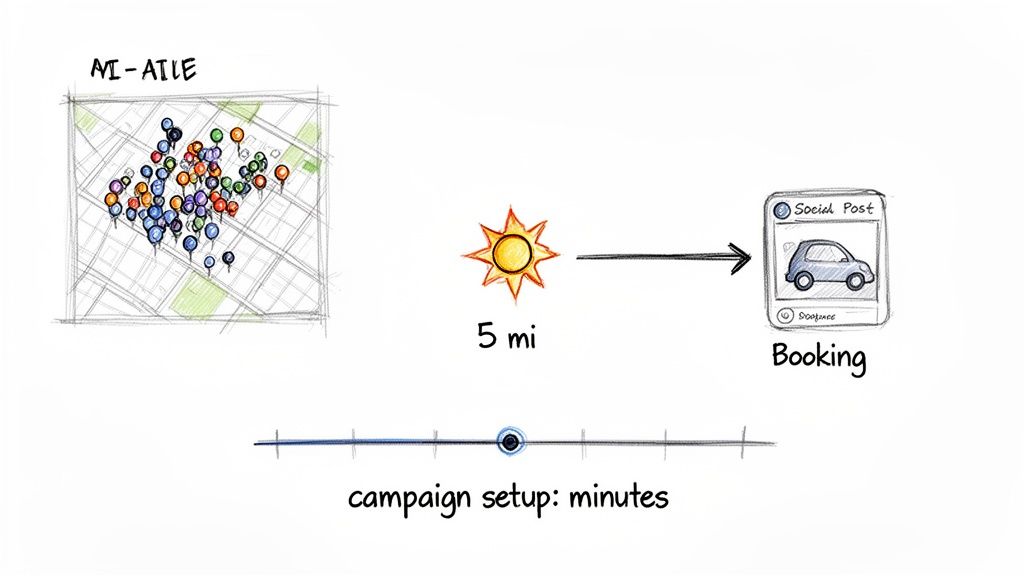
As you can see here, Sup's ready-made campaign templates turn a complicated task into just a few clicks. For a busy operator, that’s a game-changer.
From Manual Grind to Automated Growth
One of the biggest time-sinks for any restaurant owner is the sheer admin of influencer marketing. The DMs, the back-and-forth negotiations, the chasing for posts. It’s a full-time job. Sup's 'done-with-you' service gets rid of that entire burden. A mix of smart automation and human support handles all the heavy lifting for you.
The whole idea is to make influencer marketing feel easy. By automating the outreach, negotiations, content gathering, and reporting, Sup lets you get back to running your business, knowing your marketing is quietly bringing in customers.
This approach turns your marketing into a reliable, repeatable system. You can get campaigns live in minutes using pre-built templates, cutting down a process that used to take days into a simple 20-minute task. It’s a world away from the old-school, spreadsheet-heavy methods that make influencer marketing so difficult to manage.
Finally, Closing the Loop on ROI
The last piece of the puzzle is knowing what actually worked. How do you prove an Instagram post led to a booking? Sup gives you real clarity here with a dashboard that tracks offline results as they happen. Every campaign automatically creates:
- Unique Promo Codes: Each one is tied to a specific creator, so you can see every redemption right at your till.
- Trackable Booking Links: These use UTMs to show you exactly which influencer's post is driving reservations.
This information feeds directly into your dashboard, drawing a straight line from a TikTok video or an Instagram story to a full table. No more guesswork or trying to match up data manually. You get a clear, undeniable return on your investment, which makes it easy to see what’s working and put more fuel on the fire.
Your Platform Decision Checklist
Choosing the right platform is a big decision, but it gets a lot easier when you start asking the right questions. We’ve boiled down everything we've covered in this guide into a simple checklist. Think of it as your final audit before you sign on the dotted line.
This isn’t about ticking off a list of fancy features. It's about finding a partner that genuinely gets the restaurant business. You’ll feel confident in your choice when you know the platform is built to solve the unique challenges of hospitality and can actually help you grow.
Key Questions to Ask Any Platform Provider
Before you commit, run through these questions. The answers will tell you everything you need to know.
- Local Sourcing: Can I find creators by a specific postcode, or am I stuck with just a city-wide search? We need precision.
- ROI Tracking: How does it actually track performance? Can I see real-time redemptions from unique discount codes and clicks on booking links?
- Time Commitment: Let’s be realistic. How many hours a week will my team actually need to spend running a campaign on this platform?
- Content Rights: Do I automatically get the rights to reuse the content creators make? Or is that another headache I have to manage separately?
- Pricing Model: Is the pricing flexible? Does it make sense for a seasonal business like mine, or am I locked into a massive annual contract?
- Scalability: If I have multiple locations, can I run separate, localised campaigns for each one, but manage everything from a single dashboard?
Frequently Asked Questions
Jumping into influencer marketing can feel a bit daunting, and it's natural to have questions, especially when your goal is to get more people walking through your restaurant doors. Here are some straightforward answers to the questions we hear most often from owners and managers.
How Can I Actually Measure ROI on a Limited Budget?
When every pound counts, you can't afford to guess. Forget vanity metrics like 'likes' or 'views'. They don't pay the bills. The real secret is focusing on platforms that give you concrete, tangible tracking.
Look for tools that are baked right into the system, like:
- Unique Promo Codes: Giving each creator their own special code is the cleanest way to track sales. You can see every single time a code is used at your till, tying revenue directly back to a specific influencer.
- Trackable Booking Links: If you take reservations online, using links with UTM parameters is a must. This shows you exactly how many table bookings were driven by an influencer's post or story.
A platform designed for hospitality will make this incredibly simple. It’s all about drawing a straight line from a piece of content to a paying customer, without needing to wrestle with complicated spreadsheets.
Measuring success isn't about guesswork; it's about attribution. If a platform can't show you precisely how many bookings or sales came from a campaign, it’s not the right tool for your restaurant.
What Is the Real Time Commitment Involved?
Let’s be honest, the biggest hidden cost of influencer marketing is often your own time. The old way of doing things (endless scrolling to find creators, sliding into DMs, back-and-forth negotiations, and then chasing them for the actual content) can easily eat up hours every week.
But it doesn't have to be that way. A modern, automated platform can cut that time down to almost nothing. Look for a ‘done-with-you’ service that handles the heavy lifting: the outreach, the briefing, the follow-ups. Your involvement can shrink to just a few minutes a week to approve the creators and check the results. This turns what was once a time-consuming chore into a genuinely sustainable way to grow your business.
Ready to turn influencer marketing into a predictable growth channel? With Sup, you can launch fully managed campaigns in minutes, connect with local food creators, and track every booking and sale in real-time. Discover how over 650+ brands are saving time and driving measurable results. See how Sup works.
More on tools
See how many creators post about you and your competitors
Type in your brand's Instagram handle and we count the creators who post about you and about your five closest competitors. It takes about a minute and it is free. Or request a demo and we will show you the creators in your niche and walk you through the dashboard.
 Book a call