23 February 2026
How to Run a Restaurant Influencer Campaign (Step-by-Step): A Practical Guide
Running a successful influencer campaign for your restaurant isn't just a shot in the dark. It boils down to a clear, four-part process: define your business goals, set measurable KPIs, find local creators whose followers are your ideal customers, and then launch a campaign you can actually track for return on investment. This approach is what separates a hopeful expense from a predictable growth channel for your restaurant.
Setting the Stage for a Profitable Campaign
Before you even think about sliding into a single DM or offering a free meal, we need to talk strategy. A truly effective influencer campaign isn't about getting some vague "exposure"; it's a targeted marketing effort designed to hit real business goals. Without a solid plan, you're just giving away free food and crossing your fingers.
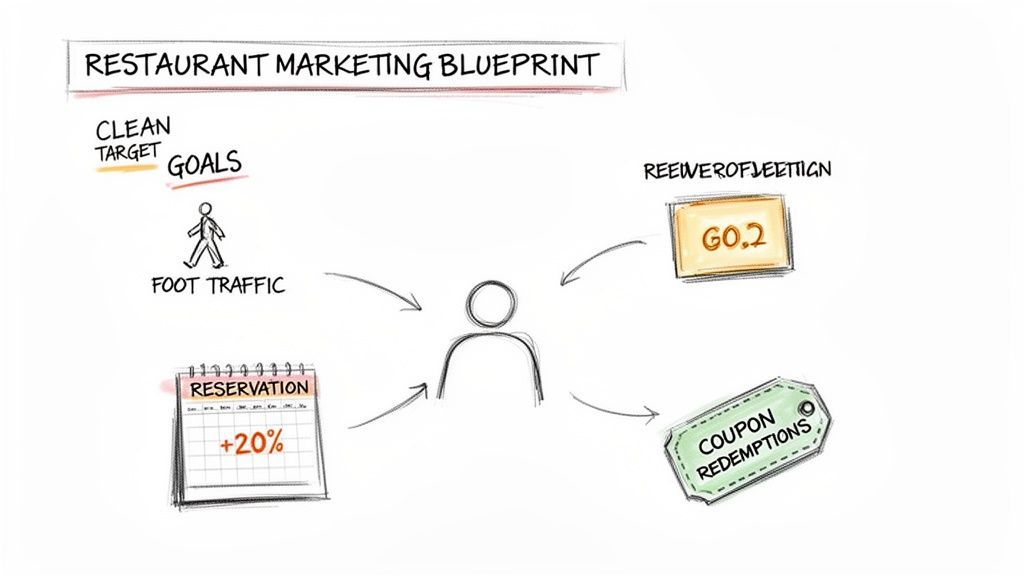
The whole process starts by getting crystal clear on what success actually looks like for your restaurant. What are you trying to achieve?
- Maybe you want to pack the house on a typically slow Wednesday night.
- Perhaps you're launching a new seasonal menu and need to generate bookings.
- Are you trying to increase online reservations through your website by 20%?
- Or do you want to boost takeaway orders during the weekday lunch rush?
Each of these is specific, measurable, and tied directly to a business need. This clarity becomes your North Star, guiding every single decision you make from here on out.
Define Your Goals and Key Metrics
Once you've nailed down a primary goal, it's time to connect it to the right Key Performance Indicators (KPIs). These are the hard numbers that will tell you if your campaign is actually working. It's easy to get distracted by vanity metrics like likes and follower counts, but those don't pay the bills. Instead, we need to focus on KPIs that reflect a tangible impact on your business.
To really get this right, it helps to understand the psychology behind why people decide to try a new place. Looking at powerful social proof examples can give you fantastic ideas on how influencers can genuinely motivate their audience to act. This insight helps you shape offers and content that create a real desire to visit.
A campaign without trackable KPIs is just a guessing game. The aim is to move from, "I think it worked," to, "I know it drove £X in sales and brought in Y new customers."
This simple diagram shows how your strategy should flow, starting with your high-level goals and moving towards execution.
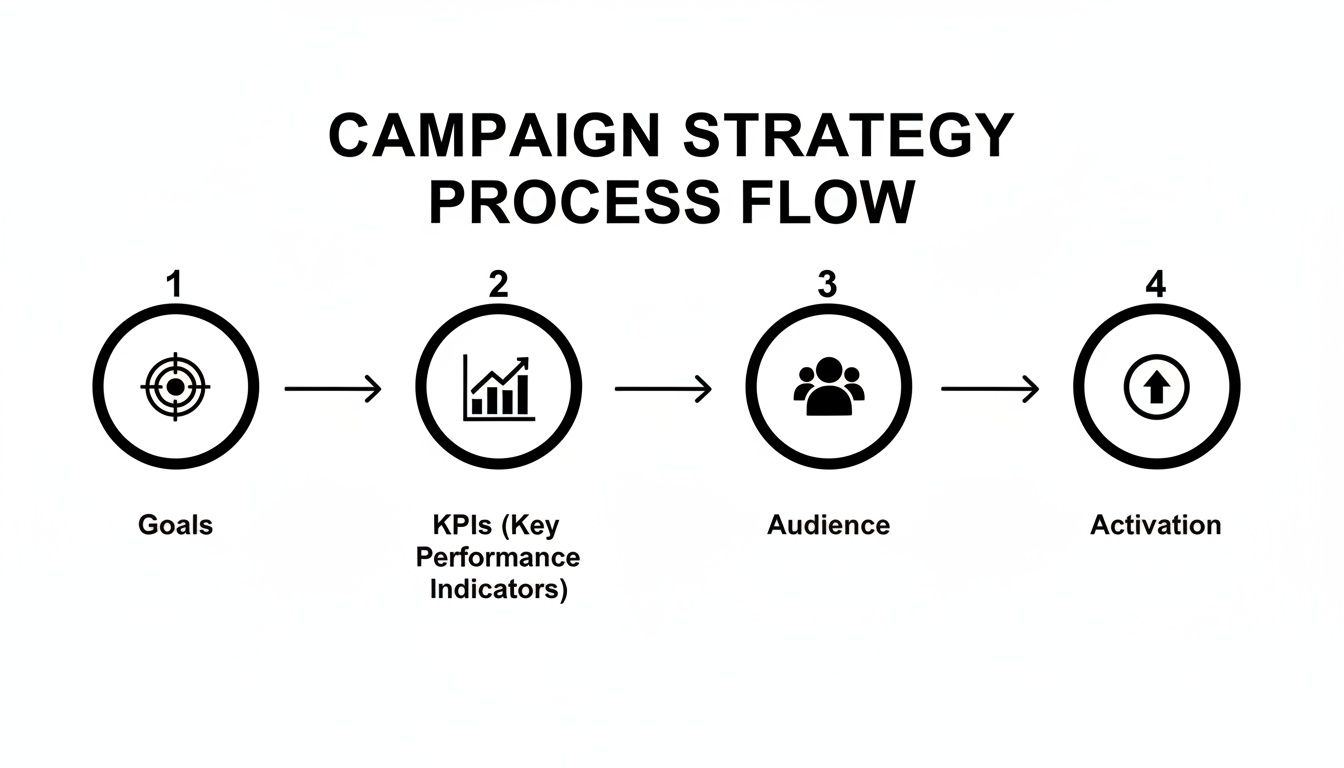
As you can see, defining your goals and KPIs is the non-negotiable first step, happening long before you even start looking for influencers.
Connecting your high-level goals to concrete metrics is where strategy turns into results. This table breaks down some common restaurant objectives and the specific KPIs you should be tracking to measure your success.
Matching Campaign Goals to Measurable Metrics
| Campaign Goal | Primary KPI | How to Track It |
|---|---|---|
| Increase dine-in footfall | Unique promo code redemptions | Assign a unique discount code to each influencer (e.g., "SOPHIE15"). |
| Boost online reservations | Tracked link clicks and conversions | Use UTM parameters on booking links to see who drives reservations. |
| Promote a new menu item | Sales of the specific item | Track item sales during the campaign period and attribute spikes to creator content. |
| Drive takeaway/delivery orders | Clicks on "Order Now" links | Create unique UTM-tracked links for your delivery platform partners. |
| Build brand awareness | Reach, impressions, and engagement rate | Monitor these metrics in your social media analytics, focusing on the influencer's posts. |
| Generate user-generated content (UGC) | Number of posts using a campaign hashtag | Create a unique hashtag (e.g., #YourBrandNights) and track its usage. |
By using this framework, you're creating a direct line between the influencer's activity and your restaurant's bottom line. It’s all about having the right tools in place before you launch.
Align Your Audience for Maximum Impact
Finally, you need to make absolutely sure the influencer's audience matches your target customer. A creator might have 50,000 followers, but if they are mostly budget-conscious students and you run a fine-dining spot, that partnership is set up to fail. This is where digging into audience demographics and interests is so critical.
Getting this strategic groundwork right is paying off for brands across the UK. The influencer marketing industry hit a massive USD 2.36 billion in 2024, and for good reason. A recent study found that 40% of UK consumers have tried new restaurants specifically because of what they saw on social media.
By setting clear goals, picking the right metrics, and ensuring your audience is aligned, you're building a blueprint for a successful campaign. Every action becomes intentional, measurable, and optimised for real results.
For a complete walkthrough on building your strategy from the ground up, check out our full guide on influencer marketing for restaurants.
Finding Local Influencers Who Actually Drive Footfall
Forget about chasing big-name creators with millions of followers. For restaurants, the real magic happens on a much smaller, more local scale. The best partners are often the micro- and nano-influencers whose followers are the very people living, working, and dining in your neighbourhood.
These creators, who typically have between 1,000 to 50,000 followers, have built tight-knit communities grounded in trust and shared local experiences. When they recommend a place, it feels less like an ad and more like a genuine tip from a friend. That authentic connection is what truly drives people through your doors, not just fleeting online attention.
Mastering Local Discovery on Social Media
Finding these local gems takes a bit of digital detective work, but it’s a straightforward process once you know where to look. Your best bet is to start on Instagram and TikTok, the platforms where visual food content is king.
You’ve got to think like a local customer. What would they be searching for? This is where using the platform's own features becomes your secret weapon.
- Location Tags: Start by searching for your restaurant’s specific location tag on Instagram. See who has already posted from your tables. These are your warmest leads: people who already love your food enough to share it. Then, broaden your search to nearby landmarks, specific neighbourhoods (like "Shoreditch, London"), and even your competitors' locations.
- Hyper-Local Hashtags: Go beyond generic tags like #foodie. Dive deep into hashtags specific to your city and cuisine, such as #manchesterbrunch, #liverpoolvegan, or #birminghamhalalfood. This immediately narrows your search to creators who are seen as authorities in your niche and local area.
- TikTok's Local Feed: TikTok's algorithm is incredibly good at local discovery. If you spend time engaging with content from your city, the "For You" page will quickly start showing you local creators. Try searching for terms like "best pasta in Bristol" or "Edinburgh coffee shops" to see who’s making waves nearby.
While this manual approach is a great place to begin, we break down even more advanced techniques in our detailed guide on how to find local food influencers in your city.
The All-Important Vetting Process
Once you’ve got a list of potential partners, the real work begins. A big follower count means absolutely nothing if the audience isn’t real or engaged. Vetting is the one step that separates a successful campaign from a complete waste of time and money.
Your goal here is to assess the quality of their influence, not just the quantity of their followers. A creator with 5,000 highly engaged, local followers is infinitely more valuable than one with 50,000 disengaged followers from all over the country.
Remember, you're looking for a true local advocate, not just a content creator. Their genuine enthusiasm for your restaurant is what will convince their followers to visit. The partnership has to feel authentic to their audience.
Analysing Engagement and Authenticity
You need to look past the surface-level numbers and see how their community actually interacts with their content. This is where you’ll spot the difference between a fantastic partner and a potential red flag.
Here's what to look for on their profile:
- Check the Comments: Are the comments genuine conversations, or just a stream of "Nice pic!" and random emojis? You want to see real questions ("What was your favourite dish?") and comments from other local accounts. That’s a sign of a real community.
- Evaluate Engagement Rate: For a micro-influencer, a healthy engagement rate is typically above 3-6%. To work it out, just add the likes and comments on a few recent posts, divide by their total follower count, and multiply by 100. A consistently low rate can be a warning sign of fake followers or a bored audience.
- Review Content Quality and Style: Does their photography and video style align with your restaurant's brand? If you’re a high-end bistro, a creator who only posts blurry, low-lit photos probably isn’t the right fit. Aesthetic alignment is crucial for brand consistency.
- Look for Past Collaborations: See how they've promoted other local businesses. Did they properly disclose the partnership (e.g., using #ad or #gifted)? Was the content creative and persuasive? This gives you a sneak peek into what it would be like to work with them.
By following this structured approach (combining smart discovery with thorough vetting), you'll build a roster of local influencers who can become powerful, long-term partners in growing your restaurant's reputation and revenue.
Crafting Outreach That Gets a 'Yes'
You've done the groundwork and found some great local creators who genuinely connect with your community. Brilliant. But now comes the part where so many restaurants fall flat: the outreach. A lazy, copy-pasted "wanna collab?" message is the quickest way to end up in the bin or be left on read.
To actually get a 'yes', your outreach has to feel personal, professional, and dead simple to understand.
Think about it from their perspective. Popular local creators get dozens of these requests. You need to stand out, and you do that by showing you’ve actually done your homework. Kick things off by mentioning a specific post of theirs you genuinely enjoyed. Maybe it was their review of another spot down the road or a Reel that actually made you laugh. This one small detail shows you see them as a person and a creative partner, not just another name on a spreadsheet.
After that personal touch, get straight to business. Briefly introduce your restaurant and, crucially, explain why you think a partnership would be a fantastic fit for their followers. Keep it short, sweet, and focused on the mutual benefit.
Structuring an Irresistible Offer
This is the heart of your message. Your offer needs to be crystal clear, fair, and tied directly to what you’re trying to achieve. For restaurants, compensation doesn't always mean a big cheque, especially when you're working with nano- and micro-influencers. Many are genuinely excited to create content in exchange for a fantastic experience.
Here are the most common ways to structure a deal in the hospitality world:
- Gifted Experience: This is the classic starting point. You offer a complimentary meal for the influencer and a plus-one. It’s a low-risk way to build a relationship and get some authentic, honest content.
- Gifted Plus: On top of the meal, you might offer a small stipend, say, £50-£150, to cover their time and effort. This is a good move if you have more specific content requests.
- Performance-Based: This is a brilliant model because it perfectly aligns your goals. You provide the gifted meal and then offer a commission for every customer who comes in using their unique promo code. It directly rewards the creator for driving real footfall.
Pro Tip: Never be vague about the offer. A casual "we'd love to host you" just creates awkwardness down the line. State exactly what’s included, whether it’s a meal up to a certain value, a specific set menu, or drinks.
Building the Perfect Campaign Brief
Once a creator says yes, the next step is sending over a campaign brief. Think of this document as the north star for your collaboration. It eliminates all the guesswork and ensures you're both completely aligned on what’s expected. A solid brief is your best insurance policy for getting the content you actually want and avoiding any painful misunderstandings.
Your brief should be detailed but not overwhelming. It's a reference guide, not a legal document. It's the playbook for a winning partnership.
Key elements your campaign brief must include:
- Campaign Overview: A quick, one-sentence summary of the goal (e.g., "Promoting our new weekend brunch menu to foodies in Manchester").
- Deliverables: Be incredibly specific. Don't just say "some posts." Say "one Instagram Reel and three Instagram Stories."
- Key Messages: What are the must-mention points? Is it your locally sourced ingredients? The cosy atmosphere? Your "two-for-one" cocktail offer on Tuesdays? List them out.
- Mandatory Tags & Hashtags: Clearly list your restaurant's handle (@YourRestaurant) and any specific hashtags you're using (#YourBrandBrunch).
- Disclosure Rules: This is absolutely non-negotiable. Remind the creator they must use #ad or #gifted right at the beginning of their caption to comply with ASA guidelines in the UK.
- Timeline: Give them a date for their visit and a clear deadline for when the content needs to be published.
Putting the effort into these partnerships really does pay dividends. In the UK, influencer marketing generates an average return of £5.78 for every £1 spent, and 83% of brands confirm it’s a highly effective way to bring in quality customers. Platforms like Sup can manage this entire workflow, from finding creators to building campaign briefs with integrated tracking that turns those views into measurable sales. Discover more about the powerful ROI of UK influencer marketing and how you can make it work for your brand.
Executing Flawlessly and Tracking Real-World ROI
You’ve laid the groundwork, found your ideal creators, and now it's time to bring the campaign to life. This is the moment where your careful planning turns into a tangible, real-world experience. The small details in this phase are what separate a good campaign from a great one.
Execution isn’t just about getting the influencer through the door. It starts with your own team. A step I see so many restaurants miss is properly briefing their front-of-house staff. Let your team know who is coming, when they’ll arrive, and why their visit matters. An influencer who feels genuinely welcomed and looked after will create content that glows with authenticity and enthusiasm. It's a simple, human touch that pays dividends.
Now, let's talk about results: the kind your accountant will actually care about. It's time to move past surface-level metrics like likes and comments and get down to the data that truly impacts your bottom line: new bookings, offer redemptions, and the actual revenue driven by each influencer.
Measuring What Matters: Promo Codes and UTMs
To confidently say an influencer's post led to a customer dining with you, you need a reliable tracking system. This is where two simple but powerful tools come into play: unique promo codes and UTM links.
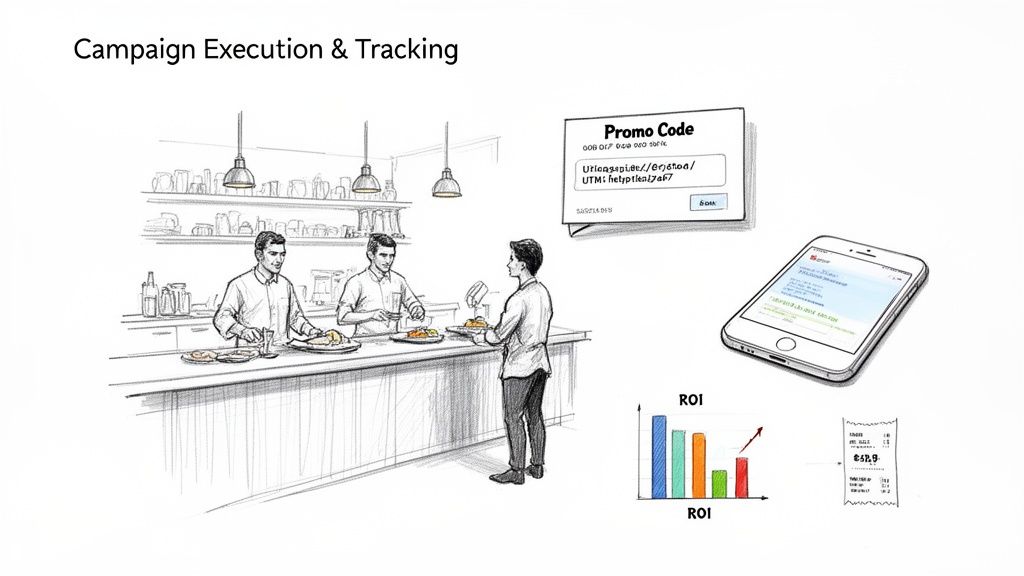
A promo code is your secret weapon for tracking footfall. Assign each influencer their own unique code that's easy for customers to remember: something like "CHLOE15" for 15% off. When a guest uses that code, you have undeniable proof that the influencer sent them. Just like that, your influencer marketing shifts from a hopeful expense to a measurable sales channel.
For online actions, such as table reservations or delivery orders, UTM links are your best friend. These are just your normal website links with a few extra tracking tags added to the end. They don't change where the link goes, but they tell your analytics software exactly where that click came from.
How to Build a UTM Link for Bookings
Let's imagine you’re working with a local food blogger named Alex to promote your new spring menu. You want to track every single booking that comes from the link in their Instagram bio. You’d build a special link for them using a free tool like Google's Campaign URL Builder.
Below is a practical example of how you would set this up to attribute online reservations directly to Alex's content.
UTM Link Builder for Restaurant Booking Systems
| UTM Parameter | Example Value | What It Tracks |
|---|---|---|
| utm_source | The platform where the traffic originated. | |
| utm_medium | influencer | The type of marketing channel (e.g., social, email, influencer). |
| utm_campaign | spring_menu_launch | The name of your specific marketing campaign. |
| utm_content | alex_foodie | Identifies the specific influencer or piece of content. |
When Alex’s followers click this tagged link and book a table, your analytics will clearly show that the reservation came directly from their post. This is how you calculate a precise return on your investment. If you're building a budget, understanding the typical cost of restaurant influencer marketing will help you allocate funds effectively.
This level of tracking isn’t just a nice-to-have; it’s fundamental to running a professional campaign. In the UK, a staggering 69% of consumers have bought something after seeing an influencer’s promotion. With 86% of marketers now using influencers, the ability to prove ROI is what separates the pros from the amateurs. You can explore more of these UK influencer marketing trends to see just how effective this channel can be.
The goal is to create a closed loop where you can see the entire customer journey, from the influencer’s post to the final sale. This data-driven approach allows you to double down on what works and cut what doesn't.
By diligently tracking every redemption and click, you gain crystal-clear insight into which partners and content styles are your most valuable assets. This is the knowledge that allows you to refine your strategy, optimise your budget, and build an influencer programme that truly grows your restaurant.
Turning One Campaign into a Long-Term Asset
When the last influencer post goes live, it’s tempting to think the job is done. But that’s a mistake. The real return on your investment comes from what you do next, transforming a single collaboration into a lasting asset for your restaurant.
This final stage is all about strategy. It's where we take all that incredible content your partners have created (the beautiful photos, engaging videos, and authentic reviews) and put it to work. Think of it as a goldmine of marketing material just waiting to be tapped.
Maximising Your User-Generated Content
Throughout the campaign, your influencer partners have been busy creating high-quality, authentic content that showcases your restaurant. This user-generated content (UGC) is far more valuable than a single post on their feed. It’s powerful social proof, and you absolutely should be repurposing it.
Of course, the first step is making sure you have the rights to do so. This should have been clearly stated in your initial campaign brief and agreement. All you need is a simple clause giving you permission to repost and repurpose their content (with credit, always).
With the green light, you can breathe new life into every piece of content. Here’s how you can weave it into your marketing:
- Social Media Feeds: Share the best influencer photos and Reels on your own Instagram, TikTok, and Facebook. This fills your content calendar with genuine, high-quality posts showing real people loving what you do.
- Email Newsletters: Got a stunning photo from an influencer? Feature it in your next newsletter to promote a seasonal special or a weekend event. It adds a layer of authenticity that stock photos can never replicate.
- Website Content: Create a gallery or a “Spotted at [Your Restaurant]” section on your website. This is incredibly powerful social proof for potential new customers browsing your site.
- Digital Advertising: Use those compelling influencer videos in your paid social ads. This kind of authentic content often smashes the performance of polished, studio-shot ads because it feels more genuine and relatable.
Analyse Performance to Identify Your Stars
Now it’s time to get your hands dirty with the data you've been carefully tracking. This is where you connect the dots between all that influencer activity and your actual business results. Your mission is to figure out what worked, what didn't, and who your top performers really were.
Pull together all your data from the promo code redemptions and UTM link clicks. This gives you a clear, quantitative picture of which influencers drove the most tangible results: bums on seats, bookings, and sales.
The post-campaign analysis is where you find your growth levers. It tells you which partners to reinvest in and what kind of content truly resonates with your target audience, turning insights into a repeatable strategy.
You might discover, for example, that an influencer with only 5,000 followers drove twice as many bookings as a creator with 25,000. This is an invaluable insight. It proves that a smaller, hyper-engaged local audience can be far more powerful. This data-driven approach is the key to making your next campaign even better.
Nurturing Key Influencer Relationships
Your top-performing influencers are more than just content creators; they're now powerful brand advocates and valuable business partners. Don't let these relationships fizzle out after one great campaign. The real goal here is to build a scalable, repeatable programme that becomes a consistent growth driver for your restaurant.
Reach out to your star performers with a personal thank-you message. Share the positive results their content generated. They’ll love knowing they made a real impact. This reinforces their value and shows that you see the partnership as a two-way street. Consider adding them to a VIP list for future events, menu tastings, or the first call for your next campaign.
To truly turn your influencer work into a long-term asset, it's also essential to continually monitor your online reputation. This helps you capitalise on the positive sentiment from the campaign and proactively address any feedback that comes up. Building these relationships turns one-off projects into a reliable network of advocates who consistently drive business and create positive buzz. This is how you move from just running a single campaign to building a powerful, long-term marketing engine for your brand.
Your Top Restaurant Influencer Campaign Questions, Answered
As you get ready to launch your first influencer campaign, a few questions are bound to come up. It's completely normal. We've heard them all from restaurant owners and marketing managers, so we’ve put together this quick guide with practical, no-fluff answers to help you get started with confidence.
How Much Should I Pay a Food Influencer in the UK?
This is the big one, and the answer is: it varies. The good news is that it doesn’t always mean handing over a big cheque. For a lot of nano-influencers (1k-10k followers) and even some micro-influencers (10k-50k followers), a complimentary meal for two at a great spot like yours is a perfectly fair exchange for some content. They get a fantastic experience, and you get authentic promotion.
Things change when you start asking for more specific content, like a high-quality Reel or a guaranteed number of posts. At this point, it’s common to bring money into the conversation. A fee between £100 to over £500 is a realistic range for these smaller creators, depending on their engagement rates and exactly what you're asking them to do.
One of our favourite approaches is a hybrid model. Offer the gifted meal plus a performance bonus based on how many people use their unique promo code. This way, your goals are perfectly aligned. They’re rewarded for genuinely driving customers through your door.
What Are the Most Important Metrics to Track?
It’s tempting to get excited about thousands of likes and views, but those are just vanity metrics. They don't pay the bills. To figure out if your campaign actually worked, you need to focus on what impacts your bottom line.
For any restaurant, these are the KPIs that truly matter:
- Promo Code Redemptions: This is your gold standard. It’s undeniable proof that a specific influencer sent a paying customer to your restaurant.
- Trackable Link Conversions: By using UTM links, you can see exactly how many online bookings or delivery orders came directly from an influencer’s post. This is how you measure digital ROI.
- Reach on Geo-Tagged Content: This tells you how many people in your area saw content about your restaurant, giving you a real sense of local brand awareness.
- Quality of User-Generated Content (UGC): Don’t underestimate the value of the photos and videos you get. A bank of high-quality, authentic content you can reuse on your own social media, website, and ads is a massive long-term win.
The most successful campaigns are the ones you can measure. By focusing on metrics that tie directly to revenue and footfall, you turn influencer marketing from a marketing expense into a predictable growth channel.
How Do I Handle UK Advertising Disclosure Rules?
This is non-negotiable. Getting advertising rules right is your responsibility as the brand. In the UK, the Advertising Standards Authority (ASA) is very clear: any paid post or gifted experience must be clearly disclosed to the audience.
Make it mandatory for influencers to use clear markers like #ad or #gifted right at the start of their caption. It can’t be buried in a sea of other hashtags at the end. Using the built-in "Paid Partnership" label on platforms like Instagram is another great way to stay compliant.
Be explicit about these requirements in your campaign brief. It protects you, the creator, and their audience, ensuring everyone maintains trust.
Is It Better to Gift a Meal or Pay a Fee?
Honestly, the right move depends on the influencer and your campaign goals. Gifting is a brilliant, low-risk way to start, especially with nano- and smaller micro-influencers. Many are keen to build their portfolios and are genuinely excited to create content in exchange for a memorable experience.
Paying a fee makes more sense when working with larger, more established influencers, or when you need very specific, guaranteed posts. For instance, if your campaign absolutely requires one permanent feed post, one Reel, and three Stories, a fee is almost always expected.
For your first few campaigns, our advice is to start with gifted collaborations. It’s a budget-friendly way to learn the ropes, see what works, and start building genuine relationships with local creators.
Ready to stop the guesswork and start driving measurable results? Sup combines smart technology with a human team to find local creators, manage your campaigns, and track ROI from post to purchase. Set up in minutes and watch the bookings roll in. Launch your first campaign with Sup.
More on industries
See how many creators post about you and your competitors
Type in your brand's Instagram handle and we count the creators who post about you and about your five closest competitors. It takes about a minute and it is free. Or request a demo and we will show you the creators in your niche and walk you through the dashboard.
 Book a call