20 April 2026
Influencers in Travel: Drive Results with Our 2026 Guide
You’re likely dealing with a familiar problem. Paid social is getting more expensive, generic brand creative blends into the feed, and the glossy destination shots your team spent weeks approving aren’t producing a clear lift in bookings, covers, or revenue.
At the same time, travellers haven’t stopped discovering places. They’ve just changed where discovery happens. The starting point now is often a creator’s Reel, a TikTok packing guide, a restaurant walkthrough, or a saved city list on Instagram.
That shift is why influencers in travel matter, but it’s also why so many programmes disappoint. Brands still brief creators like media placements, then report on reach as if reach pays for rooms, reservations, or experiences. It doesn’t. A strong travel creator programme is built like a growth channel. You need the right creator mix, the right platform fit, a campaign structure that generates usable content, and tracking that finance can understand.
The New Travel Guide Why Influencers in Travel Matter Now
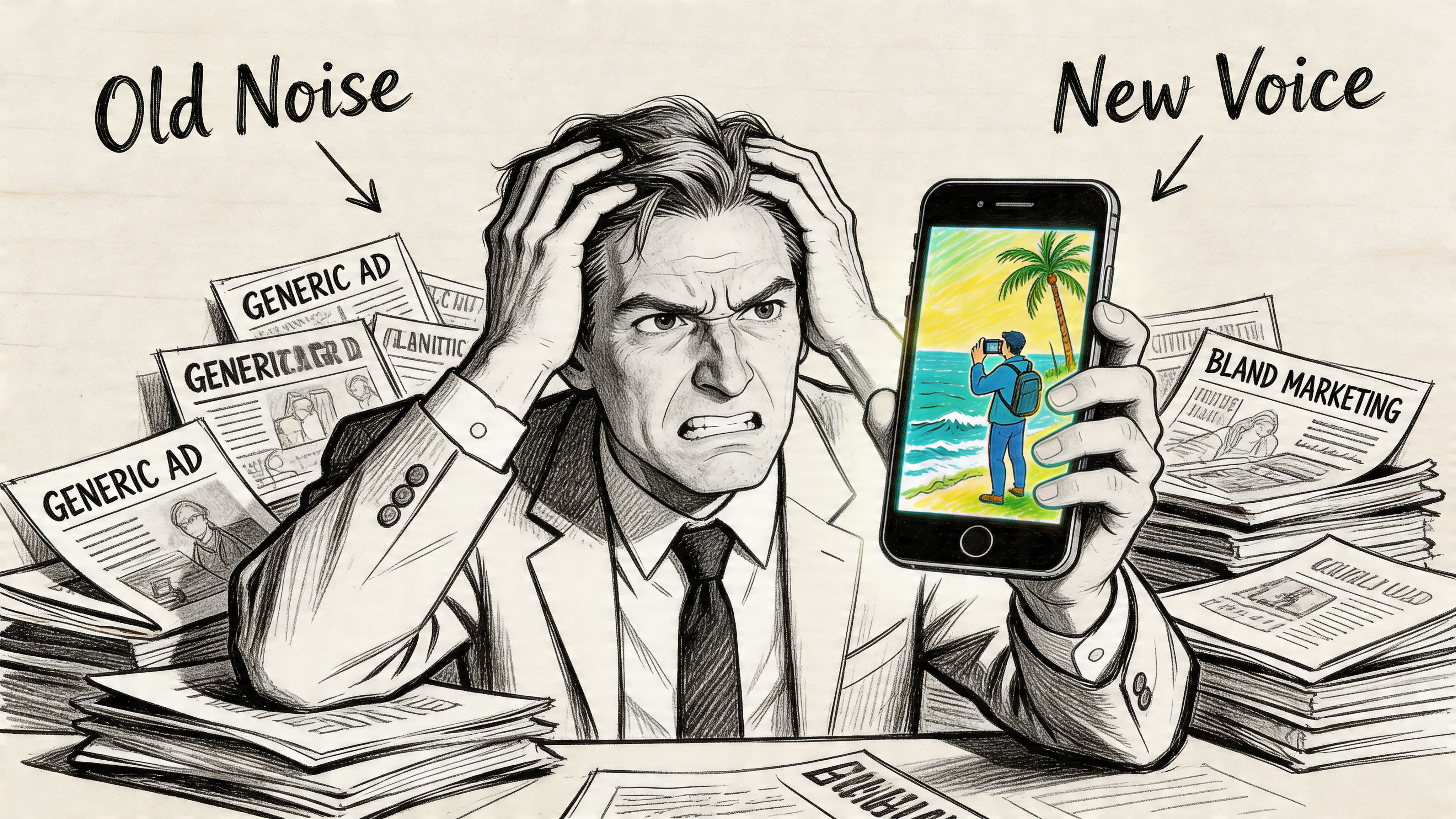
A lot of travel and hospitality teams are still trying to solve a modern discovery problem with old campaign thinking. They launch polished ads, run seasonal offers, sponsor a few posts, and hope a nice-looking asset will push someone from awareness to booking.
That’s not how most younger travellers behave now. Discovery is fragmented, social-first, and heavily influenced by people who look closer to trusted locals than polished brand accounts.
A useful benchmark comes from a November 2024 Statista study on influencer impact in trip planning. It found that 31% of millennial tourists relied on social media influencers for planning their last trip, compared with 5% of baby boomers. The same source notes that younger generations are projected to account for 80% of global travel spend by 2025.
That matters because travel decisions rarely begin with intent. They begin with inspiration. Someone sees a weekend stay that feels attainable, a creator documents a train route that looks easier than expected, or a local food guide makes a neighbourhood look worth crossing town for. The creator is no longer just distributing content. They’re shaping the shortlist.
Why trust has shifted
Brand channels still matter. They’re where people check details, prices, policies, menus, and availability. But they usually aren’t where emotional momentum begins.
Creators fill the trust gap because they show context. They answer the questions polished brand assets often avoid:
- What it feels like to stay, eat, visit, or travel there
- Who the experience suits such as couples, families, solo travellers, or budget-conscious guests
- What the trade-off is between hype and reality
- Whether the place feels current rather than stock-photo perfect
Practical rule: If your campaign only produces beautiful content, you’ve built awareness. If it shows relevance, timing, and proof, you’ve built demand.
Why urgency matters now
The teams that win with influencers in travel aren’t waiting for a perfect celebrity partnership. They’re building repeatable creator systems around discovery, content production, and measurable actions.
That’s the key opportunity. Not “doing influencer marketing” as a trend. Building a creator programme that can drive bookings, footfall, reviews, and reusable content in a way your wider team can support.
Understanding Different Types of Travel Creators
Follower count is a poor planning tool on its own. It tells you how many people might see someone’s content, not whether that creator can influence the audience you need.
In travel, the better starting point is campaign intent. Are you trying to drive local footfall, generate destination awareness, produce content for paid reuse, or support a launch in multiple locations? The right creator tier changes with the job.
Start with creator tiers, not celebrity appeal
The most useful way to segment influencers in travel is by audience size plus audience relevance.
| Creator Tier | Follower Range | Avg. Engagement | Best For |
|---|---|---|---|
| Nano | Smaller local audiences | Varies | Hyper-local trust, niche communities, authentic UGC |
| Micro | 10k to 100k followers | 4.1% | Local hospitality, destination discovery, promo code campaigns |
| Macro | More than 100k followers | 1.3% | Reach, awareness, larger brand campaigns |
| Mega | Very large celebrity-scale audiences | Varies | Broad visibility, PR moments, top-of-funnel exposure |
The strongest benchmark here comes from the 2024 study on UK travel influencer performance. In the UK travel creator ecosystem, micro-influencers with 10k to 100k followers achieve 3.2x higher engagement rates, averaging 4.1%, compared with 1.3% for macro-influencers above 100k. The same source reports a 27% uplift in promo code redemptions for local hospitality brands using this kind of niche alignment.
That finding matches what performance marketers usually see in practice. Large creators can make a venue look famous. Smaller creators are often better at making it look relevant to a specific audience that will take action.
What each tier does well
Nano creators are often underestimated. They usually work best for local venues, regional launches, and review generation because their audience often overlaps with a real geography. Their content can feel less polished, but that’s often the point.
Micro creators are the workhorse tier for most travel campaigns. They tend to balance trust, quality, responsiveness, and manageable cost. If you run a boutique hotel, a restaurant group, or a destination experience brand, this is usually where the most practical traction lives.
Macro creators can still be useful. They’re stronger when the goal is broad visibility, social proof, or a major launch. The downside is that their audience is often more general, the content can skew towards performance for the creator rather than the brand, and attribution gets harder.
Mega creators are usually PR plays more than performance plays. They can create a moment, but they’re rarely where a programme should start if your team needs measurable outcomes.
Bigger audiences usually increase variance. You might get scale, but you also accept weaker audience fit and softer attribution.
Niche matters as much as tier
A travel creator isn’t one category. There are very different subgroups with different audience expectations:
- Luxury travel creators suit premium hotels, high-end dining, and aspirational destination campaigns.
- Budget and value-focused creators often drive stronger action because their audience is trained to look for practical recommendations.
- Adventure creators fit tours, outdoor stays, transport, and experience-led travel.
- Family travel creators are useful when parents need planning confidence, not just inspiration.
- Solo travel creators often perform well for itineraries, safety reassurance, and first-time destination content.
- Local city creators are often the best match for restaurants, neighbourhood hotels, and short-stay experiences.
If you’re building programmes for hotels or hospitality groups, the playbook for local relevance matters more than a national vanity list. This hotel and hospitality influencer marketing guide is a helpful reference for thinking through that operationally.
A practical selection rule
Choose the creator tier based on the narrowest useful outcome.
If the goal is “make more people aware of us”, almost any creator can sound suitable. If the goal is “increase bookings for this location, from this audience, within this window”, your shortlist gets better very quickly.
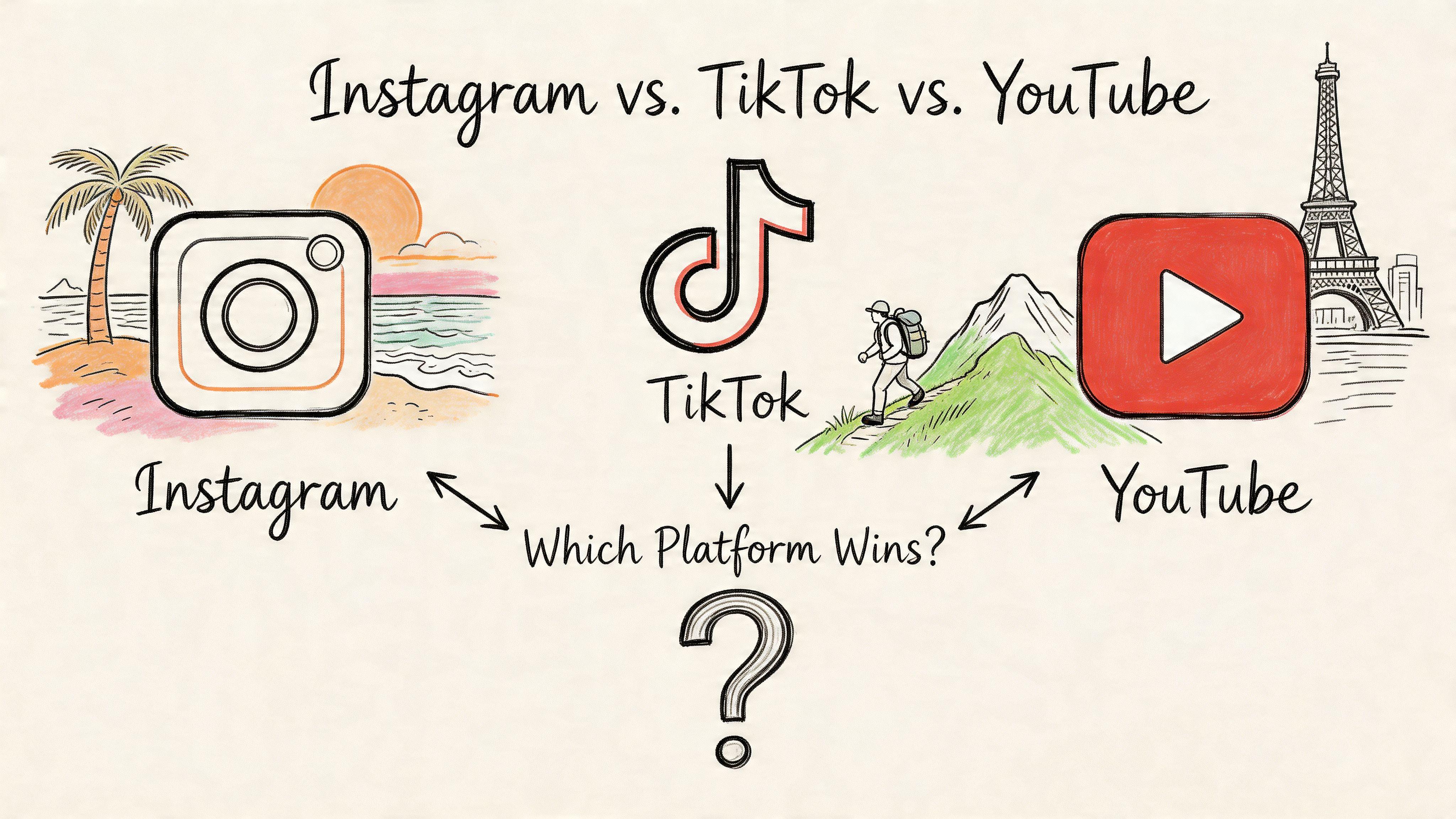
Instagram vs TikTok vs YouTube Which Platform Wins
No platform wins by default. The right answer depends on what you need the content to do after it’s published.
Travel marketers often make the mistake of picking a platform based on what looks best internally. The better question is simpler. Where does your audience discover, evaluate, and revisit travel content before acting?
Instagram wins when the destination has to feel desirable
Instagram remains strong for visual discovery, saved lists, geo-tagged browsing, and polished but still creator-led storytelling. It works well for hotels, cafés, destination venues, and experience brands that need to look bookable in a single glance.
Its main strength is intent support. People use it to compare aesthetics, check tags, scan comments, and decide whether a place fits the version of the trip they want.
It’s especially useful for:
- Shortlist building through Reels, carousels, and tagged posts
- Social proof when prospects inspect your tagged content before booking
- Repurposing because strong Instagram assets often transfer well into paid social and on-site galleries
The limitation is that Instagram content can become too polished. If everything looks like an ad, viewers may admire it without trusting it.
TikTok wins when speed and relatability matter
TikTok is where travel discovery often feels most immediate. The format rewards candid context, strong hooks, useful opinions, and moments that feel current rather than heavily art directed.
A key benchmark comes from PhotoAid’s travel and social media analysis. It reports that TikTok’s share of voice in hospitality grew 100x year-over-year by Q1 2025, and that Gen Z are 34% more likely to book trips based on influencer content than on brand advertising.
That matters because TikTok is exceptionally good at driving “I didn’t plan this, but now I want it” behaviour. Packing guides, room tours, hidden menu items, itinerary clips, and neighbourhood recommendations all map well to the platform.
TikTok often converts because it feels less like promotion and more like a useful nudge from someone already there.
For teams deciding how short-form should differ by channel, this breakdown of YouTube Shorts vs TikTok vs Reels is worth reviewing before briefing creators. The formats overlap, but audience behaviour doesn’t.
A useful creative reference sits below.
YouTube wins when planning depth matters
YouTube is slower-moving but more durable. It’s strongest when travellers want detail, comparison, and reassurance before spending more money or committing to a longer trip.
For travel brands, that means:
- Longer destination guides
- Room, route, or itinerary walkthroughs
- Evergreen search behaviour
- Deeper audience qualification
If Instagram is the window display and TikTok is the spontaneous recommendation, YouTube is often the research layer that helps people justify the decision.
The practical answer
Use platforms according to buying behaviour, not brand preference.
| Platform | Strongest Use Case | Typical Travel Strength |
|---|---|---|
| Discovery plus validation | Visual appeal, saves, tagged proof | |
| TikTok | Fast action and trend-led discovery | Relatable short-form, creator trust, immediacy |
| YouTube | Deep evaluation and evergreen search | Long-form guides, planning confidence |
If you only choose one, choose the platform your customers already use to narrow options. If you can support two, pair a fast-discovery channel with one that gives the audience more depth.
Finding and Vetting Your Ideal Travel Creators
Most teams don’t struggle to find any creators. They struggle to find the right ones without wasting days on search, DMs, spreadsheets, and vague judgement calls.
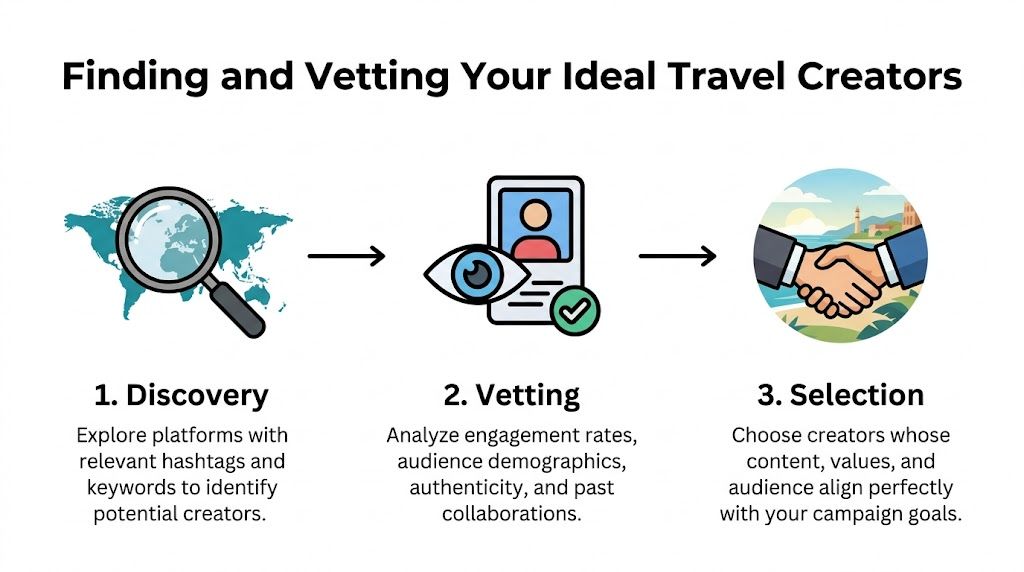
The manual route still works. You can search hashtags, inspect geo-tags, review tagged posts, scan who competitors repost, and build a list by hand. That’s often where good creator discovery starts. It’s also slow, inconsistent, and hard to repeat across locations.
How to build a shortlist manually
Use a narrow search frame first. Broad searches like “travel influencer UK” will flood you with creators who are too general to help.
Start with combinations such as:
- Location plus experience like “Manchester brunch”, “Cornwall staycation”, or “Edinburgh boutique hotel”
- Audience type plus format such as family travel, budget city breaks, solo weekend guides
- Competitor adjacency by checking who recently visited similar venues
- Local relevance signals like repeat posting from the same city or region
The quality of the shortlist depends on specificity. A creator who regularly covers a city, a dining category, or a style of travel is usually more valuable than a general lifestyle account that occasionally posts from a hotel.
Vet the audience, not just the content
A nice feed can hide a weak fit. Before outreach, review what sits behind the profile.
Use this checklist:
- Engagement quality Read the comments. Are people asking real questions, tagging friends, and referring to the place, or are the replies generic?
- Location fit Check whether the audience appears relevant to your geography. A creator can have strong numbers and still be wrong for a venue that relies on local or regional demand.
- Content consistency One great travel post doesn’t make someone a travel creator. Look for repeat evidence that their audience expects this kind of recommendation.
- Commercial balance If every post is sponsored, trust drops. Audiences notice when the feed becomes an ad carousel.
- Past brand alignment Review prior collaborations. If they’ve promoted direct competitors repeatedly, your campaign may struggle to stand out.
Red flags that deserve more scrutiny
You don’t need forensic software to spot weak creator fit. A basic review often reveals enough.
- Follower-to-engagement mismatch can suggest inflated audiences or weak relevance.
- Comment sections full of short generic praise often indicate low-value engagement.
- Sharp shifts in content style can mean the creator is chasing deals rather than serving an audience with a clear niche.
- No sense of place is a problem for travel. If their content could have been made anywhere, it may not persuade someone to visit your location.
If you can’t explain in one sentence why this creator’s audience would care about your venue, don’t move them forward.
What a good match looks like
The best travel creators usually make the brand feel like a natural part of their world. Their audience already trusts them for recommendations in that category, location, or style of travel. The collaboration doesn’t need a hard sell because the fit is self-evident.
That’s the standard worth holding. Vetting isn’t about eliminating risk entirely. It’s about stacking the odds in favour of relevance before any budget or gifting leaves the building.
Designing Your High-Impact Influencer Campaign
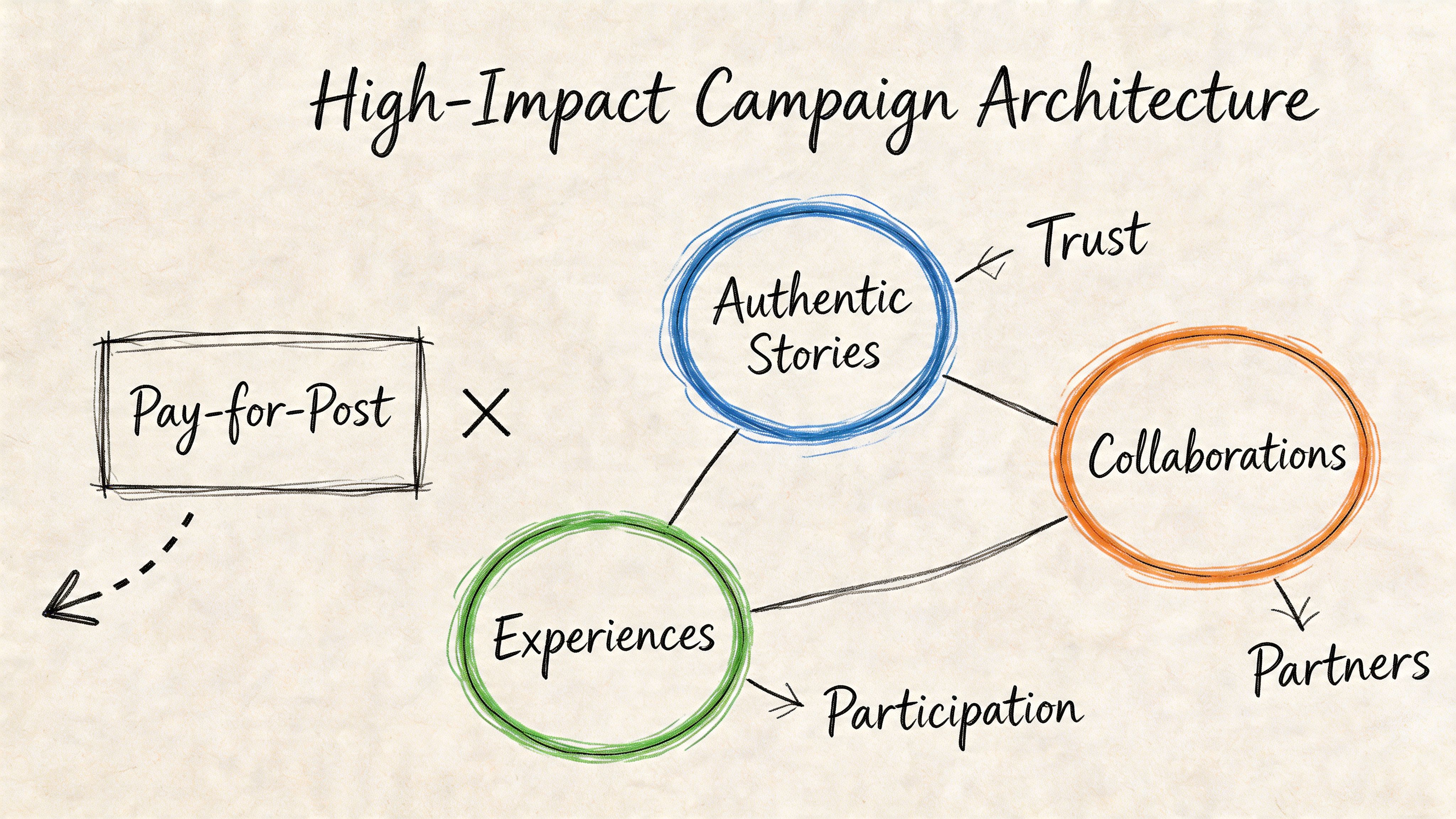
A weak campaign usually starts with a lazy brief. “Come in, make content, tag us” sounds flexible, but it leaves too much to chance. The result is often attractive content with no clear hook, no proof point, and no useful action for the audience.
Travel campaigns perform better when the experience, the creator angle, and the conversion path are all designed together.
Choose a campaign shape that fits the venue
Not every travel brand needs a press trip. In many cases, a smaller and more focused concept performs better.
Common formats that work:
- Hosted stay or visit for hotels, retreats, and experience-led properties where the creator can document arrival, service, and the surrounding area
- Day-in-the-life format for restaurants, cafés, attractions, and local experiences that need a realistic use case
- Neighbourhood or city guides where your venue appears as part of a broader itinerary
- Seasonal angle campaigns such as festive breaks, summer terraces, or weekend itineraries
- UGC-first shoots where the main goal is asset creation for your own channels, not creator reach alone
The trade-off is simple. The more ambitious the concept, the more coordination you need. The more straightforward the experience, the easier it is to scale.
Compensation needs structure, not guesswork
There isn’t one correct payment model for influencers in travel. The right structure depends on creator size, campaign objective, and how much value is being exchanged through hospitality, product, experience, or direct payment.
The main options are:
| Model | Best Use | Watch-out |
|---|---|---|
| Flat fee | Clear deliverables and timelines | Can become transactional if the brief is weak |
| Gifting or hosted experience | Venues with high experiential value | Works poorly when the creator sees little real value |
| Affiliate or commission | Campaigns with trackable conversions | Needs tight tracking and creator buy-in |
| Hybrid deal | Mix of fee, experience, and performance incentive | Requires more admin but often aligns interests better |
A common mistake is paying for output rather than fit. One polished video from the wrong creator is still the wrong campaign.
Write a brief creators can actually use
The best briefs are specific on outcome and loose on expression. You need to define what must be communicated without scripting every line.
Include:
- Campaign goal such as bookings, footfall, reviews, or content creation
- Audience including geography and travel mindset
- Core proof points like location, menu highlights, room features, or nearby attractions
- Non-negotiables such as booking link usage, promo code mention, disclosure, or date windows
- Creative freedom boundaries so the content still feels native to the creator
Good creator content doesn’t sound like a brand manager wrote it. It sounds like the creator genuinely noticed what makes the experience worth sharing.
A simple outreach script
Use outreach that shows relevance fast.
Hi [Name], we’ve been following your content around [location/niche] and liked how you cover places in a way that feels useful, not overly polished. We’re planning a campaign for [brand/venue] focused on [experience or audience angle], and your audience looks like a strong fit. If you’re open, I’d love to send over a brief with the concept, timing, and deliverables.
That works because it’s direct. It signals you’ve done the research, and it respects the creator’s style rather than pretending you’re offering generic “exposure”.
Solving the Attribution Puzzle in Travel Marketing
Most travel influencer programmes fall apart at this juncture. The content goes live, the team is pleased with the look of it, and then someone asks the obvious question: what did it drive?
That question is harder in travel than in many ecommerce categories. A customer might discover a place on TikTok, check Instagram later, visit the website on desktop, and book days after seeing the original post. A restaurant guest may walk in after seeing a Reel but never click anything at all.
The problem isn’t that influencer marketing can’t work. The problem is that many teams don’t build campaigns to be measured.
Why finance teams push back
The attribution gap is widely recognised. Creativebrief’s coverage of underused travel influencers notes that most travel brands struggle to track which influencer content drives actual bookings or revenue, leaving campaigns difficult to justify to finance and performance teams.
That’s the core issue. A post can be good for awareness and still fail the budget review if nobody can connect it to action.
Build measurement into the campaign before launch
Travel marketers need a mixed attribution model because not all outcomes happen online.
The practical setup usually includes:
- Unique promo codes for in-person redemptions, reservations, or venue-specific offers
- UTM-tagged URLs for trackable clicks from Stories, bios, or creator landing pages
- Channel-specific landing pages when you need tighter message matching
- Offer naming conventions that tie each creator to a distinct redemption path
- Post-campaign review windows that capture delayed bookings rather than only same-day actions
A lot of programmes immediately improve. Not because the creative changes, but because the tracking does.
For a more detailed framework, this guide on measuring influencer marketing ROI is useful for mapping creator content to clicks, conversions, and revenue signals.
What to measure besides last click
Last-click attribution can understate creator influence, especially in travel. That doesn’t mean you should abandon rigour. It means you need a cleaner reporting stack.
Track three layers:
- Content response Saves, shares, comments, completion quality, and audience questions
- Traffic and intent Clicks, landing page visits, booking engine visits, and code usage
- Business outcomes Bookings, reservations, covers, revenue, and review generation tied to the campaign period
The goal isn’t perfect attribution. The goal is attribution strong enough to make better budget decisions next month.
If your team can’t see which creators generate interest, which ones generate action, and which ones only generate nice-looking posts, you can’t scale intelligently.
How to Scale Your Creator Programme and Reuse Content
One-off campaigns are easy to approve because they feel contained. They’re also why many brands never get compounding value from influencers in travel.
A single collaboration can produce reach, some bookings, and a handful of good assets. A structured programme does something much more useful. It creates an ongoing stream of localised proof, audience learning, and reusable content.
Stop treating every collaboration as a fresh start
The common assumption is that scale means going bigger. In practice, scale usually means getting more organised.
An always-on creator programme tends to work better because your team can:
- Spot repeat winners by location, audience, or format
- Keep content flowing across seasons and launches
- Reduce briefing time with proven templates and offer structures
- Build local relevance across multiple venues without relying on one large creator
This matters even more for chains and franchise groups. They rarely need one famous travel creator. They need a reliable bench of local creators who can cover different regions, store openings, seasonal pushes, and neighbourhood-specific offers.
Content rights are part of campaign value
Many teams underprice creator campaigns because they only think about organic exposure. The content itself often becomes the longer-lasting asset.
When negotiating, be clear on:
- Usage rights for organic reposting
- Paid usage rights for ads and boosting
- Website and email usage
- Duration of rights
- Editing permissions such as trimming for paid placements
If those points aren’t agreed upfront, your team may end up with strong content it can’t legally reuse where it matters most.
Reuse content with intent, not just convenience
The best-performing creator content often works far beyond the original post. A hotel room walkthrough can become paid social creative. A restaurant tasting clip can support email campaigns. A city guide can be cut into multiple short-form assets.
If your team needs ideas for operational reuse, this list of content repurposing strategies is a practical reference.
A good content library should organise assets by location, creator, theme, offer, and usage rights. That turns your programme into more than outreach and posting. It becomes a production engine for the wider marketing team. This guide on building a creator content library for your brand is a solid companion for setting that up properly.
Strong travel creator programmes don’t just buy attention. They build a catalogue of proof your team can keep using.
What scale actually looks like
Scale is not more spreadsheets, more ad hoc gifting, or more random DMs. It’s a system where sourcing, briefing, approvals, tracking, and asset management are consistent enough that each campaign improves the next one.
That’s when creator marketing stops behaving like an experiment and starts behaving like a channel.
Frequently Asked Questions About Travel Influencers
How should travel brands pay creators
Use the structure that matches the campaign goal. Hosted stays or meals can work when the experience itself has obvious value and the creator is a natural fit. Flat fees make sense when you need guaranteed deliverables and timelines. Affiliate or code-based rewards work best when tracking is already in place and both sides are comfortable with performance incentives.
What’s the difference between a UGC creator and an influencer
A UGC creator mainly produces content for the brand to use on its own channels. Their personal reach may not matter much. An influencer brings distribution as well as content because they publish to an audience that already trusts them.
Some creators do both. The mistake is assuming every influencer is your best UGC producer, or that every UGC creator can drive bookings from their own audience.
Are long-term creator relationships better than one-off campaigns
Usually, yes. Long-term relationships improve briefing speed, creative quality, and audience familiarity with the brand. They also make reporting easier because you can compare repeat output over time.
That said, one-off campaigns still have a place. They’re useful for launch periods, testing new locations, or validating whether a creator niche works before you commit to a broader programme.
How long does it take to see results
You can see signals quickly if the offer, creator fit, and timing are right. Early indicators usually show up in content quality, engagement quality, clicks, and redemptions. Stronger business results often need several campaigns because the team is still learning which creators, hooks, and formats move people.
The first campaign should answer whether the setup is sound. The next set should answer where to scale.
What matters more, aesthetics or relevance
Relevance wins more often than aesthetics. Beautiful content helps, but it won’t rescue a poor audience match or a vague offer. In travel, people act when content helps them imagine the trip, the stay, the meal, or the outing in a way that feels believable and timely.
What’s the biggest mistake brands make with influencers in travel
Treating creator marketing like a branding exercise with no measurement plan. If there’s no clear offer, no trackable path, and no thought given to content reuse, the programme becomes hard to defend internally even when the content looks excellent.
If you want to turn influencer activity into a repeatable growth channel instead of another messy spreadsheet project, Sup helps teams source vetted creators, launch campaigns, track bookings and revenue with codes and UTMs, and build a reusable content library without the usual operational drag.
More on recruitment
See how many creators post about you and your competitors
Type in your brand's Instagram handle and we count the creators who post about you and about your five closest competitors. It takes about a minute and it is free. Or request a demo and we will show you the creators in your niche and walk you through the dashboard.
 Book a call