19 November 2026
Questions to Ask Influencers Before You Work Together
A creator's proposal has arrived, the content looks promising, and the campaign budget is ready. The questions to ask influencers before you work together should establish audience fit, past results, content delivery, commercial terms and brand fit before any money moves.
A polished profile doesn't answer those questions. A creator might reach the right country but the wrong city, quote a production fee without advertising rights, or show campaign views without evidence of customer action. Each answer needs supporting evidence and a clear consequence for the buying decision.
The call should produce dated audience screenshots, comparable campaign results, an agreed production schedule and written terms. An honest limit is useful too. A creator who says sales tracking wasn't available is more credible than one who treats every view as a purchase.
1. Audience location
Where do the followers live, and can the creator show recent platform analytics? Location determines whether the audience can visit a venue, receive a delivery or buy in the intended market. A good answer gives country percentages, relevant cities or regions, and a visible reporting date.

Does that location breakdown describe followers or people reached by recent content? Those measures answer different questions. A strong answer distinguishes the established audience from viewers attracted by a particular post.
Match geography to the purchase
For a café campaign, a national following isn't enough. The buyer needs evidence of an audience close enough to visit, alongside content that gives local customers a reason to act.
- Check the screenshot: Keep the account name, reporting period and metric labels visible.
- Compare relevant markets: Match the leading locations against delivery areas, trading regions or venue catchments.
- Request post-level evidence: Where available, inspect the geography of comparable content rather than relying only on account totals.
If city-level information isn't available, record that limitation. Don't turn an uncertain local audience into a confident footfall forecast.
2. Audience age and how the followers were gained
A creator in their twenties can still show a follower base that is mostly 35 to 44. What are the followers' age ranges and gender split, and how did the creator attract them? Those figures show whether the people already watching match the buyer. A good answer pairs native analytics with a plain account of the content, collaborations or promotions behind the growth. An audience built around competitions may respond differently from an audience built around product demonstrations.

Did giveaways, paid promotion or viral posts cause noticeable follower increases? The answer shows whether growth came from sustained interest or a temporary incentive. A useful answer names the posts and says whether later content kept those followers commenting and saving.
Investigate growth without assuming fraud
The mismatch shows up in the export. The largest age band sits outside the customer you sell to, or one week added a spike the rest of the feed never earned.
Run a fake follower check on unexplained growth, then compare its signals with comments and recent posts. A flag is a reason to investigate; confirm it with comments and recent posts before drawing conclusions.
Inactive accounts and suspicious accounts create different problems. Read why ghost followers skew engagement rates before you treat a low rate as proof of a weak audience. A smaller group that still replies can beat a larger group whose interest has faded.
3. Past brand work and results
What did that past campaign set out to do, and which number shows it happened? A good answer names the brand, the format, and the objective. Match each reported metric to the campaign objective it was meant to serve. Reach fits an awareness brief. Clicks, saves, or code redemptions fit a response brief.

Can the creator provide insights screenshots and explain how results were measured? Request reach, watch time, saves, clicks, or code redemptions where that metric fits the original brief. Strong evidence separates organic performance from paid distribution and names any metric the creator cannot show.
Can a previous brand confirm the collaboration and delivery process? A good answer offers a reference with permission, or explains confidentiality restrictions and supplies other proof. Check the brand's own account or website for the post before you treat the media kit as confirmation.
Where is the product demonstration, and which clicks or codes came from it? A good answer points to the post, the purchase path, and the measurement window. Entertainment performance can be real and still answer a different brief.
When considering seeding products with Amazon influencers, distinguish product receipt from a contracted publishing commitment. A gifted item, a published post, and a measured commercial result are different pieces of evidence.
4. Content format, drafts and approvals
A usable video that arrives after the launch is still a failed brief. Format, draft count and approval dates decide whether the post can land while it still matters.
Which format suits the campaign, and what evidence supports that recommendation? A product demonstration and a venue visit need different access, time and equipment. A good answer points to comparable content the creator has already published and names the customer action that format is meant to drive. If they recommend a Reel because it "performs," ask which past post and which action it served.

How many drafts and revision rounds are included, and what counts as a reshoot? The answer marks where a correction ends and new work begins. A good answer states the included rounds and the extra cost of changing an approved concept. One pass on captions is not a reshoot after the location is released.
Run approvals in this order
Name who signs off, and by when, before anyone books a shoot.
- Concept. The brand approver and the creator agree the idea, required lines and publish window. Feedback is due on a named date.
- Draft. Those same people review the cut against the brief. Changes inside the agreed concept stay in the included rounds. A new concept is a reshoot and a new fee.
- Final post. Confirm the file, caption, disclosure and publication date. Keep one route for an urgent correction if a product detail or opening time changes.
The ASA's influencer marketing advice explains that editorial control can include approval rights, scripts and required wording. Write down who holds those rights, then check how the guidance applies to this campaign.
5. Fee, usage rights and exclusivity
Where can the brand reuse the content, for how long, and with which edits? Ask this before you compare headline fees. A strong answer splits organic reposting, website use, paid advertising, and ads run through the creator's account. It also names territory, duration, permitted edits, and how a renewal is agreed.
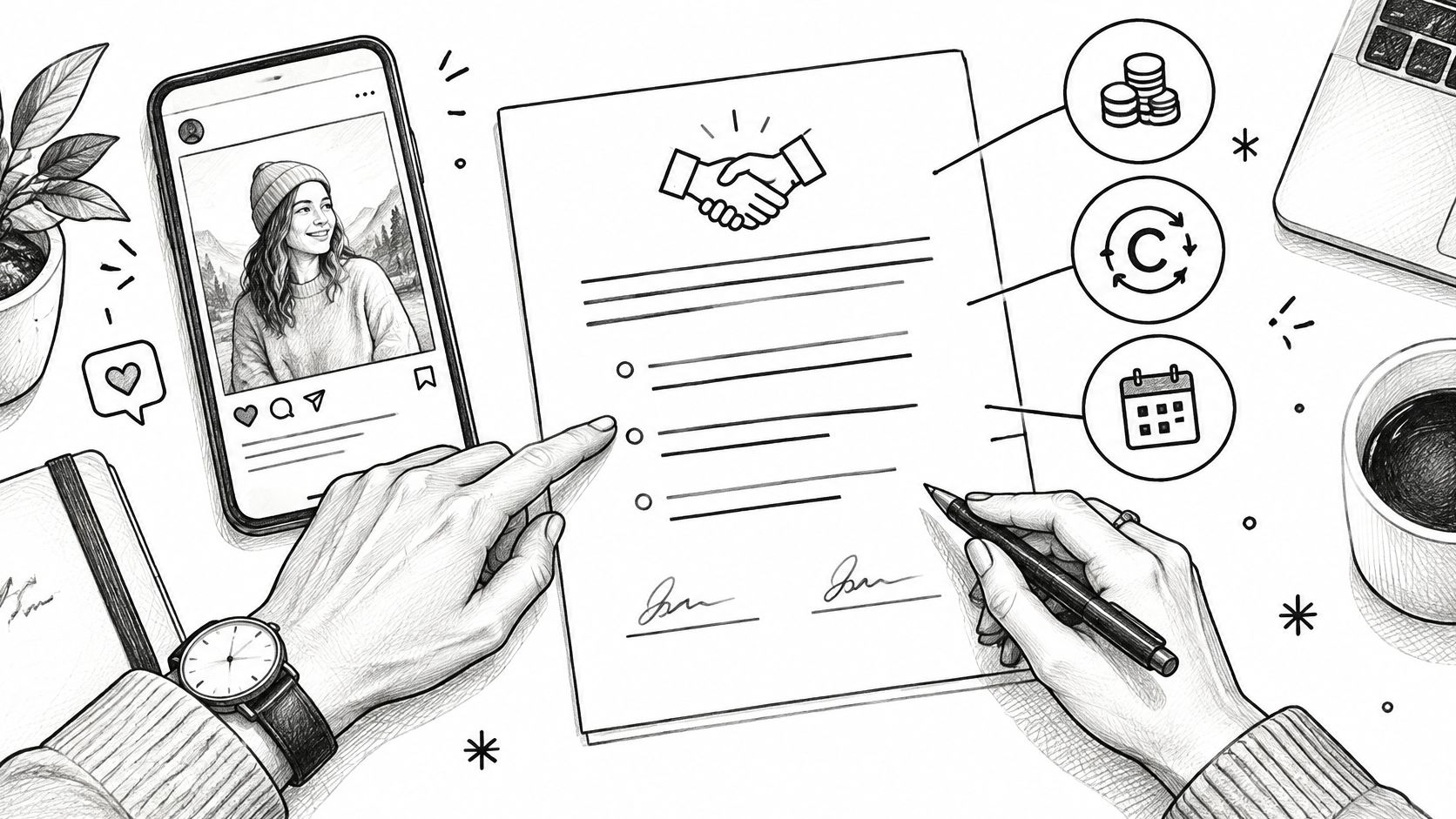
What does the full fee cover, and which services cost extra? This shows whether two similar quotes buy the same work. The guide to sponsored Instagram posts explains what usually sets the price. A good answer separates production, publication, expenses, revisions, and additional rights, so competing proposals can be lined up without guessing.
Which competitors are excluded, and for what period? The answer shows what the brand is buying with exclusivity. Define the restricted category and the dates. Broad exclusivity can raise the creator's opportunity cost without giving the brand useful protection.
Write the scope before production
A finished social post does not, by itself, settle permission for an edited advertising version. Agree the channels, territory, duration, and renewal process in writing before production starts.
Use an influencer contract template to record the terms, and consult the influencer agreement guide when checking the agreement's scope. For a California engagement requiring local legal advice, consult a California independent contractor agreement attorney.
Compare proposals on the rights they include, not only the posting fee.
6. Payment terms and disclosure
When is payment due, which method will be used, and what happens if publication is delayed or cancelled? The answer shows whether cash is tied to a calendar date, an approved asset, or a live post. A useful reply names the invoice details, currency, milestones and what the brand still owes if a post slips or is pulled. If a managed service pays the creator, ask whether money moves only after the post is live, and who confirms that.
What compensation or benefits sit outside the cash fee? Products, hospitality, travel, commission and other incentives belong in the same record. A good answer lists each item so the disclosure assessment covers the whole arrangement, not only the bank transfer.
Agree disclosure before drafting
How will every relevant asset show the commercial relationship? Look for the label, where it sits on the asset, and who checks it before anything is published. A promise to "add something later" leaves the placement and the checker unset.
Hosted visits and gifts count as compensation even without an invoice, so record them in the disclosure assessment. The guide to planning an influencer brand trip covers the paperwork for hosted visits.
The Federal Trade Commission's disclosure guidance requires clear disclosure of material connections in the United States. The ASA's social media guidance says advertising must be obviously identifiable, and its guidance on recognising ads asks for a prominent Ad label upfront. Check the campaign's circumstances with an adviser in the relevant market.
Set the payment process beside the content agreement using how to pay influencers: methods, terms and paperwork. Write the due date, the non-cash items and the disclosure check into the same note before anyone drafts a caption.
7. Why this brand and what they would not post
A recipe demonstration can sit naturally on a food creator's account. A scripted gasp sold as a first taste usually cannot. Ask where that line sits before anyone drafts a script.
Why does this brand suit the creator's audience and content? The reply shows whether they have thought past the fee. A strong answer names a specific product, a follower problem it solves, or a format they already use well. “My audience loves trying new things” tells you almost nothing.
What would the creator refuse to publish? Limits surface conflicts while the idea is still cheap to change. Listen for unsupported health or performance claims, categories they will not touch, and styles they reject, including fake surprise and hard-sell scripts. Those refusals often tighten the brief rather than end the hire.
Test the answer against the account
Are there existing relationships or personal preferences that could conflict with this campaign? You need enough to judge fit, not a copy of their other contracts. A useful answer names category exclusivity, a competing product they already feature, or a personal stance that would make this brief awkward.
Sensible limits are often a better signal than a yes to every claim and every concept.
Read recent posts before the call and set the proposed idea against their normal tone. Write agreed exclusions into the notes. If the campaign only works when they stop sounding like themselves, change the concept or drop the hire.
8. What to check yourself
The creator's pack is evidence to test, not a finished case. Check follower quality, run engagement the same way on every account, and read recent posts for the pattern, not the best frame.
Inspect patterns in the account
Followers. Review suspicious growth, repetitive comments, and accounts with little visible activity. Treat each follower-check flag as a prompt for manual review.
Comments that name a place or a real use are more useful than generic compliments. Neither pattern proves purchasing intent. Pair them with audience geography and the campaign evidence already supplied.
Engagement. Use the engagement rate calculator with recent likes, comments, and the creator's follower count. Keep those inputs identical across the shortlist.
Recent posts. Check tone, production quality, how many products they already promote, and where the label sits. Read sponsored work next to ordinary posts.
The ASA's consumer research on influencer marketing explains why advertising disclosure needs to be prominent, upfront, and immediately understandable. Open the post as a follower would and check whether the label shows before the caption expands.
Questions to ask influencers at a glance
Run the call from this table. Score each reply on whether it is specific enough to book against.
| Question area | Ask | Main risk if skipped |
|---|---|---|
| Audience location | "What share of followers is in our market, and which cities show in the last 30 days?" | You pay for reach that never hits the cities or countries in the brief. |
| Audience age and growth | "What do age and gender look like, and did giveaways or paid boosts move the count?" | The post lands on the wrong age group, or on accounts that do not watch or buy. |
| Past brand work and results | "Which recent brand posts match this goal, and what did insights show for reach, saves or clicks?" | You accept a highlight reel with no way to check the claim. |
| Format, drafts and approvals | "Which formats, how many revision rounds, who approves, and what is the feedback cutoff?" | The post slips because nobody owned the sign-off. |
| Fee, usage rights and exclusivity | "What is in the fee, where and for how long can we run it as ads, and what exclusivity applies?" | Ad use or a competitor post turns into a surprise invoice. |
| Payment terms and disclosure | "What is the schedule, method and currency, and which label goes on the post?" | Payment is disputed, or the label is too easy to miss. |
| Brand fit and limits | "Why this brand, and which claims, products or tones will you refuse?" | A draft dies late over a conflict you could have seen. |
| Your own checks | Compare their figures with your own follower, engagement and recent-post review. | Their export becomes the only evidence. |
From Questions to Signed Terms
Turn the answers you accept into a short written agreement before anyone starts production. Copy only answers that are specific enough to enforce: the deliverables, deadlines, approval steps, payment conditions, usage permissions and who checks the disclosure. If the brief asks for three Stories and one Reel, the contract should say the same, with dates and the person who signs off drafts.
Mark each open point as a gap or a deal-breaker. A creator who needs a day to find an insights screenshot has a gap: give it an owner and a deadline. A creator who will not define advertising rights has a deal-breaker until the rights, channels and period are written down. Missing sales tracking is often fine on an awareness campaign, but missing local audience evidence is a poor risk when the brief depends on venue visits.
If you would rather have the sourcing, contracts and payments handled for you, you can book a call with Sup. The brand approves each creator and each price before anything is booked.
More on recruitment
See how many creators post about you and your competitors
Type in your brand's Instagram handle and we count the creators who post about you and about your five closest competitors. It takes about a minute and it is free. Or request a demo and we will show you the creators in your niche and walk you through the dashboard.
 Book a call