17 September 2026
Local Influencer Marketing: A 2026 Playbook
You've briefed creators for a citywide launch, watched the posts go live, and then struggled to explain why the tills barely moved. The content looked polished, reach was easy to report, and every creator tagged the right branch. Yet the audience lived too far away, the offer wasn't tied to a specific visit, and nobody could distinguish one store's performance from another.
That's the operational problem with local influencer marketing in 2026. Finding a creator is only the starting point. The work sits in defining catchments, coordinating gifting, approving content, licensing usage rights, and attributing visits across multiple locations. UK brands now have a broad creator supply and an increasingly mature commercial market. The advantage goes to teams that can turn local relevance into a repeatable operating system.
Why Local Influencer Marketing Outperforms Broad Campaigns
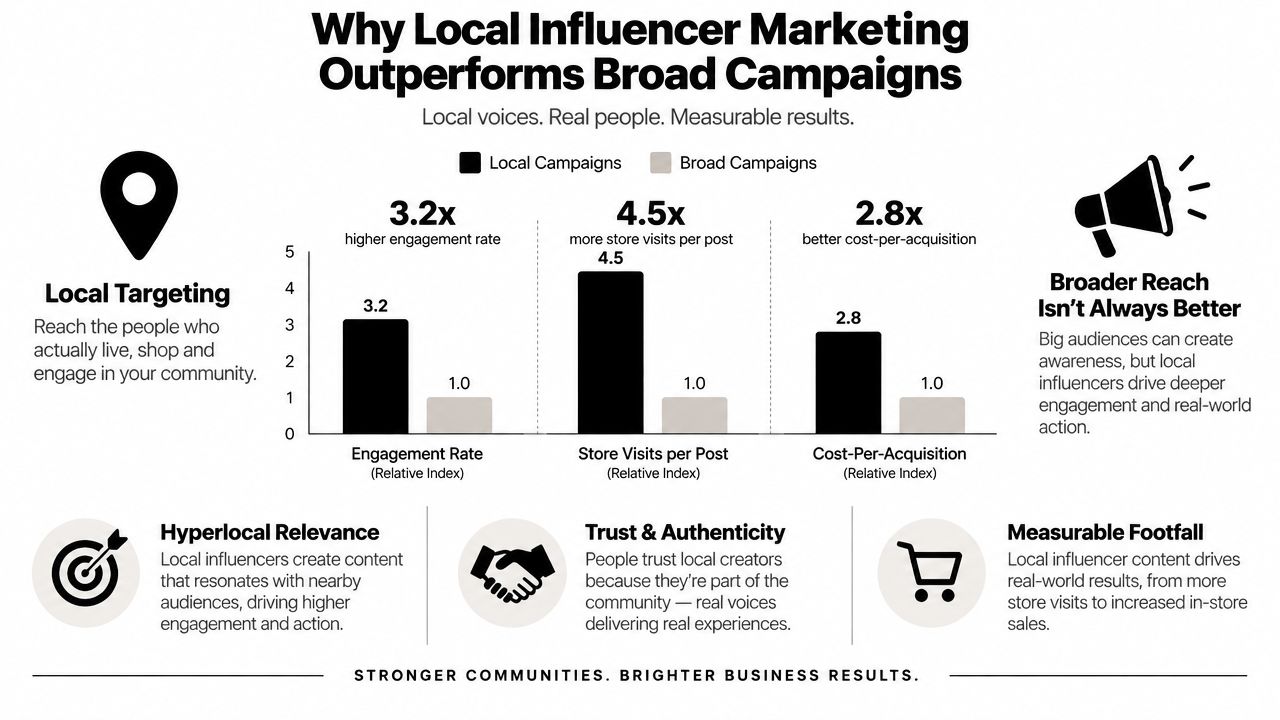
A citywide creator can generate impressive reach while sending little business to any one branch. Viewers may live too far away, lack a convenient route to the store, or fall outside the delivery area. A smaller creator whose audience is concentrated around the relevant catchment can make the recommendation actionable.
The UK market's growth makes this operational focus more important. One industry estimate values the UK influencer marketing market at USD 3.1 billion in 2025, rising to USD 3.9 billion in 2026, with a projected USD 28.3 billion value by 2034 and a 28.03% CAGR from 2026 to 2034 (IMARC's UK influencer marketing market analysis). A UK-focused estimate reports growth from £1.1 billion in 2022 to £1.45 billion in 2023 (UK influencer marketing regulation and statistics). As investment grows, local programmes give brands a way to connect media activity with branch visits, regional orders and catchment performance.
Relevance beats theoretical reach
A creator who lives near a branch understands the customer journey. They can show the entrance, explain parking or collection, mention a nearby landmark, and answer comments from people who know the area. Those details remove practical objections that a generic city tag leaves unresolved.
Influencer content can prompt purchases among UK audiences, particularly younger consumers. 51% of UK survey respondents have purchased products promoted by influencers, while 79% of UK respondents aged 18 to 29 say they have bought something after seeing it used by an influencer (UK influencer marketing regulation and statistics). The implication for campaign design is direct. Put the next action within realistic reach of the audience, then make that action measurable.
For retail, hospitality and services, define the catchment before choosing the creator. A branch may serve one neighbourhood, several suburbs, a commuter route or a delivery radius. That geography should inform the brief, offer, landing page, creator mix and reporting structure. The research on why micro-influencers outperform macro-influencers provides useful context, but the operational test remains local: can followers reach the location or order within the relevant service area?
Make the content useful
Broad campaigns often prioritise consistent brand language and polished visuals. Local activations need enough control to protect the offer and location details, while giving creators room to explain the visit naturally. A brief walkthrough can create stronger intent than a staged product image if it shows where customers go and what happens next.
Short-form video can also supply assets for branch pages, landing pages and paid social. AI video creation for businesses from LunaBloom AI can support production workflows, while creators add the human context and neighbourhood credibility that generated assets cannot provide alone.
The strongest local programme optimises for qualified attention rather than maximum reach. Track clicks on location-specific links, redemptions of branch offers, practical questions, store visits and regional orders. Use separate codes or landing pages where locations overlap, and keep branch-level reporting consistent. Broad awareness still has a role, but it should not conceal weak catchment fit or make multi-location results impossible to reconcile.
Sourcing Micro-Creators for Neighbourhood Targeting
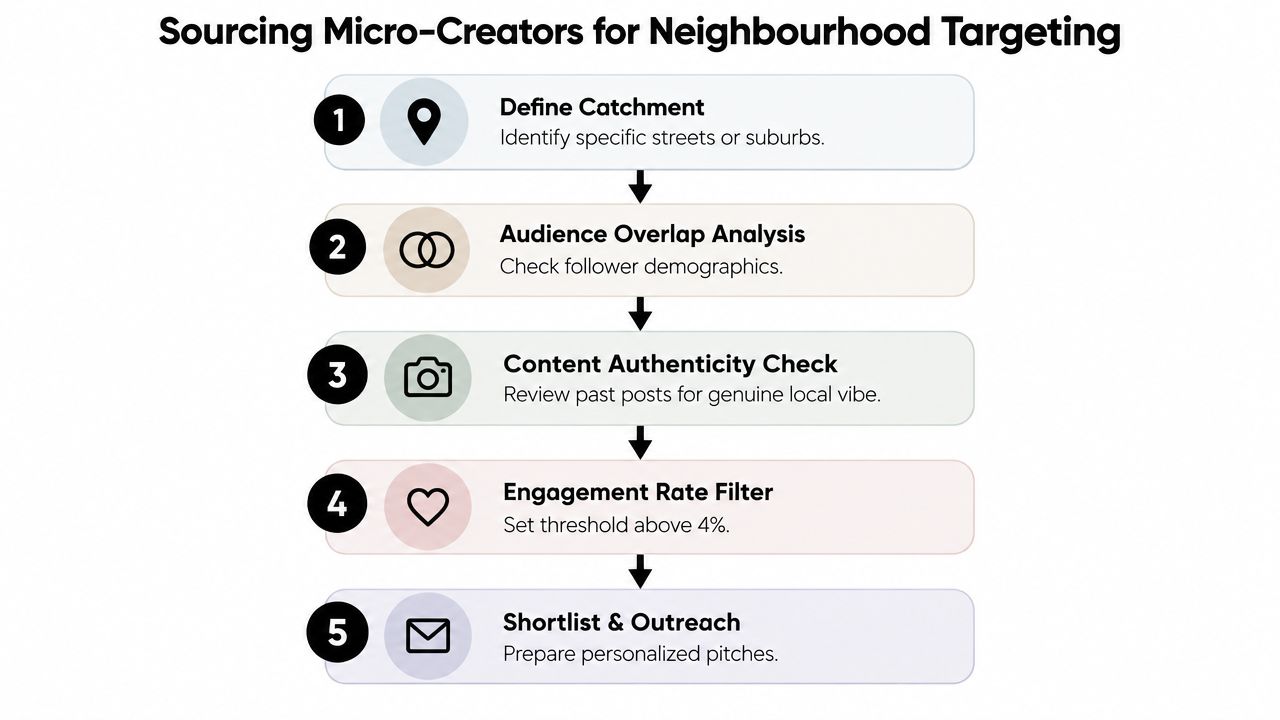
A store can sit within a busy city and still attract customers from only a few streets, suburbs, transport routes or delivery zones. Build that catchment map before searching Instagram or TikTok. Mark each store address, nearby events, local landmarks, service boundaries and practical travel routes. A city label is too broad for reliable store-level recruitment.
The UK creator pool can support a more selective process. Teams can find multiple relevant voices instead of defaulting to the most recognisable creator in each city. The priority is coverage across distinct catchments, with enough local relevance to make a visit or order plausible.
Define the audience before the shortlist
Set the customer profile for every location. A restaurant may need nearby professionals for weekday lunch, families in surrounding suburbs at weekends, or students along a specific transport corridor. A beauty brand may need local creators whose followers care about treatments, skincare or occasion-led shopping.
Assess each candidate against four signals:
- Home base: Confirm where the creator lives or operates. A location hashtag alone does not prove proximity.
- Audience geography: Request current platform analytics, or equivalent evidence, showing where followers are based.
- Topic clustering: Review recurring themes in recent posts, captions and comments. A local food, parent or fitness creator may suit the brief better than a larger general lifestyle account.
- Conversation quality: Read comments for local questions, recommendations, availability checks and signs of personal familiarity.
Neighbourhood verification needs current evidence. Check whether the creator still lives or works near the target location, whether the audience is concentrated in the catchment, and whether recent posts show activity in that area. A creator can remain tagged to a place while their home base, audience geography or posting pattern has changed.
Sup searches Instagram and TikTok live, across 350 million creators. The same checks can be completed through native platform research, creator referrals or specialist tools. Record the evidence against each candidate so different teams apply the same standard across stores.
Review the content, not just the profile
Open the creator's recent feed and examine the latest posts. Review format mix, visual style, colour palette, editing pace and how naturally the creator features places or products. Polished content is useful only when the offer can fit the established format without making the account feel rented.
A credible candidate can explain why the location matters to their followers. They may already post from the high street, cover local openings, share neighbourhood routines or participate in community conversations. That context gives the recommendation a practical reason to exist.
Run an audience-quality check before outreach. Compare visible engagement with current content, inspect whether comments are relevant, and request recent analytics when geography determines campaign value. Avoid a universal engagement threshold. A smaller account with meaningful local conversations can produce stronger store intent than a numerically larger account whose audience sits outside the catchment.
For programmes covering several related locations, geo-clustered micro-creator activations provide a useful planning model. Group candidates by actual audience overlap and travel practicality. Then check for unnecessary duplication. Briefing several creators who reach the same narrow pocket may waste product, coordination time and paid distribution unless repeated exposure is part of the plan. Keep branch, creator and catchment records aligned from the shortlist stage, so later attribution does not depend on guesswork.
Structuring Gifting, Seeding, and Paid Briefs
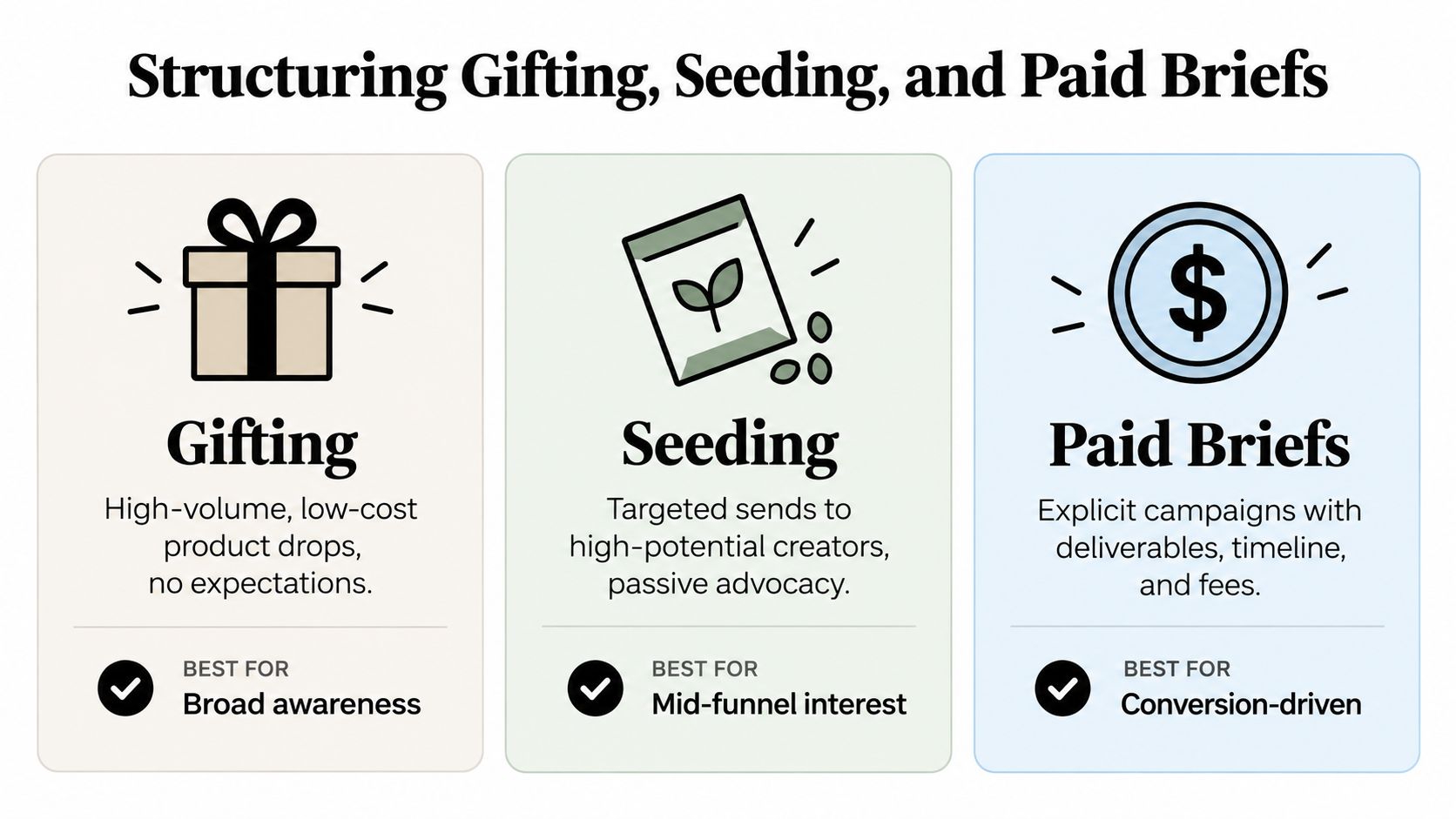
Gifting, seeding and paid briefs serve different operational needs. Treating them as interchangeable leads to disappointed creators, unsuitable content and unclear accountability. A product drop can create local discovery, but it cannot promise coverage. A paid brief can secure specific assets, provided the commercial agreement, production schedule and branch requirements are clear.
Use gifting for reach and discovery
Gifting suits products that are easy to understand, simple to deliver and relevant to the recipient. State that the product is a gift. Do not imply that a post is required unless the creator has separately agreed to provide content. This protects the relationship and stops the team treating an uncontracted shipment as guaranteed media.
For local retail, gifting can introduce a branch to relevant residents beyond the existing creator shortlist. Include the branch address, opening information, collection details and expiry restrictions, while keeping the creative request light. A creator who chooses not to post is providing useful evidence about the offer, timing or local relevance. Record that outcome rather than treating it as a fulfilment failure.
Use seeding for selective advocacy
Seeding requires a smaller, more carefully matched list. Send products or experiences to creators who already show strong fit and may become repeat advocates. Check whether each person has the time, interest and local credibility to try the product properly, especially when the activation depends on a visit or a specific customer experience.
Seeding works well for authentic trial content without a scripted endorsement. It is a weak fit when a branch launch depends on a fixed volume of posts on a fixed date. Use a paid brief for that requirement, and reserve seeding for relationships where the outcome can develop over time.
Use paid briefs for accountable conversion work
A paid brief should define the location, content format, asset count, publishing window, mandatory information, approval process, disclosure requirements, usage rights and payment terms. It should also leave room for the creator's own voice. Scripts that remove local detail can make the content less credible and less useful for store visits.
Set fees against current market conditions rather than an old rate card. Audience fit, production effort, exclusivity, usage rights and urgency all affect the commercial value. Request recent examples of comparable work, separate organic publishing from paid media licensing, and price additional edits or whitelisting explicitly.
| Structure | Best use | Main control | Main risk |
|---|---|---|---|
| Gifting | Broad local awareness | Product and recipient selection | No guaranteed coverage |
| Seeding | Mid-funnel interest and trial | Careful creator fit | Outcomes remain uncertain |
| Paid brief | Conversion-led store or regional activity | Deliverables and deadlines | Higher coordination and rights cost |
A hybrid programme usually gives operators more control than one universal model. Use gifting to find promising local voices, seeding to test deeper product fit, and paid briefs where a branch needs guaranteed content or reusable creative. That mix also helps manage fragmented fulfilment across locations, because product-only sends can remain selective while paid work is reserved for measurable store activity.
UK creator adoption supports this layered approach. The market includes 93% of UK marketers working with micro-influencers, 60% working with nano-influencers, and 58% planning to increase UGC investment, according to UK influencer marketing coverage from Kolsquare. Tie each activation to its branch, catchment and agreed outcome from the start, so later footfall analysis can distinguish exploratory gifting from accountable paid activity.
Managing Approvals, Compliance, and Logistics
A local activation can stall because one creator is waiting for a product, another is preparing a branch visit, and a third is awaiting paid usage approval. Marketing, legal, fulfilment and finance need one campaign record, not separate spreadsheets. That record should show what each creator agreed to deliver, which location owns the activity and what has been completed.
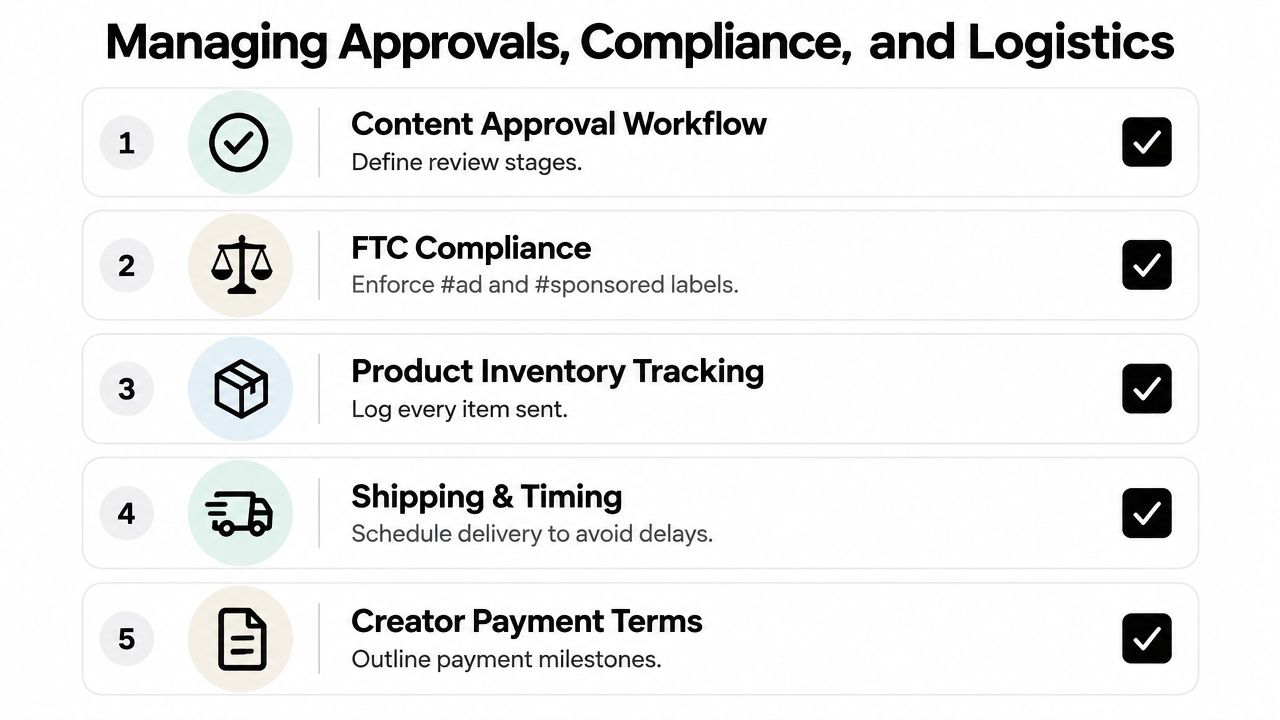
Build the workflow around three checkpoints. The first confirms the creator shortlist, neighbourhood fit and assigned branch. The second records rates, deliverables, exclusivity, usage rights and payment terms. The third approves the final content before publication. This gives brand and legal teams control while keeping routine caption changes with the campaign manager.
Treat fulfilment as campaign infrastructure
Physical gifting needs the same operational discipline as media delivery. Collect addresses through a controlled process, restrict access to people who need them, and log the product, variant, quantity, dispatch status, tracking reference and delivery outcome. Give every shipment a location identifier connected to the creator and activation. That prevents a regional programme from turning into an untraceable set of parcels.
Plan for exceptions before dispatch. Products may arrive damaged, go to an old address or miss the intended visit window. Set out who handles replacements, what happens when inventory changes and whether the creator can use a nearby branch instead. The campaign manager should see these exceptions in the central record without requesting a separate warehouse update.
Separate approval from usage rights
Approval for an organic post does not grant permission to use that content in paid advertising. Contracts should distinguish organic publication, reposting, website use, paid social, whitelisting or Spark Ads, editing rights, territory and duration. If a branch team may reuse content locally, define that permission before publication.
Apply the same central process to compliance. UK creators and brands should disclose commercial relationships clearly, including gifted and paid activity where applicable. The infographic references #ad and #sponsored labels. Legal teams should confirm the current requirements for each platform and campaign arrangement instead of applying one template everywhere.
Practical rule: If a creator, payment, product, post, approval or usage right sits outside the campaign record, expect a reporting problem later.
Payment details also need to be captured before publishing. Record the agreed currency, invoice requirement, payment milestone, bonus or affiliate treatment and tax information. For a practical overview of attribution tracking for brands, connect creator activity to campaign identifiers rather than reconciling screenshots after the campaign.
The workflow overview below illustrates how the three checkpoints connect fulfilment, approvals and reporting.
Measuring Footfall and Multi-Location ROI
A local campaign can generate visits across several branches while leaving the marketing team unable to identify which creator or catchment drove them. Shared links, codes and landing pages create that blind spot. Multi-location attribution therefore needs identifiers configured before the first post goes live, not reconstructed from screenshots afterward.
Start with a naming system covering creator, catchment, branch and campaign. Give each creator a unique tracked link leading to the relevant location page or regional checkout path. Use consistent UTM fields for source, medium, campaign, location and content identifier. Consistency lets the dashboard compare branches without manual relabelling.
Make offline actions visible
A unique promo code gives customers a simple way to identify the creator who influenced a purchase. Make codes easy to say and type, while keeping them distinct by creator or branch. Train tills and customer-service teams to record redemptions the same way at every location. A code shared across several branches removes the branch-level detail needed for budget decisions.
Stores without promo codes can add a short question to the purchase or booking process, such as how the customer heard about the location. Treat those answers as supporting evidence, alongside tracked links and transaction data. A campaign-period comparison with a relevant pre-campaign baseline can add context, provided the business records both periods consistently.
For fragmented gifting, assign fulfilment and attribution records to the same creator and branch identifiers. Otherwise, product sent to one catchment may be credited to another when redemptions or visits are consolidated.
Report decisions, not dashboards
A useful dashboard combines content status, link clicks, code redemptions, store or booking actions, attributed revenue, creator cost and usage cost. Break results down by branch, catchment, creator and content format. That view should answer practical questions, such as which locations merit another activation and which creators generate visits but little revenue.
Include every campaign cost in the financial calculation: product, fulfilment, agency or platform fees, paid amplification, usage rights and discounts. Compare attributed contribution or revenue with total investment using the business's chosen ROI or ROAS formula. Consistency matters more than selecting a fashionable formula.
Use location-based targeting when the audience, offer and fulfilment area must align. A visit during the campaign period does not automatically prove influencer causation. Label outcomes as tracked, code-attributed, self-reported or assisted, and retain those distinctions in the final report. The result is a clearer view of footfall and branch economics, even when attribution remains partial.
Scaling Local Campaigns Across Regions
A campaign that performs in one catchment can become expensive and difficult to control when repeated across regions. Each branch adds creators, addresses, contracts, tax details, shipments, approvals and local managers. Without a revised operating model, administration grows faster than the commercial return.
Payment fragmentation exposes the problem first. Marketing negotiates with creators, finance receives separate invoices, branches approve local expenses, and someone reconciles bonuses or royalties. The result is an unclear cost per location, with greater risk of missed payments, duplicate records and inconsistent terms.
Centralise the control plane
Keep local judgement, but centralise the administration. Brand teams can approve creators, briefs, rates, content and usage rights, while one workflow tracks outreach, contracts, fulfilment, payment status and reporting. Branch teams provide catchment knowledge without becoming accounts-payable coordinators.
A scalable setup needs three controls:
- Local relevance: Store teams and regional marketers confirm the catchment, customer context and practical offer.
- Central governance: One process manages legal terms, disclosures, usage rights, approvals and creator records.
- Unified measurement: Links, codes, costs and revenue use the same naming structure across locations.
For a 20-store rollout, that means one brief generates neighbourhood shortlists for each branch, one contract template covers usage rights, and one invoice reconciles creator payments. Centralised payment orchestration can also group creator fees, gifting, royalties and expenses across currencies and tax jurisdictions, giving finance one commercial view instead of a stack of unrelated transactions.
Sourcing needs the same structure. The UK creator economy is forecast to receive £1.2 billion in advertiser investment in 2026, representing 26% year-on-year growth, according to IAB UK's creator marketing coverage. As participation grows, stale creator lists, slow negotiations and disconnected reporting create avoidable operating costs.
Sup suits teams that need managed execution rather than another software interface. For a multi-branch campaign, its stated workflow covers live Instagram and TikTok sourcing, outreach and negotiation, contracts, usage rights, gifting logistics, payments, tracked links, promo codes and campaign reporting. The client still approves creators and content.
Use a repeatable regional template, then localise the parts that affect response. Standardise fields for compliance, costs, status and attribution. Adapt the offer, creator voice, timing and proof points to each catchment. That balance supports expansion without removing the neighbourhood relevance that made the original activation work.
If your brand needs to coordinate local creators, store-level tracking and multi-region payments without adding manual administration, visit Sup to review its managed influencer marketing service. Use the platform to organise creator sourcing, approvals, fulfilment, usage rights and attribution around the catchments that matter to your business.
More on recruitment
See how many creators post about you and your competitors
Type in your brand's Instagram handle and we count the creators who post about you and about your five closest competitors. It takes about a minute and it is free. Or request a demo and we will show you the creators in your niche and walk you through the dashboard.