18 March 2026
Why Micro-Influencers Outperform Macro-Influencers (With Data)
Here’s the simple truth: micro-influencers are outperforming their macro counterparts because they have real conversations, not just broadcast a message. Their smaller, tight-knit communities trust them like a friend, which translates into dramatically higher engagement rates and a much better ROI for brands.
The Shift from Megaphones to Authentic Conversations
The days of relying solely on celebrity-style endorsements are fading. Modern consumers, especially here in the UK, are growing more sceptical of glossy, large-scale adverts. They’re looking for genuine connections instead. This is why the entire conversation around influencer marketing is changing, moving away from the "megaphone" of macro-influencers toward the intimate, community-driven approach of micro-influencers.
This isn't just a feeling; the data paints a very clear picture. Looking at the UK influencer scene, micro-influencers are consistently winning on engagement. On TikTok, for example, nano-influencers (the smallest creators) are seeing an incredible 15.2% engagement rate. Compare that to macro-influencers, who average a mere 1.36%.
Further research shows that micro-creators can pull in up to 60% higher engagement simply because their audience is there to interact, not just passively scroll. You can dig deeper into these UK influencer trends in Charle Agency's 2026 report.
Micro vs Macro: A High-Level Comparison
To really grasp why this performance gap exists, it helps to put their core strategies side-by-side. Think of a macro-influencer as a massive billboard, great for broad awareness. A micro-influencer, on the other hand, is like a trusted recommendation from a friend in a close-knit group.
This difference is everything for performance-focused businesses like restaurants or ecommerce brands, where one meaningful interaction is worth a thousand fleeting impressions.
At its heart, this trend is about moving from passive viewership to active participation. A ‘like’ from a micro-influencer’s follower means more because it’s born from a genuine connection.
Here's a quick snapshot of how they stack up:
| Metric | Micro-Influencers (10k-100k Followers) | Macro-Influencers (100k-1M+ Followers) |
|---|---|---|
| Primary Value | High Engagement & Niche Trust | Broad Reach & Mass Awareness |
| Audience Relationship | Community-focused, conversational | Broadcast-style, distant |
| Content Style | Authentic, relatable, user-generated feel | Polished, professional, often aspirational |
| Typical Cost | Lower, more accessible (£100-£1,000) | High, premium fees (£1,000-£10,000+) |
| Best Use Case | Driving conversions, local footfall | Brand launches, building legitimacy |
| ROI Measurement | Easier to track via codes/links | Often tied to "brand awareness" metrics |
Ultimately, your choice depends entirely on what you want to achieve. If the goal is to get your brand name in front of as many eyes as possible, and quickly, a macro-influencer can still be a powerful tool.
But if you’re looking to drive measurable sales, build real customer loyalty, and foster a community around your products, the data points clearly to micro-influencers. Their unique ability to turn followers into customers through authentic dialogue is precisely why they're becoming the go-to for brands focused on tangible results.
A Data-Driven Look at Engagement and Audience Trust
When you cut through the noise of follower counts and glamorous photoshoots, influencer marketing really boils down to two things: engagement and trust. And this is where the data tells a fascinating story, showing precisely why micro-influencers often deliver results that their macro counterparts just can't match. Any seasoned performance marketer knows that a thousand meaningful interactions are far more valuable than a million passive views. The numbers prove it, time and again.
The difference isn't just a small gap; it's a chasm. Macro-influencers operate more like broad-reach advertisers, casting a wide net. Micro-influencers, on the other hand, act as trusted peers within a specific community. Their content sparks real conversation because their followers feel seen and understood, a dynamic that directly fuels their superior performance.
The Engagement Rate Gap
The clearest evidence of this difference is the engagement rate: the percentage of an influencer's audience that actively interacts with their content through likes, comments, shares, and saves. On virtually every platform, from Instagram to TikTok, micro-influencers consistently generate higher engagement. For a closer look at the data, you’ll find some eye-opening influencer marketing statistics that paint a very clear picture.
This isn't just a passing trend. It’s rooted in how we interact on social media. As a creator's audience swells into the millions, that personal connection naturally fades. Content consumption becomes more about passive observation than active participation.
This chart visualises just how stark the difference is.
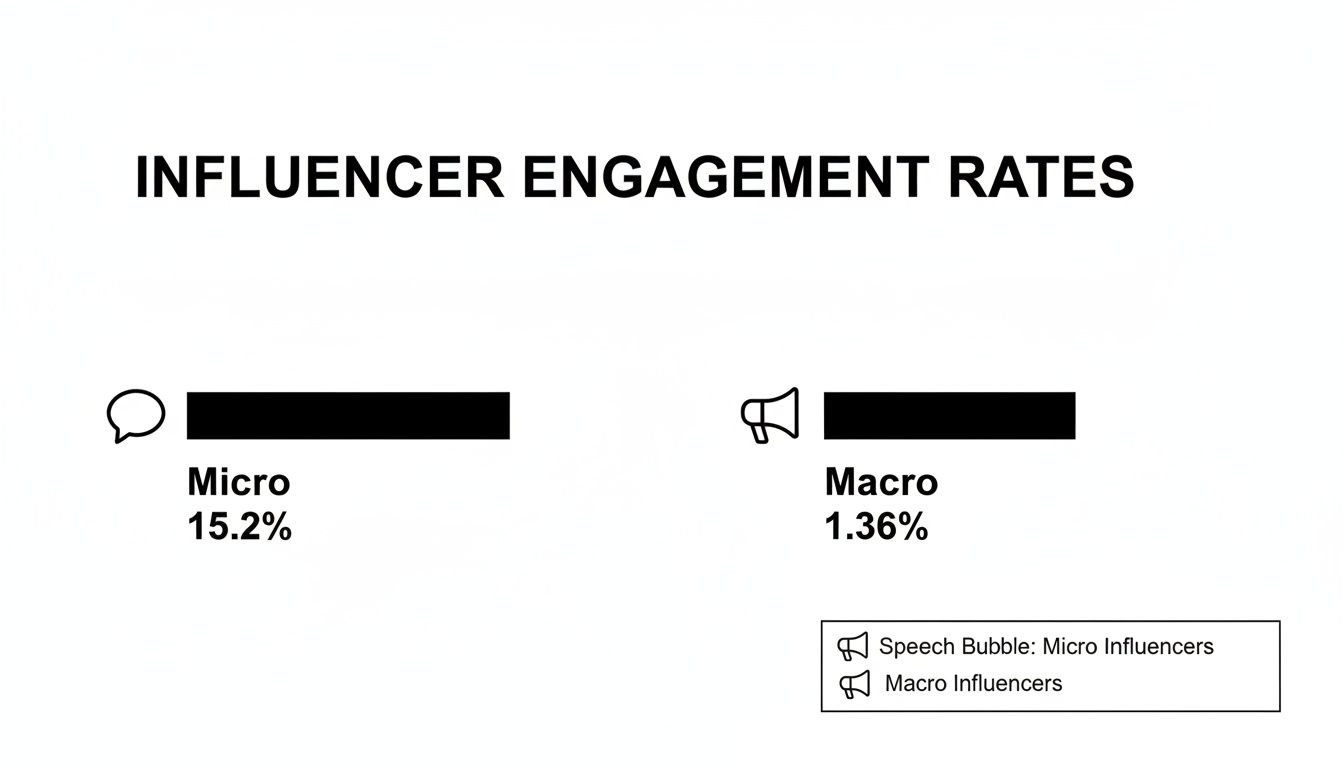
The data speaks for itself, showing micro-influencers command an engagement rate over ten times higher than macro-influencers. That’s a massive gap in audience connection.
Why Niche Communities Foster Deeper Trust
So, why such a dramatic performance difference? It all comes down to audience psychology and the power of community. Micro-influencers thrive because they operate in very specific, focused niches. Whether it's vegan baking in Bristol, sustainable fashion in Manchester, or local craft beer in London, their authority is built on genuine expertise and a shared passion.
This specialisation creates a powerful sense of belonging among their followers. They don't just see a creator; they see a credible voice and a leader within their own community. It's no surprise that audiences engage more deeply with content from niche creators who have carved out a specific area of expertise.
Just think about these two scenarios:
- Scenario A (Macro): A celebrity with 5 million followers posts a polished photo holding a new brand of coffee. The post gets thousands of likes, but the comments are mostly generic, like "Love this!" or fire emojis. The audience sees it for what it is: another ad.
- Scenario B (Micro): A coffee enthusiast with 15,000 followers, known for reviewing independent roasters, shares a detailed video of them brewing that same coffee. The comment section lights up with specific questions about grind size, flavour notes, and where to buy it.
In the second scenario, the interaction isn't just 'engagement'. It's a real-time conversation about purchasing. The trust is already baked in, making the recommendation feel like a tip from a knowledgeable friend, not a paid placement.
This is the key differentiator: Macro-influencers sell reach, but micro-influencers cultivate trust. For brands focused on conversions, trust is the more valuable currency.
The Power of Relational Authenticity
This trust is amplified by what you could call relational authenticity. Because micro-influencers are managing smaller, more tight-knit communities, they can engage in ways that are simply impossible at a larger scale. They reply to DMs, answer comments personally, and actively participate in the very communities they lead. This two-way dialogue cements their credibility and makes their followers feel valued.
When a micro-influencer recommends a product, it carries the weight of that entire relationship. It feels less like an advertisement and more like a genuine suggestion from someone you know. Research backs this up, with around 40% of consumers saying they prefer and trust smaller creators more. This perceived authenticity is a powerful driver of action and is exactly why micro-influencers outperform their macro counterparts when the goal is driving sales, bookings, or store visits.
Of course, here is the rewritten section with a more natural, human-expert tone.
Analysing the True Cost and Return on Investment
High engagement rates and genuine trust are great, but for any performance marketer worth their salt, it all comes down to the numbers. When you really get into the weeds of cost and return on investment (ROI), the case for micro-influencers becomes incredibly compelling. This isn't just about saving a bit of money; it's about making your budget work smarter and harder.
Macro-influencers play in a different league, with fees in the UK often starting at £1,000 and soaring past £10,000 for a single Instagram post. That kind of spend gets you a massive audience, no doubt, but it's a hefty price that can tie up your entire budget, making it tough to run varied, always-on campaigns. This is where the whole economic model gets turned on its head, firmly in favour of micro-influencers.
The Power of a Diversified Portfolio
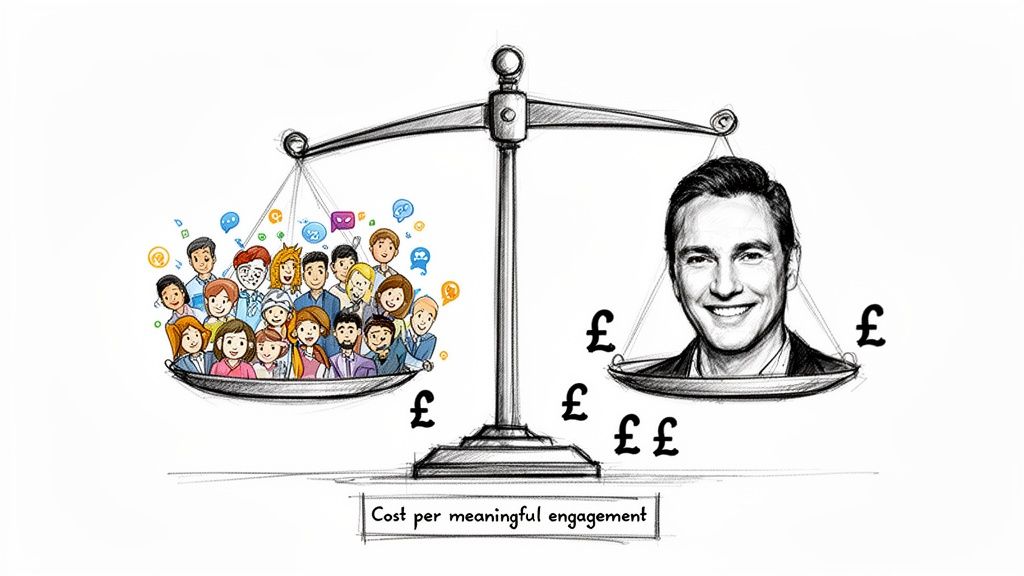
Think about it this way: instead of putting all your eggs in one very expensive basket, you can activate an entire portfolio of micro-influencers for the exact same cost. It's a classic diversification strategy. You're not just spreading the risk; you're multiplying your chances for authentic connection and, most importantly, conversion.
Let's look at a real-world example I've seen play out time and again:
- The Macro Approach: A national restaurant chain shells out £10,000 for a celebrity chef to post once about their new menu. The post gets seen by millions, creating a big splash of awareness, but good luck tracking how many people actually walked into a local branch because of it.
- The Micro Approach: That same chain invests its £10,000 into a campaign with 50 local food influencers (at £200 each) in key cities. Now, you have creators posting about their local restaurant, sharing genuine excitement and offering unique promo codes to their followers.
In the second scenario, the impact is layered and far more powerful. The combined reach might even rival the macro-influencer's, but the quality of each interaction is worlds apart. You get hyper-local exposure, a treasure trove of authentic user-generated content, and a direct way to measure footfall and sales in specific areas.
The core principle here is simple: a distributed network of trusted, local voices will almost always drive more tangible action than a single, distant broadcast. You're not just buying reach; you're investing in community-level endorsements that change real-world behaviour.
Calculating Cost Per Meaningful Engagement
To properly compare ROI, we have to look past old-school metrics like cost-per-impression. A much sharper way to analyse performance is by calculating the cost per meaningful engagement (CPME): what you actually pay for a genuine comment, a share, or a click that shows real intent.
This is where the maths really works in your favour. Because micro-influencers have much higher engagement rates, their CPME is consistently lower. Your budget goes further, buying not just passive eyeballs but active interest. A macro-influencer might give you a low cost per thousand impressions (CPM), but if those impressions are just scrolled past, the true cost of sparking a meaningful conversation is astronomical.
With micro-influencers, every pound is aimed at an audience that is already tuned in and ready to act. That efficiency is exactly what makes them the go-to choice for performance-focused brands.
The Clear ROI Advantage in the UK Market
In the UK, the cost-efficiency of micro-influencers is what makes them a performance marketer's best friend. While macros command fees of £1,000-£10,000 per post, their smaller counterparts deliver a comparable impact for a fraction of the cost. This efficiency contributes heavily to the industry-wide average ROI of £5.78 for every £1 spent on influencer marketing, a figure powered by the value of smaller creators.
It's no surprise that 61% of marketers now favour micro-influencers for their precise targeting. They are perfectly built for brands that need to run quick, trackable campaigns with clear conversion data. You can find more great analysis on how influencer tiers impact ROI on NinjaPromo's blog.
Ultimately, the financial case is clear-cut. By activating a network of micro-influencers, brands can achieve greater cumulative reach, foster more authentic interactions, and generate a higher, more measurable return on investment. For any business where every marketing pound needs to justify its existence, this data-backed approach offers a reliable path to growth.
Tracking True Impact with Better Attribution
For any brand focused on performance, attributing results directly back to your marketing spend isn’t just good practice; it's everything. While high engagement looks great on paper, what really matters is whether those likes and comments turn into clicks, sales, and bookings. This is where micro-influencers give you a serious advantage, transforming what can be a vague "brand awareness" exercise into a measurable, predictable growth channel.
With macro-influencers, you often get stuck with vanity metrics. Big numbers for impressions and reach are impressive, but they don't tell you who actually bought something. It’s a bit like buying a massive billboard on the M1; you know millions of cars drove past, but you have no idea who pulled into the next service station because of your ad.
Micro-influencer campaigns, on the other hand, are built for precise measurement. Because you're working with a whole network of creators, you can give each one the tools to draw a straight line from their content to a customer's purchase. This granular approach turns your entire campaign into a data-rich experiment, revealing exactly which partnerships are driving real value.
From Guesswork to Granular Data
Getting this level of clarity comes down to using the right attribution tools. These are simple but incredibly powerful mechanisms, and they're perfectly suited for micro-influencer programmes where you need to track individual performance at scale.
Three tools form the bedrock of solid influencer attribution:
- Unique Promo Codes: Giving a distinct code like "CHLOE15" to each influencer is the most straightforward way to track sales. It’s clear, easy for the customer, and gives you undeniable proof of who drove that conversion.
- Custom UTM Links: By adding special parameters to a URL, you can track every single click an influencer sends your way. This lets you see traffic, bounce rates, and conversions right inside your own analytics platform.
- Dedicated Landing Pages: A simple, unique landing page for an influencer (like yoursite.co.uk/chloe) isolates their traffic completely. This makes it incredibly easy to see exactly how their audience behaves once they arrive.
Of course, when you’re managing dozens of micro-influencers, manually creating and tracking all of this becomes a logistical nightmare. That's where a proper platform comes in to automate the whole process, making attribution at scale not just possible, but easy.
The real power of micro-influencers isn't just their engagement; it's their inherent trackability. A well-managed network of smaller creators gives you a crystal-clear view of performance that’s almost impossible to get from a single macro campaign.
Centralising Your Attribution Data
Technology is what elevates micro-influencer marketing into a genuinely scalable channel. Instead of getting lost in spreadsheets or chasing creators for analytics screenshots, a central platform pulls all your performance data into one place. You can see at a glance which creators are driving clicks, which codes are being used, and what your overall ROI looks like in real time.
For example, this is what a unified dashboard looks like, bringing together all that campaign data for easy analysis.
A dashboard like this removes all the manual heavy lifting. It allows brands to instantly compare performance across their entire portfolio of creators and make decisions based on hard data, not guesswork.
With this kind of insight, you can quickly spot your top performers and double down on what’s working. You can see which messages resonate and which offers are driving the most sales. To learn more about getting your numbers right, check out our complete guide on measuring influencer marketing ROI. This data-first approach, made possible by the very nature of micro-influencer campaigns, is why they consistently deliver for brands focused on the bottom line.
When to Bring in the Big Guns: Choosing a Macro-Influencer
After all the data favouring micro-influencers, it's easy to think there's no place for macros. But that would be a mistake. Dismissing them entirely means leaving a powerful tool on the table.
Think of it less as a competition and more as having the right tool for the job. Macro-influencers are the sledgehammers of the marketing world, not for everyday use, but absolutely essential when you need to make a massive impact, fast. It’s a strategic trade-off: you sacrifice the pinpoint accuracy and tight-knit community of a micro-influencer for sheer, unavoidable reach.
Scenarios That Demand a Megaphone
Not every campaign is about tracking promo code redemptions. Sometimes, the goal is to get everyone talking at once, to create a moment. This is where macro-influencers earn their premium price tag, acting as a broadcast channel to a huge, ready-made audience.
So, when does it make sense to go big?
- Major Product Launches: When your new flagship product drops, you need to create an immediate shockwave of awareness. A single post from a macro-influencer can introduce your brand to millions of potential customers overnight, making your launch feel like an event.
- Building Brand Legitimacy: Let’s face it, partnering with a household name gives your brand an instant shot of credibility. For a new company or a brand looking to reshape its public image, this "halo effect" can build trust on a massive scale far quicker than you could on your own.
- Entering a New Market: Breaking into a new country or demographic is tough. A macro-influencer who is already a trusted voice in that community acts as your passport, giving your brand an immediate and legitimate foothold.
In these situations, your main Key Performance Indicator (KPI) isn't direct sales. You’re looking at brand recall, share of voice, and media mentions. These are the metrics where the enormous scale of a macro-influencer's audience gives you a serious edge.
Choosing a macro-influencer is an investment in brand perception and market presence. You're not aiming for a one-on-one sales conversation; you're shaping the entire narrative.
A Quick Decision-Making Framework
To figure out if a macro-influencer fits your strategy, just ask yourself what your number one priority is. The answer will usually point you in the right direction.
| If Your Primary Goal Is... | Then Your Best Choice Is... | Because... |
|---|---|---|
| Immediate, widespread brand awareness | Macro-Influencer | They offer massive reach to quickly saturate a market. |
| Driving direct, trackable sales | Micro-Influencers | Their high engagement and trusted advice actually convert followers. |
| Establishing credibility and authority | Macro-Influencer | An association with a big name is a powerful shortcut to legitimacy. |
| Fostering community and loyalty | Micro-Influencers | They are masters at building real, two-way conversations. |
| Making a major splash in a new market | Macro-Influencer | Their platform can announce your arrival in a way no one can ignore. |
| Generating authentic local footfall | Micro-Influencers | Their niche, geo-specific audiences are perfect for driving local action. |
Ultimately, the smartest strategies often blend both. You could kick things off with a macro-influencer for a huge launch announcement, then follow up with an army of micro-influencers to drive deeper engagement and sales over the following months. Knowing the unique strengths of each tier is what lets you build a truly effective and responsive influencer programme.
How to Build a Scalable Micro-Influencer Programme
The data doesn’t lie: micro-influencers consistently deliver better engagement and a stronger ROI. The real catch, however, isn’t about their effectiveness. It's about the sheer chaos of managing them at scale. Anyone who's tried it knows the pain of juggling dozens of creators, from the first DM to the final payment. It can easily swamp even the most organised marketing team.
Too often, the process descends into a messy tangle of spreadsheets, endless email chains, and constant chasing to get content approved and published. This manual grind isn't just a time sink; it’s the bottleneck that stops you from turning a powerful idea into a reliable growth channel. To really make this work, you have to systemise the entire workflow.
From Manual Chaos to Automated Efficiency
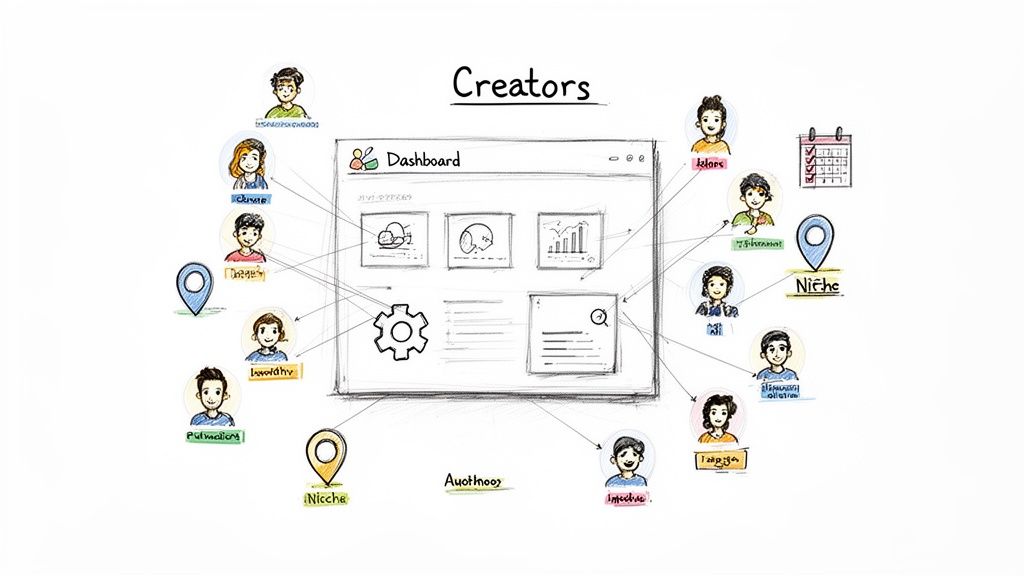
A programme that can actually scale is one that automates the repetitive, soul-crushing tasks. Imagine swapping hours of searching for creators with a platform that lets you discover and vet verified micro-influencers by niche, location, and audience in just a few minutes. That’s how you free up your team to think about strategy instead of getting buried in admin.
Finding the right partners is always the first, most crucial step. A dedicated platform transforms this from a manual guessing game into a streamlined, data-backed process. For a closer look at mastering creator discovery, check out our complete guide on micro-influencer marketing for small businesses.
When everything is centralised, you can run the entire campaign from a single place, ensuring nothing ever gets missed. Think about what that means in practice:
- Sourcing and Vetting: Find fresh, relevant creators who genuinely fit your brand and have a proven history of results.
- Campaign Deployment: Use smart templates for your outreach, contracts, and briefs to get campaigns live faster and more consistently.
- Communication Management: Ditch the scattered DMs. Keep all your chats, content approvals, and scheduling in one clean inbox.
- Automated Payments: Pay all your creators in one go, without drowning in a sea of individual invoices and payment reminders.
Unlocking True ROI with a Centralised Dashboard
Perhaps the biggest win from a proper system is the ability to see what’s working in real-time. By automatically generating unique promo codes and tracking links for every single influencer, you get a completely transparent view of your return on investment.
The goal is to transform influencer marketing from a fragmented, time-consuming task into a predictable and measurable growth channel. A scalable system provides the engine to make that happen.
A unified dashboard pulls all your crucial data into one spot. You can see exactly which creators are driving clicks, who’s making sales, and what your true cost per acquisition is across the board. This kind of clarity lets you make smarter bets, doubling down on the partners who deliver and fine-tuning your strategy for the biggest possible impact.
With the right framework, it's possible to cut down the time spent on manual management by up to 95%. This isn't just about making your life easier. That newfound efficiency means you can build more relationships, launch more campaigns, and ultimately drive more revenue. By getting rid of the operational headache, you can finally focus on what really matters: building authentic connections that grow your business.
Frequently Asked Questions
When you get into the weeds of influencer marketing, the practical questions always pop up. Here are some of the most common things we get asked by brand managers trying to decide between micro- and macro-influencers.
How Many Micro-Influencers Equal One Macro-Influencer?
This is the classic "how long is a piece of string?" question. There’s no magic number because it completely depends on what you’re trying to achieve.
If engagement is your North Star, just a handful of niche micro-influencers can generate more meaningful conversations and interactions than one macro-influencer. Think of it as sparking dozens of small, passionate discussions versus one massive, but less personal, shout-out.
But if you're chasing pure, top-of-funnel reach, you'll need a small army of micro-influencers to match the sheer audience size of a single macro. The real trick is to stop thinking about a one-to-one follower swap and start focusing on the cumulative quality and impact of the audience you're reaching.
Is It Better to Gift Products or Pay Micro-Influencers?
The right answer here often comes down to the creator's experience and what you’re asking for. Many up-and-coming micro-influencers are genuinely excited about gifted collaborations, especially if your product is a perfect match for their audience and has a high value. It’s a great, cost-effective way to get authentic content out there.
However, once you start asking for specific deliverables (like a set number of posts, a high-quality video, or long-term usage rights), you’re in paid territory. Paying them is standard practice. It shows you respect their craft and their time, professionalising the relationship from the start. A hybrid model, where you offer both the product and a fee, often hits the sweet spot.
What Are the Biggest Risks of Working with Micro-Influencers?
The two biggest hurdles are management complexity and brand safety. Juggling communications, contracts, briefs, and content approvals for dozens or even hundreds of creators is a massive operational lift. Without a solid system, it can quickly spiral out of control.
The operational load of managing a scaled micro-influencer programme is its biggest inherent risk. Without automation, the time spent on admin can quickly outweigh the ROI benefits.
On top of that, you have to ensure every single creator truly aligns with your brand’s values. This requires meticulous vetting. A successful programme hinges on finding the right partners, so understanding how to find influencers in a scalable way is key to minimising risk and keeping your brand consistent.
Ready to turn influencer marketing into a predictable, ROI-proven growth channel? Sup combines AI with a human team to source creators, manage campaigns, and track every conversion, saving you up to 95% of your time. Book a demo today and see how we can scale your collaborations.
More on insights
See how many creators post about you and your competitors
Type in your brand's Instagram handle and we count the creators who post about you and about your five closest competitors. It takes about a minute and it is free. Or request a demo and we will show you the creators in your niche and walk you through the dashboard.
 Book a call