17 November 2026
Influencer Brand Trips: How to Plan One for Your Brand 2026

A free trip can still be paid advertising. The ASA's guidance on recognising social media ads says a post must be obviously identifiable as an ad when a brand gives a payment or any other incentive. Brand trips are hosted creator visits, so plan the travel, content, approvals and measurement as a contracted campaign.
The strongest influencer brand trips give creators access to something their audiences can't understand through a parcel alone. An expensive itinerary isn't a substitute for that reason to travel.
What a Brand Trip Is and When It Beats Sending Product
A brand trip brings a selected group of creators to a venue, product site or destination to experience it and produce agreed content. It beats sending product when the location or experience is essential to the buying decision.
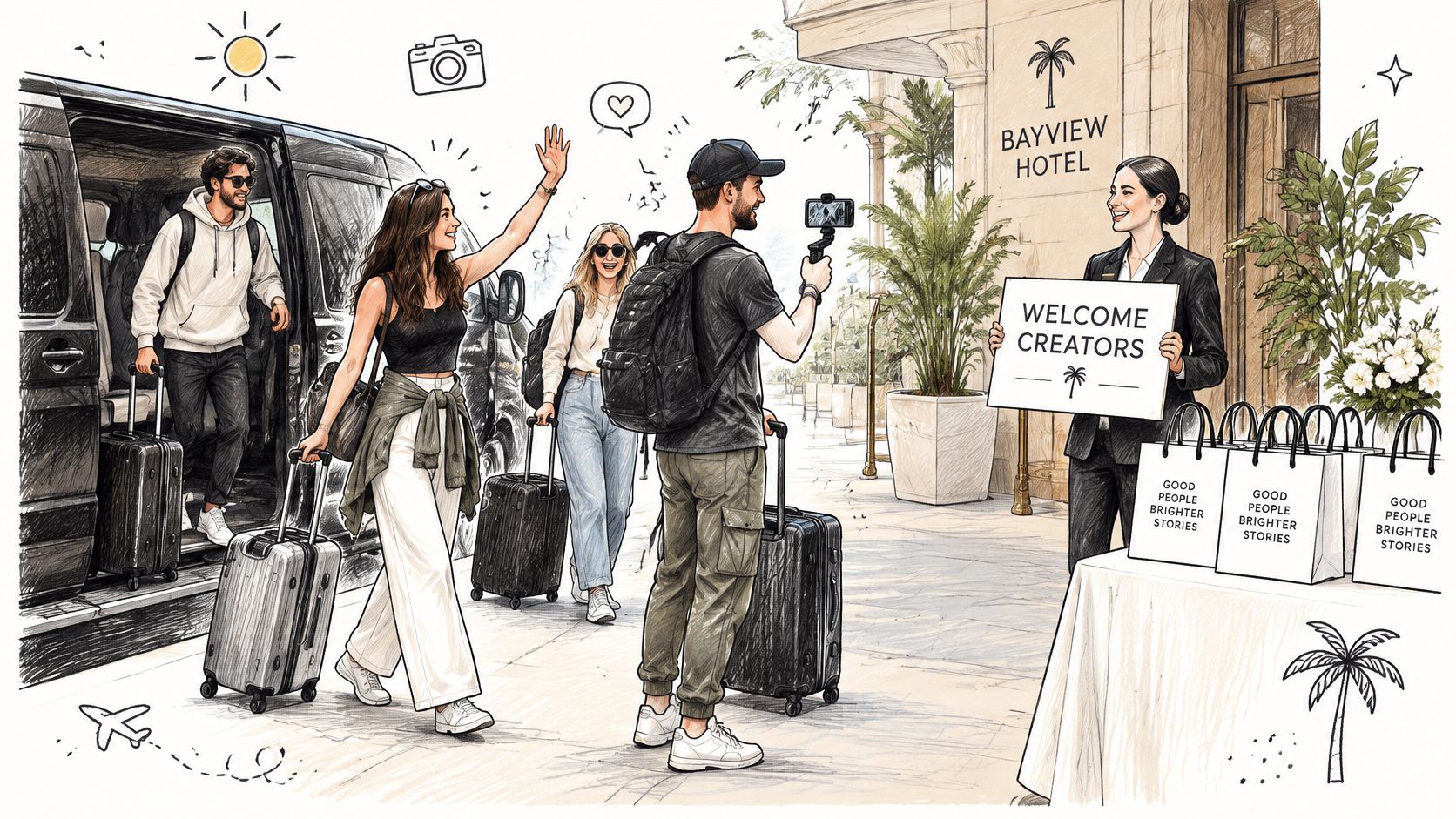
A restaurant tasting, accommodation launch or visit across several regional sites can justify travel. A product that demonstrates well at home usually suits influencer gifting better. The guide Influencer Gifting: How to Send Products and Get Posts covers that route.
Brand trip compared with sending product and local activation
| Goal | Send product | Brand trip | Local activation |
|---|---|---|---|
| Simple product demonstration | Strong fit | Weaker, costs more than the product needs | Not needed |
| Footfall to one venue or site | Weak | Strong when the venue is the destination | Strong |
| Several posts from one place | Weak | Strong | Medium |
| Cost per creator | Lowest | Highest | Medium |
| Travel and carbon exposure | None for creator travel | Highest | Low |
These are planning comparisons, not fixed price rankings. Product delivery still has an environmental footprint, and a local activation still requires staff and production.
In March 2026, VisitBritain reported that 22% of UK adults said climate change influenced their holiday choices to a large or very large extent, with younger adults more likely to be influenced. A long-haul itinerary can therefore clash with audience values.
Decision test: The campaign needs a measurable objective that genuinely requires a physical visit. Otherwise, product delivery or a local event deserves the budget.
How to Set Objectives and Pick the Right Creators
Creator selection starts with the business outcome, not the guest list. A venue seeking nearby customers needs different creators from a brand commissioning destination footage.

- Choose the primary objective. Awareness, local footfall, reviews, content production and sales require different briefs. Combining them without priorities makes creator selection harder.
- Define the audience's location. A Kent venue needs people who can realistically visit. A creator's home address doesn't establish where their followers live.
- Match the niche and format. Assess whether the creator explains food, demonstrates products or films accommodation convincingly. Select for the content the campaign needs.
- Review recent work. Check production quality, tone, audience responses and competing partnerships. Existing exclusivity may rule out an otherwise suitable creator.
- Limit invitations to useful roles. Each attendee should contribute a distinct audience or creative capability. Assign a tracked destination or code during planning.
- Confirm availability before offering places. Check travel dates, editing capacity and publishing windows before making bookings.
Follower count alone can mislead. A smaller creator with an audience near the destination may be a better commercial fit than a large account with geographically scattered followers.
In 2025, 84% of UK marketers planned to work with more creators during the following 12 months, according to a survey of more than 600 marketers published by the Interactive Advertising Bureau UK. Early shortlisting gives the team room to negotiate rather than accept whoever remains available.
The discipline behind setting goals for a leadership offsite, explained by MyPerfectStay, also applies to hosted creator events: establish the purpose before selecting attendees and activities.
A shortlist sheet should compare commercial fit, not popularity.
| Name | Location | Objective | Format | Tracked link |
|---|---|---|---|---|
| Candidate name | Verified audience city or neighbourhood | Intended contribution | Agreed content format | Assigned campaign destination |
What the Brand Pays For on a Trip
Creator fees should follow agreed deliverables, with payment conditions tied to approved, live posts where the contract provides for that. Travel and accommodation are separate campaign expenses, not substitutes for a content fee.
Brand trip cost lines and what to confirm
| Cost line | What it covers | What to confirm before booking |
|---|---|---|
| Creator fees | Agreed fee per creator | Price per deliverable and payment on approved, live posts |
| Return travel | Flights or rail to the destination | Who books, who pays change fees, route choice |
| Accommodation | Rooms for creators and staff | Room count, cancellation terms, who pays extras |
| Meals and drinks | Group meals and bar spend | Spend limit and which items are hosted |
| Hosted experiences | Tours, classes, tastings | Dates, capacity, access and cancellation terms |
| Staff and agency time | Planning, travel and on-site cover | Hours and who approves changes |
| Production | Photographers, videographers, props | Shot list and who owns the footage |
| Insurance | Cover for injury, cancellation and loss | Policy terms for every location |
| Licensing and usage | Paid use of creator content | Term, channels and territory |
| Reporting | Tracking links, analytics, post-trip review | Tools in use and who reads the data |
| Contingency | Buffer for changes | Amount and approver agreed before departure |
Separate committed spend from changeable expenses
Room bookings, contracted fees and reserved experiences become committed costs according to their cancellation terms. Extra meals, replacement transport and itinerary changes need separate monitoring. The campaign owner should record both categories in the influencer marketing budget.
Companion travel needs an explicit policy. An unapproved guest can affect room occupancy, transfers, meals and activity capacity. Accessibility needs and dietary requirements belong in supplier planning before deposits are paid.
Insurance requires more than confirmation that a policy exists. The organiser should check covered activities, exclusions, equipment, cancellation triggers and each location with the insurer.
The contingency budget needs a named approver. Without one, staff may commit to changes before anyone checks the total exposure.
Written supplier terms matter as much as creator rates. A cheap room allocation with restrictive cancellation terms can be a poor purchase when attendance remains uncertain.
What to Agree in Writing Before the Trip
The contract should turn the invitation into a plan the creators can work to. Creators need to understand the work before travel is booked, not discover extra requirements on arrival.
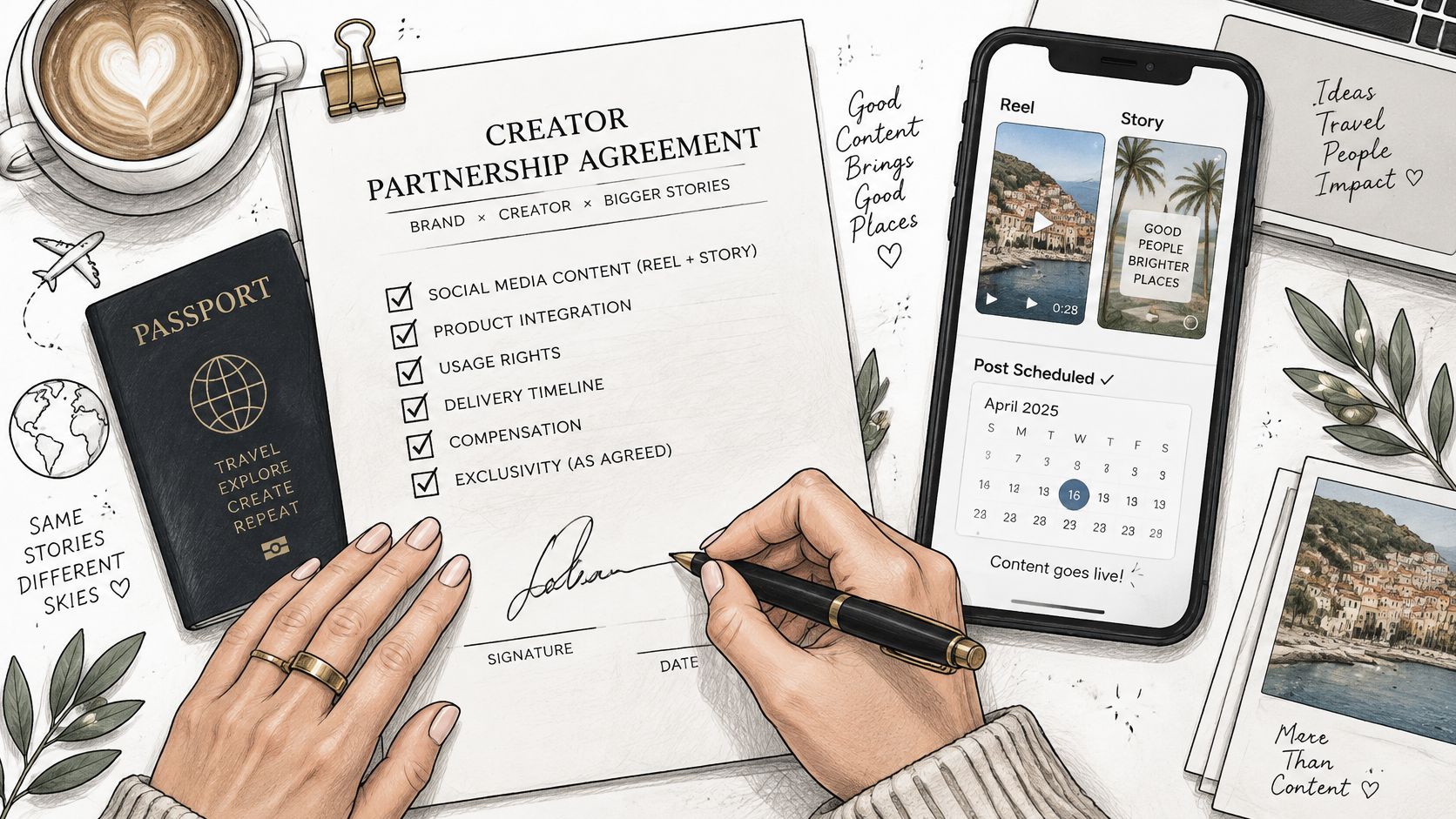
- Deliverables. Specify the quantity, format and length of the agreed influencer posts. The guide to sponsored Instagram posts explains how paid posts are usually priced. Include publication windows, required links and reporting obligations. Optional content should remain clearly separate.
- Dates. Record arrival, departure, attendance commitments and content deadlines. Travel disruption needs a process for changing deliverables rather than an assumption that everything remains possible.
- Benefits. Identify accommodation, transport, meals, hosted activities and fees as consideration. Record excluded expenses and reimbursement arrangements too.
- Disclosure. Require a prominent Ad label at the start of relevant content. “Gifted”, “hosted” or “PR” alone shouldn't be treated as an adequate substitute.
- Usage rights. Define channels, term, territory, editing permissions and paid advertising rights. A usage rights calculator can support the commercial discussion, but the signed licence must state the actual permissions.
- Approvals. Name the reviewer, submission method, revision allowance and response deadline. Keep creative feedback separate from checks on factual claims.
- Payment. State when fees become payable after approval and publication. Include cancellation, partial delivery and disruption terms so the agreement also covers work that doesn't proceed as planned.
Check the commercial relationship
The ASA's influencer flowchart explains that an incentive such as a free trip or hotel stay, combined with editorial control, can make content advertising. The absence of a cash fee or an initial request to publish doesn't settle the question.
Brands and agencies should check their own arrangements against the current CAP Code and ASA guidance. This is a practical summary, not legal advice.
A guide to influencer contracts and agreements can help organise the paperwork.
How to Run the Days So Creators Have Time to Post
A packed hospitality schedule leaves little room for production. The itinerary needs protected working time, an available reviewer and room for corrections.

The ASA's travel disclosure snapshot found that only 20% of travel advertisements in its monitored sample were adequately disclosed. This makes a publication checkpoint an operational necessity, not a caption-writing afterthought.
- Brief before departure. Send the itinerary, disclosure examples, contacts and escalation route early enough for questions. State the label's position for every planned format.
- Protect arrival time. Keep initial arrival free from mandatory filming. Staff can resolve check-in, access needs and missing paperwork without delaying a shoot.
- Reserve production blocks. Schedule shooting and editing before adding optional experiences. Allow for weather, location access, charging and file transfers.
- Check sensitive claims before filming. Food, health, price and performance statements need substantiation and approved wording. Correcting a script is easier than rebuilding a finished video.
- Review within the agreed window. The designated reviewer should be reachable while creators work. Late approvals can make same-day publishing impossible.
- Capture the publication record. Save the screenshot, publication date, disclosure wording and approval status.
- Assign corrections. Each issue needs an owner, deadline and confirmation that the change went live.
Scheduling rule: Required output must fit the actual content windows. A compulsory dinner isn't editing time.
For a lean campaign team, Taja AI's guide to building a content calendar for small teams offers useful scheduling context. The trip calendar should connect each deliverable with its creator, reviewer and publication window.
The on-site team should carry a printed itinerary with approval checkpoints marked. Current ASA guidance should also be checked before publication, especially where spontaneous content changes the planned scope.
How to Judge the Trip After It Ends
A trip earns a repeat only when the result agreed before invitations shows up in the numbers, not in how polished the weekend looked. Judge it against that written objective, using the approval trail and disclosure record collected on site.
Measures for judging a brand trip
| Measure | Where the data comes from | What it tells you |
|---|---|---|
| Qualified visits | Unique tracked URLs | Whether the trip sent people to the place or site |
| Bookings or redemptions | Booking and discount codes | Commercial intent from each creator |
| Cost per qualified visit | Campaign cost divided by qualified visits | Whether the spend was efficient |
| Cost per booking or redemption | Campaign cost divided by bookings or redemptions | Value for the trip budget |
| Usable assets | Campaign register | Content the brand can reuse within licence terms |
| Disclosure compliance | Post checks and saved screenshots | Whether labels met the agreed standard |
| Earned media value | Media monitoring | Secondary signal only |
| Revenue after all trip costs | Sales data less every trip cost | Whether attributable revenue covered campaign spending |
Baseline reach, audience geography and sentiment help separate campaign effects from ordinary activity. Comparable non-trip content, or a control period, is the cleaner reference when you can get one.
Calculate efficiency and commercial return
Cost per outcome equals the full campaign cost divided by qualified visits, bookings or redemptions. The denominator has to match the objective you set. Qualified website visits and physical footfall measure different things.
Attributed revenue less full campaign cost shows what remains before product and fulfilment costs, not automatically profit. Fees, travel, hospitality, staff time, production, licensing and paid amplification all belong in that total.
The campaign success metrics guide supports a consistent reporting framework. Raw impressions and earned media value stay secondary when the commercial objective is bookings or sales.
Keep the campaign register after everyone leaves: deliverables, disclosure evidence and usage permissions. Before departure, set the result that would justify running the trip again. A smaller local visit is the better choice when it hits that result with less spending and less risk. If you want help finding the right creators for a trip, you can book a call with Sup.
More on strategy
See how many creators post about you and your competitors
Type in your brand's Instagram handle and we count the creators who post about you and about your five closest competitors. It takes about a minute and it is free. Or request a demo and we will show you the creators in your niche and walk you through the dashboard.
 Book a call