10 November 2026
Sponsored Instagram Posts: How They Work and What They Cost
In 2021, the UK Advertising Standards Authority found that 65% of ads on 122 monitored UK Instagram accounts were not clearly disclosed as advertising. Its follow-up report on 2024 content found those same accounts disclosed 49% of their ads adequately, up from 35%. A sponsored Instagram post is still an advertisement. A creator is paid, or gifted, to publish about a brand on their own account, and the label has to make that commercial link obvious.
The fee isn't a fixed price per follower. You buy a set of deliverables, a period on the creator's profile, and, if you ask for it, the right to reuse the content as an ad. Those choices, not follower count alone, set the cost and the work your team takes on.
What a Sponsored Instagram Post Is and How It Differs From a Brand Ad
A sponsored Instagram post is a feed post, Reel or Story that a creator publishes on their own account after a brand pays them, or gives them something of value such as free product, with agreed input into what the post says. It isn't an ad the brand runs from its own ad account.
A brand-run ad is bought as media. The brand, or its agency, writes the creative, chooses the audience and the placement, and pays for the impressions. A sponsored post sits on the creator's profile and reaches that creator's followers first. The brand controls the brief and the approval, not the targeting dial.
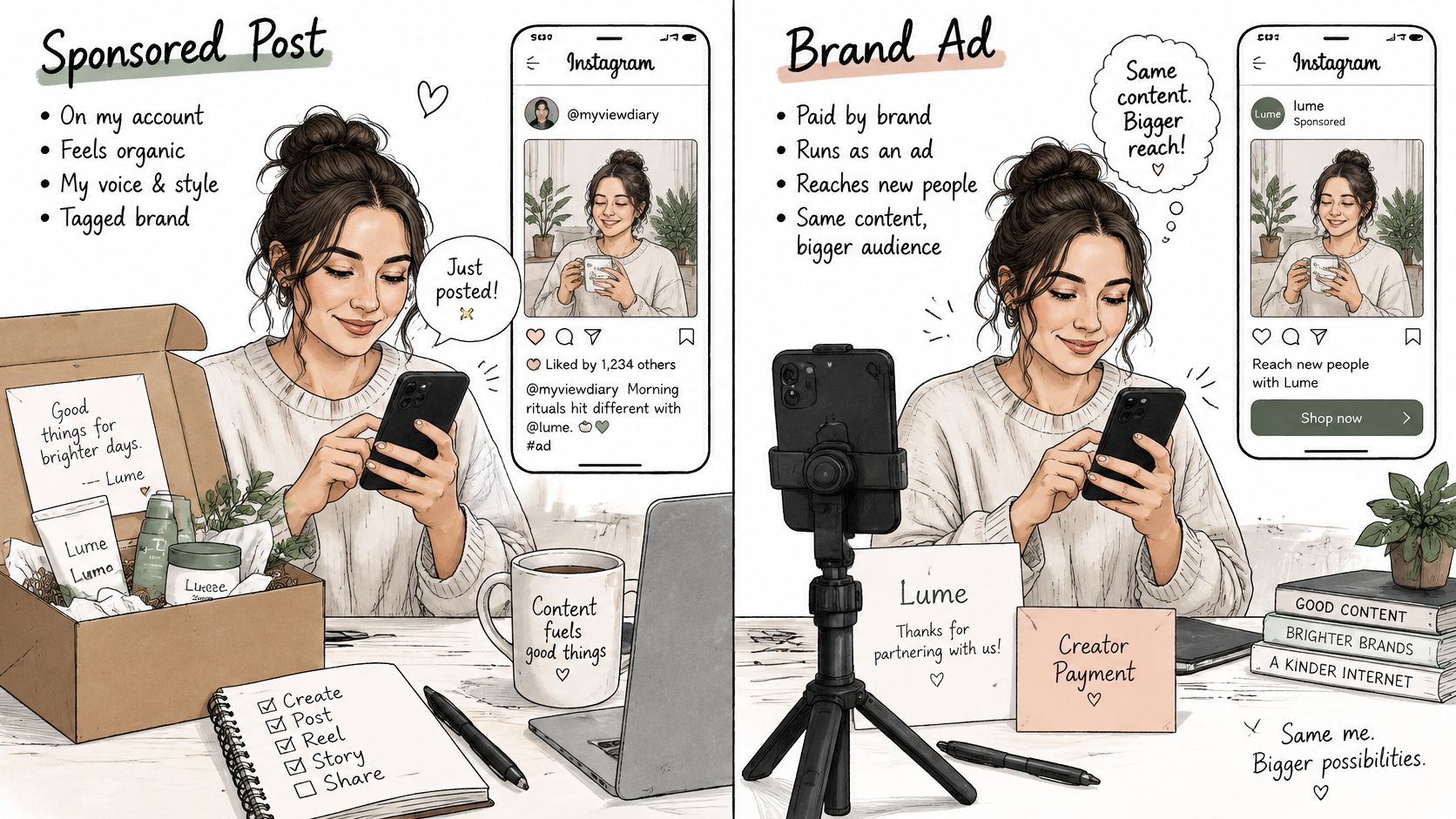
| Point | Sponsored post | Brand-run ad |
|---|---|---|
| Published from | Creator's own account | Brand's ad account |
| Who writes the content | Creator, approved by the brand | Brand or its agency |
| Who pays | Brand pays the creator's fee and any add-ons | Brand pays for media placement |
| Who sees it first | The creator's followers | The audience the brand targets |
| Usage rights | Agreed in the contract | Brand owns the ad creative it made |
A brand can later run that creator post as its own ad, still showing the creator's handle. Those placements are Meta partnership ads. How they are set up is explained in how Meta partnership ads work with creators. The wider menu, from gifting to paid posts and owned assets, is set out across creator campaign types. A post that appears on two profiles at once is a separate format, set out in how brands use Instagram collab posts.
Practical rule: Decide before you brief whether you are buying the organic post, paid use of the asset, or both. Each choice commits a different mix of fee, rights and staff time.
Organic only means you pay the creator to publish, and the post stays up for the period you agree. You don't get a right to boost it. Paid use adds a licence so the brand can run the content in ads for a named period and set of channels. Both means you pay the publication fee and the usage add-on, and you also commit time for approvals, disclosure checks and a media budget.
How to Find and Vet Creators Before You Offer a Fee
Offer a fee only after the account matches the brief. A large following that isn't your buyer is an expensive miss.
- Check the audience first. Look at location, age range and language, and confirm they match the market the product sells to. A UK product shown mostly to followers overseas wastes the fee, because those people can't buy it easily.
- Compare engagement with follower count. Add likes and comments on recent posts, divide by followers, and then read the comments. Replies that mention the product, or the creator's actual content, are a better sign than a stream of emojis or one-word praise.
- Read the last ten to twenty posts. Note brand fit, how often they post, and any earlier sponsored posts. Watch how the audience responded to those paid posts, not only to holiday photos.
- Look for fake-follower signs. Sudden jumps in followers, large numbers of accounts with no posts, comments from profiles with no photo, and engagement that stays flat while the audience grows, are all reasons to pause.
- Run a check before any offer. Put the account through a fake follower check and keep the result with the shortlist, so the fee discussion starts from a cleaned audience.
Say a skincare brand wants buyers in Manchester. A creator with strong UK comments and a steady posting rhythm is a better shortlist than a larger account whose recent comments are generic and whose followers sit mostly outside the UK.
If the audience, the engagement and the post history don't match the brief, a higher fee doesn't fix the mismatch. Walk away and brief the next name.
Paid Partnership Labels and UK Disclosure Rules
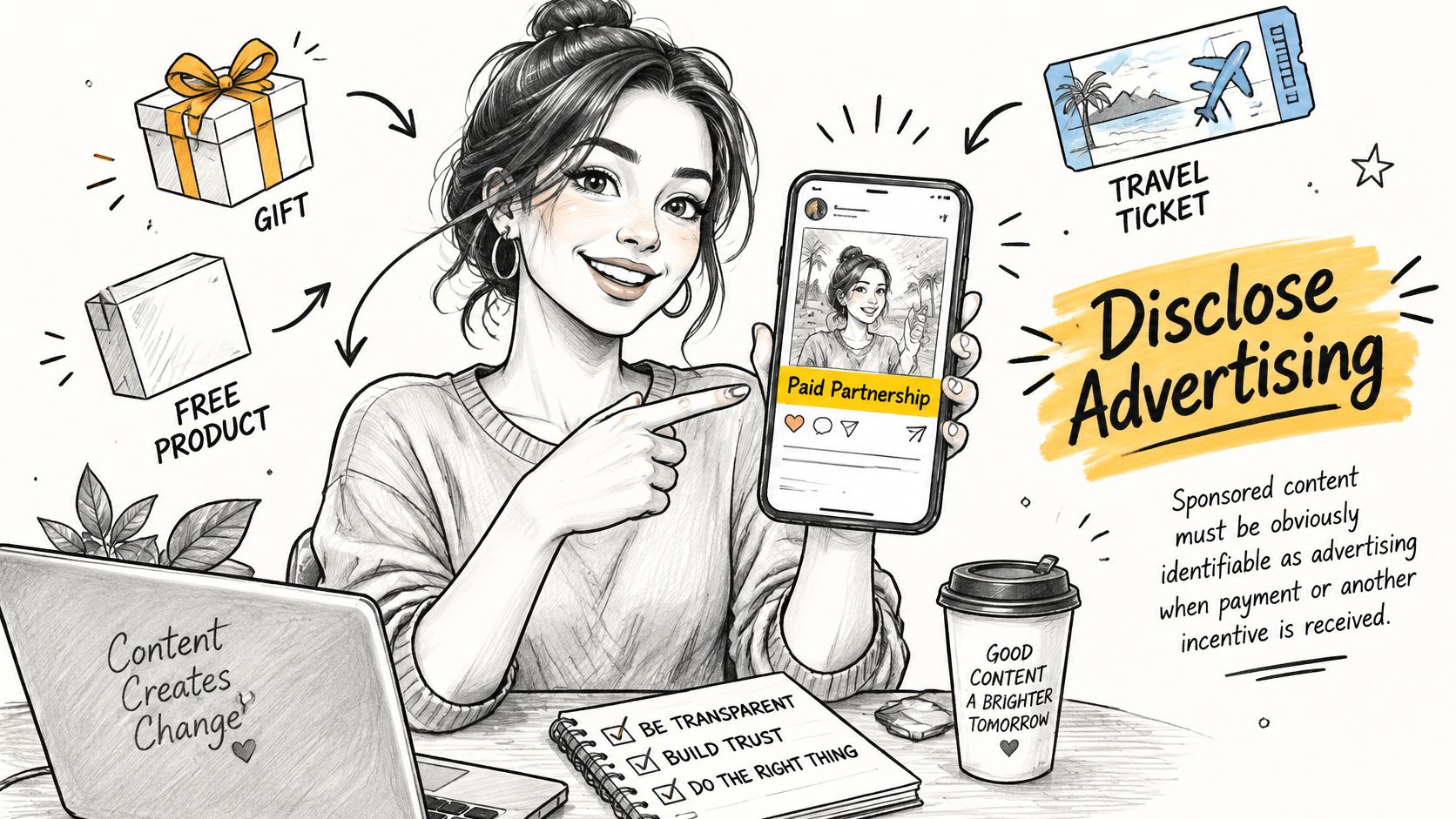
In the UK, a sponsored Instagram post must be obviously identifiable as advertising when a brand gives the creator payment or another incentive, including free products, gifts or trips, and the brand has shared control over the content. The ASA's guidance on recognising ads says the disclosure belongs upfront, before people read, like or otherwise interact with the post.
The ASA generally prefers an explicit label such as "Ad". Instagram's Paid Partnership label is acceptable only when it is clear and prominent. Instagram's help page on the paid partnership label sets out how to add it.
- Classify every paid or gifted deliverable as advertising. A non-cash benefit counts as an incentive, so a gifted post is not a favour outside the rules.
- Label each post, Reel and Story upfront. Each format is its own advertisement. A line in the bio, or on an earlier post, doesn't cover the next one.
- Review the opening frame and caption before publication. If the label sits under a fold, or after a long intro, people can like the post before they see it.
- Recheck the live post. Confirm the label is still visible after it goes up, including on Stories where a later frame can be missed.
Wording such as "gifted" or "PR" can fail to show the commercial link. Say "Ad" or "Sponsored" where people see it first.
The label travels with the post when the brand pays for reuse as an ad. Paid usage rights are a separate cost from the creator fee, and the disclosure duty applies to both the organic post and the paid version.
Brands with a US audience should also read the FTC's Disclosures 101 for Social Media Influencers. Before publication, open the post on a phone as a follower would, with the caption collapsed, and confirm the label appears before any like or tap.
What to Agree in Writing Before a Post Goes Live
Draft the brief in the order the contract will follow, and name the term each line records. The brand approves each post before it goes live.
- Deliverables. Name each format (feed post, Reel, Story or video), how many of each, and any caption points or claims the post must include.
- Approval. The brand signs off each draft, with the number of revision rounds and the named person who approves.
- Timing. Record the posting date, the time window, and whether a later Story or repost is due.
- Duration. State how long the post stays up.
- Disclosure. Specify the upfront label, and a check of every sponsored asset before publication.
- Non-cash benefits. Record any gifted product, trip or other benefit. ASA influencer guidance treats non-cash incentives as payment for disclosure purposes, and expects disclosures to remain relevant throughout an ongoing commercial relationship and in relevant content for 12 months afterwards. Both the brand and the creator are responsible for making the advertising nature clear. Ask your legal reviewer to check this disclosure clause against that 12-month expectation before signing.
- Usage rights. Organic only, or paid reuse, which channels, for how long, and at what add-on fee.
- Exclusivity. The category, the period, and what the creator may not post for rivals.
- Correction. A removal or correction clause if a post breaches the brief.
Sign the terms in a set order so each decision rests on the prior one. Agree deliverables and approval first, then timing and duration. Fix disclosure and non-cash benefits next, because both shape what the post must say and what the creator is paid beyond cash. Set usage rights and exclusivity after that, since both depend on the format and run time already agreed. Leave correction last, as the fallback if any earlier term is broken.
A fuller clause set starts with an influencer agreement template. For how those terms sit inside a longer creator relationship, practical influencer partnership strategies are a useful companion, not a substitute for your own legal review.
What Sponsored Posts Cost and What Moves the Price
The ASA's influencer ad disclosure report says UK spending on influencer advertising more than tripled between 2019 and 2023, and in its 2024 random sample, 34% of Instagram posts were identified as advertising, versus 66% that were non-advertising editorial posts. Paid posts have to be distinguishable from organic recommendations, and the fee is a negotiated package, not a platform tariff.
There is no universal fee per follower. The price follows the deliverables and the rights you buy. A post fee buys the post. Usage rights buy the right to keep using it, in the channels and for the period you agree.
| Model | What the fee covers | Best suited to |
|---|---|---|
| Flat fee per post | One agreed post or Story with set deliverables | A single launch or one-off product news |
| Fee plus usage rights | Post fee plus permission to reuse the content in paid ads for a set period | Brands that want the content as ad creative |
| Gifting with a fee | Product sent to the creator plus a paid post | Trials of lower-cost products |
| Performance bonus | Base fee plus a payment tied to tracked sales or clicks | Campaigns judged on direct sales |
| Whitelisting or exclusivity | Brand runs ads from the creator's handle, or the creator agrees not to work with rivals | High-demand categories where the brand wants sole presence |
Follower count and engagement move the opening quote. So do format (a produced Reel takes more time than a Story), the number of deliverables, how long and where the content can be reused, the length and category of any exclusivity, and how specialised the audience is. A high-reach post with no usage rights is a different purchase from a smaller post you can run as an ad for an agreed period.
Use an influencer rate calculator for a starting estimate. Figures from that tool aren't a published rate card. Confirm payment terms in writing, including when each fee falls due. For a wider look at paying for reach without losing control of the brief, buying creator reach with brand safeguards sets out the safeguards brands usually want in the deal.
Ask every creator for a fee per deliverable, not a lump sum, so you can compare offers on the same basis. Compare the post fee, the usage add-on and the tracked result separately. That keeps the decision on what you buy, not on follower count alone.
How to Budget for a Post and Measure Its Results
Build the budget as four lines, not one creator fee.
- Creator fee for the agreed posts.
- Usage or exclusivity add-on, if you asked for either.
- Product and shipping, when the campaign includes a gift.
- Staff time for the brief, the contract and the disclosure review.
Treat the disclosure check as a real cost. The ASA's 2024 analysis of more than 50,000 pieces of social-media content found that approximately 57% of influencer advertisements on Instagram and TikTok appeared to use an adequate advertising disclosure. Every post needs a check before it goes live.
Give each creator a unique tracked link and a promo code, so clicks, redemptions and revenue can be read by creator. Reach and saves show attention. They don't show a sale.
| Metric | What it shows | How to track it |
|---|---|---|
| Clicks | Interest in the product from the post | Unique tracked link per creator |
| Redemptions | Sales or sign-ups using the creator's code | Promo code per creator |
| Attributed revenue | Sales that came from the tracked link or code | Link and code reporting |
| Cost per click | Fee divided by clicks received | Fee and tracked clicks |
| Cost per acquisition | Fee divided by sales or sign-ups | Fee and tracked sales |
| Reach and saves | Attention and interest, not sales | Platform post insights |
| Store visits | Footfall for local venues | Visit codes or local redemptions |
Value the usage rights on their own line, separate from the organic post. Compare creators on cost per action, not on reach. A post that is quiet in the feed can still be the cheaper ad asset if the tracked sales hold up. A high-reach post with no redemptions hasn't earned its fee. The metrics that belong in that comparison are set out in how to measure influencer marketing. Judge each post against the single target action you set for the campaign, whether that is a sale, a visit or a sign-up.
Plan Your First Sponsored Post Campaign
A campaign should move one target action. Decide whether it is for sales, footfall or awareness, because that choice sets what you pay against and how you judge each creator.
- Set one goal and one target action, such as a tracked purchase or a store-visit code.
- Set the budget with usage rights and disclosure review included, not only the headline fee. Price paid usage as its own line so the creator fee and the rights fee stay separate.
- Shortlist five to ten creators and check audience, engagement and history before you talk money.
- Send the brief with every term agreed in writing, including the label and the usage line.
- Approve each draft and its label before anyone posts.
- Track each creator's link and promo code from the moment the post is live.
- Review results against the target action once the last post is up. Compare creators on cost per action, not follower count, and drop formats that did not produce the action.
To have creators found, briefed and paid for posts like these, start a creator campaign with Sup.
More on channels
See how many creators post about you and your competitors
Type in your brand's Instagram handle and we count the creators who post about you and about your five closest competitors. It takes about a minute and it is free. Or request a demo and we will show you the creators in your niche and walk you through the dashboard.
 Book a call