23 March 2026
How to Build an Influencer Marketing Strategy From Scratch
Before you even think about sliding into a creator's DMs, you need a solid game plan. Trying to build an influencer marketing programme without one is a recipe for chaos. It’s the difference between a predictable growth channel and just throwing money at pretty pictures, hoping something sticks.
Building Your Foundation for Influencer Success
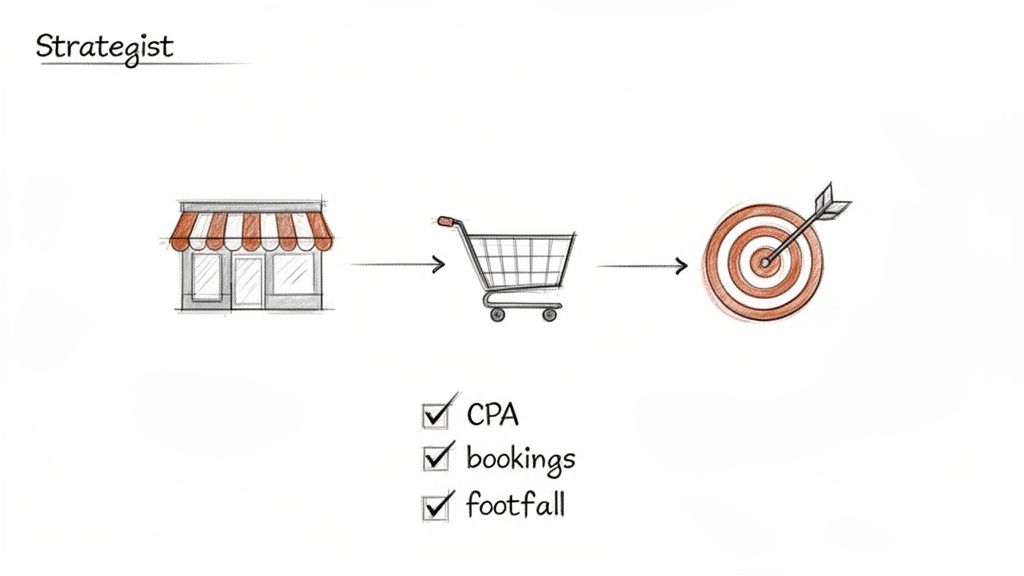
The most critical work happens long before you scout a single profile. A winning strategy is built on a blueprint that connects every influencer post directly to your core business objectives. So many brands get excited and jump straight into creator discovery, which is like setting sail without a map. You might have some fun, but you’ll almost certainly get lost.
The first step is to look past the vanity metrics. Let's be honest, likes and follower counts feel good, but they don’t pay the bills. True success is measured by tangible outcomes that actually move the needle for your business.
For a local restaurant, that might mean a 30% increase in weekday bookings. For an e-commerce brand, it could be hitting a £25 Cost Per Acquisition (CPA) on a new product line. These are the numbers that matter.
Align Business Objectives with Actionable KPIs
You have to translate your high-level business goals into specific Key Performance Indicators (KPIs) for your influencer campaigns. This alignment is what turns hopeful experiments into a reliable growth engine. Without it, you're flying blind.
Let's look at how this works in the real world:
- Goal: Increase footfall at a new cafe location.
- Primary KPI: Tracked redemptions of an influencer-specific promo code (e.g., "CHLOE10" for 10% off).
- Secondary KPI: Mentions and tags from customers visiting the cafe after seeing a post.
- Goal: Drive sales for a new skincare line.
- Primary KPI: Sales revenue generated through unique UTM links shared by creators.
- Secondary KPI: Click-Through Rate (CTR) from influencer Stories to the product page.
To help you get this right, here’s a simple table for connecting your business goals to the right influencer metrics.
Mapping Business Goals to Influencer KPIs
| Business Goal | Primary Influencer KPI | Secondary KPI | Best For |
|---|---|---|---|
| Increase Brand Awareness | Reach, Impressions, Video Views | Follower Growth, Profile Visits | New brands, product launches |
| Drive Website Traffic | Clicks, Click-Through Rate (CTR) | Unique Visitors, Session Duration | E-commerce, content-heavy sites |
| Generate Leads/Sales | Conversions (Sales, Sign-ups) | Cost Per Acquisition (CPA), ROAS | Direct-to-consumer, SaaS |
| Boost Local Footfall | In-store Promo Code Redemptions | Geo-tagged UGC, Check-ins | Restaurants, retail, services |
| Build Community | Engagement Rate, Comments, Shares | User-Generated Content (UGC), Saves | All brands, long-term strategy |
This framework ensures every piece of content has a purpose and that you're tracking what truly matters for business growth, not just social media noise.
A crucial part of this groundwork is using tools for social listening. This helps you understand what people are already saying about you and your competitors, revealing valuable insights that can sharpen your entire strategy.
Setting Realistic and Measurable Targets
Once you have your KPIs, you need to set targets. This is where many brands stumble, either aiming way too high or not setting a benchmark at all. A great place to start is by looking at your existing marketing channels. What’s your current CPA from paid social ads? Use that as your initial benchmark for influencer campaigns.
The UK influencer market is the perfect place to put this into practice. Valued at an incredible USD 2.36 billion in 2024, the market is projected to skyrocket to USD 24.15 billion by 2033. With over 633,000 Instagram accounts in the UK boasting more than 1,000 followers, the creator pool is vast.
This massive creator base makes it easier than ever to find partners who align perfectly with your goals, especially if you’re focusing on hyper-local engagement. You can learn more about how to effectively partner with these smaller creators in our complete guide to micro-influencer marketing for small businesses.
By focusing on specific, measurable goals from the very beginning, every creator you partner with serves a clear purpose. This ensures your investment delivers a genuine, trackable return.
Finding Creators Who Genuinely Connect With Your Audience
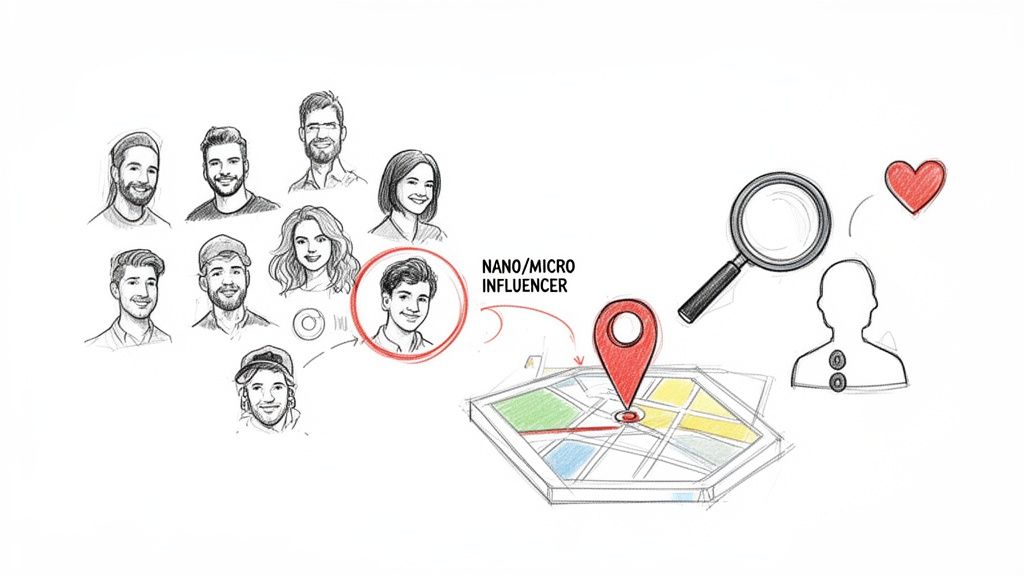
Once your goals are set, it’s time for the make-or-break part: finding the right partners. So many brands fall into the trap of getting mesmerised by huge follower counts, but that's a classic rookie mistake.
The best creators act as a true extension of your brand, not just a temporary billboard. Think of it this way: you need someone who already embodies your brand's values, style, and tone of voice. When you find that person, their content won't feel like an ad. It will feel like a genuine recommendation from a friend, which is exactly what you want.
Look for Resonance, Not Just Reach
Authenticity is the name of the game. A creator with 5,000 hyper-engaged local followers who hang on their every word can be far more valuable than one with 500,000 passive followers who scroll right past their content. The key is to separate sheer reach from real resonance.
To find it, you need to do a bit of detective work. Go beyond the polished feed and dive into their comment sections.
- Are people asking real questions? You want to see followers asking about the product, the experience, or where they can buy it.
- Is the creator actually talking back? A partner who replies to comments and nurtures their community is worth their weight in gold. Engagement is a two-way street.
- Does the feedback feel real? A flood of "Great post!" comments is a red flag. Look for specific, thoughtful reactions that show people are truly paying attention.
This is how you gauge the health of a creator’s community. A loyal, engaged audience is a much better predictor of success than a vanity follower count.
Don’t just look at who a creator is. Look at who follows them. A true partner’s audience should be a near-perfect match for the customers you want to attract.
Why Nano and Micro-Influencers Pack a Punch
For most businesses (especially local restaurants, independent shops, or niche e-commerce brands), the sweet spot is often with nano and micro-influencers. These creators have smaller, more tight-knit communities built on a foundation of trust, which translates into fantastic engagement rates.
This isn’t just a hunch; the data backs it up. In the UK, a staggering 93% of marketers favour micro-influencers. Creators in the nano (1k-10k followers) and micro (10k-100k) tiers consistently deliver better engagement than their macro-sized counterparts. In fact, in 2024, 44% of brands specifically chose to partner with nano-influencers for their impressive ROI. You can dig into more of this in the latest UK influencer marketing report.
How to Discover Creators Without Losing Your Mind
If you’ve ever tried to find creators manually, you know the pain. Scrolling endlessly through hashtags like #LondonFoodie or location tags on Instagram and TikTok feels like searching for a needle in a haystack. It’s a massive time sink, and the results are often disappointing.
This is where a bit of tech can make a huge difference. Instead of manually sifting and guessing, using a dedicated platform like Sup lets you find vetted creators with absolute precision. You can filter by the criteria that actually matter for your campaign.
Here’s how that works in practice:
- For a Multi-Location Restaurant Chain: You could search for food creators based in specific cities like Manchester, Bristol, and Edinburgh. You can even drill down to the postcode level to find influencers who can drive genuine local footfall.
- For a Sustainable Fashion Brand: You could filter for creators in the "ethical fashion" niche and check that they have a history of high engagement on posts about sustainable materials.
This targeted approach takes the guesswork out of discovery. It ensures you’re not just finding people who look the part, but partners whose audience is perfectly primed to help you smash your business goals.
Running Your First Campaign Without the Chaos
Alright, you’ve sorted your goals and have a list of creators you’re excited about. Now for the fun part: turning all that planning into an actual campaign. This is where things can get messy if you're not organised. A solid process is what separates a smooth, repeatable operation from a management headache.
Your first move is the outreach message. Forget sending a formal essay; you’re just looking to start a conversation. Think of it as a friendly, low-pressure tap on the shoulder.
Your initial email or DM needs to be short, personal, and get straight to the point. The key is to mention something specific you genuinely liked about their content. It instantly shows you've actually looked at their profile and aren't just blasting out a generic template.
Crafting Outreach That Gets a Reply
Let’s be honest: a generic message is the fastest way to get ignored. Good creators get dozens of these proposals every single day. To have any chance of standing out, your message needs to feel like it was written just for them.
Here’s a simple, effective structure I’ve seen work time and time again:
- A genuine compliment: "I loved your recent Reel on the best brunch spots in Shoreditch: your editing was fantastic!"
- A quick intro: "My name is [Your Name], and I'm with [Your Brand], a new cafe that just opened in the area."
- The 'why you' part: "We think your audience would really appreciate our focus on locally sourced ingredients, and we'd love to explore a potential collaboration."
- A clear, easy next step: "Would you be open to hearing more?"
This approach is respectful of their time and creates a bit of intrigue. Once they say yes, that's your cue to send over the full campaign brief.
The campaign brief is your single source of truth. It's the playbook that provides clear direction and sets expectations for both you and the creator, ensuring everyone is aligned on the final goal.
Building the Perfect Campaign Brief
A brilliant brief gives creators structure without killing their creativity. It’s about providing all the essential details they need to hit your goals, while still giving them the freedom to be themselves. If you're too restrictive, you’ll get robotic, inauthentic content that audiences see right through.
Your brief should clearly lay out these key areas:
- The Campaign Goal: A simple, one-sentence reminder of what we're trying to achieve (e.g., "Drive bookings for our weekend brunch using your unique promo code.").
- Key Messages: Give them 2-3 essential points you want to get across. Use bullet points, don’t write a script. Let them weave these in naturally.
- Content Deliverables: Be specific about what you need (e.g., "One Instagram Reel and three Instagram Stories with a link sticker.").
- The Non-Negotiables: This is where you list the required @mention, any campaign #hashtags, and, most importantly, the unique tracking link or promo code they have to use.
- Dos and Don'ts: Simple guidelines to avoid obvious mistakes. A restaurant, for instance, might specify, "Do capture the lively atmosphere" and "Don't use flash photography."
- Timeline: Provide clear deadlines for any drafts you need to see and the final go-live date.
For restaurants or hotels, spelling out the on-site experience is just as crucial. Giving them the specifics upfront prevents any awkward confusion and helps the creator show up ready to create great content. If you're in hospitality, you'll find more practical tips in our guide on how to run a restaurant influencer campaign step-by-step.
Deciding on Fair Compensation
Money talk is a vital part of any partnership, and the rates can vary wildly. For emerging nano-influencers (1k-10k followers), gifting a product or an experience is often a great place to start. It provides real value for them without a big cash investment from you, perfect for a restaurant offering a complimentary meal or an e-commerce brand sending its latest product.
As you start working with micro-influencers (10k-100k followers), you'll find a hybrid model is more common. This usually involves gifting the product or experience plus a fee, which can range from £100 to £500+ per post. The trick is to think about the total value exchange, not just the upfront cost. A well-run campaign can deliver a return that makes that initial investment look like a bargain.
By getting these elements (outreach, briefing, and compensation), organised, you create a predictable workflow. This structure is what allows you to manage multiple partnerships without losing your mind, freeing you up to focus on building great relationships and watching the results roll in.
Measuring Performance and Proving Your ROI
If you can't measure it, you can't improve it. This is the moment your influencer marketing moves from a hopeful experiment into a predictable, data-driven growth channel. Proving the value of your work is how you secure more budget and earn a seat at the strategy table. The secret is to look past vanity metrics and track the actions that directly impact your bottom line.
Forget the guesswork. We’re talking about tangible attribution that ties every pound you spend to a measurable return, whether that’s a sale, a booking, or a new customer. Thankfully, the tools to do this are simple, effective, and probably already at your fingertips.
Setting Up Your Tracking Toolkit
Your two most powerful weapons for attribution are unique UTM links and custom promo codes. These tools create a direct, traceable line from an influencer’s content straight to a customer's action.
- UTM Links: Think of these as standard URLs with special tracking tags added to the end. They tell your analytics platform (like Google Analytics) exactly where a visitor came from. You can create unique UTMs for each influencer, and even for each post, to see which partners and content drive the most traffic and sales.
- Promo Codes: For any business with a point of sale, like restaurants or retail shops, custom promo codes are brilliant. A code like “SARAH15” for 15% off is easy for customers to remember and simple for you to track, giving you a clear picture of the footfall driven by each creator.
This is the most critical step in building a measurable programme. It’s how you go from saying, "The campaign got a lot of likes," to, "The campaign generated £5,000 in sales with a 4:1 return on ad spend (ROAS)."
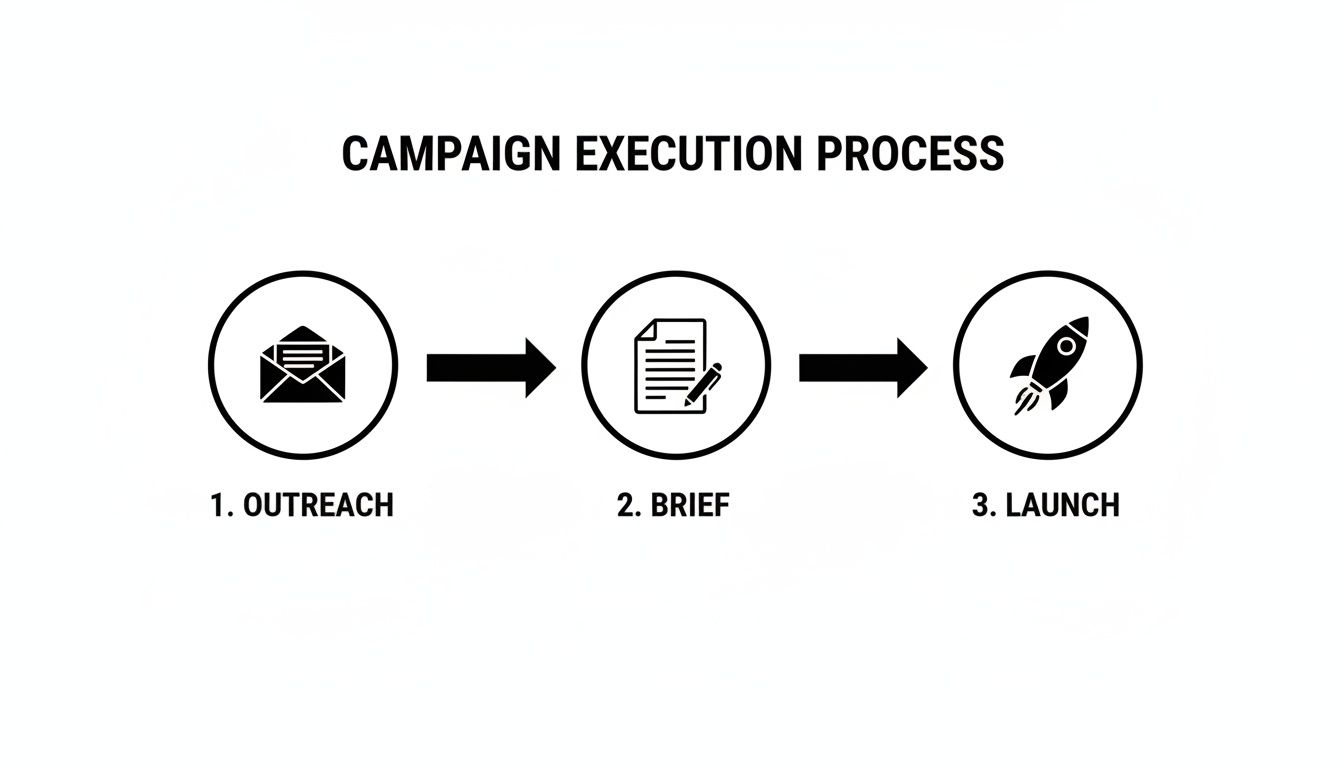
A well-organised campaign process (from outreach to brief and final launch) is the foundation for effective measurement. When your execution is clean, tracking performance becomes much simpler down the line.
A common mistake I see is brands sending all influencers the same generic link. You must create a unique, trackable link or code for each creator. It’s the only way to accurately attribute performance and find out who your real top-performing partners are.
Moving from Data to Decisions
Once your tracking is live, the data will start rolling in. This is where the fun begins. It’s not just about creating a pretty report; it’s about making smarter decisions for your next campaign, and the one after that.
This data-first approach is quickly becoming the industry standard. It's a huge reason why the UK influencer market is projected to hit USD 28.3 billion by 2034. With trust in creators remaining high (49% of consumers trust them more than brand ads), brands are shifting from one-off campaigns to long-term partnerships built on provable ROI.
By analysing which creators drive the best results, you know exactly where to reinvest your budget for the biggest impact. You can get a deeper understanding by reading our guide to measuring influencer marketing ROI.
Organising Your User-Generated Content
A fantastic bonus of any influencer campaign is the mountain of user-generated content (UGC) it produces. This authentic content is marketing gold, but only if you have a system for it.
Create a simple way to collect and catalogue every piece of content as it comes in. A shared cloud folder (like Google Drive or Dropbox) organised by creator name and campaign date works perfectly.
When you save the content, make sure to note:
- The Creator's Handle: So you can always give proper credit.
- The Campaign Name: To keep different initiatives separate and easy to find.
- Usage Rights: Double-check your agreement. Can you use it on your website, in paid ads, or just on social media?
Having this library of high-quality, authentic content ready to go is incredibly valuable. You can repurpose it for your own social channels, email newsletters, or even paid ad campaigns, extending the value of your initial investment far beyond the original post. This is how you build a truly efficient influencer marketing engine.
Scaling Your Strategy and Turning Wins Into a System
That first successful campaign feels fantastic, but the real question is: now what? A one-off win is great, but building a predictable, repeatable system is where the true value of influencer marketing lies. This is the moment you transition from simply running campaigns to building a proper growth engine for your business.
It all starts by digging into your results to figure out what really worked. Was it a specific creator? A certain type of content? Maybe a particular message that just clicked with their audience? Getting answers to these questions is how you stop guessing and start building a strategy that delivers time and time again.
From Good Partners to Great Ambassadors
Once you've found creators who genuinely drive results (whether that’s sales, bookings, or a flood of engagement), don't just thank them and move on. Letting a high-impact partnership end after a single project is a huge missed opportunity.
The smart move is to nurture these proven relationships for the long haul. Think about turning your best-performing creators into genuine brand ambassadors.
When a creator consistently talks about your brand over several months, their audience stops seeing it as a paid ad. Instead, it becomes a natural part of that creator's life. That kind of long-term association is incredibly powerful for building deep brand loyalty.
An ambassador programme doesn't need to be complicated to set up. You can start with simple, meaningful perks:
- Early Access: Let them be the first to try a new dish on your menu or get their hands on a new product before the official launch.
- Exclusive Offers: Give them a unique, ongoing discount code to share with their community, making their followers feel special.
- Performance Incentives: Set up a commission structure on the sales they generate. This creates a true partnership where everyone has skin in the game.
This approach does more than just reward your top talent; it gives them a vested interest in your ongoing success. It’s how you turn a transactional post into a powerful, lasting alliance.
Scaling Local Influence for Multi-Location Brands
For businesses with multiple locations, like a restaurant chain or a network of retail shops, scaling presents a unique puzzle. A successful campaign in Birmingham won't automatically work in Bristol. Relying on a single national influencer just won't drive footfall to specific postcodes. You need local voices with real connections in each community.
The trick is to think centrally but act locally. Here’s a practical way to approach it:
- Develop a Core Playbook: Create your main campaign goals, messaging, and brief at a central level to ensure brand consistency. From there, empower local managers or use a platform to find and activate creators in their specific area.
- Clone Your Success: Look closely at the creator persona that worked so well in your initial campaign. Was it a foodie micro-influencer, a local parent blogger, a student vlogger? Use that profile as a template to discover similar creators in new cities.
- Roll Out in Phases: Instead of trying to launch everywhere at once, which can be chaotic, roll out your campaigns in small, manageable clusters of 5-10 locations. Analyse the data, fine-tune your process, and then move on to the next group.
This methodical rollout lets you keep your brand standards high while still tapping into the authentic power of hyper-local influence. You get measurable results, venue by venue.
Sidestepping Common Scaling Pitfalls
As your influencer programme grows, so do the potential headaches. The little shortcuts and informal processes that worked when you were managing two or three creators will quickly break down when you're coordinating twenty.
Most scaling problems come from a breakdown in your systems. A vague brief that a trusted, long-term partner could decipher will only create confusion and off-brand content when sent to a dozen new creators. Likewise, messy communication leads to missed deadlines and endless back-and-forth.
To avoid these growing pains, you have to go back to basics. Double-down on creating crystal-clear briefs, streamlined communication channels, and flawless tracking methods. By turning what you learned from your early wins into a robust, organised system, you’ll be ready for sustainable, long-term growth.
Your Top Influencer Strategy Questions, Answered
Once you’ve got a plan on paper, the real-world questions always start to bubble up. These are the practical, nitty-gritty details that can trip up even the most well-thought-out strategy. Let's tackle some of the most common queries I hear from brands diving into creator partnerships for the first time.
How Much Should I Pay an Influencer in the UK?
This is the big one, and the honest answer is there's no simple rate card. A creator’s fee is a blend of their follower count, how engaged their audience is, their specific niche, and what you’re actually asking them to do.
A good way to start thinking about it is by the type of creator you’re approaching.
- Nano-influencers (1k-10k followers): For this group, a 'gifted' collaboration is often the way to go. Think a complimentary meal for a restaurant or your latest product for an e-commerce brand. It’s a fantastic, low-risk way to start building relationships and get your first pieces of content.
- Micro-influencers (10k-100k followers): Once you move into this tier, you're usually looking at a gifted product plus a fee. In the UK, this could be anywhere from £100 to £500+ per post. Don't get hung up on just the cost; focus on the total value you're getting and be ready to have a conversation about it.
The best partnerships come from a place of fair value exchange. The question shouldn't be "How little can I get away with paying?" but "What is this creator's content and audience access worth to my business?" When a creator feels genuinely valued, you get their best work. Simple as that.
How Do I Find Local Influencers for My Business?
If you run a business that depends on people walking through the door (a café, a salon, a shop), finding truly local influencers isn't just a good idea, it's non-negotiable. A creator with a massive following in London is no use if you’re trying to fill tables in Manchester.
You could start by manually trawling through location-specific hashtags on Instagram or TikTok (like #BristolFood or #GlasgowVintage). But be warned: it’s a time sink. You’ll spend hours sifting through profiles that just aren't right.
A much smarter approach is to use a platform with robust location filters. Tools like Sup let you get incredibly specific, searching for vetted creators by city or even down to a postcode. This ensures their audience is actually in your service area. When you're vetting them, look for proof. Are they already posting about other local spots? That’s your sign they are an authentic voice in the community you want to reach.
What Is the Difference Between an Outreach Message and a Campaign Brief?
Think of it this way: the outreach message is the friendly knock on the door. Its one and only job is to get a "Yes, I'm interested!" and start a conversation. It needs to be short, personal, and make it crystal clear why you’ve picked them.
The campaign brief comes next. This is the official playbook for the job. It’s the document that lays out everything you’ve both agreed to.
A solid campaign brief must include:
- Key Messages: The one or two main things you absolutely need them to say.
- Deliverables: Exactly what content you expect (e.g., 1 Instagram Reel, 3 Stories with a link sticker).
- Deadlines: Clear dates for when you need to see a draft and when the content should go live.
- Mandatories: The non-negotiables. This means your brand's @handle, any campaign #hashtags, and the crucial unique tracking link or promo code.
A great brief provides clear guardrails but leaves plenty of creative freedom for the influencer’s own voice and style to come through.
How Long Until I See Results From Influencer Marketing?
This depends entirely on what you’re trying to achieve. If your goal is brand awareness, you can see results almost instantly. The likes, comments, and impressions will start rolling in within hours of a post going live.
But if you’re focused on conversions, like sales or bookings, the pattern is different. You’ll likely see an initial surge, but the real value often comes from the 'long tail' as the content gets discovered over the following days and weeks. This is precisely why tracking with UTMs and unique promo codes is so critical. It lets you see the full picture.
As a general rule, give any campaign at least a 30-day window to measure its full impact. For real, sustainable growth in brand loyalty and sales, nothing beats consistent, always-on activity over several months. That’s how you build true momentum.
Ready to stop guessing and start scaling your influencer marketing with predictable results? Sup combines smart technology with a human touch to find your perfect creators, manage campaigns, and prove your ROI, all in a fraction of the time. Launch your first campaign with Sup today.
More on strategy
See how many creators post about you and your competitors
Type in your brand's Instagram handle and we count the creators who post about you and about your five closest competitors. It takes about a minute and it is free. Or request a demo and we will show you the creators in your niche and walk you through the dashboard.
 Book a call