21 March 2026
Influencer Marketing Budget Planning: How Much Should You Spend? A Quick Guide
One of the first questions I always get asked is, "How much should we actually be spending on influencer marketing?" It’s a fair question, and thankfully, we've moved past the days of just guessing.
The standard industry advice is to set aside 15-20% of your total marketing budget for your creator campaigns. This isn't just a number pulled out of thin air; it’s a solid starting point that reflects just how central influencer marketing has become for UK brands, especially in driving real-world results for restaurants, e-commerce shops, and agencies.
Setting Your UK Influencer Marketing Budget
So, why that specific 15-20%? A few years ago, you might have called influencer marketing 'experimental'. Today, it's a non-negotiable part of the marketing mix. It's a powerhouse for hitting tangible goals like boosting sales, securing bookings, and even increasing footfall. With platforms offering much clearer attribution, the fuzzy ROI of the past is gone. You can now connect your spend directly to results.
The market data backs this up completely. Here in the UK, ad spending in the creator economy is set to hit a staggering £930 million in 2024. Forecasts show it climbing to an estimated £1.3 billion by 2029. That's more than double the projected spend for France and Germany combined. As you can see from these insights into UK market trends, sitting on the sidelines is no longer an option for any serious UK brand.
Matching Your Budget to Your Business Size
Of course, that 15-20% figure will look very different depending on your company's scale. A local start-up’s £5,000 spend has different objectives than a national retailer's £100,000 investment. The principle, however, is the same: dedicate a meaningful slice of your marketing pie to a channel proven to deliver.
For many UK brands I work with, particularly in hospitality and e-commerce, nano-influencers are the secret weapon. Their rates can be as low as £50-£200 per post, offering a fantastic, low-risk way to get started. It's perfect for testing what resonates with your audience or running highly targeted, location-specific campaigns.
To help you visualise what this looks like in practice, here’s a quick-reference table. It shows how that 15-20% recommendation translates into actual figures for businesses of different sizes.
Recommended Influencer Marketing Budget Allocation by Business Size
This table provides a quick reference for brands to estimate their starting budget based on their annual marketing spend, using the recommended 15-20% allocation.
| Annual Marketing Budget | Recommended Influencer Spend (15%) | Recommended Influencer Spend (20%) | Typical Focus |
|---|---|---|---|
| £25,000 | £3,750 | £5,000 | Local awareness, nano-influencer gifting |
| £100,000 | £15,000 | £20,000 | Driving sales, micro-influencer mix |
| £500,000 | £75,000 | £100,000 | National reach, multi-channel campaigns |
| £1,000,000+ | £150,000 | £200,000 | Market dominance, macro & ambassador programmes |
Think of this as your strategic baseline. It gives you a data-supported benchmark, helping you move past the initial "how much?" and onto the more important work of building a budget that will smash your business goals for 2026 and beyond.
Connecting Your Budget to Your Business Goals
Throwing money at influencer marketing without a clear goal is a fast track to wasted spend. Before you even think about allocating a single pound, you need to be absolutely certain what you're trying to achieve. Planning an effective budget isn't about plucking a number from thin air; it’s about tying every penny back to your core business objectives.
Your primary goal really does dictate everything that follows, from the type of creators you work with to how you structure their payments. Think of it this way: your budget is the fuel, but your goal is the destination. Without that destination, you're just burning cash.
For most brands, the end game falls into one of four main categories. Pinpointing which one is your top priority is the most critical first step. This flow chart breaks down the basic thinking process.
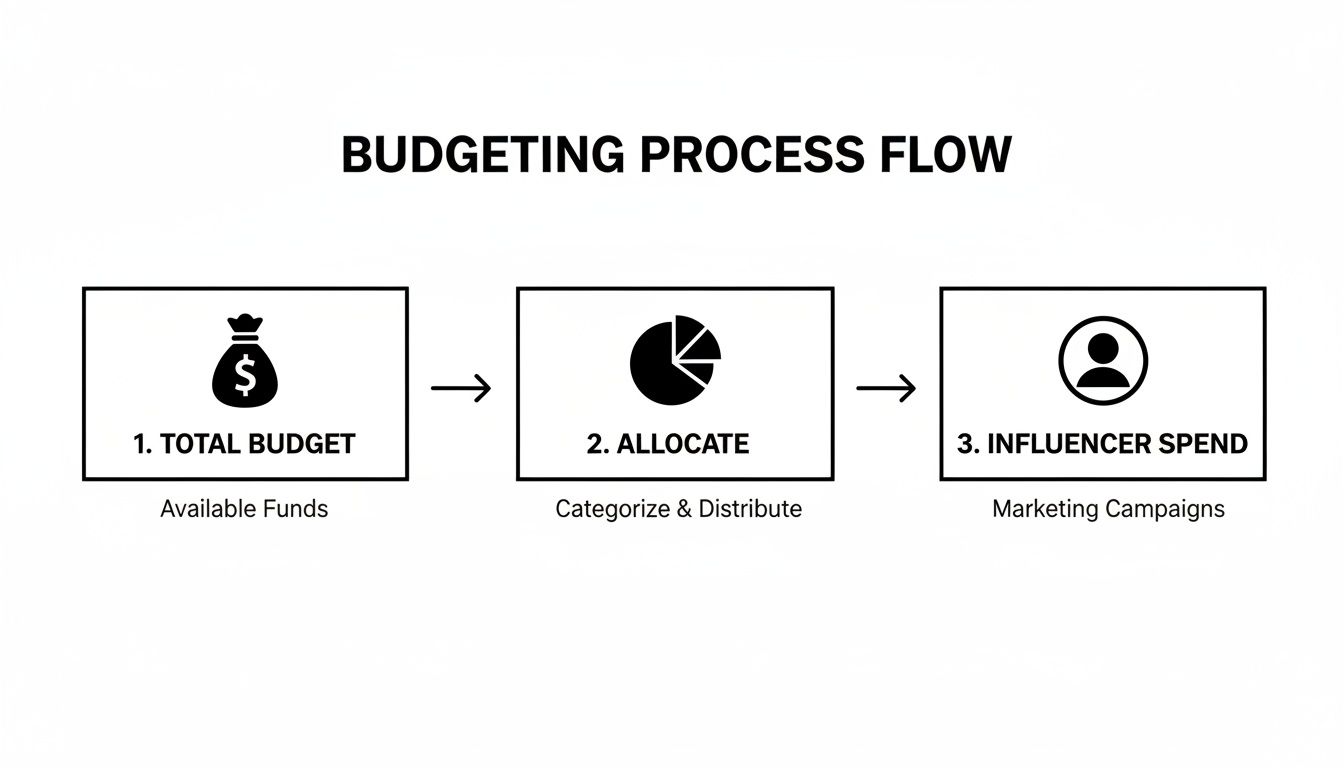
Following this ensures your spending is always strategic, never just a shot in the dark.
The Goal of Brand Awareness
If you’re a new brand breaking into the market or launching a new product line, your main objective is almost certainly brand awareness. The aim is simple: get your name in front of as many relevant people as you possibly can. You want to spark conversations, build recognition, and get people talking.
With awareness as the goal, your budget should be funnelled towards maximum reach and visibility. This usually means collaborating with a mix of creators, including some macro-influencers (100k-1M followers) who command large, broad audiences. Your Key Performance Indicators (KPIs) will be all about top-of-funnel engagement.
- Key KPIs: Impressions, Reach, Video Views, and Follower Growth.
- Budget Focus: Paying flat fees for high-reach posts and stories. You're paying for exposure, not a direct action.
The key thing to realise with awareness campaigns is that you are buying eyeballs, not clicks. Your investment is in planting a seed with a wide audience. Don’t get hung up on low click-through rates; focus on the sheer volume of people who see your brand.
The Goal of Driving Website Traffic
Perhaps your website is the centre of your universe. It’s where customers learn about your services or read your brilliant content. If that’s the case, your goal is to drive website traffic. Success here isn’t just about views; it’s about convincing people to take the next step and visit your site.
This objective calls for content that really piques curiosity and features a crystal-clear call-to-action (CTA). Micro-influencers (10k-100k followers) are often a perfect fit for this, as their highly engaged audiences are much more likely to act on a trusted recommendation.
- Key KPIs: Link Clicks, Click-Through Rate (CTR), and Website Sessions.
- Budget Focus: Investing in creators who are fantastic storytellers and can create compelling "swipe up" or "link in bio" content that feels natural.
The Goal of Securing Direct Sales
For most e-commerce and direct-to-consumer (DTC) brands, the bottom line is generating direct sales. This is the most performance-focused objective, where your return on investment is measured in pounds and pence. Your budget must be structured to directly incentivise and track every single conversion.
Success here hinges on picking creators whose followers genuinely trust their product recommendations. This is where nano- and micro-influencers truly excel, as their endorsement often feels less like an ad and more like a hot tip from a friend. Your budget should absolutely include performance-based elements.
- Key KPIs: Conversion Rate, Cost Per Acquisition (CPA), and Total Revenue Generated.
- Budget Focus: Using hybrid payment models (a smaller flat fee plus commission) or pure affiliate structures. Tracking is non-negotiable; you'll need unique discount codes and UTM links for every creator involved.
The Goal of Increasing Footfall
For brick-and-mortar businesses (think restaurants, indie coffee shops, and high-street boutiques), the goal is often to increase footfall. You need to translate online buzz into real-world customers walking through your door. This requires a laser-focused, local strategy.
Your budget should be concentrated on hyperlocal nano-influencers whose followers live, work, and socialise right on your doorstep. Their content needs to showcase the in-person experience and give people a compelling reason to visit now.
- Key KPIs: In-store redemptions of a specific promo code, social media check-ins, and mentions in location-tagged posts.
- Budget Focus: Partnering with a larger volume of local nano-creators, often through product gifting (contra deals) or smaller fees, to completely saturate a specific geographic area with positive buzz.
As a quick tip from my own experience: when using a platform like Sup, you can filter for pre-built campaign templates designed specifically for these goals. For instance, selecting a "drive footfall" or "boost sales" campaign automatically sets you up with the right tracking mechanisms and outreach scripts, which can save hours of tedious manual setup.
Calculating Your Creator Costs and Finding the Right Mix
Once you’ve got your goals pinned down, it's time to get into the nitty-gritty of your influencer marketing budget: the creators themselves. This isn't just about picking someone with a huge follower count. The real art is in building a smart 'creator mix': a portfolio of partners who line up perfectly with your campaign goals and what you can afford to spend.
The UK market is particularly buzzing right now. More than half of marketers are increasing their influencer spend year on year. And while everyone acknowledges that creator costs are on the rise, the speed of the ROI means brands are more than willing to keep investing. It’s a trend that shows just how dominant this channel has become.
Decoding the Creator Tiers
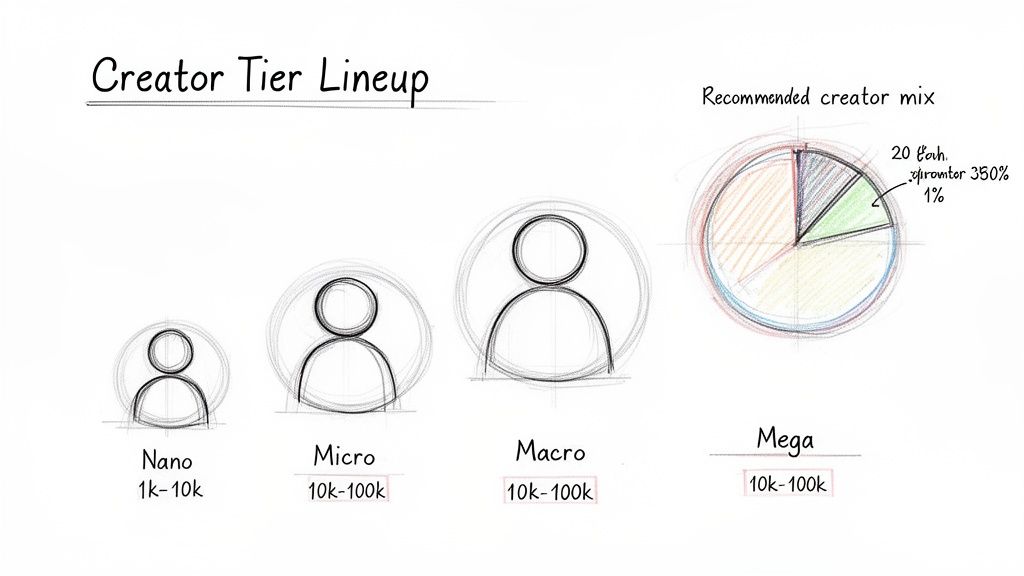
First things first, you need to understand the different types of creators out there. They're usually categorised into tiers based on follower count, and each one brings something different to the table at a very different price point. Knowing the difference is crucial for spending your budget wisely.
- Nano-Influencers (1k to 10k followers): Think of these as your passionate, everyday advocates. Their audiences might be small, but they're incredibly engaged and loyal. Authenticity is their superpower.
- Micro-Influencers (10k to 100k followers): A step up in audience size, micros still have that powerful community trust and often a specific niche authority. They're the sweet spot for many brands, offering a great balance of reach and genuine connection.
- Macro-Influencers (100k to 1M followers): These are your established digital personalities and experts in their field. They offer serious reach, which makes them a great choice for big awareness campaigns.
- Mega-Influencers (1M+ followers): This is the realm of celebrities and top-tier social media stars. A collaboration here gives you massive exposure, but it comes with a premium price tag and often, a lower rate of engagement.
From my own experience working with UK e-commerce and hospitality brands, the real magic often happens with nano and micro-influencers. Their endorsement feels less like an ad and more like a genuine tip from a friend, which is gold when you're trying to drive sales or get people through the door.
Aligning Tiers with Your Budget
So, let's talk money. A creator's fee depends on a whole mix of things: their follower numbers, engagement rate, the type of content you want, and how much work is involved. There’s no universal price list, but there are definitely ballpark figures you can use to start your influencer marketing budget planning.
For example, a UK-based nano-influencer might charge anywhere from £8 to £200 per post. For that, you get high engagement within a super-targeted niche. Move up to the micro-influencer tier, and you’re looking at £200 to £1,000 per post. You get broader reach but still maintain that authentic feel without the celebrity price tag.
A core part of your strategy should be building a 'creator mix'. Instead of blowing your whole budget on one macro-influencer, think about spreading it across 10-15 micro-influencers. This diversifies your campaign, reduces risk, and lets you test which messages and creators connect best with different parts of your audience.
This table gives you a rough idea, but for a much deeper dive into pricing across different platforms and content formats, you should definitely read our complete guide on how much you should pay Instagram influencers.
The Power of Product Gifting
If you're an emerging brand or just working with a tighter budget, never underestimate the value of product gifting, often called contra deals. It’s simple: you send your product to a creator for free, and in return, they share a review or a post about it.
This works especially well with nano- and smaller micro-influencers who are genuinely excited to discover new things and share them with their community. It’s a fantastic, low-risk way to:
- Generate that all-important early social proof and reviews.
- Collect brilliant user-generated content (UGC) that you can then repurpose.
- Build real, lasting relationships with the next wave of creators.
Even though you’re not paying a fee, don’t forget to account for the cost of your products and the shipping. Think of gifting not as a freebie, but as an investment in building brand love from the ground up.
Bringing Your Budget to Life with Real-World Scenarios
Alright, let's get practical. Theory is great, but what does this all look like on the ground? The best way to understand how to build a budget is to see how other businesses do it. It’s at this stage that the numbers on a spreadsheet start to feel real.
We're moving beyond high-level percentages now and getting into the nitty-gritty, line-by-line planning that separates a successful campaign from a hopeful guess.
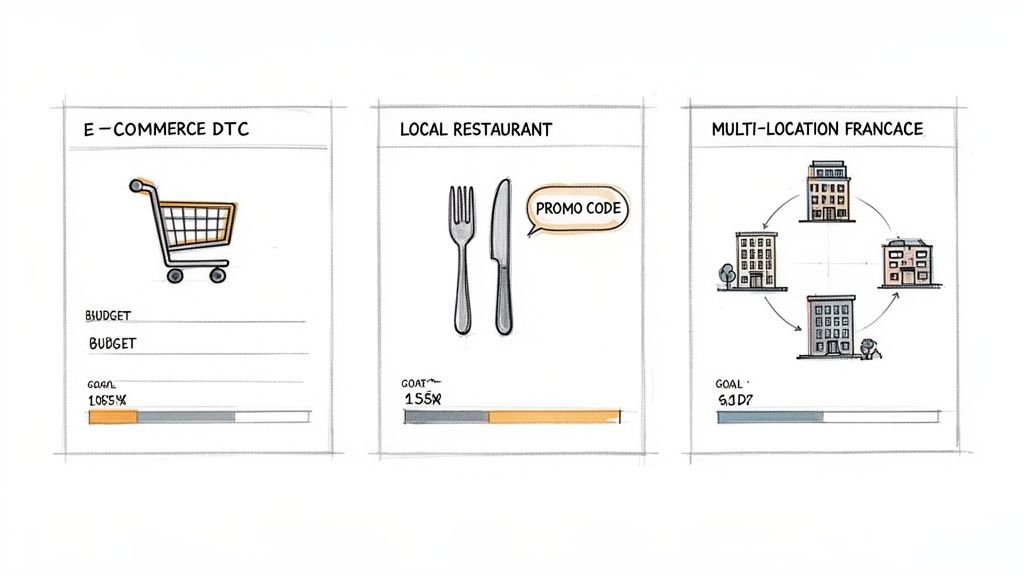
Let’s explore how three very different businesses might tackle their influencer budget: a direct-to-consumer (DTC) e-commerce brand, an independent local restaurant, and a fast-growing franchise with multiple locations.
E-commerce DTC Brand Driving Sales
First up, imagine a UK-based sustainable fashion brand. They've set aside a healthy annual marketing budget of £100,000 and decided to allocate 20% of it to influencer marketing. This gives them a £20,000 quarterly budget to work with, and their number one goal is to drive sales.
Here’s a breakdown of their game plan:
- Objective: Generate direct online sales and get their hands on a steady stream of high-quality user-generated content (UGC) to repurpose in their own ads.
- Creator Mix: They're using a smart mix of paid micro-influencers for targeted reach and gifted nano-influencers for authentic, grassroots buzz.
- Tracking: Every creator gets their own UTM link and a unique discount code. There's no guesswork here; they can attribute every single sale.
A detailed budget is non-negotiable. The table below shows how this e-commerce brand might break down its spending, revealing that there’s more to it than just creator fees. To get a fuller picture of these often-overlooked expenses, it’s worth exploring the real cost of running influencer campaigns in-house.
Sample Influencer Budget Breakdown for a UK E-commerce Brand
| Expense Item | Description | Cost Breakdown (£) | Percentage of Budget |
|---|---|---|---|
| Creator Fees | Paid collaborations with 15 micro-influencers (£500 avg. fee) | £7,500 | 37.5% |
| Product Gifting | Cost of goods for 50 nano-influencers (£100 retail value each) | £5,000 | 25% |
| Shipping & Handling | Postage costs for all 65 product sends | £500 | 2.5% |
| Platform/Tools | Subscription for a platform like Sup to manage outreach, tracking, & attribution | £2,000 | 10% |
| Content Boosting | Ad spend to promote the best-performing influencer content | £5,000 | 25% |
| Total Campaign | Total Investment for the Quarter | £20,000 | 100% |
Notice how this isn't just about paying for posts. It’s a strategic investment that covers the tools needed for efficient management, the cost of the products themselves, and a dedicated fund to put ad spend behind the best-performing content.
Local Restaurant Driving Footfall
Now, let's shift gears to a completely different scenario: an independent restaurant in Manchester. With a much tighter marketing budget of around £1,000 per month, the goal is simple: get more bums on seats, especially during those quieter mid-week evenings.
- Objective: Increase footfall and generate authentic, local buzz.
- Creator Mix: Hyperlocal nano-influencers (under 5k followers) who either live in Manchester or are known for visiting the city's food scene.
- Tracking: They've set up a simple but effective promo code, "SUPPERCLUB20," which gives customers a free drink when they book a table from Monday to Wednesday.
For a local business, reach is less important than relevance. A collaboration with a creator whose 2,000 followers are all local foodies is far more valuable than working with a London-based influencer with 50,000 followers.
With a modest budget, their entire strategy is built on contra deals (exchanging product for posts).
The investment is focused entirely on their product. They offer complimentary meals for two to 20 local nano-influencers throughout the month. The actual cost of goods for these meals works out to around £1,000 (at £50 per table).
The owner handles all the outreach manually through Instagram DMs. It's time-consuming, for sure, but it keeps cash costs at zero. Success is then measured by how many times the promo code is redeemed, a direct line from an Instagram Story to a customer walking through the door.
Multi-Location Franchise Building Local Presence
Finally, let’s consider a fitness franchise with 10 studios dotted across the UK. Their main goal is to drive new membership sign-ups for each individual location. The challenge is running hyper-localised campaigns at scale without it becoming an administrative nightmare.
- Objective: Increase new membership sign-ups at each studio.
- Creator Mix: They need a high volume of local micro- and nano-influencers who live near each of the 10 studios.
- Tracking: Each studio gets its own unique landing page and promo code (e.g., "studio-name-FIT10") to track performance accurately.
They have a central budget but execute locally, allocating £2,000 per location for a total campaign spend of £20,000. This is where a management platform becomes essential.
Instead of drowning in spreadsheets and manual DMs, they use a tool to streamline the entire process. A platform like Sup, for instance, is perfect for this kind of multi-location challenge. It allows one marketing manager to:
- Source influencers by identifying 10-15 relevant fitness creators near each studio.
- Manage the campaign where each creator gets a free 3-month membership and a small fee of £100-£200 for a content package.
- Attribute results by tracking all traffic and sign-ups through the unique links, showing exactly which creators and locations are delivering ROI.
This approach turns a complex logistical problem into a repeatable, scalable growth strategy, proving that even nationwide brands need to think local.
Measuring ROI to Prove Your Spend Is Working
Your influencer budget is only as good as the results it drives. I’ve seen too many brands pour money into campaigns without a clue what’s actually working, and it’s a fast way to burn cash. This is where measurement and attribution stop being buzzwords and become your best friends. They’re how you justify your spend, keep stakeholders happy, and figure out how to scale your strategy intelligently.
Getting your influencer programme out of the vague ‘brand expense’ column and into the predictable ‘performance channel’ one is all about tracking. With the right setup, you can move past guesswork and see real-time data on everything from views to revenue, turning your campaigns into a reliable growth engine.
Calculating Your Core Performance Metrics
To really prove your investment is paying off, you need to get comfortable with a couple of simple but powerful formulas. These aren't just for the finance team; they are vital for any marketer wanting to make data-driven decisions. The two metrics that matter most are Return on Investment (ROI) and Cost Per Acquisition (CPA).
- Return on Investment (ROI): This tells you exactly how much profit you made for every pound you spent. It’s the ultimate bottom-line measure of success. The formula is straightforward: (Profit from Campaign - Campaign Cost) / Campaign Cost x 100 = ROI %
- Cost Per Acquisition (CPA): This shows you how much it cost to bring in one new customer. For any sales-focused campaign, this metric is non-negotiable. Here's the formula: Total Campaign Cost / Number of New Customers = CPA
So, if you spent £5,000 on a campaign that generated £15,000 in profit, your ROI would be a very healthy 200%. If that same campaign brought in 100 new customers, your CPA would be £50. Tracking these two figures gives you a crystal-clear verdict on performance.
Essential Tracking Tools for Accurate Attribution
Those formulas are only as good as the numbers you feed them. You need rock-solid ways to connect an influencer's post directly to a customer's action. Messy attribution is the enemy of a smart budget.
Luckily, tracking doesn't have to be a headache. Here are the three most effective tools we see brands using successfully every day:
- Unique Discount Codes: This is the classic for a reason. Give each influencer their own code (e.g., "SOPHIE15"). When it's used at checkout, you know exactly who drove the sale. It's a lifesaver for e-commerce and works surprisingly well for tracking footfall in physical locations like restaurants.
- Custom UTM Links: A UTM link is just a standard URL with special tracking tags added on. When someone clicks it, your analytics tool (like Google Analytics) instantly logs the source, medium, and campaign. This is your go-to for tracking website traffic, sign-ups, and conversions from specific posts or Stories.
- Affiliate Programmes: For campaigns where you pay per result, affiliate links are the industry standard. They use cookies to track a customer’s journey from the creator's content right through to your site, automatically crediting the sale and calculating commission. No manual work needed.
To truly understand the value of your influencer marketing spend, it's essential to measure the outcomes. A powerful tool for this is a conversion rate calculator, which helps you quantify the effectiveness of your campaigns.
The Power of a Centralised Dashboard
Let's be honest, juggling dozens of discount codes, UTM links, and creator conversations in a spreadsheet is a nightmare. It’s inefficient, riddled with errors, and makes it impossible to see the bigger picture in real-time. This is where a centralised platform isn't a nice-to-have; it's a game-changer.
Using a dashboard like the one in Sup brings all your campaign data into one place. You can see views, clicks, code redemptions, and revenue generated per creator, all updated live. This clarity is what allows you to quickly double down on what’s working and cut what isn’t.
This level of insight shifts you from being reactive to proactive. You can spot your top-performing creators instantly and focus on building stronger, long-term partnerships with them. For a deeper look at this, check out our guide on how to measure influencer marketing ROI effectively.
Don’t Forget the Hidden Value of UGC
Finally, a complete ROI calculation has to include the value of the content itself. Every photo and video you get from an influencer is a valuable piece of user-generated content (UGC). It’s authentic, high-quality content you didn’t have to pay a production company to create.
Just think about the cost of a professional photoshoot. That creator content can be repurposed everywhere: on your website, in email newsletters, and even in your paid ad campaigns. This "bonus return" adds enormous value to your influencer spend, giving you a library of assets that build social proof long after the initial campaign ends.
Of course. Here is the rewritten section, designed to sound completely human-written, with a natural flow and expert tone.
Optimising Your Budget for Long-Term Growth
Let’s be honest: successful influencer marketing isn’t about splashing cash on a few one-off campaigns and hoping for the best. It’s about building a reliable, repeatable system that delivers predictable growth. As you get a few campaigns under your belt, your thinking needs to shift from simply spending a budget to making a long-term investment.
And it seems most UK marketers are already on board with this. The latest data is pretty telling, with a massive 87.49% planning to increase their influencer spend through 2026. Even more striking is that 72.22% of those are looking at aggressive hikes of over 50%. This isn’t just wishful thinking; it’s a direct response to a channel where 65.9% of marketers see a return within the first month. As you can see in the full Influencer Marketing Benchmark Report, sitting on the fence in this climate means you're actively losing ground to your competitors.
So, the data is clear: it’s time to scale up. The real question is how to do it without just throwing money away.
From One-Offs to Ambassador Programmes
One of the smartest ways to make your budget work harder for you long-term is by turning your top-performing creators into brand ambassadors. You know the ones I mean: the influencers who didn't just hit their KPIs but genuinely clicked with your product. Their audience loved the content, the comments were glowing, and their creative work was spot on. Instead of just paying them for another single post, it’s time to bring them into the fold.
An ambassador programme isn’t transactional; it's relational. Here’s what that looks like in practice:
- Long-Term Contracts: You move away from ad-hoc payments and agree on a retainer for a set number of deliverables over several months, or even a year.
- Deeper Integration: Give them a sneak peek at new products, invite them to creative brainstorming sessions, and make them feel like part of your team. This buy-in is invaluable.
- Preferential Rates: In exchange for that long-term commitment, you can often negotiate a better overall rate. It gives the creator predictable income and gives you more bang for your buck.
A great ambassador is so much more than a marketing channel; they become a true advocate for your brand. That genuine enthusiasm connects with their audience on a level a single sponsored post never could, driving sustained growth and real loyalty.
Reinvesting and Refining Your Strategy
Once your programme matures, your past campaign data is gold. Use it to sharpen every single part of your future budget planning. Don't just rinse and repeat what worked; dig into why it worked and double down on that.
Dive into your analytics. Did creators in a particular niche consistently drive the highest conversion rates? Was there a specific content style (like "get ready with me" videos or unboxings) that always sparked more engagement? These are the patterns that should inform your next move.
This cycle of launching, measuring, and refining is what separates a good programme from a great one. It lets you reinvest your profits with confidence because you know every pound is being spent based on proven success, not just a hunch. You're building a powerful, repeatable engine that saves you time and drives consistent, long-term growth.
Common Questions on Influencer Budgets
When you're mapping out an influencer budget for the first time, a few questions always seem to pop up. Let's tackle the most common ones we hear from UK brands.
How Much Should a Small Business Spend?
There's no magic number, but a solid starting point for a small UK business is to earmark 15-20% of your total marketing budget. If you're working with a really tight budget, don't worry. You can still get started.
Kick things off with product-gifting campaigns, often called 'contra deals', with nano-influencers. Their fees can be incredibly reasonable, sometimes as low as £50-£200 per post. This approach lets you test the waters, build genuine relationships, and gather valuable user-generated content without a massive upfront investment. Start small, track your results obsessively, and then double down on what proves effective.
What Are the Hidden Costs?
Creator fees are just the tip of the iceberg. It’s the costs lurking beneath the surface that can really throw your budget off course if you’re not prepared for them.
Always remember to factor in:
- Product Costs: The actual retail value of whatever you’re gifting.
- Shipping & Handling: Getting those products into the creator’s hands costs money.
- Content Boosting: Putting ad spend behind your best-performing influencer content to expand its reach.
- Tool Fees: The subscription costs for any platforms you use to find creators, manage campaigns, or track results.
Forgetting these can sink an otherwise perfectly planned campaign before it even gets going.
When you're running a campaign focused on sales, consider a hybrid payment model. Offering a smaller base fee topped up with a commission on sales is a great way to align the creator's motivation with your own and reduce your initial risk.
Ready to stop guessing and start growing? Sup combines AI with a human team to launch, manage, and attribute your creator campaigns, saving you up to 95% of the time. Turn your influencer marketing into a repeatable growth channel.
More on strategy
See how many creators post about you and your competitors
Type in your brand's Instagram handle and we count the creators who post about you and about your five closest competitors. It takes about a minute and it is free. Or request a demo and we will show you the creators in your niche and walk you through the dashboard.
 Book a call