29 September 2026
Hire an Agency for Influencer Marketing
You've started with a sensible plan. A few creators receive products, some posts go live, and the first results look promising. Then the programme expands. Your team is chasing replies, checking usage rights, reconciling invoices and trying to prove which posts influenced sales. The creative work still matters, but the operational load starts to consume the people who were meant to manage growth.
That's the point at which an agency for influencer marketing can either remove friction or add another layer of it. The right partner handles execution without taking away your control. The wrong one adds meetings, opaque fees and a recycled creator list to an already crowded workflow.
Why Your Creator Workflow Needs an Agency Partner
Internal management works well while the programme remains small and familiar. A marketer can identify a creator, write a personal message, arrange gifting and check the final post. Problems appear when several campaigns run at once, each with different deliverables, rights, deadlines, platforms and payment terms.
The visible cost is staff time. The hidden cost is opportunity. A senior marketer who spends the afternoon chasing missing analytics isn't planning the next test, improving the brief or reviewing customer feedback. A finance colleague who receives separate invoices from many creators has less time for higher-value work. A legal reviewer pulled into every small contract becomes a bottleneck.
The UK market makes this pressure harder to ignore. Influencer marketing was estimated at £1.45 billion in 2023, up from £1.1 billion in 2022, according to UK influencer marketing market estimates. A later estimate put the sector at about £2.9 billion in 2026, which indicates how quickly campaign volume and commercial expectations have expanded.
Find the operational breaking point
The break usually arrives through repetition rather than one dramatic failure. Your team may be able to manage individual tasks, but the hand-offs create risk:
- Discovery: A search based on personal contacts or a static spreadsheet misses relevant creators who have emerged since the list was built.
- Negotiation: Rates, exclusivity, usage rights and deadlines sit across email threads, so nobody has a reliable commercial view.
- Delivery: A post can be late, incorrectly labelled or missing a required link without an organised approval checkpoint.
- Payments: Creator invoices, gifted products, expenses and bonuses reach finance through separate routes.
- Measurement: Results are collected after the campaign, often in different formats, with no consistent link between content and revenue.
The issue isn't that an internal team lacks marketing skill. It's that creator campaigns combine media buying, production, partnerships, legal administration and accounts payable. Few marketing departments are structured to run all of those functions manually at scale.
Practical rule: Keep strategy, brand judgement and final approval close to your team. Outsource repetitive execution when it starts taking time away from those decisions.
A useful test is to calculate the full workflow, not just the creator fee. Include sourcing, outreach, follow-ups, product fulfilment, contracts, rights checks, approvals, reporting and payment reconciliation. The real cost of running influencer campaigns in-house becomes clearer when each task has an owner and an estimated time requirement.
An agency should solve that workload, not just present a shortlist. Ask whether it can run sourcing, negotiation, contracting, approval, publishing checks and reporting as one connected process. If your team still has to copy data between tools and chase every creator, you've bought a supplier, not operational capacity.
Comparing Traditional Agencies and Managed Services
Traditional agencies and managed services may use the same language, but they sell different operating models. A traditional agency often centres on strategic planning, creative development, senior account management and access to established talent. That can suit a launch where one recognisable ambassador, a strong concept and broad awareness are the priority.
A managed service behaves more like an execution engine. Your team sets the objective, brief, creative boundaries and approval rules. The partner then manages the repeatable work, including live creator sourcing, outreach, negotiation, contracts, rights, payments, fulfilment and status tracking.
Neither model is automatically right. The decision depends on what your internal team can already do and what the campaign needs to achieve.
| Feature | Traditional Agency | Managed Service |
|---|---|---|
| Primary value | Strategy, creative direction and senior campaign leadership | End-to-end execution and workflow management |
| Creator selection | Often relationship-led and based on an established roster | Live sourcing against the brief, audience, location and content fit |
| Campaign shape | Well suited to flagship activations and selected ambassadors | Well suited to repeatable, multi-creator programmes |
| Commercial model | Commonly a retainer, project fee or negotiated markup | Often structured around execution, creator spend and agreed service terms |
| Client control | May be shared across agency and brand teams | Brand keeps brief, creative direction and final approval |
| Operational burden | Can remain with the client if processes sit across separate systems | Designed to absorb outreach, rights, payments and reporting |
| Best fit | A brand seeking a large creative platform or high-profile partnership | A team seeking scale, local relevance and measurable delivery |
Traditional agencies can add real value when the creative idea is the difficult part. They can also become expensive if you're paying for senior strategy while your team still handles the detailed administration. A large retainer doesn't guarantee faster replies, better rates or cleaner reconciliation.
Managed services have a different trade-off. They may offer less of a full-service brand campaign concept, but they can bring more operational depth to sourcing and delivery. That matters for programmes using many niche or local creators. UK survey data reports that 93% of UK marketers work with micro-influencers and 60% work with nano influencers, while 43% mostly work with creators new to them. Those conditions favour a process that can find, vet and negotiate with a broad pool rather than repeatedly opening the same contact list. The figures and workflow implications are discussed in UK influencer budget and operating model coverage.
The hybrid option is often practical. Keep a creative or brand agency for positioning and campaign direction, then use a managed service for execution. But define ownership clearly. Two partners without a single workflow can create duplicated outreach, conflicting briefs and unclear responsibility for compliance.
Sourcing Criteria and RFP Questions to Ask
A polished proposal tells you how an agency wants to be perceived. Its sourcing process tells you how it will work when your brief is live.
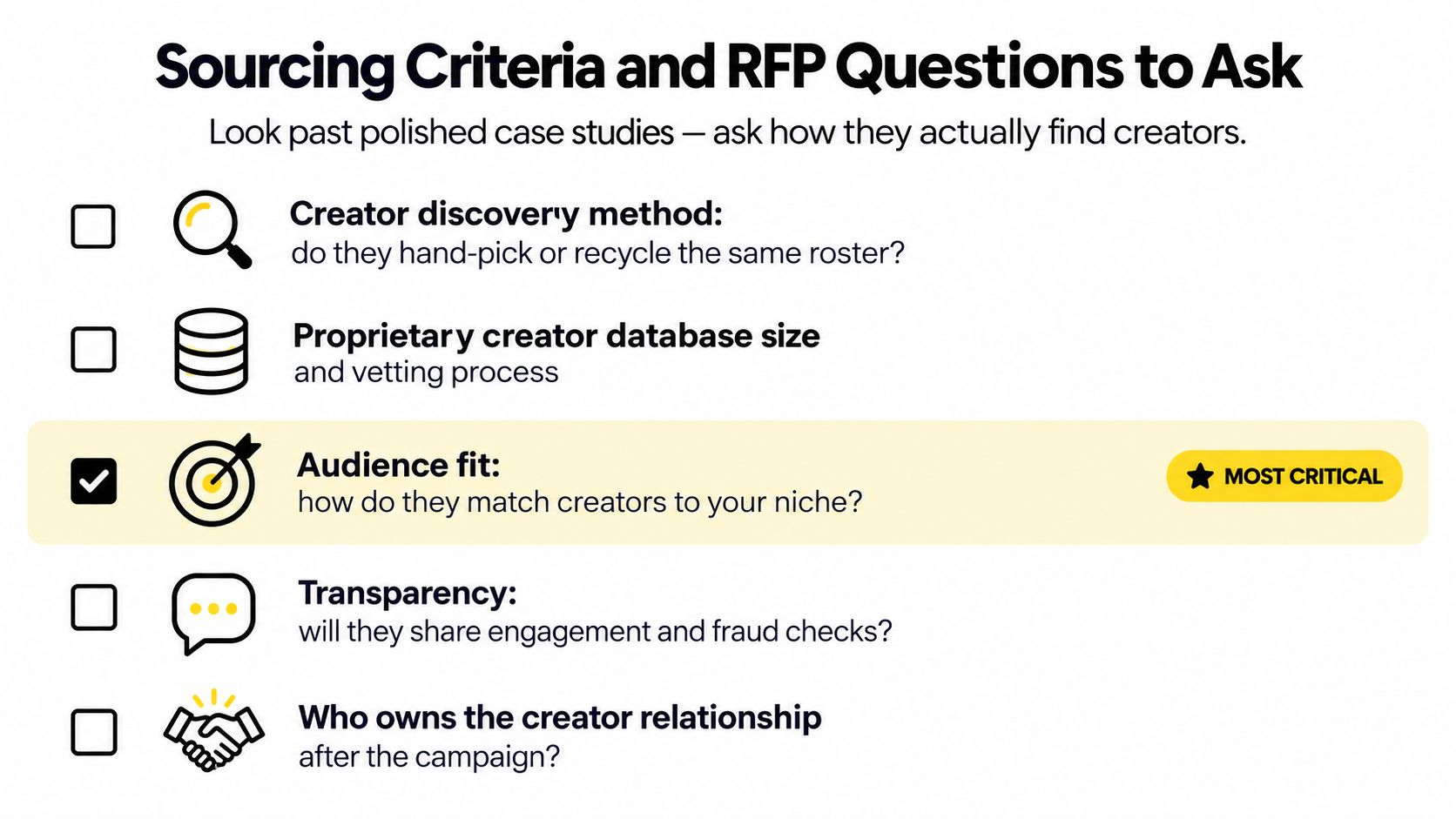
Start by asking whether the agency searches for creators for each campaign or relies on a fixed database. A database can be useful for initial research, but it ages quickly. Creator availability changes, audiences move, rates shift and brand partnerships affect suitability. Live sourcing should reflect the current brief, target audience, geography, platform and content style.
Put the sourcing method under scrutiny
Include these questions in your RFP:
- How do you discover creators for a new brief? Ask for the exact workflow, not a general statement about access. Does the team search current Instagram and TikTok activity, or filter an old roster?
- How do you verify audience quality? Request the checks used for audience location, engagement quality, suspicious activity, previous partnerships and content history.
- How do you assess fit beyond follower count? A good answer should cover topic relevance, tone, format, audience needs, location and the creator's ability to explain the product naturally.
- How do you manage parallel negotiations? Ask how the agency records rates, deliverables, exclusivity, timelines, usage rights and counteroffers.
- Who approves the shortlist? You should see the creators before outreach or booking. Approval must include the reason each person fits the brief.
- What happens after a creator accepts? Look for contract management, disclosure checks, product tracking, reminders, content review and live-post verification.
- Who owns the relationship? Confirm whether the creator can work with your brand directly later and how ongoing partnerships are handled.
- What will the dashboard show? Insist on campaign status, costs, links, codes, content, approvals and results in one view.
The right partner can explain how it will source a creator in a specific neighbourhood, match a persona to a category and compare current rates. The weak answer is a large creator count with no explanation of freshness, vetting or access.
For a platform-specific starting point, this guide on finding your next TikTok partner offers useful questions around niche, audience and content fit. Use that thinking in the RFP, then ask agencies to demonstrate their process against your own brief.
Test the workflow, not just the presentation
Give each shortlisted agency the same practical task. Ask for a small sample of creators for a defined audience and location, with a reason for each recommendation. Then ask how it would negotiate the group, what information it would collect and how it would handle a creator who misses a deadline.
A strong response separates discovery from approval. It also shows the commercial trail from first contact to agreed terms. Read how to do influencer outreach for a useful view of the detail that sits behind a successful first message.
Use the embedded walkthrough below as a prompt for your evaluation meeting.
Don't accept a creator database as proof of reach. Ask how recently profiles were checked, whether rates are benchmarked against live conversations and how the agency handles creators who are unavailable. The best sourcing partner gives you more relevant choice without forcing your team to manage the resulting volume.
Navigating UK Compliance and Payment Logistics
Compliance belongs in the operating model, not at the end of the creative review. In the UK, influencer disclosures are governed by the Consumer Protection from Unfair Trading Regulations 2008 and the CAP Code. The ASA says the rules apply when a creator receives an incentive, including free products or another non-cash benefit, or has a personal or commercial link to the brand. The content must be obviously identifiable as advertising, as set out in ASA influencer guidance.
That means gifting isn't a compliance-free alternative to payment. Paid partnerships, gifted items, loaned products, affiliate links and discount codes all need appropriate disclosure. Updated CMA and ASA guidance on social media endorsements says disclosures should be immediate, prominent and easy to understand. A label buried in hashtags or expandable text isn't a sound process.
Require a visible approval trail
Your partner should check the disclosure before publishing and retain evidence of the check. Ask who reviews captions, overlays, affiliate language, claims, usage restrictions and edits. The CAP Code requires ads to be obviously identifiable, and Parliament's report on influencer culture notes that an upfront, prominent #ad label can help meet that standard.
The legal environment has also widened. The Digital Markets, Competition and Consumers Act 2024 covers influencer campaigns alongside the CAP Code. From 6 April 2025, it also bans fake reviews and drip pricing, while UK influencer guidance was updated in November 2024 to address accessibility, sustainability, AI and virtual influencers. These changes are summarised in the UK advertising and marketing practice guide.
Treat payments as campaign infrastructure
Payment administration creates a second risk layer. Your agency should state who contracts the creator, who pays them, how expenses are approved and how tax jurisdictions and currency differences are recorded. It should also distinguish creator fees from gifting, usage rights, royalties, bonuses and agency charges.
A single campaign invoice is easier for finance to approve than a trail of separate requests. The system should reconcile agreed terms with live posts and flag missing deliverables before payment is released. Ask to see a sample payment report, not just a promise of efficient finance.
An agency that treats compliance and payments as separate from campaign delivery will create hand-off problems. An agency that connects the brief, contract, disclosure, approval, publication and payment record gives your team an auditable process.
Evaluating Pricing Models and Performance KPIs
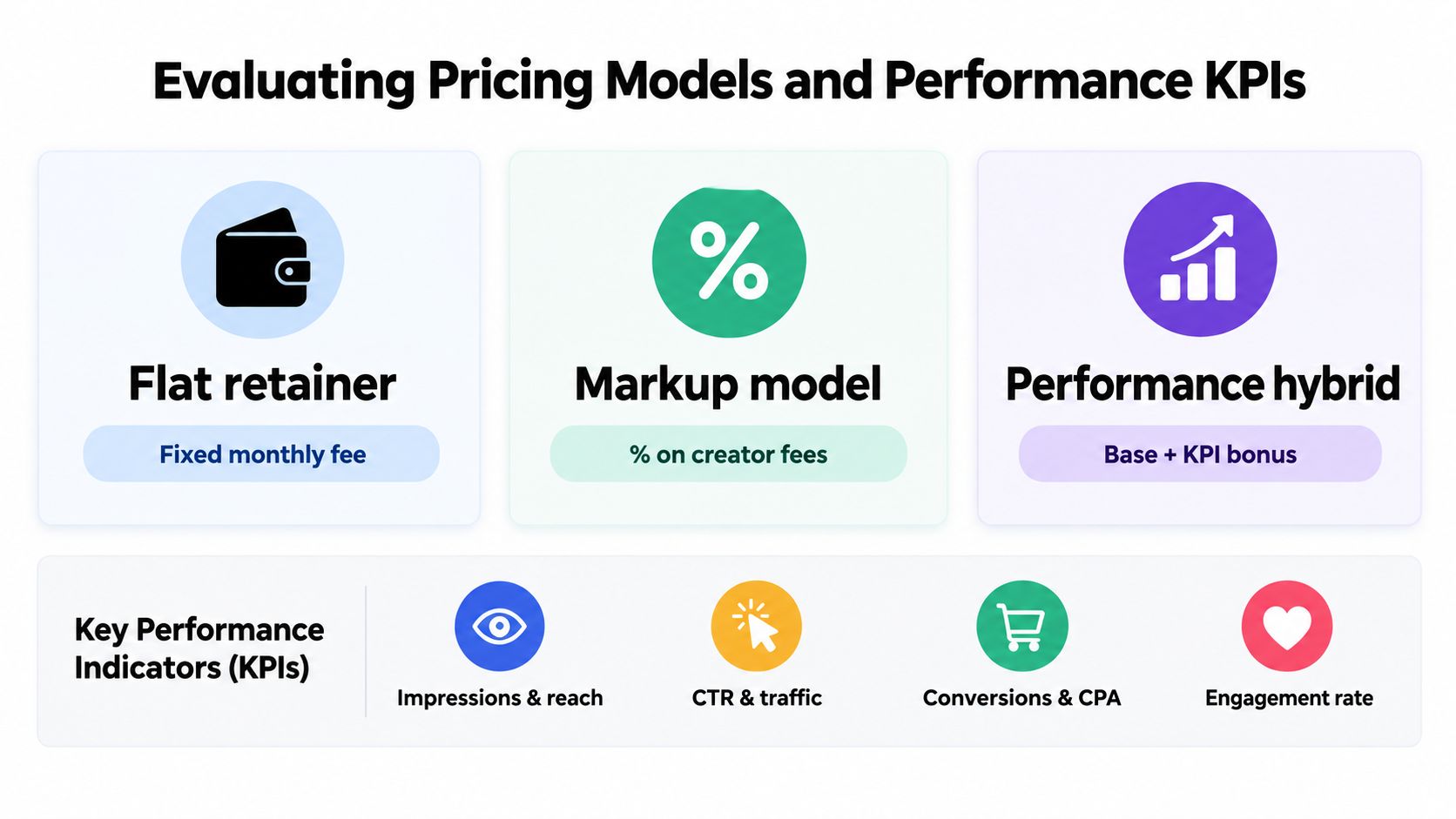
Agency pricing becomes difficult to assess when the proposal combines a retainer, creator fees, production costs, usage rights and reporting. Separate each component before comparing suppliers. Otherwise, a lower headline fee may hide a large markup or leave your team paying for work you expected the agency to handle.
The main models have different incentives:
- Flat retainer: You pay a fixed fee for an agreed service level. This gives budget predictability, but check the number of campaigns, sourcing rounds, negotiations and reporting cycles included.
- Markup on creator fees: The agency adds a percentage or margin to creator costs. This can be simple to administer, but request a clear breakdown of the creator fee, rights, expenses and agency charge.
- Performance hybrid: A base fee is combined with a bonus tied to agreed outcomes. This can align incentives, but only if attribution rules, tracking windows and exclusions are defined in advance.
- Project fee: You pay for a defined activation. It suits a one-off campaign, but it may not cover follow-up, repurposing, late content or post-campaign analysis.
Link the fee to the work
Ask for a line-by-line commercial schedule. It should show what happens if a creator cancels, content needs revisions, products are returned or usage expands. It should also state whether the agency receives commission on creator fees, paid amplification or licensing.
A performance bonus shouldn't reward an outcome the agency can't influence. If your partner controls sourcing, negotiation and delivery, a bonus may reasonably reflect completed, compliant posts or attributable action. If your team controls the media budget, landing page and offer, don't make the agency solely responsible for revenue.
For a wider framework on evaluating performance partners, see this guide on how to choose a performance agency. The same discipline applies here. Define the commercial outcome, measurement method and ownership before work starts.
Measure the journey, not only the audience size
Reach and impressions can explain distribution. They don't prove commercial impact. Your dashboard should connect each creator and post to the action that matters for the campaign.
Track the following where relevant:
- Attention: Reach, impressions, video views and completion behaviour.
- Response: Engagement quality, comments, saves, shares and sentiment.
- Traffic: Tracked clicks, landing-page visits and product-page activity.
- Action: Promo-code redemptions, affiliate activity, leads, conversions and attributed revenue.
- Efficiency: Cost per acquisition, cost per click, creator cost per deliverable and total campaign cost.
Use unique links and codes by creator. Require platform analytics where available, then reconcile them with your own site or commerce data. Read how to set influencer marketing KPIs that drive growth for a practical approach to choosing metrics before the first post.
A useful report shows planned cost, agreed deliverables, live status, rights, tracked activity and revenue in one place. If the agency only sends a presentation of reach after the campaign, it's reporting activity, not managing performance.
Final Selection and Next Steps for Your Brand
Select the partner that removes operational work without taking decisions away from your team. The proposal should show how creator discovery connects to audience fit, how negotiations reflect current rates, how contracts define usage rights, and how approvals cover disclosure before publication. It should also show who owns measurement after the content goes live.
Reject an agency that:
- Shows only polished case studies: Request a live workflow, sample dashboard and delivery timetable.
- Cannot explain its database: A large roster matters little without evidence of freshness, vetting and creator availability.
- Hides commercial detail: Separate creator fees, rights, expenses, markup, retainer and performance fees.
- Leaves compliance vague: Require named review steps for disclosures, claims, accessibility and AI-related content.
- Measures only exposure: Reach helps assess distribution, but cannot stand alone as proof of value.
- Keeps ownership unclear: Confirm who controls relationships, content rights, data and final approvals.
The positive signals are practical. The agency asks about the objective before suggesting creators, sources locally and nationally, and explains each creator's fit with the audience and format. It records negotiated terms, works from current market conditions and gives your team a clear approval point.
Start with a controlled pilot
A pilot should test the operating relationship as well as the creator selection. Define the audience, campaign objective and deliverables, then agree on approvals, disclosure rules, usage rights, payment terms, tracking links, promo codes and reporting before outreach begins. This exposes hidden costs early, including repeated internal reviews, payment reconciliation and rights corrections.
Use these questions during the review:
- Did the partner find creators your team would not have found?
- Were rates, rights and timelines documented clearly?
- Did content arrive on time and meet the brief?
- Could finance reconcile payments without manual detective work?
- Could you connect posts to clicks, redemptions, conversions or revenue?
- Did the workflow give your team more time for strategy and creative quality?
The UK buying pattern supports a serious test rather than a token experiment. 84% of UK marketers plan to work with more creators in the next 12 months, 81% of UK brands expect to increase influencer budgets in 2026, and 17% plan to grow those budgets by 50% or more, according to IAB UK's 2025 state of influencer marketing report. A partner that performs at small scale but fails during approvals, payments or reporting will create problems as activity increases.
Base the decision on evidence. Keep the partner if it reduces administration, improves creator relevance and produces trustworthy commercial reporting. Change direction if it adds meetings, obscures costs or leaves your team repairing the workflow it was hired to manage.
Book a conversation through Sup to review your creator workflow, from live sourcing and negotiation to approvals, rights, payments and performance tracking. Sup provides managed end-to-end execution while your team keeps control of the brief, creative direction and final approvals, so you can decide whether that model fits your next campaign.
More on tracking
See how many creators post about you and your competitors
Type in your brand's Instagram handle and we count the creators who post about you and about your five closest competitors. It takes about a minute and it is free. Or request a demo and we will show you the creators in your niche and walk you through the dashboard.
 Book a call