4 March 2026
How to Calculate Customer Acquisition Cost from Influencer Marketing in 2026
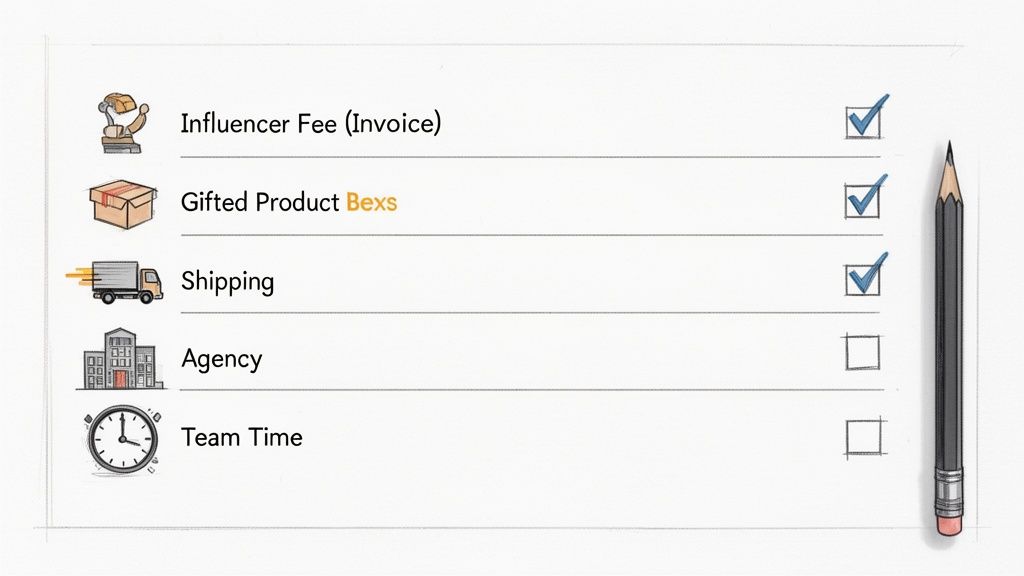
To figure out your Customer Acquisition Cost from an influencer campaign, you just need a simple bit of maths. Add up everything you spent (the creator’s fee, the cost of any gifted products, shipping, even your team’s time) and divide that total by the number of new customers you gained from their work.
That’s it. This straightforward calculation is what turns influencer marketing from a fuzzy brand-building exercise into a proper performance channel you can measure and scale.
Why Calculating Influencer CAC Is No Longer Optional
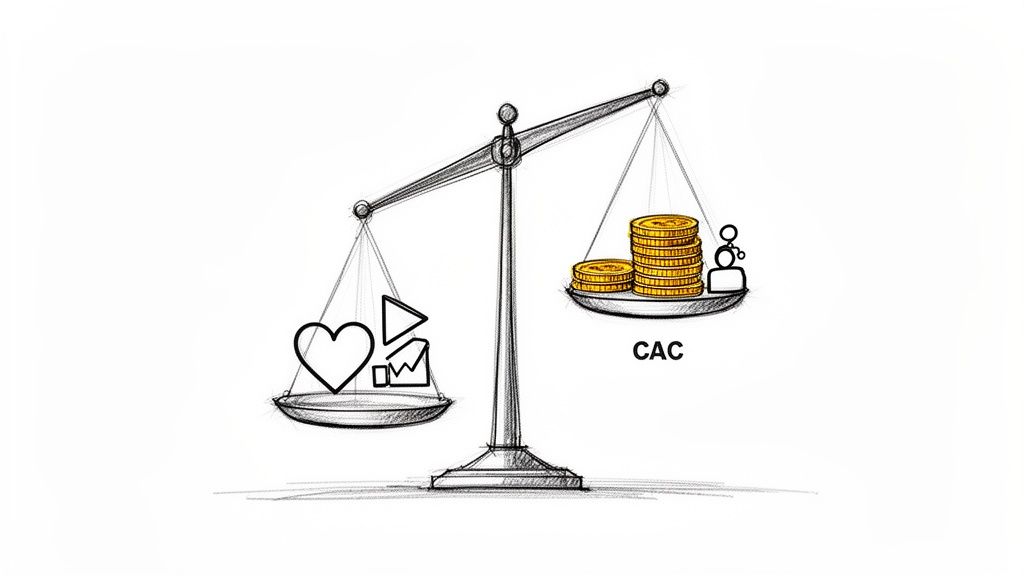
The days of judging an influencer campaign on likes and views are well and truly behind us. As we move deeper into 2026, marketing budgets are under a microscope and competition is fiercer than ever. You absolutely have to understand the true return on your investment, and calculating your influencer Customer Acquisition Cost (CAC) is how you do it.
Knowing your numbers moves influencer marketing from an ambiguous "brand awareness" spend into a growth driver you can predict and rely on. The real power comes when you can confidently say, "It costs us £25 to acquire a new customer through this influencer." Suddenly, you can compare its efficiency directly against your other channels, like paid social or search ads.
The Growing Need for Financial Accountability
The influencer marketing world is growing up fast. What started as an experimental tactic for many is now a core part of the marketing budget, and with that growth comes a serious demand for accountability.
The UK influencer marketing market hit £930 million in ad spend during 2024 and is on track to reach a massive £1.3 billion by 2029. This boom means brands can't afford to rely on vanity metrics anymore. Instead, the focus has shifted to tracking hard data with unique promo codes and UTM links to pin down exactly what it costs to win a new customer. You can explore more about these trends and what they mean for marketers in detail.
The core benefit of calculating influencer CAC is simple: It provides a unified metric that both marketers and finance teams understand. It translates engagement into the language of business performance, making it easier to justify budgets and prove value.
Before diving into the full calculation, it's helpful to get a clear picture of the inputs and outputs involved. This table breaks down the core components you'll need to gather.
Core Components Of Influencer CAC Calculation
| Component | Description | Example |
|---|---|---|
| Total Campaign Costs | The complete investment in the campaign, including all direct and indirect expenses. | Influencer fees, product costs, shipping, software subscriptions, team time. |
| New Customers Acquired | The number of first-time buyers who converted directly from the campaign. | 150 new customers tracked via a unique discount code. |
| Attribution Window | The timeframe during which a conversion can be credited to the influencer's content. | 30-day click-through window. |
| Final CAC | The resulting cost to acquire a single new customer. | £3,750 total cost / 150 new customers = £25 CAC. |
Having these pieces of information ready makes the whole process much more straightforward and ensures your final number is accurate.
Who Needs to Calculate Influencer CAC
This isn't a strategy just for massive e-commerce giants. Any business using influencers to bring in new customers can, and should, be measuring their CAC.
- E-commerce and DTC Brands: This is your bread and butter. You can directly connect influencer posts to online sales with promo codes and trackable links.
- Restaurants and Cafés: You can measure new customer footfall by tracking how many people redeem a unique, influencer-specific offer in-store.
- Multi-location Businesses: It’s a brilliant way to see how well local micro-influencers are driving traffic to your different branches.
- App and SaaS Companies: Track the downloads, free trial sign-ups, or new subscriptions that come directly from a creator campaign.
By embracing this financial metric, you stop hoping for results and start engineering them. You get the clarity you need to spot your most valuable partners, put your budget where it works best, and build an influencer programme that delivers profitable growth, time and time again. This guide will give you the framework to get started.
Getting to Grips with the Real Cost of Influencer Marketing
Before you can even think about calculating your customer acquisition cost, you need to have an honest conversation about what you're actually spending. I’ve seen it countless times: a brand just looks at the influencer's fee and celebrates a fantastic CAC, but the number is pure fantasy.
To get a figure you can actually trust, you have to account for every single pound that goes into a campaign. This means digging deeper than the obvious payments and tallying up all the direct and indirect costs.
The Obvious Outgoings: Direct Costs
These are the costs that are easiest to spot, but they often have layers you might not consider at first glance. Think of this as anything you pay directly to or for the creator.
- Influencer Fees: This is your starting point. It could be a flat fee for a package of content, a rate per post, or even a commission on the sales they generate.
- Product Gifting: This is a big one people miss. That £200 product package you sent isn't free; its cost of goods sold (COGS) is a direct campaign expense.
- Shipping and Handling: Don't forget the cost to get that product to the influencer. Postage, custom packaging, and any international customs fees all need to be on your spreadsheet.
- Production Support: Did you pay for a professional photographer to help the creator? Or rent out a studio for them? Those expenses belong here.
The Hidden Expenses: Indirect Costs
This is where most brands trip up. They fail to account for the internal resources and operational costs that make their influencer programme tick. These costs are just as real and can seriously skew your numbers if ignored.
An accurate CAC is built on total transparency. Acknowledging every cost, from shipping fees to team salaries, is the only way to avoid celebrating a falsely low number and making poor investment decisions down the line.
The industry is getting more expensive, which makes tracking even more critical. The Kolsquare State of Influencer Marketing 2025 Report found that 33% of UK marketers see rising costs and unclear pricing as major hurdles. With mid-tier influencers charging $2,500 to $10,000 and macro-influencers demanding up to $50,000 per campaign, every pound matters. You can read the full Kolsquare report to understand pricing trends.
Here are the indirect costs you absolutely must factor in:
- Team Time and Salaries: Your team's time is money. Work out an hourly rate for your marketing staff and track the hours they spend finding creators, negotiating contracts, briefing them, and managing the relationship.
- Agency or Platform Fees: If you're working with an agency, their retainer is a significant campaign cost. The same goes for any subscription fees for influencer marketing platforms like Sup.
- Affiliate Payouts: Using an affiliate model? Every commission paid out to a creator for a sale they drove is a campaign cost and must be tallied.
- Content Usage Rights: If you paid extra for the rights to use the influencer’s content on your own channels (like in paid ads or on your website), that licensing fee is part of the total investment.
Think about a London café gifting a £50 meal to a food blogger. The cost isn't zero; it's the £50 cost of the meal plus the value of the manager’s time spent organising the visit. Understanding the complete picture of influencer marketing costs for restaurants is essential for knowing if it's actually working.
By diligently tracking both of these cost categories, you get a complete and honest view of your total investment. This is the only way to build a foundation for a CAC calculation that you can genuinely rely on.
Right, you've got your costs sorted. Now comes the part that separates the pros from the amateurs: actually connecting influencer activity to paying customers. Without a solid tracking system, you're essentially flying blind and just hoping for the best. If you can't trace a sale back to its source, you can't prove your ROI.
We're going to focus on the two cornerstones of any good influencer attribution model: unique discount codes and UTM-tagged URLs. Get these right, and you'll have the hard data you need to calculate your customer acquisition cost with confidence.
Arm Your Influencers with Unique Discount Codes
Unique discount codes are the most straightforward way to track sales from a specific creator. It’s simple: you give each influencer their own code (think ‘SOPHIE15’ or ‘LONDONFOODIE20’) that their audience can use at the checkout.
The beauty of this method is its clarity. When a customer uses ‘SOPHIE15’, there’s no debate about where that sale came from. You know Sophie Miller drove that acquisition. This works brilliantly for e-commerce, but don't overlook it for brick-and-mortar businesses. A restaurant, for instance, could offer a code for a free appetiser or drink, redeemed in person.
A few tips from experience on making your codes work for you:
- Keep them simple. Nobody wants to type in X7G-9RT-32Z. A creator's name plus the discount amount is a tried-and-tested format because it's easy to remember.
- One code per creator. Never, ever reuse codes or give the same one to multiple influencers in a campaign. This is fundamental for accurately calculating your CAC for each person you work with.
- Automate where you can. Creating and tracking dozens of codes manually is a headache waiting to happen. Platforms like Sup can generate unique codes for every creator automatically, which keeps your data clean from the get-go.
Master UTM-Tagged URLs for Deeper Insights
Discount codes are fantastic for tracking the final sale, but Urchin Tracking Module (UTM) parameters let you see the entire customer journey. A UTM is just a bit of text added to the end of a URL that tells your analytics software precisely where your traffic originated.
This gives you a much richer picture. You'll see not only who bought something but also how many people clicked a link, which social platform was most effective, and even which specific post or story drove the most interest. Given that 69% of consumers trust influencer recommendations, UTMs show you that trust turning into tangible clicks and traffic.
You can build these yourself with Google’s free Campaign URL Builder. For an influencer campaign, you'll want to define these key parameters:
- utm_source**:** The platform where the link lives, like ‘instagram’ or ‘tiktok’.
- utm_medium**:** The marketing channel, which in this case is always ‘influencer’.
- utm_campaign**:** A name for your overall initiative, such as ‘spring_launch_2026’.
- utm_content**:** This is the most important one for us. Use it to identify the creator, for example, ‘sophie_miller’.
Put it all together, and your link will look something like this: yourwebsite.co.uk/?utm_source=instagram&utm_medium=influencer&utm_campaign=spring_launch_2026&utm_content=sophie_miller.
Pro Tip: Long, messy UTM links look spammy in a social media bio and can put people off clicking. Always use a link shortener like Bitly or a branded short domain to create a clean, trustworthy link.
Defining Your Conversion Goals
Tracking clicks and code usage is only useful if you've defined what a "conversion" actually is for your business. You need to set up specific goals in your analytics platform to measure what matters.
For an e-commerce brand, the ultimate goal is almost always a purchase. The easiest way to track this is by setting a goal that fires every time a user lands on your order confirmation or 'thank you' page: a page they can only reach after a successful payment. If you want to explore this further, our influencer marketing for ecommerce guide dives deep into these strategies.
But sales aren't the only valuable actions. You might also want to track goals like:
- Newsletter sign-ups
- App downloads
- Free trial registrations
- Bookings or reservation form completions
When you combine unique codes with detailed UTM links and have clearly defined conversion goals, you create a system that leaves no room for guesswork. This setup gives you the accurate "New Customers Acquired" figure that is the final piece of your CAC calculation puzzle.
Applying The Formulas To Calculate Your Influencer CAC
Alright, you've done the groundwork. You know your costs and you've got your tracking sorted. Now for the satisfying part: turning all that data into a number that actually tells you something important.
The formula for your influencer Customer Acquisition Cost (CAC) is, thankfully, very straightforward.
Total Campaign Costs ÷ New Customers Acquired = Customer Acquisition Cost
Don't let the simplicity fool you. The real power comes from how you use it. You can get a bird's-eye view of your entire campaign's health, or you can zoom in to see how each individual creator is performing. That granular detail is where you'll find the insights to truly start optimising your budget and scaling what works.
The goal is to create a clear line of sight from the influencer's activity straight through to a sale. It’s about linking the data, tracking the journey, and measuring the outcome.
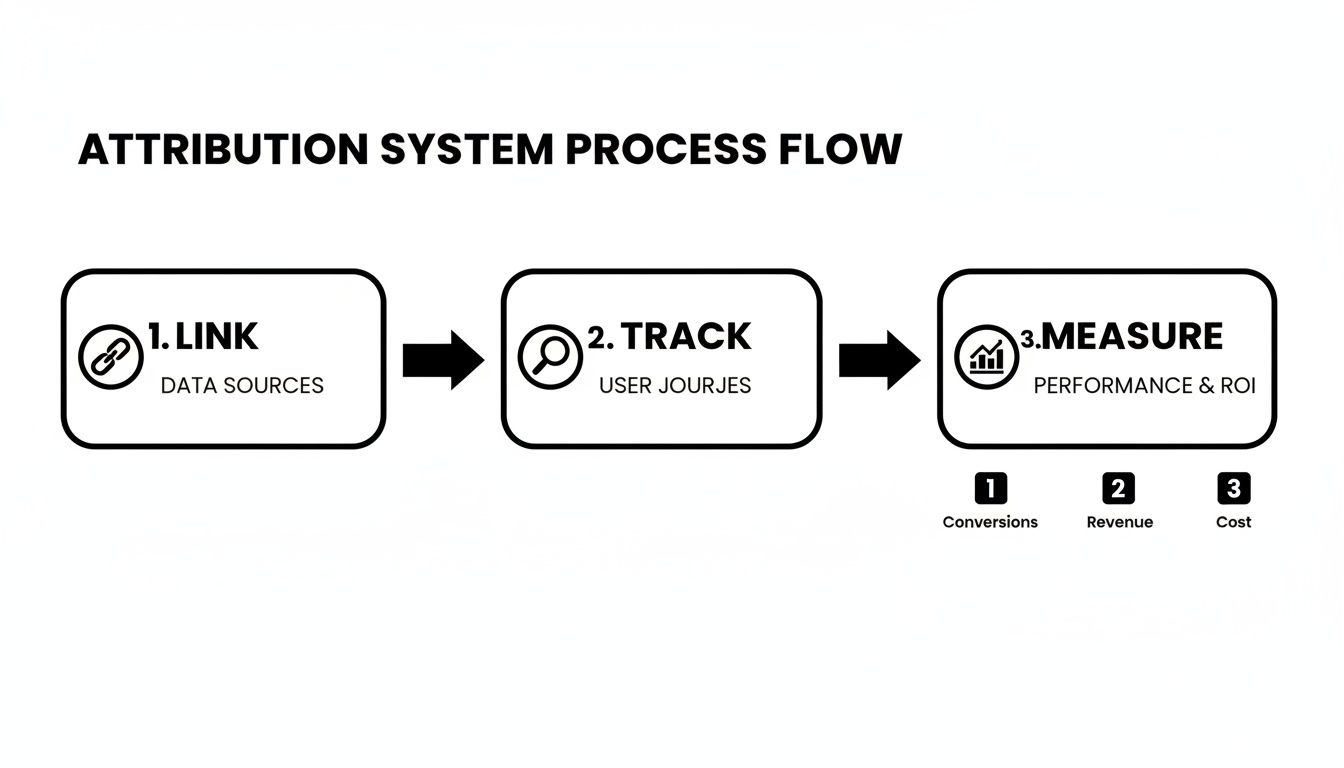
This is the fundamental flow that makes accurate CAC calculation possible. It connects the dots between a post and your profit.
Two Real-World Examples: Ecommerce vs. Restaurant
Theory is one thing, but let's see how this plays out in practice. The core logic works whether you're selling skincare online or burritos in person. The key is simply having a reliable way to connect a customer's purchase back to a specific influencer.
Here’s a side-by-side look at how two very different businesses would approach this.
Ecommerce vs. Restaurant CAC Calculation Example
| Metric | Ecommerce Skincare Brand | Restaurant Chain |
|---|---|---|
| Business Goal | Drive online sales for a new serum. | Increase footfall during quiet midweek days. |
| Influencer | Beauty influencer on Instagram. | Local food blogger in Manchester. |
| Total Campaign Cost | £1,165 | £490 |
| Tracking Method | Unique promo code: ‘SOPHIE20’ | Verbal offer code: ‘TOMSBURRITO’ |
| New Customers Acquired | 50 | 70 |
| Final CAC | £23.30 | £7.00 |
Let's break down the maths behind those numbers.
The Ecommerce Skincare Brand
First up, a London-based DTC skincare brand launching a new vitamin C serum. They decide to work with a beauty influencer, Sophie, on Instagram.
Here’s a breakdown of their costs:
- Influencer Fee: £1,000 for one Reel and three Stories.
- Product Cost (COGS): £50 for the gifted serum and other goodies.
- Shipping & Packaging: £15.
- Internal Team Time: 4 hours of management at an internal rate of £25/hour, which comes to £100.
This brings the Total Campaign Cost to £1,165.
The brand gives Sophie a unique promo code, ‘SOPHIE20’, for 20% off. After their 30-day attribution window, they check their Shopify dashboard. They see Sophie’s code was used by 50 unique, first-time customers.
Plugging this into the formula is easy: £1,165 (Total Costs) ÷ 50 (New Customers) = £23.30 CAC
Just like that, the brand knows it costs £23.30 to get a new customer from this specific partnership. This number is gold. They can now benchmark it against their other marketing channels (like Meta ads or Google Shopping) and compare Sophie’s performance against other creators. Understanding how to scale these efforts, particularly with partners like micro-influencers, is a massive advantage for smaller businesses.
The Restaurant Chain
Now, let's switch gears to a brick-and-mortar business. A burrito restaurant chain in Manchester wants to get more people through the door on traditionally quiet Tuesdays and Wednesdays. They team up with a well-respected local food blogger, Tom.
Let's tally the investment:
- Influencer Fee: £400 for a grid post and a few Stories.
- Product Cost (COGS): £40 to cover Tom's meal and drinks.
- Team Time: 2 hours of the marketing manager's time to coordinate, costing £50.
The Total Campaign Cost adds up to £490.
Their tracking method is a simple verbal offer. Tom tells his followers to "Mention 'TOMSBURRITO' when you order on a Tuesday or Wednesday to get a free side of churros with any main." The staff are trained to log this in their point-of-sale (POS) system.
At the end of the month, the report shows the 'TOMSBURRITO' offer was redeemed 70 times.
Time for the maths: £490 (Total Costs) ÷ 70 (New Customers) = £7 CAC
For just £7, the restaurant brought in a new customer who might otherwise have gone elsewhere. That’s a powerful, tangible result they can use to justify future collaborations.
Whether you're selling online or in-person, the logic remains the same. The key is to have a reliable mechanism (a unique code, a specific offer, or a tracked link) to connect an influencer's content directly to a new customer.
If you’re juggling multiple campaigns, doing these calculations manually can become tedious and prone to error. Using a dedicated customer acquisition cost calculator can help manage the inputs and automate the maths, freeing you up to focus on what the numbers are actually telling you.
How to Interpret Your CAC and Boost Campaign ROI
So, you’ve done the sums and now you have a Customer Acquisition Cost. Great. But what does it actually mean? One brand might find their influencer CAC is £23, while another clocks in at £7. Which is better? The truth is, on its own, the number is pretty meaningless.
To give your CAC any real context, you have to weigh it against another vital metric: Customer Lifetime Value (LTV). LTV is the total revenue you can realistically expect to earn from a single customer over their entire relationship with your brand.
The interplay between these two figures is the ultimate health check for your marketing. It tells you, plain and simple, if you're paying a sustainable amount to bring in customers who will actually spend more than they cost to acquire.
The LTV:CAC Ratio: A Benchmark For Growth
The ideal balance between what you spend and what you earn is captured in the LTV:CAC ratio. In my experience, the widely accepted benchmark for a healthy, scalable business is a ratio of 3:1 or higher.
This means that for every £1 you spend acquiring a new customer, you should expect to generate at least £3 in revenue from them over time.
- A 1:1 ratio is a red flag. It means you’re essentially losing money on every new customer once you factor in the cost of your goods and other operational expenses.
- A 3:1 ratio is the sweet spot. This signals a solid, profitable business model where your customer acquisition is working well.
- A ratio of 5:1 or higher is fantastic, but it might also suggest you're underinvesting in marketing. You could potentially be growing even faster.
Calculating LTV can get complicated, but a straightforward way to start is: (Average Order Value) x (Average Purchase Frequency) x (Average Customer Lifespan). Once you have both your LTV and CAC, you can work out your ratio and see exactly where your influencer efforts stand.
A low CAC isn't automatically good, and a high one isn't always bad. A £50 CAC is a huge win if your LTV is £500 (that's a 10:1 ratio!). But a £10 CAC is a disaster if your LTV is only £8 (a 0.8:1 ratio). Context is everything.
Actionable Strategies to Improve Your LTV:CAC Ratio
If your ratio isn't quite where you want it, don't panic. This is where your CAC calculation becomes a powerful tool for optimisation. Your goal is to either lower your CAC, increase your LTV, or, ideally, do both.
Here are a few proven strategies I've seen work time and again for boosting influencer marketing ROI.
Negotiate Smarter, Not Harder
Your biggest cost is almost always the influencer's fee. You should always pay creators fairly for their work, but there's often room to negotiate a smarter deal. Instead of just paying a flat fee, think about hybrid models.
Try offering a lower base fee plus a higher commission on sales. This approach directly aligns the influencer's incentives with yours. They earn more when they drive more customers for you.
Optimise Your Campaign Brief for Conversions
A vague brief leads to vague results. Be absolutely explicit that the main goal is customer acquisition. Give creators clear talking points about the product's value, create some urgency around the offer, and provide a strong call-to-action for using their specific discount code or link. The easier you make it for them to build a compelling case for buying now, the better your results will be.
Partner with High-Performing Micro-Influencers
The data doesn't lie: micro-influencers (those with 10k-100k followers) consistently deliver higher engagement rates for a fraction of the cost of macro-creators. In fact, 73% of brands now prefer working with micro and mid-tier creators for this very reason.
Platforms like Sup can automate the sourcing and management of these creators. This allows you to build a diverse portfolio of partners and quickly identify which ones deliver the best CAC at scale.
Repurpose Top-Performing Content
Your campaign shouldn't end when an influencer's post goes live. That user-generated content (UGC) is a seriously valuable asset. Take the best-performing videos and images and repurpose them into paid ads, use them on your product pages, or feature them in your email newsletters.
This simple step extends the life and value of your initial investment, effectively lowering your overall CAC by getting more mileage from the same spend.
When interpreting your CAC and looking to boost ROI, it's also helpful to think about the bigger picture of measuring social media ROI across all your marketing channels.
By continuously analysing your LTV:CAC ratio and putting these strategies into practice, you turn a simple calculation into a powerful optimisation loop. You stop guessing what works and start building a predictable, profitable, and scalable influencer growth engine.
Common Questions About Calculating Influencer CAC
Getting the basic CAC formula right is one thing. But out in the wild, the real head-scratchers always pop up during campaign execution. The theory is clean, but practice is messy: full of nuances around attribution, different campaign goals, and what ‘good’ even looks like.
We get these questions all the time from brands. Getting the details sorted is what separates a vague guess from a number you can confidently take to your finance team. Let’s get into the nitty-gritty.
How Do I Choose The Right Attribution Window?
Your attribution window is the timeframe where a conversion can be officially credited to an influencer's efforts. It’s a crucial setting. Get it wrong, and your data is skewed.
A window that’s too short will definitely miss legitimate sales. But one that’s too long might give an influencer credit for a sale they didn't really drive. The trick is to match the window to your customer’s typical buying journey.
Think about it. For impulse buys with a low price, like a new coffee or a snack, the journey from seeing a post to buying is incredibly short. A food blogger's post might drive someone to visit that very day.
- For fast-moving consumer goods (FMCG) or low-cost items: A 7-day window is usually plenty.
- For more considered purchases like fashion, electronics, or furniture: A 30-day window is a much more realistic starting point. This gives people the time they need to see the content, do a bit of research, compare their options, and finally make the purchase.
My advice? Start with a 30-day, last-click attribution model as your default. Then, dive into your own sales data in Google Analytics. Look for the average time between a user’s first click from an influencer and their purchase. That data is your best guide for fine-tuning the window for your specific business.
What Is A Good CAC For Influencer Marketing?
This is the million-pound question. And the honest-to-goodness answer is always: it depends. There’s no magic number for a "good" CAC because it's completely relative to your business model and, most importantly, your Customer Lifetime Value (LTV).
A 'good' CAC is simply one that gives you a healthy LTV:CAC ratio. The benchmark for a sustainable business is generally 3:1 or higher. In plain English, for every £1 you spend to bring in a new customer, they should generate at least £3 in value over their time with you.
Just look at these two scenarios:
- A subscription box service with a £600 LTV would be thrilled with a £50 CAC. That's a phenomenal 12:1 ratio.
- A brand selling £25 t-shirts would find a £50 CAC completely unsustainable. That’s a disastrous 0.5:1 ratio, meaning you're losing money on every sale.
The real acid test is to benchmark your influencer CAC against your LTV and against the CAC from your other marketing channels, like paid search or social ads. If influencer marketing is bringing in high-value customers more efficiently, you know you're onto a winner.
How Do I Calculate CAC For Non-Sales Goals?
What if your goal isn't a direct sale? The great thing about the CAC formula is how adaptable it is. You just need to swap out "New Customers Acquired" with whatever action you’re actually trying to drive. You're not calculating CAC anymore, but a different (and equally valuable) cost metric.
For instance:
- For app installs: Your formula becomes Total Campaign Costs ÷ Number of Downloads. This gives you a Cost Per Install (CPI).
- For newsletter sign-ups: It's Total Campaign Costs ÷ Number of New Subscribers, which gives you a Cost Per Lead (CPL).
The core process doesn't change. You still need to define your key conversion, make sure your tracking (like UTMs or promo codes) is set up to measure it, and then run the numbers. This way, you can prove the value of influencer marketing for building your audience and filling the top of your funnel, not just for driving immediate sales.
Ready to stop guessing and start measuring your influencer ROI with confidence? Sup combines AI-powered sourcing with a human team to launch, manage, and attribute your creator campaigns in one place. We handle the DMs, spreadsheets, and tracking so you can focus on scaling what works. See how Sup automates your influencer marketing.
More on tracking
See how many creators post about you and your competitors
Type in your brand's Instagram handle and we count the creators who post about you and about your five closest competitors. It takes about a minute and it is free. Or request a demo and we will show you the creators in your niche and walk you through the dashboard.
 Book a call