22 March 2026
7 Things What Restaurant Owners Get Wrong About Influencer Marketing in 2026
Influencer marketing promises a direct line to hungry customers, but for many restaurant owners, the reality falls short of the hype. It's a world often filled with confusing metrics, time-consuming administration, and results that feel more like guesswork than genuine growth. The problem isn’t the channel itself; it’s the execution. Many restaurateurs are still relying on outdated assumptions that lead to wasted budgets, frustrating collaborations, and a negligible impact on actual foot traffic and sales.
This isn’t about just getting pretty food photos posted online; it's about building a predictable, measurable, and scalable revenue stream for your business. For every successful campaign that packs a dining room, there are dozens that burn through cash with little to show for it. Understanding what restaurant owners get wrong about influencer marketing is the first step toward correcting course and achieving meaningful returns.
This guide moves beyond generic advice to offer a strategic blueprint for transforming your influencer efforts from a cost centre into a powerful growth engine. We will tackle seven critical misconceptions head-on, providing concrete data, actionable fixes, and real-world examples to show you precisely how to get it right. From picking the right creators to tracking every pound spent, you will learn to build a programme that consistently puts customers in your seats. Prepare to rethink everything you thought you knew about collaborating with food influencers.
1. Misconception: Only Mega-Influencers Drive Real Results
A common and costly belief among restaurant owners is that influencer marketing success hinges on collaborating with celebrity-status creators or those boasting hundreds of thousands of followers. This assumption often leads to overlooking a far more effective strategy: partnering with local micro and nano-influencers. While a mega-influencer's post might reach a vast audience, it often lacks the local relevance and authentic connection needed to convert viewers into actual diners. For a neighbourhood bistro or a city-centre pizzeria, broad, untargeted reach is simply vanity.
The reality is that creators with smaller, more engaged followings (typically 1,000 to 100,000 followers) deliver superior results for hospitality venues. Their audiences are built on trust and shared interests, making their recommendations feel more like a genuine tip from a friend than a paid advertisement. This authenticity is precisely what drives footfall.
Key Insight: For restaurants, a creator's value is not in their total follower count, but in the percentage of their audience that lives or works within a 10-mile radius and trusts their dining recommendations.
Why Smaller is Mightier for Restaurants
Micro and nano-influencers cultivate niche communities, often centred around a specific location or interest like "best brunch in Manchester" or "London's top vegan eats". Their content resonates deeply because it's relatable and actionable for their local followers. Reports from sources like HubSpot and the Influencer Marketing Hub consistently show these smaller creators achieve higher engagement rates, a critical metric that indicates an active and attentive audience.
Consider these real-world scenarios:
- A Chicago pizzeria partnered with 15 local micro-influencers (each with 5k-20k followers). The campaign generated over 200 tracked customer visits and 89 verified discount code redemptions in one month.
- An independent food blogger with just 5,000 dedicated followers in Bristol drove over 40 paying customers to a new cafe through a single, authentic video review.
- A New York City sushi spot saw a 3.2x return on ad spend (ROAS) from its nano-influencer programme, compared to a meagre 0.8x ROAS from a one-off collaboration with a macro-influencer.
These examples highlight a crucial point in understanding what restaurant owners get wrong about influencer marketing: they chase follower counts instead of audience quality and relevance.
Actionable Tips for Finding and Working with Micro-Influencers
- Prioritise Local Relevance: Use creator sourcing platforms or manual searches on Instagram and TikTok with location-specific hashtags (e.g., #LeedsFoodie, #EdinburghEats) to find creators whose audience is geographically desirable.
- Focus on Engagement, Not Followers: Look for creators with an engagement rate of 3% or higher. A simple way to estimate this is (Likes + Comments) / Followers * 100. High engagement signals a loyal and active community.
- Track Everything: Provide each creator with a unique discount code (e.g., "HANNAH15") or a custom UTM link for online orders. This is the only way to accurately measure who is driving tangible results, from footfall to revenue.
- Build Lasting Relationships: Instead of one-off gifted meals, build a network of local creators. Offer them a small budget for repeat visits to foster genuine advocacy. This approach is more cost-effective and builds deeper brand loyalty over time. To dig deeper into this approach, explore why smaller creators can drive a bigger ROI for businesses just like yours.
2. Misconception: Follower Count Equals Campaign Success
Another trap many restaurant owners fall into is equating a large follower count with guaranteed campaign success. It’s an easy mistake to make; the logic seems simple: more followers should equal more exposure and, therefore, more customers. However, this focus on a single vanity metric often leads to wasted budgets and underwhelming results, as it ignores the factors that actually drive people to dine out. A creator’s influence is not just their audience size, but the quality and attentiveness of that audience.
The reality is that metrics like engagement rate, audience demographics, and content relevance are far more powerful indicators of a successful partnership. For a restaurant, an influencer with 50,000 followers and a 1.2% engagement rate, whose audience is spread across the country, is significantly less valuable than a local food creator with 8,000 followers and a 12% engagement rate. The smaller creator has a more dedicated and geographically relevant community that trusts their recommendations.
Key Insight: The success of an influencer campaign is determined by audience engagement and relevance, not follower numbers. High engagement means an active, trusting community that is more likely to act on a recommendation.
Why Engagement Trumps Follower Count
A high follower count can be misleading. It can be inflated by bots, inactive accounts, or followers who have no genuine interest in the creator's content. Engagement-which includes likes, comments, shares, and saves-is a direct measure of an audience's active interest. A creator with a high engagement rate has built a community that listens and responds. This is a critical distinction in understanding what restaurant owners get wrong about influencer marketing; they are buying reach when they should be investing in trust and action.
Consider these real-world scenarios:
- A restaurant partnered with a local food creator who had 30,000 followers but an exceptional 15% engagement rate. The campaign drove 120 tracked visits, with 47% of those customers redeeming a unique discount code.
- In contrast, a different venue worked with a lifestyle influencer with 200,000 followers but a low 1.2% engagement rate. The campaign resulted in only three verified visits, proving the audience was not aligned or motivated.
- A New York City café directly compared two creators: one with 12,000 followers and 18% engagement drove 47 paying customers, while another with 89,000 followers and 2.1% engagement brought in just eight.
Actionable Tips for Evaluating Influencers Beyond Followers
- Prioritise Engagement Rate: Calculate engagement as a primary metric: (Likes + Comments + Saves) / Followers * 100. Aim for creators with a rate of 3% or higher. Look at their last 10-20 posts to check for consistency.
- Verify Audience Location: Your campaign is only effective if it reaches people who can actually visit your restaurant. Ask creators for a screenshot of their audience analytics showing their followers' top cities and countries.
- Analyse Content Alignment: Review the creator’s feed. Do they post about similar cuisines or dining experiences? Their content should feel like a natural fit for your brand to maintain authenticity.
- Request a Media Kit: Professional creators will have a media kit with detailed audience demographics, past campaign results, and pricing. This is a standard and acceptable request. Instead of focusing solely on follower counts, understanding how to measure social media success beyond vanity metrics can provide a more accurate picture of campaign effectiveness.
- Start with a Test: Before committing to a large campaign, run a smaller, paid test with a creator to validate that their engaged audience translates into actual footfall or online orders for your restaurant.
3. Misconception: One-Off Campaigns Are Optimal
Many restaurant owners approach influencer marketing with a transactional mindset, viewing each collaboration as a singular, one-off event. This "one and done" strategy is a significant pitfall, as it prioritises short-term exposure over sustainable growth and often leads to higher costs and less impactful content. Constantly sourcing, negotiating with, and briefing new creators is inefficient and prevents the development of genuine brand advocacy.
This transactional approach is a classic example of what restaurant owners get wrong about influencer marketing. It overlooks the compounding benefits of building long-term relationships. When a creator becomes familiar with your brand, your menu, and your team, their content becomes progressively more authentic and effective. They shift from being a paid promoter to a genuine fan, and their audience can tell the difference.
Key Insight: The most valuable influencer partnerships are not one-time transactions but ongoing relationships. Repeat collaborations build trust, improve content quality, and generate a much higher long-term return on investment.
Why Lasting Partnerships Outperform One-Off Posts
Building a network of reliable creators who consistently promote your restaurant creates a powerful and sustained marketing engine. Familiarity breeds authenticity; a creator who has visited multiple times can speak with genuine authority about your seasonal specials, your friendly staff, or the unique atmosphere you’ve cultivated. This depth cannot be achieved in a single visit.
Consider these real-world scenarios:
- A restaurant running quarterly campaigns with the same 10 creators spent £3,200 per quarter and generated over 320 tracked visits. A one-off approach with new creators each time would have cost an estimated £4,800, representing a 33% cost saving and delivering more consistent results.
- A hospitality chain that nurtured relationships with eight repeat creators per location saw a 40% improvement in content quality and a 25% lower cost by the second year of the programme.
- A sushi restaurant found that the third collaboration with the same food blogger generated twice the engagement and footfall compared to their initial post, as the creator's audience had built trust in the recommendation over time.
These examples show that investing in relationships pays clear dividends. The initial outreach and negotiation effort is amortised over multiple campaigns, and performance improves as the creator’s advocacy deepens.
Actionable Tips for Building a Creator Ambassador Programme
- Identify Your Top Performers: After your initial campaign, analyse the results. Use your tracking codes to identify the 5-10 creators who drove the most footfall or redemptions. These are your prime candidates for a long-term partnership.
- Negotiate Retainer Agreements: Instead of paying per post, approach your top creators with a proposal for a quarterly or bi-annual retainer. This gives you predictable costs and secures their availability for key promotional periods.
- Create a Loyalty Programme: Treat your best creators like VIPs. Offer them a bonus for recurring collaborations, exclusive first tastes of new menu items, or priority access to special events. This fosters loyalty and encourages them to go above and beyond.
- Establish a Content Calendar: Work with your repeat creators to plan content in advance. Align their posts with your seasonal menu changes, holiday promotions, or special events to create a coordinated and impactful marketing push.
- Measure Performance Over Time: Use the same unique tracking codes for each repeat creator across all their collaborations. This allows you to measure their performance improvement and demonstrate the increasing value of the long-term relationship.
4. Misconception: No Need to Track or Measure Attribution
One of the most damaging mistakes restaurant owners make is running influencer campaigns with a "spray and pray" approach, measuring success with vague hopes for "brand awareness." Without proper tracking, it's impossible to know which creator's post led to the queue outside your door or the spike in online orders. This lack of attribution means you can't calculate your return on investment (ROI), leading to wasted budget on underperforming collaborations and an inability to scale what actually works.
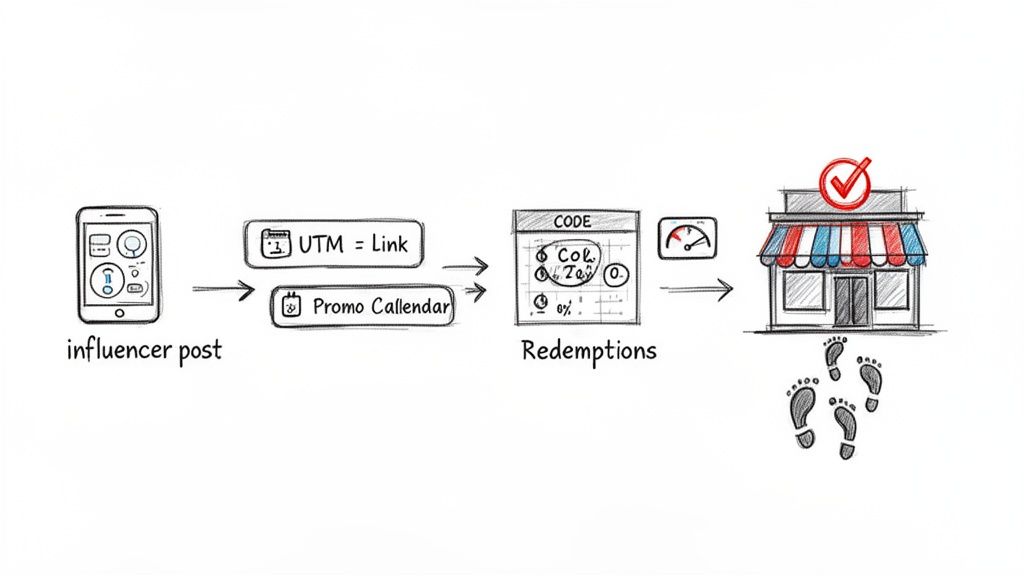
The reality is that modern influencer marketing is a performance channel. Treating it any other way is like running a paid ad without a single link or metric. To avoid leaving money on the table, it's crucial to understand how to effectively measure the success of your marketing videos and apply those same principles to influencer campaigns. Data-driven decisions are not just for tech companies; they are essential for hospitality businesses looking to thrive.
Key Insight: Influencer marketing without attribution is just guesswork. By tracking every creator's performance, you turn a creative campaign into a predictable, revenue-generating engine.
Why Data Beats Guesswork in Hospitality
Justifying a marketing budget requires clear evidence of its impact. When you can show exactly how much revenue a specific creator generated, the conversation changes from "Is this working?" to "How can we do more of this?". This is a core reason what restaurant owners get wrong about influencer marketing is so costly: they miss the opportunity to optimise and reinvest in proven success.
Consider these real-world scenarios:
- A restaurant chain tracking 50 creators with unique promo codes found that its top 8 influencers generated 78% of all attributed visits. By reallocating its budget to these top performers, it improved its campaign ROI from a 1.1x baseline to a profitable 3.2x.
- A café measured UTM link clicks from its campaigns and discovered that TikTok creators drove 4x more online order conversions than Instagram creators, despite having smaller followings. It quickly redirected 60% of its budget to TikTok, capitalising on the higher-intent audience.
- A hospitality group compared its tracked vs. untracked influencer programmes. The tracked campaigns, which used unique codes and links, averaged a 2.8x return on ad spend (ROAS). The untracked "awareness" campaigns averaged a dismal 0.6x ROAS with no clear insights for improvement.
Actionable Tips for Tracking Influencer ROI
- Assign Unique Tracking Assets: Give every creator their own trackable code (e.g., "SARAH15") for in-store redemptions or a custom UTM link for online orders and bookings. This is non-negotiable for measuring individual performance.
- Integrate with Your POS System: Work with your point-of-sale provider (like Toast or Square) to ensure influencer discount codes can be easily entered and tracked, linking redemptions directly to sales data.
- Review Performance Weekly: Don't wait until the end of a campaign. Set up a simple dashboard to review metrics like code redemptions, link clicks, and revenue per creator each week. This allows you to spot trends and make quick adjustments.
- Optimise, Don't Just Measure: Use the data to make smarter decisions. Double down on your top-performing creators, test different offers (e.g., 15% off vs. a free appetiser), and pause collaborations that aren't driving results. For a complete guide on this process, you can learn more about how to calculate influencer marketing ROI and prove its value.
5. Misconception: DIY Management is Cost-Effective and Scalable
Many restaurant owners, keen to keep overheads low, fall into the trap of managing influencer campaigns themselves. Armed with DMs, spreadsheets, and emails, they believe this DIY approach saves money. In reality, it quickly becomes a time-consuming and error-prone process that limits growth and delivers inconsistent results. Managing even a small group of 20 creators manually descends into coordination chaos, with missed deadlines, payment errors, and ultimately, an unmeasured return.
The assumption that manual management is "free" ignores the immense cost of time and opportunity. A restaurant manager spending 10-15 hours a week chasing creators, tracking content, and compiling data is not spending that time on core business operations like staff training, menu development, or customer service. This approach is neither cost-effective nor scalable.
Key Insight: Effective influencer marketing requires a system, not just more effort. The true cost of DIY management isn't zero; it's the sum of your valuable time, lost opportunities, and the poor results from a chaotic process.
Why Manual Management Fails at Scale
At first, managing a handful of local food bloggers seems simple. But as the programme grows, complexity multiplies. Spreadsheets become tangled, DMs get buried, and follow-ups are forgotten. This manual disorganisation directly hurts the campaign's performance and your brand's reputation among creators. A disorganised programme leads to a poor creator experience, making it harder to attract and retain high-quality partners.
Consider these real-world scenarios:
- A single-site restaurant manager spent 12 hours a week manually coordinating 15 creator collaborations, achieving a meagre 1.2x ROAS with multiple missed follow-ups and payment errors.
- A marketing team of two tried to manage 30 creators for a new menu launch via spreadsheets. The campaign saw only a 30% content completion rate, high creator churn, and produced no reliable ROI data.
- A multi-location chain attempted a DIY programme across three sites. It collapsed after reaching 25 creators due to coordination complexity, forcing them to switch to a management platform which reduced weekly admin to under two hours.
These examples are a stark reminder of what restaurant owners get wrong about influencer marketing: they undervalue their own time and overestimate the efficiency of manual tools for a specialised task.
Actionable Tips for Streamlining Campaign Management
- Calculate Your True Cost: Before committing to DIY, estimate the real hourly cost. Multiply your or your manager's hourly wage by the 10-15 hours per week the process will take. Compare this to the monthly cost of a creator management platform. For more than 10 active creators, the platform investment often becomes ROI-positive within months.
- Standardise Your Workflow: Whether DIY or using a tool, create standardised briefs, outreach templates, and contracts. Clear, consistent communication reduces back-and-forth and sets expectations from the start regarding deadlines, payment terms, and deliverables.
- Upgrade from Basic Spreadsheets: If you must stay DIY for a short period, use a more robust tool like Airtable or a shared Google Drive. A well-organised system with clear status tracking (e.g., 'Outreach Sent', 'Brief Agreed', 'Content Live', 'Paid') can minimally reduce spreadsheet chaos.
- Acknowledge the Need for a System: True scalability comes from systems, not just individual efficiency. As you grow beyond 10-15 ongoing partnerships, investing in a professional platform becomes essential for consistency, compliance, tracking, and ROI measurement. To understand the financial impact, you can explore the real cost of running influencer campaigns in-house and see where your time is truly going.
6. Misconception: Content Brief and Approval Control Are Unnecessary
Many restaurant owners fall into one of two damaging extremes when managing creator collaborations. They either micromanage every detail, providing restrictive scripts and shot lists, or they offer zero guidance, hoping for the best. Both approaches are flawed; over-control kills the authenticity that makes influencer content effective, while under-control risks off-brand, sloppy, or ineffective posts that fail to deliver results. The key is a balanced creative brief.
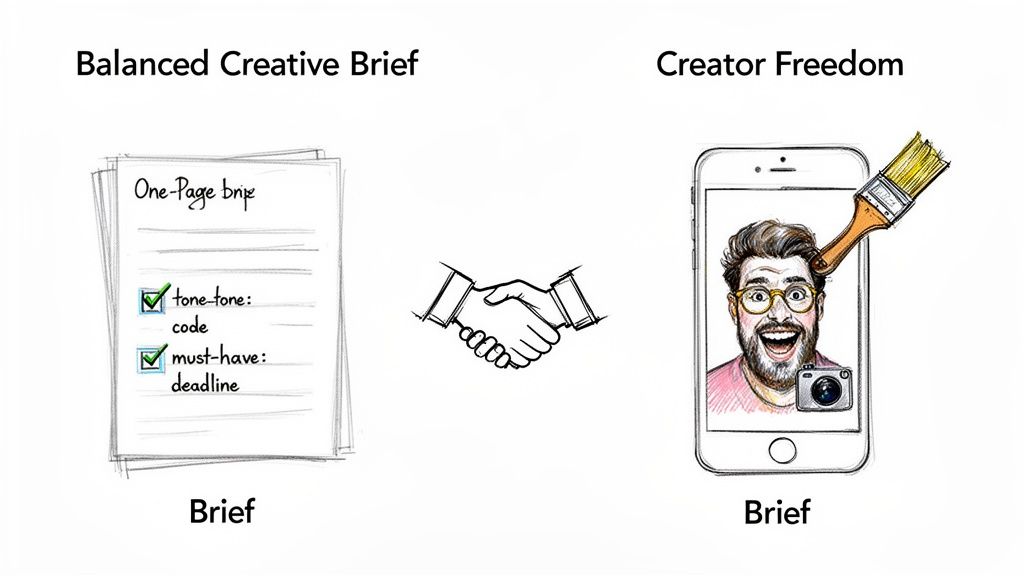
Successful campaigns find a middle ground. They provide clear brand guidelines, essential messages, and technical requirements (like where to place a discount code) while granting the creator freedom over storytelling and presentation. This balance ensures the content is both brand-safe and genuinely engaging for the creator's audience. This is a common mistake restaurant owners make with influencer marketing: they fail to realise that guidance and freedom are not mutually exclusive.
Key Insight: A great brief isn't a script; it's a set of guardrails. It tells the creator where the finish line is (e.g., drive visits with a promo code) but lets them choose the best path to get there.
Why a Balanced Brief Wins
The difference in outcomes between a controlled, hands-off, and balanced approach is stark. Creators are experts on what resonates with their own audience. Forcing them into a rigid box suppresses their unique voice and results in content that feels like a poorly disguised advert. Conversely, no direction can lead to missed objectives and wasted investment.
Consider these scenarios:
- A restaurant that supplied a tight script with specific talking points saw just 4% engagement. The creator later reported feeling uncomfortable and the partnership was a one-off.
- Another owner sent no brief at all. The resulting content included competitor tags, awkward product placement, and earned a mere 2.1% engagement due to its off-brand feel.
- A pizzeria provided a balanced brief covering brand values, a mandatory discount code, and creative freedom. The authentic content achieved 12% engagement, and the creator later requested a repeat collaboration at a 20% discount.
Actionable Tips for Creating the Perfect Brief
- Standardise a One-Page Brief: Create a simple template that includes your brand voice, 2-3 key messages, and clear "must-haves" like the promo code and required tags.
- Guide, Don't Dictate: Include examples of on-brand content you like, but add the phrase, "We'd love to see your unique take on our dishes!"
- Be Clear on Non-Negotiables: Specify technical requirements like "Promo code must be visible in the first three lines of the caption" or "Link must be in bio for 48 hours".
- Define Brand "Don'ts": Clearly list things to avoid, such as mentioning direct competitors or engaging with controversial topics. This protects your brand without stifling creativity.
- Share Your Story: Briefly explain your restaurant's mission or the story behind a signature dish. This emotional context helps creators build a more genuine connection.
- Set Clear Timelines: Give creators at least 2-3 weeks of lead time to produce high-quality content. Aim to approve submitted drafts in under 48 hours to keep momentum.
7. Misconception: Budget Allocation is One-Size-Fits-All
A frequent and damaging error restaurant owners make is treating their influencer budget like a free-for-all, where every creator receives the same flat fee or gifted meal value. This "equal share" approach ignores a fundamental truth of performance marketing: not all partners deliver equal results. This oversight means precious marketing funds are wasted on underperforming creators instead of being concentrated on those who genuinely drive footfall and sales.
The reality is that a small segment of your creator roster, often the top 20%, will typically generate 60-80% of your tangible results. By failing to identify and reward these high-performers, restaurants miss a massive opportunity to compound their return on investment. A data-driven budget allocation strategy, where funds are dynamically shifted towards what works and away from what doesn’t, is essential for building a profitable creator programme.
Key Insight: A one-size-fits-all budget is a recipe for waste. Strategic allocation based on performance data allows you to reward your best creators, cut your losses, and continuously improve your overall campaign return on investment by 2-3x.
Why Data-Driven Budgeting is Crucial
Adopting a performance-focused mindset, similar to the Pareto Principle (the 80/20 rule), transforms your spending from a gamble into a calculated investment. It requires diligent tracking through unique discount codes and UTM links, but the payoff is substantial. This approach allows you to answer critical questions: Which creators drive the most reservations? Which platform converts best? Which niche audience is most profitable?
Consider these real-world scenarios:
- A restaurant gave 20 creators an equal £200 budget. The top four creators achieved a 3.8x ROAS, while the bottom eight barely hit 0.4x. By reallocating the budget to the top eight performers and a small test group, their overall campaign ROI improved from 1.1x to 2.8x.
- A hospitality chain discovered its local micro-food creators (1k-10k followers) averaged a 3.2x ROAS, compared to lifestyle creators who only managed a 0.8x ROAS. They shifted 70% of their budget to the food-focused group, improving overall performance by 68%.
- A multi-location restaurant found that TikTok creators drove 4x more conversions than their Instagram counterparts. Shifting 60% of their spend to TikTok increased their total ROAS from 1.6x to 3.1x.
These examples make it clear that a major factor in what restaurant owners get wrong about influencer marketing is their failure to let performance data guide their financial decisions.
Actionable Tips for Strategic Budget Allocation
- Segment Creators by Performance: After your first few campaigns, categorise creators into performance tiers (e.g., A, B, C) based on metrics like ROAS or code redemptions. Allocate your budget accordingly: 60% to A-tier, 30% to B-tier, and 10% for testing new C-tier creators.
- Set Clear Performance Thresholds: Establish a minimum acceptable ROAS or number of redemptions per campaign. If a creator consistently fails to meet these benchmarks after two collaborations, it’s time to reallocate that budget.
- Reward Your Top Performers: When a creator delivers exceptional results, increase their compensation by 25-50% for the next collaboration. This incentivises continued performance and strengthens the partnership.
- Review and Rebalance Quarterly: Your top performers and platforms may change over time. Conduct a quarterly review of your creator data and rebalance your budget allocation to reflect the most recent performance trends. Don’t be afraid to cut what isn’t working and double down on your winners.
7 Influencer Marketing Misconceptions for Restaurant Owners
| Item | 🔄 Implementation complexity | ⚡ Resource requirements & scalability | ⭐📊 Expected outcomes / Impact | 💡 Ideal use cases & tips | Key advantages |
|---|---|---|---|---|---|
| Misconception: Only Mega-Influencers Drive Real Results | 🔄 Moderate to High: coordinate many micro/nano creators across campaigns | ⚡ Moderate: low cost per creator but needs sourcing tools and coordination to scale | ⭐📊 Higher engagement and lower CPE; better local conversions and ROI when aggregated | 💡 Local restaurants aiming for foot traffic; use creator platforms, track unique codes, shift 70 to 80% budget to micro/nano | Authenticity, cost-efficiency, repeat collaborations |
| Misconception: Follower Count Equals Campaign Success | 🔄 Low to Moderate: requires vetting beyond surface metrics | ⚡ Low: analytics tools + manual review; scalable with verification tools | ⭐📊 More predictive conversions by prioritizing engagement and audience fit; reduces wasted spend | 💡 Vet creators by engagement rate, audience location and niche; test small before scaling | More accurate selection, higher conversion likelihood |
| Misconception: One-Off Campaigns Are Optimal | 🔄 Low initially, Moderate ongoing: relationship-building takes consistent effort | ⚡ Moderate: upfront time/negotiation; cost per collab drops with repeats | ⭐📊 Improved content quality, trust, and compounding ROI over multiple collaborations | 💡 Identify top performers after first run; schedule 4 to 6 campaigns/year and negotiate retainers | Lower long-term cost, better content, higher repeat visits |
| Misconception: No Need to Track or Measure Attribution | 🔄 Moderate: set up UTM, promo codes, POS integration and dashboards | ⚡ Moderate: tracking platforms + creator compliance; requires coordination with ops | ⭐📊 Clear attribution enables optimization and can boost ROAS significantly | 💡 Assign unique promo codes + UTMs, review weekly dashboards, disqualify low performers after tests | Data-driven decisions, accountability, efficient budget allocation |
| Misconception: DIY Management is Cost-Effective and Scalable | 🔄 High if manual: heavy coordination, risk of errors and missed steps | ⚡ High time cost (10 to 15 hrs/wk+); platforms reduce to <2 hrs/wk and scale better | ⭐📊 DIY often yields inconsistent ROI and scalability; platforms/agencies improve efficiency and outcomes | 💡 DIY only for very small trials; adopt a platform/agency once >10 creators | Automation, consistent creator experience, reliable reporting |
| Misconception: Content Brief and Approval Control Are Unnecessary | 🔄 Low to Moderate: create a 1‑page brief and a fast approval cycle | ⚡ Low: one-time template effort; minimal ongoing oversight improves speed | ⭐📊 Balanced briefs increase engagement and reduce revisions; preserve authenticity | 💡 Use a one-page brief with must-haves (code, tone) and allow creative freedom; approve within 48 hrs | Higher engagement, faster turnaround, repeat creator interest |
| Misconception: Budget Allocation is One-Size-Fits-All | 🔄 Moderate: requires performance segmentation and quarterly rebalancing | ⚡ Moderate: needs historical data and attribution systems to reallocate effectively | ⭐📊 Concentrating on top performers can improve ROI 40 to 150%; reduces wasted spend | 💡 After 5 to 10 campaigns segment A/B/C; allocate ~60/30/10 (top/mid/test) and cut bottom 20% | Optimized ROI, scalable investment in proven creators |
From Guesswork to Growth: Your New Influencer Playbook
Navigating the world of influencer marketing can feel like trying to follow a recipe with half the ingredients missing. As we've explored, many common practices that seem logical on the surface are precisely what restaurant owners get wrong about influencer marketing. Relying on follower counts, chasing one-off campaigns with mega-influencers, and neglecting to track your results is a direct path to wasted budgets and frustration. The good news is that a more effective, data-driven approach is not only possible, it's easier to implement than you might think.
The core shift is moving from guesswork to a deliberate, measurable strategy. It means looking beyond vanity metrics and focusing on authentic connections. Instead of paying for a single, expensive post from a national celebrity, you can build a community of local micro-influencers who genuinely love your food and become true brand advocates. This strategy fosters authentic content and drives consistent, local footfall.
Key Takeaways for Your Restaurant
To truly turn influencer marketing into a reliable growth channel, concentrate on these fundamental changes:
- Prioritise Engagement Over Reach: A micro-influencer with 5,000 highly engaged local followers will almost always drive more bookings than a macro-influencer with 100,000 disinterested ones. Look for creators whose audience trusts their recommendations, not just those with the biggest numbers.
- Embrace the "Always-On" Approach: Ditch the one-and-done mindset. Consistent, long-term partnerships create a compounding effect. Your restaurant stays top-of-mind, and the influencer's content feels more genuine over time, building deeper trust with their audience.
- Track Everything, Assume Nothing: Every influencer collaboration should have a clear goal and a way to measure it. Use unique discount codes, custom UTM links for your booking platform, and dedicated landing pages. This is the only way to know what’s working and calculate your true return on investment.
- Systemise Your Workflow: Manual outreach, negotiation, and content management are not scalable. A clear, templated brief, a fair and transparent compensation model, and an organised system for tracking deliverables are non-negotiable. This professionalism protects your brand and builds better relationships with creators.
By moving past the seven common misconceptions we've detailed, you are no longer just "doing" influencer marketing. You are building a strategic asset for your business. You stop spending money and start investing it in a predictable system that generates real-world results, from table bookings and takeaway orders to increased brand recognition in your local area. The era of 'post and pray' is over. Your new playbook is built on data, authentic relationships, and scalable systems, ensuring every pound you spend works to put more customers in your seats.
Ready to stop guessing and start growing? The key is having the right system to manage, track, and scale your creator partnerships without the administrative headache. Sup is a platform built specifically to solve the problems we've discussed, automating everything from creator discovery and outreach to content management and ROI tracking. Learn how Sup can turn your influencer programme into a powerful, automated growth engine.
More on industries
See how many creators post about you and your competitors
Type in your brand's Instagram handle and we count the creators who post about you and about your five closest competitors. It takes about a minute and it is free. Or request a demo and we will show you the creators in your niche and walk you through the dashboard.
 Book a call