21 May 2026
Travel Influencers UK: A Brand's 2026 Playbook
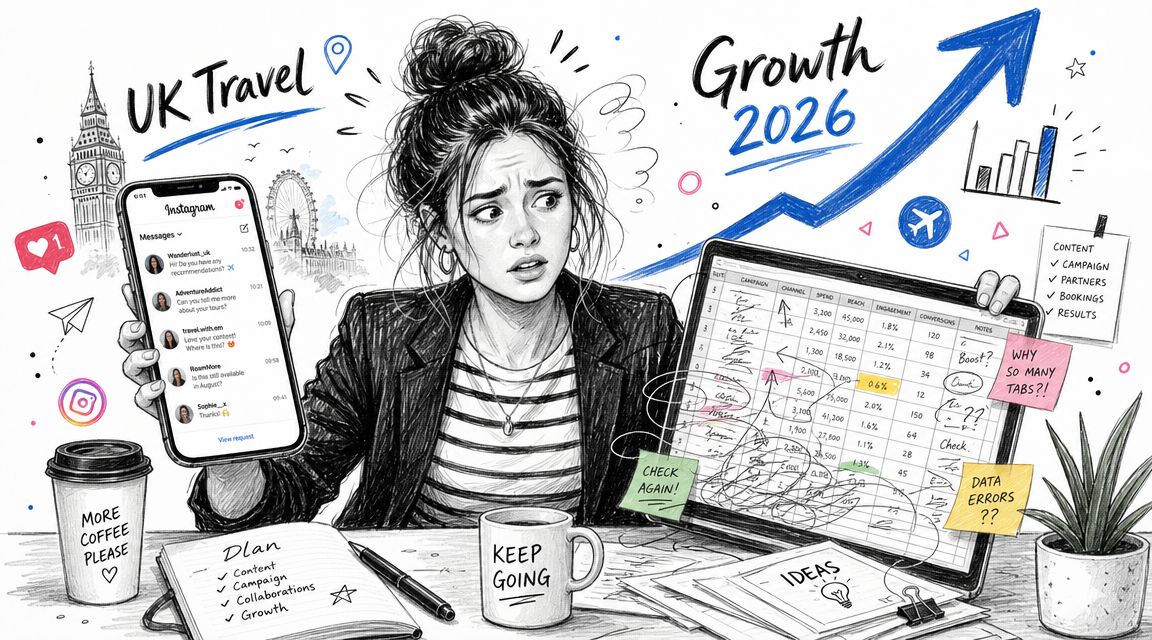
Your team is probably doing some version of this already. A marketer pulls a list of travel influencers uk from Google, sends a batch of DMs, gets a few replies, negotiates by email, posts go live, and then nobody can say with confidence which creator drove bookings, footfall, or actual revenue.
That process feels busy, but it isn't a system. It's a collection of one-off bets.
The fix isn't to stop using creators. It's to stop treating travel influencer work like PR-only exposure and start running it like a local acquisition channel. In the UK, that shift matters because the market is mature, the creator pool is deep, and consumers already use creator content to plan where they go. The brands that win now don't just buy inspiration. They build repeatable campaigns around location, audience fit, and attribution.
Why UK Travel Influencers Are a Core Growth Channel in 2026
A lot of teams still talk about influencer marketing as if it's experimental. In the UK, it isn't. The category is already large, crowded, and commercially proven.
The scale alone should change how brands think about it. In 2026, the UK influencer marketing industry is projected to be worth £2.9 billion, and for travel brands that matters because 60% of global travellers say influencers are their most useful source for planning trips, while 84% of UK Gen Z follow influencers, according to Charle's influencer marketing statistics roundup.
Travel content sits close to purchase
Travel is not like abstract lifestyle content. When someone watches a creator review a hotel, show a rail route, map out a weekend itinerary, or compare neighbourhoods, they're often already in planning mode. That makes the content useful, not just entertaining.
For brands, useful content converts better than vague awareness. A boutique hotel in York, a spa in Bath, a restaurant group in Manchester, or a coastal staycation operator in Cornwall all benefit when the creator answers practical questions a customer was already asking.
Practical rule: Treat travel creators as distribution for decision-making content, not just branded storytelling.
If your current reporting only shows reach, likes, and a screenshot of a Reel, you're measuring the least commercial part of the work.
Mature market means stronger systems win
The UK also has a large creator base, which is one reason random outreach no longer works well. There are enough creators in-market that brands can be selective. That means your advantage isn't finding any travel influencer. It's building a selection and tracking process the team can repeat every month.
This is also why platform-specific planning matters. If your mix includes YouTube alongside Instagram or TikTok, the 2026 YouTube influencer marketing playbook is worth reviewing because the briefing, content lifespan, and attribution logic differ from short-form creator campaigns.
What brands get wrong
Many UK teams still make three mistakes:
- They choose on follower count first and only later ask whether the audience is local enough to matter.
- They brief for generic wanderlust content instead of a bookable offer, route, menu, room type, event, or seasonal push.
- They don't set attribution before launch, so they end up debating impact after the fact.
That isn't a creator problem. It's an operating model problem.
Sourcing UK Travel Creators Beyond Obvious Lists
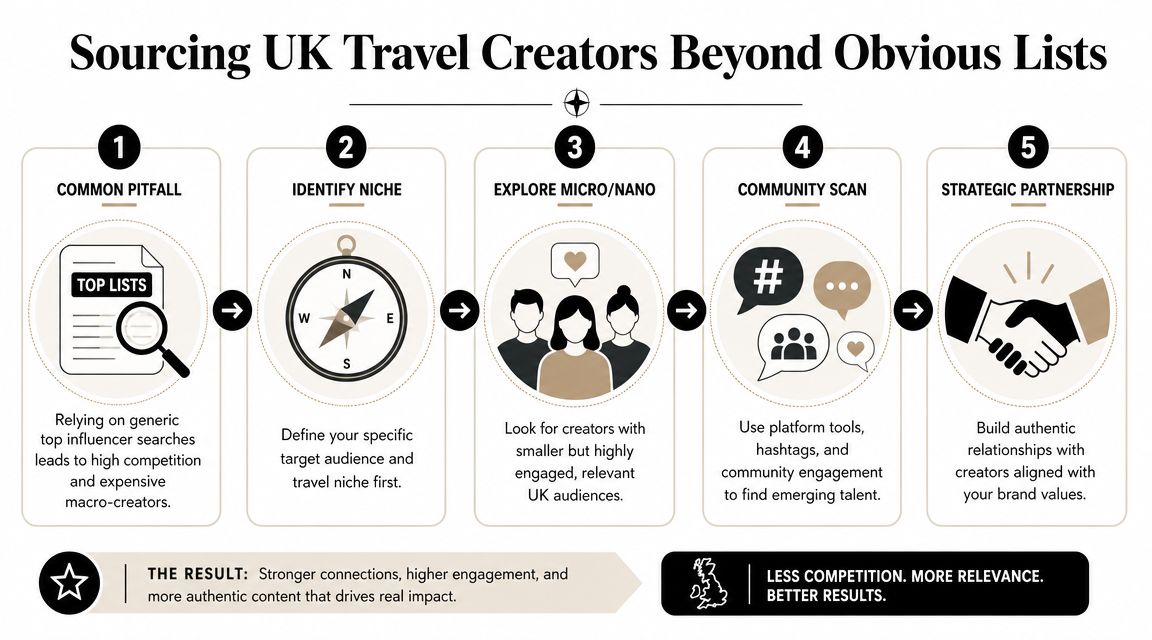
The expensive route is obvious. Search “top UK travel influencers”, email the same names every other brand is emailing, and pay a premium for creators whose audiences may be broad but not locally actionable.
The better route is narrower. Start with the location, the customer action, and the type of traveller you need to influence.
A useful market signal backs this approach. In a 2024 survey across France, Germany, Spain, and the UK, 42% of travellers said social media was their primary travel-planning source, ahead of official sites at 14% and search engines at 8%, as summarised by PhotoAid's travel social media statistics analysis. If discovery is happening in-feed, your brand needs creator coverage where people browse.
Start with a postcode, not a platform
Most bad sourcing starts too wide. “We need UK travel influencers” is not a brief. “We need creators who influence couples looking for weekend breaks within driving distance of the Lake District” is a brief.
Before opening Instagram or TikTok, define:
- Commercial objective. Bookings, walk-ins, event ticket sales, lead forms, or code redemptions.
- Geographic radius. National, regional, city-level, or neighbourhood-level.
- Traveller type. Luxury, family, dog-friendly, budget, wellness, food-led, outdoors, or accessible travel.
- Content angle. Itinerary, review, day trip, room tour, hidden menu item, seasonal event, or local guide.
That last part matters because creators perform better when the assignment fits how they already publish.
Instagram sourcing that surfaces local relevance
Instagram is still strong for hospitality and destination discovery because location tags, saved guides, and story-driven review content make intent easier to read.
Use a practical workflow:
- Search the location tag first, not the hashtag.
- Open recent posts, not just top posts.
- Save creators who repeatedly post about the area, not those who passed through once.
- Check whether they also cover adjacent places your customer would realistically visit.
- Review comments for local questions like parking, menu, timings, transport, dog policy, or pricing cues.
A creator answering practical comments is usually more useful than one posting polished but generic destination imagery.
For teams building a broader shortlist, this travel influencer strategy guide is a useful companion read because it helps frame creator discovery around campaign fit rather than popularity.
TikTok sourcing that catches momentum early
TikTok is where many brands miss fresh talent because they search hashtags and stop there. That's too shallow.
A better TikTok workflow looks like this:
- Search by place name and niche together. Think “Manchester hotel”, “Cotswolds weekend”, “Brighton brunch”, “Edinburgh stay”.
- Follow sound trails. If a local creator posts a strong travel video on a trending sound, tap through and inspect similar creators using it in related contexts.
- Check comment prompts. Creators whose audiences ask “where is this?”, “is it worth it?”, or “can you do a weekend guide?” often have commercial potential.
- Look for repeatability. One viral clip isn't enough. You want creators who can turn local discovery into a series.
When a creator can make three useful posts about one area without repeating themselves, they've usually built an audience that trusts their recommendations.
Mine adjacent communities
One of the best ways to find underused creators is to look where your competitors aren't.
Try these inputs:
| Source | What to look for | Why it works |
|---|---|---|
| Complementary brands | Followers commenting on hotels, cafes, attractions, rail providers, luggage brands | These creators often overlap with your customer without being overpitched |
| Tourism pages | Tagged posts and local guide contributors | Good source of region-specific creators |
| Event accounts | Festival, market, wellness retreat, or food event attendees | Strong for short-term conversion campaigns |
| Creator comment sections | Other creators leaving thoughtful comments | Good way to uncover peers with similar audience fit |
The point isn't to build the biggest list. It's to build a shortlist you can activate without paying for broad reach you don't need.
How to Vet Influencers for Audience Not Just Followers
A creator can look perfect on the surface and still be a bad buy. The usual failure point is simple. The audience isn't local enough, engaged enough, or believable enough.
That's why follower count should be treated as context, not proof.
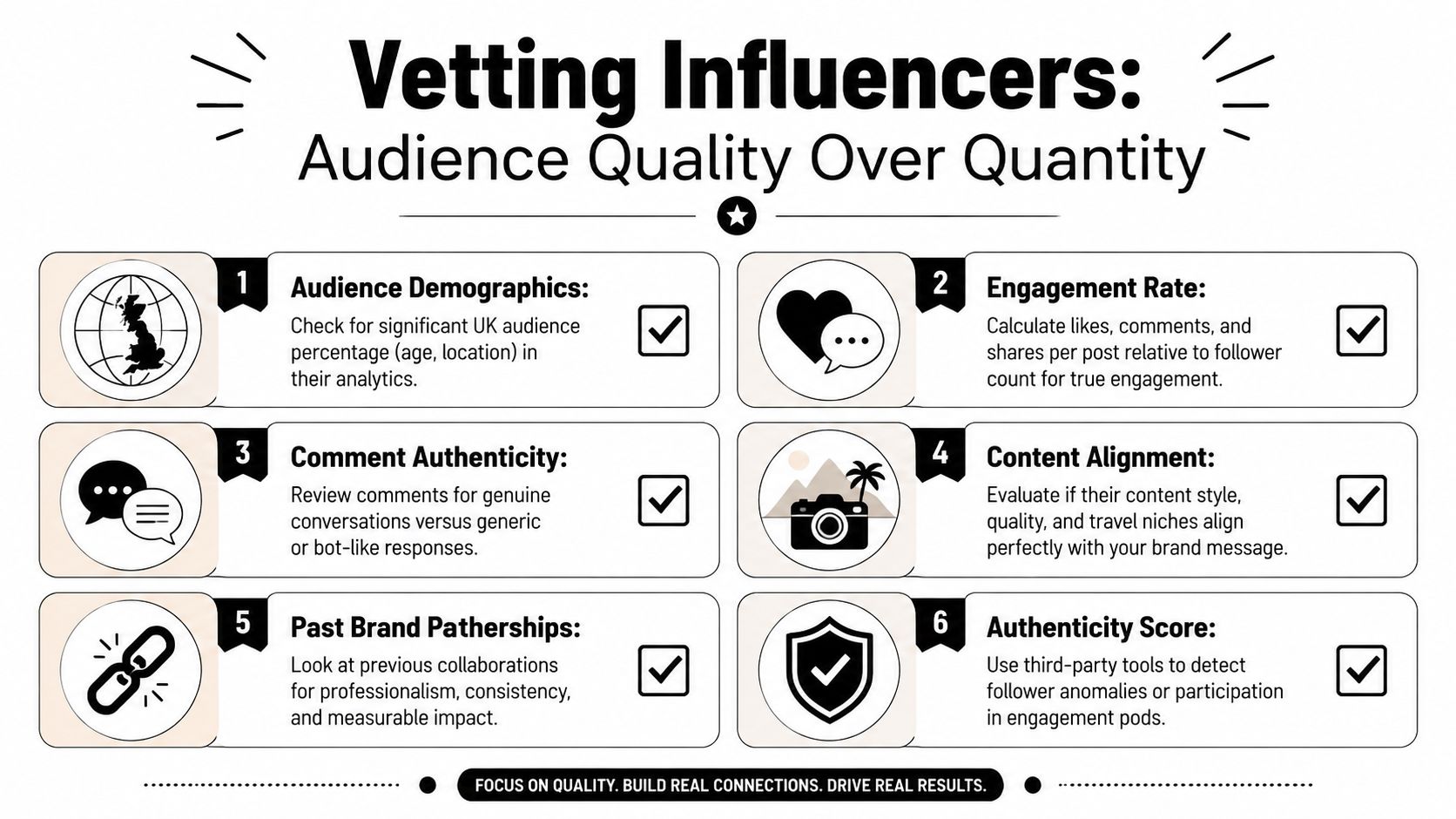
A 2026 peer-reviewed study found that audience reach and engagement rate were more accurate indicators than follower count, and it recommends checking audience fit and recent engagement before contracting. The same study also notes that organic creator content is perceived as more authentic. The original research is available via Taylor & Francis Online.
The three-layer vetting process
I use a simple pass or fail structure. If a creator misses badly on one layer, I don't try to talk myself into the deal.
Layer one: audience fit
Ask for platform insights before discussing final deliverables. You want screenshots or exports that show where the audience is located and whether that audience matches the trip type or venue.
For a regional UK hospitality campaign, check:
- UK relevance. Is there enough UK concentration to make the placement worthwhile?
- Location match. Does the audience align with your catchment area or feeder cities?
- Age and life stage. Family hotel and solo city-break creator audiences aren't interchangeable.
- Platform match. Some creators sell well in Stories. Others only move attention in short-form video.
If a creator hesitates to share audience data, that isn't always disqualifying, but it is a warning sign.
Recent engagement matters more than historic averages
Don't accept “my engagement is good” as an answer. Pull the recent content and inspect it yourself.
Review the latest organic posts and then compare them with sponsored content. You're looking for consistency, not one standout result.
A practical review sheet should include:
- Post-by-post engagement quality across recent uploads
- Comment depth, especially questions and replies
- Save/share signals if available in creator screenshots
- Drop-off between organic and branded posts
- Content format fit, such as Reel, carousel, Story, or TikTok voiceover
If a creator's branded content suddenly becomes stiff, polished, and over-scripted, expect weaker performance.
Field note: The best-performing travel partnerships usually feel like the creator's normal recommendation style with better production support, not like an ad that interrupted their feed.
For teams trying to sharpen their analysis workflow, the official LunaBloom AI insights blog is useful for broader thinking on audience and content evaluation.
Red flags worth catching before contract stage
This part saves budget.
| Red flag | What it suggests | What to do |
|---|---|---|
| Sudden follower spikes with no clear content trigger | Possible paid growth or low-quality acquisition | Ask for historical context and recent analytics |
| Generic comments repeated across posts | Engagement pods or bot-heavy activity | Review more posts before proceeding |
| Strong travel aesthetic but weak local depth | Good content, poor conversion fit | Reposition for awareness only, or skip |
| Sponsored posts perform very differently from organic | Audience resists obvious ad treatment | Tighten brief and reduce scripting |
| Audience data is vague or unavailable | Low transparency | Move to another creator |
Brand safety is not just about controversy
For travel influencers uk campaigns, brand safety also means operational trust. Will the creator show up on time, follow usage terms, disclose properly, and capture what was agreed without needing ten rounds of chasing?
Review past partnerships for signs of professionalism. Look at whether the creator can communicate an experience clearly, not just shoot attractive footage. A beautifully edited hotel Reel that omits booking cues, location context, and any real recommendation is often less useful than a simpler piece of content that answers customer questions.
Engaging Influencers and Structuring Compliant Campaigns
Outreach gets ignored when it reads like a mass send. Most brands either write too vaguely or ask for too much before trust exists.
The creators you want are already getting offers. Your message has to tell them, fast, why this partnership fits their audience and what action you want next.
Bad outreach versus good outreach
Bad outreach sounds like this:
Hi, we love your content and would love to collaborate. Please send your rates and media kit.
That message puts all the work on the creator. It also tells them nothing about fit, timing, deliverables, or why your brand chose them.
A better opening is specific:
Hi [Name], we're planning a campaign around weekend stays in [Location]. Your recent content on [specific post or place] stood out because you make local recommendations feel practical, not generic. We're looking for a creator whose audience would genuinely act on a staycation offer in this area. If that sounds relevant, I can send the brief, dates, and content options.
That works because it proves you looked at the account and gives the creator a reason to continue.
A copy-pasteable outreach template
Use this as a starting point, then personalise the middle.
Subject line: Collaboration for [location]-focused travel campaign
Email body:
Hi [Name],
I'm reaching out from [Brand]. We're running a creator campaign focused on [offer, venue, route, or location].
We thought of you because your content on [specific post, format, or destination] is closely aligned with the audience we want to reach. We're particularly interested in creators who can make local travel decisions feel useful and bookable.
The rough shape of the partnership:
- Timing: [month or launch window]
- Focus: [what the audience should do]
- Deliverables: [initial outline only]
- Tracking: unique links or codes will be provided so performance can be measured clearly
- Usage: please let us know if paid usage rights are available
If you're interested, I can send over the brief and confirm whether there's a fit on both sides.
Best, [Name]
Structure the agreement before content starts
At this stage, campaigns either stay manageable or become admin-heavy.
At minimum, your agreement should cover:
- Deliverables. Be exact on format, platform, quantity, and deadlines.
- Content approval. State what needs approval and what doesn't.
- Usage rights. Organic reposting, paid ads usage, whitelisting, and duration should be explicit.
- Exclusivity. Define any category restrictions clearly.
- Disclosure. Require compliant ad labelling.
- Payment terms. Tie timing to deliverables and invoice requirements.
- Cancellation and rescheduling. Especially important in travel, hospitality, and event-led campaigns.
If your team needs a practical legal starting point, this guide to influencer contracts and agreements is a solid reference.
Keep briefs tight, not controlling
Over-briefing kills travel content. Under-briefing creates unusable content.
A strong brief should include:
- the commercial goal
- the audience
- the experience details the creator must capture
- any mandatory messaging
- tracking links or codes
- disclosure requirements
- essential requirements on timing and claims
Then leave room for the creator's own structure, language, and sequencing.
The fastest way to flatten creator performance is to make every post sound like it came from your internal brand deck.
Compliance in the UK is not optional
For UK campaigns, make ad disclosure expectations explicit from the first outreach. Don't assume a creator will handle it correctly without guidance.
Your team should confirm:
- when a post must be clearly labelled as an ad
- where that disclosure appears
- whether gifted stays or hosted experiences still require disclosure
- who checks compliance before or after posting
This is one area where “we'll sort it later” creates avoidable risk.
Measuring What Matters Clicks Conversions and ROI
If influencer activity can't be tied to a business result, it stays vulnerable in budget reviews. The reporting might look impressive, but it won't survive scrutiny from finance, paid media, or senior leadership.
The fix is straightforward. Build measurement before outreach starts.
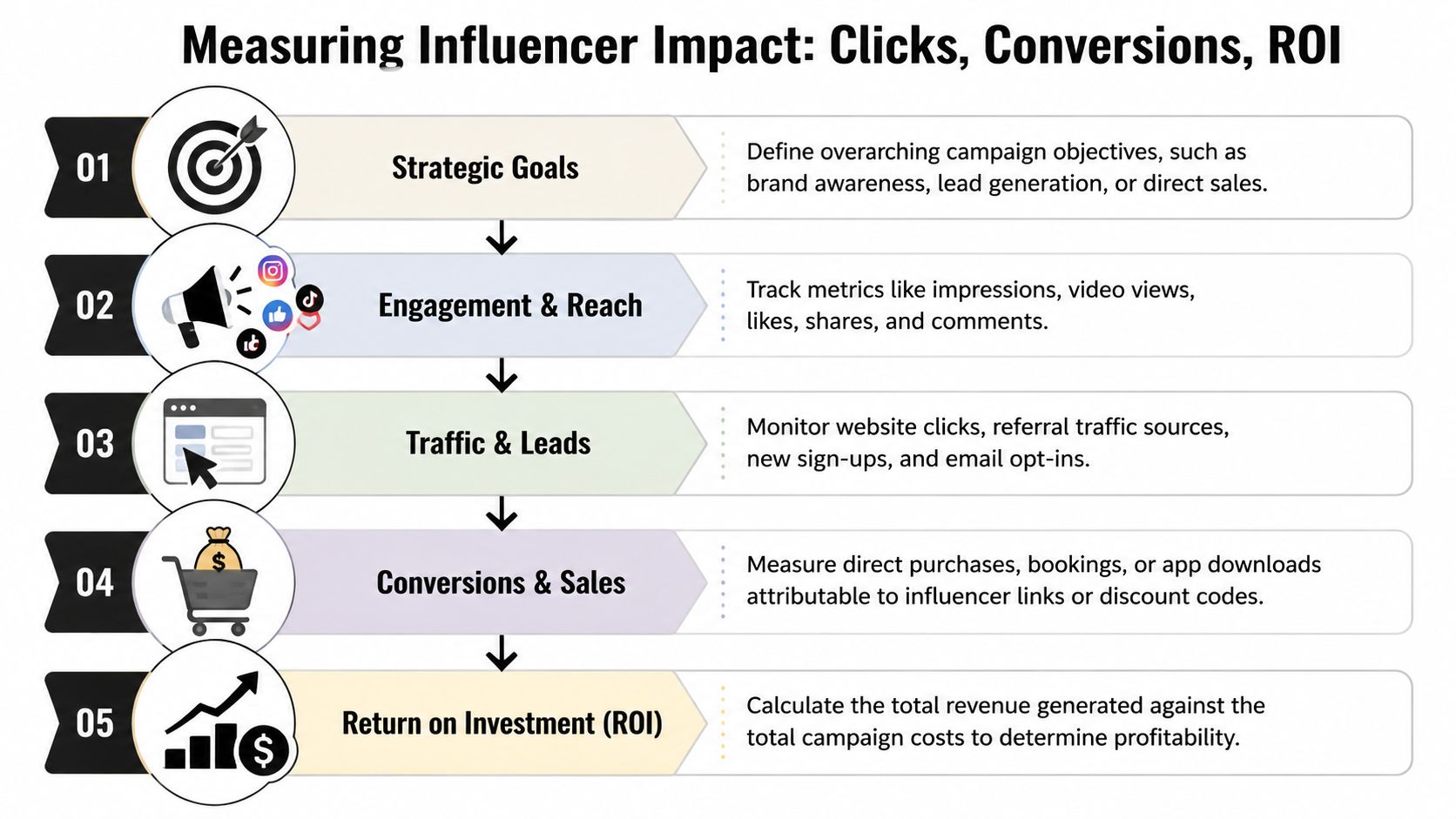
Best practice for UK travel campaigns is clear: define measurable KPIs first, then use UTM-tagged links and unique promo codes for attribution. A further benchmark is to combine one macro-influencer for reach with multiple micro-influencers for engagement so ROI can be evaluated more cleanly, as outlined in Sprout Social's UK travel influencer marketing guide.
The minimum viable measurement stack
You don't need complicated software to start. You need naming discipline.
A clean setup includes:
- A campaign naming convention Example: spring-stays-manchester creator-name platform format
- Unique UTM links per creator Build links that identify source, medium, campaign, and creator.
- Unique promo or booking codes Essential for creators driving direct offers, dining, tickets, rooms, or packages.
- A landing page or booking path that matches the content Don't send users from a creator's hotel room tour to your generic homepage.
- A reporting sheet or dashboard updated on a fixed cadence Track posts live, clicks, assisted conversions, redemptions, and spend.
Match the KPI to the campaign type
Teams often make a critical mistake. They use one reporting template for every creator regardless of the objective.
A better framework looks like this:
| Campaign type | Primary KPI | Secondary KPI | Common mistake |
|---|---|---|---|
| Hotel or staycation push | Bookings | Landing page visits | Sending traffic to a generic site page |
| Restaurant or venue launch | Code redemptions or booked covers | Story taps or map clicks | Counting views as success |
| Regional tourism push | Qualified traffic to itineraries | Saves and shares | No route from content to next step |
| Attraction or event campaign | Ticket sales | Click-through rate | Overlapping creator launch windows |
That last point matters. Attribution becomes messy when multiple creators post around the same time without a clean rollout plan.
Separate organic creator impact from paid amplification
Don't lump everything into one result line. If you boost creator content, whitelist it, or run it as paid social, split the reporting.
You should know:
- what the creator drove organically
- what paid amplification contributed
- what happened by creator, by asset, and by time window
That split tells you whether you bought strong creator influence or just bought media on top of mediocre content.
Good attribution doesn't just tell you that a campaign worked. It tells you which creator, message, and location angle should be repeated.
If your team wants a sharper framework for engagement and performance reporting, this guide for effective social media measurement is useful. For an ROI-specific lens, this influencer marketing ROI guide is also worth keeping in your planning docs.
A practical benchmark model for reporting
For local travel influencer work, I like a simple hierarchy:
- Top line. Reach, views, and content delivery status
- Mid funnel. Clicks, landing page sessions, saves, shares, and enquiry starts
- Bottom line. Bookings, covers, ticket sales, code redemptions, revenue, and acquisition cost
That gives each stakeholder what they need. Social gets content performance. Growth gets traffic and conversion data. Leadership gets commercial output.
The Strategic Shift From Discovery to Local Conversion
A lot of travel marketing still runs on an outdated fantasy. The creator discovers a hidden gem, posts about it, and the brand wins on exposure alone.
That logic is weaker now.
The market is crowded, the creator ecosystem is mature, and once enough creators publish about a place, it stops being hidden. Commentary on travel influencer saturation makes that point directly. The “hidden gems” idea is largely a myth once creator attention arrives, and the smarter opportunity now is in hyperlocal, trackable campaigns that drive local conversion, as discussed in this travel influencer saturation commentary.
What this changes for UK brands
The shift is strategic, not cosmetic.
If you're a hospitality or tourism brand, stop asking only, “Who can put us on people's radar?” Start asking:
- who can drive bookings in a specific catchment
- who can influence nearby feeder cities
- who can create practical local content at scale
- who can repeat performance across multiple locations
That's why broad inspiration campaigns often underperform for regional operators. They create attention without enough path to action. A local creator with a smaller but more relevant audience can be far more useful when the offer is tied to a place, date, and next step.
The operating model that scales
The most effective travel influencers uk programmes now share a few traits.
They use:
- clusters of micro-creators by location, not one oversized national face
- clear offers and booking paths, not just “visit us”
- rolling activations, so the brand keeps local presence rather than one launch spike
- reuse of creator content across owned and paid channels, where rights allow
- tight attribution, so underperformers are replaced quickly and winners are rebooked
This turns creator marketing into something much closer to local media buying, except the message arrives through a person the audience already follows.
What stops working
Several habits need to go.
First, chasing the same creator lists as every competitor. Second, overpaying for broad aesthetic travel content that doesn't move a local audience. Third, briefing creators to produce generic “dreamy” content with no route to booking, visit, or enquiry.
A mature UK market rewards sharper execution. It doesn't reward lazy discovery.
The edge is no longer finding a creator. The edge is building a repeatable local system around the right creator.
The 2026 playbook in one view
If I had to reduce this to a working model for a UK brand, it would look like this:
| Old approach | Better approach |
|---|---|
| Broad national inspiration | Hyperlocal conversion campaigns |
| Follower-led creator choice | Audience and engagement-led selection |
| One-off partnerships | Ongoing creator pools by region |
| Vanity metrics reporting | UTM, code, booking, and revenue tracking |
| Heavily scripted content | Native creator storytelling with clear commercial goals |
That shift is what makes influencer work easier to defend internally. It gives the team a sourcing method, a vetting standard, a contract structure, and a measurement model that can be reused.
And once it's reusable, it becomes scalable.
If your team wants to run creator campaigns this way without spending weeks in DMs and spreadsheets, Sup helps brands source local micro and nano creators, launch campaigns with tracking built in, and tie content back to clicks, bookings, and revenue. It's built for teams that need influencer marketing to perform like a real growth channel, not a side project.
More on recruitment
See how many creators post about you and your competitors
Type in your brand's Instagram handle and we count the creators who post about you and about your five closest competitors. It takes about a minute and it is free. Or request a demo and we will show you the creators in your niche and walk you through the dashboard.
 Book a call