6 June 2026
Music Influencer Marketing: A Guide to Real ROI in 2026
52% of UK 16 to 24-year-olds use TikTok to discover music, and 37% use Instagram, according to a 2024 UK music discovery summary citing BPI data. That shifts music influencer marketing out of the “nice to have” bucket. It puts it inside the discovery path itself.
The practical implication is simple. If your campaign only measures views, likes, or even streams in isolation, you're missing the commercial question that matters most. Did the creator content move listeners towards a real action, such as a ticket purchase, merch order, venue visit, profile click, or repeat listening behaviour that can be attributed back to a post?
That's where most music campaigns still fall apart. The creative often lands. The attribution usually doesn't.
A useful music influencer marketing system has to do three jobs at once. It has to match the right creators to the right sound, give them a brief that still feels native to their audience, and track what happened after the post went live. Without all three, you get noise instead of a growth channel.
What Music Influencer Marketing Really Is
Music influencer marketing is creator-led recommendation that puts a track, artist, venue, or music experience inside a format people already choose to watch. The commercial value is not exposure alone. It is whether that recommendation leads to a measurable action, such as a save, profile visit, ticket sale, merch order, guestlist claim, or venue visit.
That changes how the channel should be planned.
A celebrity campaign can buy attention. Creator campaigns shape intent. In music, the strongest placements feel less like advertising and more like trusted taste-making inside a scene, city, or subculture. That difference affects performance. Audiences respond to relevance and context far more than polished endorsement.
Discovery beats interruption
Creator content works best when it introduces music through a use case. A late-night drive clip, a dance format, a local venue recommendation, a rehearsal moment, a festival prep video, or a recurring creator series can all give the same track a different commercial job. One might drive audio uses. Another might move ticket clicks. Another might bring people through the door on the night.
That is why generic briefs fail. If the post could promote any artist with a quick caption swap, it will usually produce weak intent and soft conversion.
Practical rule: If the content could be swapped from one artist to another without changing much, the brief is too generic.
The goal is not to force a creator into your campaign language. The goal is to place the release inside a format that already earns attention from the right audience, then build a clear path to the next action.
What the channel is actually doing
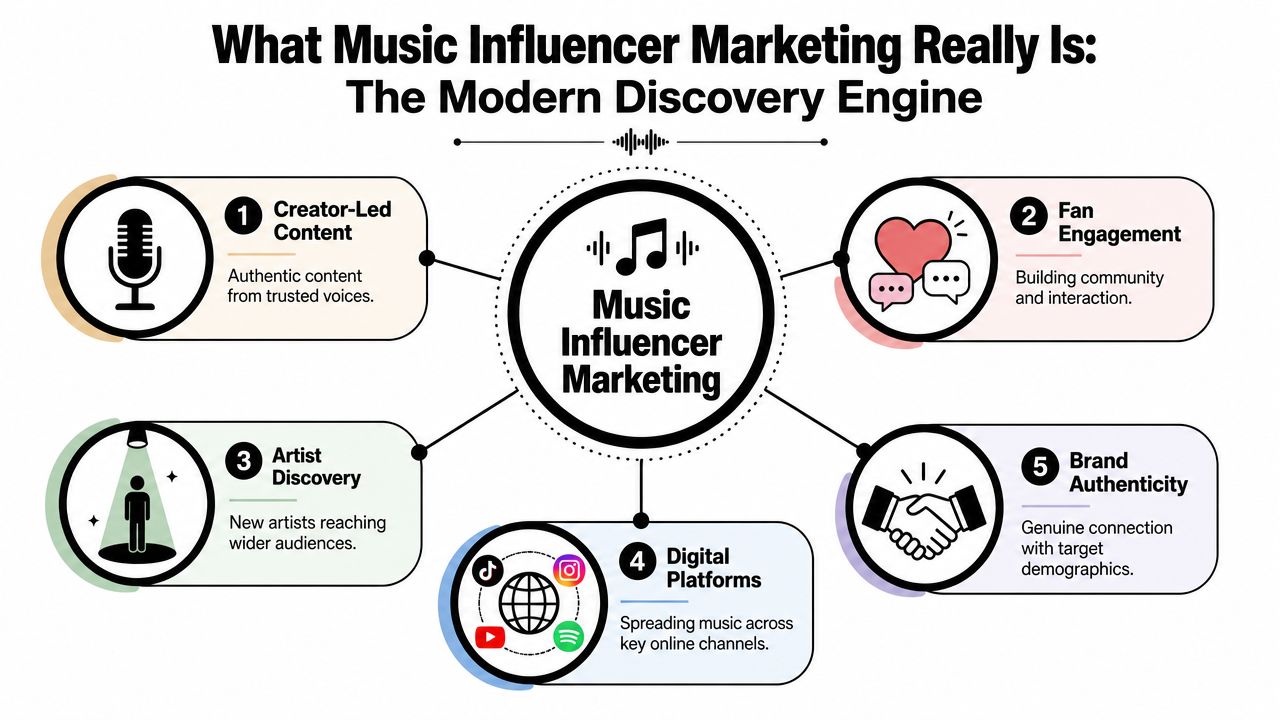
Music influencer marketing works across five connected layers:
- Cultural framing: The creator gives the track a setting, mood, identity, or reason to matter now.
- Audience filtering: The recommendation reaches people with the right genre interest, location, age bracket, or scene affiliation.
- Social proof: Comments, saves, shares, and repeat use signal that the track belongs in the conversation.
- Action path: The post gives people a next step, such as pre-save, profile click, ticket tap, merch code use, RSVP, or in-store redemption.
- Attribution: The campaign tracks which creator, format, message, and audience segment produced the result.
That final layer is what separates a growth channel from a pile of posts. Streams still matter, but they are only one output. For many campaigns, the better question is which creators drove the cheapest ticket sale, the highest merch conversion rate, the strongest repeat listening, or the biggest lift in venue footfall within a defined time window.
In practice, that means setting up measurement before content goes live. Use creator-specific links, codes, landing pages, offer variants, geo splits, and post windows that match the buying cycle. Without that structure, teams can see activity but cannot explain revenue.
Music influencer marketing is not just about getting heard. It is about proving who moved people from discovery to action, and doing it in a way you can repeat.
Choosing Your Stage and Stars
Platform choice should follow campaign intent. Creator choice should follow audience fit. Teams that reverse that order usually end up paying for reach they can't use.
What each platform is good at
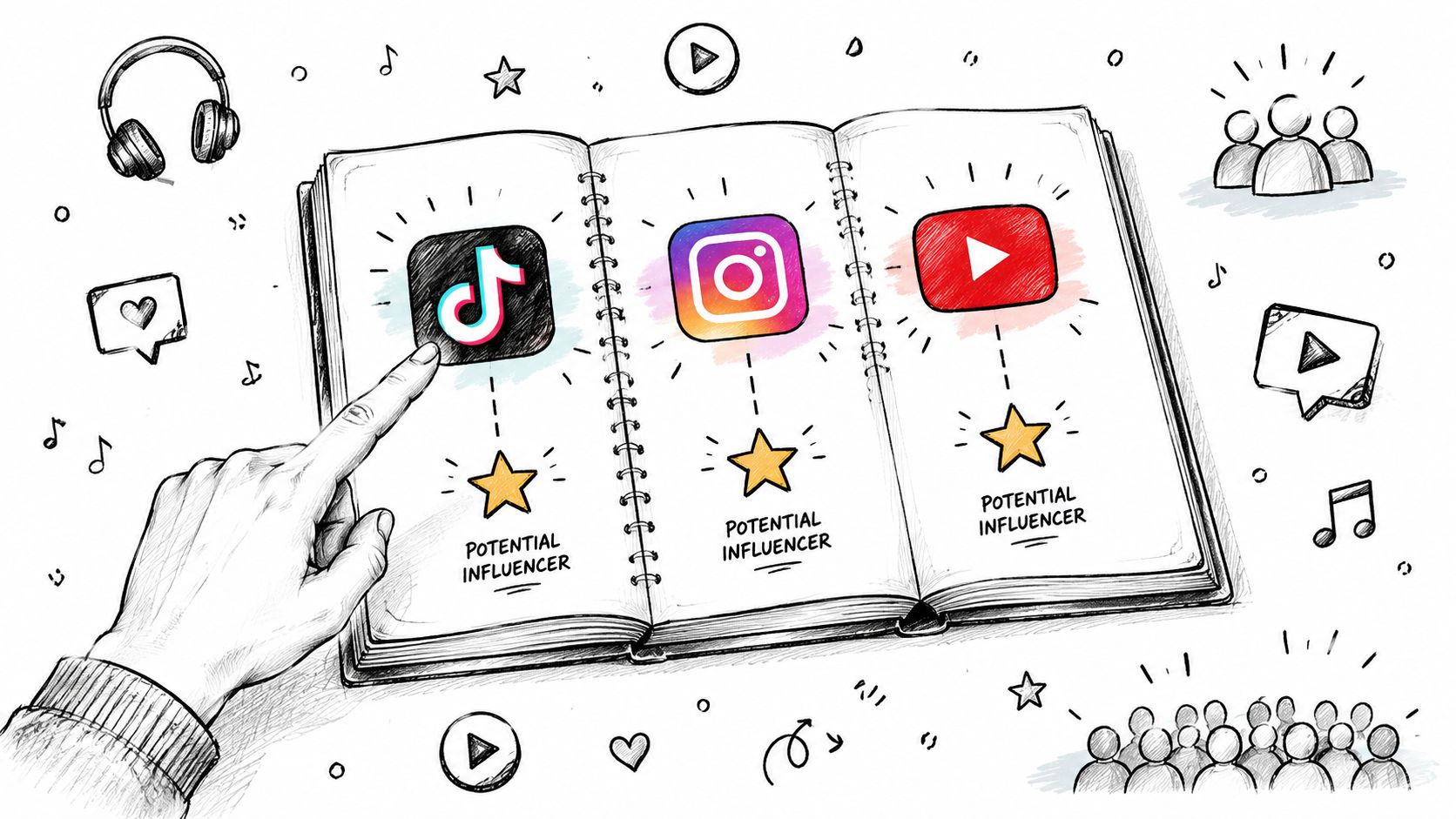
TikTok is where tracks can pick up momentum quickly because the format rewards repeatable ideas, audio reuse, and creator interpretation. It's useful when you need volume of testing and fast signal collection. If a hook, line, or visual motif is going to travel, TikTok usually reveals that early.
Instagram does a different job. It's stronger when the campaign needs aesthetic consistency, artist world-building, local recommendation, or a bridge from discovery into profile visits, DMs, event interest, and community response. It often works well for venues, gig series, launches, listening parties, and merch drops because the audience is used to clicking through profiles and Stories for next steps.
YouTube usually sits further down the depth curve. It's less about quick trend participation and more about context, performance, catalogue value, and searchable storytelling. Long-form doesn't create the same kind of rapid creative testing, but it can hold value for artist narratives, acoustic cuts, behind-the-scenes footage, and session content.
Follower count is a weak planning tool
Teams still over-index on creator size because it's easy to compare in a spreadsheet. In practice, music campaigns rise or fall on audience alignment and post behaviour.
A broad creator can create awareness. A tightly matched creator can create action.
The creator who looks smaller on paper often produces the cleaner conversion path.
That matters even more for local campaigns. One of the most overlooked opportunities in UK music influencer marketing is hyperlocal creator planning. As noted in this analysis of local music promotion gaps, most guides don't explain how to combine local creators, venue proximity, and city-specific audiences to drive attendance rather than just online reach.
When local micro-creators win
For place-based outcomes, local micro-creators often outperform broader music pages or generic entertainment accounts because they carry situational trust. Their audience already sees them as useful for deciding where to go, what's worth trying, and what's happening nearby.
That changes the campaign logic.
| Campaign goal | Better creator type | Why |
|---|---|---|
| Launching a new single to niche listeners | Genre-aligned creators | They can frame the sound in a way that feels credible |
| Selling tickets for a city date | Local micro-creators | Their audience can actually attend |
| Driving venue footfall | Local lifestyle and food creators | They influence real-world plans, not just streams |
| Building artist identity | A mix of visual storytellers and music-native creators | One group shapes image, the other shapes listening intent |
For a Manchester date, don't only ask which creators like the genre. Ask which creators regularly influence what people in Manchester do on a Thursday night. That's a better predictor of attendance.
Your Step-by-Step Campaign Roadmap
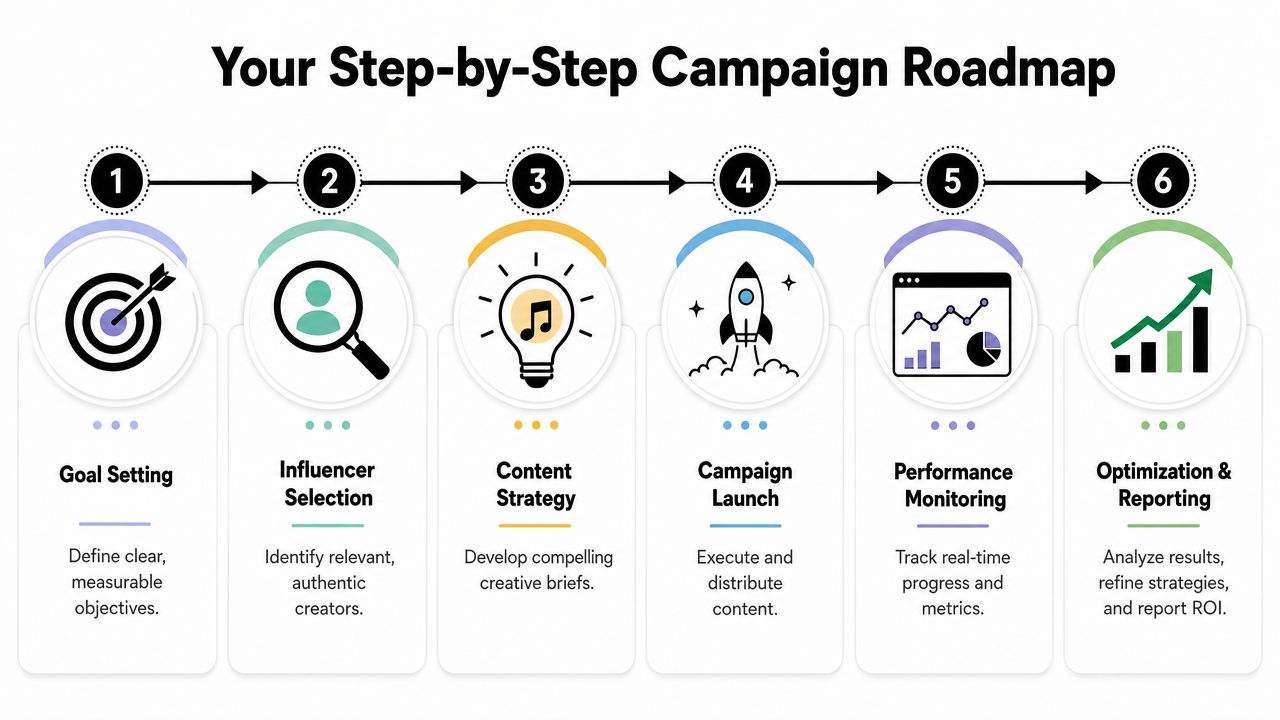
Campaigns underperform for a simple reason. Teams start with creator outreach before they decide what commercial result the campaign needs to produce.
Set the business outcome first, then build backwards. If the goal is ticket revenue, the plan should be built around box office clicks, code redemptions, and sales windows. If the goal is venue footfall, track reservations, guestlist claims, or postcode-level lift near the event. If the goal is merch, use creator-specific links and discount codes from day one. That discipline is what turns creator marketing from content activity into a revenue channel.
Start with the measurable action
Before anyone builds a shortlist, lock four decisions.
- Commercial outcome: Choose the action that matters most. Streams, ticket sales, pre-saves, merch purchases, reservations, or in-store and venue visits.
- Audience definition: Genre fit helps, but it is not enough on its own. Add geography, age band, live event intent, and platform behaviour.
- Offer or hook: Give people a reason to act now. Early access, a limited merch drop, an event angle, an exclusive clip, or a fan participation mechanic all work if they match the artist.
- Tracking method: Decide how each action will be recorded before launch. Use UTM links, creator codes, landing pages, profile click tracking, CRM tags, or box office reporting fields.
This part decides whether you can prove ROI later. A useful framework for setting that up sits in this guide to measuring influencer marketing ROI by business outcome.
Vet creators like a media buyer
The shortlist should answer a harder question than "Do they like music?" It should answer "Can this creator move the specific audience needed for this campaign?"
Check recent posts for consistency, tone, and whether music already appears naturally in their content. Read comments, not just engagement totals. Questions, tagged friends, local recommendations, and purchase intent tell you more than like counts. For attendance campaigns, audience location matters. For merch or direct sales, look for evidence that followers click, buy, or use creator codes.
I also look for fit under pressure. A creator can look perfect on paper and still miss because their style cannot carry a release naturally. If the post is going to feel bolted on, the audience will treat it like an ad and scroll past it.
If you need an execution reference that stays practical, Mogul's piece on tactical indie music promotion is useful because it stays close to campaign mechanics rather than vague awareness goals.
Build briefs that creators can actually use
The best brief gives structure without flattening the creator's voice. Include the release context, approved links, required call to action, disclosure language, usage rights, review process, and anything that is off-limits. Then leave room for interpretation.
Prompt-based direction works better than scripted copy. "Show where this track fits in your week" usually performs better than "mention the single and say it is out now." One sounds like the creator. The other sounds like brand instructions.
Keep approval tight. One owner on your side. One feedback round unless legal review changes the terms. Long email chains and conflicting edits waste the posting window, which is often where the best conversion lift happens.
Launch in waves, not all at once
Stagger posting across creator tiers and content formats. Start with a smaller test group, check early click and save behaviour, then put more budget behind the creators and messages that are already producing action. This approach protects spend and gives you time to fix landing pages, update codes, or sharpen the call to action before the full rollout.
A simple campaign structure works well in practice:
- Test a small creator group with different hooks.
- Review early conversion signals and audience response.
- Increase budget only for creators and formats that are driving the target action.
- Retarget engaged users with ticket, merch, or streaming follow-up.
- Capture all redemptions, visits, and sales against creator IDs.
That is the difference between a campaign that generates screenshots and a campaign that generates attributable revenue.
Later in the rollout, this video is a useful companion for thinking about the creator side of campaign execution and content packaging:
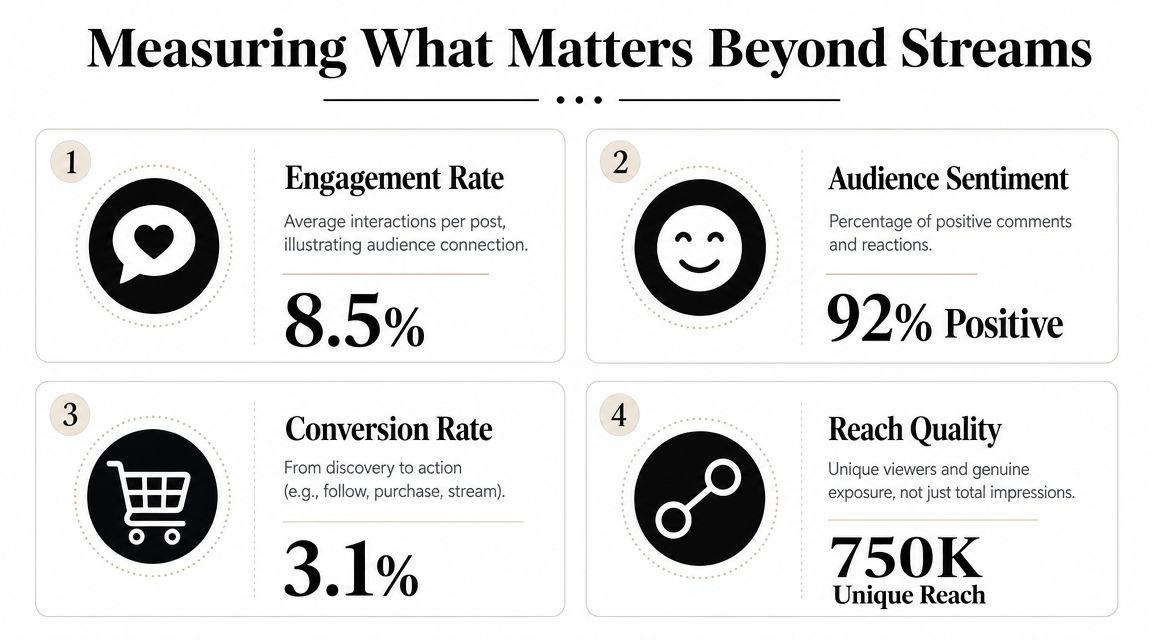
Measuring What Matters Beyond Streams
The hardest part of music influencer marketing isn't getting content live. It's proving what the content did.
Most campaign reports still lead with reach, views, and top-line engagement. Those are useful context metrics, but they don't answer the budget question. The budget question is whether the creator moved someone towards revenue or a meaningful precursor to revenue.
Use a funnel that connects content to action
For UK music campaigns, the strongest signal isn't raw views. It's post-level conversion behaviour in the first 72 hours. Practitioner guidance recommends tracking Spotify for Artists streaming spikes within 72 hours after each influencer post, plus TikTok saves and shares and Instagram profile clicks. The same guidance also suggests using engagement quality screens and then comparing creator efficiency after about two weeks through cost-per-stream or cost-per-action analysis, as described in this music campaign measurement guide.
That gives you a more useful KPI hierarchy:
| Funnel layer | What to track | Why it matters |
|---|---|---|
| Awareness | Reach, views, watch behaviour | Confirms delivery, not commercial value |
| Consideration | Saves, shares, comments, profile visits | Shows intent and audience response |
| Conversion | Streams after post timing, ticket clicks, merch code use, bookings | Connects creator activity to action |
| Revenue outcome | Sales, redeemed codes, venue attendance, repeat purchase signals | Tells you whether to scale |
The sequence matters. A post with modest reach but strong saves and profile clicks can be more valuable than a high-view post that creates no next step.
Measurement rule: Track by post, by creator, and by time window. Aggregated campaign averages hide the useful signal.
How to build attribution in practice
Attribution doesn't require perfect tracking. It requires consistent tracking.
Use platform-native analytics for post performance, then connect those signals to your owned assets. Give each creator a unique link where possible. Use promo codes for merch and ticketing. If a venue is the goal, use creator-specific booking links, guest list tags, or named offers at the door. If direct web tracking is limited, map post timestamps against Spotify for Artists and website traffic patterns.
Many teams need a more rigorous reporting model. A useful companion read is this influencer marketing ROI framework, especially if you're trying to standardise reporting across multiple creators or locations.
For creative production, don't ignore the measurement implications of the asset itself. Different edits create different actions. A performance clip might drive streams. A talking-head recommendation might drive profile clicks. A venue montage might drive bookings. If you're building more content variants around a release, MelodicPal's guide to AI video production and monetization is useful for thinking about how to create more testable video assets without making every post feel identical.
What to do with the data
Once the posts are live, avoid the common mistake of waiting until the end to judge performance. Review early. Reallocate fast.
Look for patterns such as:
- Creators who drive saves and shares: Often strong for music discovery and algorithmic momentum.
- Creators who drive profile clicks: Useful if the artist page or venue page is built to convert.
- Creators who drive code use or bookings: These are your commercial operators.
- Creators with high impressions but weak intent signals: Suppress or don't renew.
The best music influencer marketing programs don't optimise for the loudest post. They optimise for the most efficient path from creator content to measurable action.
Campaign Examples and Outreach Templates
The commercial pressure on creator spend is rising. As noted in this discussion of scrutiny around UK creator effectiveness, marketers increasingly need to prove outcomes beyond awareness, especially for tickets, merch, and venue revenue. That's why campaign design has to start with the action you want to trace.
Example one, indie release with creator-led pre-save intent
An emerging indie band is releasing a debut single. The mistake would be chasing broad entertainment accounts and hoping for a trend. A tighter approach is to recruit small creators who already post around alt-pop, daily life edits, fashion, night travel, and “tracks I'm into this week” formats.
The brief would avoid polished ad language. Better prompts include using the chorus in a relatable edit, filming a “songs for walking home late” post, or reacting to a favourite lyric. Every creator gets a unique pre-save link, and the team watches which formats create profile visits, saves, and click-through behaviour.
The campaign doesn't need the same post from every creator. It needs repeated exposure from different angles that all point towards the same next step.
Example two, local venue campaign with attendance as the KPI
A small venue is launching a weekly live music night. Instead of briefing only music pages, it brings in local food, city-life, and nightlife creators who regularly influence where people go in the area.
The content angle is the night out, not just the line-up. One creator covers drinks and atmosphere. Another covers the neighbourhood and convenience. Another frames it as a recurring recommendation for after-work plans. Each creator gets a booking link or named offer, and the venue tracks redemptions alongside door data and walk-in mentions.
Good venue campaigns sell context as much as they sell music.
If you're writing outreach from scratch, it helps to study how creators assess inbound offers. The Contesimal creator playbook is useful because it shows what makes a collaboration feel clear and credible from the creator side too.
For more tactical outreach structure, this guide to writing the perfect influencer outreach email is worth keeping open while you build your first message.
Influencer Outreach and Brief Templates
| Template Type | Key Elements | Example Text Snippet |
|---|---|---|
| Initial outreach email | Why them, campaign context, deliverable outline, timing, payment model, next step | “Hi [Name], I'm reaching out because your content already sits naturally in [genre/city/lifestyle lane]. We're planning a campaign around [track/event], and I think your audience is a strong fit for it.” |
| Follow-up message | Short reminder, clear ask, simple reply path | “Just following up in case this got buried. If you're open, I can send the brief, timing, and usage details today.” |
| Creative brief | Track or event details, audience angle, approved links, CTA, disclosure, do's and don'ts | “Use the release in a format that already performs for you. Keep the recommendation natural. Include the provided link and disclosure label. Don't use alternate audio or outdated ticket info.” |
| Approval checklist | Caption review, link check, disclosure check, timing confirmation, usage rights | “Before posting, confirm caption, tag, disclosure label, landing page link, and agreed publish time.” |
| Post-campaign recap request | Live links, screenshots, analytics, notes from audience response | “Please send live URLs and platform screenshots once the post has been up long enough to capture early performance.” |
Common Pitfalls and Legal Guardrails
Music influencer marketing usually breaks down long before anyone notices it in the report. The post goes live, engagement looks healthy, and the campaign still fails to move ticket sales, merch revenue, or venue traffic in a measurable way. In practice, the problems are usually operational. Wrong creator fit, unclear rights, weak conversion paths, or reporting that stops at views.
Poor targeting costs more than weak creative
A polished post cannot rescue a bad audience match. If a creator's followers like their personality but do not act on music recommendations, local events, or artist discovery, the campaign may generate comments and still produce no commercial return.
The fix is stricter selection criteria. Check past content themes, audience geography, comment quality, and whether followers respond to recommendations with action. For live shows, city fit matters more than total reach. For releases, audience behaviour matters more than follower count. I would rather back a smaller creator with proven influence in the right scene than a larger one with broad, passive reach.
Warning signs usually show up early:
- Broad but inconsistent content: Reach is there, but there is no clear lane connecting the creator to the release or event.
- Shallow audience response: Comments are generic reactions, not questions, saves, shares, or intent signals.
- Geographic mismatch: The creator is credible, but their audience is concentrated outside the market you need.
- Suspicious audience patterns: Follower numbers look strong, while engagement quality and trust signals look thin.
Bad targeting creates a measurement problem too. If the audience was wrong from the start, low redemptions and weak sales lift do not tell you whether the creator underperformed or the plan was flawed.
Rights, approvals, and contracts need to be settled before production
Music campaigns carry more legal risk than a standard product mention because the content may involve sound recordings, compositions, sponsored distribution, reposting, and paid amplification. If those permissions are not clear in advance, a good-performing post can become unusable the moment you want to scale it.
Put the working terms in writing before briefs are approved. That includes deliverables, posting windows, approval steps, disclosure language, revision limits, payment terms, cancellation, content usage, paid media rights, and how long the content can stay live. This influencer contracts and agreements guide is a useful reference if your process is still handled across email threads and PDFs.
One clause gets overlooked all the time. Reuse rights.
If a creator post drives strong ticket sales or merch conversions, you need the option to repost it, cut it into ads, or run it from brand-owned channels without renegotiating under pressure. If that right is missing, the best asset in the campaign may be stuck in a format you cannot use commercially.
Disclosure also needs explicit handling. Paid partnerships must be labelled clearly, and the brief should state the exact format expected on each platform. Vague instructions create avoidable risk for both the creator and the campaign owner.
Weak attribution is still the most expensive mistake
The biggest reporting failure in music influencer marketing is stopping at platform metrics. Views, likes, and even streams can help explain reach, but they do not tell finance, promoters, or venue teams what the campaign produced.
Track the campaign to a revenue event. That might mean ticket sales through creator-specific links, merch orders tied to codes, RSVP completions, email signups that later convert, or local footfall measured through check-ins, guest list claims, or timed redemption offers. For releases, streams still matter, but they should sit inside a wider attribution model that shows whether creator activity led to profitable audience action.
That standard changes how campaigns are judged. A creator with lower reach but stronger code redemption, better conversion to ticket checkout, or more in-venue visits is often the better investment.
The legal and operational guardrails matter because they protect ROI. Clear rights let you scale what works. Tight approvals reduce expensive mistakes. Real attribution shows which creators generate revenue, not just noise.
Frequently Asked Questions
How do you handle music rights when a creator uses your track
Put it in writing before content is produced. Clarify whether the creator can use the track only in organic posts, in sponsored content, or in content you may later repost or run as paid media. Also define who is responsible for clearing any extra rights if the post moves beyond standard social use. If you want to repurpose the content later, say that upfront.
How are music influencers usually paid
The model depends on risk and confidence. Some campaigns use a flat fee for a specific deliverable. Others use a flat fee plus a performance incentive tied to a tracked outcome such as ticket sales or code use. For local activations, some partnerships also include guest list access, hospitality, or product alongside payment. The key is to align the model with the action you want.
Can you reuse influencer content on the artist or venue channels
Only if the agreement gives you that right. Never assume that because you paid for a post, you also bought reuse rights. Spell out where the content can appear, for how long, whether edits are allowed, and whether paid amplification is permitted. That protects both sides and avoids awkward renegotiation after the post performs well.
If you want a cleaner way to run music influencer marketing without juggling spreadsheets, DMs, promo codes, and manual reporting, Sup helps teams launch and attribute creator campaigns with verified local creators, tracked links, reusable UGC, and a dashboard built around measurable outcomes like clicks, bookings, conversions, and revenue.
More on industries
See how many creators post about you and your competitors
Type in your brand's Instagram handle and we count the creators who post about you and about your five closest competitors. It takes about a minute and it is free. Or request a demo and we will show you the creators in your niche and walk you through the dashboard.
 Book a call