19 April 2026
Influencers for Instagram: Your 2026 Playbook for ROI
Most advice about influencers for instagram is backwards.
It tells brands to start with reach, chase the biggest profile they can afford, and treat attribution as an afterthought. That approach creates pretty screenshots and messy P&Ls. For restaurants, ecommerce brands, and agencies managing local campaigns, the better model is smaller creators, tighter audience fit, cleaner tracking, and a system you can repeat every week.
The gap is obvious in local and niche campaigns. An underserved angle in UK Instagram influencer content is region-specific performance from micro and nano-influencers under 10k followers, while most coverage still centres on global, top-tier creators. Statista 2025 data cited in this analysis says 68% of UK DTC brands report under 20% attribution accuracy in influencer campaigns because local nano-collabs are tracked poorly, and a 2025 UK survey cited there says 72% of restaurant marketers name finding niche local creators as their top challenge (analysis of local influencer gaps).
That’s why the winning playbook isn’t “book one big creator”. It’s building a measurable engine. You need a repeatable way to source local creators, vet them, brief them, track clicks and redemptions, and then keep the ones who drive sales or bookings.
Beyond the Hype a Real Influencer Marketing Strategy
The follower-count obsession is expensive because it pushes brands towards visibility without accountability.
A restaurant doesn’t need a creator who is famous nationwide if most of their audience lives nowhere near the venue. A Manchester fashion brand doesn’t need broad lifestyle reach if the audience doesn’t buy in that category. A multi-location chain doesn’t need one celebrity. It needs a local creator bench that can activate city by city, opening by opening, offer by offer.
What a real programme looks like
A workable influencer strategy behaves more like paid acquisition than PR. It has inputs, controls, tests, and reporting. The creators may be people, but the programme still needs structure.
That usually means:
- A local or niche-first creator pool instead of defaulting to the largest accounts
- Consistent campaign formats so performance can be compared fairly
- A tracking layer built before outreach starts, not after the posts go live
- A retention loop where strong creators become repeat partners, not one-off experiments
The reason this matters is simple. Local trust travels further than broad awareness when the goal is a booking, an order, or a purchase.
Your best influencer programme often looks less like sponsorship and more like distributed local sales.
Why brands get stuck
Teams typically don’t fail because they misunderstand creativity. They fail because operations collapse under manual work.
Someone has to find creators, check whether their audience is real, send the first message, negotiate terms, log deliverables, chase content, issue tracking links, monitor code redemptions, and reconcile payments. If you do all of that ad hoc, the programme never scales. It stays trapped at the stage where one marketer can juggle a few collaborations in a spreadsheet and call it influencer marketing.
For influencers for instagram to become a real growth channel, the mindset has to change. Stop treating each collaboration as a bespoke gamble. Start treating creator partnerships as a pipeline with measurable stages: sourcing, vetting, outreach, execution, attribution, and renewal.
Where the upside is
For niche businesses, the upside sits in creator density, not creator fame. A cafe group needs many relevant local voices. A skincare brand needs creators whose audiences already care about skincare, not generic lifestyle reach. Agencies need a process they can run across multiple clients without rebuilding from scratch each time.
The brands that make this work usually do one thing differently. They design the system first, then plug creators into it.
Finding the Right Influencers for Your Brand
Discovery is where teams often waste time. They scroll, save posts, DM a few creators, then lose momentum because the process is too manual to sustain.
Start with sourcing channels, not individual profiles. There are three practical ways to build a pipeline: manual search, marketplaces, and AI-supported sourcing with human review. Each has a place.
Manual search works best for hyper-local campaigns
Manual discovery is still useful when geography matters more than scale.
If you run a restaurant, start inside Instagram itself. Search location tags, recent posts around your venue, tagged content from nearby businesses, and creators who already post in your category. For ecommerce, search category-specific hashtags, but don’t stop there. The better signal is whether the creator repeatedly shows the kind of product your customers already buy.
A simple manual workflow looks like this:
- Search by place first for restaurants, cafes, gyms, salons, and retail stores with physical locations
- Check tagged posts to find customers who already create decent content without being formal influencers
- Look at comment sections on competitor posts and complementary local businesses
- Open suggested accounts from a good creator profile to branch into similar creators quickly
Manual search is slower, but it finds creators marketplaces often miss. That matters if you need a vegan food creator in a specific borough, or a fashion creator with a recognisable local following rather than generic UK reach.
For a quick gut check on whether a profile even deserves deeper review, tools like an Instagram engagement calculator can help you prioritise which accounts to inspect properly.
Marketplaces are efficient, but quality varies
Marketplaces save time because they centralise profiles, rates, and messaging. They’re helpful when your team needs speed, broad category coverage, or a way to compare many creators at once.
The trade-off is that marketplaces can create false confidence. A listed creator isn’t automatically a good fit. Some are strong on presentation and weak on audience quality. Others are overpriced for the business result they’re likely to deliver.
Use marketplaces when you need:
| Situation | Why a marketplace helps | Where it falls short |
|---|---|---|
| Agency campaign with tight deadlines | Faster shortlisting | Fit can still be shallow |
| National ecommerce launch | More creator volume | Local nuance may be weak |
| Small in-house team | Easier communication | Vetting still sits with you |
If you’re comparing managed support options as part of a broader creator strategy, a guide like Top Influencer Agencies NYC: Your 2026 Guide is useful for understanding how specialist partners structure sourcing and campaign operations.
After you shortlist, review the creator outside the marketplace. Marketplace data is only the start.
A useful explainer on discovery workflows sits below.
AI-supported sourcing is how you scale
Once you need volume, manual search becomes a bottleneck. That’s where AI-supported sourcing with human review becomes practical.
You feed in the niche, locations, creator size, platform, campaign type, and exclusions. The system surfaces likely matches. A human then removes weak fits, obvious fraud risks, and creators who don’t match the brand tone. This model is especially useful for agencies, franchises, and hospitality groups that need creators across several cities at the same time.
What works well here is standardisation. Define your sourcing brief clearly:
- Business type such as restaurant, DTC skincare, fashion, or multi-site fitness
- Location filter by city, neighbourhood, or delivery radius
- Content style such as talking-to-camera, polished reels, UGC-style review, or food photography
- Commercial model gifted, paid, affiliate, or mixed
- Operational constraints including turnaround speed, posting windows, and content rights
Build a live bench, not a one-off list
The mistake is treating sourcing as a campaign task. It’s an always-on function.
Keep a working list of creators in three groups:
- Ready now Good fit, available, and worth contacting this week.
- Watchlist Promising creators who need more posting history or a better campaign match.
- Repeat partners Creators who’ve already delivered useful content or measurable commercial results.
This is how influencers for instagram move from “someone we found last month” to a proper acquisition channel.
How to Vet Influencers and Avoid Common Pitfalls
Sourcing creates options. Vetting protects budget.
This is the stage where weak creator programmes usually break. Teams get excited by aesthetics, follower counts, or a fast response in DMs, then skip the hard checks. The result is predictable. A UK influencer vetting analysis says 63% of marketers encounter influencer fraud, mainly fake followers and bots (UK influencer vetting methodology).
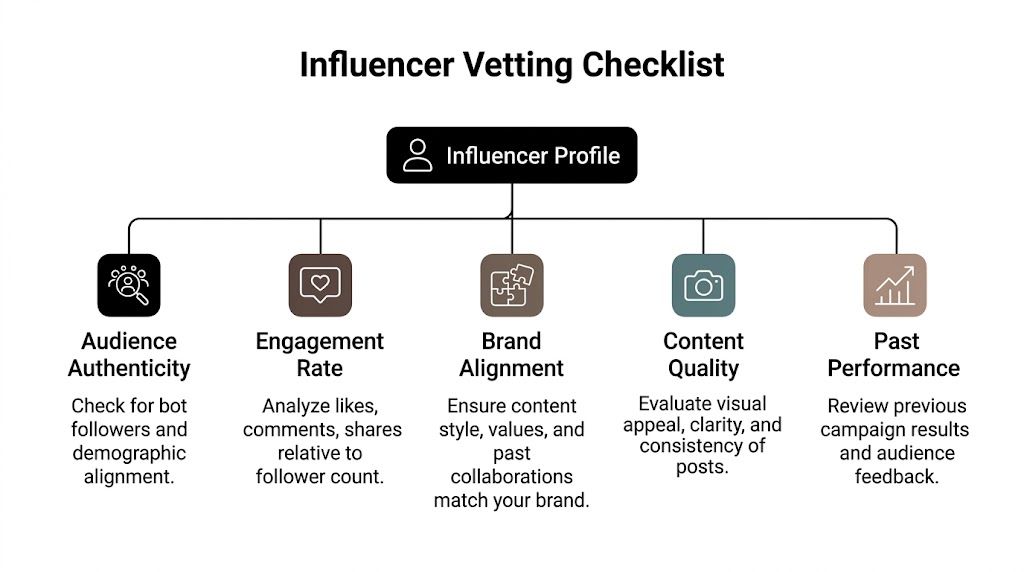
Phase one checks engagement quality
The first screen is quantitative. Calculate engagement ratio as likes plus comments divided by followers. In the same UK analysis, ratios under 2 to 3% are flagged as suspicious, and mismatched audiences often show engagement below 1%.
That doesn’t mean every lower-engagement profile is fake. Some real creators have weaker formats or dormant audiences. But it does mean you should slow down and inspect further before spending.
Look for pattern consistency, not one viral outlier.
- Healthy consistency means posts land in a similar engagement band over time
- Sudden spikes with no clear reason can indicate inorganic growth or paid activity
- Flat comments such as repetitive emojis or generic praise often signal low-quality interaction
- Strong saves and useful comments usually indicate actual audience interest, even if the profile is smaller
Phase two checks audience fit
Audience fit matters more than creator popularity.
The same vetting methodology recommends auditing demographics through Instagram Insights or tools such as HypeAuditor, aiming for 70 to 80% alignment with your UK regional target when the business depends on place or demographic fit. For an ecommerce brand, that may mean urban 18 to 34 audiences in the right region. For a restaurant, it may mean local followers who can realistically visit. If you would rather have the checks done for you, our HypeAuditor alternative page sets the two side by side.
Many campaigns go wrong; the content looks right, but the audience cannot buy.
Here's a simple way to look at it:
| Brand type | Audience question that matters most |
|---|---|
| Restaurant | Do enough followers live close enough to visit? |
| Local ecommerce brand | Does the audience match the product niche and likely buyer profile? |
| Multi-location chain | Can this creator activate one specific location well? |
| Agency client work | Does the audience align with the client brief, not just creator aesthetics? |
Practical rule: If you can’t explain why this audience should convert, you haven’t finished vetting.
Phase three checks authenticity in the content itself
The numbers can look passable while the content still fails commercially.
Review the creator’s feed and stories like a buyer, not a marketer trying to justify a shortlist. Does the creator sound like a real user of products in the category? Do they make recommendations with specificity? Can they explain taste, texture, fit, convenience, or experience in a way that helps someone decide?
The same UK guidance recommends checking comment quality against post activity, using a 5 to 10% comment-to-like ratio as a sign of more genuine interaction. That’s useful because bought engagement often looks shallow. You’ll see likes without meaningful conversation.
A practical content audit should answer:
- Would this creator make your product look credible?
- Does their audience ask real questions?
- Do previous brand posts feel forced or natural?
- Can they create content in the style you need, not just the style they prefer?
If you need more context on checking image history and account-level signals while researching creators, mastering Insta Photo Search is a useful reference point.
Phase four checks commercial proof
This is the check most brands skip because it requires discipline.
The same source recommends verifying historical ROI with past campaign UTM data, and reports that properly vetted micro-influencers with 10k to 50k followers achieve 5.2x higher conversion rates than unvetted macro ones in that framework. That doesn’t mean every micro creator will outperform. It means vetted fit beats unvetted scale.
Ask for practical evidence from previous collaborations:
- Screenshots of story link clicks
- Code redemption summaries
- Examples of high-performing branded posts
- Any indication of repeat brand work, which often suggests the creator delivered value before
Common mistakes that kill ROI
The costliest errors are usually operational, not creative.
The same UK source notes common fee issues, including average pricing of £500 to £2,000 per UK nano-influencer post, and says 40% of campaigns yield negative ROI because attribution is poor. It also reports that data-driven matching improves success rates to 75%, and AI-human hybrid platforms can save 95% of manual time. The same source cites £18 earned media value per £1 invested when fraud is avoided, compared with £2 to £3 without vetting.
The lesson isn’t to haggle every creator down. It’s to stop paying for profiles you haven’t pressure-tested.
Crafting Outreach That Actually Gets a Reply
Most outreach fails before the creator opens the message. The pitch sounds copied, the offer is vague, or the brand asks for work before explaining why the creator is a fit.
Good outreach respects the creator’s time and makes the next step easy. It should show three things quickly: you know who they are, you know why their audience matters, and you’ve already thought through the collaboration structure.
What not to send
Avoid generic DMs like “Hey lovely, we’d love to collaborate”. They signal low effort and usually attract the wrong kind of responses.
Skip these habits:
- Mass personalisation theatre where only the first name changes
- Undefined asks such as “let us know your rates” with no campaign context
- Overly long intros about your brand story before getting to the point
- No commercial framing so the creator can’t tell whether it’s gifted, paid, or performance-based
Creators read dozens of similar messages. The clearer you are, the more credible you look.
A better outreach structure
A strong first message usually has five parts:
- Specific opener Mention the post, format, location, or niche detail that made you shortlist them.
- Why the fit is real Tie their audience or style to the product, venue, or campaign.
- Clear offer type State whether it’s gifted, paid, affiliate, or a hybrid.
- Simple deliverable range Give a rough idea of what you’re considering rather than asking them to guess.
- Easy reply path Ask one clear question, not five.
“We shortlisted you because your restaurant reviews are local, useful, and feel like genuine recommendations. We’re launching a new dinner offer in Shoreditch and looking for one reel plus supporting stories. If that’s of interest, I can send the brief and timing.”
That works because it’s specific and low-friction.
Match the offer to the creator stage
The commercial model should fit both the creator and the campaign objective.
| Creator situation | Best starting offer | Why it works |
|---|---|---|
| Early nano creator | Gifted experience or product | Lower risk for both sides |
| Strong local micro creator | Paid package | Better for time-sensitive launches |
| Conversion-focused creator | Affiliate or code-based commission | Aligns incentives with performance |
| Repeat high performer | Retainer or ambassador arrangement | Builds consistency and lowers recruitment churn |
Gifted campaigns can work well for restaurants, beauty, and consumer products if the creator already posts in the category. Paid terms make more sense when timing, usage rights, or guaranteed output matter. Affiliate structures are strongest when you can track code redemptions cleanly and want to reward creators who convert.
For message examples and a useful starting template, this guide on how to write the perfect influencer outreach email is worth keeping on hand.
What to settle before the campaign starts
Don’t leave key terms floating in DMs.
Agree on the basics in writing:
- Deliverables such as reel, story frames, static posts, or UGC only
- Posting window so the campaign doesn’t drift
- Usage rights if you want to repurpose content in ads or on-site
- Approval process including whether brand review is needed before posting
- Payment terms and what triggers payment
- Tracking details so links, codes, or booking instructions are ready in advance
The fastest way to ruin a promising creator relationship is to become disorganised after they say yes.
Structuring and Managing Your Influencer Campaigns
The difference between a smooth campaign and a chaotic one is usually the brief.
A creator can’t read your internal Slack thread. If the brief is loose, they’ll fill the gaps themselves. Sometimes that works. Often it produces content that looks fine but misses the commercial objective.
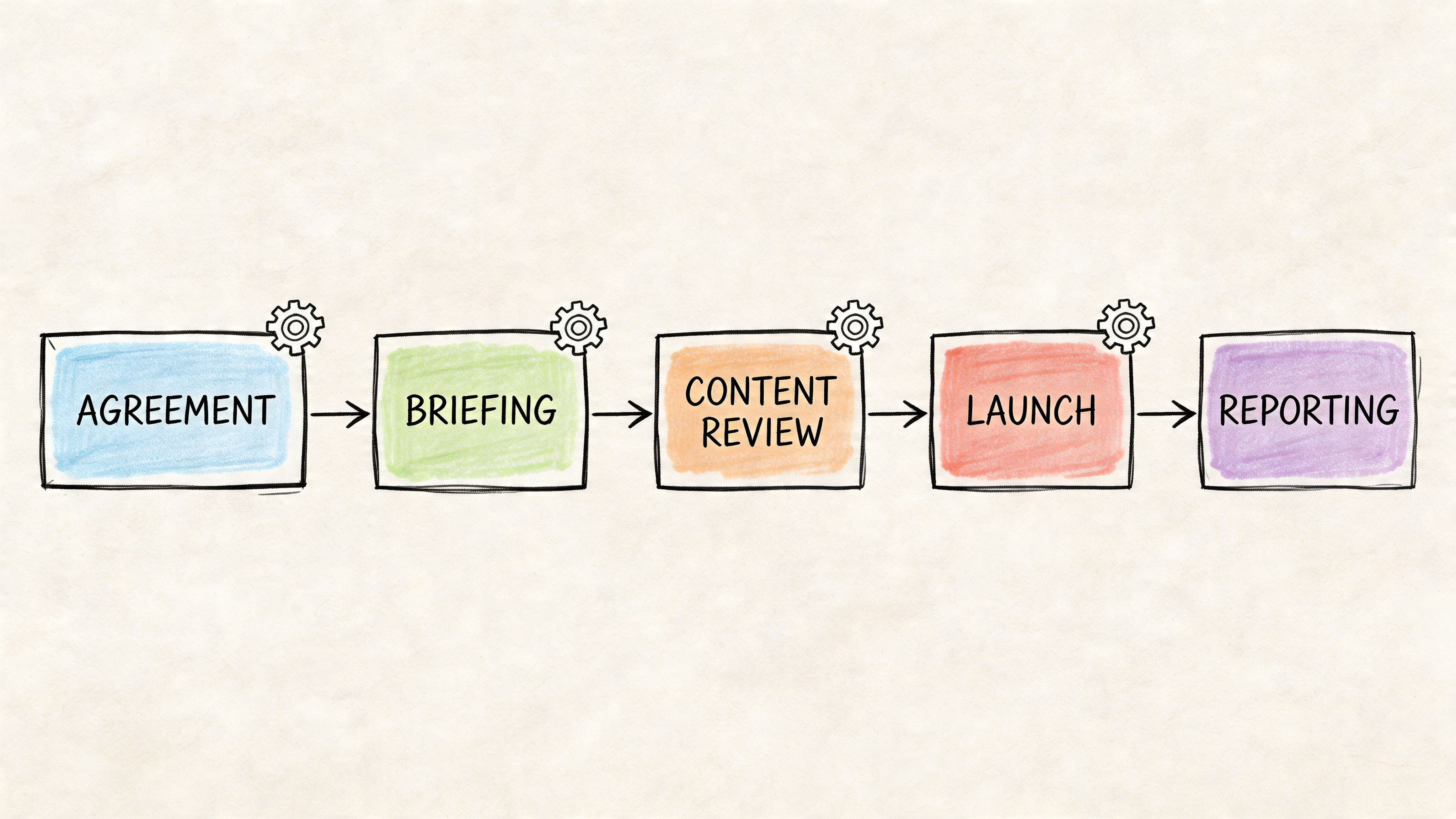
The brief needs to remove ambiguity
A useful brief is short, concrete, and operational. It doesn’t drown the creator in brand language.
Include these core elements:
- Campaign objective Say whether the goal is purchases, bookings, footfall, reviews, or content creation.
- Audience and angle Explain who the content should speak to and what problem or moment matters.
- Deliverables Define the content format, number of assets, and mandatory mentions.
- Offer or call to action Tell the creator exactly what action the audience should take.
- Timing Include content due date, review window, and post date.
- Do and don’t list Keep this practical. Required talking points, restricted claims, brand safety issues.
Keep control without strangling the content
The best creator content still sounds like the creator.
That means the brief should define boundaries, not script every sentence. If you over-direct, the content loses credibility. If you under-direct, it may miss the angle that drives action. The balance is a short message house with room for personal delivery.
A strong approval workflow usually looks like this:
| Stage | Brand responsibility | Creator responsibility |
|---|---|---|
| Kick-off | Send brief and assets | Confirm scope and timeline |
| Draft review | Check claims, CTA, brand safety | Share draft or concept if agreed |
| Final prep | Confirm links, codes, handles | Load final caption and assets |
| Post-live | Monitor delivery and tracking | Share live URLs or story evidence |
The brief should tell creators what must be true, not make them sound like your intern wrote the caption.
Use one operating system for the whole campaign
The admin burden gets ugly fast when campaigns run on email, DMs, notes apps, and spreadsheets at the same time.
Whether you use a platform or build your own process stack, keep these campaign assets in one place:
- Creator contact status
- Signed terms or written agreement
- Brief version
- Tracking links and codes
- Draft approvals
- Live post links
- Payment status
- Collected UGC files
That single change removes most of the avoidable chaos. It also makes reporting easier later, because the campaign trail already exists.
Measuring Influencer Marketing ROI with Precision
If attribution is weak, influencer marketing stays in the “probably worked” bucket. That’s where budgets get cut.
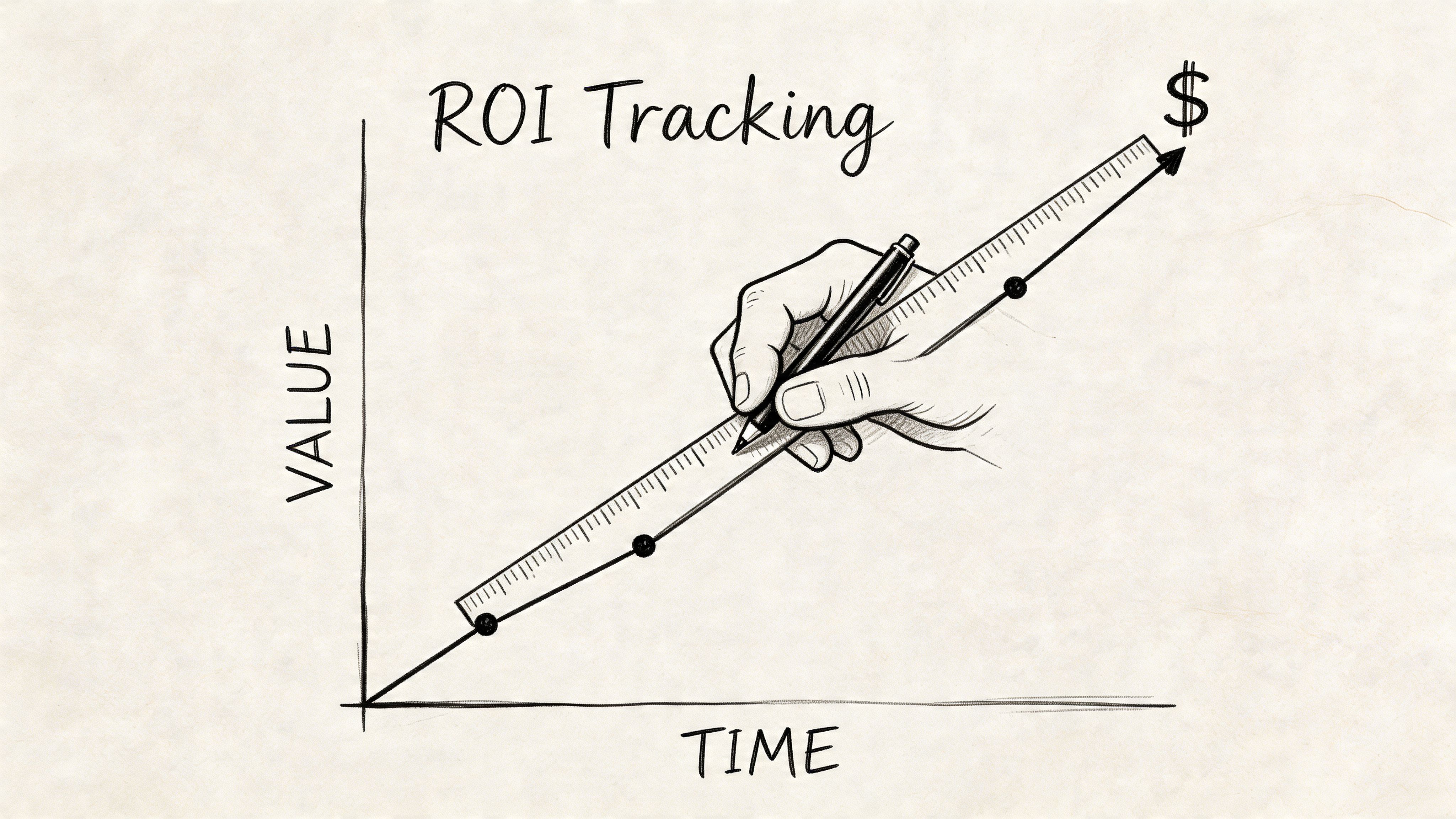
Precise measurement starts before the first message goes out. A UK ROI measurement framework says influencer attribution needs unique promo codes and UTM parameters because traditional MMM struggles with messy, asynchronous creator data (UK Instagram influencer ROI measurement framework).
Build the attribution stack before launch
The practical setup is straightforward.
Assign each creator a bespoke code and a dedicated UTM-tagged link before content goes live. The same UK framework gives examples such as a creator-specific promo code and a UTM structure like ?utm_source=ig_influencer&utm_campaign=sup_restaurant. Track performance in Google Analytics 4 or Shopify dashboards.
That allows you to separate:
- Clicks from the UTM link
- Redemptions from the promo code
- Revenue tied to those actions
- Creator-level performance across the same campaign
If you need a more detailed breakdown of attribution models and reporting logic, this guide on influencer marketing ROI and what actually works is a useful companion.
What to track for different business models
Not every brand should optimise for the same output.
For ecommerce, track product page sessions, add-to-basket behaviour, code use, and attributed revenue. For restaurants, clicks matter, but so do bookings, voucher redemptions, and in-venue code usage. For agencies, creator-level comparability matters because you’ll need to defend budget allocation to clients.
A practical scorecard looks like this:
| Business type | Primary metric | Supporting metrics |
|---|---|---|
| Ecommerce | Attributed revenue | Clicks, redemptions, content quality |
| Restaurant | Bookings or code-led footfall | Story clicks, DMs, voucher use |
| Multi-location chain | Location-level performance | City-specific creator output |
| Agency | Client ROI by creator | Delivery quality, turnaround, cost control |
The same UK source suggests target click-through rates of 2 to 5% and redemption conversion of 1 to 3% in the tracking layer. Those aren’t guarantees. They are planning benchmarks for a properly instrumented campaign.
The ROI formula has to stay simple
Keep the calculation blunt enough that everyone can understand it.
Use:
ROI = (revenue - fees) / fees
In the same UK framework, this is the stated method, with 4 to 6x presented as a benchmark for UK restaurants driving footfall. That’s helpful because it grounds creator spend in commercial language, not vanity reporting.
A creator campaign report should answer four questions:
- What did we pay?
- What traffic or redemptions did this drive?
- What revenue can we attribute?
- Should we run this creator again?
If the report can’t answer those questions, it isn’t ready for scale.
Why so many programmes still misread performance
Measurement often fails because the tracking layer is incomplete, not because influencer marketing is impossible to attribute.
The same UK source says 48% of UK campaigns lack proper measurement, which leads to 30% misattribution and inflated costs. It also notes that authentic micro-creators can reach 12% engagement and £11 ROI per £1, while hybrid AI-human sourcing can scale to 50+ UK creators weekly and save substantial manual time. The same source adds that fraud checks can boost verifiable sales by 3x, and hospitality dashboards show 20 to 30% view-to-click uplift.
The practical lesson is not “track everything imaginable”. It’s “track the few things that connect content to money”.
If a creator drove attention but you can’t connect it to bookings, revenue, or verified redemptions, you bought exposure, not a growth channel.
A workable reporting rhythm
Weekly reporting beats end-of-month archaeology.
Review creator performance while the campaign is still active. Pause weak creators quickly. Extend strong ones. Compare by niche, city, format, and offer type. Over time, you’ll learn which combinations are worth repeating.
For influencers for instagram, the core advantage is that measurement changes behaviour. Once every creator has a code, a link, and a comparable report, decision-making gets sharper. You stop arguing about which post “felt strong” and start funding what converts.
Scaling Your Programme From Collabs to Growth Engine
One-off collaborations create work. Systems enable scale.
A scalable creator programme keeps running because the workflow is standardised. New creators enter through the same sourcing criteria. Every shortlisted profile goes through the same vetting gate. Every accepted partner receives a clean brief, tracking setup, and reporting template. That consistency is what lets a small team manage more output without losing control.
What scaling actually looks like
At scale, the programme starts producing two assets at once.
First, it produces commercial outcomes such as sales, bookings, and attributed redemptions. Second, it produces a content library of UGC, testimonials, location shots, product demos, and social proof that other teams can reuse across paid social, email, landing pages, and organic channels.
That changes the economics of the channel. A creator who performs moderately on direct response may still be valuable if the content is strong and reusable. A creator who drives both content quality and conversion should move into a repeat or ambassador tier quickly.
The brands that win do fewer random campaigns
They don’t keep restarting from zero.
They keep a bench of proven creators, retire underperformers fast, and map creators to business needs: local openings, seasonal pushes, product launches, menu updates, and always-on content generation. That’s the point where influencers for instagram stop being a side project and start acting like infrastructure for growth.
Start smaller than you think. Build the pipeline, enforce vetting, track every campaign properly, and keep only the creators who prove they can move the metric you care about.
Sup helps restaurants, ecommerce brands, agencies, and multi-location teams turn creator marketing into a measurable operating system instead of a pile of DMs and spreadsheets. If you want a done-with-you setup for sourcing local micro and nano creators, managing outreach, launching campaigns, and tracking every code redemption and UTM-driven result, take a look at Sup.
More on channels
See how many creators post about you and your competitors
Type in your brand's Instagram handle and we count the creators who post about you and about your five closest competitors. It takes about a minute and it is free. Or request a demo and we will show you the creators in your niche and walk you through the dashboard.
 Book a call