27 March 2026
Influencer Marketing for Restaurants: 8 Before and After Case Studies
While many restaurants dabble in influencer marketing, few unlock its true potential. Moving beyond vanity metrics like likes and follows, the real transformation happens when you treat creator collaborations as a measurable growth channel. This isn't about getting a few nice photos; it's about driving tangible results: more bookings, higher revenue, and a quantifiable return on investment. The difference between a simple shout-out and a profitable campaign lies in data, strategy, and a clear understanding of the 'before' and 'after'.
This article dives deep into real-world influencer marketing for restaurants: before and after case studies. We will break down the exact strategies, metrics, and data that turned creator posts into profitable outcomes. You will see precisely how restaurants, from local pizzerias to multi-location chains, used data-driven approaches to achieve specific goals, such as recovering footfall, launching new menus, and even repairing their online reputation. Central to data-driven influencer collaborations is the strategic use of social proof; understanding the concept of social proof in marketing is crucial for maximising restaurant success.
Forget generic success stories. Here, we reveal the replicable tactics that separate thriving establishments from the rest. You will learn:
- How to select the right micro- and nano-influencers for specific goals.
- The methods for setting up and tracking campaigns with promo codes and UTM links.
- The exact 'before' and 'after' results, including views, bookings, and revenue.
- Actionable lessons and templates you can apply to your own restaurant immediately.
Get ready to move from guesswork to a data-backed system for predictable growth.
1. Local Micro-Influencer Footfall Recovery: Small Pizzeria Case Study
For restaurants battling post-pandemic lulls or increased local competition, driving consistent footfall is the primary goal. A hyper-localised micro-influencer strategy offers a direct, cost-effective way to get more customers through the door. This approach focuses on activating a group of smaller creators within a specific neighbourhood or city, using their authentic connection with their local audience to build trust and generate immediate interest.
This method stands out in our list of influencer marketing for restaurants before and after case studies because it directly solves the "empty tables" problem with measurable results. Unlike broad-based campaigns, it targets people who can realistically visit the restaurant that same day.
Case Study: Austin Pizzeria
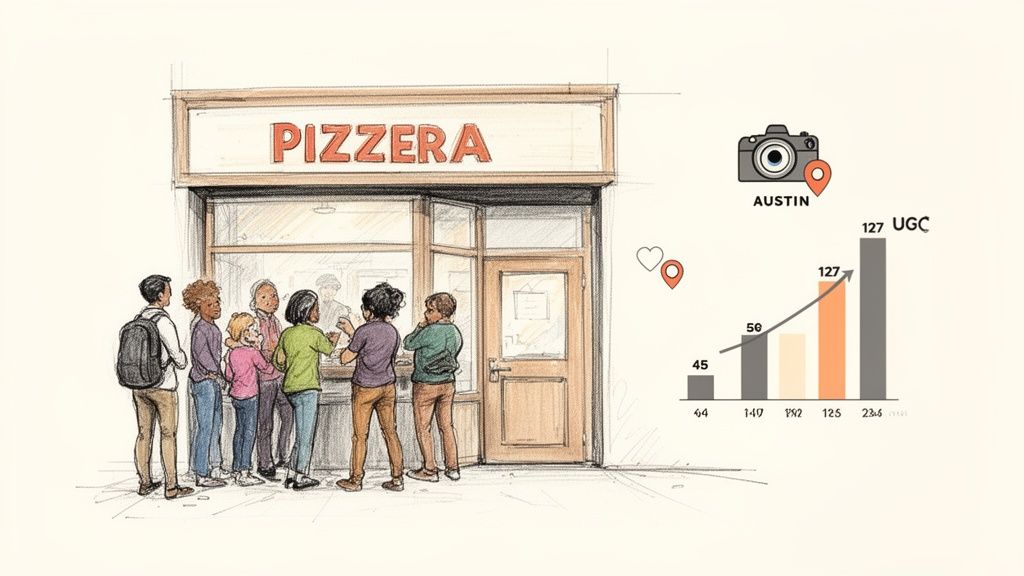
A neighbourhood pizzeria in Austin, Texas, was struggling with low customer counts, averaging just 45 daily customers. To reignite local interest, they organised a 30-day campaign with 12 local food micro-influencers (5k-25k followers). The total campaign cost was a modest $1,200, paid as a mix of gift cards and small fees.
The Results:
- Footfall: Average daily customers increased from 45 to 127.
- Attribution: 34% of new visits were directly attributed to influencer content via a simple "How did you hear about us?" verbal poll at the till.
- Revenue & ROI: The campaign generated an estimated $8,400 in attributed revenue, achieving a 7x return on investment.
Key Insight: The campaign's success was built on geographical relevance. Every follower of the selected creators was a potential customer, making the audience targeting extremely efficient. The pizzeria created an authentic, localised buzz that felt like a community recommendation, not a corporate advert.
Replicable Strategy & Tips
You can apply this model to your own establishment by following a few core principles. A similar campaign for a Brooklyn coffee shop using eight local creators saw a 3.2x ROI in 45 days.
- Creator Volume: Start with 10-15 micro-influencers per location to generate enough social proof and gather meaningful data. Finding the right local talent is the first critical step; you can discover how to find local food influencers in your city with specialised search tools.
- Strategic Timing: Require creators to post during peak dining decision hours (e.g., 11 am-1 pm for lunch, 5 pm-7 pm for dinner) to capture immediate intent.
- Trackable Offers: Use unique, tiered promo codes (e.g., INFLUENCER10 for a first visit, INFLUENCER15 for a second) to track redemptions and encourage repeat business.
- UGC Collection: Secure rights to repost all influencer-generated content (UGC) on your restaurant's own social media channels and website, turning one campaign into months of marketing assets.
2. Multi-Location Chain Review Generation: QSR Case Study
For restaurant chains, maintaining a positive online reputation across dozens or hundreds of locations is a monumental task. A low star rating on Google or Yelp can directly harm local search visibility and deter customers. A coordinated nano-influencer campaign offers a scalable way to generate authentic reviews, boost ratings, and improve local SEO performance simultaneously. This strategy activates hyper-local creators to visit specific branches and share their genuine feedback on key review platforms.
This approach is a critical part of our list of influencer marketing for restaurants before and after case studies because it addresses a digital-first problem: online reputation management. Unlike a single-location footfall campaign, this method scales trust and social proof across an entire network, impacting everything from local search clicks to franchisee satisfaction.
Case Study: Multi-Location QSR Chain
A 23-location quick-service restaurant (QSR) chain was concerned about its stagnant 4.1-star average Google rating and low review volume. To improve its digital curb appeal, the chain ran a 60-day campaign using nano-influencers (1k-10k followers) in each of its markets. Each creator was given a unique code for a complimentary meal, with the primary call-to-action being an honest review on a specified platform.
The Results:
- Review Volume: The campaign generated 287 new verified reviews, an average of 12.5 per location.
- Rating Improvement: The chain's average Google rating increased from 4.1 to 4.6 stars.
- Local Search Impact: This rating boost correlated with a 24% increase in clicks from local search results (e.g., "burgers near me").
Key Insight: The success hinged on decentralised execution with centralised goals. By empowering local creators to visit their nearest branch, the campaign felt authentic to each community while contributing to a chain-wide objective. The focus was on honest feedback, not just positive reviews, which built credibility with both creators and platforms like Google.
Replicable Strategy & Tips
You can adapt this model to improve the online reputation of your multi-location brand. For instance, a Subway franchise network of 47 locations generated over 1,200 new reviews in 90 days using a similar tiered incentive system.
- Location-Specific Briefings: Create simple, one-page briefing documents for each location or region. This ensures creators have the correct address, opening hours, and specific review platform links.
- Incentivise Action: Use small discounts on future visits or a sweepstake entry to thank creators for leaving a review. This encourages follow-through without explicitly paying for a positive rating, which violates most platforms' terms of service.
- Stagger Rollouts: Launch the campaign in different regions or cities sequentially. This avoids overwhelming review platforms with a sudden influx of influencer-driven reviews, which could trigger spam filters. You can discover more about scaling influencer marketing for restaurant chains to manage this process effectively.
- Train Franchisees: Equip local managers and franchisees with best practices for responding to new reviews, both positive and negative. A prompt and professional response amplifies the campaign's impact.
3. New Menu Launch Amplification: Fine Dining Restaurant Case Study
Launching a new menu, especially in the competitive fine dining sector, requires more than just culinary excellence; it needs storytelling and social proof. An influencer marketing campaign can amplify a launch by creating authentic excitement and visually compelling content that communicates the new offering’s unique flavour and artistry. This strategy uses creators to bridge the gap between the chef's vision and the diner's curiosity.
This particular approach earns its place in our list of influencer marketing for restaurants before and after case studies because it addresses a specific business objective: driving adoption of high-margin new items. It turns a menu update into a must-try cultural event, influencing customer choice at the point of ordering.
Case Study: San Francisco Fine Dining
An upscale farm-to-table restaurant in San Francisco wanted to ensure its redesigned seasonal menu was an immediate success. They partnered with 18 lifestyle and food influencers (with followings between 50k and 500k) for a 45-day campaign, focusing on creators known for their high-quality visuals and expertise in fine dining.
The Results:
- Menu Item Adoption: New menu items' share of total orders rose from just 8% to 34%.
- Attribution: 312 new reservations were directly attributed to influencer content via unique booking codes.
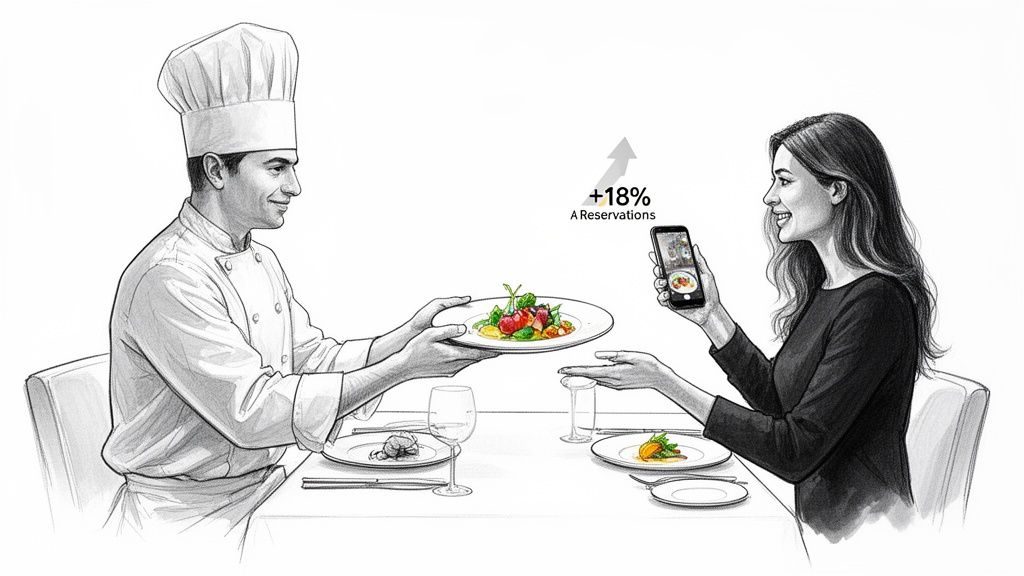
- Revenue: The average check size increased by 18% as diners, influenced by the content, opted for the new, premium dishes.
Key Insight: The campaign succeeded by treating influencers as culinary storytellers, not just advertisers. By hosting exclusive tasting events and giving creators access to the chef's philosophy behind the ingredients, the restaurant facilitated authentic, in-depth content that built genuine desire and justified a premium price point.
Replicable Strategy & Tips
This model is highly effective for any restaurant launching new products. A similar campaign for a NYC Michelin-starred establishment with 24 influencers led to a 127% increase in bookings for its premium tasting menu.
- Creator Vetting: Prioritise influencers with proven expertise in food and lifestyle. Their audience is more likely to appreciate and act on recommendations for a fine dining experience.
- Exclusive Events: Host an intimate, pre-launch tasting event. This creates exclusivity and allows creators to capture high-quality content and stories in an ideal setting.
- Content Focus: Mandate high-quality video content like Instagram Reels. Video is far more effective at conveying the atmosphere, plating, and sensory experience of a dish than static photos.
- Reservation Tracking: Implement unique reservation codes (e.g., "CHLOE22") for each influencer to accurately measure direct booking impact and attribute ROI.
- UGC for Retargeting: Secure commercial rights to all user-generated content (UGC). Use the best photos and videos in your own paid social media ads to retarget audiences who engaged with the original influencer posts.
4. Quick Turnaround Brand Pivot: Casual Dining Repositioning Case Study
Repositioning a restaurant brand is a delicate operation. Changing customer perceptions from "casual dining" to "modern, health-conscious" requires a coordinated effort to communicate a new identity authentically. Influencer marketing provides a powerful channel for this, using trusted voices to introduce the "new" brand to a target demographic in a way that feels like a genuine discovery, not a forced corporate message.
This strategy is a standout in our list of influencer marketing for restaurants before and after case studies because it tackles a brand perception problem, not just a footfall issue. It demonstrates how to rapidly shift public opinion and build affinity with a completely new customer segment across multiple markets simultaneously.
Case Study: Regional Casual Dining Chain
A regional casual dining chain with eight locations was struggling to attract a younger audience, with its brand seen as dated. To pivot to a "modern, health-conscious" identity, they launched a 30-day blitz campaign with 45 nano and micro-influencers across their markets. The campaign cost £14,500 and focused on showcasing new menu items, revamped decor, and a fresh brand narrative.
The Results:
- Brand Recognition: Gen Z brand recognition surged from 12% to 34% in a post-campaign survey.
- Audience Growth: The chain's social media following grew by 156%, adding over 8,400 new followers.
- Customer Acquisition: New customer trial increased by 67%, measured by redemptions of a "first-visit" promo code.
- Revenue & ROI: The campaign generated approximately £275,000 in attributed first-time customer revenue, delivering a 19x return on investment.
Key Insight: The campaign's success relied on disciplined messaging combined with creator authenticity. A detailed brand brief ensured all influencers communicated core pillars of the rebrand, while templated content angles maintained consistency. This allowed the brand to control the narrative at scale without stifling the creators' unique styles.
Replicable Strategy & Tips
You can use this framework to steer your own brand repositioning. A similar approach for a heritage burger chain saw a 52% brand awareness lift in 45 days using 38 creators.
- Detailed Brand Brief: Create a comprehensive guide for creators outlining key messaging pillars, the rebrand story, and specific menu items or design changes to highlight.
- Templated Content Angles: Provide creators with flexible content templates (e.g., "My new favourite healthy lunch spot," "You won't believe this is [Old Brand Name]") to ensure message consistency while allowing for personal flair.
- Staggered Posting: Schedule creator posts across different days and time zones to maintain a continuous stream of content and maximise visibility.
- Tiered Promo Codes: Implement unique codes to track performance and encourage repeat visits, such as NEWYOU15 for a first-time discount and COMEBACK20 for a second visit.
- Daily Content Monitoring: Actively monitor posts each day to ensure they align with the brand's new identity and quality standards, allowing for quick course corrections if needed.
5. Seasonal Campaign Optimisation: Ice Cream Shop Winter Pivot Case Study
For seasonal businesses like ice cream shops or beachside cafes, the off-season often brings a dramatic drop in revenue. A well-timed influencer marketing campaign can counteract this slump by repositioning the menu and creating a new reason for customers to visit. This strategy focuses on shifting perceptions from a seasonal treat to an all-year-round indulgence, driving footfall when it's needed most.
This tactic is a powerful example in our list of influencer marketing for restaurants before and after case studies because it demonstrates how to create demand where none existed. Instead of accepting seasonal decline, it actively reshapes customer behaviour and extends the profitable business calendar.
Case Study: Brighton Ice Cream Parlour
A popular ice cream parlour in Brighton typically experienced a 65% revenue decline during winter. To combat this, they launched a 90-day "Winter Indulgence" campaign with 22 local food and lifestyle influencers. The campaign focused on their new range of warm desserts, specialty hot chocolates, and decadent winter-themed sundaes.
The Results:
- Revenue Growth: Average monthly revenue for December-January rose from a historical £18,000 to £34,000, an 89% increase.
- Attribution: 52% of new customers surveyed mentioned discovering the winter menu through an influencer's post.
- Off-Season Viability: The campaign successfully turned the loss-making winter months into a profitable period, preventing the need for reduced operating hours.
Key Insight: The campaign's triumph was rooted in its narrative pivot. By briefing influencers on specific flavour stories and the "cosy indulgence" angle, they transformed the shop from a summer-only spot into a go-to winter destination for comfort food.
Replicable Strategy & Tips
You can adapt this seasonal pivot model to your own restaurant's cyclical challenges. For instance, a beach restaurant used 18 creators for a summer-to-autumn transition, achieving a 71% revenue increase in Q4.
- Advance Planning: Begin campaign planning 90 days before the seasonal shift to allow ample time for creator outreach, briefing, and content creation.
- Thematic Briefing: Provide influencers with detailed briefs on seasonal product benefits and unique flavour stories. For example, explain the origin of the cinnamon in a winter special.
- Seasonal Loyalty: Incentivise repeat visits with a seasonal loyalty card. For example, "Buy four hot chocolates, get a warm brownie free" to encourage return customers during the campaign period.
- Build a Content Library: Secure rights to all user-generated content (UGC). This allows you to build a valuable asset library to promote the same seasonal menu the following year, reducing future content creation costs.
6. User-Generated Content Licensing: Restaurant Content Monetisation Case Study
An influencer campaign's value doesn't end once the creator posts. By licensing the user-generated content (UGC) they create, restaurants can build a massive, cost-effective library of high-performing assets for paid advertising and organic social media. This approach turns a one-off influencer post into a long-term marketing engine, allowing you to use authentic, creator-led visuals across all your channels.
This strategy is a powerful part of our influencer marketing for restaurants before and after case studies because it addresses the constant need for fresh ad creatives. Instead of spending thousands on professional photoshoots, restaurants can acquire a diverse range of authentic content that resonates more effectively with ad audiences.
Case Study: California Restaurant Group
A California-based restaurant group aimed to improve its paid advertising efficiency on Meta, TikTok, and YouTube. Over six months, they collaborated with 120 creators, licensing over 850 individual pieces of UGC. The total investment in influencer fees and licensing was £25,200.
The Results:
- Ad Performance: UGC ads outperformed traditional branded content, achieving a 4.2x better return on ad spend.
- Attributed Revenue: The licensed content library directly generated £488,000 in attributed revenue from the paid campaigns.
- ROI: The total programme delivered £699,000 in incremental revenue, an exceptional return on the initial investment.
- Creator Earnings: Creators earned an additional £1,900 in residual licensing fees, strengthening the partnership.
Key Insight: The success hinged on treating UGC as a strategic asset, not just a social media byproduct. By systematically licensing and testing content, the group created a feedback loop where top-performing UGC informed future ad creative, continuously optimising their paid media spend.
Replicable Strategy & Tips
You can build a similar content engine for your restaurant. For example, a casual dining group saved an estimated £140,000 in annual commercial production costs by licensing UGC, and a QSR chain improved its paid ad efficiency by 62% using a library of 1,200+ UGC assets from 89 creators.
- Secure Rights Early: Negotiate perpetual or long-term licensing rights in your initial influencer agreement to avoid future complications.
- Clear Payment Structure: Establish a transparent residual payment model, whether it's a flat fee, per-usage fee, or monthly retainer, to maintain good creator relationships. To start your own programme, you can learn how to get UGC for your restaurant without paying thousands by structuring smart agreements.
- Request Ad-Ready Formats: Specifically ask for high-resolution horizontal and vertical video formats suitable for paid ad placements on platforms like YouTube and TikTok.
- A/B Test Creatives: Systematically test different UGC variants (e.g., testimonials vs. product shots) in your ad campaigns to identify the styles that resonate most with your target audience.
7. Crisis Recovery and Reputation Repair: Restaurant Negative Review Mitigation Case Study
When a restaurant's reputation takes a direct hit from negative press, viral complaints, or a food safety scare, the damage can be swift and severe. An influencer-led crisis recovery campaign offers a powerful way to rebuild public trust by demonstrating transparency and amplifying positive, real-world experiences. This strategy uses trusted local voices to directly address concerns and showcase corrective actions, turning a public relations crisis into an opportunity for authentic engagement.
This method is a critical inclusion in our list of influencer marketing for restaurants before and after case studies because it moves beyond promotion into reputation management. It shows how creators can become advocates who rebuild consumer confidence when it matters most, providing a human element that a corporate press release cannot.
Case Study: National Steakhouse Chain
A well-known steakhouse chain suffered a major crisis after a food safety complaint went viral on social media, causing a 47% drop in reservations in a single month. To counter the negative narrative, they quickly mobilised a 60-day campaign with 30 local food influencers across key locations. The creators were briefed on the new, stringent safety protocols and invited to see them in action.
The Results:
- Content Volume: The campaign produced 312 positive pieces of content that explicitly mentioned safety and hygiene.
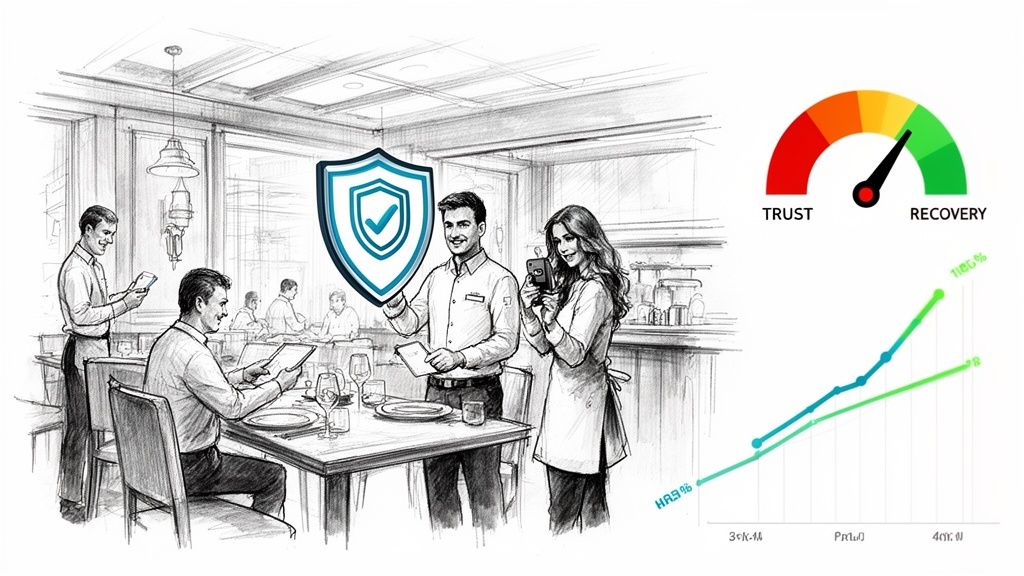
- Reputation Shift: The chain's average Google rating improved from 3.2 to 4.1 stars.
- Business Recovery: Reservations increased by 83% from the crisis low point, and the new customer acquisition cost decreased by 41%.
Key Insight: The success hinged on transparency and authenticity. Instead of asking influencers to simply post a positive review, the brand gave them behind-the-scenes access to new operational procedures. This allowed creators to share a credible, first-hand account of the restaurant's commitment to safety, which was far more persuasive than a standard advertisement.
Replicable Strategy & Tips
You can adapt this crisis response model for your own establishment. A casual dining brand facing service complaints used 26 creators in a rapid-response campaign and saw its reputation score improve by 34 points in 30 days.
- Proactive Planning: Have a crisis communication plan ready before you need it. This should include a pre-vetted list of trusted influencer partners willing to help in a recovery effort.
- Transparent Briefing: Equip influencers with the facts, but avoid defensive language. Brief them on the issue, the solutions implemented, and any third-party certifications earned. Honesty builds credibility.
- Focus on a New Narrative: Direct content to focus on operational improvements and the positive guest experience now. Encourage creators to document realistic, behind-the-scenes moments that demonstrate change.
- Amplify & Engage: Actively promote the positive influencer content and testimonials across all your channels. It's equally important to continue responding professionally and constructively to any remaining negative comments.
- Measure Sentiment: Track the sentiment shift on a weekly basis using social listening tools to gauge whether the narrative is changing and adjust your strategy accordingly.
8. Hyperlocal Niche Community Building: Specialty Restaurant Cult Following Case Study
For specialty restaurants built around a core mission, such as veganism, sustainability, or wellness, success hinges on attracting a dedicated community that shares those values. This strategy moves beyond simple food promotion to build a loyal following by partnering with niche influencers who are genuine advocates for the restaurant's ethos. The goal is to create a sense of belonging and turn customers into brand evangelists.
This method earns its place in our list of influencer marketing for restaurants before and after case studies by showing how to build a durable brand with high customer lifetime value. It focuses on long-term loyalty over short-term footfall, creating a resilient customer base that is less sensitive to price and competition.
Case Study: Vegan Fine Dining Restaurant
A new vegan fine dining establishment aimed to become a hub for the local sustainability and wellness communities. They partnered with 35 niche micro-influencers (8k-40k followers) who focused on these specific lifestyle values. The 75-day campaign involved gifted meals, exclusive tasting events, and open conversations about sourcing and mission.
The Results:
- Follower Growth: Grew their Instagram account to 8,200 highly engaged followers.
- Customer Loyalty: Achieved a 78% repeat customer rate among diners who discovered the restaurant through an influencer.
- Brand Advocacy: Generated 412 sustainability-focused online reviews and testimonials.
- Customer Lifetime Value (CLV): Influencer-sourced customers showed a 3.2x higher CLV compared to customers from other channels.
Key Insight: The campaign's triumph was rooted in shared values. By selecting creators who already championed sustainability, the restaurant's message was delivered with authentic passion, attracting diners who were looking for more than just a meal, they were looking for a movement to support.
Replicable Strategy & Tips
You can apply this community-building model to your own concept by focusing on authenticity and shared principles. A similar campaign for a zero-waste restaurant concept saw a 213% premium on customer lifetime value versus their control group.
- Define Value Pillars: Identify 3-5 core values your brand stands for, such as health, community, or innovation. Research creators whose content and audience align with these pillars.
- Encourage Storytelling: Brief creators to go beyond food photos. Ask for long-form content about your restaurant's sourcing, mission, and the people behind it to build a deeper connection.
- Create Community Experiences: Host exclusive events like kitchen tours, producer meet-and-greets, or workshops. This gives influencers meaningful content and makes their followers feel like insiders.
- Measure Value Alignment: Track success not just with revenue, but with qualitative data. Monitor the language used in reviews and testimonials to see if your core values are resonating with the audience.
8 Before-and-After Influencer Marketing Case Studies for Restaurants
| Case Study | Implementation Complexity 🔄 | Resource Requirements ⚡ | Expected Outcomes 📊 | Ideal Use Cases 💡 | Key Advantages ⭐ |
|---|---|---|---|---|---|
| Local Micro-Influencer Footfall Recovery (Small Pizzeria) | Medium: careful creator selection, POS & promo-code setup | Low: $1.2K, ~12 local creators, dashboard/UGC capture | Rapid foot-traffic lift (45 → 127 avg/day); 34% visits attributed; 7x ROI | Single-location eateries seeking immediate walk-in growth | High ROI; authentic local recommendations; reusable UGC |
| Multi-Location Chain Review Generation (QSR) | Medium-High: franchise coordination, compliance, centralized tracking | Moderate: $200 to $400 per location; nano-influencers per market | 287 verified reviews across 23 locations; rating 4.1→4.6; +24% local search clicks | Franchise/chain aiming to improve local SEO and review volume | Scales across locations; long-term SEO gains; decentralized accountability |
| New Menu Launch Amplification (Fine Dining) | High: premium creator curation, events, high-production assets | High: 18 influencers (50K to 500K), tasting events, higher fees | Menu attach rate 8%→34%; 312 reservations; +18% average check | Upscale restaurants launching premium/seasonal menus | Boosts prestige and AOV; aspirational UGC; justifies premium pricing |
| Quick Turnaround Brand Pivot (Casual Dining Repositioning) | High: rapid onboarding, synchronized multi-market launch | Moderate-High: 45 creators, $18K campaign cost, templates for scale | Brand recognition 12%→34%; +156% followers; 67% new customer trial; $340K attributed | Fast rebrands targeting Gen Z or rapid perception shifts | Fast market penetration; cost-effective nano-scale reach; FOMO momentum |
| Seasonal Campaign Optimization (Ice Cream Winter Pivot) | Medium: seasonal calendars, weather-triggered scheduling, advance planning | Moderate: ~22 local influencers; seasonal promo rotation | Dec to Jan revenue +89% ($18K → $34K); 52% new customers discovered via influencers | Seasonal or weather-sensitive businesses fighting off-season declines | Extends profitable seasonality; builds recurring influencer relationships |
| User-Generated Content Licensing (Restaurant Group) | High: legal/licensing framework, rights management, content ops | High: 120 creators, $32K investment, large content library | UGC outperforms branded ads (4.2x); $620K from paid UGC; $890K incremental revenue | Brands scaling paid media needing creative at volume and authenticity | Improves paid-ad efficiency; reduces commercial production costs; scalable creative testing |
| Crisis Recovery & Reputation Repair (Steakhouse Chain) | High: crisis plan, rapid 48-hour activation, sentiment tracking | Moderate: 30 local influencers mobilized quickly | 312 positive pieces; rating 3.2→4.1; reservations +83%; CAC −41% | Brands facing viral complaints or safety-related reputation damage | Influencer credibility accelerates trust recovery; measurable sentiment improvement |
| Hyperlocal Niche Community Building (Vegan Fine Dining) | Medium-High: deep niche research, long-term partnerships | Moderate: 35 niche micro-influencers, community programming | 8,200 engaged followers; 78% repeat rate; 3.2x CLV for influencer-sourced guests | Niche/value-driven concepts seeking loyal, high-LTV customers | Highly engaged audiences; stronger loyalty and CLV; authentic values alignment |
Your Blueprint for Measurable Influencer Marketing Success
The detailed "Influencer Marketing for Restaurants: Before and After Case Studies" we have explored throughout this article share a powerful, unifying message. Success in this channel is not a game of chance, reliant on viral luck or a single big-name creator. Instead, it is the direct result of a methodical, data-driven, and repeatable system. Each case, from the local pizzeria recovering footfall to the fine dining establishment launching a new menu, illustrates that a well-organised strategy is the most crucial ingredient.
Across these diverse scenarios, a clear pattern emerges. The restaurants that achieved remarkable, measurable results consistently prioritised specific, goal-oriented tactics. They moved beyond vanity metrics and focused on what truly matters: getting diners through the door, generating positive reviews, and driving tangible revenue.
Core Principles for Replicable Success
Reflecting on the journeys of the pizzeria, the QSR chain, and the specialty ice cream shop, the same foundational principles underpinned their victories. These are not just interesting observations; they are the cornerstones of your own future campaigns.
- The Power of Precision: The most impactful campaigns began with a crystal-clear business goal. Whether it was increasing Tuesday night bookings, generating authentic User-Generated Content (UGC), or repairing a damaged reputation, a specific objective dictated every subsequent decision. Without a defined target, your campaign is simply a shot in the dark.
- Authenticity Over Audience Size: Time and again, nano and micro-influencers proved their value. Their genuine connection to a local or niche community generated more trust and higher engagement than a macro-influencer's broad but shallow reach ever could. Diners trust recommendations from people who feel like peers, not paid advertisers.
- Measurement is Non-Negotiable: The "after" in these case studies was only possible because of diligent tracking. Unique discount codes, dedicated booking links with UTM parameters, and careful monitoring of code redemptions were essential. This data transformed influencer marketing from a perceived expense into a proven, high-ROI investment.
- Systemisation is the Key to Scaling: Managing influencer outreach, negotiations, content approvals, and payments manually is a recipe for burnout and missed opportunities. As the multi-location chain discovered, trying to scale local efforts with spreadsheets and direct messages is unsustainable. A centralised system is vital for efficiency and growth.
Building Your Own Influencer Marketing Engine
The insights from these before-and-after case studies provide more than just inspiration; they offer a blueprint. The path forward involves moving away from ad-hoc, reactive campaigns and towards building a proactive, structured programme. This means creating a system to discover and vet creators, manage communications, and, most importantly, track performance with unflinching accuracy. To ensure your restaurant's influencer campaigns yield maximum results, it's essential to follow established influencer marketing best practices that cover everything from initial outreach to final reporting.
By adopting this strategic mindset, you can elevate influencer marketing from a time-consuming experiment to one of your most predictable and powerful channels for business growth. The evidence is clear: when strategy, systemisation, and measurement align, the results speak for themselves.
Tired of juggling spreadsheets, DMs, and payment reminders? Sup provides the all-in-one platform to execute the strategies discussed in these case studies. Find local creators, manage campaigns, track real-time ROI, and build a library of high-performing content, all from a single dashboard.
More on industries
See how many creators post about you and your competitors
Type in your brand's Instagram handle and we count the creators who post about you and about your five closest competitors. It takes about a minute and it is free. Or request a demo and we will show you the creators in your niche and walk you through the dashboard.
 Book a call