3 March 2026
Influencer Marketing for Restaurant Chains: Scaling Across Multiple Locations
Trying to scale influencer marketing from one restaurant to fifty? The playbook that got you here won't get you there. It's time to stop chasing expensive, big-name influencers and start thinking smaller. Much smaller. The real secret to filling seats across every single location lies with local creators: the community champions who drive real foot traffic and deliver results you can actually measure.
Why Your Chain Needs A Hyper-Local Influencer Strategy
Let's be honest. For a restaurant chain, broad brand awareness is a vanity metric. What truly matters is getting people through the doors of your specific branches, whether you're in Liverpool, London, or Leeds. This is precisely where most large-scale marketing campaigns fall apart.
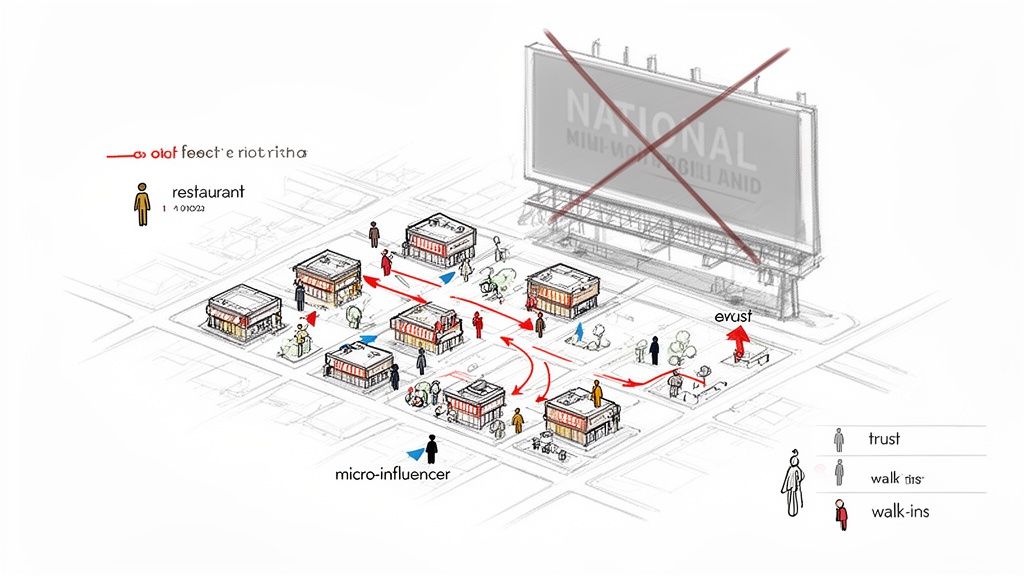
Sure, a macro-influencer with a million followers can post a stunning photo of your signature burger. But what percentage of their audience actually lives within a five-mile radius of your Bristol location? It’s often a tiny, insignificant fraction. You end up paying a premium for national reach when all you really need is neighbourhood influence.
The Unmatched Power of Community Trust
This is where a network of local creators changes the game. We're talking about the nano-influencers (1k-10k followers) and micro-influencers (10k-100k followers) who are the go-to foodies in their towns. Their followers aren't just random accounts; they're friends, neighbours, and colleagues who genuinely trust their recommendations.
This approach transforms your marketing from a generic broadcast into hundreds of authentic, trusted conversations happening at once, right where your restaurants are.
When a local food blogger in Manchester raves about your new brunch menu, their audience sees it as a genuine tip from a friend, not a paid advertisement. That’s a level of credibility a celebrity endorsement simply can't buy.
To get a better sense of how these two approaches stack up, let's compare them side-by-side.
Localised Vs. Traditional Influencer Models For Chains
| Attribute | Traditional (Macro-Influencer) Model | Localised (Micro-Influencer) Model |
|---|---|---|
| Audience Relevance | Broad, national, or international audience with low geographic density. | Highly concentrated local audience living and working near your locations. |
| Cost | Very high cost per post, often requiring large cash payments. | Low cost per creator, often collaboration-based (e.g., free meal). |
| Authenticity | Can feel like a polished, paid advertisement. Lower trust. | Perceived as a genuine recommendation from a peer. High trust. |
| Engagement Rate | Typically lower (1-2%). | Significantly higher (often 5-10% or more). |
| Scalability | Difficult and expensive to scale across many unique locations. | Highly scalable; you can activate dozens of creators for the cost of one macro. |
| Measurement | Focuses on reach and impressions (vanity metrics). | Focuses on foot traffic, redemptions, and local sales (business metrics). |
As you can see, the localised model is purpose-built for the unique challenges a multi-location restaurant chain faces, prioritising tangible results over broad, fuzzy awareness.
Built for Scale, One City at a Time
A local strategy is inherently designed for growth. Instead of putting all your eggs in one massive, high-risk campaign basket, you're running dozens of smaller, lower-risk collaborations. This decentralised model gives you authentic content that speaks to the unique flavour of each city. The foundation for this is great social media marketing for restaurants, which helps you understand how to engage local audiences effectively.
The data backs this up. For UK restaurant chains, 81% of brands now favour creators in the 10k-100k follower range for their authentic, location-specific reach that scales effortlessly from Glasgow to Brighton. With 66% of brands now on TikTok, short-form video has become a key tool for driving customers to make a purchase.
This playbook will give you the exact steps to build, manage, and measure a programme like this. We'll show you how to turn influencer marketing from a costly branding exercise into a predictable engine that puts customers in seats, at every single one of your locations.
Building Your Repeatable Creator Sourcing System
If you want to scale influencer marketing across multiple restaurant locations, everything hinges on one thing: a solid, repeatable system for finding the right local creators. This isn't about a one-off search for a single campaign. It’s about building a predictable engine that surfaces authentic partners for every restaurant, in every city, whenever you need them.
This is how you move away from the time-sucking, aimless scrolling and create a structured process instead. Your team needs to be able to efficiently find, vet, and recruit partners, whether you're launching a new site in Edinburgh or pushing a seasonal menu in Brighton. A systematic approach is what ensures consistency and quality across the board.
Mining the Digital Landscape for Local Gems
Your hunting ground is, of course, the social platforms themselves. But you have to think like a local. Generic searches just won’t work. You need to follow the digital breadcrumbs left by real diners and creators in each specific area.
This kind of active discovery is so much more effective than just waiting for creators to find you. You're getting on the front foot, seeking out people who are already shouting about their local food scene.
Here’s where you should be looking:
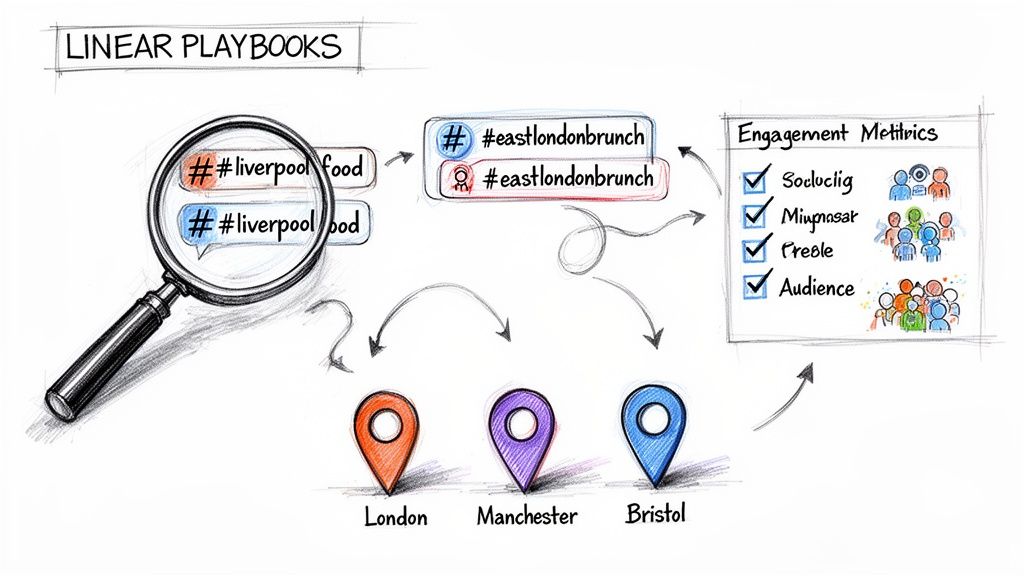
- Hashtag and Location Tag Mining: Go deep on Instagram and TikTok. Forget just searching #foodblogger. Instead, get hyper-local with tags like #manchesterfoodie, #eastlondonbrunch, or even #birminghamvegans. It’s also smart to check the location tags for your own restaurants and your direct competitors. You’ll find people already posting from those exact spots.
- Competitor Analysis: Check out which local influencers your competitors are working with. This hands you a pre-vetted list of creators who are already active in your space and get how restaurant collaborations work. Look at their content. Does it feel genuine? Is the engagement good?
- Community Group Trawling: Local Facebook groups are absolute goldmines. Think "Bristol Food Lovers" or "What's On in Liverpool." People in these groups are constantly asking for recommendations and sharing their dining experiences. Search for mentions of food bloggers or just keep an eye out for individuals who consistently share high-quality posts about eating out.
At this stage, you're casting a wide, but very targeted, net. The goal is to build a solid longlist of potential partners for each of your locations. For a more granular look at this, our guide on how to find local food influencers offers more city-specific tactics.
From Longlist to Shortlist: The Vetting Checklist
Once you’ve got a pool of potential creators, you need a clear framework to vet them properly. A pretty feed is not enough. You’re looking for partners who can actually influence local dining decisions.
A creator with 5,000 highly engaged local followers who genuinely loves your style of food is infinitely more valuable than a creator with 50,000 generic followers who happens to live in the same city.
Your vetting checklist has to focus on the metrics that really matter for your business.
- Audience Demographics: Does their audience actually match your target customer for that location? Any serious creator can show you a breakdown of their follower demographics, including age, gender, and top cities. If their audience is mostly in London but your restaurant is in Glasgow, it's a non-starter.
- Engagement Rate vs. Follower Count: It’s time to ignore vanity metrics. A huge follower count means nothing without an active audience. Calculate their engagement rate yourself: ((Likes + Comments) / Followers) x 100. For micro-influencers, anything above 3-5% is a great sign of a healthy, switched-on community.
- Content Authenticity and Quality: Look past a single great post. Does their overall content style fit with your brand's look and feel? Do their captions sound authentic, or are they just a messy string of hashtags? You’re searching for someone whose personal brand truly complements your restaurant's identity.
Imagine you’re the marketing manager for ‘The City Grill,’ a modern British eatery. For your Manchester location, you might find a creator known for their vibrant, trend-led TikToks. But for your more traditional Bristol branch, you might choose a blogger who writes thoughtful, detailed reviews. This is how you build a diverse, yet consistently effective, network of partners.
Crafting Campaign Templates That Scale Effortlessly
If you’re trying to manage dozens of influencer collaborations across multiple sites, you'll know the admin can quickly become overwhelming. The secret isn't to work harder; it's to build a master campaign template. Think of it as your blueprint, a core document you can quickly tweak for any restaurant location, ensuring everything stays consistent and saving your team countless hours.
A solid template takes the guesswork out of the equation. It gives your team a ready-made framework, so no one’s reinventing the wheel every time you partner with a new creator. It’s what turns potential chaos into a smooth, scalable operation.
The Non-Negotiable Components Of Your Master Template
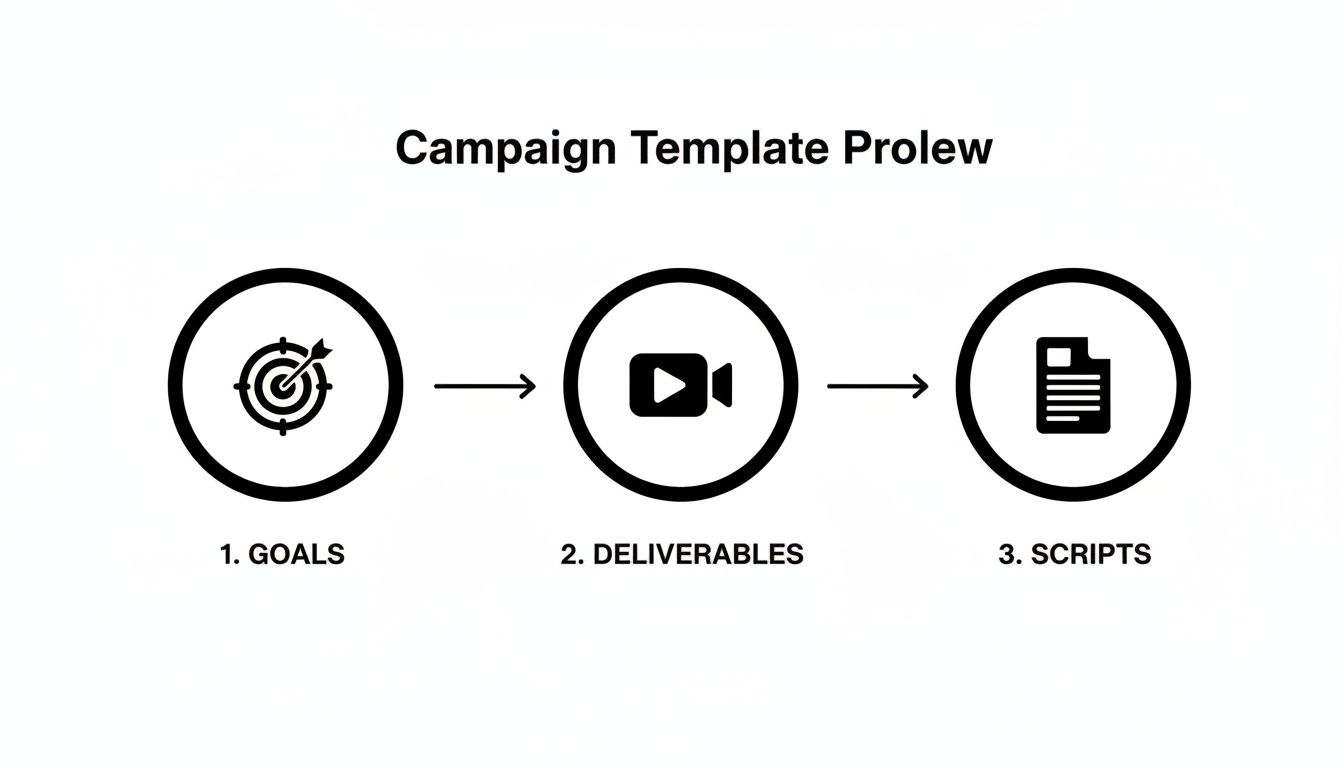
Your template needs to be broken down into clear, digestible sections. It should be a 'campaign-in-a-box' that anyone, from your marketing manager to a local general manager, can pick up and run with. To be truly effective, it must cover three core areas.
Key Template Elements:
- Pinpoint Your Campaign Goals: Be brutally specific. "Drive awareness" is too vague. Instead, aim for something like, "Promote the new weekend brunch menu at our Leeds location to drive 20+ tracked bookings in May." This clarity makes success measurable from day one.
- Outline Exact Deliverables: Don't leave content requirements open to interpretation. You need to be crystal clear about what you expect. For example: "1 TikTok video showcasing the new dishes" and "2 Instagram Stories with a swipe-up link to our booking page."
- Provide Simple Brand Guidelines: Keep it brief and to the point. Include key messages ("fresh, locally-sourced ingredients"), visual do's and don'ts ("use bright, natural light; avoid dark, moody filters"), and the right tags for each location (e.g., @YourBrandUK #YourBrandLeeds).
This structured approach means that whether a creator is visiting your restaurant in Cardiff or Aberdeen, the core message and the content they produce will always align with your brand.
Designing Outreach Scripts That Actually Get Replies
Your first message to a creator is make-or-break. A generic, copy-pasted script is a one-way ticket to being ignored. The real skill is blending the efficiency of a template with a touch of genuine personalisation.
Start with a customisable script, but make sure it has fields that must be personalised for each creator. This small bit of effort shows you’ve actually looked at their profile. Mention a specific post of theirs that you enjoyed, for instance, "I loved your recent review of that Italian place in the Northern Quarter..."
A great outreach message frames the collaboration as a genuine partnership, not just a transaction for a free meal. Offer value beyond the food. This could be access to an exclusive chef’s tasting, a plus-one for a friend, or the chance to be featured on your brand’s national social media channels.
This approach shows you respect the creator's work and makes them feel like a valued partner, which is exactly what you need to attract the best local talent. That positive first impression is the foundation for long-term relationships that really pay off. For a deeper dive, check out our complete guide on how to run a restaurant influencer campaign from start to finish.
The Power Of A Unified Approach In The UK Market
For UK restaurant chains, implementing these templates is particularly powerful right now. We know social media is a huge discovery tool (45% of diners find new places to eat this way) but the real opportunity is in targeted, local execution.
With 69% of UK consumers buying after seeing an influencer-promoted product and food content driving nearly half of all diner decisions, a systematic approach is no longer a nice-to-have. As forward-thinking operators look towards 2026, many are doubling down on micro-creator collaborations to boost footfall across multiple sites. You can learn more about how food content is shaping diner choices from the UK Food Council.
By creating these scalable assets, you’re not just being efficient. You're building a powerful influencer marketing engine that turns authentic local content into paying customers, one location at a time.
Measuring Real ROI With Smart Tracking And Attribution
Let’s be honest, vanity metrics like ‘reach’ and ‘impressions’ look nice on a report, but they don’t keep the lights on. If you want to prove that influencer marketing actually works for your restaurant chain, you have to connect a creator’s post directly to a customer walking through the door and paying for a meal.
This is where your tracking and attribution system comes in. Without one, you’re just throwing money at social media and hoping for the best. With a smart setup, however, you can see exactly which influencers are driving real footfall to which locations. It’s what turns your influencer programme from a marketing expense into a genuine growth driver.
Building Your Location-Specific Tracking Framework
The only way to get a true read on performance is to create unique tracking assets for every single collaboration. That means no more generic discount codes or links to your homepage for everyone. For a multi-location chain, every influencer, for every campaign, at every restaurant, needs their own distinct set of tracking tools.
This isn’t just about being organised; it's essential for smart spending. It’s how you’ll know if your creator in Birmingham is outperforming the one in Bristol, helping you allocate your budget where it will have the biggest impact.
Here’s a practical way to set this up:
- Unique Promo Codes: Don’t just use "TASTY10". Generate specific codes that link back to both the influencer and the restaurant location. Something simple and memorable works best. For example, if you're working with a creator named Anna for your Birmingham branch, her code could be ANNA15BHM. Your point-of-sale (POS) system can then easily track every redemption and credit the sale to her.
- Custom UTM Links: For any online call-to-action (like booking a table or viewing a special menu), you absolutely must use custom UTM links. These are just standard URLs with special tags that tell your analytics software exactly where the click came from. You can structure the link to track the influencer's name (utm_source), the social platform (utm_medium), and the specific campaign (utm_campaign).
A centralised dashboard that organises this for you makes attribution so much simpler. You can see at a glance which creators and campaigns are actually delivering, without getting buried in endless spreadsheets.
Connecting Data Points to Business Outcomes
Once your tracking is live, the real work begins: connecting that data to the numbers that truly matter to your business, like footfall, sales, and customer acquisition cost (CAC). Tying all this together can be complex, and some brands turn to social media monitoring API providers to pull in extra data on campaign performance and brand sentiment.
The real goal here is to stop talking about social media metrics and start speaking the language of the finance department. When you can confidently say, "Our Manchester campaign with five local creators generated 85 new customers at a CAC of £7.50 each," you've proven the programme's value in a way no one can argue with.
This data-driven approach is especially powerful in the UK, where the influencer marketing market is projected to hit USD 3.1 billion by 2026. A massive 89% of UK brands already use Instagram for these campaigns. Even with a modest average conversion rate of 2.55%, a well-tracked campaign can produce a significant return, especially for chains that get serious about using promo codes and UTM links for every single activity.
By putting a smart tracking system in place, you’re not just running influencer campaigns. You're building a predictable and scalable growth channel for every single restaurant in your portfolio.
Designing Your Workflow For Seamless Execution
Taking your influencer programme from five locations to fifty isn't about just doing more of the same thing. It’s about being smarter. Without a solid operational plan, you’ll quickly drown in messy spreadsheets, missed deadlines, and chaotic email threads. A well-oiled workflow is what separates brands that scale smoothly from those that stumble.
The first big question is how to structure your team. Do you run everything from head office, or give local managers free rein? A fully centralised team can maintain brand consistency but often misses the nuances of a local market. On the other hand, total local autonomy can lead to a disjointed brand message and inconsistent results.
For most growing chains, the sweet spot is a hybrid model. This approach brilliantly balances central strategy with local know-how, creating a system that’s both consistent across the board and genuinely relevant in every city you operate in.
Building A Hybrid Management Team
In a hybrid setup, everyone knows their role. You clearly define responsibilities to make the most of everyone's time and expertise. Think of your central marketing team as the strategic hub, with your local managers acting as the crucial on-the-ground experts.
Here’s how that typically breaks down:
- Central Marketing Manager: This person is the architect of your entire influencer programme. They’re responsible for creating the master campaign templates, setting the brand guidelines, managing the overall budget, and looking after the tech stack and analytics. They keep the big picture in focus.
- Local Restaurant Managers/Marketers: These are your community champions. Their main job is to approve local creators from a pre-vetted list that the central team provides. They also handle all the on-site logistics, from scheduling a creator’s visit to making sure the restaurant team delivers a fantastic experience.
This division of labour lets each side play to its strengths. The central team builds the scalable engine, while the local teams provide the human touch that makes every single collaboration feel authentic and personal.
Mapping Your Scalable Workflow
Once your team is in place, you need to map out the entire collaboration process, from the first outreach to the final performance report. The goal here is a predictable, repeatable process that leaves no room for error or confusion. This workflow becomes the single source of truth for everyone.
Instead of a rigid list, think of it as a journey with clear milestones:
First comes sourcing and vetting. Your central team uses a consistent process to build a database of on-brand creators for each key city. This becomes your go-to talent pool.
When it’s time for campaign activation (say, for a new summer menu), the central team customises a master template and briefs the relevant local managers.
Those local managers then handle creator selection and outreach. They pick the best-fit creators for their specific restaurant from the approved list and use pre-written outreach scripts to get the ball rolling.
After a creator says yes, a standard digital agreement is sent and scheduling begins. The local manager works directly with the creator to book their visit.
Then, it’s all about content creation and approval. The creator visits, works their magic, and submits the content for a quick check to ensure it aligns with the brief.
Once the content goes live, posting and tracking kick in. Unique promo codes and UTM links automatically track performance, feeding real-time data back to your central dashboard.
Finally, after all deliverables are met, payment and analysis are handled. Payments are processed automatically, and the central team dives into the data to analyse the ROI for each location and the campaign as a whole.
A well-designed workflow transforms your influencer programme from a series of disjointed activities into a smooth, predictable system. It ensures that even with hundreds of active collaborations, every step is managed efficiently and consistently.
Standardising Legal And Compliance
As you grow, you simply can't afford to wing it on the legal side. Negotiating terms one-by-one or having different disclosure rules for each creator is a recipe for disaster. This has to be a core, non-negotiable part of your workflow.
Standardised Influencer Agreements Get a legal professional to draft a master influencer agreement. This template should clearly cover deliverables, payment terms, content ownership rights, and timelines. It protects you, it protects the creator, and it cuts out weeks of back-and-forth on every single partnership.
Ensuring Proper Disclosure Your brand guidelines must be crystal clear: all influencers must comply with the Advertising Standards Authority (ASA) rules. This means explicitly disclosing paid partnerships using tags like #ad. This isn’t just a box-ticking exercise; it’s essential for maintaining transparency and protecting your brand’s reputation.
For restaurant chains looking to scale efficiently, a centralised platform is key. If you're managing multiple locations, explore how a system can help you manage your multi-location chain's influencer marketing without the chaos. It's about creating a foundation that can support growth effortlessly.
Turning Influencer Content Into A Long-Term Asset
Too many restaurant chains see an influencer post go live, breathe a sigh of relief, and move on. That's a huge mistake. The real return on your investment comes after that initial buzz, but only if you have a plan to turn that content into a lasting asset.
A single collaboration can fuel your marketing for months. The trick is to shift your focus from vanity metrics like likes and reach to the numbers that actually matter to the business. We're talking about tangible results like the cost per redemption on an influencer’s unique promo code, or the total influencer-driven revenue at a specific location. That's how you prove the programme is working.
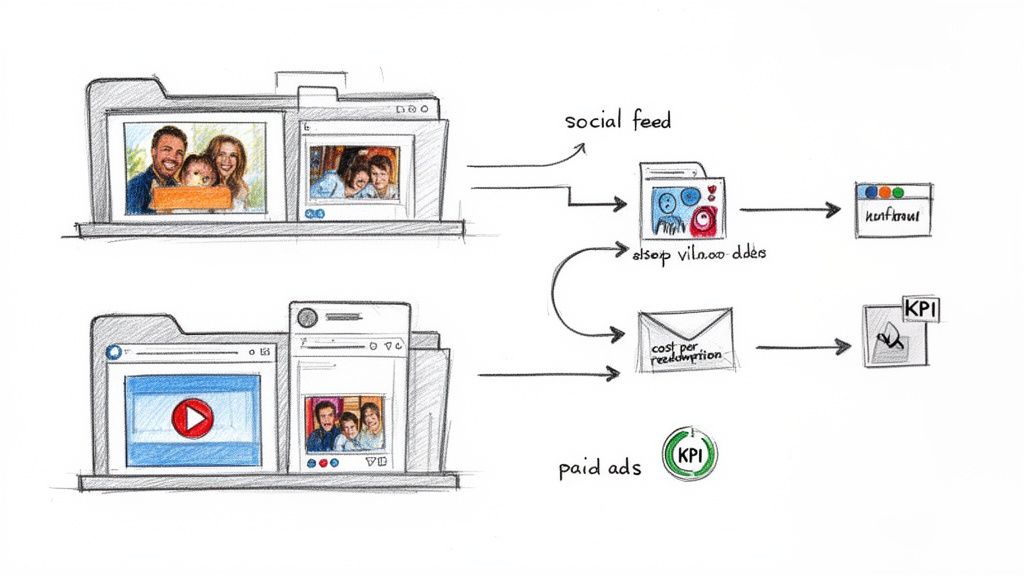
Building Your User-Generated Content Library
One of the most effective strategies we've seen for scaling influencer marketing is building a dedicated user-generated content (UGC) library. This is simply a central spot where you collect, tag, and organise every brilliant photo, Reel, and TikTok your creator partners produce.
Think of your UGC library as a sustainable content engine. Instead of a one-time campaign expense, each collaboration feeds a growing collection of authentic marketing materials you can deploy anytime, anywhere.
This organised approach solves the constant, nagging need for fresh content. It means those fantastic, high-quality images of your signature dish don't just disappear into the social media ether after 24 hours.
Activating Your Content Across All Channels
Once you have a well-organised library, you can start getting really clever about repurposing that content. This is how you stretch your budget and turn a single paid partnership into months of marketing fuel.
Here are a few practical ways to put that content to work:
- Fuel Your Own Social Feeds: Repost the best influencer content on your brand’s national and local Instagram or Facebook pages. It’s the perfect way to add authentic social proof and break up your more polished, corporate-style posts.
- Enhance Your Email Marketing: Drop compelling influencer photos or videos into your newsletters to announce new menu items or promote a special offer. Seeing a real person loving your food is far more persuasive than any stock photo.
- Power Your Paid Ad Campaigns: Take your top-performing influencer videos and turn them into paid social ads. We consistently see UGC outperform brand-created ads because it feels more genuine and trustworthy, which almost always leads to higher click-through rates and a lower cost-per-click.
By systematically collecting and reusing content, you transform one-off influencer posts into an ever-growing library of marketing assets. It's an approach that maximises your ROI while ensuring your marketing stays fresh, authentic, and genuinely connected to your local communities.
Common Questions About Scaling Restaurant Influencer Marketing
When you're trying to grow an influencer programme from a few one-off collaborations into a system that works across all your locations, you'll inevitably hit a few roadblocks. Let's tackle some of the big questions that always come up when marketing managers are in the trenches, trying to make this work at scale.
How Much Should We Pay Local Micro-Influencers?
This is always the first question, and the answer isn't as complicated as you might think. For most micro-influencers in the UK (those with around 10k-100k followers), you’re typically looking at a combination of a gifted experience plus a fee.
A complimentary meal for two is a perfectly reasonable starting point for a simple exchange: say, one in-feed post and a couple of stories. It’s a classic, fair trade. However, as soon as you want more (like video content, higher engagement rates, or a more involved campaign), you need to bring a fee into the conversation. A good benchmark for a single post is anywhere from £100 to £500, depending on the creator's track record.
The most important thing is to be upfront. Treat it like a partnership from the start and get everything in writing. A clear agreement on pay and what you expect in return saves everyone a headache later.
Instagram Or TikTok: Which Is More Important?
It’s a false choice. The real question isn’t which one, but how to use both. Think of them as two different tools for two different jobs, both essential for a modern restaurant chain.
- Instagram is your brand’s glossy magazine. It's where you show off that perfect, drool-worthy food photography and the carefully curated atmosphere of your restaurants. This is where you build your polished brand identity.
- TikTok is your engine for authentic, local buzz. It’s built for fun, behind-the-scenes videos that feel real and have the potential to go viral in a specific town or city. This is how you spark curiosity and get people through the door, especially younger diners.
How Do We Manage Influencers Across 20+ Locations?
And here’s the million-dollar question. Juggling this with spreadsheets and endless email threads is a recipe for chaos and will burn your team out, fast. You need a system.
The only way to manage influencer relationships at scale without it becoming a full-time job is through standardisation, centralisation, and smart delegation. Automation isn't just a nice-to-have; it's critical.
It boils down to a three-part framework. First, you standardise your entire process with things like campaign templates and pre-written outreach scripts. Second, you centralise all your communication and data into one place, like a dedicated platform. Finally, you delegate intelligently. A hybrid model works wonders here: a central marketing manager defines the overall strategy, while local managers get the final say on which creators to approve and handle the on-site hosting.
This gives you brand consistency and control from the centre, but with the local touch that makes these campaigns feel genuine.
Ready to stop the manual chaos and start scaling your influencer marketing with a proven system? Sup combines AI-powered sourcing with a human team to launch, manage, and attribute creator campaigns that drive real results. Find out more at the Sup website.
More on industries
See how many creators post about you and your competitors
Type in your brand's Instagram handle and we count the creators who post about you and about your five closest competitors. It takes about a minute and it is free. Or request a demo and we will show you the creators in your niche and walk you through the dashboard.
 Book a call