16 March 2026
A Guide to Influencer Marketing for Home and Interior Brands
For home and interior brands, influencer marketing isn't just another channel to tick off the list. It's become one of the most powerful engines for growth, especially in a market where seeing is believing. Partnering with the right creators allows you to place your products into real, lived-in homes, building a level of trust and desire that sterile studio shots simply can't match.
Why Influencer Marketing Is a Game-Changer for Home Brands
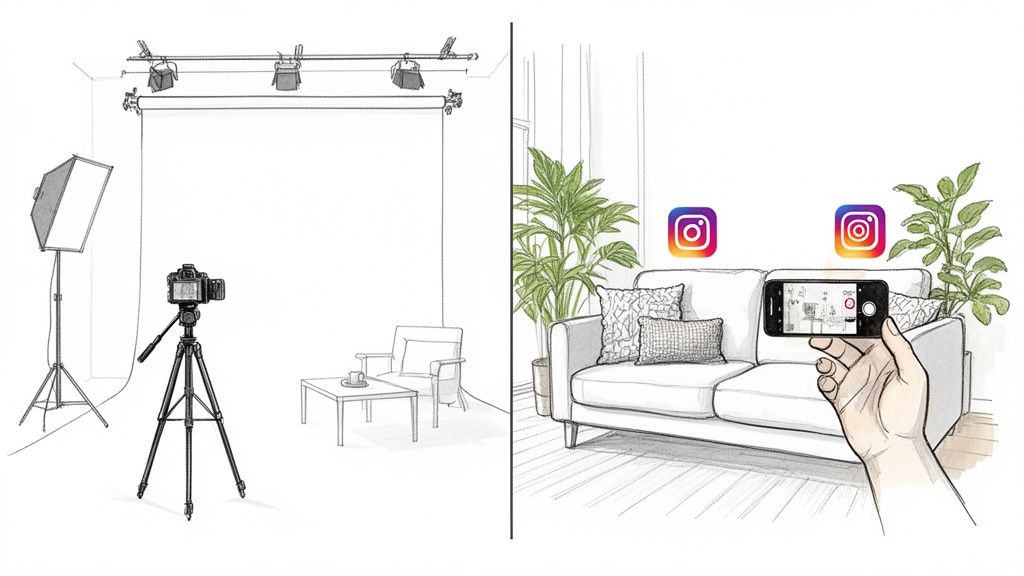
Let's be honest, selling a sofa or a statement lamp online comes with a big hurdle. Your customers can't touch the fabric, judge the scale, or truly picture how it will look next to their own coffee table. This is the exact problem that influencer marketing solves so brilliantly. It closes the imagination gap between your online catalogue and their living room.
Think about it. A potential buyer sees a beautiful armchair on your website, shot perfectly in a professional studio. It looks great, but it’s an abstract idea. Then, they see that same armchair in the home of an interior creator they follow: styled with cosy throws, next to a stack of books, with a cat curled up on it. Suddenly, it’s not just a product anymore; it's part of a real, aspirational life. It becomes tangible and, most importantly, desirable.
The Unmatched Power of a Real Recommendation
This kind of authentic placement is where the magic really happens. People trust recommendations from other people far more than they trust a slick advert. In a market so driven by personal taste and aesthetics, this "social proof" is everything. A creator's genuine enthusiasm for a product acts as a powerful endorsement, signalling both quality and style to their dedicated followers.
The benefits ripple out far beyond just one sale. Done right, these partnerships help you:
- Build genuine trust and credibility: Content from creators feels like a tip from a design-savvy friend, not a hard sell from a faceless brand.
- Generate a stream of high-quality visuals: You get an endless supply of beautiful, real-world photos and videos to repurpose for your own ads, social feeds, and even product pages.
- Tap into highly specific audiences: You can connect directly with engaged communities, whether their passion is for #newbuildjourney transformations or mastering #smallapartmentdecor.
- Drive sales you can actually measure: With tools like unique discount codes and tracked links, you can see a clear, quantifiable return on your investment.
In the UK, the influencer marketing industry has become a true force, valued at an enormous £2.36 billion in 2024. For e-commerce home brands, this translates directly to scalable growth, with average returns hitting an impressive £5.78 for every £1 spent. Diving into the latest UK influencer marketing data reveals just how big this opportunity has become.
To better understand the current landscape, let's look at the key market dynamics and what they mean for your brand.
UK Influencer Marketing at a Glance for Home Brands (2026-2029)
This table summarises the key market statistics and consumer behaviours driving the growth of influencer marketing in the UK home and interiors niche.
| Metric | Statistic/Trend | Implication for Home Brands |
|---|---|---|
| Market Growth | The UK influencer market is projected to grow by 12% YoY. | Consistent budget allocation is key to maintaining a competitive edge. Early adoption of new platforms will be rewarded. |
| Consumer Trust | 78% of UK consumers aged 25-40 trust creator recommendations when making home purchase decisions. | Partnering with authentic creators is non-negotiable. Their endorsement is more powerful than traditional advertising. |
| Dominant Platform | Instagram remains key, but TikTok’s influence on home-related search and discovery is growing by 40% annually. | A multi-platform strategy is essential. Use Instagram for aesthetics and TikTok for discovery, DIY, and "how-to" content. |
| Content Format | Short-form video (Reels, TikToks) generates 3x the engagement of static image posts for home décor. | Brief creators to produce video-first content, focusing on transformations, styling tips, and before-and-afters. |
| Micro-Creator ROI | Micro- and nano-influencers (under 50k followers) deliver 30% higher engagement rates than macro-influencers. | Focus on building a community of smaller, niche-specific creators for better engagement and a more authentic feel. |
These trends make it clear: the future of marketing in this space is authentic, visual, and creator-led.
From Scrolling to Shopping
Ultimately, the best interior creators on platforms like Instagram and TikTok don't just display products; they sell a vision. They show their audience how a simple rug can anchor an entire room, or how a piece of art can spark daily joy. This storytelling approach is what inspires followers to move from passively admiring to actively buying. It’s how you turn scrolled-through content into real, measurable business growth.
This guide will give you the complete, step-by-step playbook to make that happen.
Building Your Campaign Foundation
Before you even start daydreaming about the perfect creator or sending a single outreach DM, we need to talk strategy. I've seen countless home and interior brands dive headfirst into influencer marketing, and the ones that succeed are always those who lay a solid foundation first. This isn't about spontaneous gifting; it's about building a campaign that delivers real business results.
Let’s be honest, vague goals like "increase brand awareness" are useless. They feel good to say, but they don't give you anything to measure. Without clear targets, you have no way of knowing if your investment (of time, product, and money) is actually working. Getting this part right from the start is absolutely critical.
Defining Your Specific Campaign Goals
Instead of broad ambitions, you need to get granular. What does a "win" look like in concrete numbers? This goal will be your guide for every other decision, from the creators you partner with to the kind of content you ask them to create.
Think about what you truly need right now. Is it content? Is it sales?
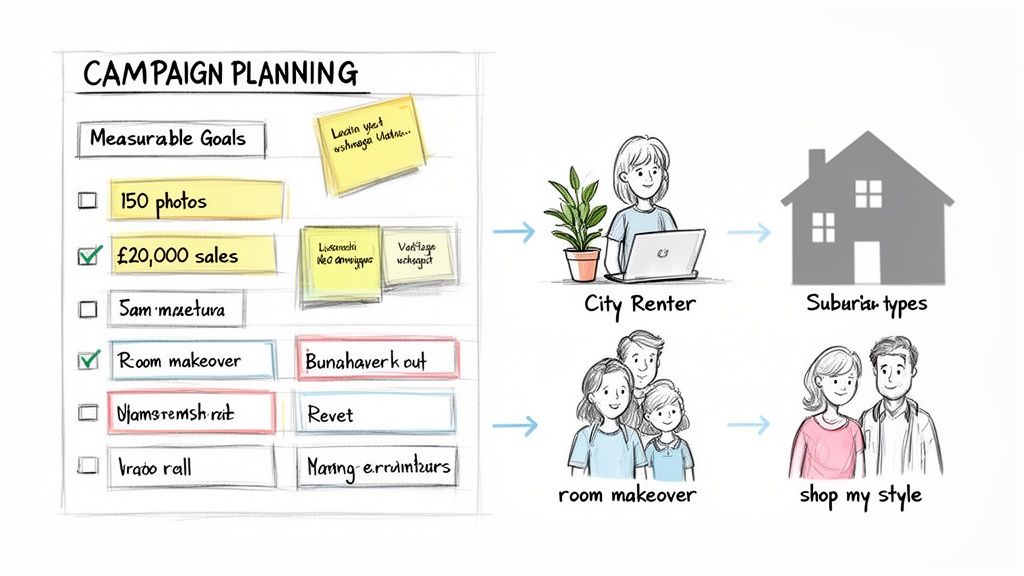
- Content Generation: Perhaps your goal is to build a bank of authentic visuals. It might sound like this: "Our aim is to generate 150 high-quality, user-generated photos and 20 video assets this quarter to use in our paid social ads and on our product pages."
- Sales and Revenue: If you're focused purely on performance, a clear goal is essential. For example: "We aim to drive £20,000 in direct sales through creator-specific discount codes within the next 60 days."
- Website Traffic: Maybe you just launched a new collection and need eyes on it. Your goal could be: "We want to increase referral traffic from Instagram to our new collection page by 35% by partnering with five micro-influencers."
A strong visual library is a huge asset. While creator content provides authenticity, you can complement it with professional shots. Using tools that generate high-quality AI product photos for home decor can fill in any gaps, giving you a complete set of visuals for every marketing channel.
A well-defined goal acts as your North Star. If your objective is to generate stunning images, you’ll prioritise creators with incredible photography skills over those with a huge follower count but mediocre content. If it's sales, you'll seek out creators who have a proven track record of driving conversions for other brands.
Pinpointing Your Ideal Customer
With your goal set, it's time to get crystal clear on who you're actually trying to reach. "Homeowners" is far too broad. To make a real connection, you have to think about your customer’s life, budget, and personal style. This deep understanding is what allows you to find influencers whose followers are your people.
Let’s paint a picture with a few real-world examples:
- The City Renter: Imagine a 28-year-old living in a small city flat. They’re looking for multi-functional furniture, clever storage, and decor that won't cost them their security deposit. They follow creators who are experts in #smallapartmentliving and renter-friendly DIYs.
- The Suburban Renovator: Picture a family in their late 30s in the middle of a #kitchenrenovation. They need durable finishes, family-proof furniture, and inspiration for that modern farmhouse look. Their feed is full of creators documenting their own #newbuildjourney.
- The First-Time Buyer: Think of a couple in their early 30s who just got the keys to their first home. They need everything, from paint to lighting, and are searching for affordable-yet-stylish pieces. They're drawn to "shop with me" hauls and relatable room makeovers.
Matching these specific customer profiles to the right influencer is where the magic happens. A campaign for a high-end, bespoke sofa will fall completely flat with an audience of renters hunting for budget decor. By aligning your goals, customer profiles, and creator selection from the very beginning, you build a campaign that is designed for success.
For a deeper dive into the mechanics of running campaigns, especially on popular e-commerce platforms, getting familiar with influencer marketing for Shopify stores can offer some fantastic tactical insights.
Finding and Vetting the Right Home Creators
Let's be frank: your entire campaign hinges on who you partner with. It's easy to get distracted by big follower numbers, but for home and interior brands, the real magic happens with creators who have built genuine, tight-knit communities. I'm talking about the nano and micro-creators whose followers hang on their every word and truly trust their taste.
Finding these creators is a bit of an art form, but one you can definitely get the hang of. It means looking past the surface and digging deep to find partners whose audience and style are a perfect mirror of your own brand. This isn't just about ticking a box; it's about curating a list of creators you’d be proud to have represent you.
How to Uncover Those Hidden Gems
Your ideal partners are already out there, sharing their home projects and building loyal followings. You just need to know how to spot them. While it takes time, a bit of strategic manual searching can unearth some absolute gold.
Get into the mindset of your dream customer. What hashtags are they glued to?
- For projects in progress: Search for tags like #newbuildjourney, #homerenovationuk, and #DIYonabudget. This will lead you straight to creators who are in the middle of projects where your products would fit perfectly.
- For specific styles: Explore tags like #darkinteriors, #cottagecoreaesthetic, or #scandihome. This is your shortcut to finding creators who have already cultivated an audience that loves a particular look.
- For local targeting: Try location-specific tags such as #londonapartment or #manchesterhome to connect with creators in your key markets.
A pro tip: don't just skim the 'Top' posts. Dive into the 'Recent' tab on Instagram and TikTok. That's where you'll find the rising stars who aren't yet swamped with brand deals. They’re often the most authentic and enthusiastic partners. Of course, you can also use influencer discovery platforms to speed things up, filtering by niche, engagement, and audience data to save hours of scrolling.
The Vetting Checklist I Swear By
Okay, you've got a list of potential creators. Now comes the most important part: vetting. Never, ever skip this. It’s how you make sure you’re investing in a real community and an aesthetic that genuinely fits your brand.
Here’s what I look for in every potential partner:
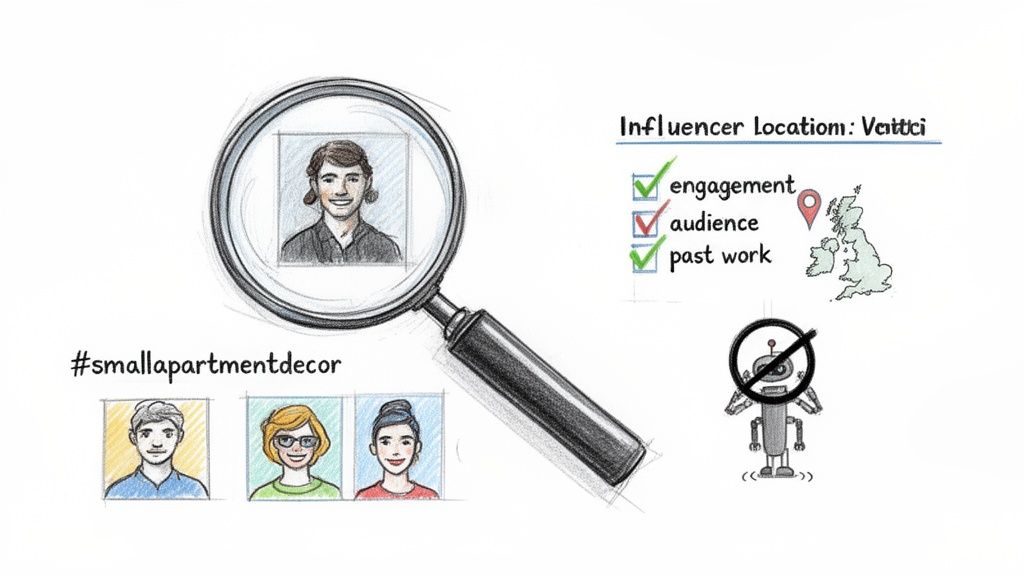
- Real Engagement: Forget follower count for a moment and look at the comments. Are they all generic things like "Nice pic!" or "Love this!"? Or are people asking real questions: "Where did you get that lamp? I've been looking for one just like it!" The second type shows a truly invested audience.
- Audience Audit: The creator’s audience is your audience. Use a platform to check their follower demographics. If you’re a UK brand, you need a creator with a majority UK following. Simple as that.
- Past Partnerships: Sift through their previous sponsored work. Does it feel natural and woven into their regular content, or does it stick out like a sore thumb? The best creators make sponsored posts feel like a genuine recommendation.
- Aesthetic & Vibe Check: This is non-negotiable for home brands. Does their style (whether it's minimalist, maximalist, or modern farmhouse) actually complement your products? A clash in aesthetics will feel forced and won't show your product in its best light.
The UK home and interiors niche is incredibly active, especially on Instagram. We've seen top creators in this space hit engagement rates as high as 39.01%. Their audiences are typically 90% female and overwhelmingly based in the UK (81.54%), which is a dream demographic for most home brands.
My Two Cents: A creator's true worth isn't their follower count; it's the trust they've built. Always choose genuine connection and aesthetic alignment over vanity metrics. That’s the secret sauce for successful influencer marketing in this space.
Don't be afraid to focus on smaller creators. It might sound backwards, but these focused partnerships can be far more valuable than one-off campaigns with a huge creator. You can learn more about why nano-influencer marketing drives bigger ROI and how to make it work for you. By following this careful discovery and vetting process, you'll set yourself up for a campaign that not only looks stunning but actually delivers.
Running Your Campaign: From First Message to Final Post
You've done the hard work of finding the perfect creators. Now comes the part where the magic really happens: turning that curated list into a real, living campaign. This is where many brands stumble, falling back on generic, copy-paste messages that get lost in a sea of DMs.
To stand out, your approach needs to be as carefully considered as your products. It’s less about a transaction and more about starting a genuine creative partnership.
How to Write an Outreach Message That Actually Gets a Reply
First impressions are everything. Your initial message is your one shot to show a creator you’ve done your homework and aren't just firing off another mass email. Think of it as a friendly chat, not a cold pitch.
I’ve seen this approach work time and time again. Forget templates; a truly personal message has a few key ingredients.
Start with a genuine, specific compliment. Show them you're a real follower. Something like, "I absolutely loved your recent reel on styling that small entryway; the way you used that slim console table was so clever," immediately proves you’re paying attention.
Then, introduce your brand and make the connection obvious. Keep it brief. "I'm with [Your Brand], and we design minimalist, sustainable lighting. Your focus on clean lines and natural materials feels like a perfect match for our philosophy."
Be direct, but flexible, about what you have in mind. Try, "We're launching a new collection of pendant lights and would love to partner with you on a dining room refresh. We're picturing one Reel and a few static images, but we're completely open to your creative ideas."
Most importantly, be upfront about what's in it for them. State the compensation clearly, including both the product and any fee. "We'd, of course, provide you with the light of your choice (valued at ~£450) and have a budget of £800 to compensate you for your time and content."
Finally, end with a clear, low-pressure call to action. Make it easy to say yes. "If this sounds interesting, just let me know and I can send over a proper brief. No pressure at all!" This respects their profession and starts the relationship on the right foot.
The Creative Brief: Your North Star, Not a Rulebook
Once a creator is on board, it's time for the creative brief. The biggest mistake brands make here is being too controlling. A brief isn't an instruction manual; it's a guide meant to spark creativity, not suffocate it. You hired them for their unique vision, so give them the space to use it.
This simple diagram shows how the whole process fits together, with the brief acting as the central pillar connecting your initial outreach to the final content.
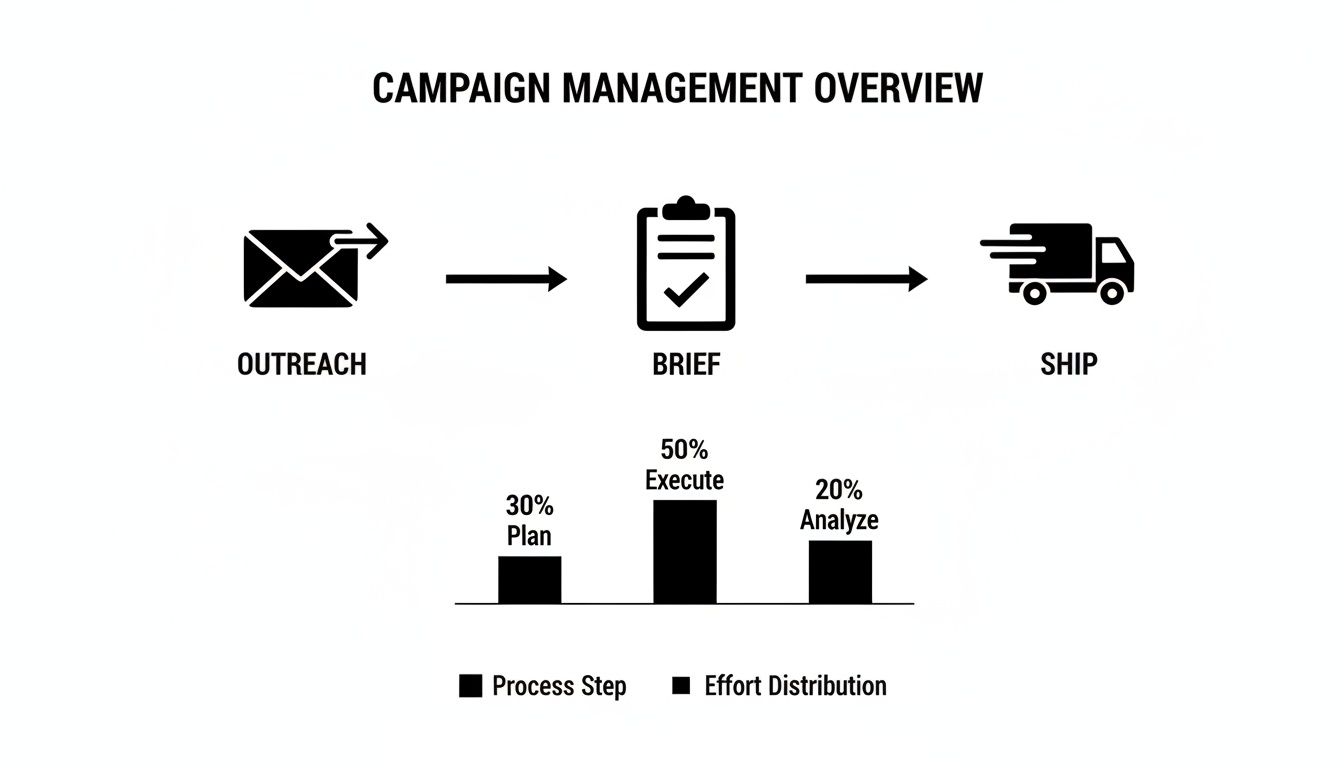
A solid brief should be a single, scannable document that covers the essentials without getting bogged down in unnecessary detail.
Here's what to include:
- Core Campaign Message: What’s the single most important takeaway? For example, "Our new sofa is modular and perfect for small, flexible spaces."
- Content Deliverables: Be specific. Think "1 Instagram Reel (60-90 seconds) and 5 high-resolution static images."
- Key Product Features: List just 2-3 non-negotiable points you want them to mention. Is the fabric pet-friendly? Is the wood sustainably sourced?
- 'Do's and 'Don'ts': Keep this section short and sweet. A 'do' might be, "Show the product in plenty of natural light." A 'don't' could be, "Please avoid using filters that distort the product's true colour."
- Call to Action & Tracking: Give them everything they need in one place: the unique discount code and the specific UTM-tagged link for their post.
A great brief gives a creator the what and the why, but trusts them with the how. It’s the difference between commissioning an artist and just hiring a photographer.
Getting to Grips With Home & Interiors Logistics
Finally, you can't ignore the unique logistical hurdles of home and interiors marketing. Shipping a cushion is one thing; coordinating the delivery of a king-sized bed frame is a whole different ball game.
Plan for these challenges from the very beginning:
- Large Item Deliveries: For bulky items like sofas or dining tables, clear communication about delivery windows is key. For a truly premium feel, consider a white-glove service that will carry the item into the creator's home. The delivery experience itself is part of the collaboration.
- DIY & Renovation Timelines: If your product is part of a bigger project, like tiles for a bathroom renovation, you have to be realistic. Projects get delayed. Build buffer time into your campaign schedule and keep the lines of communication wide open.
- Product Assembly: Does your product require assembly? Make sure the instructions are crystal clear. Better yet, if you have a helpful assembly video, share the link. A creator struggling to build your flat-pack furniture on camera doesn't make for great content.
By nailing your outreach, creating inspiring briefs, and planning for the logistical realities, you'll build a smooth campaign process that fosters great relationships and produces the kind of authentic content that truly resonates.
Measuring Real ROI and Repurposing Content
The creator has posted. The content looks incredible, and the first wave of comments is rolling in. But now the real work begins: figuring out if it actually worked. A stunning campaign is one thing, but a profitable one is what keeps the lights on.
Once the content is out there, your role shifts from creative director to data detective. To prove the value of your influencer campaigns, you have to look past the vanity metrics like likes and views and dig into the numbers that directly affect your bottom line.
This is where attribution becomes your best friend. Honestly, if you can’t track it, you can’t scale it. The only reliable way to do this is by giving each creator their own unique tracking tools before the first post ever goes live.
At a bare minimum, every single partner needs their own unique discount code (like ‘LUCYHOME15’) and a custom UTM-tagged URL. This isn't optional; it's the foundation of a measurable campaign. It’s how you’ll know, without a doubt, which creators are driving traffic and, more importantly, who is actually turning that traffic into sales.
The Metrics That Actually Move the Needle
For home and interior brands, some KPIs tell a much richer story than others. While a high engagement rate is a great sign that the creator’s audience is connected, your finance team cares about cold, hard revenue.
Below is a breakdown of the key metrics we obsessively track to measure the true performance of our influencer collaborations. These are the numbers that separate a good campaign from a great one.
Essential KPIs for Home & Interior Influencer Campaigns
| KPI | What It Measures | Why It's Important for Home Brands |
|---|---|---|
| Return on Ad Spend (ROAS) | The total revenue generated for every pound spent on the collaboration (including fees, product costs, etc.). | This is your ultimate profitability metric. A 3:1 ROAS means for every £1 you invested, you got £3 back. It’s the clearest indicator of financial success. |
| Cost Per Acquisition (CPA) | How much it costs, on average, to acquire one new customer through that specific influencer. | This tells you how efficient a creator is. A low CPA means you're acquiring customers cost-effectively, helping you decide which creators to re-invest in. |
| Conversion Rate | The percentage of people who clicked the creator’s link and completed a purchase. | A high conversion rate proves the creator's audience isn't just browsing. They're inspired to buy. It validates that their style and following are a perfect match for your products. |
| Code Redemptions | The total number of times a creator's unique discount code was used at checkout. | This is the most direct, undeniable proof of sales. It’s clean data that shows exactly how many purchases were driven by that creator’s recommendation. |
By building a dashboard that prioritises these figures, you get a crystal-clear picture of performance. If you want to get really granular on the calculations, our guide on how to measure influencer marketing ROI is a brilliant resource.
Squeezing Every Drop of Value from Creator Content
Think the campaign is over once the content is live? Think again. One of the costliest mistakes I see brands make is letting beautiful, hard-won creator content die on the influencer's feed. That user-generated content (UGC) is a goldmine you’ve already paid for. It's time to put it to work.
This isn't just a nice-to-have anymore; it's becoming standard practice. A recent report showed that a huge 81% of UK marketers are planning to boost their influencer budgets for 2026, with a sharp focus on paid media and UGC. This trend makes it clear that repurposing content is no longer optional for growth.
Get it in writing. Your influencer agreement absolutely must grant you explicit usage rights to their content. Without this permission, you can't legally use their photos or videos. Make sure your contract clearly states that you have the right to repurpose the assets across your own marketing channels.
Smart content repurposing strategies can massively extend the lifespan and value of your initial investment, dramatically lowering your overall creative production costs.
Here’s how you can start doing it right away:
- Fuel your paid social ads. Creator content is the ultimate fuel for Meta and TikTok ads. It feels native, builds immediate social proof, and almost always outperforms sterile, corporate-looking studio shots. Run A/B tests with different creator assets to see which ones deliver the lowest CPA.
- Upgrade your product pages. Weave creator photos and videos directly into your product detail pages (PDPs). Seeing your throw blanket artfully draped over a sofa in a real, stylish home helps customers visualise it in their own space and overcomes that last bit of purchase hesitation.
- Enrich your email marketing. Ditch the boring product grids. Feature a creator's room makeover in your next newsletter. This tells a story and provides genuine inspiration, which is far more powerful than a simple 'buy now' button.
- Populate your own social feeds. You should never be scrambling for content again. Build a library of approved UGC that you can pull from for months, keeping your Instagram, TikTok, and Pinterest feeds full of authentic, real-world style.
When you combine meticulous tracking with a clever repurposing plan, influencer marketing stops being a speculative expense. It becomes what it should be: a predictable, scalable, and highly profitable channel for growth.
Answering Your Top Questions
As we've walked through the strategy, I know what happens next. The practical, "how do I actually do this?" questions start popping up. It's completely normal. Let's tackle some of the most common hurdles I see home and interior brands face when they're getting started.
Think of this as the final checklist before you launch, giving you the confidence to get your next collaboration out the door.
How Much Should I Actually Budget for an Influencer Campaign?
There’s no magic number here. The best way to set a budget is to work backwards from your goal. Don't just pull a figure from thin air. First, decide what you really want to achieve. Are you after stunning content for your own channels, a direct sales uplift, or just getting your brand name out there?
If you're just dipping your toe in, a fantastic starting point is product-only collaborations, or gifting. This works especially well with nano-creators (1k-10k followers), who are often hungry for great products to feature and build their portfolios. It's a low-risk way to see what works and gather that all-important first batch of user-generated content.
Once you need more guaranteed results, you'll shift to a paid model. A common yardstick in the home and interiors niche is a Cost Per Mille (CPM) (the fee per 1,000 followers), which typically lands somewhere between £10 to £40. So, for a creator with 30,000 followers, you could expect to pay a fee from £300 to £1,200, plus the cost of the product.
My Advice: Start small. Carve out a test budget you feel comfortable with, maybe enough for a handful of nano-creators. Give each one a unique tracking link or discount code and watch the results. Let that initial data tell you where to scale your budget.
Is It Better to Gift Products or Pay a Fee?
Honestly, the "gifting vs. paying" debate depends entirely on what you want to achieve and who you're working with. One isn't inherently better; they just serve different functions.
- Gifting is perfect for forging genuine connections, especially with up-and-coming nano-influencers. For them, receiving a beautiful piece of furniture or a set of high-quality textiles feels like a fair exchange for content, particularly if they already love your brand. This approach generates real enthusiasm you just can't buy.
- Paying a fee becomes the standard as you work with more established micro-influencers and beyond. This is their profession, after all. A fee respects the time, creative skill, and audience they've worked so hard to build. It also gives you the right to be more specific with your requests, like asking for a polished Reel or a full gallery of high-resolution images.
Often, the sweet spot is a hybrid model. You provide the product as a gift but add a fee to guarantee the specific content you need. This ensures you get exactly what you’re after for your marketing while building a professional, respectful relationship.
Do I Really Need a Formal Contract?
Yes. One hundred percent, yes. Even for gifted collaborations where no money changes hands. A contract, or even a simple collaboration agreement, isn't about mistrust. It’s about making sure everyone is on the same page. It’s the single best tool for preventing headaches and miscommunication later on.
It doesn’t need to be 20 pages of dense legal text. A simple, clear document should cover the essentials:
- The Deliverables: What content are they creating? Be specific (e.g., ‘1x Instagram Reel and 3x static images for the grid’).
- Key Timelines: When are you sending the product, and what’s the deadline for posting?
- Usage Rights: How can you use their content? Spell it out (e.g., ‘Rights to repurpose on our website and in paid social ads for 12 months’).
- Payment Details: If there's a fee, what is it and when will it be paid?
- Disclosure Rules: A simple reminder to use the correct ad identifiers like #ad or #gifted to comply with advertising standards.
Taking this step immediately elevates the partnership from a casual chat in the DMs to a proper, professional project.
How Do I Handle Shipping Large Items Like Furniture?
Logistics can be a real pain point for home brands: sending a sofa is a world away from posting a candle. The key to making it painless is crystal-clear communication from the very beginning.
Before you agree to anything, discuss delivery windows and any specific access requirements with the influencer. Always use a reliable courier service that provides both tracking and insurance. For big-ticket items like a dining table, bed, or wardrobe, seriously consider a white-glove delivery service. They will carry the item into the creator's home and often handle assembly, which creates a seamless, premium experience.
Remember, the delivery and unboxing are part of the story. A smooth process leads to a happy creator, which in turn leads to much better, more authentic content. Just be sure to factor these higher shipping costs and longer lead times into your overall campaign plan.
Ready to stop juggling spreadsheets and start scaling your influencer campaigns? Sup combines AI with a human team to find your perfect creators, manage outreach, and track every sale in real-time. Turn influencer marketing into your most predictable growth channel. Learn more and get started at Sup.
More on industries
See how many creators post about you and your competitors
Type in your brand's Instagram handle and we count the creators who post about you and about your five closest competitors. It takes about a minute and it is free. Or request a demo and we will show you the creators in your niche and walk you through the dashboard.
 Book a call