4 March 2026
Influencer Marketing for Shopify Stores: The Complete Playbook
If you've ever felt that influencer marketing is more about chasing likes than making actual money, it's time for a rethink. For today's Shopify stores, it's not about vanity metrics; it's about building a predictable sales channel. This playbook will show you how to turn what can feel like a chaotic mess of collaborations into a system that drives measurable revenue and genuine growth.
Moving Beyond Views To Drive Real Shopify Sales
Influencer marketing has grown up. Gone are the days of paying for a single post and just hoping for the best. For smart Shopify store owners, this is now a primary engine for growth, often outperforming traditional ads because it’s built on something far more powerful: trust. The entire game has shifted from untrackable shout-outs to an ROI-focused programme that generates sales and a goldmine of authentic content.
This isn’t about one-off campaigns. It's about building a sustainable system. Think of it as the difference between renting an influencer's audience for a single post versus owning a powerful, continuous stream of customer-winning content. Every collaboration becomes a strategic investment designed to produce a tangible return for your store.
The Shift To Authentic, ROI-Driven Partnerships
The opportunity for ecommerce brands right now is immense. The UK influencer marketing market hit US$2.36 billion in 2024 and is on track to reach an astonishing US$24.15 billion by 2033. This explosion isn't happening in a vacuum; it’s fuelled by a fundamental shift in consumer behaviour. Young UK adults are now 2.5 times more likely to turn to TikTok for product recommendations than to their own friends or family.
With 81% of UK brands planning to increase their influencer budgets, simply dabbling is no longer enough. The time to build a proper, strategic programme is now. You can discover more insights about these UK influencer marketing trends and see how they impact ecommerce.
The real goal is to turn influencer content into a powerful asset that fuels your entire marketing ecosystem. A single post isn't just a post. It’s a potential paid ad, a website testimonial, and an email marketing feature, all rolled into one.
This is what a direct path from engagement to revenue looks like.
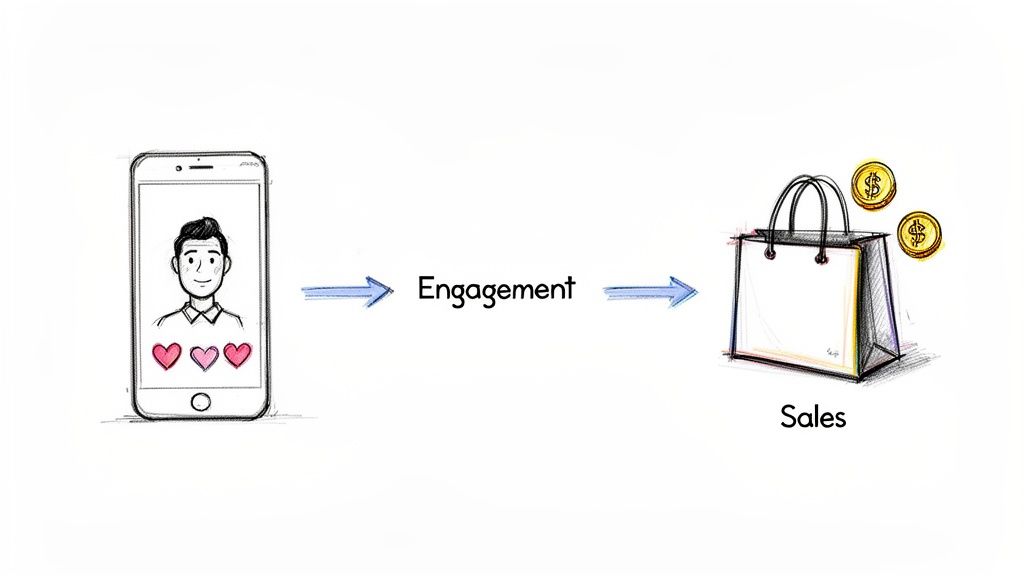
The image above gets right to the point: there's a direct line from a creator's post to a sale in your store. The key to proving ROI is building a clear, trackable bridge between those two points.
Why Your Shopify Store Needs A System
Without a structured approach, influencer marketing quickly devolves into a time-consuming chaos of chasing DMs, managing spreadsheets, and manually tracking results. It’s simply not scalable. A well-defined system, on the other hand, brings order, predictability, and control.
It allows you to:
- Actually track performance: Know with certainty which creators and campaigns are driving sales and which aren't.
- Scale your efforts efficiently: Onboard and manage a growing roster of creators without drowning in admin.
- Systematically capture and reuse content: Build a library of valuable user-generated content (UGC) to use across all your marketing channels.
This playbook is all about showing you how to build that very system. Smart platforms can automate the heavy lifting (from finding creators to sending payments), freeing you up to focus on the high-impact strategy that actually grows your business.
Your Campaign Blueprint: The Foundation for Success
Before you even dream of sliding into an influencer's DMs, you need a solid plan. Launching an influencer campaign without clear goals is like setting off on a road trip with no map. You’ll definitely be busy, but you won't end up anywhere you actually want to be. For Shopify stores, this means looking beyond vanity metrics like likes and comments and zeroing in on goals that genuinely move the needle for your business.
Think of your strategy as the architectural drawings for a new house. You wouldn't let a builder start knocking down walls without one, so don’t start a campaign without first defining what success looks like. Every single decision you make, from the creators you partner with to the content they post, should flow directly from this initial blueprint.
First, Define Your Primary Campaign Goal
It's easy to want it all at once: more sales, more followers, and more content. But the most effective campaigns are laser-focused. You need to pick one primary objective. This simple act sharpens your entire strategy and makes it much, much easier to measure your success.
Your main goal will almost always fall into one of three buckets:
- Driving Direct Sales: This is the bread and butter for most Shopify stores. Success here is all about the numbers: conversion rate, revenue generated, and Return on Ad Spend (ROAS).
- Sourcing User-Generated Content (UGC): Here, the main prize is a library of authentic, high-quality photos and videos from creators. You can then repurpose this content for your paid ads, website, and social media, which dramatically cuts down your own creative production costs.
- Building Brand Awareness: Perfect for new stores or brands breaking into a new market. The aim is to maximise your reach, impressions, and engagement within a specific audience, laying the groundwork for future sales.
Just look at the beauty brand Glossier. They practically built their empire by turning their community into a legion of micro-influencers. An incredible 70% of their online sales come from peer-to-peer referrals. It's a powerful lesson in how a well-defined strategy, focused on community and authentic content, can deliver massive financial returns.
Next, Set Measurable Key Performance Indicators
Once you've got your primary goal locked in, you need to attach specific Key Performance Indicators (KPIs) to it. These are the hard numbers that will tell you whether your plan is actually working. Fuzzy goals like "increase sales" are useless; you need concrete targets to aim for.
Think of KPIs as the signposts on your journey. They tell you if you're on the right path and how far you are from your destination. Without them, you're just driving in the dark.
Here’s a simple breakdown of how to connect KPIs to your goals:
| Primary Goal | Key Performance Indicators (KPIs) | How to Measure It |
|---|---|---|
| Driving Sales | - Conversion Rate: The percentage of clicks that turn into a sale. - Customer Acquisition Cost (CAC): Total campaign cost / number of new customers. - Return on Ad Spend (ROAS): Campaign revenue / total campaign cost. | Shopify Analytics, UTM tracking, unique discount code reports. |
| Sourcing UGC | - Number of Assets Acquired: The total count of photos and videos you get. - Content Usage Rights: A clear agreement that you can repurpose the content. - Cost Per Asset: Total campaign cost / number of assets acquired. | Manual tracking in a spreadsheet or a dedicated content platform. |
| Brand Awareness | - Reach & Impressions: The total number of unique people who saw the content. - Engagement Rate: Likes, comments, and shares divided by the creator's followers. - Website Clicks: Clicks from the creator's link-in-bio or story swipe-ups. | Influencer analytics, Google Analytics, platform dashboards. |
Setting a realistic budget is the final piece of your blueprint. Your budget has to make sense for your goals and the KPIs you’ve just set. For instance, if you're aiming for a 4x ROAS and your average order value is £50, you can quickly work out how much you can afford to spend to get each new customer. To get a much deeper look at how all these pieces fit together, check out our complete guide to influencer marketing for ecommerce in 2026. Getting this groundwork right ensures every pound you spend is a smart investment in your Shopify store’s growth.
Finding Influencers Who Actually Drive Sales
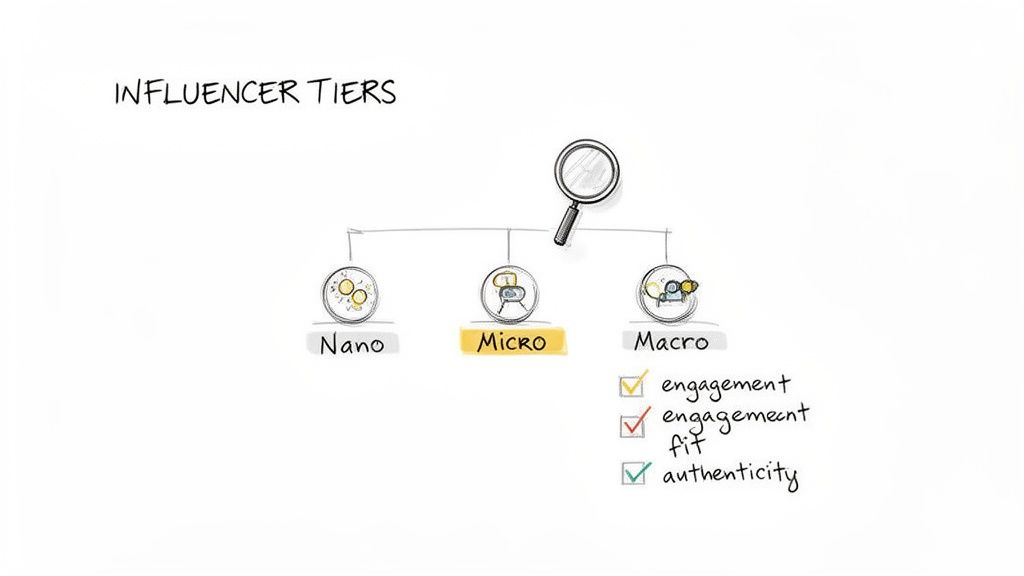
When you're building a Shopify brand, it's tempting to chase creators with huge follower counts. But the real wins often come from a different corner of the internet altogether: nano and micro-influencers. These are the creators with smaller, tight-knit communities who can build genuine trust and, more importantly, drive actual sales.
Think of it like this. A mega-influencer is a billboard on the M1: millions might see it, but the connection is fleeting and impersonal. A micro-influencer, however, is like a trusted friend recommending a product over a coffee. Their audience doesn't just see the content; they believe in it.
This authenticity is exactly why smaller creators are becoming the go-to for so many UK brands. The numbers don't lie: a staggering 93% of UK brands now work with micro-influencers (those with 10k-100k followers), while only 66% use macro-influencers. They simply deliver a better mix of authentic reach and real engagement.
With one in four UK adults swayed by creators in their buying habits (a figure that jumps to over 50% for Gen Z), partnering with these trusted voices isn't just a good idea; it's essential. You can see the full breakdown of these trends in Kolsquare's UK report.
Choosing Your Influencer Tier For Shopify
Selecting the right type of influencer is one of the most important decisions you'll make. It directly impacts your budget, the kind of content you'll get, and the results you can expect. Here’s a quick breakdown to help you decide which tier makes the most sense for your Shopify store.
| Influencer Tier | Follower Range | Typical Engagement | Best For Shopify Stores | Est. Cost (UK) |
|---|---|---|---|---|
| Nano | 1k - 10k | Highest | Driving initial sales, building community, generating authentic UGC. | Gifting or £50-£200 |
| Micro | 10k - 100k | High | Targeted campaigns, niche audiences, balancing reach with authenticity. | £200 - £1,500 |
| Macro | 100k - 1M | Moderate | Brand awareness, reaching a broad audience, large-scale campaigns. | £1,500 - £10,000+ |
| Mega | 1M+ | Low | Massive reach, celebrity endorsement, top-of-funnel awareness. | £10,000 - £50,000+ |
For most Shopify stores, especially those just starting out or on a tight budget, the sweet spot is clearly with nano and micro-influencers. They offer the perfect blend of affordability, high engagement, and the kind of trustworthy content that converts followers into customers.
Where To Find Your Perfect Creator Matches
So, where do you find these gems? The key is to look for audience alignment first and follower count second. Your goal is to find creators whose followers are basically your ideal customers, just waiting to be introduced to your brand.
Here are a few proven methods we use to build a list of high-potential partners:
- Hashtag Deep Dives: Don't just search for broad tags like #ukfashion. Go deeper. Look for niche and long-tail hashtags that your target customers would actually use, like #sustainablefashionuk or #londonfoodblogger. Check both the "Top" and "Recent" posts to find active creators.
- Competitor and Brand Stalking: This is my favourite trick. Have a look at who your direct competitors and aspirational brands are working with. Sift through their tagged photos and mentions to see who is already organically shouting about similar products. It’s a goldmine for finding pre-vetted creators who are already a great fit for your niche.
- Platform Search Tools: Use the search bars on Instagram and TikTok. Type in keywords directly related to your products or niche (e.g., "vegan skincare," "handmade jewellery UK") and then filter the results by "Accounts." This quickly surfaces profiles that are built around your industry. For more ideas, check out our deep-dive guide on leveraging micro-influencer marketing for your small business.
Vetting Creators To Avoid Wasting Your Budget
Once you've got a shortlist, it's time for the most critical step: vetting. This is what separates successful campaigns from those that burn through your budget with nothing to show for it. You need to learn how to spot the authentic creators from the ones with vanity metrics.
Your goal is to find creators who don't just post, but persuade. This requires looking beyond surface-level metrics and analysing the quality of their community engagement and the authenticity of their following.
Here’s what you need to look for to find a true partner:
- Analyse Engagement Quality, Not Just Quantity: A high like count can be misleading. Dive into the comments section. Are people asking genuine questions and having conversations, or is it just a wall of "Nice post!" and fire emojis from bots? Real engagement is a two-way street.
- Check for Follower Authenticity: Be wary of accounts with sudden, massive spikes in followers. It’s a huge red flag. Use a free online audit tool to get a quick sense of their follower health. These tools can estimate the percentage of fake or inactive followers, giving you a much clearer picture of who you'd actually be reaching.
- Confirm Genuine Brand Alignment: Scroll through their feed, and I mean really scroll. Does their personal brand, aesthetic, and tone of voice feel like a natural fit for your Shopify store? A creator who promotes fast fashion on Monday and sustainable living on Tuesday isn't going to build the trust you need to convert their audience. Look for consistency and genuine passion.
Crafting Outreach That Creators Actually Want To Answer
Let’s be honest. A lazy, generic "Hey, wanna collab?" DM is the fastest way to get ignored. Creators with real influence are swimming in these kinds of messages, so yours has to stand out from the very first word. Think of your outreach as your shop's first handshake. You need to make it a good one.
Your message must immediately show you're a serious, professional brand that genuinely values their work. And that means getting personal.
I'm not just talking about using their first name. I mean proving you've actually watched their videos or read their posts. Mention a specific piece of content you enjoyed and tell them why it caught your eye. This small bit of effort shows you’ve done your homework and instantly lifts you above the 90% of brands just blasting out copy-and-paste templates.
Your First Message: The Conversation Starter
Your initial message is like a headline; its only job is to be interesting enough to earn a reply. Keep it short, respectful, and make your intentions clear without being pushy.
Remember, the goal here is to open a door, not to close a deal in the first DM. A great opening message should have a few key ingredients:
- A real compliment: Pinpoint a specific post, video, or story you liked.
- A quick intro: Who are you and what does your Shopify store sell?
- The "why": Briefly explain why you think their audience would love your products.
- A clear next step: Politely ask if you can move the conversation over to email to share more details.
Here’s a simple template that works: "Hi [Creator Name], my name is [Your Name] and I run [Your Shopify Brand]. I absolutely loved your recent post about [specific topic]: the way you [explained/showcased] it was brilliant! We make [your product type] with a focus on [brand value, e.g., sustainable materials], and I had a feeling your audience would really appreciate that. If you're open to exploring partnerships, I'd love to send more details over via email. No pressure at all!"
This approach respects their time and frames the potential collaboration as a genuine partnership, not just another transaction.
Building The Perfect Campaign Brief
Once you've got an enthusiastic "yes," it's time to follow up with your campaign brief. Don't skip this step. The brief is arguably the most important document in this entire process. It’s your insurance policy against crossed wires and your guide to getting content that actually drives results for your Shopify store.
A well-crafted brief empowers the creator to do their best work because they know exactly what you need. It’s the blueprint for success.
Key Elements of a Killer Campaign Brief:
- Campaign Goals & KPIs: Be crystal clear. Are you trying to drive sales or gather user-generated content (UGC)? State the main goal and the metrics you'll be tracking, like sales from their unique discount code.
- Key Messages & Talking Points: Give them the core messages you want to get across. The trick is to provide these as bullet points, not a rigid script. You want their personality to shine through.
- Content Deliverables: Get specific. How many posts or videos do you need? Spell it out clearly (e.g., 1 Instagram Reel, 3 static Story frames, and the 2 raw video clips for you to reuse).
- Creative Guardrails: This is your "dos and don'ts" list. Are there any words to avoid or specific product features you need them to highlight? Crucially, you should also reinforce that you want their creative style and authentic voice to lead the way.
- Timelines & Deadlines: Lay out the schedule. Include dates for when drafts are due for a quick look-over (if needed) and the final go-live dates.
- Compensation & Tracking: Put the payment terms in writing. State the agreed fee, commission, gifted product arrangement, or hybrid model. Don’t forget to include their unique discount code and any trackable links.
A comprehensive brief like this builds trust and sets the stage for a smooth, successful partnership. It gives creators the confidence and clarity they need to produce amazing content that hits your Shopify store's goals.
Setting Up Bulletproof Tracking in Shopify
Let's be honest: if you can't measure it, you can't improve it. This is the golden rule of performance marketing, and it's what separates a real revenue-driving influencer programme from an expensive hobby. Without solid tracking, you're just throwing money at collaborations and hoping for the best. This is where we stop guessing and start building a bulletproof attribution system right inside your Shopify store.
Think of yourself as a detective on a case. Your mission is to find the undeniable evidence that links an influencer’s content directly to a sale. The tools for the job? UTM parameters, unique discount codes, and affiliate links. Once you have these set up, you’ll never again have to wonder if your investment is actually paying off.
The Three Pillars of Shopify Influencer Tracking
To build a tracking system you can truly rely on, you need to combine a few key methods. Just using one leaves you with blind spots in your data. By layering all three, you create a safety net that catches sales from every possible customer journey, giving you a crystal-clear picture of your ROI.
These are your three non-negotiable components:
- UTM Parameters: These are just little bits of text tacked onto the end of a URL. They don't change the destination page, but they secretly pass crucial information back to your analytics, telling you exactly who sent you that traffic.
- Unique Discount Codes: This is the simplest and often most powerful method. For each influencer, you create a unique code (like ‘SOPHIE15’) in Shopify. When a customer uses it, the sale is automatically and undeniably tied to that influencer.
- Affiliate Links: These are special, trackable URLs that place a cookie on a user's browser. If that person buys something within a set window (say, 30 days), the influencer gets credit for the sale, even if the customer didn’t use a discount code at checkout.
Using these three together covers all your bases. Someone might click a UTM link from an Instagram Story but forget the code later. Another person might see the code, close the app, and type your website in directly. A multi-layered approach makes sure you track the sale no matter how it happens.
Creating Trackable Links with UTM Parameters
UTMs might sound technical, but they’re incredibly easy to create and are the absolute foundation of professional marketing analytics. A UTM-tagged link simply tells Google Analytics and Shopify the ‘who, what, and where’ behind every click. It looks something like this: yourstore.co.uk/products/bestseller?utm_source=instagram&utm_medium=social&utm_campaign=spring22&utm_content=chloe_story.
Here’s a quick breakdown of what that all means:
- utm_source: Identifies where the traffic came from (e.g., instagram, tiktok, youtube).
- utm_medium: The marketing channel used (e.g., social, influencer, cpc).
- utm_campaign: The name you’ve given your campaign (e.g., spring_launch_22).
- utm_content: Differentiates specific links within the same campaign. This is perfect for tracking individual creators (e.g., chloe_reel or tom_story).
You can easily build these for free using Google’s Campaign URL Builder. Just give each influencer their own unique, UTM-tagged link for their bio or swipe-ups, and you'll be able to see exactly who is driving clicks and sales right inside Shopify Analytics.
Setting Up Discount Codes and Affiliate Links
While UTMs track the click, discount codes are what often get a customer over the finish line. You can generate a unique code for every single influencer in seconds from your Shopify admin. This gives you a direct, unambiguous way to attribute sales.
Creating unique codes is the single most powerful way to attribute revenue. When a sale comes through with the code 'SARAH20', you know with 100% certainty that Sarah’s content drove that purchase.
For a more automated approach, you can turn to affiliate links. Apps like Shopify Collabs or other third-party tools let you generate special links that automatically track sales and can even handle commission payouts for you. To really master this and get a much deeper view of your return on investment, it's worth learning how to Track Influencer Sales On Shopify.
This whole process starts way before you send out a link. It begins with clear and organised outreach.
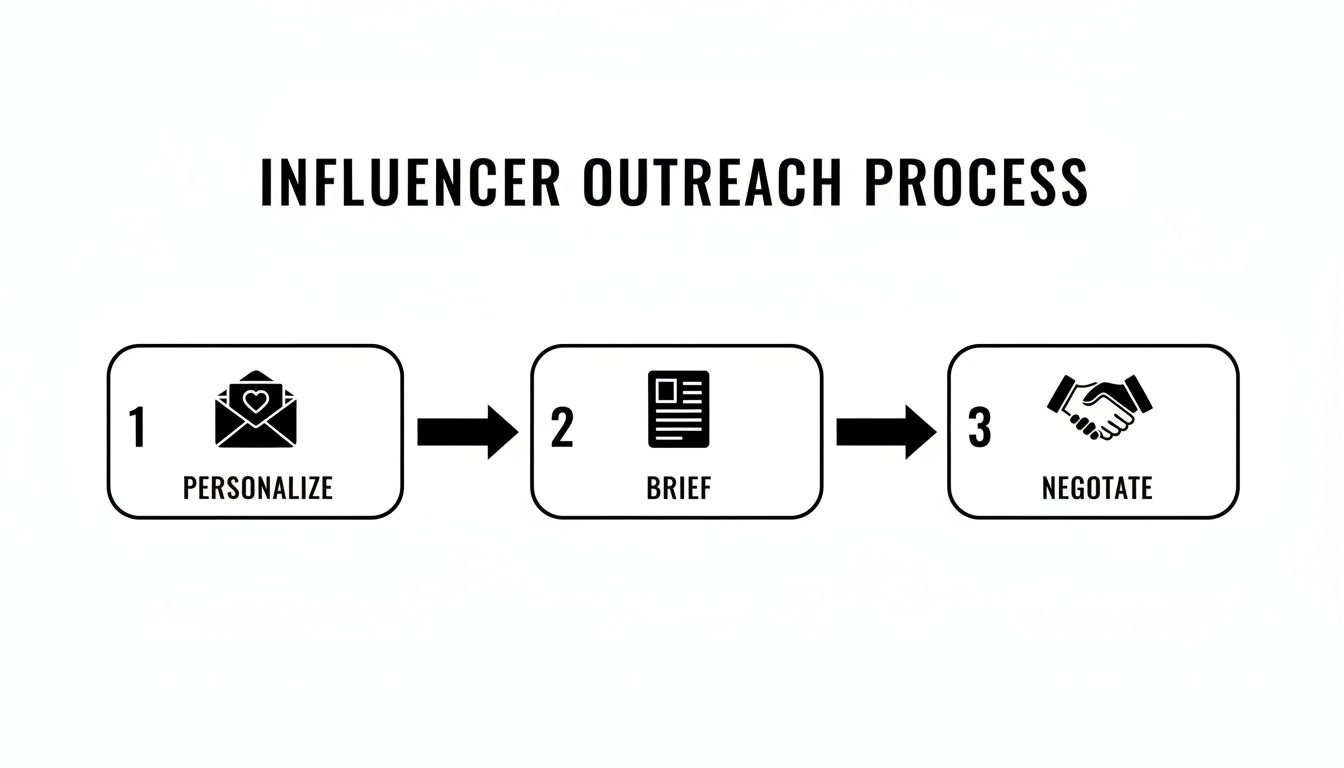
When you personalise your outreach, provide a clear brief, and agree on all the terms upfront, you’re setting the stage for a smooth, trackable campaign. By the time you share the tracking links, the foundation for success is already there.
Getting your tracking right is what turns your influencer programme from a fun experiment into a predictable, scalable sales channel. By implementing these three pillars, you'll have the hard data needed to confidently double down on what works, tweak your strategy, and prove the incredible value of influencer marketing for your Shopify store.
How To Measure And Scale Your Influencer Programme
Once your tracking is up and running, the real fun begins. You're no longer throwing things at the wall to see what sticks; you're actually analysing the results. This is the part where you turn all that data into a proper strategy and build a predictable sales engine for your Shopify store.
Think of your data as a treasure map. By digging into your Shopify and Google Analytics reports, you can pinpoint exactly which influencers, discount codes, and campaign links are striking gold. It's time to look beyond vanity metrics and focus on what’s genuinely moving the needle for your business.
Identifying Your Top Performers
The first job is to cut through the noise and zero in on what truly matters. Instead of drowning in a sea of data, concentrate on these three critical indicators to find your most valuable creators:
- Revenue Per Influencer: This is the bottom line. Head over to your Shopify sales reports and filter by the unique discount codes you handed out. This will tell you, in pounds and pence, how much cash each creator has actually generated.
- Conversion Rate Per Campaign: Lots of clicks are nice, but they mean nothing if nobody buys. Check your UTM data in Google Analytics to see which influencer’s audience didn't just visit, but actually converted into paying customers.
- Return on Ad Spend (ROAS): This is your ultimate profitability check. To work it out, simply divide the revenue from a campaign by what you spent on it. For influencer marketing, a ROAS above 3x is generally considered a solid return.
The real aim here isn't just to find one great influencer. It's to spot the patterns. What do your best creators have in common? Look at their audience size, their content style, or the niche they operate in to find a blueprint for success.
To really get a handle on your collaborations and scale up properly, it's essential to get comfortable with measuring social media ROI for your Shopify store. Understanding this will sharpen your entire approach.
Doubling Down and Fostering Ambassadors
When you find creators who are smashing it for you, the next step is a no-brainer: double down on what works. Get in touch with your top performers and talk about a longer-term partnership. This is how you start building a team of genuine brand ambassadors.
These long-term relationships are far more cost-effective and, over time, produce much more authentic content. They get to know your brand inside and out, so they can talk about your products with real authority. If you're interested in how smaller creators can play a huge role here, check out our guide on why nano-influencers often drive bigger ROI.
Repurposing Content to Maximise ROI
The value of an influencer campaign doesn't just stop once the content is posted. That high-performing User-Generated Content (UGC) you've just paid for is a goldmine. One of the smartest things you can do is repurpose this authentic content across all your other marketing channels to squeeze every last drop of value from it.
Here are a few ideas for reusing your best influencer content:
- Paid Social Ads: Content from creators often works better in ads than polished brand creative. It looks native to the feed and feels far more trustworthy to potential customers.
- Email Newsletters: Drop influencer photos and testimonials into your emails. It adds powerful social proof and gives people a reason to click through to your products.
- Website Product Pages: Embedding authentic videos or images on your product pages shows your products being used in the real world, which can give your conversion rates a serious boost.
By analysing what works, nurturing your best relationships, and reusing winning content, you create a powerful feedback loop. This is how you transform your influencer marketing from a series of one-off projects into a scalable, repeatable, and highly profitable part of your growth strategy.
Your Shopify Influencer Marketing Questions Answered
Even with the best plan in place, you're bound to have a few questions. Let's run through some of the most common ones I hear from Shopify owners when they first dip their toes into influencer marketing.
How Much Should I Pay an Influencer?
This is the million-dollar question, isn't it? The honest answer is: it depends. An influencer’s fee is a mix of their audience size, how engaged that audience is, and the actual work you're asking them to do.
For most Shopify stores, the smart money is on nano and micro-influencers. Here’s how those deals usually break down:
- Product Gifting: This is your entry point, perfect for nano-influencers (1k-10k followers). The product itself is the payment. It’s a brilliant low-risk way to get your first pieces of authentic user-generated content (UGC) and start building relationships.
- Affiliate Commissions: This is a pure performance model. Creators get a slice of every sale they generate through their unique link or discount code. It’s a genuine win-win, as you’re only paying for actual, measurable results.
- Hybrid Deals: This has become the standard for micro-influencers (10k-100k followers). You offer a reasonable flat fee to cover their creative time, topped up with a sales commission. It shows you value their work upfront while still tying payment to performance.
As a general guide, a flat fee for a UK-based micro-influencer can be anywhere from £200 to £1,500 per campaign. The key is to find a starting point that fits your budget, prove the ROI, and then confidently scale up your investment.
When Will I See Results From My Campaign?
Everyone wants to know how quickly the sales will start rolling in. If you’ve got a fantastic offer and the creator is a great fit, you can definitely see a sales bump within the first 24-48 hours. But the real magic of influencer marketing for your Shopify store is a long game.
Think of it less like flipping a switch and more like getting a flywheel spinning. That first push requires the most effort, but every collaboration after that adds momentum, making it turn faster and more predictably over time.
You'll get those immediate hits of website traffic and a few initial sales. But that deep brand trust, the steady stream of customers, and the predictable revenue? That comes from building ongoing partnerships with a core group of creators over a 3-6 month period.
Can I Do This With a Small Budget?
Yes, absolutely. One of the biggest myths out there is that you need a massive budget to succeed. A sharp strategy and solid tracking are infinitely more valuable than a huge pile of cash.
The secret is to concentrate all your initial efforts on nano and micro-influencers. Instead of betting the farm on one big, expensive macro-influencer, you can build a whole portfolio of smaller creators.
This method just makes more sense:
- It spreads your risk: If one collaboration doesn't land, it hasn't blown your entire budget.
- It’s a perfect testing ground: You can experiment with different niches, content styles, and audiences to discover what truly clicks with your customers.
- It’s built to scale: You can start by gifting products and simply reinvest the revenue you make into paid deals with your best performers. This creates a powerful, self-funding growth engine for your brand.
Ready to turn influencer marketing into a predictable, ROI-proven growth channel for your Shopify store? Sup combines AI and a human team to source creators, manage campaigns, and track every sale. Get started in 20 minutes and see how it works.
More on industries
See how many creators post about you and your competitors
Type in your brand's Instagram handle and we count the creators who post about you and about your five closest competitors. It takes about a minute and it is free. Or request a demo and we will show you the creators in your niche and walk you through the dashboard.
 Book a call