18 April 2026
How to Turn Customers Into Micro-Influencers for Your Restaurant: A Guide
A customer orders your signature pizza, slides the plate towards the window, takes two quick photos, tags your restaurant, and posts before the bill lands. Most operators see that as a nice bonus. The smart ones treat it as the start of a system.
That post matters because it comes with something your paid ads can’t manufacture. Credibility. The person posting isn’t trying to sound like a campaign. They’re just showing where they ate and what they enjoyed. For local restaurants, that kind of recommendation often carries more weight than polished brand content.
The problem is that most restaurants leave it to chance. They wait for guests to post, maybe reshare a Story, then move on. There’s no shortlist, no outreach process, no tracking, no reuse plan, and no clear way to tell which creator drove a booking. That’s why so many venues dabble in influencer marketing without building anything repeatable.
How to Turn Customers Into Micro-Influencers for Your Restaurant starts with a shift in mindset. Stop treating customer content as random social proof. Start treating it as an owned growth channel you can organise, measure, and scale.
The Untapped Marketing Potential in Your Dining Room
The best potential creators for your restaurant are often already sitting at your tables.
They’re the couple who always order the same small plates and post a Reel. They’re the office team who tag your lunch specials. They’re the regular who knows exactly where the good light is and makes your tiramisu look better than your own menu shoot. These people aren’t celebrities. They’re local diners with trusted voices in their own circles.
That matters because local influence often beats broad reach. In the UK restaurant sector, micro-influencers with 5,000 to 50,000 followers on Instagram and TikTok averaged 3.86% engagement, which was 60% higher than larger creators, according to food marketing analysis cited here. The same source notes that a 2023 ResDiary study found a 35% increase in bookings within 72 hours of campaign posts when restaurants partnered with local micro-influencers and tracked results through unique promo codes.
Those figures explain why customer-led creator programmes work when they’re built properly. You’re not borrowing fame. You’re activating existing trust.
Why customer creators outperform random paid collaborations
A cold outreach creator might deliver beautiful content and still send you the wrong audience. A loyal diner usually starts from a better place. They already understand your menu, your vibe, your peak times, and what people typically order.
That changes the tone of the content. It feels less like an ad and more like a recommendation from someone who’d go there anyway.
Practical rule: If a customer has already posted about you without being asked, they’ve already crossed the hardest line in creator marketing. They’ve shown genuine intent.
What most restaurants get wrong
They treat every collaboration as a one-off exchange. Free meal in. Post out. Done.
That approach can work for a single evening, but it rarely builds momentum. What works better is a simple system:
- Spot natural advocates: Watch tags, mentions, and repeat posters.
- Reward the right behaviour: Offer incentives tied to useful content and trackable actions.
- Capture permissions: Get the right to reuse the content in your own channels.
- Measure outcomes: Tie each creator to codes, links, bookings, or footfall signals.
- Repeat with the winners: Build a dependable bench of local advocates.
A single great customer post is nice. A repeatable engine of local advocates is better.
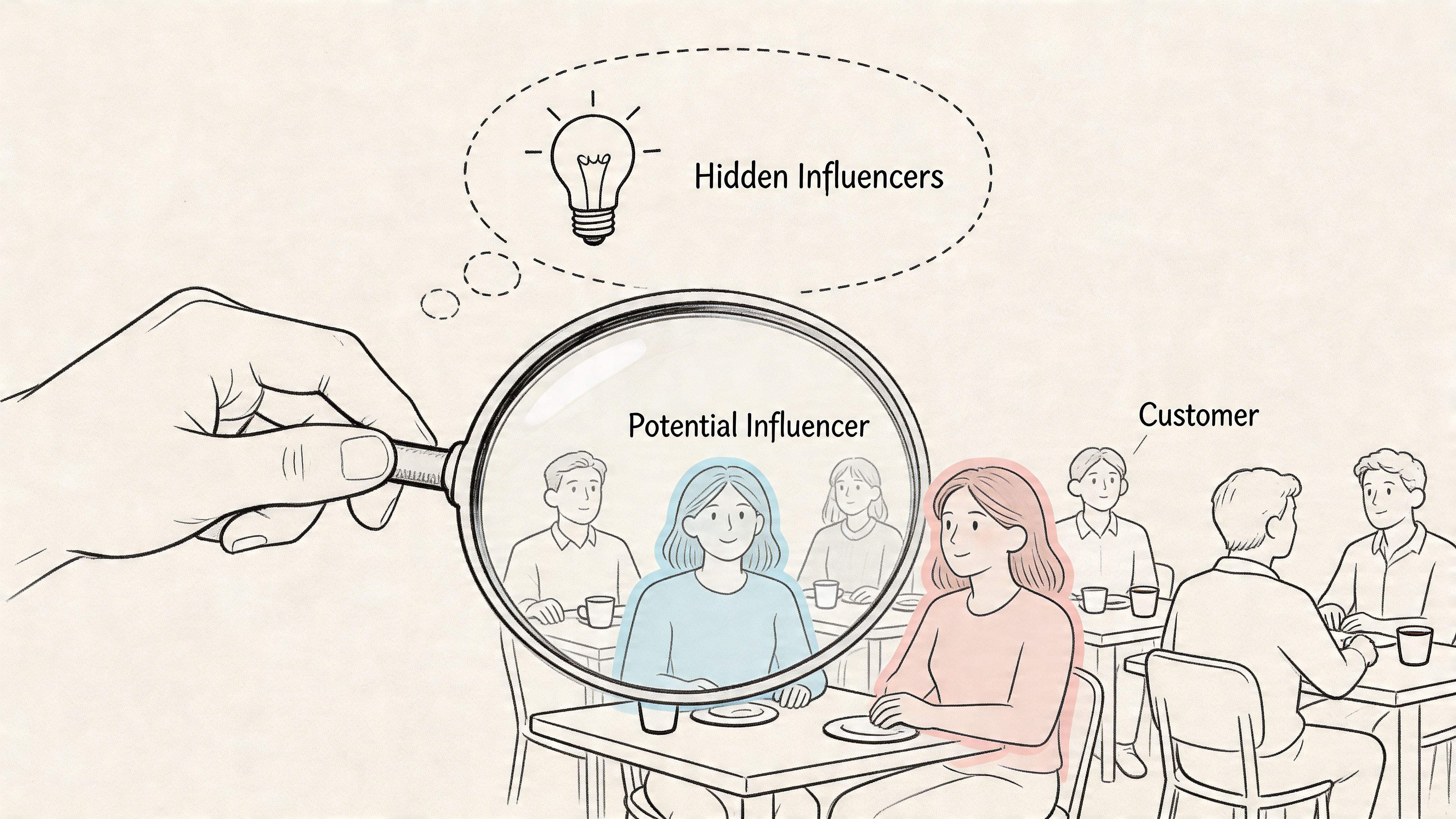
How to Identify Your Hidden Influencers
The biggest mistake I see is restaurants starting with follower count and stopping there. That’s how you end up chasing people who look impressive on paper but don’t care about your food, your neighbourhood, or your audience.
The better approach is to look for proof of affinity first. Influence comes second.
What this looks like in a single-location restaurant
Take a neighbourhood pizzeria. You don’t need software to start. You need a sharper eye on the floor and a better habit in your socials.
Front-of-house staff often know who the obvious candidates are before the marketing team does. They see who films the cheese pull. They notice who asks which cocktail looks best in natural light. They recognise the regular who tags every weekend special. Train the team to flag those guests casually, not awkwardly.
A practical shortlist for an independent venue usually comes from four places:
- People who already tag you organically: They’ve done the hard part already.
- Repeat customers who post food content often: Consistency matters more than one great photo.
- Guests whose followers comment like locals: You want nearby intent, not passive likes from everywhere.
- Customers who bring other diners with them: Influence isn’t only digital. Some people create offline pull as well.
One café I worked with kept a simple shared note with Instagram handles, visit dates, what the guest ordered, and whether they posted. Nothing fancy. But it turned scattered observations into a usable pipeline.
What this looks like in a multi-location chain
A chain can’t rely on memory and staff instinct alone. You need a process that can survive manager changes, shift patterns, and multiple cities.
That usually starts with social listening around location tags, branded hashtags, and repeat mentions. Then you layer in reservation and CRM data to find customers who come back, spend consistently, and post publicly about dining out. If you want a practical framework for the search side, this guide on finding local food influencers in your city is a useful companion.
The key difference for chains is standardisation. Each site should identify creators using the same criteria, even if the local audience changes.
The traits that matter more than raw reach
You don’t need every customer creator to have a huge audience. You need enough signs that people pay attention when they post.
Look for:
- Local relevance: Their followers live, work, or socialise near your venue.
- Content fit: They already post restaurants, drinks, date nights, brunches, or local recommendations.
- Natural enthusiasm: The tone feels genuine, not copied from a media kit.
- Reliability: They post consistently and respond when contacted.
- Social proof quality: Comments like “adding this to my list” are more useful than generic praise.
A creator with modest reach and strong local trust is often more valuable to a restaurant than a bigger account with a scattered audience.
Use an in-person trigger, not just a social one
A lot of venues miss a simple move. Tie creator discovery to a visit.
UK restaurants using customer-to-micro-influencer strategies through UGC contests saw a 40% boost in engagement and an 18x ROI, while in-person visit requirements drove 22% more footfall in regional trials across Manchester and Edinburgh venues, according to this analysis of restaurant influencer campaigns. That matters because it turns passive followers into actual guests, then gives you a reason to identify the best of them.
A smart version looks like this:
- Prompt the visit: “Post your meal with our campaign hashtag for a chance to join our tasting list.”
- Collect the handle: Add a QR code on the table or receipt.
- Review the account later: Check fit after service, not in the middle of a rush.
- Invite selectively: Don’t reward everyone. Build a quality shortlist.
That last point matters. Not every customer with a public Instagram account should become part of your programme. The goal isn’t volume for its own sake. It’s to identify diners who already create trust around your restaurant and can do it again.
Crafting Irresistible and Scalable Incentives
Most restaurants start with the same offer. Free meal for a post.
It’s understandable, but it’s also blunt. It attracts people who want a comp more than a relationship, teaches customers to wait for giveaways, and gives you very little control over quality. If you want this channel to hold up over time, your incentives need structure.
Why tiers work better than freebies
A tiered system solves two problems at once. First, it protects margin because you’re not handing out the same value to every creator. Second, it signals professionalism. Customers understand what they’re being invited into and what the exchange looks like.
The best programmes match reward to contribution. A Story tag from a regular customer isn’t the same as a well-shot Reel with a booking code in the caption. Both can be useful. They just shouldn’t be priced the same.
For independents, tiers help stop over-gifting. For chains, they create consistency across sites.
A practical incentive model
Here’s a simple structure that works well in hospitality.
| Tier | Customer Profile (Example) | Incentive / Offer | Expected Content Deliverable |
|---|---|---|---|
| Tier 1 | Loyal regular who posts occasionally | Complimentary dessert, drink, or add-on | Story tag during visit |
| Tier 2 | Local food enthusiast with steady engagement | Hosted tasting of selected dishes | Feed post or carousel plus Story tags |
| Tier 3 | Strong local creator with proven fit | Full meal for two or preview event access | Reel or TikTok plus trackable code mention |
| Tier 4 | Repeat high-performing customer creator | Ongoing ambassador perks, early access, featured reposts | Recurring content across launches or seasonal moments |
This works because it’s easy to explain and easy to manage. Staff know what to approve. Managers know what each tier costs. Creators know what they’re being offered.
The best incentives aren’t always monetary
Restaurants often undervalue access.
An invitation to a soft launch, first taste of a seasonal menu, chef counter moment, or behind-the-scenes kitchen visit can be more attractive than another generic comp. It gives creators something their audience hasn’t seen before, which makes better content and keeps your brand from feeling transactional.
Good non-cash incentives include:
- Preview access: New menu tastings, seasonal launches, collaboration nights
- Recognition: Featuring creators on your own channels with proper credit
- Status: A named ambassador group or local insiders list
- Convenience: Priority booking windows or reserved creator slots during quieter service periods
These offers also filter for better partners. People who only want the highest-value freebie usually disappear when the perk becomes more experience-led.
Protect brand value while still being generous
There’s a line between rewarding advocacy and training your customers to negotiate every visit. The easiest way to cross that line is to make your offers vague.
Set clear terms instead:
- State what’s included: Specific dishes, set menus, drinks, or spend caps
- State what’s expected: Type of content, tags, timing, and whether a code must be included
- State what happens next: Whether this is a one-off invite or the start of a longer programme
If a customer creator overdelivers, move them up a tier. Don’t renegotiate from scratch every time.
If the incentive can’t be repeated without stress, it isn’t a system. It’s a favour.
What works for independents and what works for chains
A single-location restaurant can stay flexible. You might know the customer personally. You might swap a chef’s special for a Reel because you trust the fit. That’s fine, as long as you write it down and can repeat it.
Chains need tighter guardrails. Site managers shouldn’t invent creator deals on the fly. Head office should define approved incentive bands, usage rights, disclosure language, and escalation rules for higher-value collaborations.
The principle is the same in both cases. Reward behaviour that creates measurable value, not just content for content’s sake.
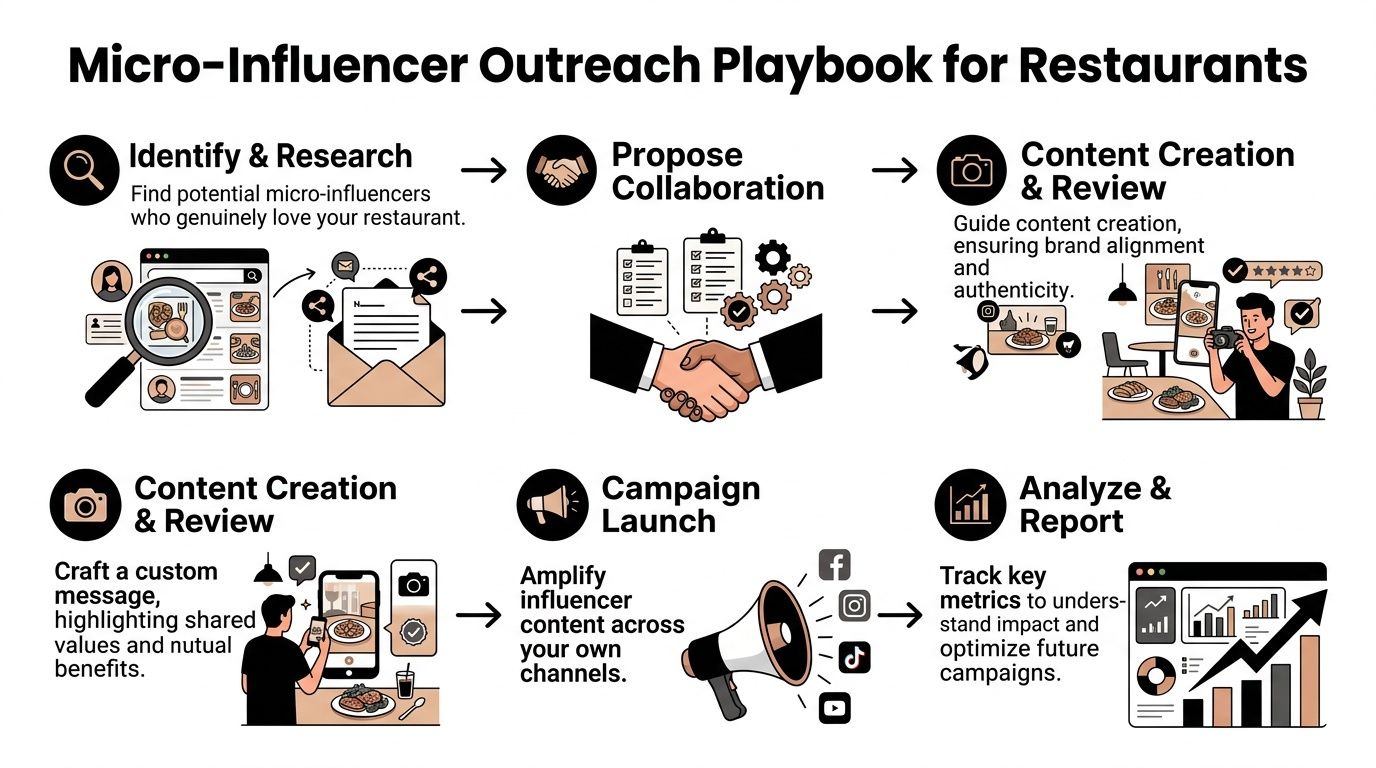
The Outreach and Campaign Activation Playbook
Once you know who you want to work with and what you’re offering, execution becomes the difference between a programme that feels polished and one that feels chaotic.
Many restaurants stumble by identifying good people, sending rushed messages, forgetting to brief the team, and hoping the content lands well. That’s avoidable.
Start with a message that sounds human
The best outreach feels like recognition, not recruitment. You’re contacting someone because they already fit your restaurant, not because you copied and pasted their handle into a spreadsheet.
A strong first message usually does four things:
- Acknowledges something specific they posted or said
- Makes clear why they’re a fit for your venue
- Suggests a simple collaboration
- Keeps the next step easy
Here’s a DM template that works well for a single-location restaurant:
Hi [Name], thanks for posting about your visit to [Restaurant]. We loved how you captured [specific dish or moment]. We’re putting together a small group of local customers and creators we’d love to host for selected menu features. If that sounds like your kind of thing, I can send over the details.
For a chain with a more formal process, email tends to work better:
Subject: Invitation to collaborate with [Restaurant Location] Hi [Name], We’ve seen your content around local food spots in [City], and your style feels like a strong fit for [Restaurant]. We’d love to invite you in for a hosted experience at our [Location] venue in exchange for content if it feels like a match on your side too. If you’re interested, I’ll send over the menu details, timing options, and content expectations. Thanks, [Name]
If your team needs extra help tightening that first message, this guide on how to reach out to influencers is useful because it shows how to make outreach specific without sounding stiff.
Keep the brief tight
Restaurants often over-brief or under-brief. Neither helps.
A good one-page brief should include:
- The purpose of the visit: Launch, seasonal push, quiet-day footfall, new location awareness
- The must-have tags: Handle, location tag, campaign hashtag if you’re using one
- The practical deliverables: Story, Reel, carousel, or a combination
- Any tracking element: Promo code, booking link, or landing page
- Disclosure guidance: #ad or #gifted where appropriate
- Content boundaries: Don’t script every caption, but do note anything legally or operationally important
The brief should shape the work without flattening the creator’s voice. If it reads like your brand manager wrote an advert for them to copy, the content will look forced.
A useful benchmark comes from a structured UK restaurant model outlined by ResDiary’s guide to influencer marketing for restaurants, which frames the process around five steps: identifying high-engagement diners, offering tiered rewards with trackable codes, providing simple content kits, monitoring via dashboards, and repurposing UGC. The same source says UK restaurants using that model saw 22% follower growth and 18% booking uplift.
Prepare the visit like service matters, because it does
A creator visit is still a guest experience. If the host is confused, the kitchen misses the pacing, or nobody knows what was promised, the collaboration starts to wobble before the first dish lands.
Before the visit, make sure these details are settled:
- Booking notes: Name, handle, party size, time, incentive agreed
- Service window: Avoid your busiest crush if you want better attention and content
- Menu plan: Decide what should be tried and in what order
- Floor communication: Host, manager, and server should know the basics
- Kitchen awareness: Don’t surprise the pass with a creator brief mid-service
Here’s where a lot of single-site venues win. They can make the experience feel personal. Chains can still do that, but only if the process is documented well enough that each location executes the same standard.
Give creators a content kit, not a script
A content kit can be simple. It might include the best seats for natural light, signature dishes to shoot first, plating notes, and your preferred spelling for menu names.
That’s enough to improve quality without smothering authenticity.
A practical content kit can include:
- Best shooting spots: Window tables, bar pass, outdoor frontage
- Visual priorities: Hero dishes, pours, cheese pulls, garnish moments
- Brand cues: Tone, colours, plating details worth highlighting
- Usage permissions: A simple line confirming whether you may repost or use content later
Later in the campaign, use this as a visual reference point for your team.
Always secure usage rights clearly
A lot of restaurants remember to ask for a post and forget to ask for reuse.
That’s a waste. Good customer creator content can support your Instagram feed, website gallery, paid social, email campaigns, and local launch materials. But only if you’ve got permission.
Put it in writing, even if the arrangement is friendly. Keep it simple and direct:
Thanks again for visiting. With credit to your handle, are you happy for us to repost your content across our organic channels and use selected assets in future marketing?
Don’t assume. Ask.
Measuring What Matters From Social Posts to Booked Tables
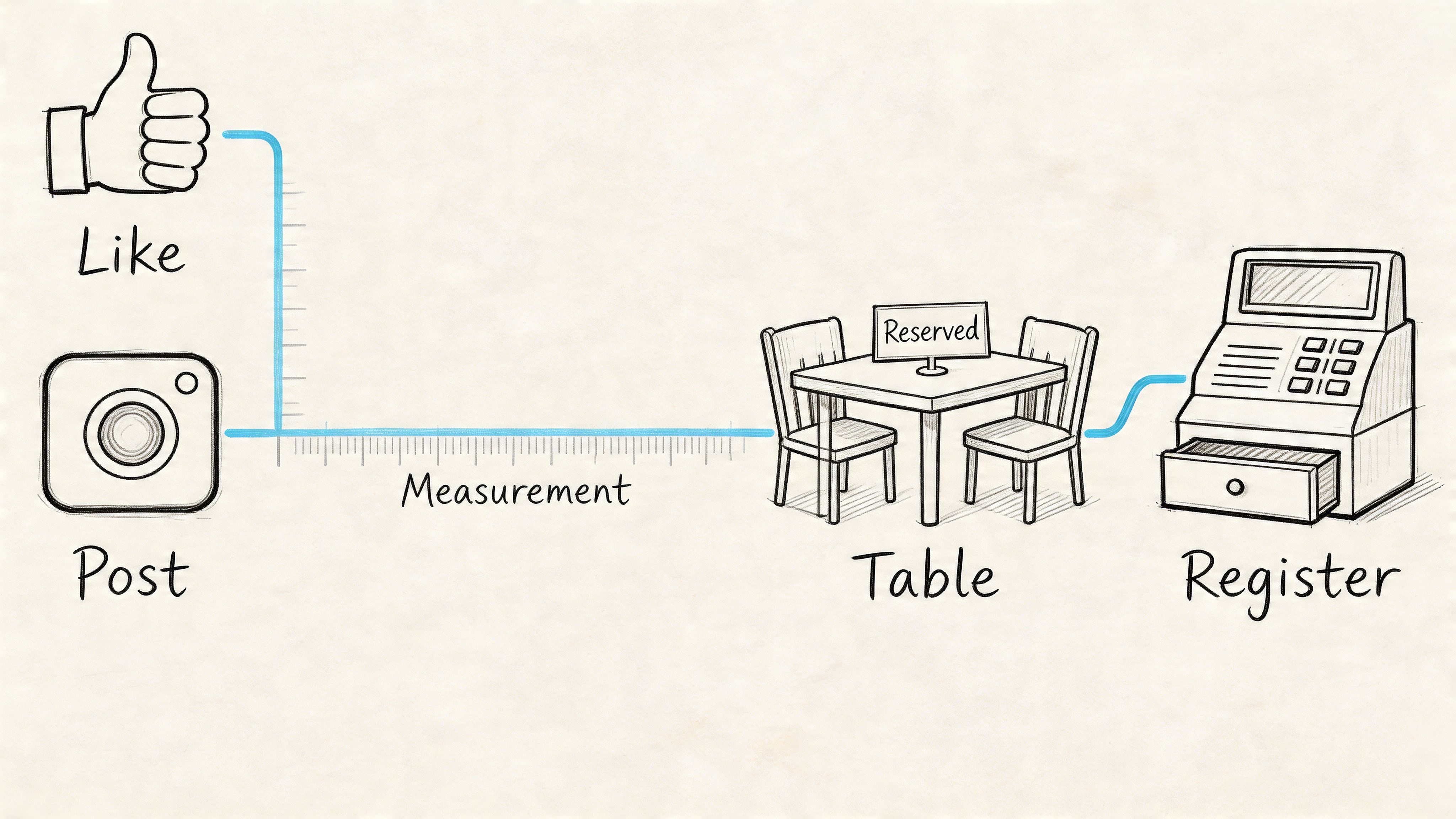
If you can’t connect creator activity to business outcomes, you don’t have a marketing channel. You have a scrapbook.
That sounds blunt, but it’s the truth. Restaurants lose money on influencer work when they treat likes as the end point. The real question is whether the content helped drive bookings, redemptions, walk-ins, or future reusable assets that improve performance elsewhere.
The minimum viable tracking setup
You don’t need an enterprise stack to start measuring. You do need discipline.
At minimum, give each creator:
- A unique promo code: Easy to say, easy to remember, easy to tie back to one person
- A unique UTM link: Especially useful if you take online bookings or sell vouchers
- A campaign log: Who posted, when, what offer was used, and what happened afterwards
This is the core of a proper attribution framework. According to Deliverect’s guide to working with food influencers, UK restaurant attribution should include sourcing customers via location tags, launching with trackable UTMs and promo codes, tracking views, clicks, and revenue in a real-time dashboard, analysing traffic in GA4, and A/B testing content formats. The same source notes that 45% of campaigns fail measurement without this framework.
What to track for a single location
An independent restaurant can keep this surprisingly lean.
A spreadsheet with one row per creator is often enough if the campaign volume is low. Track:
- Creator name and handle
- Visit date
- Offer given
- Code assigned
- Link assigned
- Post type and posting date
- Bookings or redemptions tied to that creator
- Notes on comments, saves, and quality of audience response
That final line matters more than many operators think. A creator might not drive immediate bookings but may produce strong signals like “saving for Friday” or “we’ve been meaning to try this place.” That’s not the final KPI, but it’s useful directional evidence.
If you want a cleaner framework for deciding which numbers matter, this breakdown of influencer marketing metrics that actually matter is worth reviewing.
What to track for chains and groups
Chains need another layer because multiple locations create attribution noise.
If the same campaign runs across several cities, head office needs a consistent naming structure for links, codes, reporting windows, and content formats. Otherwise every local team reports differently and the whole dataset becomes unreliable.
For multi-site brands, I’d separate reporting into three buckets:
| Reporting bucket | What it should answer |
|---|---|
| Creator performance | Which creators drove clicks, code use, bookings, or strong audience response |
| Location performance | Which sites converted creator activity into real visits most effectively |
| Content performance | Which formats and messages produced the best commercial signals |
Don’t ignore offline reality
Restaurants are not pure ecommerce businesses. A lot of value still shows up in the dining room before it shows up in analytics.
That means your tracking has to include operational habits as well as digital tools. Hosts should ask how guests heard about the venue. Staff should know active creator codes. Managers should review spikes in covers around campaign posts instead of only reading platform dashboards.
Good attribution in restaurants is rarely one tool. It’s a chain of small habits that connect online attention to offline behaviour.
Metrics that matter and vanity metrics that don’t
Views can be useful. Reach can be useful. Engagement can be useful. None of them are enough on their own.
Pay closest attention to:
- Code redemptions: The cleanest signal of direct response
- Tracked bookings: Especially from a creator-specific link
- Footfall patterns around posts: Imperfect, but often revealing
- Repeat creator performance: One good post is less meaningful than repeated business impact
- Reusable content quality: Can this asset reduce future content production pressure?
What matters less than many restaurants think:
- Follower count by itself
- Likes without comments or saves
- Generic praise from non-local audiences
- Screenshots of reach with no commercial follow-through
If a creator’s content looks good but never helps you fill a quiet Tuesday or sell a launch menu, they may still be a content partner. They probably aren’t a performance partner.
Scaling Your Programme and Maximising Content Value
Once the first few collaborations work, most restaurants face a new problem. They’ve proved the idea, but the process still depends on memory, goodwill, and whoever happens to be organised that week.
That’s the stage where a creator programme either becomes a proper operating system or falls apart.
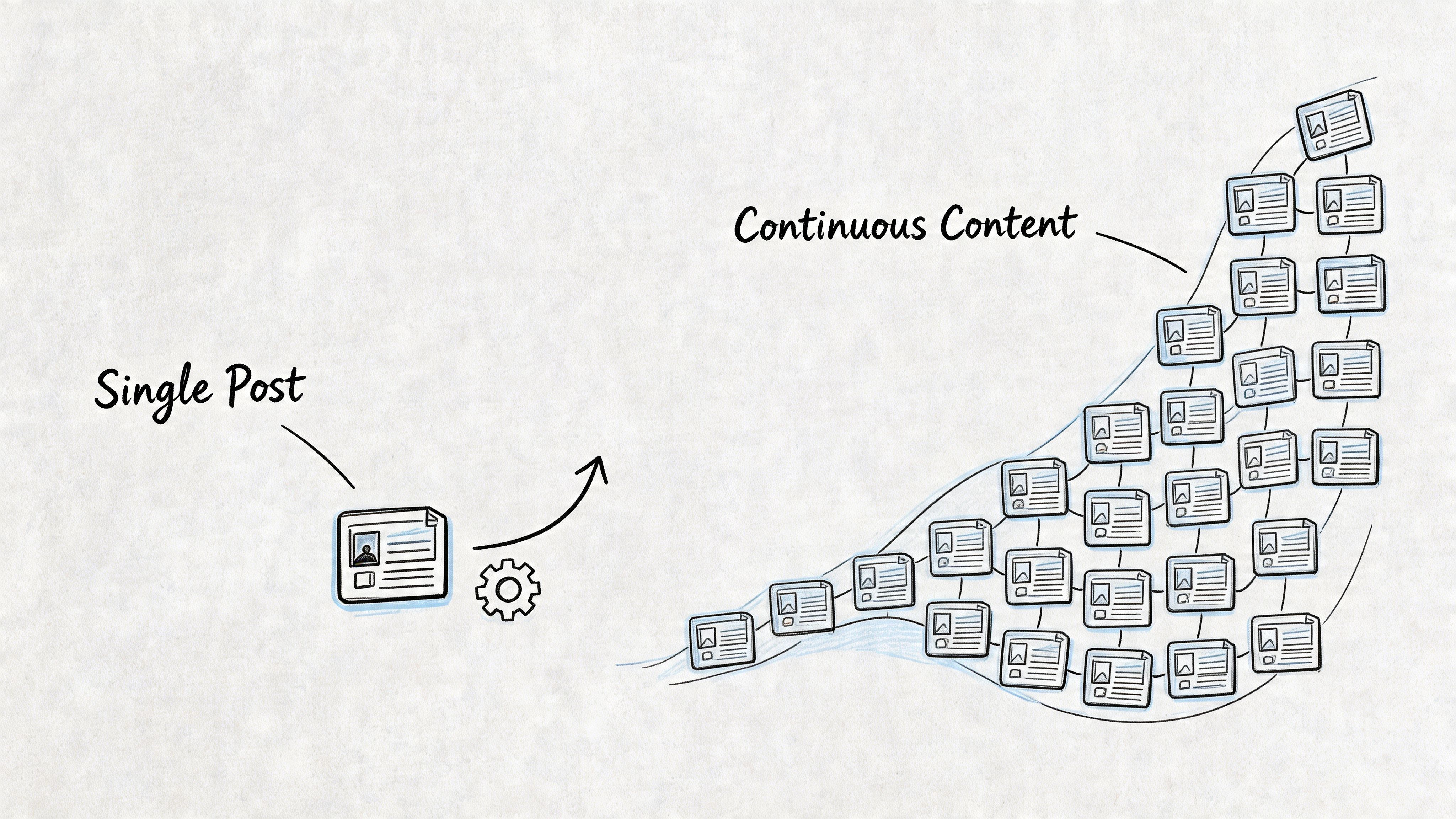
Build an ambassador programme, not a pile of one-offs
A repeatable programme needs structure around people, assets, and reporting.
For an independent restaurant, that may be a small bench of regulars and local creators you can activate around menu drops, events, and quieter trading windows. For a multi-city group, it usually means a formal ambassador layer at local level with central oversight on standards, approvals, and reporting.
The aim is simple. You want to know:
- who your reliable creators are
- what kind of content each person makes well
- what offer each person responds to
- what commercial result tends to follow
Once you have that, campaigns stop starting from zero.
Treat UGC like inventory
Restaurants are often much better at collecting invoices than content. That needs to flip.
Every useful creator asset should be saved, tagged, and filed in a way your team can use later. Not lost in someone’s bookmarks. Not buried in a WhatsApp thread. Properly organised.
A strong UGC library should classify assets by:
- Location
- Menu category
- Season or campaign
- Format
- Permission status
- Performance notes
That gives you more than a social archive. It gives you a working content bank for email, organic social, landing pages, and ads. If your team wants a practical framework for reuse, this guide on repurposing influencer content for paid social ads is useful.
The value of a creator post doesn’t end when the Story expires. In many cases, the post is only the first use.
What scaling looks like for chains
Multi-location groups have a harder job because local authenticity and central control pull in different directions.
Local teams know who’s relevant in their area. Head office knows what the brand can and can’t support. A scalable model respects both.
The cleanest operating model usually looks like this:
- Head office sets the rules: Incentives, disclosure language, permissions, reporting templates
- Local teams source and host: They know the market and the regulars
- Central marketing approves and audits: This keeps quality and compliance steady
- Shared dashboards consolidate results: Everyone works from one reporting standard
Some groups also use specialist platforms to manage creator communication and asset organisation. If you’re comparing tools, a saucial app for influencer management can help show what centralised coordination looks like in practice.
The hard part is still attribution
Scaling creator activity across locations is not mainly a sourcing issue. It’s an attribution issue.
According to this write-up on attribution challenges for restaurant chains, 62% of UK restaurant conversions happen offline, but only 29% of campaigns accurately attribute them. The same source says a 2026 Kantar study found that 47% of London chains overestimate influencer impact without proper tech, and that hybrid AI-human verification can cut fake engagement by 82%, which speaks directly to the creator vetting problem.
That’s why mature programmes don’t stop at promo codes. They combine digital tracking with local manager feedback, code redemption habits, visit notes, and quality control on creator selection.
Get more value from the same content
The easiest win in a scaling programme is often not signing more creators. It’s using existing content better.
A single useful creator visit can feed:
| Asset created | Secondary uses |
|---|---|
| Reel or TikTok | Paid social creative, website embeds, email features |
| Story sequence | Highlights, launch recaps, testimonial proof |
| Still images | Organic posts, menu pages, local listings, posters |
| Review-style caption | Website testimonials, newsletter copy, social proof blocks |
That approach helps both small operators and chains. Independents stretch limited production budgets further. Chains avoid asking every site to create fresh brand content from scratch all the time.
The basic rule is simple. Don’t just run campaigns. Build assets, systems, and reporting habits that improve every campaign after the first one.
Frequently Asked Questions
How much time does this take each week
More than restaurants expect at the start, and less than they fear once the system is set.
The heavy lifting is upfront. You need to identify creators, define offers, write templates, brief staff, and set up tracking. After that, the work becomes more operational. Reviewing tags, sending invites, hosting visits, logging results, and organising content.
For a single location, one organised manager or marketer can usually keep a small programme moving. For a chain, the time problem is less about hours and more about coordination.
What if a customer posts negative feedback after a hosted visit
Treat it like any other guest feedback. Don’t panic and don’t get defensive in public.
If the criticism is fair, use it. Reach out politely, thank them for the visit, and address the issue directly. If the experience broke down operationally, fix that first before inviting more creators in.
What doesn’t work is trying to control every opinion. If you only want guaranteed praise, you’re not building authentic advocacy. You’re buying scripted promotion, and audiences can usually tell.
Should every creator get the same offer
No. Equal treatment sounds fair, but it usually creates weak economics and poor fit.
Offers should reflect the creator’s relevance, past performance, content quality, and the value of the campaign. A regular who posts one Story can still be worth hosting. They just shouldn’t automatically receive the same package as someone producing a polished video and driving tracked bookings.
Consistency matters in process. Uniformity in reward often doesn’t.
What if we don’t have online booking
You can still run a measured programme.
Use creator-specific promo codes at the till, train front-of-house to ask how guests heard about you, and keep a simple campaign log. If you’re disciplined, you can still spot patterns around covers, redemptions, and campaign windows.
Offline restaurants shouldn’t give up on attribution. They just need a more operational version of it.
How do we avoid awkward outreach to existing customers
Lead with appreciation and fit. Don’t message people like they’ve applied for a job.
Reference their visit, mention the specific content they posted, and invite them into something small and relevant. The tone should feel like a local relationship, not a procurement exercise.
A clumsy message usually sounds mass-sent. A good one sounds observant.
When should we move someone from one-off guest to ambassador
When they do three things reliably. They create content that fits your brand, they’re easy to work with, and their activity produces useful business signals.
That doesn’t always mean direct redemptions every time. Sometimes it means strong local response, consistent quality, and content you can keep reusing. But if someone repeatedly delivers weak fit, vague communication, or no visible impact, don’t force the relationship.
What’s the biggest mistake restaurants make
They confuse activity with a programme.
Posting a giveaway, hosting a creator dinner, or comping a meal can all be useful. But none of that becomes a growth channel until you can repeat it with the right people, the right offers, and the right measurement. That’s the line between dabbling and building.
If you want help building a customer-to-creator system without managing manual DMs, spreadsheets, tracking codes, and follow-ups yourself, Sup gives restaurant teams a done-with-you way to source local creators, launch campaigns, track bookings and revenue, and build a reusable UGC engine around what’s already happening in your dining room.
More on industries
See how many creators post about you and your competitors
Type in your brand's Instagram handle and we count the creators who post about you and about your five closest competitors. It takes about a minute and it is free. Or request a demo and we will show you the creators in your niche and walk you through the dashboard.
 Book a call