21 March 2026
How to Repurpose Influencer Content for Paid Social Ads
If you're already investing in influencer marketing, you’re sitting on a goldmine of ad creative. The trick is knowing how to turn those authentic, organic posts into high-performing paid social ads. It’s a process that bridges the gap between getting a shoutout and getting scalable, predictable results.
This isn't just about reposting a creator's content; it's a deliberate strategy. You start by securing the rights to use the content in your creator contracts, then you edit those assets to fit specific ad platform specs, and finally, you put targeted ad spend behind them to reach your ideal customers.
The Untapped Goldmine in Your Influencer Campaigns
Let's be honest, many brands still run their influencer and paid social teams in completely different silos. It’s an old-school approach that’s both inefficient and expensive. Influencer collaborations are seen as one thing, paid ads another.
The real growth comes from merging the two. When you do, you stop paying for one-off posts and start building a library of evergreen ad creative. Every great piece of influencer content becomes a long-term asset, constantly driving measurable returns and slashing your creative production costs.
I’ve seen it time and again: the brands that win are the ones who nail three things. First, they secure the rights to use the content. Second, they optimise that creative for their ad platforms. And third, they track performance obsessively. Get this system right, and your influencer content will work much harder for you.
This whole idea is a form of content repurposing, which is really just about working smarter, not harder, with the creative you've already paid for.
From Organic Posts to Performance Ads
The shift from simply chasing organic reach to demanding performance-driven outcomes is undeniable. In the UK, where influencer marketing ad spend was projected to hit a staggering £930 million in 2024, repurposing creator content has become a crucial advantage.
Think about the sheer volume of available creative. With 93% of UK marketers already partnering with micro-influencers, the pool of authentic, engaging content is huge. For sectors like e-commerce and restaurants, this is especially powerful, given that 78% of UK consumers say they trust influencer recommendations enough to make a purchase.
To make this strategy work, we need to focus on three essential stages. These pillars form the foundation of a repeatable system for turning influencer content into winning ads.
Core Pillars of Repurposing Influencer Content for Ads
| Pillar | Key Focus | Primary Outcome |
|---|---|---|
| Rights | Securing perpetual, paid media usage rights in contracts. | A legally-sound library of creator content ready for advertising. |
| Optimise | Editing content for different platforms and ad formats. | High-performing ad creative tailored for specific placements (e.g., Reels, Stories). |
| Track | A/B testing creative, audiences, and monitoring KPIs. | Data-driven insights to scale winning ads and improve future campaign performance. |
Following this framework moves you from guesswork to a structured, repeatable process.
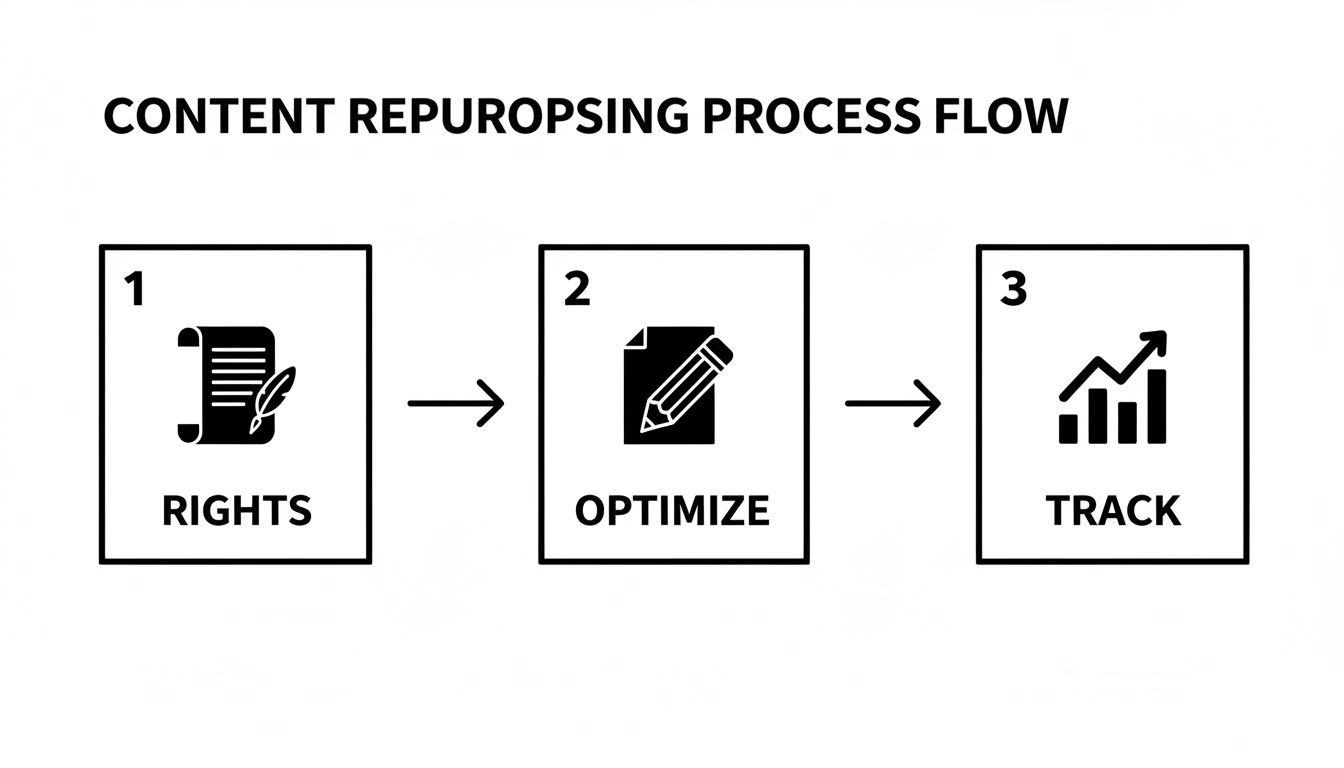
This simple workflow is the key to unlocking a scalable and repeatable process for your campaigns.
For any brand, this is the starting point for building a system where every piece of content generates measurable results. We've seen this play out with great success in the food and beverage industry, and you can see real examples of how restaurants use influencer content as paid ad creative to drive footfall and online orders. It’s all about turning those scattered collaborations into a predictable channel for growth.
Sorting Out Content Rights for Paid Ads
It’s a familiar feeling. You spot a fantastic Reel or TikTok from an influencer that’s perfect for your brand, and your first instinct is to throw some ad spend behind it. But hold on. Before you even think about your budget, you absolutely must secure the legal rights to use that content.
I’ve seen too many marketers get swept up in the excitement of a viral post and rush to boost it, only to land in a legal mess down the road. Getting your content rights sorted isn't just a box-ticking exercise; it’s the bedrock of your entire paid social campaign.
Failing to get explicit permission for paid media is probably the most common, and expensive, mistake you can make. You simply cannot repurpose an influencer's organic content for paid ads without a written agreement. In the eyes of the creator (and the law), their organic post and your paid ad are two completely different things.
A brand once repurposed a creator's video for a major ad campaign without the correct licence. The fallout was messy, damaging their reputation and costing them a significant payout. It’s a stark reminder of a simple truth: always get it in writing. An honest conversation upfront prevents a disaster later on.
What to Put in Your Agreements
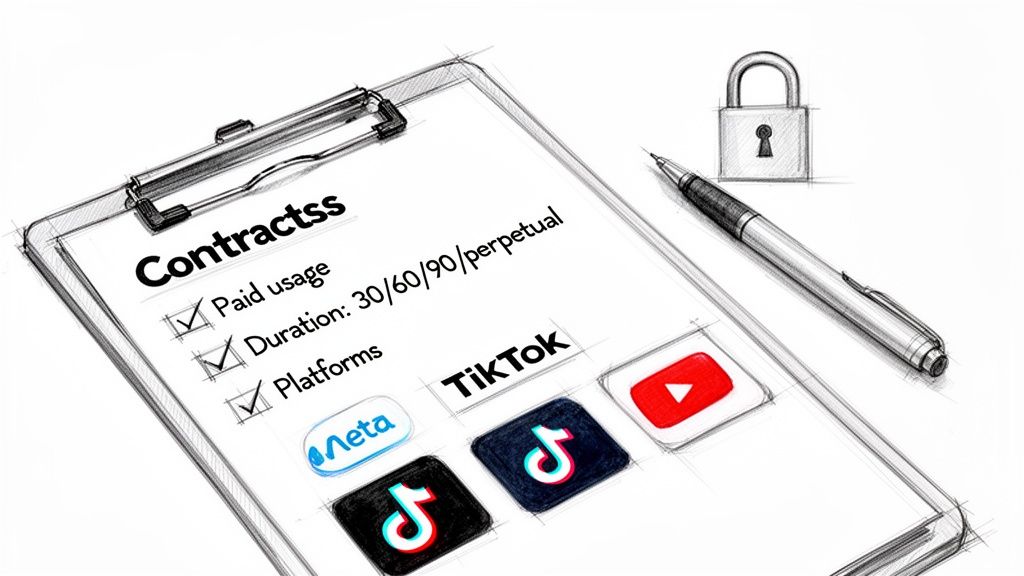
A vague contract is just asking for trouble. Your influencer agreements have to be crystal clear about how, where, and for how long you can use their content. A generic clause like "brand may use content" won't cut it. You need specifics to protect your brand and, just as importantly, your relationship with the creator.
At a minimum, your contract must spell out the difference between organic usage (the creator posting to their own feed) and paid media usage (you running it as an ad from your brand's account).
Here’s what I always insist on having in writing:
- Scope of Use: State that the rights are specifically for paid advertising purposes.
- Permitted Platforms: Name the exact channels, like "Meta platforms (Instagram, Facebook), TikTok, and YouTube." Don’t leave it open to interpretation.
- Editing Permissions: Clarify what you’re allowed to do. Can you add text overlays, trim clips, or create different versions for testing? Get that permission upfront.
- Exclusivity: Define if the creator can't work with your direct competitors for a certain period. This protects your investment.
Getting this right from the start turns a one-off post into a valuable, reusable asset for your ad account.
How Long Should You Have the Rights For?
Perpetual rights (the ability to use content forever) might sound tempting, but they're usually expensive and honestly, a bit overkill. Most influencer content has a pretty short shelf life anyway. A much smarter (and more cost-effective) approach is to negotiate rights for a set amount of time.
I generally work with these timeframes:
- A 30-day licence is perfect for testing. It gives you enough time to see if a piece of creative has potential without a huge financial commitment.
- A 60-90-day licence works well for content that’s already proven itself in testing. This lets you put serious budget behind a winner for a full quarter.
- Perpetual rights should be reserved for those rare, truly exceptional pieces of evergreen content you know you'll use for years. Just be ready to pay a premium for it, often 100-200% on top of the creator's base fee.
The UK influencer market is set to be worth over £1.2 billion by 2026, and with 66% of brands ramping up their paid media spend, getting your rights management right is non-negotiable. Thankfully, the industry's overall compliance is high at 92%, setting a clear standard for transparency. Using a platform like Sup can really help here, as it lets you build campaigns with clear tracking from the get-go, creating a library of attributable UGC that's primed and ready for paid ads. You can dig into more UK influencer marketing statistics to get a better feel for the market. This way, a single piece of creator content becomes a compliant and powerful asset across all your channels.
From Raw Clips to High-Converting Ads
Once you've secured the rights to an influencer's content, you're not at the finish line. You're at the starting block. This is where the real creative work begins. A raw video file isn't a ready-made ad; it’s the clay you’ll use to sculpt several brilliant ones. The trick is to transform this authentic, user-generated content (UGC) into a paid social ad that performs without losing its soul.
Your main goal is to keep that raw, native feel that makes UGC so effective in the first place, while tailoring it for a paid environment. If you over-polish it with slick graphics or a corporate voiceover, you'll strip away its authenticity. It’ll just look like every other ad people scroll past. The secret is a light touch: enhance what’s there, don’t reinvent it.
Identifying Your Golden Moments
Let's be honest, not every second of an influencer’s video is going to be ad-worthy. Your first job is to become a prospector, sifting through the raw footage to find those "golden moments" that will stop someone mid-scroll. I always recommend watching the entire clip at least twice, tagging any moments that grab your attention.
Here’s what I look for:
- A Killer Hook: The first 1-3 seconds are make-or-break. Is there a provocative question, a surprising visual, or a bold statement that immediately piques curiosity? That's your hook.
- A Clear Product Shot: Find the part where the product is being used naturally and its benefits are crystal clear. Think of someone's eyes widening after tasting a dish or their genuine excitement during an unboxing.
- An Authentic Reaction: Real emotion is magnetic. A genuine laugh, a look of surprise, or an unscripted testimonial will always be more persuasive than a polished marketing line.
For instance, say a creator sends you a two-minute review of your restaurant. You might pull a 3-second clip of them savouring that first bite of pasta, a 5-second pan showing off the restaurant's buzzing atmosphere, and a 10-second snippet where they declare, "This might be the best carbonara in London." Each of these is a potential ad just waiting to be made.
Editing for Each Social Platform
Once you've got your clips, you need to edit them to feel at home on each platform. A one-size-fits-all video just doesn't cut it anymore; it'll underperform everywhere. The key is making your ad feel like it belongs in someone's feed, not like it's crashing the party.
This is a common pitfall. I've seen countless brands take a beautiful landscape video and try to shoehorn it into a vertical story, leaving it awkwardly cropped and feeling completely out of place. Platform-specific editing isn’t just a nice-to-have; it's essential.
Your ad should feel like a natural part of the conversation, not an interruption. When you repurpose influencer content, you're borrowing its credibility. The best way to maintain that credibility is to format the ad so it looks and feels like it belongs on the platform where it’s being shown.
Here are a few non-negotiables for editing:
- Go Vertical: For platforms like TikTok, Instagram Reels, and YouTube Shorts, you have to edit in a 9:16 aspect ratio. This vertical format fills the entire mobile screen, creating a far more immersive and native experience.
- Caption Everything: An incredible number of users (some studies suggest up to 85%) watch videos with the sound off. Adding bold, easy-to-read captions ensures your message lands, even in silence. Don’t just rely on the platform's auto-captions; create styled text overlays that feel like part of the creative.
- Keep It Short and Sharp: Attention spans are fleeting. Aim for ad lengths between 15-30 seconds. You need to deliver value and a clear call-to-action before they swipe away.
Turning One Clip Into Many Ads
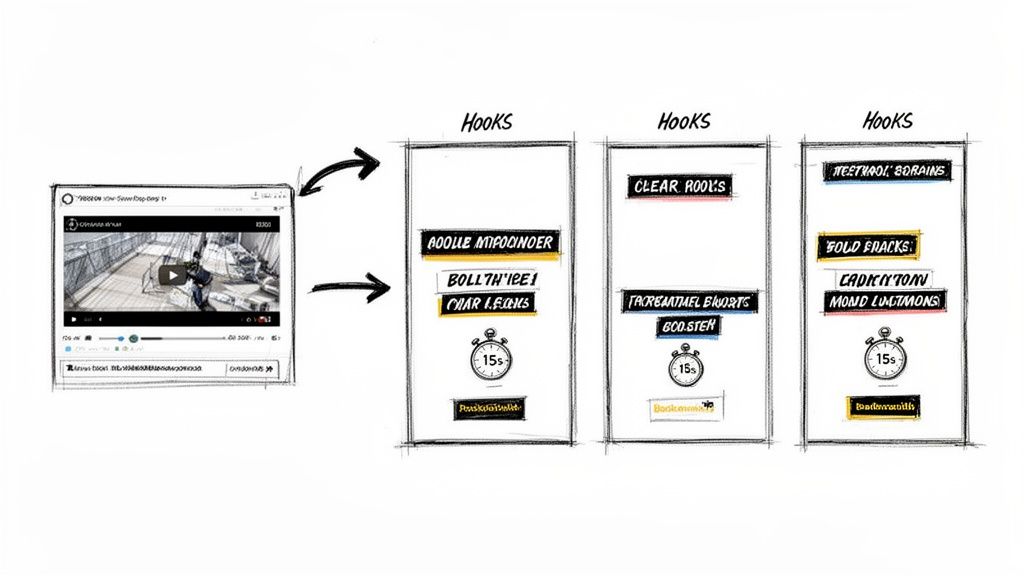
The smartest way to repurpose influencer content is to think in variations. A single, solid piece of UGC can be sliced, diced, and remixed into a whole suite of ad creatives for testing. This is how you scale production efficiently, without needing a constant firehose of new raw content.
Let’s go back to our restaurant example. That one two-minute video can fuel an entire ad campaign.
- Ad 1 (The Hook Test): Create a 15-second clip focused squarely on the "best carbonara" quote. Add a text overlay that asks, "Is this the best pasta in London?" The CTA could be "Book a Table."
- Ad 2 (The Vibe Test): Use the 10-second pan of the restaurant's interior to create an ad with captions like "Our new favourite date night spot." This tests whether the atmosphere resonates more than a specific dish.
- Ad 3 (The Reaction Test): Isolate that 7-second clip of the creator's delighted reaction to their first bite. This ad leans entirely on raw emotion to build curiosity and drive clicks.
By creating these variations, you can A/B test different hooks, angles, and calls-to-action to discover what truly connects with your audience. This data-driven approach is the foundation of any successful paid social strategy. For brands just starting out, mastering how to get creator content that converts is the perfect first step toward building a powerful UGC pipeline.
Targeting Strategies for Influencer-Powered Campaigns
So, you’ve edited your influencer clips into some fantastic-looking ads. The next question is, who are you going to show them to? Simply hitting "boost" and hoping for the best is a sure-fire way to burn through your budget with little to show for it.
This is where precision targeting comes in. It’s what separates the campaigns that fizzle out from the ones that deliver serious results, ensuring every pound you spend is working as hard as possible. The brilliant thing about using influencer content is that you're not starting from a blank slate. You're tapping into a pre-built community, giving you a huge advantage over traditional, brand-first advertising.
Tapping Into the Creator’s Audience
Your first port of call should always be the people who already know and trust the influencer. This is your warm audience, and they’re far more receptive to an ad because it features a familiar, credible face.
There are a couple of smart ways to reach them:
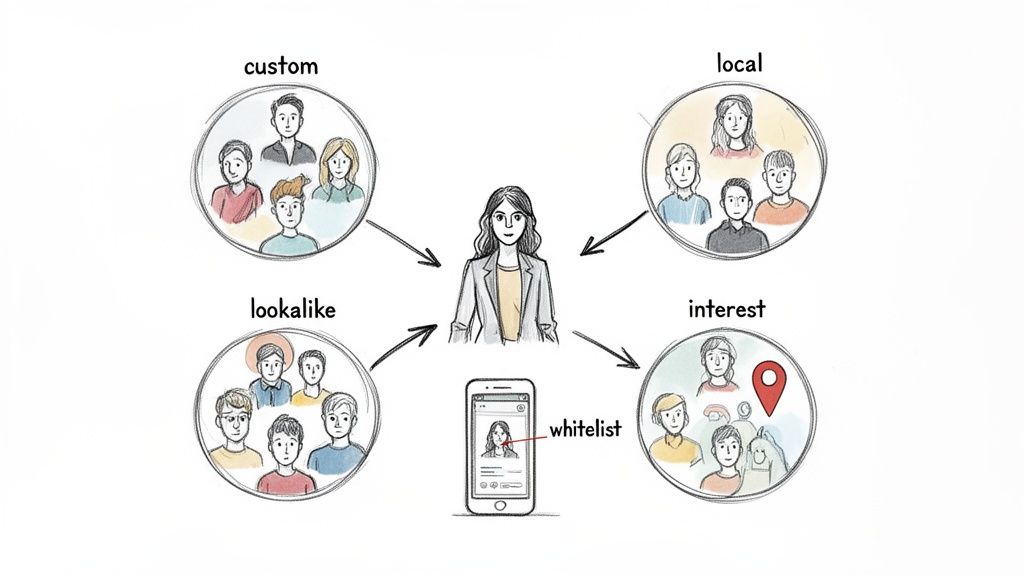
- Custom Audiences: Build a highly-engaged audience list by targeting users who have recently interacted with the creator's profile, watched their videos, or engaged with their posts. These are their most loyal followers.
- Lookalike Audiences: This is where you can really scale. Take your Custom Audience of engaged followers and ask the platform's algorithm to find millions of other users who share similar interests and online behaviours. It’s a powerful way to find new customers who act just like the creator’s biggest fans.
An ad featuring an influencer is exponentially more powerful when served to their own lookalike audience. You're combining a trusted messenger with a hyper-relevant audience, creating a perfect storm for high conversion rates. It’s the closest you can get to a personal recommendation at scale.
For instance, say you’ve worked with a micro-influencer in Manchester on a great video for your new vegan cafe. You can create a Lookalike Audience based on their engaged followers and then layer it with location targeting for Manchester. All of a sudden, you're reaching thousands of local foodies who are primed to trust that recommendation and pop in for a visit.
The Power of Whitelisting
If you want to take authenticity to the next level, you need to look at whitelisting (sometimes called allowlisting). This is an advanced tactic where you get permission to run your ads directly through the influencer's social media account, not your own.
Think about it. When most people see an ad from a brand, their guard immediately goes up. But when they see a "Sponsored" post from a creator they already follow and like, it feels more like a genuine tip-off. This subtle shift can have a massive impact on performance, often leading to a lower cost-per-click (CPC) and a higher click-through rate (CTR).
Whitelisting does require a solid relationship and a clear agreement with the creator, as they'll need to grant you access to their ad account. Because of this, it's a strategy best reserved for your most trusted, long-term partners.
Matching Targeting to Your Business Goals
Your targeting strategy has to be tailored to what you're actually trying to achieve. A direct-to-consumer (DTC) brand selling nationwide has very different needs from a local restaurant trying to get more people through the door.
- For Local Businesses: Go hyper-local. Use content from micro-influencers in your area and target by postcode, city, or a tight radius around your business. Layer this with interests relevant to what you do (e.g., "fine dining," "craft beer," "live music").
- For E-commerce/DTC Brands: You can cast a wider net. Start with your creator Lookalike Audiences, then begin testing broader interest and behavioural audiences. Don't be afraid to target people interested in your competitors, related hobbies, or those who show strong online shopping signals.
The market is moving fast. By 2026, UK brands are projected to spend $1.6 billion USD on influencers each year, with 81% planning to increase their budgets. With 93% of UK marketers prioritising micro-influencers for their highly engaged communities, building Lookalike Audiences from this base is a proven strategy. Given that consumer trust in influencer advice is at 78%, running these ads to targeted segments amplifies that trust, turning views into real, measurable sales. If you want to dive deeper, you can explore more statistics on the rise of UK influencer marketing.
Measuring Performance and Optimising for ROI
Getting your repurposed influencer ads live is a great start, but the real work begins now. Without a sharp eye on what’s working and what isn’t, you're just throwing money at the wall and hoping something sticks. You need to know, without a shadow of a doubt, which creative is actually driving sales.
Paid social platforms give us a mountain of data, but it’s easy to get lost in vanity metrics. The key is connecting your ad spend directly to revenue. This is where a rock-solid attribution strategy separates the pros from the amateurs, giving you concrete proof of performance.
Setting Up a Bulletproof Attribution Framework
To really understand performance, you have to be able to trace every click and every pound earned back to its source. For me, this boils down to two non-negotiable tools: UTM parameters and unique discount codes.
Think of UTM parameters as little breadcrumbs you add to your URLs. They tell your analytics platform exactly where a user came from. You can, and should, create a unique link for each ad creative and audience you’re testing. This level of granularity lets you see precisely which influencer clip, paired with which audience, is hitting the mark.
At the same time, giving each influencer’s ad set a unique discount code (like "SOPHIE15") gives you a direct line of sight to sales. When a customer uses that code, you know with 100% certainty which ad drove that purchase.
Combining unique UTMs with specific discount codes creates a powerful, multi-layered tracking system. It eliminates all guesswork. You can confidently say, "This clip from this creator drove £X in sales," which is the exact insight needed to justify and scale your budget.
The A/B Testing Flywheel: Your Engine for Growth
With your tracking locked in, it’s time to start optimising through A/B testing. The goal isn't just to run a single test but to build a continuous "flywheel" where data from one experiment fuels the creative ideas for the next.
The golden rule? Test one thing at a time. If you change the hook, the caption, and the call-to-action all at once, you’ll never know which element actually moved the needle. Keep your tests clean to get clear, actionable results.
Here are the crucial elements I always test with repurposed influencer ads:
- The Hook (First 3 Seconds): This is everything. Test different opening clips from the same piece of UGC. Does starting with a question grab more attention than a bold statement? Does a surprising visual beat a straight product shot?
- Ad Copy and Captions: Play around with different lengths and tones. Pit a short, punchy caption against a longer one that tells more of a story. See what your audience responds to.
- The Call-to-Action (CTA): This one’s simple but powerful. Test your CTA buttons and the text itself. Does "Shop Now" outperform "Learn More" for your specific offer?
- The Creative Clip: Put two completely different clips from the same creator head-to-head. You might be surprised which one truly resonates with your audience and drives the best results.
Identifying Your Key Performance Indicators (KPIs)
To make sense of your test results, you need to know which numbers actually matter for your campaign goals. A campaign aimed at driving sales will have very different KPIs from one focused on brand awareness.
This table breaks down the essential KPIs to track based on your primary objective, helping you measure what really counts.
KPIs for Repurposed Influencer Ad Campaigns
| Campaign Objective | Primary KPI | Secondary KPIs | Good Benchmark |
|---|---|---|---|
| Brand Awareness | Reach / Impressions | Video Views, CPM | £3 to £7 CPM |
| Consideration | Click-Through Rate (CTR) | Cost Per Click (CPC), Link Clicks | 1% to 2% CTR |
| Conversions | Return on Ad Spend (ROAS) | Cost Per Purchase (CPP), Conversion Rate | 2.5x+ ROAS |
By focusing on the right metrics, you can quickly identify winning creatives and turn off the ones that are draining your budget.
Methodical testing is how you move from making assumptions to making data-driven decisions. To get the most from your efforts, you should also continually learn how to optimize Facebook Ads, as platform-specific tactics can make a huge difference. For a deeper dive, check out our guide on how to measure influencer marketing ROI.
Common Questions on Repurposing Influencer Content
Once you start thinking about turning great influencer content into paid social ads, a lot of questions pop up. It's a smart move, but moving from organic posts to a full-blown ad strategy means getting the details right. We hear the same questions from marketers all the time.
So, let's clear the air. My goal here is to give you straightforward answers so you can move forward, build better relationships with creators, and make sure every pound you spend on ads is pulling its weight.
How Much Should I Pay for Influencer Content Usage Rights?
There's no magic number here. The price for usage rights really depends on the creator's audience, how long you want to run the ads for, and on which platforms. The best way to think about it is as a percentage of what you paid for the original content creation.
A good starting point for a standard 30-day paid media licence is an extra 15-25% on top of their base fee. If you’re looking for a longer run, say 90 days, that figure can easily jump to 50% or more. And for "in-perpetuity" rights (where you can use the content forever), you should expect to pay a serious premium, often 100-200% of the original fee.
Here's a tip I always give: start small. Don't pay a fortune for year-long rights on untested content. Negotiate a 30-day licence first. If the ad performs well, you have hard data to justify going back to the creator and paying to extend the licence. It’s a much safer bet.
With micro-influencers, you'll find there's often more flexibility. I've seen brands successfully bundle a 30 or 60-day paid licence into the initial fee, especially when they have a solid, long-term partnership. The most critical thing is to get it all in writing. Your contract needs to spell out the term (e.g., '60 days from ad launch date') and the platforms ('Meta platforms including Instagram and Facebook') in no uncertain terms.
What Makes UGC Good for Repurposing as an Ad?
The best content for paid ads is the stuff that feels real. It should look like it belongs on the platform and grab you instantly. Anything that looks too polished or staged tends to fall flat because it loses that raw, trustworthy vibe that makes user-generated content (UGC) work in the first place.
When you're sifting through creator content, here’s what to hunt for:
- A Killer Hook: The first three seconds are non-negotiable. Does the video kick off with something unexpected, a burning question, or a genuine emotional reaction? That’s what stops the scroll.
- An Organic Product Moment: The product can't feel forced. The golden moments are when it's being used to solve a real problem or is just a natural part of the creator's story.
- Real Emotion: You can't fake genuine excitement, humour, or surprise. Those unscripted reactions are far more convincing than any ad copy you could ever write.
Here's a little workflow hack: as you review footage, create a simple tagging system. Use labels like 'strong hook,' 'product demo,' 'funny moment,' or 'testimonial.' This builds a searchable library so when you need the perfect clip for a new campaign, you can find it in seconds.
Can I Edit Influencer Content Before Using It in Ads?
Yes, and you absolutely should, as long as you have clear permission. This is a non-starter without it. Your contract must explicitly state that you have the right to edit the content or create "derivative works." Most creators are totally fine with this, as long as your edits don't twist their words or misrepresent their original opinion.
Common edits usually involve:
- Trimming clips to fit different ad specs (like turning a 60-second video into a punchy 15-second Reel).
- Adding text overlays or captions to get the message across when the sound is off.
- Popping a branded end card on with your logo and a clear call-to-action.
Remember, this is a relationship. As a best practice, I always recommend sending the final edited ad to the influencer for a quick look before it goes live. It’s a simple act of respect that keeps them in the loop and ensures they’re happy with how they're being represented.
How Do I Track ROI from a Specific Influencer's Content?
If you can't connect ad spend to sales, you're just guessing. To really know if repurposing is working, you need a tight tracking setup.
The most reliable way to do this is with a mix of unique tracking links and dedicated discount codes. For every ad you make from a piece of content, create a specific UTM link. For example, your link might use a parameter like utm_content=influencerA_clip1. This lets you filter your analytics to see exactly which ad creative drove visits and revenue.
To take it a step further, give each influencer's ad set a unique discount code (e.g., 'JESSICA15'). When a customer uses that code at checkout, your e-commerce platform chalks up a sale directly to that campaign. Combining UTMs and codes gives you undeniable proof of what's working and what isn't, showing you a clear return on ad spend (ROAS).
Ready to turn your influencer collaborations into a predictable, ROI-proven growth channel? Sup combines AI with a human team to help you find creators, launch campaigns, and track real-time results from a single dashboard. Learn how Sup can save you 95% of your time and scale your influencer marketing.
More on content & ugc
See how many creators post about you and your competitors
Type in your brand's Instagram handle and we count the creators who post about you and about your five closest competitors. It takes about a minute and it is free. Or request a demo and we will show you the creators in your niche and walk you through the dashboard.