19 May 2026
7 Food Bloggers in London to Partner With (2026)
You're probably in the same spot most restaurant and brand teams hit when they start searching for food bloggers in london. The search results are crowded, every creator looks promising at first glance, and then the actual work starts. You chase replies across email and Instagram, sort through mismatched audiences, and end up trying to measure bookings or sales in a spreadsheet that nobody trusts.
That's the operational problem. The market itself is real and substantial. Feedspot's $2026 London food influencer ranking/$ lists 100 creators, and it includes London-based accounts such as The Lazy Foodie with 265.1K Instagram followers. Separate UK rankings also show food creators tied to London scaling far beyond local discovery, including Sophie Macfie at 1.62 million followers, Pretty Little London at 1.53 million, and Ben Lippett at 1.23 million in Joli's 2026 UK food-and-drink directory. That tells you food bloggers in london aren't a niche outreach channel. They're a serious local media layer.
This guide is built for marketers, not diners. It focuses on seven options you can use for campaign planning, partner vetting, outreach, and ROI tracking. If you're also tightening your broader local acquisition stack, pair this with $AI Tools for Local SEO/$.
1. Sup
Your team signs off on a local creator push for London. Two weeks later, the shortlist is still stuck in DMs, nobody agrees on who fits the brief, promo codes are missing, and finance is asking what any of it will return. Sup is built for that operating problem.
Sup is a platform and managed service for running local influencer campaigns with less manual coordination. For marketers assessing food bloggers in london, the value is not discovery alone. The value is getting sourcing, outreach, approvals, tracking, payments, and content reuse into one workflow.
That makes it a strong option for restaurant groups, delivery brands, FMCG teams, and agencies that need repeatable creator activation instead of one-off gifting.
UK creator search tools already segment this category by audience quality, engagement, niche, and location. Heepsy's $London food influencer index/$ shows how buyer-side vetting is now structured, and it reinforces the point: the hard part is selecting and managing the right partners against a commercial goal, not finding a long list of names. If you need a broader view of campaign structure, this guide on $how restaurants work with London food influencers/$ is a useful companion.
Why marketers should use it
Use Sup if your team needs execution discipline across the full campaign cycle:
- Creator sourcing: Finds Instagram and TikTok micro and nano creators by niche and location.
- Campaign setup: Creates outreach scripts, promo codes, UTM links, and ROI estimates.
- Operations: Handles communication, scheduling, and follow-up.
- Attribution: Tracks views, clicks, code redemptions, conversions, bookings, payments, and revenue in one place.
- Creative reuse: Stores UGC in a central library for paid and organic use.
The commercial upside is control. You can brief against neighbourhood, menu category, launch window, or store cluster, then measure performance against actual actions rather than vanity metrics.
Practical rule: If a creator cannot be tied to a booking link, code redemption, or checkout session, treat the spend as content production, not channel performance.
Best campaign fit
Sup fits teams building an always-on local creator program. It is a practical choice for postcode targeting, multi-site restaurant launches, franchise support, seasonal menu pushes, and city-by-city rollouts where campaign consistency matters.
Its strengths are workflow speed, centralised reporting, and operational support. The limitation is channel focus. Sup is built around Instagram and TikTok micro and nano creators, so it is less suitable for celebrity talent buys or YouTube-led brand campaigns. Pricing is not public, which means procurement and budget owners will need a sales conversation before scoping a test.
2. London Eater
$London Eater/$ is the right pick when you want editorial credibility, not social hype.
Kang Leong has been publishing London restaurant reviews since 2008, and that longevity changes the kind of partnership you're buying. This isn't a fast-turn Reel account built around opening-week buzz. It's a long-running independent review platform with a serious readership and a reputation for detailed opinion.
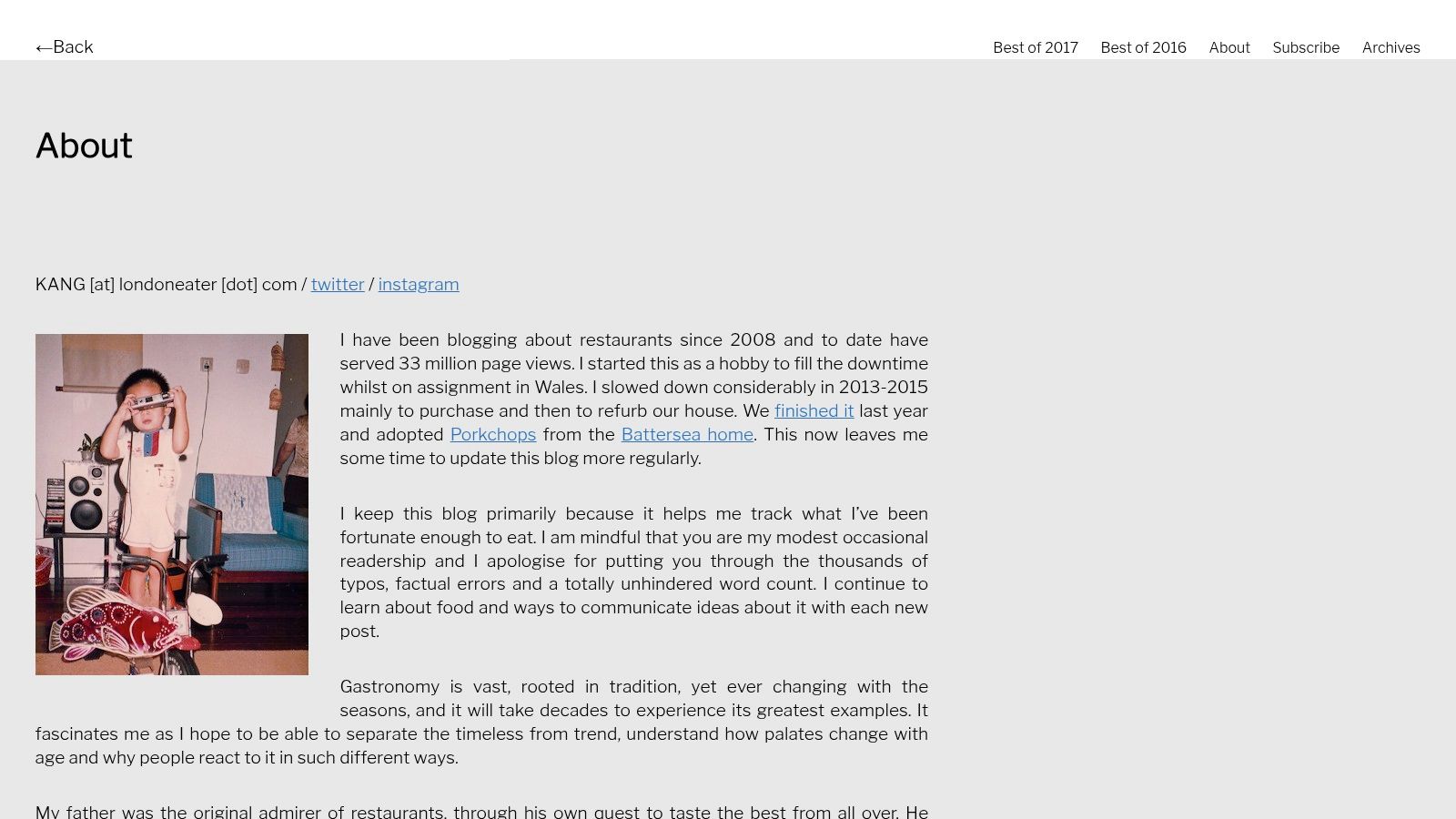
The biggest commercial advantage is archive value. London Eater's About page states the site has generated 33M+ page views to date, which signals long-term search visibility and audience trust for restaurant discovery. For a venue that benefits from evergreen search traffic, that's more useful than a short spike from trend-led content.
When to brief London Eater
Use London Eater for:
- Chef-led restaurants: Venues where technique, produce, craft, and seasonality are part of the sales story.
- Reputation building: Openings that need third-party credibility with diners who read before they book.
- Search-led discovery: Restaurants that want coverage with a longer shelf life than a disappearing Story.
If you're planning a broader creator mix, this guide on $how restaurants work with London food influencers/$ is useful context for structuring the rest of the programme around more trackable social activations.
A London Eater placement works best when the dining experience can withstand scrutiny. Don't pitch spectacle alone. Pitch substance.
The downside is straightforward. This is a solo author site, so cadence can vary, and it's not built around short-form video distribution. If your KPI is immediate footfall from Reels and TikTok, pair this type of editorial partner with a social-first creator layer instead of expecting one blog review to do everything.
Outreach is simple because contact details are publicly available on the About page. Keep the pitch concise. Lead with what makes the menu or concept distinct, and skip generic PR language.
3. East London Girl
$East London Girl/$ is built for practical local discovery. That makes it useful for marketers who care about geography as much as audience size.
Nicola's platform stands out because it's organised by neighbourhood, supported by interactive maps, and supported by a contributor team. For venue groups, bars, brunch launches, and local campaigns, that structure is operationally valuable. It mirrors how people make their decisions about where to go in London. They search by area, occasion, and mood.
Best use case
This is the blogger to brief when location is the selling point.
A rooftop in Shoreditch, a brunch opening in Notting Hill, or a bar rollout spanning multiple neighbourhoods fits naturally into East London Girl's format. The site is especially useful for mainstream hospitality concepts that need frequent consumer touchpoints rather than one deep critical review.
There's also a practical partnership signal here. The site includes contact, press, and testimonial pages, which usually means the collaboration path is already defined. That saves time during outreach and reduces the friction that slows down smaller teams.
For restaurants that haven't built a creator process yet, this walkthrough on $how to get food influencers to promote your restaurant/$ helps tighten the brief before you reach out.
What to watch
- Strong fit: Neighbourhood launches, bars, casual dining, brunch, rooftops, and list-style inclusion campaigns.
- Weaker fit: Highly specialised cuisines that need deep technical storytelling rather than upbeat recommendation-led content.
- Measurement angle: Track location page visits, map-click behaviour, reservation links, and branded search lift after publication.
East London Girl tends to be a positive discovery environment, which is good for hospitality brands that want broad appeal. It also means you shouldn't expect the kind of critical long-form perspective you'd seek from a pure reviewer. If your goal is geo-targeted reach and frequent inclusion in area-based discovery content, it's a strong commercial option.
4. ET Food Voyage
If your concept serves halal diners, $ET Food Voyage/$ belongs on the shortlist immediately.
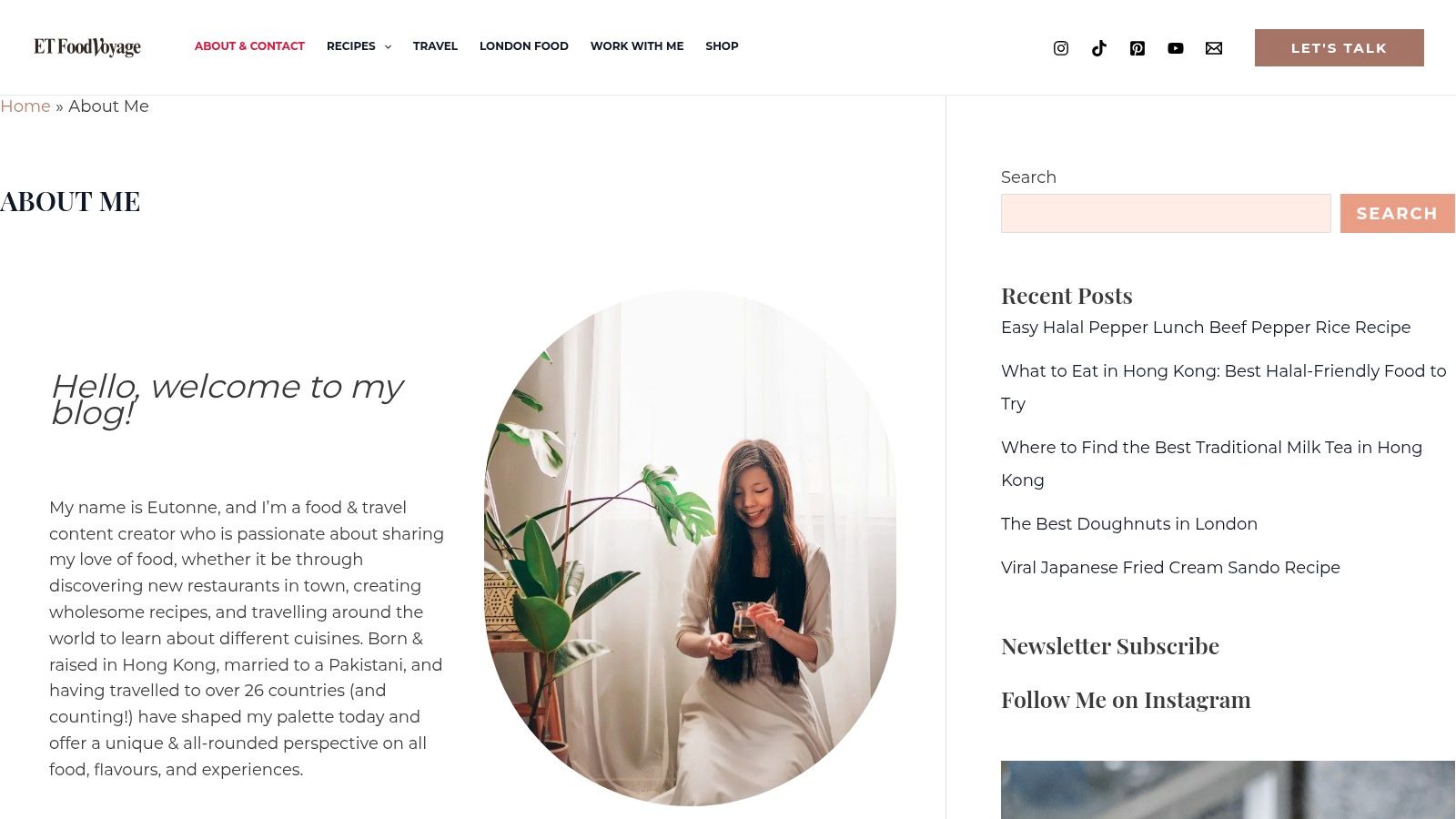
Most lists of food bloggers in london skew broad. ET Food Voyage is more valuable because it serves a specific dining need with clear commercial intent behind it. Eutonne's London coverage includes a strong halal angle, alongside recipes and broader food content. For restaurants trying to reach Muslim diners, that niche focus is an asset, not a limitation.
Why niche matters more than scale
The biggest mistake marketers make is overpaying for broad food coverage when the offer is niche. Halal-friendly venues don't need generic food visibility. They need qualified discovery from people who are actively looking for the right dining fit.
That's exactly where a specialist blogger beats a bigger but less relevant account.
Buyer note: Audience relevance beats broad reach when the diner has a clear requirement before booking.
ET Food Voyage also has a clear “Work with me” path and collaboration contact, which matters. Marketers waste time when a creator looks active but has no visible process for commercial partnerships. Here, the route is defined and the niche is obvious.
If you need more local prospecting help beyond this shortlist, use this guide on $how to find local food influencers in your city/$.
Best partnership approach
Use ET Food Voyage for openings, menu launches, Ramadan-related offers, halal afternoon tea, halal fine dining, and family-friendly dining campaigns. Build the brief around clarity. State halal credentials, certification details where relevant, family suitability, and reservation path.
The only real limitation is fit. If your restaurant doesn't offer halal options or can't serve that audience well, this isn't the right partner. Also note that the site blends restaurant and recipe content, so some coverage sits closer to home cooking than venue discovery. That isn't a weakness. It just means you should match the brief to the creator's strongest commercial angle.
5. The Food Connoisseur
$The Food Connoisseur/$ is a strong choice for brands that want a local voice with range.
This blog has covered London food and culture since 2011, with a perspective rooted in the city rather than built around generic trend roundups. That matters if your venue sits outside the usual launch circuit or if your target diner spends more time in East and Central London than in headline-grabbing destination areas.
Where it fits
The Food Connoisseur works well for comfort food, neighbourhood restaurants, Asian dining, independent cafés, and value-led hospitality. The archive gives marketers useful context before outreach. You can see what cuisines and formats already resonate instead of sending a pitch blind.
That kind of pattern-checking is basic but important. A creator who already writes naturally about your category will usually produce better content with less back-and-forth.
Try this briefing structure:
- Lead with neighbourhood relevance: Explain why the venue matters in its local context.
- Be specific on cuisine: Mention signature dishes, regional angles, or house specialities.
- Offer a clear call to action: Invite a hosted tasting, menu preview, or opening visit with a simple booking path.
The main advantage here is authenticity. The site doesn't feel like a generic hospitality placement machine. It feels like a London-native lens on where to eat, which is often more persuasive for local audiences than polished but interchangeable creator content.
Commercial caution
Posting frequency can vary, and the site sometimes moves beyond pure restaurant coverage into lifestyle and culture. That isn't a problem if you want flexible editorial fit. It is a problem if you only buy on a rigid volume model and expect uniform posting windows.
Use this partner when you want trust and local character. Don't use it as a replacement for social-first creators if your KPI is immediate short-form reach.
6. The Foodaholic
For premium hospitality, $The Foodaholic/$ is the cleanest fit on this list.
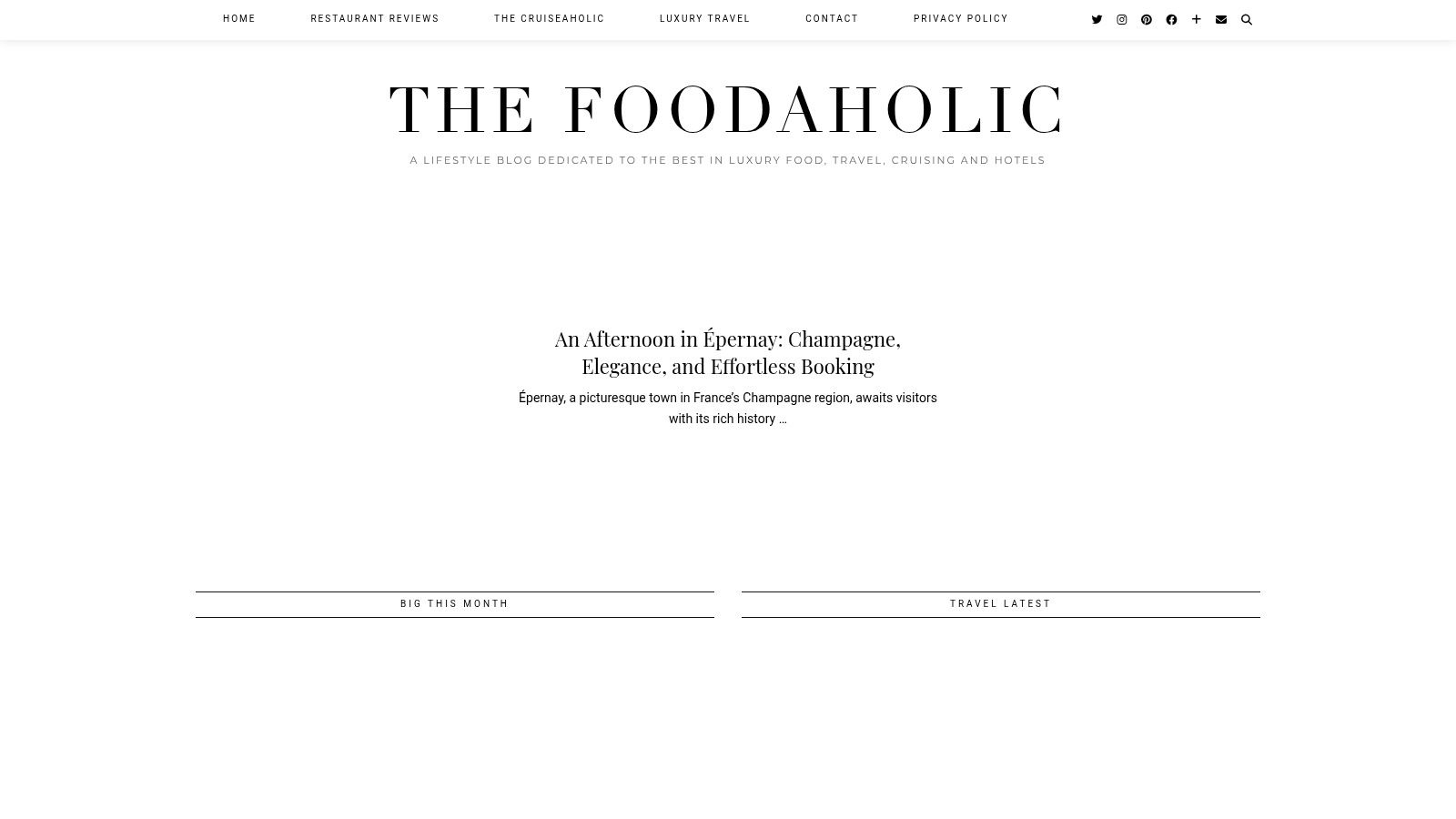
Its positioning leans toward polished restaurant, hotel, and travel coverage, with strong London relevance across Mayfair-style dining, hotel restaurants, and high-end experiences. If your venue sells ambience, service, wine, tasting menus, or a luxury setting, that tone does part of the brand work before the reader even gets to the review.
Best for premium positioning
The strongest campaigns here aren't discount-led. They're experience-led.
This is the right partner for hotel dining launches, chef collaborations, tasting menu reveals, seasonal luxury experiences, and premium brunch or afternoon tea. The site's imagery and tone support a higher-spend customer journey. That's useful when the venue needs to justify price through presentation and perceived quality.
Sprout Social's 2026 UK food-influencer guide also shows why premium hospitality teams shouldn't think in blog-only terms. It highlights MOB Kitchen as a cross-platform benchmark with 3.3M Instagram followers, 1.5M TikTok followers, 189K YouTube subscribers, and 653K Facebook followers, reinforcing that successful UK food brands increasingly behave like media brands across channels $in Sprout Social's UK food influencer guide/$. The lesson for a premium venue is simple. Use a polished blog partner like The Foodaholic for positioning, then extend the campaign into reusable short-form assets.
Recommended measurement
- Primary KPI: Reservation enquiries or booking-page visits from a dedicated landing page.
- Secondary KPI: Asset quality for paid social reuse.
- Tertiary KPI: Brand search and premium menu page traffic after publication.
The limitation is obvious. Budget eateries and fast-casual concepts may not benefit from this luxury framing. Also, whenever a creator works closely with hospitality PR and brand events, expectations around disclosures, approvals, and deliverables need to be explicit from the start. That's not a reason to avoid the partnership. It's a reason to scope it properly.
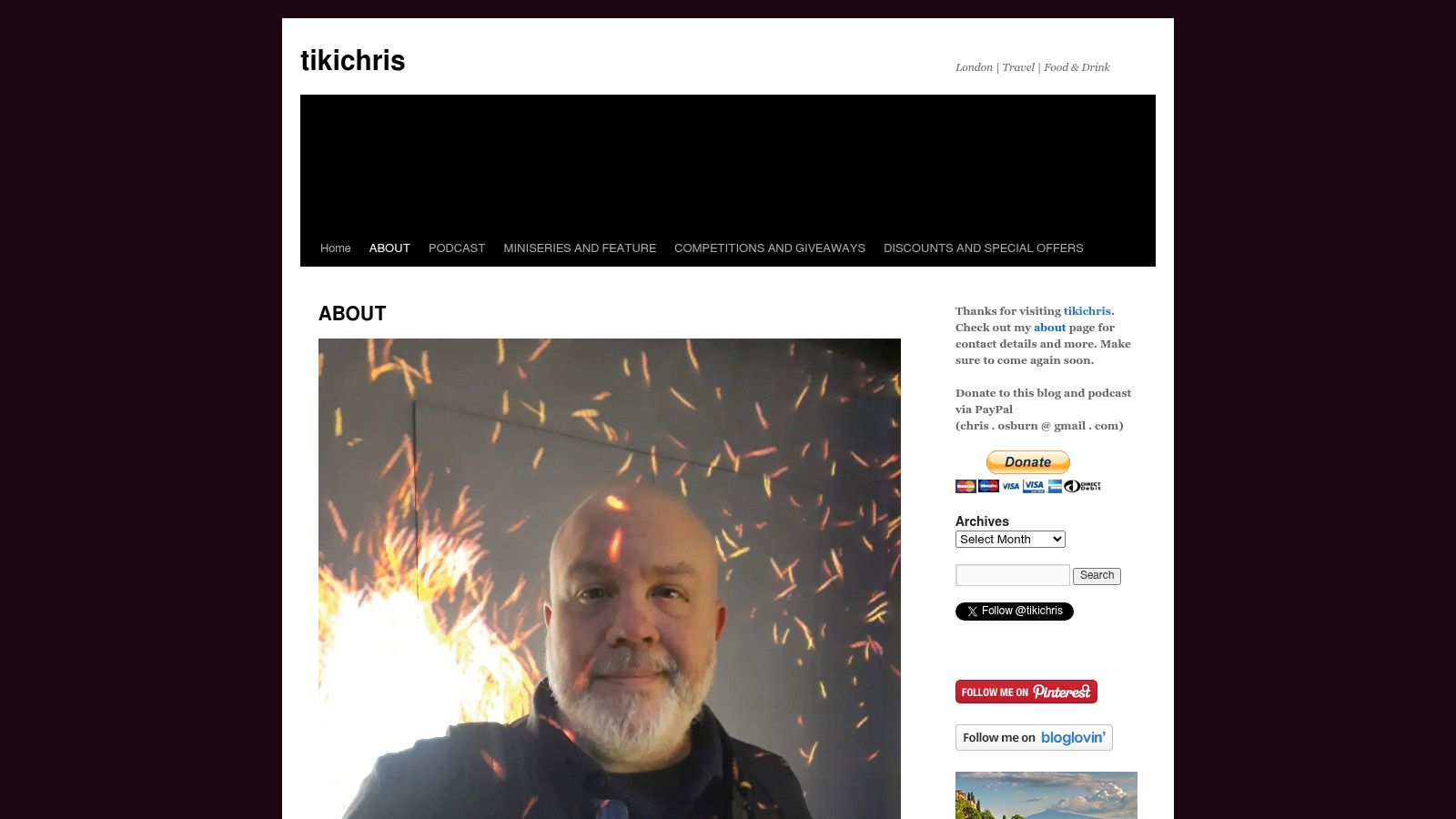
7. tikichris
$tikichris/$ is the pick for campaigns that sit between food, drink, events, and London lifestyle.
Chris Osburn has been blogging for well over a decade, and that experience shows up in the way the site handles launches, tastings, city culture, and hospitality news. This isn't a narrow restaurant-review proposition. It's more useful than that for experiential campaigns because the editorial frame can stretch beyond the plate.
Why marketers use creators like this
Some launches need more than a meal recap. They need context. A bar opening with live music, a supper club tied to a neighbourhood event, or a venue launch wrapped into city culture fits a broader editorial voice better than a single-format food page.
tikichris is useful because the author understands PR workflows, deadlines, and event-led storytelling. That lowers execution risk for agencies and in-house teams handling multiple moving parts.
The broad UK market also supports this kind of segmentation. Infludata's UK food-and-drink ranking lists 17,383 creators in the category, with an aggregate 909.9M followers and 4.37% average engagement, which suggests there's enough creator supply for brands to segment by niche and local relevance instead of buying generic food coverage $in Infludata's UK food and drink influencer ranking/$. For tikichris, the niche isn't just food. It's food inside a wider city experience.
If the venue story includes a launch moment, event angle, or cultural tie-in, broader editorial creators often outperform pure dish-focused accounts.
Best fit and watchouts
Use tikichris for restaurant launches, tasting events, drinks-led campaigns, food festivals, and city-experience packages. Outreach should highlight what makes the activation newsworthy, not just tasty.
The trade-off is breadth. Because the site covers more than restaurants, not every reader is there for venue discovery alone. That's fine if you want lifestyle reach. It's less ideal if you only care about narrow restaurant-intent traffic.
Top 7 London Food Bloggers Comparison
| Item | 🔄 Implementation complexity | ⚡ Resource requirements | 📊 Expected outcomes | 💡 Ideal use cases | ⭐ Key advantages |
|---|---|---|---|---|---|
| Sup | Low, managed AI + human service; quick setup (~20 min) | Medium, paid platform/onboarding; minimal internal labor | Measurable, scalable creator ROI; consolidated UGC & attribution | Localized creator programs, multi-location chains, performance DTC | End-to-end attribution; AI+human sourcing; prebuilt campaign playbooks |
| London Eater (Kang Leong) | Low, direct outreach to solo author | Low, PR time; occasional paid collaborations possible | Long-form, credible reviews with loyal readership | Craft- and seasonality-focused restaurants seeking thoughtful coverage | Long-standing credibility; deep archives and engaged serious readers |
| East London Girl (Nicola) | Low, standard outreach to editorial team | Low, easy briefability; ongoing contributor capacity | Frequent, neighbourhood-targeted exposure across London | Geo-targeted openings, brunch, rooftops, multi-neighbourhood activations | Consistent cadence; interactive maps; strong local reach |
| ET Food Voyage (Eutonne) | Low, contact via clear collaboration page | Low, straightforward outreach; social amplification | Targeted engagement with halal-first audience | Halal-friendly concepts, family-friendly dining and niche targeting | Niche authority in halal dining; clear collaboration pathways |
| The Food Connoisseur | Low, direct contact via blog/social | Low, PR/hosted tastings feasible | Authentic local coverage with flexible feature options | Neighbourhood openings, comfort food, Asian and value-oriented spots | Authentic local voice; focused East/Central London perspective |
| The Foodaholic | Low, contact via dedicated page | Low–Medium, premium positioning may need higher budgets | Polished, premium-oriented features and imagery | Premium hospitality, hotel restaurants, tasting menus | Professional imagery and tone suited to luxury campaigns |
| tikichris (Chris Osburn) | Low, direct email outreach to media-savvy author | Low, experienced creator familiar with PR needs | Credible media coverage and experiential storytelling | Launches, tastings, PR-driven campaigns tied to city culture | Media-savvy author with industry recognition and long-running archives |
From Shortlist to Sales Activating Your Creator Campaign
Your team approves a creator shortlist on Monday. By Friday, nobody can answer three basic questions. Which post drove bookings? Which creator reached the right London audience? Which partnership should be renewed? That is the difference between a creator list and a working acquisition channel.
Treat food bloggers in london as a campaign portfolio with defined roles. Assign each creator a job before outreach starts. One creator should drive neighbourhood awareness. Another should support premium brand positioning. Another should produce content you can track through promo codes, UTM links, reservation tags, or menu-specific landing pages. Once each partner has a commercial role, budget discussions get easier and reporting gets sharper.
The market still pushes marketers toward the wrong filter. Many directories rank creators by follower count first, even though restaurant and hospitality campaigns usually depend more on local relevance, cuisine fit, and audience proximity. Joli's 2026 UK directory, for example, features creators with large followings, which helps with top-line reach but does less for a brand that needs borough-level demand and measurable footfall $in Joli's UK food influencer directory/$.
Set the campaign around three decisions:
- Pick the commercial goal: bookings, walk-ins, user-generated content, menu trial, or brand positioning.
- Pick the creator role: long-form reviewer, neighbourhood guide, niche specialist, premium publisher, or micro-creator for scale.
- Pick the attribution method: unique booking links, promo codes, reservation notes, campaign-specific landing pages, or post-campaign review trends.
For hospitality brands, the strongest structure is usually a mixed creator set. Use one or two trusted editorial-style names to build credibility and local discovery. Add trackable social creators to push short-form reach and direct action. DTC and ecommerce food brands should use the same model. Relevance gets attention. Attribution tells you whether the spend worked.
Sup reduces the manual work in sourcing, briefing, follow-ups, approvals, and payment admin. It also gives teams one place to connect creator activity to clicks, conversions, bookings, and revenue. That matters when you are running campaigns across multiple locations, agency teams, or repeat launch calendars.
If your team also relies on outbound and social prospecting to fill the top of the funnel, review $PostClaw on lead generation/$ alongside your creator process.
Book a strategy call today
We'll show you the creators in your niche, build a campaign plan, and walk you through the dashboard. All within 15 minutes, no commitment.