25 February 2026
How to Get Food Influencers to Promote Your Restaurant: A 2026 Guide
To get food influencers genuinely excited to promote your restaurant, you need to think beyond just a transaction. It starts with finding creators whose personal brand and audience truly align with your restaurant's vibe. From there, it's about crafting an outreach that feels personal and offers real, mutual value. A successful partnership is built on clear communication and expectations, whether it's a complimentary meal for a nano-influencer or a paid contract for a more established creator. The goal is to build lasting relationships, not just get a few quick posts.
Why Food Influencers Are Your Restaurant's Secret Weapon
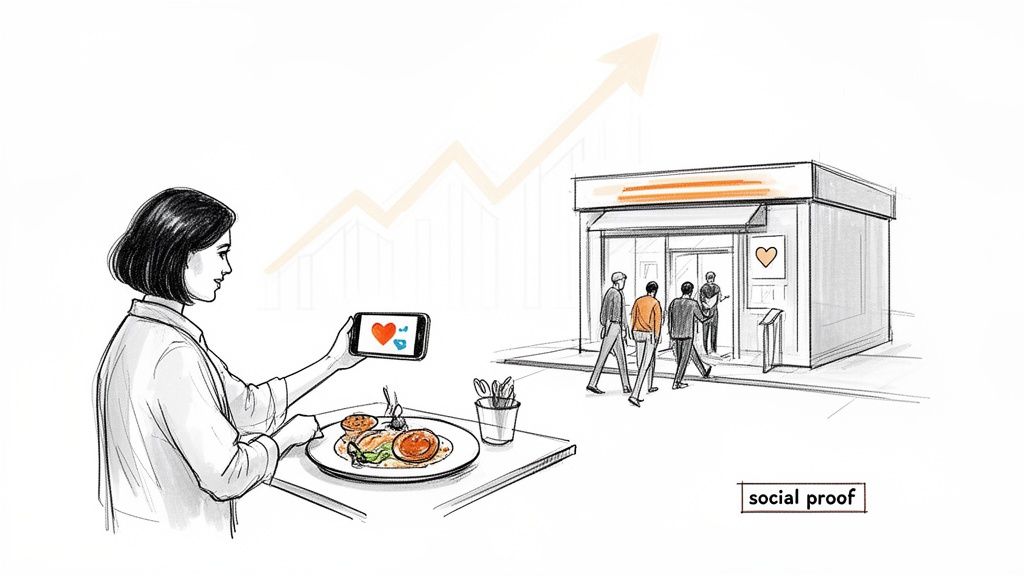
Let's be honest, the days of relying solely on a good newspaper review or a spot in a glossy magazine are long gone. Today, the most compelling restaurant recommendations are happening in a 15-second Reel on Instagram. This isn't just a minor shift; it's a fundamental change in how people decide where to eat.
This is about more than just pretty pictures of your food. When a trusted food creator shares their genuine experience at your restaurant, they provide something an advert never can: authentic social proof. Their followers don't see it as a sales pitch. They see it as a hot tip from a friend, and that kind of digital word-of-mouth is incredibly effective at driving real, immediate footfall.
The Power of Authentic Recommendations
Think about it. You're scrolling through your phone and see a creator you follow post a video of a perfect, gooey cheese pull or a beautifully garnished cocktail. If their taste aligns with yours, your first thought is probably, "I need to go there." That’s the magic of influencer marketing for restaurants. It closes the gap between someone seeing your dish online and actually making a booking.
The numbers don't lie. The UK influencer marketing industry hit a staggering USD 2.36 billion in 2024 and is still growing at an incredible pace. For hospitality, this translates directly into bums on seats. A recent survey revealed that over 66% of UK adults aged 18-34 have been persuaded to visit a specific restaurant after seeing it on social media. That’s a massive audience making dining choices based on what creators post. You can dig deeper into UK influencer trends and their impact on consumer behaviour to see just how significant this is.
Working with influencers gives you several advantages that old-school marketing just can't match.
Quick Guide to Influencer Collaboration Benefits
Here’s a quick breakdown of why this strategy works so well for restaurants and hospitality brands.
| Benefit | Description | Key Statistic |
|---|---|---|
| Instant Credibility | An influencer’s endorsement acts as a powerful third-party validation, lending your restaurant immediate trust with their followers. | 71% of consumers trust influencer recommendations. |
| High-Quality Content | You gain a library of authentic photos and videos from the collaboration that you can repurpose on your own social media, website, and ads. | User-generated content is seen as 2.4x more authentic than brand-created content. |
| Hyper-Targeted Reach | Partner with creators whose followers match your ideal customer, whether they're local foodies, vegans, families, or cocktail connoisseurs. | Micro-influencers can have up to 60% higher engagement rates than macro-influencers. |
These benefits aren't just nice-to-haves; they are a direct route to building a stronger brand and a busier restaurant.
Moving Beyond Likes to Bookings
While a flood of likes and comments feels great, the real measure of success is getting more people through your doors. A truly effective influencer campaign is designed to do exactly that. It turns passive scrolling into active dining.
A single, well-executed influencer post can fill your reservation book for a week. The ROI isn't just in brand awareness; it's in tangible revenue and a bustling dining room.
This is especially true when you collaborate with nano and micro-influencers. These are creators with smaller, but often hyper-engaged and very local, followings. A glowing recommendation from a trusted neighbourhood foodie can be far more powerful than a post from a national celebrity because their audience is right on your doorstep, ready and willing to visit.
Throughout this guide, we'll walk you through exactly how to find these gems and build partnerships that pay off.
Finding Foodies Who Fit Your Brand
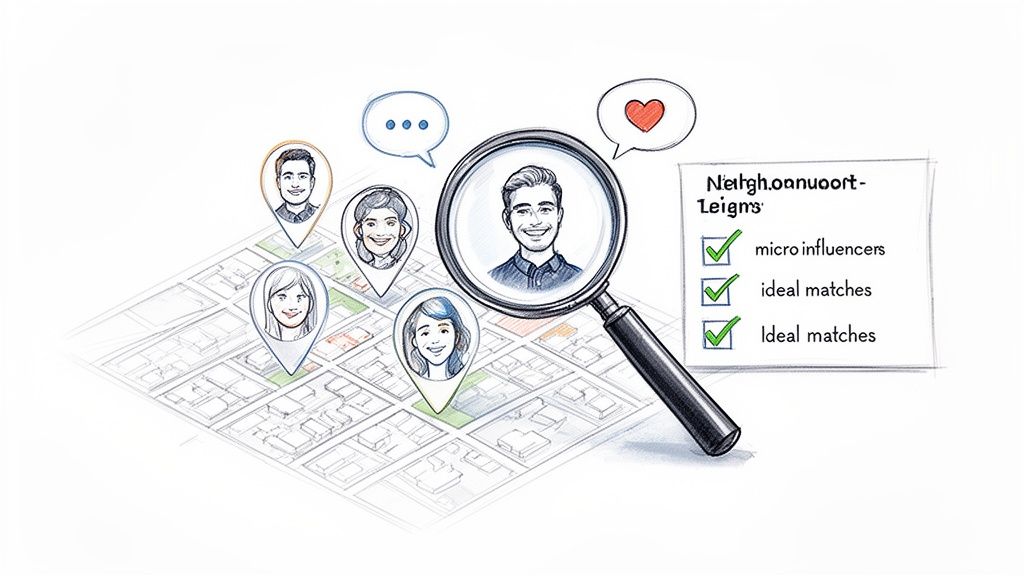
This is the single most important part of any influencer campaign: finding the right partners. It’s not about chasing the biggest follower counts. It’s about finding creators whose audience and personal brand are a perfect match for what makes your restaurant special. A mismatch here can waste time, money, and even dent your credibility.
Authenticity is everything. You're looking for genuine fans, not just hired guns. The goal is to find influencers who would naturally love your restaurant anyway. Their excitement will translate into content that feels real and persuasive, which is exactly what drives their followers to book a table.
Look Beyond Follower Numbers
A massive follower count can be seriously deceptive. A creator with 100,000 followers spread across the country is far less valuable to a local restaurant than a nano-influencer with 2,000 hyper-local followers who hang on their every word. These smaller creators often have much higher engagement because they’ve built a tight-knit community.
When you're vetting potential partners, focus on what really matters:
- Engagement Rate: Don't just glance at likes. Look at the comments. A high number of genuine comments (from real people, not bots!) shows an active and loyal audience.
- Audience Demographics: Do their followers actually live near your restaurant? Do they fit your target customer profile, whether that's young professionals, families, or vegan foodies? Most serious creators can provide a breakdown of their audience analytics if you ask.
- Content Quality and Niche: Does their photography style match your restaurant’s aesthetic? Is their content focused on a specific niche, like "best brunch spots in Manchester" or "affordable eats in Glasgow"? A specialised focus means a more targeted, interested audience.
Finding the right micro-influencer is like hiring the most popular person in your neighbourhood to be your brand ambassador. Their recommendation carries immense weight because it comes from a trusted local source.
By prioritising these factors, you ensure your message reaches people who can actually walk through your door. For a deeper dive into this process, check out our complete guide on how to find local food influencers in your city.
Mastering Your Discovery Tactics
So, where do you actually find these ideal foodie partners? It takes a bit of digital detective work, but the results are well worth the effort. Forget generic searches; you need to think like a local.
Start by getting specific with your searches on platforms like Instagram and TikTok. Don't just look for #foodie. Instead, drill down into niche and location-based hashtags.
For example, a modern European restaurant in Bristol might search for:
- #bristolfoodie
- #bristolrestaurants
- #eatbristol
- #thingstodoinbristol
This simple trick immediately filters your search to creators who are active and relevant in your specific area. Another great tactic is to search your restaurant's own location tag to see who has already visited and posted about you organically. These people are your warmest leads for a potential partnership.
A Quick Vetting Checklist
Once you have a shortlist of potential influencers, it's time to vet them carefully. Run each candidate through this checklist to spot any red flags and confirm they're a good fit before you even think about reaching out.
- Check for Authenticity: Does their feed feel genuine, or is it wall-to-wall ads? Look for a healthy mix of sponsored and organic content.
- Analyse Their Comments: Are the comments thoughtful conversations, or just generic emojis and bot-like phrases? Real engagement is a sign of a real community.
- Review Past Partnerships: Look at how they’ve worked with other restaurants. Do they disclose partnerships clearly (using #ad or #gifted)? A lack of transparency can be a major red flag for both you and their audience.
- Assess Professionalism: Is their bio clear and professional, with a contact email listed? This shows they take their work as a creator seriously.
This vetting process protects your brand and makes sure you're investing in partners who will represent your restaurant with the same care and passion you do.
Crafting an Outreach That Gets a 'Yes'
So, you’ve done the hard work and found some food creators who feel like a perfect match for your restaurant. What’s next? The outreach. This is where so many brands stumble, firing off generic, copy-and-pasted messages that are destined for the digital bin.
To get food influencers genuinely excited to promote your restaurant, your first message has to show you’ve done your homework. It needs to prove you actually see them and value what they do.
Think about it from their perspective. A popular foodie’s inbox is a battlefield. A personalised, thoughtful message is your golden ticket to standing out from the dozens of lazy pitches they’re scrolling past every single day. It shows respect for their craft and signals that you’re looking for a real partnership, not just a quick, transactional post.
The Anatomy of a Perfect Pitch
Forget rigid templates. What you need is a flexible framework that allows for genuine, human connection. A great outreach message, whether it’s an email or a DM, should always feel like it was written for one person and one person only.
Your pitch really just needs to nail three things:
- A Personalised Hook: Start by mentioning something specific you liked about their content. "Hi Sarah, absolutely loved your recent Reel on that new bakery in Shoreditch: your editing made that croissant look incredible!" This instantly proves you’re a real fan, not a bot.
- The ‘Why Them’ Connection: Clearly explain why they are the right fit for your brand. Connect their unique style or audience to what you’re all about. For instance, "Your focus on authentic, family-run spots is exactly why I'm reaching out. Our Italian restaurant has been using my Nonna's recipes for over 30 years."
- A Simple, Clear Ask: Don't beat around the bush. State what you have in mind, but keep it light. It could be as simple as, "We'd love to invite you for a complimentary dinner to experience our new menu," or, "We're looking to partner with a few creators for our summer menu launch and wanted to see if you'd be open to discussing a paid collaboration."
This approach turns a cold pitch into a warm introduction. It’s the difference between a door slammed shut and a welcome conversation, setting the stage for a great relationship from day one.
Common Outreach Mistakes to Avoid
Knowing what not to do is just as important as knowing what to do. Plenty of restaurants make easily avoidable mistakes that guarantee their message gets ignored.
One study created a fake restaurant just to test influencer responses. The takeaway? Creators are drowning in offers. Your pitch has to be professional and personal to even get a look-in; anything less shows a fundamental lack of respect for their business.
To make sure your message actually gets a response, steer clear of these classic blunders:
- Sending Mass DMs or Emails: This is the fastest way to get ignored. Influencers can spot a generic, impersonal message from a mile away. It just screams "spam."
- Getting Their Name Wrong: It sounds so basic, but it happens constantly. Always double-check you've spelled their name and handle correctly.
- Making Vague Offers: A message like "Let's collab!" is completely meaningless. Be specific. What are you offering? What are you hoping for?
- Demanding Too Much Upfront: Your first message isn't the time to lay out a ten-point contract. Keep it short and sweet. The goal is simply to start a conversation.
As you get ready to hit send, brushing up on the latest influencer marketing best practices can make a huge difference. It helps you frame your offer in a way that aligns with industry standards and shows creators you’re a professional and serious partner worth their time.
Structuring a Deal That Works for Everyone
So, you’ve found a fantastic food influencer, slid into their DMs, and they’re keen to collaborate. Brilliant! Now comes the crucial part: putting together a deal. This is where you lay the groundwork for a great partnership, making sure everyone’s on the same page from the start. A clear, fair agreement prevents any awkwardness down the line and paves the way for a smooth, successful campaign.
The kind of deal you offer will really depend on your budget, the influencer’s own following and experience, and what you’re trying to achieve. There’s no one-size-fits-all answer here. It’s worth noting that this is a space more and more UK businesses are investing in. In fact, a massive 86% of UK marketers are already using influencers, with 59% planning to up their spend. With nearly 70% of UK consumers trusting what influencers recommend, a well-structured deal is a direct investment in getting more bums on seats.
Choosing the Right Compensation Model
Let's clear something up: you don't always need a massive budget. Some of the best collaborations, especially with nano and micro-influencers, start with a simple, friendly exchange. The trick is to match the offer to the creator's status and what you're asking them to do.
Here’s a look at the most common ways to pay for a collaboration:
- Complimentary Meal (A 'Contra' Deal): This is your go-to for nano-influencers or creators who are just starting out. You offer them and a plus-one a free meal, and in return, they create some content, maybe a Reel and a few Stories. It’s a fantastic, low-cost way to get authentic posts and start building genuine relationships.
- Paid Fee + Complimentary Meal: Once you start working with more established micro or mid-tier influencers, a flat fee is pretty standard. This payment recognises their skill, the time they put in, and the value of the audience they’ve built. The meal is usually covered on top of this fee.
- Performance-Based Fees: This one’s a bit more advanced but offers a crystal-clear return on investment. You might agree on a commission for every table booked using the influencer’s unique promo code. It’s a great way to tie spend directly to results.
Getting a handle on the typical costs can help you set a realistic budget. If you're wondering what to set aside, our guide on how much influencer marketing costs for restaurants breaks it all down for you.
Influencer Compensation Models Compared
To help you decide, here’s a quick comparison of the main deal structures.
| Model | Best For | Pros | Cons |
|---|---|---|---|
| Complimentary Meal (Contra) | Nano-influencers (1k-10k followers) just starting out; building initial buzz on a tight budget. | Low cost; builds authentic relationships; great for generating user-generated content (UGC). | Less control over content; may not be attractive to more experienced creators. |
| Paid Fee + Meal | Micro- to Macro-influencers (10k+ followers) with proven engagement and a professional approach. | Secures high-quality, professional content; clearer expectations; better for specific campaign goals. | Requires a dedicated budget; can be expensive for top-tier influencers. |
| Performance-Based | Driving specific, trackable actions like bookings or voucher downloads; working with affiliate-style creators. | Low risk, as you only pay for results; direct and measurable ROI. | Can be complex to track; may not be appealing to creators who prefer guaranteed income. |
| Discount Code | Any influencer tier; great for tracking conversions and offering value to the creator's audience. | Easy to track; gives the creator's followers a direct incentive to visit. | The discount eats into your margin; less of a direct payment to the creator. |
Ultimately, the best model is one that feels fair to both sides. A happy influencer who feels valued will always create better, more enthusiastic content for your restaurant.
This flowchart gives you a bird's-eye view of the whole process, from that initial spark of an idea to sealing the deal.
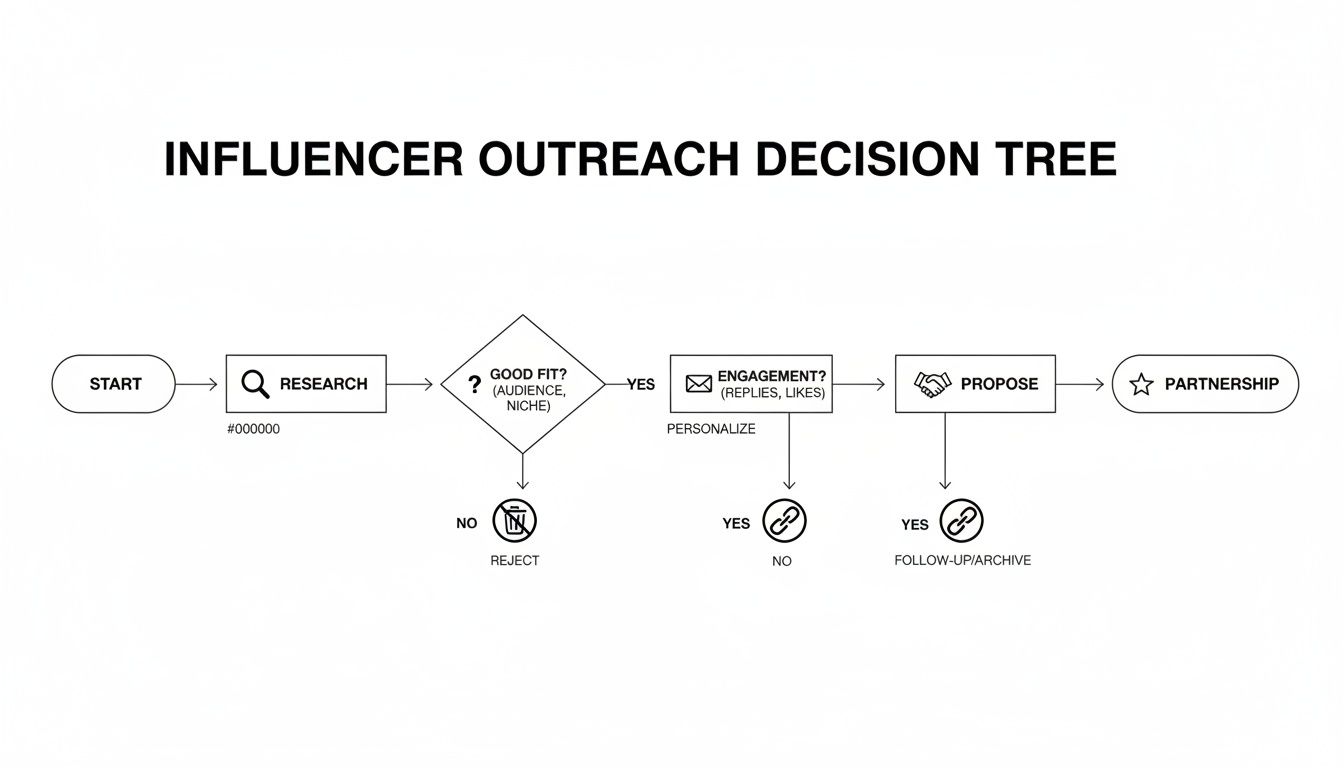
As you can see, a successful partnership isn’t a fluke; it's built on doing your homework and reaching out with a personal touch.
Building a Clear and Concise Campaign Brief
Once you've agreed on the deal, you need a campaign brief. Think of it as the playbook for your collaboration. It’s just a simple document that lays out all the important details so everyone knows exactly what they’re doing. A good brief gives direction without killing the creator’s vibe.
Think of the brief as guardrails, not a straitjacket. It’s there to guide the creator towards your campaign goals while giving them the creative freedom to produce content that feels authentic to their audience.
Your brief doesn't need to be a novel. Just keep it short, sharp, and cover these key points:
- The Goal: What's the point of this whole thing? Are you trying to shift more of your new pasta dish, fill tables on a quiet Tuesday night, or just get the word out about a bottomless brunch? Be specific.
- Key Messages: Is there anything you really want them to mention? Maybe the story behind your head chef, your commitment to local suppliers, or a two-for-one cocktail offer.
- Content Deliverables: Spell out exactly what you need. Don’t just say “a post.” Say, “One Instagram Reel, around 15-30 seconds long, and three Instagram Story frames with a link sticker to our booking page.”
- Tags & Mentions: List your social media handles (e.g., @YourRestaurant) and any specific hashtags you want to use (#YourCampaignTag).
- The Legal Bit (Disclosure): This one’s not optional. You must remind the creator to clearly label their content as an ad. In the UK, this means using #ad or #gifted right at the start of the caption to comply with advertising standards.
By setting out these expectations clearly from the get-go, you’re building a professional relationship built on trust. It lets the influencer get on with what they do best (creating great content) while you get the promotion your restaurant deserves.
Measuring the Real Impact on Your Business
A flood of likes and glowing comments on an influencer's post feels fantastic, but those are vanity metrics. They look good on paper, but they don’t directly pay your staff or stock your kitchen. When you work with food influencers, the real goal is to turn that online buzz into tangible results: more bookings, higher sales, and a consistently packed dining room.
To make that happen, you have to stop guessing and start tracking. It is absolutely essential to get a simple but solid measurement system in place before any content goes live. Without it, you're just flying blind, with no real way of knowing if your investment (whether it’s cash, a free meal, or just your time) actually paid off. This is what separates a one-off promotional post from a scalable, repeatable growth strategy.
Setting Up Your Tracking Systems
The good news? You don't need some wildly complex analytics platform to see what’s working. A few straightforward tools and tactics will give you a crystal-clear picture of how a campaign is performing. The trick is to give each influencer their own unique tracker, so you can pinpoint exactly who is driving the most valuable business your way.
Here are a few of the most effective methods I’ve seen restaurants use:
- Unique Discount Codes: This is arguably the simplest and most powerful tracking method out there. Give each influencer a unique code (like "SOPHIE15") to share with their followers for 15% off their bill. Every time that code is punched into your till, you have a direct, undeniable link between their post and a paying customer.
- Custom Booking Links (UTM Parameters): If your main goal is driving online reservations, create custom links with UTM parameters. These are just small snippets of code you add to a URL that tell your website analytics exactly where the click came from. For example, a link can track the influencer's name, the platform (Instagram), and the campaign, giving you precise data on how many bookings their content generated.
- A "How Did You Hear About Us?" Prompt: Never underestimate the power of just asking. Train your front-of-house team to ask guests making reservations or walking in how they discovered you. A simple checkbox in your booking system or a quick, friendly question can reveal how many people mention seeing "a post on Instagram" or a specific influencer by name.
By setting up these tracking mechanisms, you move from hoping for results to actively measuring them. It turns your influencer marketing from a cost centre into a profit-driver with a provable return on investment.
Identifying the KPIs That Actually Matter
Once your tracking is up and running, you need to zero in on the right Key Performance Indicators (KPIs). For a restaurant, that means focusing on the metrics that directly reflect the health of your business.
Forget vanity metrics and concentrate on these core KPIs:
- Tracked Reservations: The total number of bookings made through an influencer's unique UTM link.
- Code Redemptions: The number of times an influencer’s discount code was used.
- Website Clicks and Menu Views: The volume of traffic driven to your website from their "link in bio" or story swipe-up.
- Increase in Direct Enquiries: A noticeable jump in phone calls or emails for bookings right after a campaign launch.
For these collaborations to really move the needle, implementing effective social media management is crucial for monitoring engagement and keeping the momentum going. It ensures you capture all the value from the new attention. This whole process isn't just about measurement; it's about understanding what works so you can do more of it. If you discover one creator's content led to 50 code redemptions while another brought in just five, you know exactly where to put your budget next time.
Calculating ROI and Repurposing Content
With this data in hand, calculating your return on investment (ROI) becomes refreshingly simple. Just add up the total revenue from all your tracked bookings and code redemptions. Then, subtract your total investment: the influencer’s fee, the cost of the gifted meal, and the value of the discounts you gave out. If the number is positive, congratulations, the campaign was profitable.
But the value doesn't stop there. One of the biggest long-term wins is the treasure trove of high-quality user-generated content (UGC) you get. The authentic photos and videos created by the influencer are powerful marketing assets you can repurpose across your own channels, from your social media feeds and website to email newsletters and even paid ads.
This extends the life and value of the collaboration far beyond the initial post. Many e-commerce brands have mastered this, and restaurants can learn a lot from their approach. To see how they do it, you can explore this complete playbook on influencer marketing for e-commerce and adapt their tactics for your own business.
Your Top Restaurant Influencer Marketing Questions, Answered
Diving into the world of food influencers can feel a bit like walking into a busy kitchen during the dinner rush: exciting, but also a little overwhelming. You've probably got a dozen questions swirling around. What's this all going to cost? What if they don't like the food? How do I keep track of it all?
Don't worry, these are the exact same questions every restaurant owner asks. Let's get them sorted so you can build partnerships that actually bring people through your doors.
How Much Should I Be Paying a Food Influencer?
Ah, the million-dollar question. Or, more accurately, the 'is this going to cost me a free meal or a four-figure cheque?' question. The honest answer is: it really depends. There's no industry-wide price list.
A local creator with a small but loyal following is a totally different ball game to a big-name food blogger with a massive audience. The price is always a negotiation, and it's shaped by a few key things:
- Follower Count: This is the most obvious starting point. A nano-influencer with 5,000 followers simply won't have the same rate card as a macro-influencer with 100,000. They fall into different tiers, and their asking price reflects that reach.
- Engagement Rate: Honestly, this is more important than follower numbers. I’d take a creator with a smaller, super-engaged community over a huge account with a silent audience any day. If their comments section is buzzing with real conversations, they have genuine influence, and they can (and should) charge for that.
- The 'Ask': What do you actually want them to do? A quick snap for an Instagram Story that disappears in 24 hours is a world away from a beautifully shot and edited Instagram Reel or TikTok video. The more time, effort, and creative skill involved, the higher the cost.
So, what's a realistic budget? In the UK, a nano-influencer (around 1k-10k followers) might be perfectly happy with a free meal for them and a plus-one (often called a 'contra' or gifted deal). Once you get into the micro-influencer space (10k-50k followers), you’re looking at fees anywhere from £150 to £500+ per post. Big-name creators? They can command thousands.
Your best bet is to just ask for their media kit or rate card. It lays everything out and gives you a clear starting point for a conversation.
What if an Influencer Posts Something Negative?
Okay, let's talk about the scenario that keeps every restaurateur up at night. You host an influencer, and they post something critical. It’s a gut-punch, I know. But before you fire off an angry DM, take a breath. This is actually a golden opportunity.
A negative comment gives you a public stage to show everyone just how brilliant your customer service is.
Here’s your game plan:
- Acknowledge and Apologise. Publicly. Jump onto their post or story and respond. Thank them for their honest feedback and apologise that their experience wasn't up to scratch. A simple, "We're so sorry to hear this," shows you’re listening.
- Take it Offline. Quickly. Your next move is to get the conversation out of the public eye. Say something like, "This isn't the standard we strive for at all. Could you please send us a DM or email? We'd love to hear more so we can make this right." It shows you’re proactive without starting a public debate.
- Actually Learn From It. Once you're in a private chat, listen. Genuinely listen. Was it a specific dish? The service? A mix-up with the booking? This is priceless, direct feedback. Use it to fix the underlying problem.
Turning a critic into a fan is one of the most powerful marketing moves you can make. When other potential customers see you handle criticism with grace, it builds more trust than a hundred glowing reviews ever could.
And a quick legal note: you can't contractually require someone to post a positive review. Advertising standards are very clear on this. True authenticity means giving creators the freedom to share their real experience, good or bad.
How Can I Manage Multiple Collaborations at Once?
Juggling one or two influencer partnerships is easy enough. But when you’re trying to coordinate five, ten, or even twenty at the same time, things can get chaotic, fast. You'll be drowning in DMs, losing track of who was promised what, and staring at a spreadsheet that makes absolutely no sense.
If you want to scale this, you have to get organised.
When you're just starting out, a well-made spreadsheet can do the job. Just make sure you have columns for the influencer's name, contact info, the agreed content, deadlines, their unique discount code, and whether you've paid them. It’s a basic dashboard to see where everything is at a glance.
But as you grow, that spreadsheet will become your worst enemy. It’s a massive time-suck and a recipe for mistakes. This is the point where you need to look at a dedicated influencer marketing platform. These tools are built to handle everything: finding creators, sending outreach, approving content, and tracking results, all in one place. It frees you up to do what you do best: build relationships and run your restaurant.
Ready to turn influencer marketing into a repeatable, ROI-proven growth channel for your restaurant? Sup combines AI with a human team to launch, manage, and scale creator campaigns, saving you up to 95% of your time. Discover how Sup can help you drive more collabs, views, and bookings today.
More on industries
See how many creators post about you and your competitors
Type in your brand's Instagram handle and we count the creators who post about you and about your five closest competitors. It takes about a minute and it is free. Or request a demo and we will show you the creators in your niche and walk you through the dashboard.
 Book a call