1 June 2026
Fitness Influencers UK: Your 2026 Playbook
Most brands looking for fitness influencers in the UK are stuck in the same loop. They pull a few names from a “top creators” list, send generic DMs, gift product to whoever replies, then try to explain weak results with phrases like brand awareness or community buzz.
That approach breaks because it treats creator marketing like PR when it should be run like a channel. The UK market is crowded, fragmented, local, and full of creators who look similar on the surface but perform very differently once you track clicks, bookings, code use, and repeat conversions.
The practical opportunity isn't only with the biggest names. It sits with smaller fitness creators who have trusted local audiences, consistent posting habits, and content that moves people from interest to action. If you're building an activewear, wellness, nutrition, gym, studio, or consumer brand, the actual work is not finding fitness influencers UK. It's building a repeatable system for choosing, briefing, paying, and measuring them properly.
Why Micro-Fitness Influencers Are Your UK Growth Channel
A lot of teams start with reach. They want the biggest profile they can afford, or the biggest profile they can persuade into a gifting deal. That feels efficient, but it usually creates soft visibility and weak attribution.
The better starting point is audience intent. YouGov's GB data shows that 11% of Britons say they compare themselves to fitness influencers on social media. That audience is disproportionately young and female, with 69% aged 18 to 34 compared with 28% of the general public, and 59% women compared with 41% men. The same dataset shows stronger behaviour signals inside that group, including 57% saying they count calories versus 24% nationally, and 60% saying they limit foods they enjoy to look good or stay thin versus 27% nationally.
That matters because this isn't a passive audience. It's an audience already wired for routine, aspiration, and behaviour change. For activewear, supplements, studios, healthy food brands, wellness apps, and local fitness businesses, that's a stronger foundation than broad lifestyle reach.

Smaller creators fit the way UK brands actually sell
Most UK brands don't need celebrity. They need relevance. A London Pilates creator, a Manchester run-club organiser, or a Glasgow strength coach can be more useful than a national name if the campaign goal is trial, store visits, app installs, or tracked ecommerce sales.
Micro and nano creators also force better discipline. You can't hide behind vanity metrics when you're working with smaller accounts. You have to look at audience fit, comment quality, creator reliability, and whether the person can persuade their followers to try something.
Practical rule: If a creator can't drive action without a huge follower base, the issue is usually trust, not scale.
This is why the industry has moved away from “who's biggest?” and towards “who's measurable?”. If you want a concise data-led argument for that shift, this breakdown on why micro-influencers outperform macro-influencers with data is worth keeping in your team's playbook.
What works better than a top-10 list
A list can still help with discovery. It just shouldn't drive selection. In practice, the useful filters are much narrower:
- Local audience fit. Does the creator speak to the city, postcode cluster, or lifestyle segment you sell into?
- Routine-based content. Do they post workouts, meal structure, recovery habits, product use, or coaching-style education?
- Commercial naturalness. Can they mention products without sounding like they're reading ad copy?
- Operational reliability. Do they answer clearly, deliver on time, and follow instructions without killing authenticity?
For teams building adjacent channels, it also helps to study how ecommerce operators think about attribution, retention, and channel mix. Receiver's archive of ecommerce marketing articles is useful for that broader lens because influencer performance rarely lives in isolation from email, paid social, landing page quality, and conversion flow.
Identifying and Vetting Influencers Who Convert
Discovery is easy. Vetting is where most budgets get wasted.
There are now huge directories and ranking pages for fitness influencers UK, but a name appearing in a list doesn't tell you whether that creator will move product. It only tells you they're visible. Visibility and conversion are related, but they're not the same thing.
A better filter is relationship strength. A peer-reviewed study on fitness influencers found that stronger follower relationships were associated with social attractiveness, physical attractiveness, task attractiveness, and content quality, and that these stronger relationships significantly increased exercise intentions (β=0.597, p<0.001). The practical takeaway is simple. A creator who is trusted for instruction and consistency is often more commercially useful than one who merely looks the part.
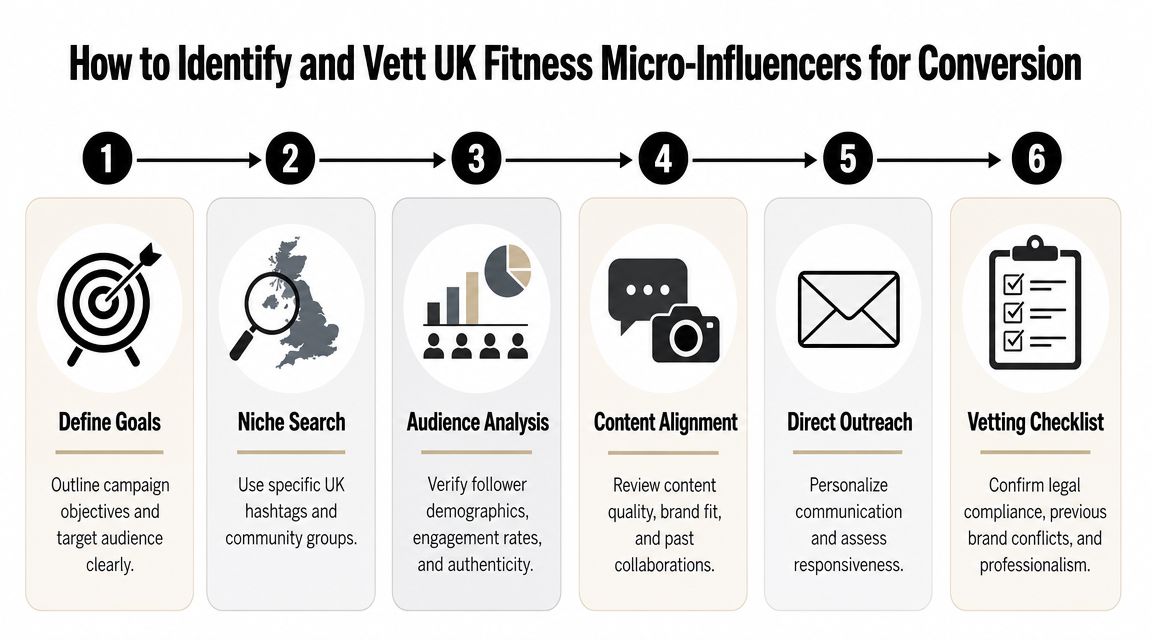
The six-part vetting method
I use a simple sequence before a creator ever sees a brief.
- Start with the business outcome If the goal is first-purchase ecommerce sales, I want creators who can demonstrate product use and answer objections. If the goal is gym footfall, I want local creators with community credibility. If the goal is UGC for paid ads, I care more about camera presence and content structure than raw audience size.
- Review the last two months, not the highlight reel Consistency beats one viral post. Look at cadence, average comment quality, whether story content supports feed content, and whether engagement is steady.
- Audit the audience conversation Don't stop at likes. Read comments. Are people asking genuine questions about workouts, form, food, recovery, routine, and product choices? Or is the feed full of generic fire emojis and bot-like praise?
- Check for teachability Creators who explain movements, habits, mistakes, and process tend to build stronger trust than creators who only post polished aesthetics.
- Assess commercial fit Look at prior brand work. Did they integrate the product naturally? Did the sponsored content still feel like their normal posting style?
- Test responsiveness early A slow, vague, disorganised reply before the campaign rarely becomes a smooth collaboration after the contract is signed.
What to look for in parasocial signals
The phrase sounds academic, but the practical markers are easy to spot.
- High-trust comments such as followers asking for recommendations, routines, or advice.
- Visible back-and-forth where the creator replies in a way that feels specific, not copied.
- Demonstration content showing workouts, product usage, form cues, or coaching moments.
- A recognisable point of view on training, recovery, nutrition, or mindset.
Strong creator performance usually comes from repeat trust built over time, not from one polished brand post.
If your team needs a simple pre-screening layer before manual review, an Instagram engagement calculator is useful as a quick filter. It won't replace judgement, but it helps eliminate accounts that look stronger than they really are.
Red flags that deserve a hard no
Some warning signs are obvious. Others get ignored because the creator looks good on a media kit.
- Engagement that feels detached from the content. Comments that don't reference the post usually mean weak real interest.
- Audience mismatch. Great fitness content, wrong geography, wrong age profile, wrong buying power.
- Too many conflicting partnerships. If they promote competing products constantly, their recommendation loses weight.
- Content quality drift. One excellent reel doesn't matter if the rest of the feed is inconsistent.
- Poor communication. If they can't confirm deliverables cleanly, campaign management gets expensive fast.
A useful crossover here comes from sales discipline. The same way a lead generation team qualifies prospects before investing time, influencer teams need qualification logic before sending offers. DMpro's guide to the lead generation process is a good reminder that strong pipelines are built by filtering early, not chasing everyone.
Crafting Outreach That Actually Gets a Reply
The average micro fitness creator isn't short on inbound. They're short on good inbound.
That distinction matters. Most outreach fails because it sounds lazy. It asks for a collaboration without showing any sign that the brand understands the creator, the audience, or the value exchange. In a market where London-focused rankings report 8,206 fitness and wellness influencers with 364.3M total followers, generic outreach gets ignored because creators have too many options and too little time.
What weak outreach looks like
Bad message:
Hi, we love your content and would love to collaborate. We're a fitness brand and think you'd be a great fit. Let us know if you're interested.
It fails for three reasons. It proves no actual familiarity with the creator. It gives no campaign context. It creates work for the recipient because they have to ask basic questions before deciding whether to reply.
What good outreach sounds like
Better message:
Hi [Name], we've been following your posts on [specific training style, series, or format]. Your way of explaining [specific example] stood out because it feels practical rather than performative. We're launching a UK campaign for [product/category] aimed at [audience]. We think your audience aligns because of your focus on [routine, coaching style, wellness angle, local community]. We'd like to discuss a partnership built around [deliverable type], with [paid / gifted / affiliate] terms depending on fit. If you're open, we can send a concise brief with deliverables, timeline, and usage terms so you can decide quickly.
That works because it reduces uncertainty. It signals professionalism, commercial clarity, and respect for the creator's time.
The parts that increase reply quality
A reply is not the goal. A useful reply is.
Use this checklist before you hit send:
- Reference one real content detail. Mention a reel topic, recurring series, training philosophy, or community format.
- Name the campaign objective. Sales, launches, footfall, reviews, trial, UGC, or awareness.
- State the commercial model early. Paid, gifted, affiliate, or hybrid.
- Keep the first message short. Don't paste a full brief into a DM.
- Offer a next step. Ask whether they'd like the brief or rate expectations, rather than forcing a vague conversation.
Outreach should feel like the start of a business relationship, not a compliment wrapped around a favour request.
A practical reply framework
Once they answer, momentum matters. Brands often lose good creators here by becoming slow, vague, or overly legal too early.
A clean follow-up should cover:
| What to send | Why it matters |
|---|---|
| Short brand summary | Gives context without making them research you |
| Campaign objective | Helps them assess audience fit |
| Deliverables | Removes ambiguity |
| Timeline | Signals professionalism |
| Usage expectations | Avoids friction later |
| Budget approach | Prevents misalignment from dragging on |
One more point. Don't over-personalise to the point of awkwardness. You're not writing fan mail. You're showing informed intent.
The best outreach messages sound like they were written by someone who has already decided why this creator fits the campaign, and has done enough homework to make a serious offer.
Designing Campaigns and Writing Effective Briefs
The brief decides whether a creator produces native content or a polite advert that nobody remembers.
That's why campaign design matters before copy, assets, or negotiation. The UK creator market no longer sits only in bodybuilding, gymwear, and transformation content. UK coverage has expanded into yoga, meditation, and mental health creators, which means brands have to choose between performance-oriented fitness creators and wellness creators based on the KPI, not personal preference.
Match creator type to the job
A performance-led creator is useful when you need direct product demonstration, training credibility, or strong purchase intent around gear, supplements, gym products, or structured programmes.
A wellness-led creator is often stronger when the goal is softer trust building. Think recovery, routine, community, balance, mindfulness, studio experiences, or products that fit broader lifestyle habits.
That doesn't mean one is better. It means each solves a different problem.
- Use performance creators when the offer needs proof, comparison, or clear utility.
- Use wellness creators when the customer journey depends on emotional trust, daily habits, or lower-pressure discovery.
- Blend both when the campaign needs reach across intent stages, especially if one group handles conversion-oriented content and the other supplies warmer top-of-funnel storytelling.
For brands building around training content and practical exercise education, a platform like GrabGains' exercise and workout platform is a useful reference point for how structured fitness content can support creator partnerships with a clearer instructional angle.
A strong brief also benefits from seeing how creators structure on-camera communication. This example is useful for thinking about delivery style and content framing:
The brief should guide, not script
Overwritten briefs create stiff content. Underspecified briefs create missed expectations.
The sweet spot is a document including commercial and brand essentials while leaving room for the creator's own language, pacing, and format choices.
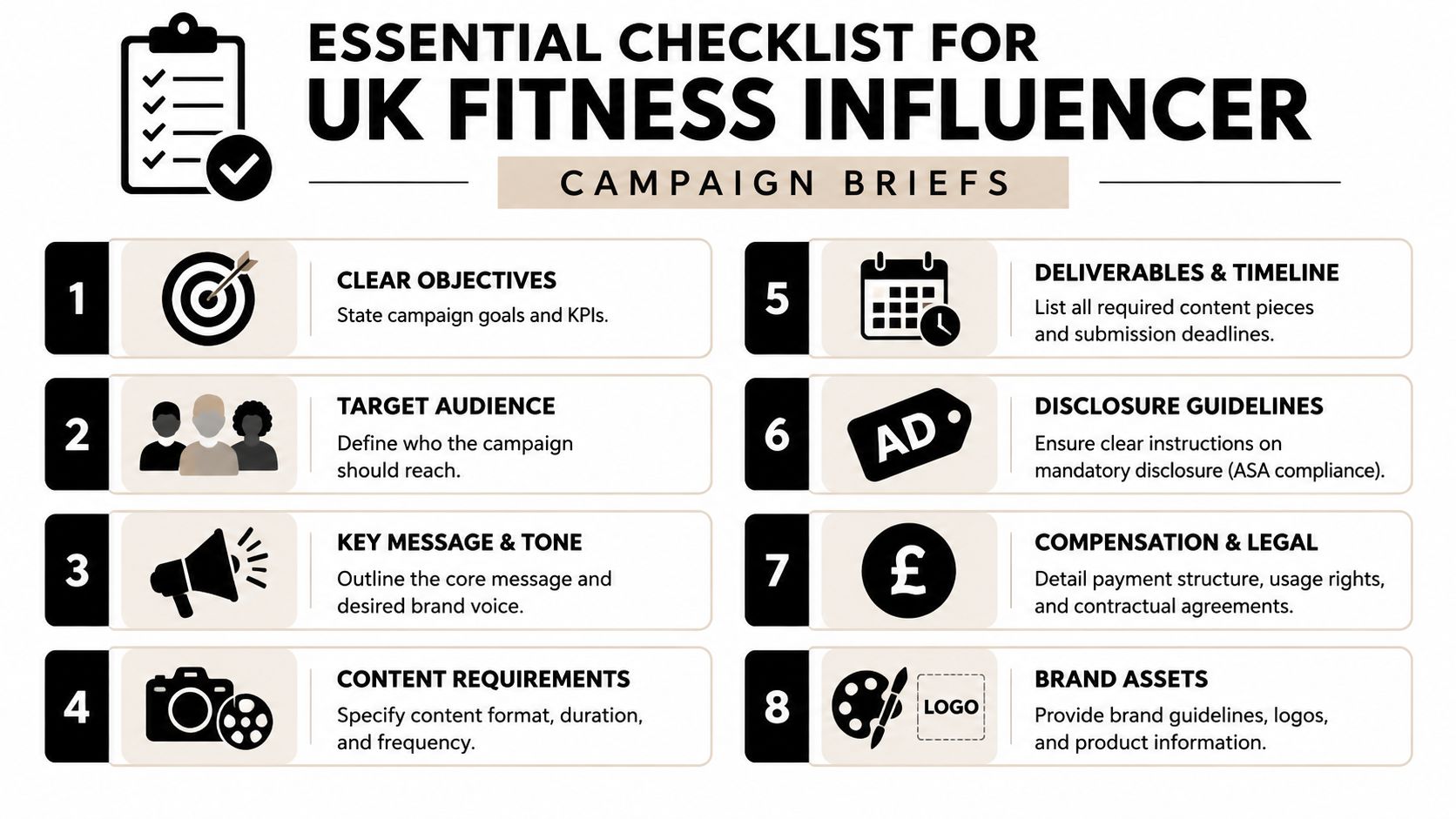
Use this checklist.
- Campaign objective. Be specific about whether success means sales, sign-ups, bookings, traffic, reviews, or UGC creation.
- Audience definition. State who the content should speak to and what problem the product solves for them.
- Core message. Give one clear message hierarchy instead of a long list of talking points.
- Mandatory points. Include disclosure requirements, product claims you can support, and anything legally required.
- Creative guardrails. Explain what must be shown, but avoid writing every line for them.
- Deliverables and timing. Confirm format, platform, deadlines, approval flow, and posting window.
- Usage rights. State whether you want organic reposting, whitelisting, paid usage, or archive rights.
- Tracking method. Include the creator's unique code, landing page, and link handling instructions.
What strong briefs avoid
Most weak sponsored fitness posts come from one of three problems.
First, the brand asks for too many messages in one piece of content. Second, it chooses a creator whose normal style doesn't fit the ask. Third, it treats authenticity like a decorative word while controlling every line.
Give creators a destination and guardrails. Don't hand them a script unless the channel requires one.
The best-performing briefs leave enough room for the creator to sound like themselves while making the business objective obvious internally.
Setting Rates and Handling Contracts Legally
Teams want certainty and rarely get it. They ask for a benchmark card, but the UK market doesn't behave like a neat spreadsheet.
That's partly because the supply is broad and uneven. A city-focused Modash directory surfaces 95 London fitness influencers, which underlines how fragmented the market is. In fragmented markets, standardised rate cards are rare. Two creators with similar follower counts can quote very differently because audience locality, filming quality, demand, niche, turnaround speed, and usage rights all change the value.
Use a benchmark table as a starting point only
You asked for a benchmark table, but there is a hard reality here. There is no verified rate data provided for UK nano or micro fitness influencers across Instagram and TikTok, so any precise pricing table would be invented. That would be bad practice and bad buying.
Instead, use a decision table that reflects what moves price in negotiations.
UK Micro-Influencer Rate Benchmarks (2026)
| Follower Tier | Avg. Engagement | Instagram Post (£) | Instagram Reel (£) | TikTok Video (£) |
|---|---|---|---|---|
| Nano creators | Varies by niche, audience quality, location, and consistency | No verified benchmark available | No verified benchmark available | No verified benchmark available |
| Micro creators | Varies by niche, audience quality, location, and consistency | No verified benchmark available | No verified benchmark available | No verified benchmark available |
That may look less satisfying than a fake benchmark sheet, but it's more useful. Rate setting should be based on commercial inputs, not recycled internet averages.
What should influence the fee
In negotiations, these variables matter more than follower count alone:
- Audience relevance. A local audience with the right buyer profile often justifies stronger value than a broader but looser following.
- Content complexity. A simple story mention is different from a well-shot training reel or TikTok with multiple scenes.
- Usage rights. Organic creator posting is one fee. Paid usage by the brand is another commercial layer.
- Exclusivity. If you're blocking competing partnerships, expect the rate to move.
- Turnaround and admin load. Tight timelines and heavy revision rounds increase cost.
- Track record. Creators who deliver professionally and consistently often deserve simpler, faster approval and fairer pricing.
Contract terms you shouldn't skip
Most influencer disputes aren't dramatic. They're boring. Missed assumptions about edits, payment timing, usage rights, or disclosure wording create friction that slows the programme down.
Your contract should cover:
- Deliverables Platform, format, quantity, posting date, and whether drafts are required.
- Compensation Payment amount or structure, invoicing method, and payment timing.
- Usage rights Whether the brand can repost, edit, run paid ads from the asset, or use the content after the campaign ends.
- Exclusivity Define category restrictions narrowly. Broad exclusivity creates resentment and inflated fees.
- Disclosure and compliance Spell out ad labelling expectations clearly. The creator and the brand both need that protection.
- Approval process State how many revision rounds are included and what counts as a material change.
- Cancellation terms Include what happens if either side delays, withdraws, or misses deadlines.
For a practical walkthrough, this guide to influencer contracts and agreements is a solid resource for teams that need a working checklist rather than legal theatre.
Measuring What Matters and Scaling Your Programme
A creator programme isn't real until it can be defended in a budget review.
Likes and comments help explain resonance, but they don't prove commercial value on their own. If you want fitness influencers UK to become a scalable acquisition or retention channel, you need attribution built in from the start. That means unique links, unique codes, and a dashboard that ties creator activity to outcomes.
Sprout Social's guidance on UK fitness influencers is directionally right here. Benchmark engagement rate, reach, conversions, and earned media value, and use 60+ days of historical performance data to separate repeat performers from one-off spikes.
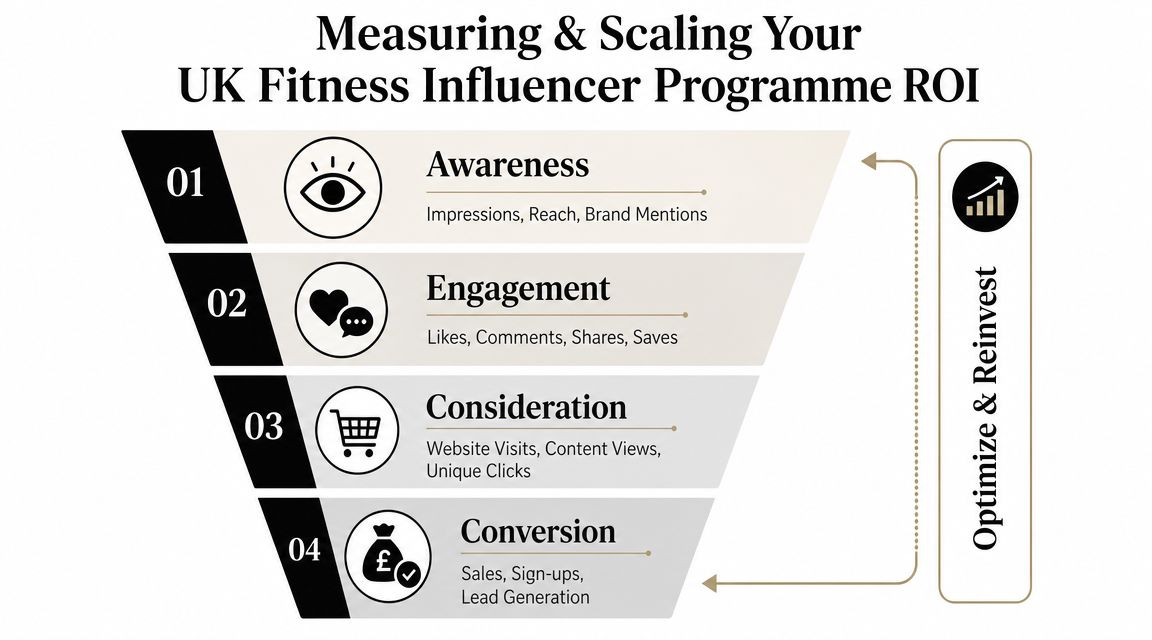
The measurement stack that actually helps
At minimum, every creator should have:
- A unique UTM-tagged link for traffic attribution
- A unique code for conversion attribution
- A clear content log with post date, format, and key message
- A basic scorecard that compares outputs and outcomes
If the campaign is for hospitality, studios, clinics, or local services, track bookings, redemptions, and reviews. If it's for ecommerce, track sessions, assisted conversions, direct code use, and repeat purchase patterns where possible.
What to do with the data
The point of tracking isn't reporting. It's reallocation.
When a creator consistently drives qualified traffic but weak code use, the issue may be landing page friction or offer design. When a creator gets lower reach but strong conversion, that's often a signal to extend the relationship, increase posting frequency, or test paid usage on their best-performing assets.
The right creator is the one who produces outcomes you can repeat, not the one who produces the loudest screenshot.
Scaling usually looks less glamorous than people expect. You don't jump from one creator to fifty overnight. You identify a handful of reliable profiles, document what format and offer worked, build a tighter brief, improve the landing experience, and then expand by niche, city, or creator type.
That is how the channel stops being experimental and starts becoming operational.
If you want a simpler way to run creator campaigns without juggling DMs, spreadsheets, codes, and reporting manually, Sup helps brands and agencies source verified micro and nano creators, launch campaigns quickly, and track clicks, conversions, bookings, and revenue in one place.
More on recruitment
See how many creators post about you and your competitors
Type in your brand's Instagram handle and we count the creators who post about you and about your five closest competitors. It takes about a minute and it is free. Or request a demo and we will show you the creators in your niche and walk you through the dashboard.
 Book a call