3 May 2026
Brand Ambassador Programmes A Complete 2026 Guide
A lot of brands still treat brand ambassador programmes as a soft-awareness play. That’s outdated. A 2024 survey of UK marketers found that 61% plan to increase investment in brand ambassador programmes, with improved content authenticity (36%), strong ROI (34%), and better engagement (32%) among the main reasons.
That shift matters because ambassadorships work differently from one-off influencer deals. They compound. A creator who posts about your brand once can create a spike. A creator who uses your product, learns your offer, refines their message, and talks about you repeatedly can become a durable acquisition and content channel.
Most advice stops at recruitment. That’s where problems begin. If you don’t set up measurement, contracts, workflows, and a scalable operating model from day one, you don’t have a programme. You have a spreadsheet full of names, unpaid follow-ups, fuzzy attribution, and internal debate about whether any of it worked.
To see which brands have the most returning creators, and how Sup builds a programme, read our page on brand ambassador programs.
What Are Brand Ambassador Programmes and Why They Matter
Brands that treat ambassador programmes as a reach tactic usually struggle to prove commercial value. The programmes that hold up under scrutiny are built as repeatable acquisition and retention channels, with clear attribution, operating rules, and a model that can scale beyond a founder-managed spreadsheet.
Brand ambassador programmes are structured, ongoing partnerships with people who promote your brand repeatedly over time. They can be customers, creators, local personalities, niche experts, or community members. What makes them ambassadors is consistency, not follower count.
The difference from a one-off influencer campaign is operational. An ambassador learns the product, understands the offer, and improves their message over multiple touchpoints. That tends to produce stronger content, better audience trust, and cleaner conversion paths than a single sponsored post.
For UK ecommerce brands, the upside is usually measurable revenue plus a steady supply of content that can be reused across paid social, email, product pages, and ads. For hospitality businesses, the win is often more local and more practical. Bookings, footfall, review volume, event attendance, and venue-level demand in specific postcodes.
That only works if the programme is set up to track outcomes properly. Promo codes alone miss too much. Last-click reporting often understates the impact of creator content. Manual gifting, inconsistent terms, and vague posting expectations create legal and reporting gaps that surface later, usually when finance asks what the programme generated.
If you already understand creator partnerships and want a better framework for scaling influencer campaigns with data, ambassador programmes should be treated as a managed growth channel with defined inputs, controls, and reporting.
For a more foundational definition, this guide to what brand ambassadors are is a useful reference point.
Brand ambassador programmes matter when they produce attributable sales, bookings, and reusable content on a repeatable basis, without creating a manual reporting problem behind the scenes.
Defining Your Programme Goals and Success Metrics
Programmes that start with awareness goals usually end with reporting problems. The team has posts, screenshots, and engagement charts, but finance still asks the same question. What revenue, bookings, or usable assets did this produce?
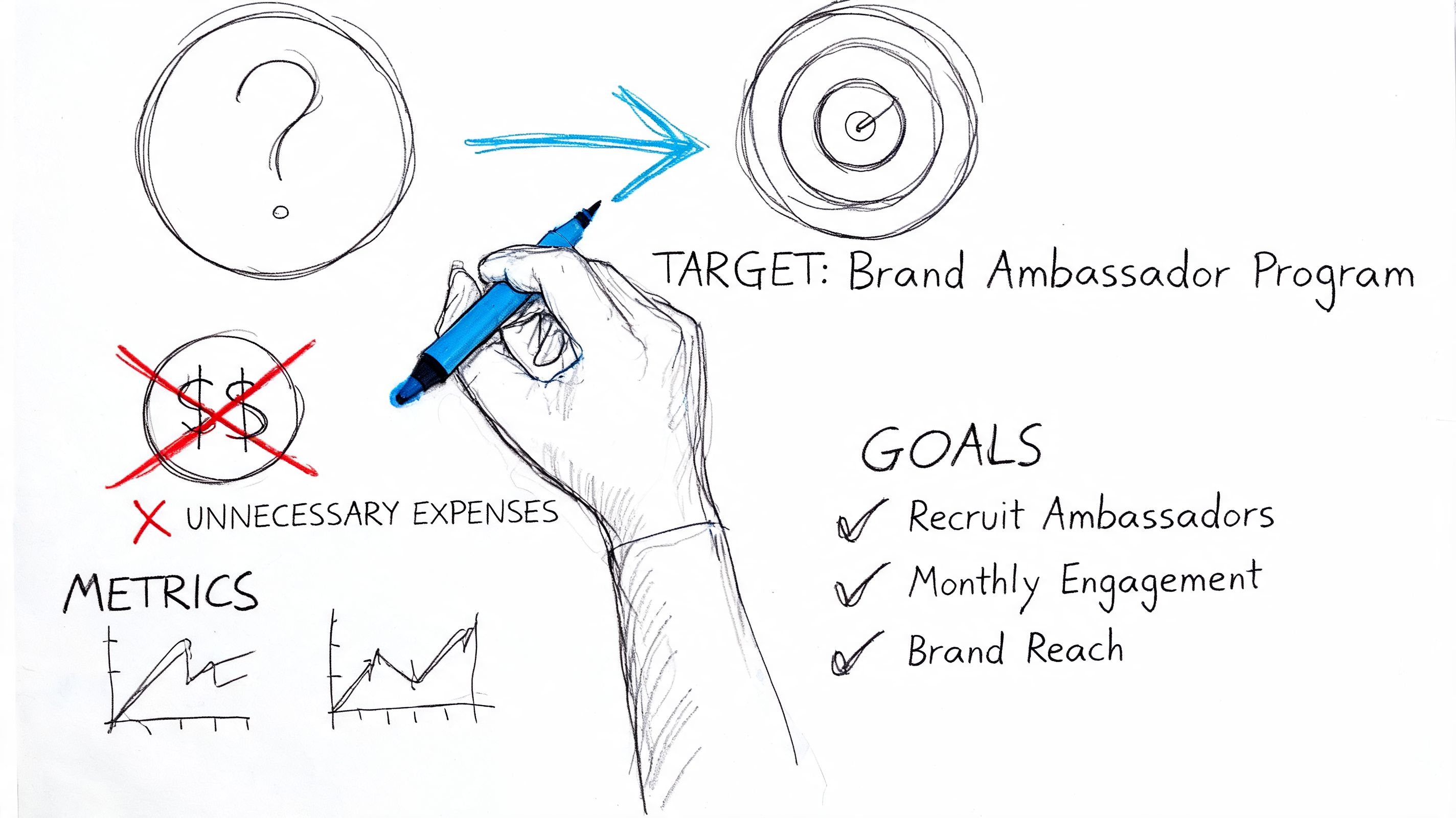
Set the goal in commercial terms first. Then decide how the programme will be measured, who owns the numbers, and what level of performance justifies more budget. If those answers are vague, the programme will drift toward vanity metrics because they are easier to collect than revenue data.
Four goals tend to justify an ambassador programme:
- Revenue generation: attributable sales, bookings, trials, or subscriptions linked to individual ambassadors
- UGC production: a repeatable flow of content your team can reuse across paid social, organic, email, and landing pages
- Social proof: credible product mentions, testimonials, and visible usage that reduce purchase hesitation
- Local demand creation: venue visits, postcode-level bookings, event attendance, and review volume for specific locations
Each goal needs a different operating model. That is where teams go wrong.
A creator who produces strong UGC may have weak conversion rates. A local hospitality ambassador may drive table bookings and footfall but look average in platform analytics because the sale happens offline. If both are judged on likes, reach, and follower count, you will back the wrong people and cut the ones creating commercial value.
The KPI framework should reflect how customers buy.
| Goal | Strong KPI | Weak KPI |
|---|---|---|
| Revenue | Promo code redemptions, UTM conversions, affiliate sales, attributed bookings | Likes, views alone |
| UGC | Approved assets produced, content with usage rights, asset reuse rate, cost per usable asset | Total posts published |
| Social proof | Testimonial volume, quality of mentions, comment sentiment, review use on site or menus | Follower count |
| Local demand | In-store redemption, booking-linked codes, review generation, venue-level uplift by campaign period | Reach outside target areas |
For UK ecommerce brands, that usually means combining links, codes, post-purchase survey data, and platform attribution rather than relying on one method. For hospitality, it often means connecting creator activity to booking systems, till redemptions, event check-ins, or venue-specific offers. Promo codes alone miss too much, especially when customers see creator content on social and convert later through search, direct traffic, or in person.
There is also a legal and reporting angle that many guides skip. If the programme includes gifting, commission, or repeated partnerships, disclosure rules and written terms need to line up with how performance is tracked. If an ambassador is posting regularly but there is no clean record of deliverables, permissions, and payment triggers, attribution disputes show up later. Usually when someone asks why one partner was paid more than another.
Build the scorecard before recruitment starts. I treat these five questions as the minimum:
- Which action counts as success?
- How will each ambassador be tracked across online and offline conversions?
- Who owns reporting each week or month?
- What threshold defines acceptable performance after the first campaign cycle?
- Which metrics are leading indicators, and which ones determine budget decisions?
That last point matters. Saves, shares, comments, and story replies can indicate message fit. They do not prove return on spend by themselves.
The reporting mindset should be operational, not decorative. This breakdown of operational social strategy and measurement on video is useful because it focuses on connecting content output to accountable business results.
Practical rule: If someone asks what the programme produced and the answer starts with impressions, the measurement model is incomplete.
Choosing the Right Ambassador Programme Model
The right model depends less on budget than on buying behaviour, sales cycle, and how your customers discover you. I’ve seen brands pick a model because it sounded scalable, then spend months managing the wrong kind of partner.
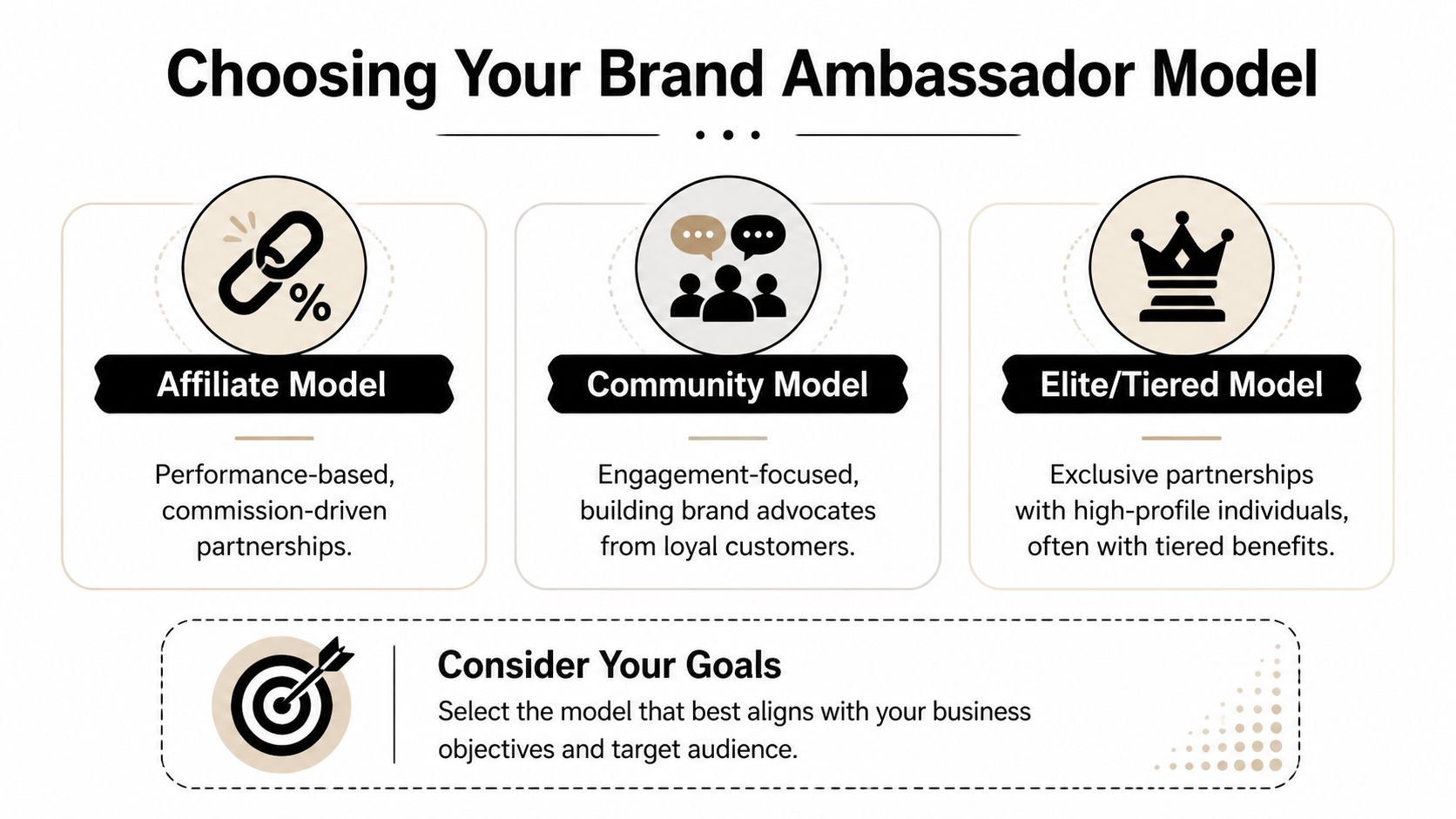
Three models cover most use cases. You can combine them later, but it’s better to start with one primary operating model and make it work.
Organic advocate model
These ambassadors are existing customers or supporters who already like the brand. They aren’t professional creators first. They’re users first.
This model works best when trust and credibility matter more than polished production. Skincare, supplements, niche apparel, boutique fitness, and community-led food brands often do well here because genuine use is part of the message.
Compensation usually sits around product seeding, perks, early access, or community status. Sometimes there’s a referral element, but the core exchange is belonging and recognition.
The trade-off is consistency. Organic advocates can produce highly credible content, but they often need more prompting, more structure, and more follow-up than experienced creators.
Paid micro or nano ambassador model
This is the most practical model for many UK ecommerce and hospitality brands. These ambassadors are small creators with a defined niche, audience fit, or local relevance. They usually know how to make short-form content, understand platform norms, and can produce on a cadence.
For a multi-location restaurant group, local micro or nano creators are often the strongest option because they can speak to a place, not just a product. For a DTC brand, they can create repeated use-case content that feeds both organic and paid channels.
This model gives you more control than organic advocacy and more authenticity than a celebrity-style deal. The downside is management overhead. Once you’re juggling outreach, briefs, approvals, content collection, reminders, payment terms, and rights across a growing roster, manual systems start breaking.
Affiliate or performance partner model
These ambassadors care most about trackable output. They work well when your offer converts cleanly, your margins support commission, and your attribution setup is reliable.
The content can feel more sales-led, which is fine if the audience expects recommendations and deal-led promotions. This model is often effective for ecommerce offers with straightforward economics. It can be less effective for hospitality brands where offline conversion and local context matter more than click-through alone.
Use this model when you want direct accountability. Avoid it if your product requires long education, heavy brand storytelling, or an offline conversion journey you haven’t instrumented properly.
Comparison of Brand Ambassador Programme Models
| Model Type | Who They Are | Primary Goal | Typical Compensation | Best For |
|---|---|---|---|---|
| Organic advocate | Loyal customers, fans, community members | Social proof, authentic UGC, advocacy | Free product, perks, exclusives, recognition | Community-led brands, products with strong repeat use |
| Paid micro or nano ambassadors | Smaller creators with niche or local influence | Reach with authenticity, UGC, local demand, repeat promotion | Fixed fee, product, perks, performance bonus | Ecommerce brands, restaurants, cafes, multi-location chains |
| Affiliate or performance partners | Creators or publishers focused on trackable sales | Attributable revenue | Commission, hybrid fee plus commission | DTC, ecommerce brands with clean conversion paths |
How to choose without overcomplicating it
Use decision criteria, not instinct alone:
- Choose organic advocates if your brand already has strong customer love and you need believable, lower-pressure advocacy.
- Choose paid micro or nano ambassadors if you need dependable content output and regional relevance.
- Choose affiliate-style partners if your finance team wants direct line-of-sight to commercial results.
Don’t start with the ambassadors you can get. Start with the model your business can measure and operate well.
Building Your Legal and Incentive Framework
Poor legal setup does more than create paperwork risk. It breaks attribution, slows payment, and turns a promising ambassador programme into a stream of one-off exceptions that nobody can scale.
For UK ecommerce and hospitality brands, the legal framework needs to do two jobs at once. It needs to protect the business, and it needs to make commercial performance measurable. If the agreement is vague on disclosure, content rights, promo code use, booking attribution, or payment triggers, the programme becomes hard to govern and even harder to defend internally.
That is usually where problems start. A creator posts without proper disclosure. A restaurant group wants to reuse a high-performing Reel in paid social but never secured usage rights. Finance asks why two ambassadors were paid on the same sale. Nobody can answer quickly because the rules were never written down.
What your agreement needs to cover
A workable ambassador agreement should be easy to sign and specific enough to enforce. It should define the commercial mechanics, not just the relationship. At minimum, include:
- Deliverables: What content is required, on which channels, in what format, and by what date.
- Disclosure requirements: Clear instructions for paid partnership labels, #ad use, and any brand-specific wording needed to meet UK advertising rules.
- Compensation model: Fixed fee, gifted product, dining credit, commission, or a hybrid structure, plus exactly when payment is approved.
- Usage rights: Whether you can repost organically, use the content in ads, edit it, crop it, localise it, or keep it in a content library.
- Exclusivity: Which competitors are restricted, for how long, and in which category or geography.
- Attribution rules: The code, link, landing page, booking note, or POS method that must be used for commission to count.
- Approval and compliance: Whether content needs pre-approval, what claims are not allowed, and what happens if disclosure is missing.
- Termination: How either side can end the agreement, what happens to unpaid commissions, and whether content usage survives the contract term.
For a stronger starting point, use this guide to influencer contracts and agreements before sending your first draft.
Incentives need to drive the behaviour you can measure
Incentives fail when they are generous but disconnected from outcomes. They also fail when they are so aggressive on performance that ambassadors lose interest before they have enough familiarity with the product to sell it well.
The best programmes balance certainty with accountability. That balance looks different by business model.
For ecommerce, a common structure is product seeding or a modest fixed fee paired with commission on tracked sales. That gives ambassadors a reason to create, while keeping the programme tied to revenue. For hospitality, the structure often needs a local conversion layer. Dining credit or stay credit can work, but it should sit alongside a booking code, tracked reservation link, or staff redemption process at venue level. Otherwise, the team sees activity but cannot tie it back to bookings, covers, or repeat visits.
A practical incentive stack usually includes:
- Base reward: Product, credit, access, event invites, or fixed monthly retainer for agreed output
- Performance reward: Commission, booking bonus, revenue share, or milestone payment tied to attributed outcomes
- Retention reward: Better rates, priority campaigns, or extra perks for ambassadors who deliver reliably over time
Avoid the two incentive models that break programmes
The first is vague product-only compensation with no clear output standard. That often attracts people who like freebies more than repeatable promotion.
The second is flat-fee heavy compensation with weak tracking. That gives marketing plenty of content but leaves finance with no clean line to sales.
Both models create friction as the programme grows. One side feels underpaid or overmanaged. The other side feels they are funding activity they cannot verify.
Set the rules before recruitment starts. Define what counts as a valid conversion, what evidence is required, how returns or cancelled bookings affect commission, and when an ambassador moves up a tier. That is what makes a programme scalable. It reduces negotiation, protects margin, and gives your team a structure you can roll out across dozens or hundreds of ambassadors without rebuilding the terms every month.
Your Step-by-Step Programme Launch Checklist
A programme usually becomes messy long before it becomes large. The work stacks up in small tasks. Vet one creator. Chase a reply. Resend the brief. Clarify the code. Follow up on the post date. Check whether the Story went live. Update the sheet. Ask finance about payment. Repeat.
That’s why launch discipline matters. Here’s the process that keeps things controlled.
Discovery and vetting
Start with fit, not follower count. The strongest ambassadors usually sit at the intersection of audience relevance, content quality, reliability, and commercial potential.
Look for signals such as:
- Category fit: Do they already post in a way that makes your brand feel native?
- Audience alignment: Are their viewers likely to buy, book, visit, or care?
- Content behaviour: Can they make usable content regularly, not just occasionally?
- Professionalism: Do they reply clearly, follow basic instructions, and disclose paid partnerships properly?
For hospitality, location matters more than broad reach. A local creator with an audience in the right catchment area is often more useful than a larger creator with national reach but no local pull.
For ecommerce, depth usually beats surface-level polish. A creator who can demonstrate repeat use, comparison, routine integration, or product education is often stronger than someone who only does aesthetic unboxings.
Outreach that gets a response
Generic outreach gets ignored because it looks generic. Most brands send versions of the same message: “We love your content and think you’d be a great fit.” That says nothing.
Write messages that prove you’ve looked at the creator’s work and understand why they fit your offer. Keep it concise. Don’t negotiate the entire deal in the first message. Get the conversation started.
A solid outreach note does three things:
- References something specific about their content.
- Explains why the partnership makes sense.
- Gives a simple next step.
If you’re contacting several creators at once, keep the core structure standardised but customise the opening line and fit rationale. That balance keeps the process efficient without sounding automated.
Onboarding without friction
Once someone says yes, speed matters. Don’t let the relationship drift into a week of disconnected emails.
A clean onboarding pack should include:
- Programme overview: What the partnership is, how often they’ll post, and what success looks like.
- Brand guardrails: Claims they can make, claims they can’t make, tone, visual preferences, and disclosure requirements.
- Tracking setup: Their unique code, link, or instructions for attribution.
- Admin essentials: Contract, payment info, shipping details, deadlines, and contact person.
The best onboarding reduces future clarification. Every unanswered question becomes a future delay.
Management and communication cadence
At a certain scale, manual systems usually start to crack. One or two ambassadors are easy. Ten feels busy. Beyond that, teams start relying on memory, inbox search, and fragmented spreadsheets.
Use a simple operating rhythm:
- Weekly check-ins: Confirm content status, answer questions, and catch blockers early.
- Monthly reviews: Assess performance, quality, and next steps for each ambassador.
- Asset collection: Save approved content as it goes live, with rights status attached.
- Payment reconciliation: Tie payments to deliverables and tracked outcomes, not scattered screenshots.
Airtable, Notion, Google Sheets, and Slack can carry you through an early pilot if they’re organised well. But once volume increases, manual follow-up becomes the main bottleneck. Not strategy. Not recruitment. Admin.
What usually goes wrong
The most common launch mistakes are operational:
- Too many ambassadors too early: Teams recruit faster than they can manage.
- No single owner: Marketing, social, and partnerships all touch the programme, but nobody owns it.
- Loose briefs: Creators interpret the brief differently, and then everyone argues about whether the content was “right”.
- No content archive: Good assets disappear into chat threads and social feeds.
- Delayed feedback: Ambassadors stop prioritising the programme because responses are slow.
A smaller, tighter launch beats a broad, chaotic one every time. Prove the workflow first. Then increase volume.
How to Measure ROI and Scale Your Programme
Without clean attribution, ambassador programmes turn into a cost centre disguised as community marketing.
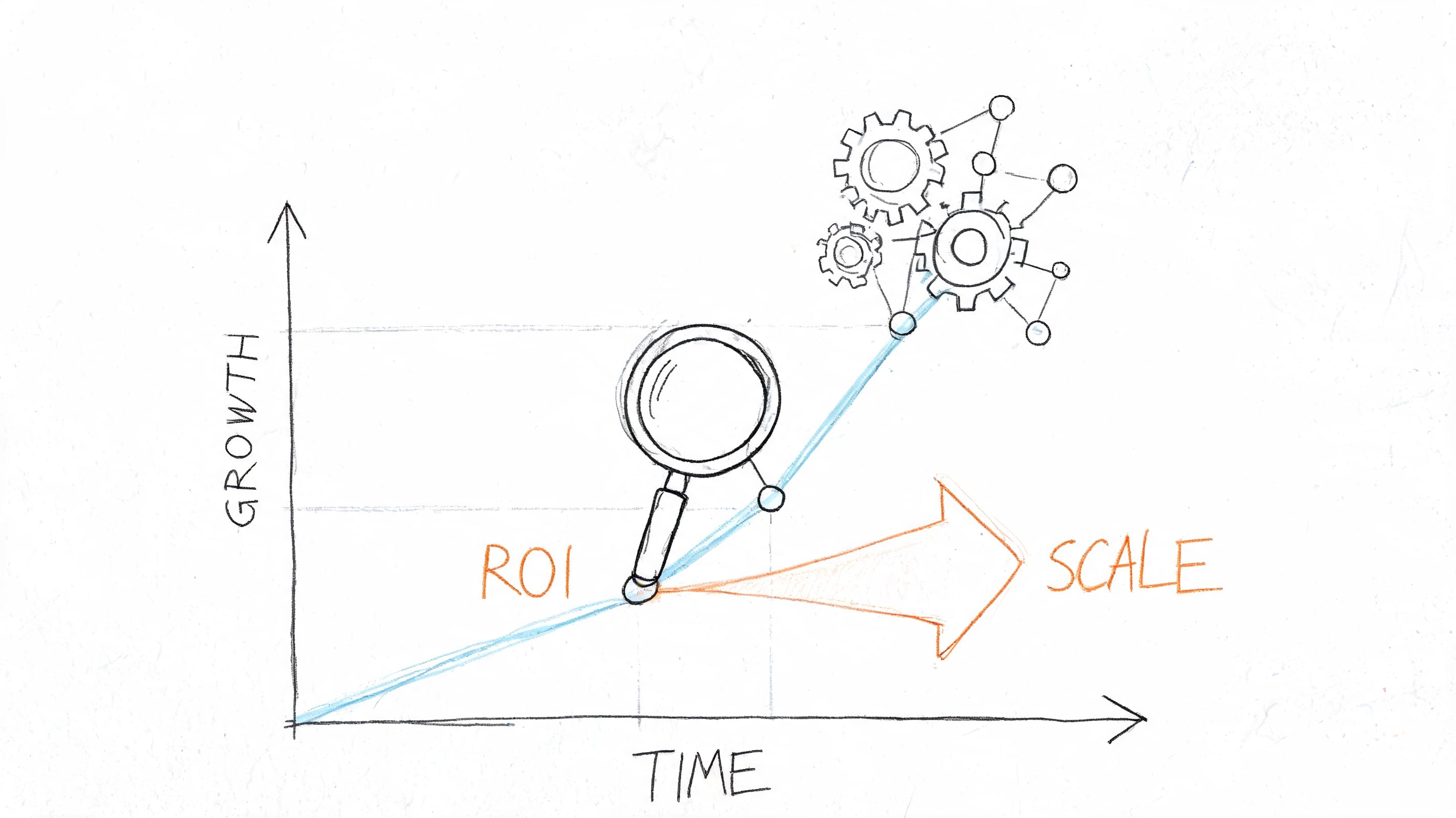
The first job is simple to describe and easy to get wrong in practice. Every ambassador needs a trackable path to conversion. For ecommerce, that usually means a unique discount code plus a UTM-tagged link. For hospitality, it often means a booking link, a code tied to a reservation source, or a landing page built for a specific creator.
Use both link and code tracking where possible. Links catch clicks. Codes catch people who see the content, search later, and convert on another device. If you only use one method, you will undercount performance and make bad budget decisions.
At ambassador level, track five things:
- Content delivered: what went live, on which platform, and on what date
- Traffic generated: sessions, clicks, and landing page behaviour from tracked links
- Conversions: purchases, bookings, enquiries, or sign-ups tied to links, codes, or referral fields
- Revenue contribution: gross revenue, net revenue, average order value, or booking value
- Secondary value: content you can reuse in paid social, email, product pages, or organic social
That fifth metric matters more than many teams expect. Some ambassadors drive direct sales. Others produce content that performs better in ads than on their own feed. If you treat every ambassador as a pure sales affiliate, you will cut people who are profitable in a different role.
Measure net return, not just top-line revenue. Start with revenue attributed to the ambassador, then subtract product cost, fees, free stock, paid boosts, platform costs, and team time if the programme is labour-heavy. For hospitality brands, include discounts, comped stays or meals, and any third-party booking fees. A programme can look healthy on gross revenue and still lose money once delivery cost is included.
Last-click attribution is a workable starting point. It is not the full picture. A customer may first see an ambassador on Instagram, return through search, then convert on email. That does not make the ambassador irrelevant. It means the channel assisted the sale, and your reporting setup needs to separate direct attribution from influence.
A practical setup is to report on three layers at once: directly attributed revenue, assisted conversions, and content reuse value. That gives a much better view of what each ambassador is contributing. For a more detailed framework, this guide to measuring influencer marketing ROI is a useful reference.
UK brands also need to close two gaps that many guides skip. The first is disclosure. If an ambassador does not label commercial content properly, the legal risk sits with the brand as well as the creator. The second is data quality. If codes are shared on voucher sites or links are copied without UTM parameters, reported ROI gets inflated or muddied fast. Put controls in place early. Use single-use codes where appropriate, set clear disclosure rules in the contract, and review traffic sources for leakage.
Scaling should follow evidence, not enthusiasm.
Expand the programme only after you can answer a few basic questions with confidence. Which ambassador profiles convert at a profitable CPA? Which content formats lead to bookings or higher basket value? Which locations, audiences, or offers perform well enough to repeat? Which ambassadors are producing reusable assets that reduce paid creative costs?
Once those answers are clear, scale in stages:
- Prove attribution works
- Benchmark performance by cohort, not just by individual
- Set minimum thresholds for ROI, content quality, and compliance
- Increase volume in the segments that hit those thresholds
- Remove low-signal partnerships quickly
- Feed top-performing content into paid and lifecycle channels
For teams refining wider reporting practices, this piece on operational social media ROI is useful because it focuses on measurement as an operating process.
The programmes that scale well usually look less exciting behind the scenes than people expect. Clean tracking. Clear thresholds. Fast reporting. Tight compliance. That is what turns ambassador activity into attributable revenue, rather than a spreadsheet full of posts and guesswork.
Essential Templates and Scripts to Get You Started
Templates should reduce thinking, not replace judgement. Use them as a base, then tailor them to your category, offer, and creator type.
Outreach message template
This works best when you personalise the opening and keep the ask simple.
Hi [First Name], I came across your content on [platform] and liked the way you talk about [specific topic, format, or angle]. It feels relevant to what we’re building at [Brand]. We’re putting together a brand ambassador programme focused on [product, audience, or location], and I think you could be a strong fit because of [specific reason]. The partnership would involve ongoing collaboration rather than a one-off post. If you’re open to it, I can send over the outline with deliverables, timing, and how the programme works. Interested?
Why it works: it’s specific, low-pressure, and doesn’t bury the lead.
Welcome email template
You must remove ambiguity. The tone should be warm, but the information should be operationally clear.
Subject: Welcome to the [Brand] ambassador programme Hi [First Name], Great to have you on board. Here’s everything you need to get started. What we’re looking for [Short summary of the partnership, the audience, and the role you’ll play] Your deliverables [List expected content, cadence, and platforms] Your tracking details Promo code: [Code] Link: [Tracked URL] Disclosure requirements Please include clear paid partnership disclosure where relevant, including #ad where required. Key dates [Deadlines, posting windows, launch dates] Payment and perks [Compensation structure, payment timing, products, or access] Your main contact [Name and email] Reply here if anything is unclear before you begin.
Campaign brief template
A brief should be clear enough to guide, not so rigid that it kills authenticity.
Campaign name [Name] Objective [What action the content should influence] Audience [Who should respond to the content] Core message [One or two points only] Mandatory inclusions [Product, offer, location, code, link, disclosure] Avoid [Claims, wording, visuals, competitors, prohibited statements] Creative direction [Examples of tone, hooks, scenes, or content style] Deliverables and deadline [Exactly what is due and when] Usage rights [What the brand may do with the content after publication]
Keep briefs narrow. The more messages you pile in, the weaker the content gets.
Review template before renewal
If the first cycle went well, don’t renew casually. Review properly.
Before renewing an ambassador, ask four questions: Did they deliver on time? Did their content fit the brief? Did tracked outcomes justify the spend? Would you want more content in the same style?
That quick review stops underperforming partnerships from drifting into long-term overhead.
Turning Ambassadorship into a Repeatable Growth Channel
The strongest brand ambassador programmes don’t look glamorous from the inside. They look organised.
They start with a narrow goal, recruit the right kind of partner for that goal, and set rules that remove ambiguity. They track performance at the level of the individual ambassador. They store content properly. They make legal compliance part of the workflow, not an afterthought. They stop relying on screenshots, inbox searches, and optimistic reporting.
That’s what turns ambassadorship from a promising tactic into an operating channel.
For ecommerce brands, that channel can produce attributable revenue, reusable UGC, and repeated product education. For hospitality and multi-location businesses, it can create local demand with far better visibility into which creators, venues, and offers move people to act. For agencies, it creates a system that clients can understand and renew because the work is measurable.
The common thread is discipline. Strategy first. Measurement from day one. Scalable workflow before expansion.
Get those right, and brand ambassador programmes stop being hard to defend internally. They become one of the clearest ways to turn trusted voices into repeatable growth.
If you want to launch brand ambassador programmes without getting buried in DMs, spreadsheets, code setup, and attribution cleanup, Sup helps teams run measurable creator campaigns end to end. It’s built for ecommerce brands, restaurants, agencies, and multi-location groups that need local creators, clean tracking, and a clearer path from content to revenue.
More on programs
See how many creators post about you and your competitors
Type in your brand's Instagram handle and we count the creators who post about you and about your five closest competitors. It takes about a minute and it is free. Or request a demo and we will show you the creators in your niche and walk you through the dashboard.
 Book a call