17 April 2026
What Are Brand Ambassadors: 2026 Guide to ROI
Many organizations don’t start looking into brand ambassadors because they love the term. They start because their current creator model is leaking money.
You brief a one-off influencer campaign. The content looks polished. The post goes live. A few likes roll in, maybe some comments, maybe a temporary bump in traffic. Then the campaign ends and so does the momentum. No repeat mentions. No ongoing customer conversation. No reliable way to tie spend to sales, bookings, or reviews.
That’s the point where the question changes from “should we work with creators?” to “what are brand ambassadors, and how do we build a programme that compounds instead of resetting every month?”
Our page on brand ambassador programs ranks the brands whose creators come back most often.
The shift is bigger than vocabulary. A brand ambassador is not just a cheaper influencer or a friendlier affiliate. Done properly, an ambassador programme gives you recurring content, stronger audience trust, cleaner attribution, and a bench of people who can speak for the brand without sounding scripted. That matters more now because the UK creator economy keeps expanding. The influencer and brand ambassador marketing sector in the UK was valued at £1.5 billion in 2023 and is projected to reach £3.2 billion by 2028, while 72% of UK brands allocated over 20% of their marketing budgets to creator collaborations. That growth reflects a clear shift towards authentic partnerships over traditional advertising, as outlined in this UK brand ambassador market overview.
For DTC brands, restaurants, and agencies, the operational question isn’t whether advocacy matters. It’s whether you can build a system that turns advocacy into a repeatable channel. If you’re already exploring creator-led growth, this guide to creator-led commerce is useful context because the best ambassador programmes sit inside that broader model.
Introduction Beyond One-Off Collabs to True Advocacy
A lot of marketing teams are stuck in the same loop. They run creator campaigns in bursts, approve content one post at a time, and judge performance too early or too loosely. The result is activity without much carryover.
Brand ambassadors solve a different problem than one-off influencers. They create continuity. They keep the brand present in feeds, local communities, review ecosystems, and customer conversations over time. Instead of renting attention, you build a group of people with a reason to keep showing up.
What changes when advocacy becomes a system
The difference is easiest to see operationally:
- One-off collaborations create spikes. You get a burst of awareness, then silence.
- Ambassador programmes create repetition. The same people post, review, refer, and reinforce trust over time.
- Short campaigns often optimise for content delivery.
- Longer partnerships let you optimise for outcomes like bookings, code redemptions, repeat purchases, and usable UGC.
That last point matters. A creator who works with you once is a media buy. A creator who keeps using the product, visits the venue repeatedly, answers follower questions, and shares proof in different contexts becomes part of your growth engine.
Practical rule: If the partnership only makes sense on posting day, you don’t have an ambassador programme. You have a content transaction.
Why this matters to buyers now
Consumers have become harder to persuade with polished brand language alone. They want evidence that a real person rates the product, would use it again, and isn’t reading from a brief. Ambassadors create that layer of credibility because they look closer to customers than advertisers.
For hospitality brands, that often shows up as local proof. People want to see the dish, the table, the atmosphere, the staff interaction, and whether someone nearby would recommend it. For ecommerce, it shows up in repeat wear, unboxing, tutorials, before-and-after content, and customer-style reviews that feel lived-in rather than staged.
The practical takeaway is simple. If your team is tired of resetting creator relationships from scratch, you probably don’t need more campaigns. You need a programme.
Defining the Modern Brand Ambassador
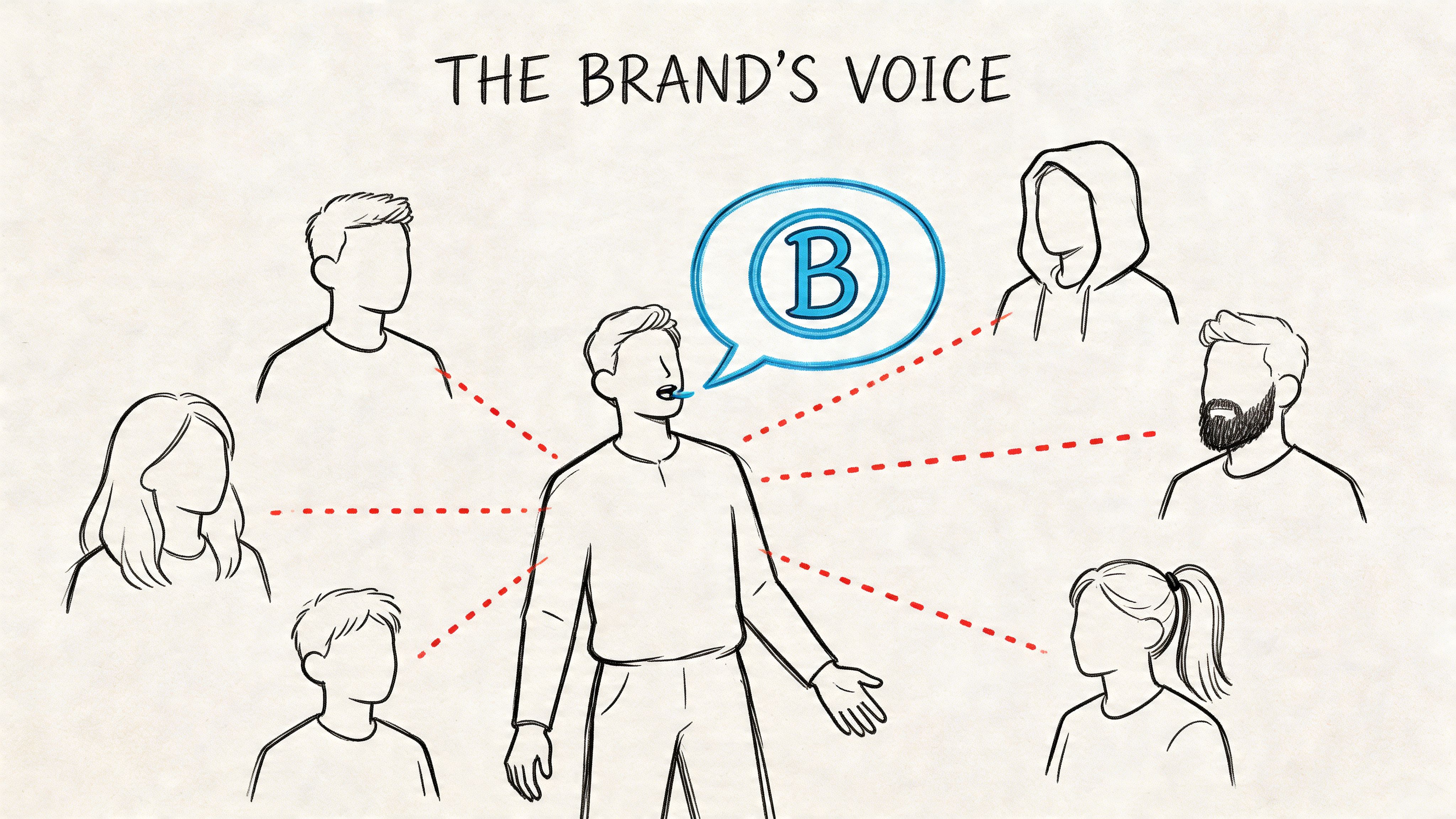
A modern brand ambassador is a person who represents your brand on an ongoing basis because there’s real alignment between them and what you sell. They aren’t just hired to post. They advocate, create, refer, and reinforce trust over time.
A simple way to think about it: an ambassador is closer to a committed club member than a guest performer. A guest performer shows up, does the set, and leaves. A club member brings people back, talks about the place between visits, and helps shape the atmosphere.
The four ambassador types that matter most
Most successful programmes include more than one kind of ambassador.
Loyal customers
These are the easiest people to underestimate. They already buy, already talk about the product, and often need very little prompting to create credible UGC. They’re useful because their content looks like real customer behaviour, not campaign content.
They also tend to spot friction early. If packaging confuses people, if an offer lands badly, or if product quality shifts, customer ambassadors will usually surface it fast.
Employees
Employee advocacy is becoming more important, especially in hospitality. The rise of employee brand ambassadors in UK hospitality has accelerated with labour shortages. A Reed Hospitality study found that 68% of chains now use employee advocacy, which drives 24% more reviews via TikTok UGC, and a CIPR survey found these internal posts generate 3.2x higher engagement than paid influencers in UK locales, as summarised in this employee advocacy guide.
For restaurants, cafés, and multi-location groups, staff often have an advantage external creators don’t. They know the product, know the customer questions, and can show behind-the-scenes moments that feel natural.
Niche experts
Some brands need credibility more than reach. That’s where specialists matter. In beauty, that may be a make-up artist. In fitness, it may be a coach. In food, it may be a respected local reviewer with a highly relevant audience.
Their value isn’t just audience size. It’s authority.
Local advocates
These matter most for multi-location brands. A local food creator in Manchester solves a different problem than a broad lifestyle creator with followers spread everywhere. Local ambassadors help drive nearby intent, local relevance, and location-specific offers.
If you’re building this kind of programme, it helps to understand the overlap between advocacy, moderation, and community care. This primer on What Is a Community Manager? is useful because ambassador programmes often work best when someone owns the community layer, not just recruitment.
What ambassadors actually do
Their role usually spans several jobs:
- Create UGC: Photos, videos, testimonials, reviews, and day-in-the-life content.
- Drive action: Promo codes, tracked links, event attendance, bookings, and referrals.
- Provide feedback: Product issues, store-level observations, audience objections, and offer reactions.
- Shape perception: They give the brand a face, a tone, and social proof.
Some teams confuse ambassadors with KOLs. There can be overlap, but the emphasis is different. If you want the distinction, this explanation of what a KOL is is a helpful reference.
The best ambassadors don’t sound like campaign assets. They sound like people with a reason to care.
Ambassadors vs Influencers The Key Differences
Most confusion comes from treating ambassadors and influencers as interchangeable. They aren’t.
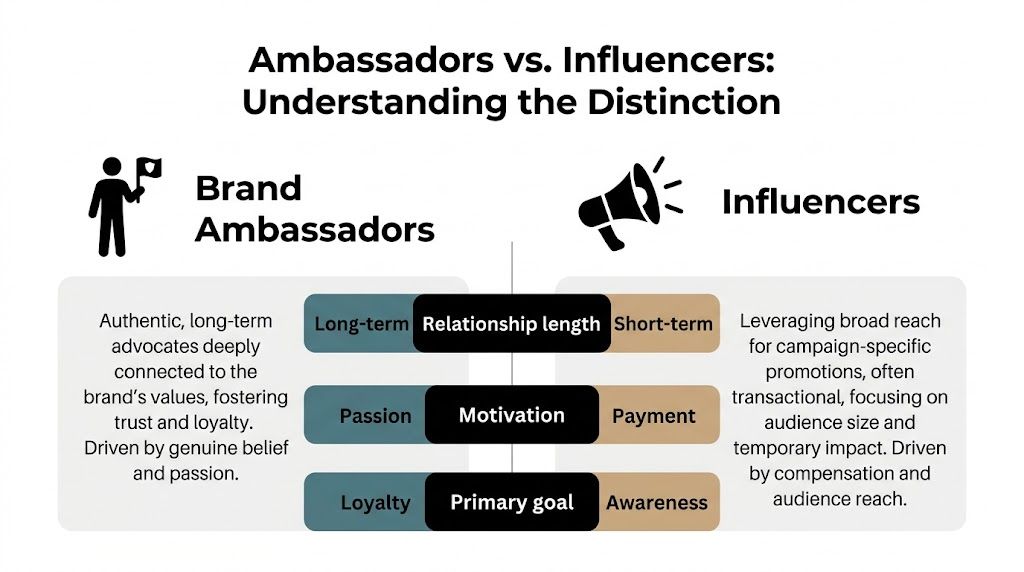
An influencer is usually hired for reach, content output, or campaign visibility within a defined window. An ambassador is usually chosen for ongoing fit, repeat advocacy, and longer-term commercial value. One model can work well without the other, but they solve different problems.
The shortest useful distinction
Influencers help you launch. Ambassadors help you sustain.
That isn’t absolute. Some influencers become excellent ambassadors. Some ambassador programmes include campaign-style deliverables. But if the relationship is short, highly transactional, and built around a single content burst, you’re operating in influencer territory.
Where the trade-offs show up
The big differences show up in three places.
Relationship length
Ambassador relationships are built to last. That matters because credibility improves when an audience sees repeated, consistent association with a brand. In UK fashion and lifestyle, long-term ambassadors with contracts over 12 months achieved 42% higher media impact value at £2.7 million per campaign, compared with £1.5 million for one-off influencers, according to the 2025 Launchmetrics Brand Ambassador Marketing Report.
Motivation
A good ambassador usually has some pre-existing alignment with the brand. They like the product, use the service, or fit the audience naturally. Compensation still matters, but belief comes first. Influencer deals can be highly effective, but they often start with the commercial agreement.
Output style
Influencer content often needs to perform in the moment. It may be polished, campaign-led, and highly produced. Ambassador content usually works better when it feels embedded in normal life. Repeated product use beats one perfect hero post.
Brand Ambassador vs. Influencer A Quick Comparison
| Attribute | Brand Ambassador | Influencer |
|---|---|---|
| Relationship | Ongoing, often long-term | Usually short-term or campaign-based |
| Core fit | Brand alignment and genuine use | Audience reach and content performance |
| Main goal | Loyalty, trust, repeat advocacy | Awareness, launches, burst visibility |
| Content style | Natural, recurring, closer to UGC | More campaign-led or polished |
| Payment model | Product, perks, commission, fees, or mixed terms | Often upfront fee per deliverable |
| Operational focus | Retention, attribution, consistency | Delivery, timelines, reach |
| Best for | DTC retention, local footfall, community growth | Product drops, awareness pushes, launches |
What works and what usually fails
Teams get better results when they stop choosing based on follower count alone and start choosing based on role.
Use influencers when you need fast distribution around a launch, event, or major announcement. Use ambassadors when you want recurring content, repeat visits, local proof, customer trust, and attributable sales over time.
What fails is the halfway model. That’s when brands call someone an ambassador but treat them like a one-off influencer with a lower fee. The creator sees no path, the audience sees no consistency, and the business sees no compounding effect.
Field note: If you can swap one creator out for another tomorrow with no operational impact, that person isn’t acting as an ambassador yet.
The Business Case Why Your Brand Needs an Ambassador Programme
The strongest case for an ambassador programme is not branding language. It’s commercial control.
A good programme gives you a more stable flow of content, a more believable recommendation layer, and more ways to attribute performance than traditional awareness activity usually allows. That matters whether you’re selling skincare online, trying to fill tables on a Tuesday night, or running creator campaigns for multiple client locations.
Trust converts better than polish
People buy from people they believe. An ambassador creates proof through repetition. They use the product again, revisit the venue, answer follower questions, and keep validating the choice after the first post.
That repeated exposure changes the quality of the recommendation. It stops looking sponsored and starts looking tested.
UGC reduces content pressure
Most brands don’t just need exposure. They need usable creative.
Ambassadors can supply a steady library of customer-style content that works across organic social, paid social, landing pages, review flows, and sales enablement. That lowers the pressure on internal teams to manufacture every asset from scratch, and it often gives paid teams more realistic creative to test.
Local programmes solve local growth problems
Restaurants and multi-location operators gain the most. A broad creator campaign may generate awareness. It won’t always shift local intent. Ambassador programmes can.
A local advocate can show the exact venue, the actual menu item, the atmosphere at a realistic time of day, and a reason to visit now. That’s much closer to how people decide where to book, eat, or drop in.
The hidden upside is feedback
Ambassadors don’t just promote. They report.
The useful ones tell you which offers confuse people, which products get repeat mentions, which objections keep appearing in DMs, and which locations feel more shareable than others. That feedback loop is one of the biggest practical differences between ambassador programmes and ordinary creator campaigns.
A well-run programme turns marketing into a two-way channel. You’re not only pushing messages out. You’re hearing what real people say back, and you can act on it quickly.
Building Your Programme From Launch to Scale
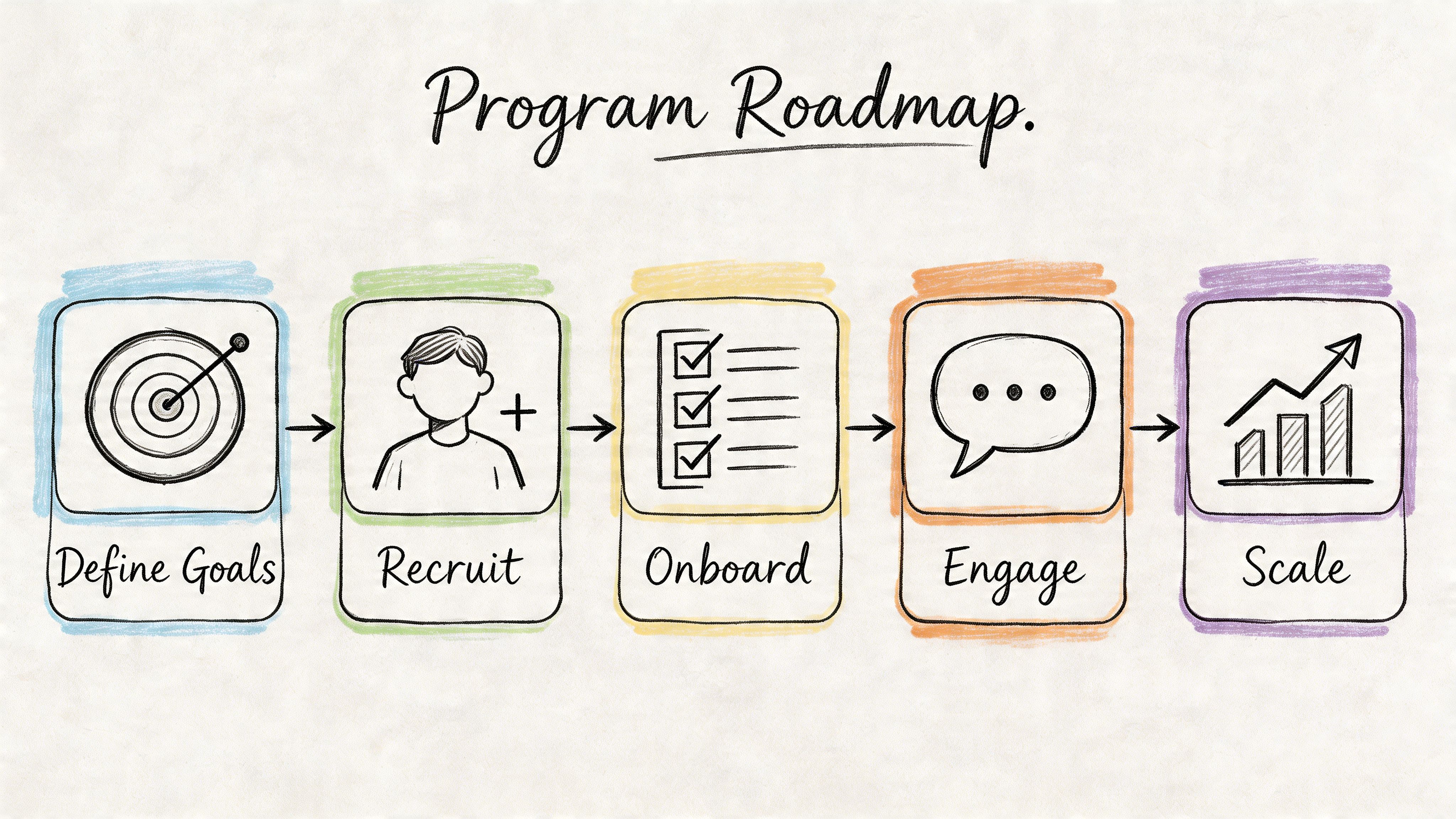
Scaling an ambassador programme is not a creative exercise first. It’s an operational one. The teams that struggle usually don’t fail because they picked the wrong creators. They fail because they never built a system for selection, onboarding, compliance, communication, and attribution.
Start with one business outcome
Don’t launch with a vague brief like “build awareness.” Pick the primary job.
For most brands, it’s one of these:
- Drive sales online
- Increase bookings or footfall
- Generate reusable UGC
- Lift review volume and local proof
- Support retention through repeat advocacy
Choose one as the lead metric. You can track the rest, but one outcome should decide whether the programme is working.
Recruit for fit, not fame
The best early ambassadors are often existing customers, local creators, employees, or niche voices who already look natural with the brand. The mistake is recruiting only for audience size. Reach is easy to overvalue. Fit is harder to replace.
For restaurants, local relevance matters more than broad exposure. For DTC, product-category fit matters more than generic lifestyle reach. For agencies, creator reliability often matters more than raw vanity metrics because you need repeatable delivery across client accounts.
A practical filter helps:
- Content fit: Does their existing content already resemble the content you need?
- Audience fit: Are they speaking to the customer you want?
- Behaviour fit: Do they respond, meet deadlines, and follow instructions?
- Brand fit: Would you still want them associated with the brand six months from now?
Set terms before content starts
Most programmes become messy because brands recruit first and define the relationship later.
You need clarity on:
- Deliverables: Posting cadence, review expectations, event attendance, referral expectations
- Compensation: Product, vouchers, flat fees, commission, or hybrid structures
- Usage rights: Whether the brand can reuse content in paid and organic channels
- Disclosure rules: How paid or gifted relationships must be labelled
- Exit clauses: What happens if either side wants out
This matters even more in the UK because compliance is not optional. A critical and often overlooked issue is compliance with the Consumer Protection from Unfair Trading Regulations 2008 and ASA guidelines. ASA data from 2025 showed enforcement actions against 45 UK influencer campaigns for non-disclosure of ads, up 28% from 2024, highlighting the legal risk of weak contractual frameworks, as covered in this UK legal overview of brand ambassador obligations.
If your ambassador brief explains the caption but not the disclosure, your programme is exposed.
Build onboarding like an operating procedure
Good onboarding saves weeks of back-and-forth later. It should answer the questions creators are going to ask anyway.
Include:
- Brand positioning: What the brand stands for and what it doesn’t
- Creative guardrails: What content styles work, what to avoid, and which claims are off-limits
- Offer mechanics: Codes, links, booking flows, location notes
- Approval process: What needs approval and what doesn’t
- Communication rules: Who they contact, where updates live, and when payments are made
Many brands skip this and rely on DMs plus a loose PDF. That works with three people. It breaks at fifteen. It becomes chaos at fifty.
A lot of teams also forget format diversity. If you need video-heavy output, your briefing process has to match the platform. This YouTube influencer marketing playbook is useful if part of your programme includes longer-form creator content alongside short-form social.
Give ambassadors a reason to stay active
Retention in ambassador programmes is often treated too casually. If creators only hear from the brand when it wants another post, the relationship goes flat.
Keep the programme active with a mix of:
- Regular missions: Product reviews, visits, launches, themed content pushes
- Community updates: New product drops, insider previews, local openings
- Recognition: Featured content, tier upgrades, early access
- Performance visibility: Let people know what’s working
The strongest programmes feel less like outreach and more like membership.
Here’s a practical walkthrough that’s particularly relevant for hospitality teams managing recurring creator relationships at location level: building an influencer ambassador programme for your restaurant.
After the structure is in place, this video gives a useful visual overview of how creator programmes can be organised in practice.
Scale by tightening the system, not by hiring more chaos
Going from your first few ambassadors to a team of 50+ changes the work. Recruitment becomes less important than operations.
At scale, you need:
- One source of truth for briefs, links, codes, approvals, and payments
- Clear segmentation by location, category, or performance tier
- Regular pruning of inactive or low-fit ambassadors
- Simple reporting that shows which creators drive results, not just activity
Brands usually hit a wall when they try to manage scale through inbox threads and spreadsheets. That setup hides underperformance, creates payment mistakes, and makes attribution harder than it needs to be.
Measuring What Matters KPIs for Ambassador Success
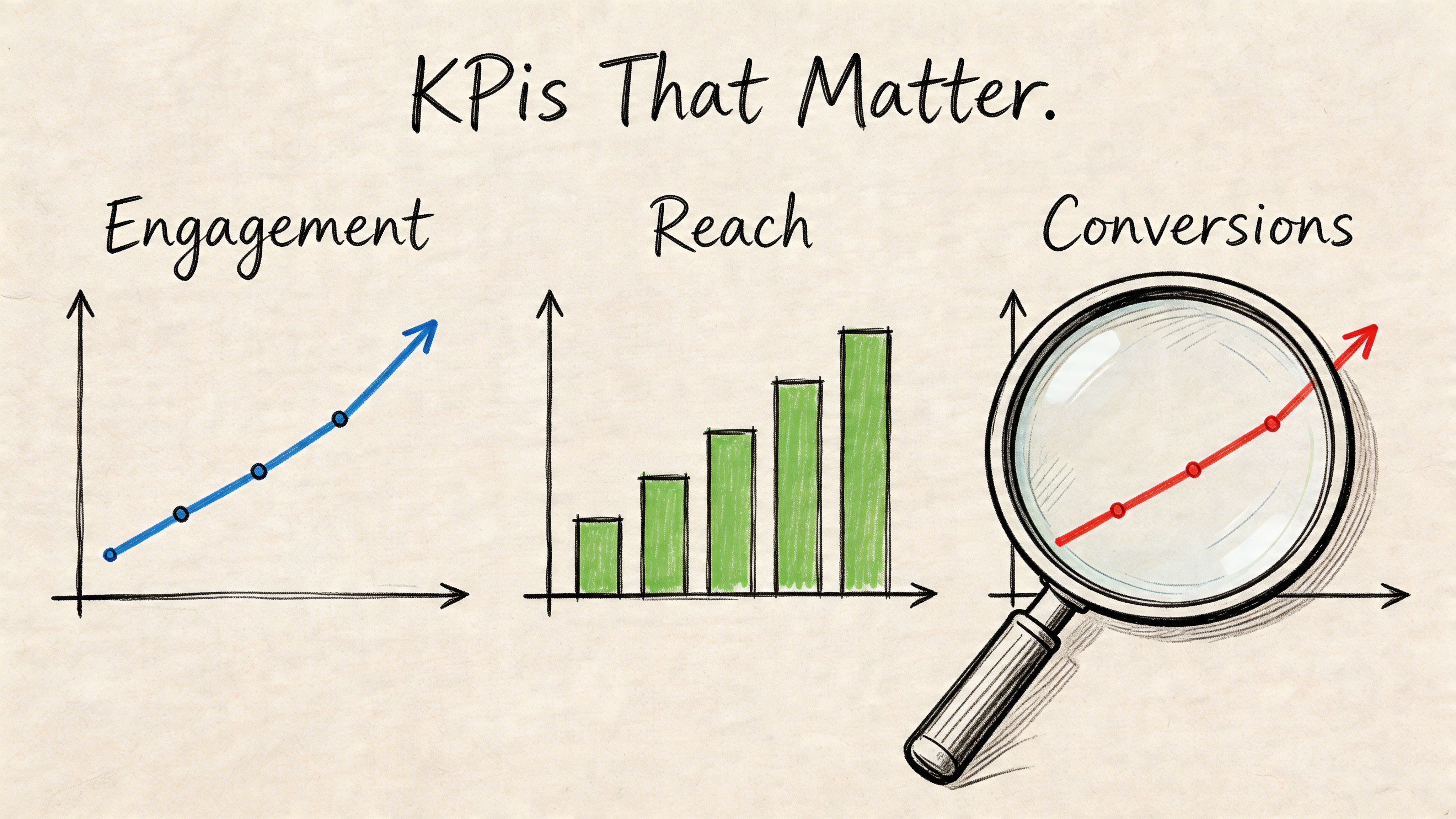
The fastest way to ruin an ambassador programme is to judge it by the wrong metrics. Likes look nice in a recap deck, but they rarely tell you whether the programme deserves more budget.
What matters is whether ambassador activity creates revenue, bookings, reviews, usable content, and repeatable learning.
Start with attributable actions
Every ambassador should have a trackable path to outcome. If you can’t tie activity to a code, link, booking flow, review path, or content asset, you’re mostly estimating.
The cleanest KPI stack usually includes:
- Revenue from unique promo codes
- Traffic and conversions from UTM links
- Bookings or visits tied to creator-specific offers
- Review generation where relevant
- Volume of reusable UGC produced
- Content reuse performance in paid and organic channels
Use engagement as a filter, not the finish line
Engagement still matters. It’s just not the main event.
In the UK, micro-influencer ambassadors with under 10k followers achieve average engagement rates of 3.2% to 5.1%, which outpaces macro-influencers. Significantly, programmes using verified micro-creators saw 2.4x higher conversion rates at 4.7% from promo codes and UTM-tracked sales, and every £1 spent yielded £17.50 to £27.50 in incremental revenue, according to this UK benchmark on ambassador KPIs.
That’s why engagement should be treated as a screening metric. It helps you spot creators worth testing or retaining. It doesn’t replace sales data.
Measurement rule: A creator with modest reach and clean conversions is more valuable than a creator with broad reach and fuzzy attribution.
Judge output quality, not just output volume
A programme can generate lots of content and still underperform. Volume matters less than whether the content is usable and whether it changes buyer behaviour.
Ask:
- Does the UGC answer common objections?
- Can the paid team reuse it without heavy editing?
- Does it show real context, not just product placement?
- Does it produce comments, saves, clicks, code use, or review behaviour?
For restaurants, the strongest content often includes context that buyers care about but brands overlook. Portion size, queue times, table setting, ambience, neighbourhood feel, service moments, and whether the location feels worth a visit.
Build a simple scorecard
You don’t need an elaborate dashboard to start. A practical scorecard per ambassador is enough.
| KPI area | What to track |
|---|---|
| Commercial impact | Code uses, revenue, bookings, conversion actions |
| Content value | Number of usable assets, quality, repurposing potential |
| Audience response | Engagement quality, questions, saves, comments with intent |
| Reliability | Deadline adherence, communication, compliance |
| Strategic fit | Local relevance, product fit, brand alignment |
The point isn’t to over-measure. It’s to stop guessing.
Conclusion Your Engine for Scalable Growth
If you’re still asking what are brand ambassadors, the most useful answer is this: they’re not a trend label. They’re a structured way to turn creator relationships into an operating channel.
That channel works when the programme is built around fit, consistency, compliance, and attribution. It fails when brands treat ambassadors like cheaper influencers, track only surface metrics, or try to manage scale through scattered messages and spreadsheets.
For DTC brands, restaurants, agencies, and multi-location groups, the upside is straightforward. Better trust. Better UGC. Better local relevance. Better visibility into what drives revenue.
The brands that win here don’t necessarily have the biggest budgets. They have the cleaner system. They know who they’re recruiting, why those people matter, what they’re expected to do, and how success is measured.
That’s what turns ambassador marketing from a loose idea into a scalable growth engine.
Frequently Asked Questions
What are brand ambassadors in simple terms?
They’re people who represent and recommend a brand on an ongoing basis. Unlike a one-off creator post, the relationship is designed to continue over time through content, referrals, reviews, product use, or local advocacy.
Are brand ambassadors the same as influencers?
Not usually. Influencers are often campaign-based. Ambassadors are typically longer-term partners with deeper brand alignment and a more consistent role in promotion, content, and trust-building.
Who makes a good brand ambassador?
Look for people who already fit the product, communicate clearly, create believable content, and can influence the right audience. Reliability matters as much as creativity. For local businesses, proximity and community relevance often matter more than broad reach.
How should you pay brand ambassadors?
There isn’t one perfect structure. Common models include free product, meals, early access, vouchers, commission, flat fees, or a hybrid of those. The right model depends on the effort required, the creator’s fit, and whether the role is focused more on content, referrals, or recurring visits.
How long should an ambassador contract last?
Long enough to test genuine fit and repeated performance. Short trial periods can work at the start, but ambassador relationships usually become more effective when both sides have time to build familiarity, improve content, and measure real outcomes over multiple cycles.
What should be in a UK ambassador agreement?
At minimum: deliverables, compensation, content rights, disclosure requirements, approval rules, and termination terms. UK compliance matters, especially around ad disclosure and misleading promotion. If the agreement is vague, the risk sits with the brand as much as the creator.
What should you track first?
Start with the outcome closest to revenue. That could be code redemptions, UTM-driven conversions, bookings, review generation, or content assets that can be reused in paid media. Track engagement too, but don’t stop there.
If you want to turn ambassador marketing into a repeatable system instead of another spreadsheet-heavy channel, Sup helps brands launch, manage, and attribute creator programmes with far less manual work. It’s built for restaurants, ecommerce brands, agencies, and multi-location teams that need verified micro and nano creators, cleaner workflows, and clear visibility from post to booking, sale, or review.
More on programs
See how many creators post about you and your competitors
Type in your brand's Instagram handle and we count the creators who post about you and about your five closest competitors. It takes about a minute and it is free. Or request a demo and we will show you the creators in your niche and walk you through the dashboard.
 Book a call