4 May 2026
What is a PR Package? A 2026 ROI-Focused Guide
A PR package is a curated box of products, samples, and a personal note sent to influencers or journalists to spark authentic publicity, and in UK influencer marketing it can drive 26% higher engagement than paid sponsorships when recipients choose to post organically. The useful version isn't just a gift. It's a trackable campaign asset that can connect unboxings, clicks, redemptions, bookings, and revenue.
If you're asking what is a pr package, you're probably in one of two positions. You're either sending products out and hoping someone posts, or you've seen competitors get unboxings, reviews, and local buzz from creator gifting and want to know how to make it work without wasting stock and shipping budget.
If you would rather have the sending and the tracking done for you, see how Sup runs influencer gifting and product seeding.
The difference between a box that gets ignored and a box that earns results usually isn't the ribbon, the filler, or the freebie count. It's whether the package was built around a clear job. Generate creator content, support a launch, drive local footfall, win reviews, or prove revenue. Once that job is defined, the package stops being a nice gesture and starts acting like a measurable channel.
Unboxing the PR Package What It Is and Why It Matters
A PR package is a branded, curated delivery sent to a creator, journalist, editor, or tastemaker with the aim of getting your product experienced and talked about in public. In practice, that usually means a box with a hero product, a few supporting items, some brand context, and a note that makes the recipient feel chosen rather than bulk mailed.
The problem is that numerous teams still run PR packages like a lottery. They pick a list, ship a pile of boxes, refresh Instagram, and call whatever happens “brand awareness”. That approach creates cost, not a channel.
The old model is hopeful gifting
Hopeful gifting sounds familiar because it's common. Products go out. A few posts come back. Nobody can say which creator mattered, which package format worked, or whether the campaign moved anything beyond vanity metrics.
That doesn't mean PR packages are outdated. It means the execution is often lazy.
Practical rule: If you can't explain what success looks like before the package ships, you don't have a PR strategy. You have a fulfilment task.
A working PR package sits between earned media and performance marketing. It should feel organic to the creator, but it should still be structured enough for the brand to learn from each send.
The better model is measurable influence
A strong programme starts with a simple question. What should this box cause someone to do?
Possible answers include:
- Post an unboxing: Useful when you need fresh social proof and visual content.
- Test a product properly: Better for skincare, food, supplements, and any category where use matters more than a first impression.
- Visit a venue: Essential for restaurants, cafés, bars, and hospitality brands.
- Share a code or link: The cleanest route to attribution.
- Start a relationship: Valuable when the first send is a stepping stone to a longer creator partnership.
That shift changes everything. Recipient selection gets tighter. Packaging becomes functional, not decorative for its own sake. Notes become prompts. Landing pages, QR codes, and codes stop being optional extras. They become the mechanism that turns attention into action.
The Anatomy of an Unforgettable PR Package
A memorable PR package works like a conversation starter in a box. Every item inside should help the recipient understand what the product is, why it matters, and what to do next. If an item doesn't support that, it's clutter.
The six parts that actually matter
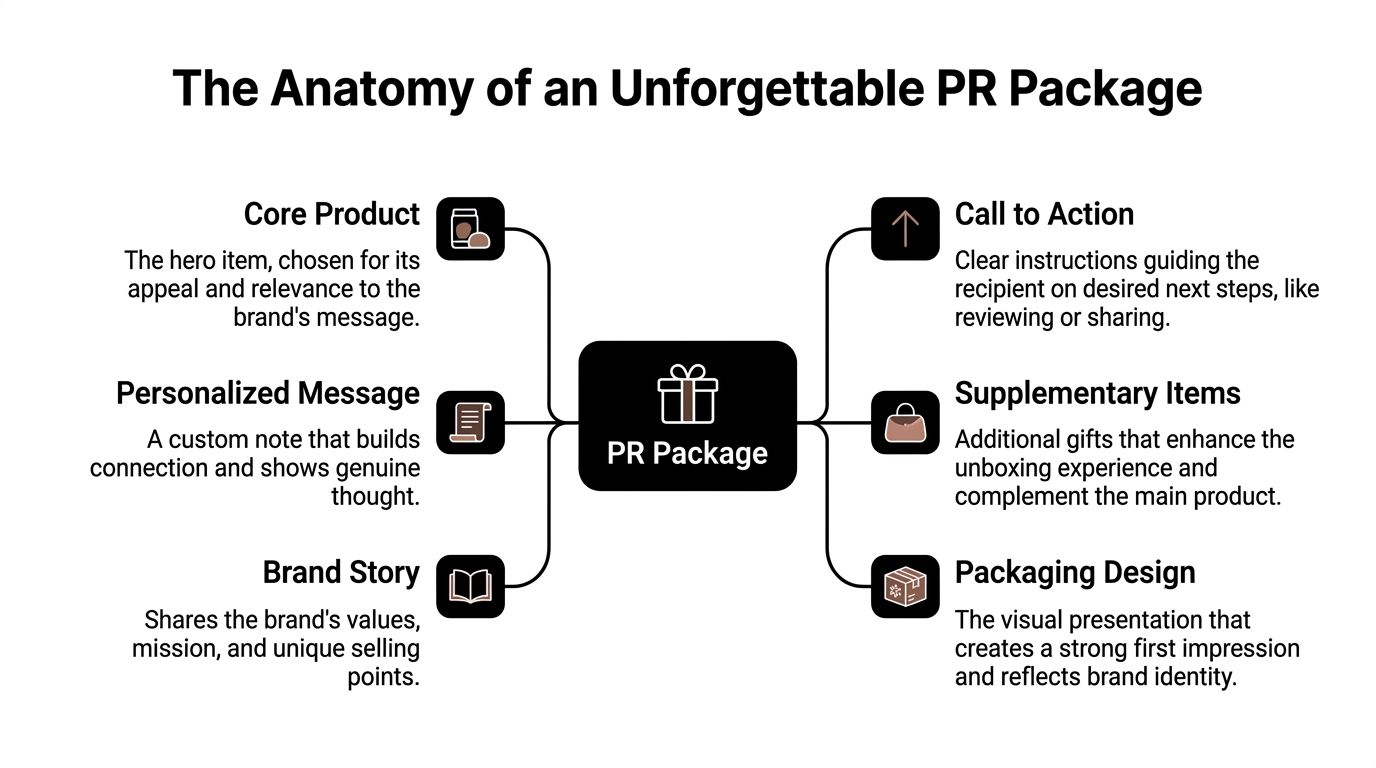
Start with the hero product. That is the star. It should be the first thing the recipient sees and the easiest thing to understand on camera. If you're launching a serum, the serum leads. If you're promoting a brunch menu, the voucher or experience invite leads.
Then add a personalised message. This is one of the most impactful elements in the box because it frames the experience. A generic card says “campaign”. A note that references the creator's style, audience, or past content says “fit”.
A brand story insert matters when it stays short. One page is enough. The recipient needs the angle, not your company history. Include what the product is, why it exists, and what makes it distinct.
The call to action is where many boxes fail. Brands act as if asking clearly makes the send less organic. It doesn't. “If you love it, we'd be grateful if you shared your honest thoughts” is fine. So is a QR code to a landing page with product details, creator assets, and a trackable link.
Supporting items should complement the main product, not compete with it. If you need design inspiration for tactile finishing that helps create a lasting impression, embossed or debossed details can add texture without making the package feel gimmicky.
What to include and why
| Component | Purpose | Pro Tip |
|---|---|---|
| Hero product | Gives the recipient one obvious thing to focus on | Put it at the top or centre so the camera catches it first |
| Personalised note | Makes the outreach feel relevant, not bulk sent | Reference the creator's niche or local audience directly |
| Brand story card | Gives context the creator can repeat accurately | Keep it short enough to skim in seconds |
| Supporting samples | Increases trial and content angles | Add only items that help explain the core product |
| QR code or landing page | Bridges physical gifting with digital tracking | Send to a page with links, usage info, and creator-specific UTMs |
| Branded packaging | Shapes the first impression and unboxing flow | Use materials that photograph cleanly and protect the contents |
Less is often better
Big boxes can backfire. They feel expensive to the sender, but they can feel confusing to the recipient. Too many inserts, too much merch, and too many reveal layers create friction.
A better box is edited. The recipient should know within moments what the brand wants them to notice. If the unboxing requires explanation, the structure is doing too much work.
Keep the box easy to open, easy to film, and easy to understand. Friction kills shareability faster than plain packaging ever will.
Why Brands Send PR Packages The Strategic Goals
Brands don't send PR packages because free products are magical. They send them because the right creator can turn a product experience into trusted public proof. That matters more than polished brand messaging in crowded categories.
In the UK, PR packages sent to micro-influencers produced a 26% higher engagement rate than paid sponsorships, and 68% of UK nano-influencers posted organic content after receiving them. Those organic posts generated 3.2x more saves and shares because audiences perceived them as more genuine. Trackable PR packages also attributed 15-22% of conversions directly, with £4.50 ROI per £1 spent in hospitality, while geo-targeted London creators drove 12% café footfall lifts in the cited example. The same source notes that packages under 2kg with custom-branded, recyclable packaging boosted open rates by 41%, and 73% of UK Gen Z influencers were swayed by sustainability considerations, according to the cited analysis in this UK PR package breakdown.
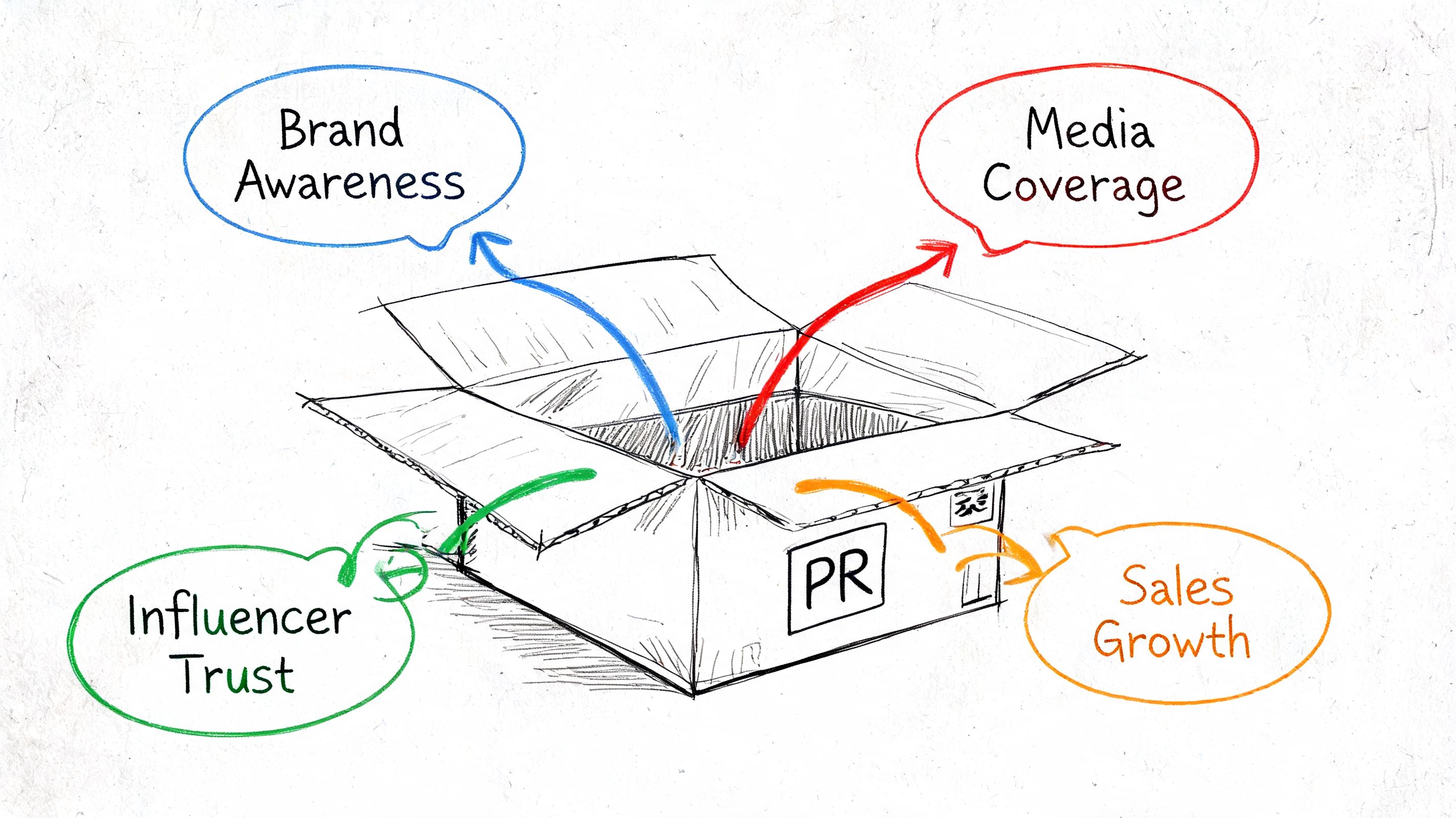
The strongest goals are specific
“Awareness” is too vague to steer a campaign. Better goals tell you who to send to, what to include, and how to measure success.
Common strategic goals include:
- Generate UGC with social proof: Unboxings, stories, Reels, TikToks, and honest reviews give future buyers evidence from a third party.
- Support a launch: A PR package can seed the first wave of public reactions before paid spend ramps up.
- Drive local demand: Restaurants and venues can use gifting to get creators through the door, fill quieter periods, and build a bank of local content.
- Test creator fit before paid work: Gifting helps identify who naturally understands the product before you commit to a larger collaboration.
- Create reusable assets: Good creator content often outlives the initial post and can support broader campaign activity.
The wrong goal creates the wrong package
If you want reviews, don't build a box optimised only for aesthetics. If you want footfall, don't send a beautiful package without a clear reason to visit. If you want trackable sales, don't leave out the code, link, or booking prompt.
That's where many teams get stuck. They optimise for “wow” and forget behaviour.
A PR package isn't successful because it looks expensive. It's successful because it makes the right next step obvious and appealing.
Real-World Examples From Ecommerce to Restaurants
The most useful way to understand what is a pr package is to stop thinking about it as a generic influencer box and start thinking about how the format changes by business model.
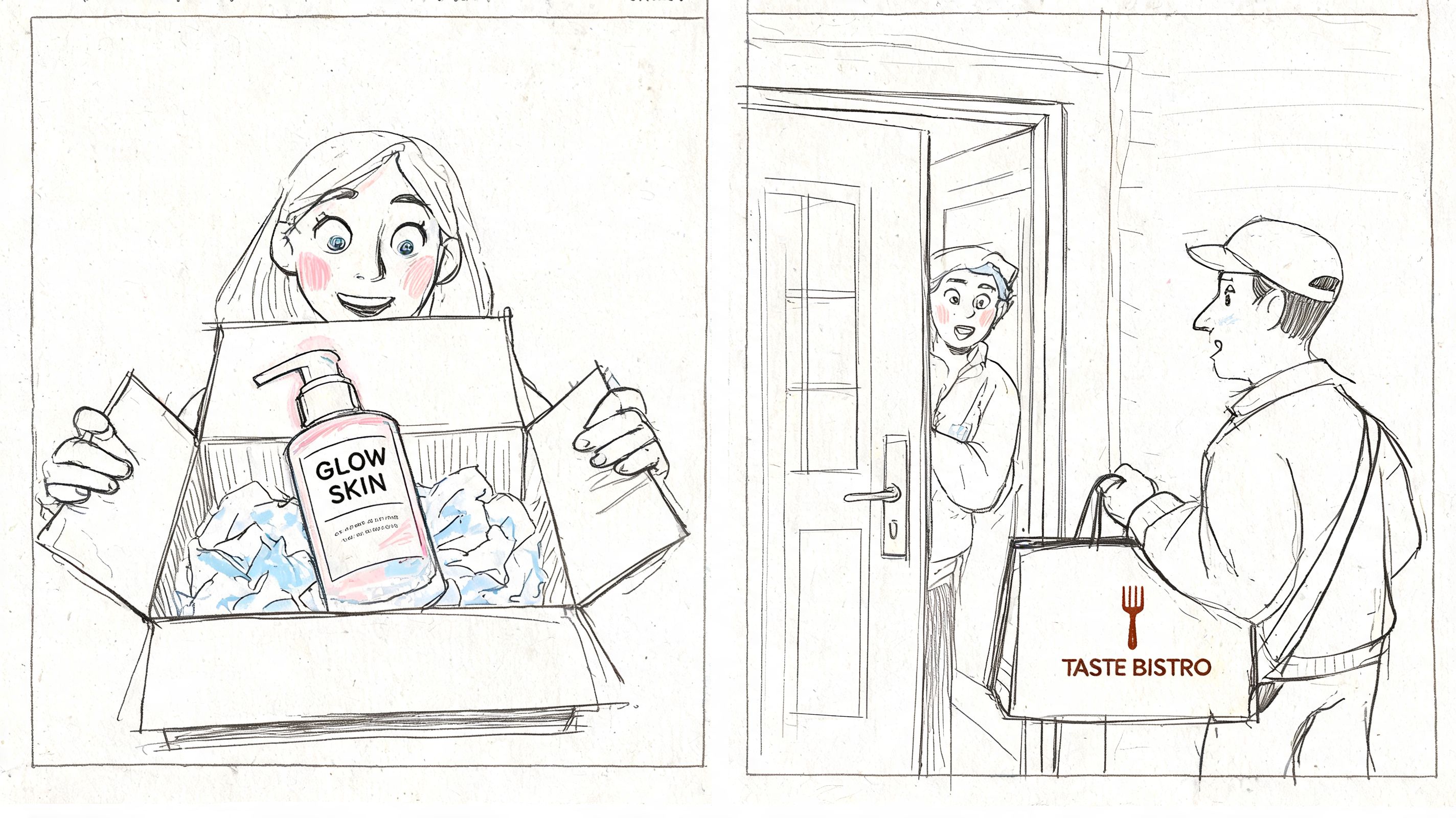
A skincare launch that needs proof, not hype
A UK DTC skincare brand is launching a new vegan serum. The team doesn't need celebrity reach. It needs believable creator reviews from people whose audiences already care about routines, ingredients, and texture.
So the package is built for use and explanation. Inside is the serum, a smaller companion sample, a short usage card, a personalised note referencing the creator's skincare content, and a QR code linking to a product page with ingredients, creator assets, and a unique tracking link. The outer packaging is clean, recyclable, and camera-friendly.
The send list stays tight. Beauty micro-creators on TikTok and Instagram who already post GRWM videos, shelfie content, and first-impression reviews get priority. The brand isn't asking for a scripted post. It's creating the conditions for an honest one.
What works here is alignment. The product needs demonstration. The creator format supports demonstration. The tracking layer shows who drove traffic and which voices created content worth repurposing later. For more on the broader model behind that kind of campaign, this guide to influencer marketing for ecommerce is a useful companion.
A café opening that needs local action
Now switch to hospitality. A new café in Manchester doesn't need a nationwide splash. It needs people in the area to show up, take photos, tag the venue, and leave credible reviews.
The PR package looks different. It may still be physically delivered, but the core offer is the visit. Inside are a branded invite, a tasting voucher, a note that invites the creator to try specific menu items, and a simple prompt to tag the location if they share their experience. The package is less about product ownership and more about orchestrating a visit that feels personal rather than transactional.
Brands often overcomplicate things. They send merch no one needs and forget the friction points that matter. Booking. Timing. Menu guidance. The fact that hospitality content depends on lighting, atmosphere, plating, and service as much as the food itself.
Why the same template fails both brands
The skincare brand needs content that explains product experience over time. The café needs local relevance and immediate footfall. Same tactic. Different mechanics.
A useful rule is simple:
- Ecommerce brands should optimise for trial, content quality, and attributable traffic.
- Restaurants and venues should optimise for visits, local tags, reviews, and bookable demand.
- Both should make it easy for creators to understand the offer and easy for the brand to track what happened next.
Creating Your PR Package Best Practices and Legal Rules
Good creator gifting is disciplined. Most bad campaigns fail before the box is sealed because the brand chose the wrong recipients, wrote weak outreach, or treated compliance as an afterthought.
Relevance beats follower count every time. A small creator with the right audience, tone, and posting style is usually a better PR package recipient than a larger account that never shares products like yours naturally. You want content fit, audience fit, and a clear reason that person should care.
Build for trust first
Personalisation doesn't need to be elaborate. It needs to prove that the brand knows who it's contacting. Mention the creator's niche, their city if local relevance matters, or the kind of content that made them a fit.
Your packaging matters too, but not because you need a luxury-box fantasy. It matters because the unboxing should be organised, protective, and easy to process on camera. If you're reviewing materials, layout, and print choices, these packaging design tips for businesses are a practical reference point.
The best packages feel considered, not overproduced. Creators can tell when a brand spent money on spectacle instead of clarity.
UK compliance is not optional
If the recipient posts content from a gifted package in the UK, the disclosure matters. UK-specific ASA rules require #gifted or #ad disclosures for resulting content. In 2025 audits, non-compliance fines averaged £18,000 per violation across 150 cases, according to the cited summary of CAP Code 2.1 evidence in this ASA-focused PR package article.
This isn't just legal housekeeping. The same cited source says compliant PR campaigns achieved 2.1x earned media value, or £7.80 per £1, versus 0.9x for undeclared campaigns. It also states that platforms such as TikTok demoted non-transparent posts by 35% reach.
That changes the usual conversation. Disclosure doesn't weaken content. Hidden gifting does.
Put the rules in writing
A simple written agreement prevents confusion. It should cover disclosure expectations, usage rights if you plan to reuse content, and any rules around timing or exclusivity. If your team needs a practical starting point, this guide to influencer contracts and agreements helps frame the essentials.
Use a straightforward checklist before any send goes out:
- Check fit: Confirm the creator already makes the kind of content your product needs.
- Check disclosure wording: Tell them clearly how to label gifted content.
- Check the CTA: Make sure the package points to one next step.
- Check the landing path: Codes, UTMs, booking links, and QR destinations should all work before dispatch.
- Check reuse rights: If you want to run their content in paid social later, settle that up front.
Measuring Your PR Package ROI From Views to Revenue
Most PR package reporting falls apart at the point where stakeholders ask one fair question. “What did we get back?” If the answer is a list of likes, views, and screenshots, the channel stays trapped in the cost-centre category.
That's a measurement problem, not a format problem.
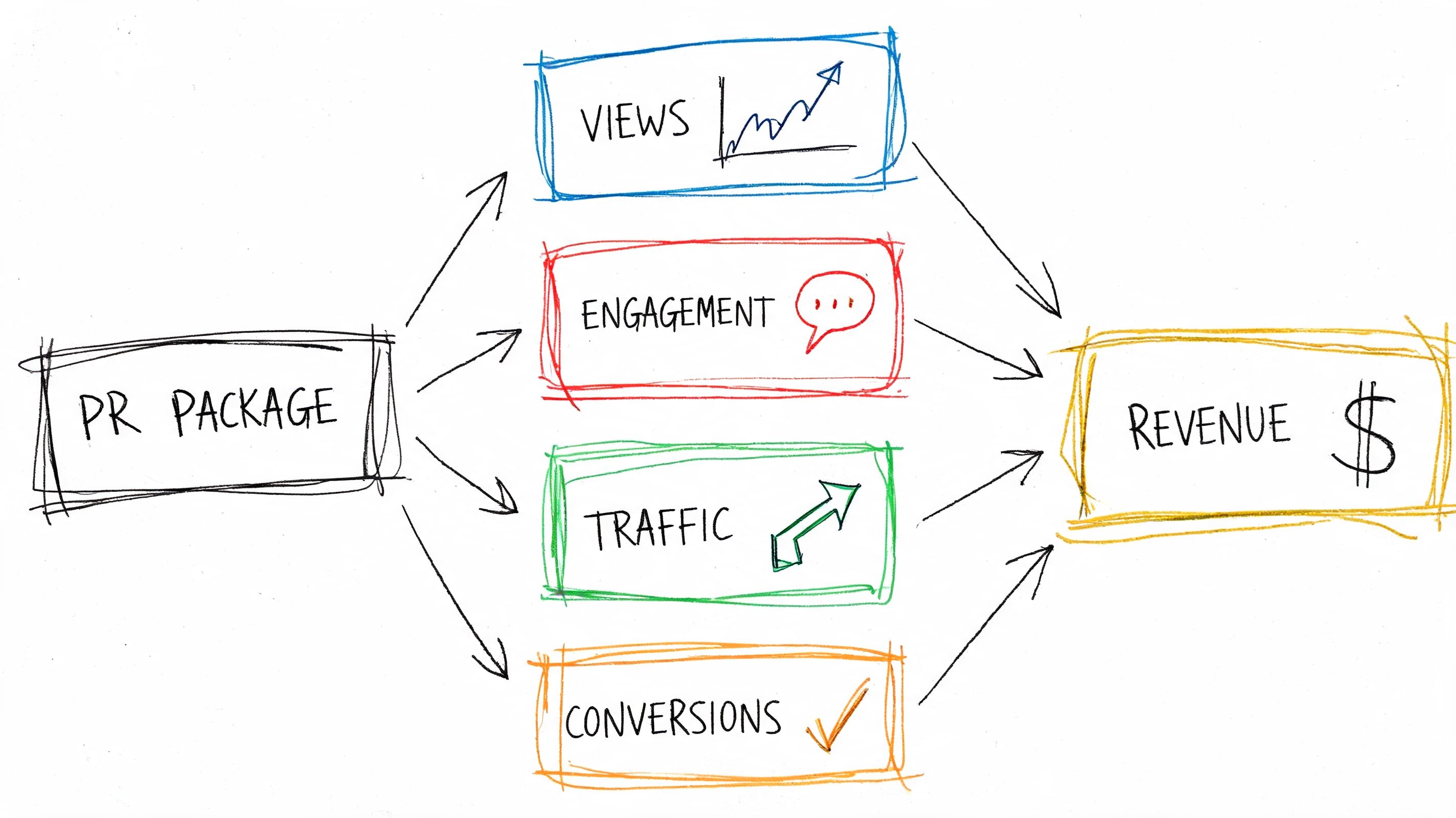
Vanity metrics are the starting line, not the finish
Views and engagement still matter. They tell you whether the content landed and whether a creator can attract attention. They don't tell you enough on their own.
In UK hospitality, nano-creators generated 52% of restaurant footfall via UGC in a July 2025 study cited in this ROI attribution analysis. The same source says only 15% of UK PR campaigns use attribution tools, compared with 78% in paid collaborations, leading to 60% ROI underestimation for multi-location chains.
That gap explains why many teams underestimate creator gifting. They built the campaign like PR, then judged it like performance without installing any tracking.
The practical attribution stack
If you want PR packages to act like a measurable growth channel, use a basic attribution stack on every serious campaign.
- Unique promo codes: Give each creator their own code. That ties redemptions to a person, not a campaign blob.
- UTM links: Use creator-specific links on landing pages, menu pages, or booking flows.
- QR codes inside the box: Helpful when the physical package needs to bridge into digital traffic.
- Landing pages matched to the send: A skincare creator shouldn't land on a generic homepage. A restaurant invite shouldn't dump people onto a broad site with no booking cue.
- Content logging: Save every post, Story, Reel, TikTok, and review in one place so performance can be compared later.
For teams that ship delicate items, chilled goods, or campaign kits across regions, logistics still affect measurement because damaged packages distort results before content even starts. If you're handling more complex fulfilment, guidance on proper air freight packing is useful for reducing avoidable delivery issues.
Track the path, not just the post. The post is only evidence of attention. The path shows whether attention turned into action.
A more detailed framework for tying creator activity to commercial outcomes is covered in this guide to influencer marketing ROI.
What to report back to the business
Once tracking is in place, reporting gets sharper. Instead of “we sent 40 boxes and got some good buzz”, you can answer with operational detail.
Report on:
- Content output: Who posted, what format they used, and whether the content matched the brief.
- Traffic quality: Which creators sent clicks that stayed, browsed, or booked.
- Redemptions and bookings: Which codes converted and which locations performed best.
- Review volume and sentiment: Especially useful for hospitality and local service brands.
- Reusable asset value: Which pieces of creator content deserve a second life in organic or paid channels.
This short walkthrough is a useful visual if your team needs a quick grounding in how creators think about gifted packages and response patterns.
Turning Gifting into a Growth Engine
A PR package can be a branded box, a soft launch tool, a review trigger, a local footfall driver, or a creator relationship opener. None of those outcomes happen because the package exists. They happen because the campaign was designed around fit, clarity, compliance, and tracking.
That's the definitive answer to what is a pr package in modern marketing. It's not just a gift. It's a structured prompt for earned attention that can be measured if you build it properly.
The teams that get the most from PR gifting don't treat it like a side project for leftover stock. They decide what the box is meant to do, send it to people who make sense, make the next action obvious, and install attribution before the first package leaves the warehouse. That's what turns sporadic buzz into a repeatable system.
If your current process still relies on DMs, spreadsheets, and best guesses, the issue isn't effort. It's infrastructure. Once you can match the right creators, launch faster, and connect posts to clicks, bookings, and revenue, PR packages stop being hard to defend internally.
Sup helps brands, restaurants, agencies, and multi-location teams turn creator gifting into a measurable programme instead of a manual scramble. If you want a done-with-you system for finding local micro and nano creators, launching campaigns quickly, and tracking every code, click, booking, and sale, explore Sup.
More on relationships
See how many creators post about you and your competitors
Type in your brand's Instagram handle and we count the creators who post about you and about your five closest competitors. It takes about a minute and it is free. Or request a demo and we will show you the creators in your niche and walk you through the dashboard.
 Book a call