20 May 2026
What is a Key Opinion Leader? A Practical 2026 Guide
A Key Opinion Leader is a trusted expert whose influence comes from credentials, experience, and peer recognition, not just follower count. In one physician poll, 86% said a KOL's credibility depends on professional credentials, experience, or peer recommendations, while only 10% said content quality alone mattered most.
That already cuts against the most common advice on this topic. A lot of marketing content treats KOLs as just a more polished version of influencers. That's wrong, and it leads teams to hire for visibility when they should be hiring for trust.
If you're asking what is a key opinion leader, the practical answer is simple. A KOL is the person your audience already believes before your brand enters the conversation. In healthcare, that may be a respected clinician or researcher. In restaurants, it might be the local food writer, chef, or neighbourhood creator whose recommendations move bookings. In DTC, it could be a niche specialist who gives buyers enough confidence to stop scrolling and buy.
The useful shift for operators is this. Stop treating KOL selection like audience rental. Start treating it like credibility acquisition. That's where measurable outcomes tend to come from, especially for local businesses and niche brands that don't need mass attention. They need the right people to trust them in public.
What is a Key Opinion Leader Really
KOLs and influencers aren't the same thing, even if they sometimes use the same channels.
A Key Opinion Leader is an expert whose authority comes from recognised knowledge, experience, and standing in a field. The term itself goes back to communications research from the 1940s by Paul Lazarsfeld, which focused on how trusted people shape decisions through interpersonal networks rather than mass media alone. In the healthcare context, that still holds. A recent physician poll found that 86% said a KOL's credibility depends on professional credentials, experience, or peer recommendations, while only 10% said content quality alone was the most important factor, as discussed in this medical history and KOL credibility research.
That distinction matters because it changes how you choose partners.
Authority is the asset
An influencer has an audience. A KOL has authority.
Those can overlap, but they aren't interchangeable. Someone can have strong reach and weak decision-making power. Someone else can have a smaller audience and still influence what people buy, prescribe, visit, or recommend because their opinion carries professional or local weight.
Practical rule: If your shortlist starts with follower count, you're probably building an influencer campaign, not a KOL programme.
For a restaurant, this might mean the local creator who knows the dining scene, understands the area, and has built trust with people who go out nearby. For a niche skincare brand, it might mean an esthetician or specialist reviewer whose audience treats their recommendations like product due diligence.
Trust travels through context
The biggest mistake teams make is assuming influence works the same way everywhere. It doesn't.
In regulated categories, peer recognition and expertise carry obvious weight. In local consumer categories, trust often comes from repeated relevance. People believe someone because they've seen them consistently make sound recommendations in a narrow context, whether that's Manchester brunch spots, gluten-free baking, or premium running gear.
That's why KOLs work. They reduce uncertainty. They don't just create awareness. They help buyers feel that choosing you is a credible decision.
KOLs vs Influencers A Clear Distinction
The cleanest way to understand KOLs is to stop asking which label sounds better and ask what job the partner is doing.
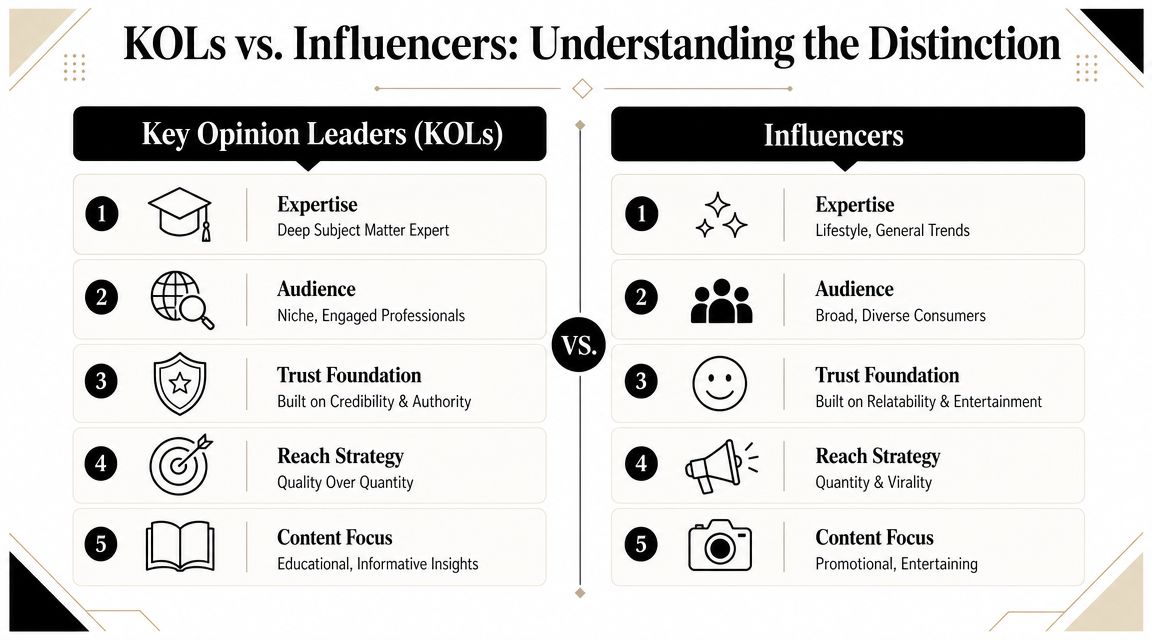
What each one is built to do
A KOL is usually the better fit when your goal is trust transfer, category education, or adoption in a specialised market. An influencer is usually stronger when your goal is fast reach, attention, or trend participation.
| Dimension | Key Opinion Leader (KOL) | Social Media Influencer |
|---|---|---|
| Expertise | Deep subject matter expert | Lifestyle or general trend creator |
| Audience | Niche, high-trust, often specialised | Broad or consumer-facing audience |
| Trust foundation | Credibility, authority, peer recognition | Relatability, personality, entertainment |
| Reach strategy | Precision and quality | Scale and visibility |
| Content focus | Educational, evidence-led, opinion-shaping | Promotional, lifestyle, attention-driving |
That table looks simple, but the implications are operational.
If you're launching a technical supplement, a premium kitchen tool, or a new tasting menu, the wrong kind of partner can make the campaign look busy while producing very little commercial movement. Reach can create noise without creating belief. That's why teams often pair broad creator campaigns with more authority-led voices, especially when the purchase requires trust.
For brands studying e-commerce influencer marketing campaigns, this distinction is useful because many high-performing creator programmes blend both roles. One partner creates demand. Another validates it.
The overlap is real, but the screening criteria differ
Some creators sit in the middle. They have genuine expertise and an active content presence. That's where many teams get confused.
The fix is to vet for the primary source of influence. Ask:
- Why does the audience listen: Because this person is entertaining, or because they're trusted to judge the category?
- What comments appear under posts: Lots of passive praise, or detailed questions that show decision-making trust?
- What happens off-platform: Do people cite them in conversations, reviews, group chats, and recommendations?
If you need a sharper framework for smaller creator categories, this guide to what a micro-influencer is helps. It's especially relevant for local brands where a smaller voice may outperform a bigger one because the audience is concentrated, relevant, and ready to act.
The right partner isn't the one with the biggest audience. It's the one whose opinion changes behaviour in the category you care about.
The Business Case for KOL Marketing
The business case for KOL marketing is stronger than most decks make it sound. This isn't just about awareness. It's about reducing doubt at the moment a buyer hesitates.
In practical terms, businesses use KOLs because trusted experts help explain product benefits, build brand awareness, and establish thought leadership. What matters is how credibility is judged. In a physician poll cited by Indeed's explanation of key opinion leaders, 48% ranked professional credentials as the top credibility factor, and 0% cited social media following or engagement.
That hierarchy is useful far beyond healthcare. It tells marketers something blunt: if your category depends on confidence, follower count is a weak proxy for commercial impact.
Where KOLs create actual business value
KOL partnerships tend to matter most when the buyer asks one of these questions:
- Is this product credible
- Is this worth the price
- Can I trust this recommendation
- Is this better than the alternatives
- Is this relevant to my situation
A respected voice can answer those questions faster than a brand ad can. That's why KOLs often help with product adoption, launch credibility, education-heavy categories, and market entry where buyers want reassurance before they commit.
For restaurants, that may mean trust around quality, consistency, or whether a place is worth a trip across town. For niche DTC brands, it may mean confidence in ingredients, materials, performance, or fit.
What works and what fails
What works is using KOLs where expertise changes buyer behaviour.
What fails is using them as expensive content factories with no clear commercial role. If the brief is vague, the message becomes generic. If the creator is chosen for aesthetics rather than authority, the output may look polished and still do very little.
Teams also underrate the downstream value of KOL content. Strong expert-led assets often become useful across landing pages, paid social, email, and retailer conversations. If you want stronger execution after the partnership goes live, these strategies for effective social posts are useful because they help teams adapt expert content for broader channels without flattening the original credibility.
A useful walkthrough on how trusted voices shape business outcomes is below.
Strong KOL marketing doesn't replace performance marketing. It improves it by giving buyers a reason to believe the click was worth taking.
How to Find and Vet Authentic KOLs
Finding KOLs isn't the hard part. Vetting them properly is.
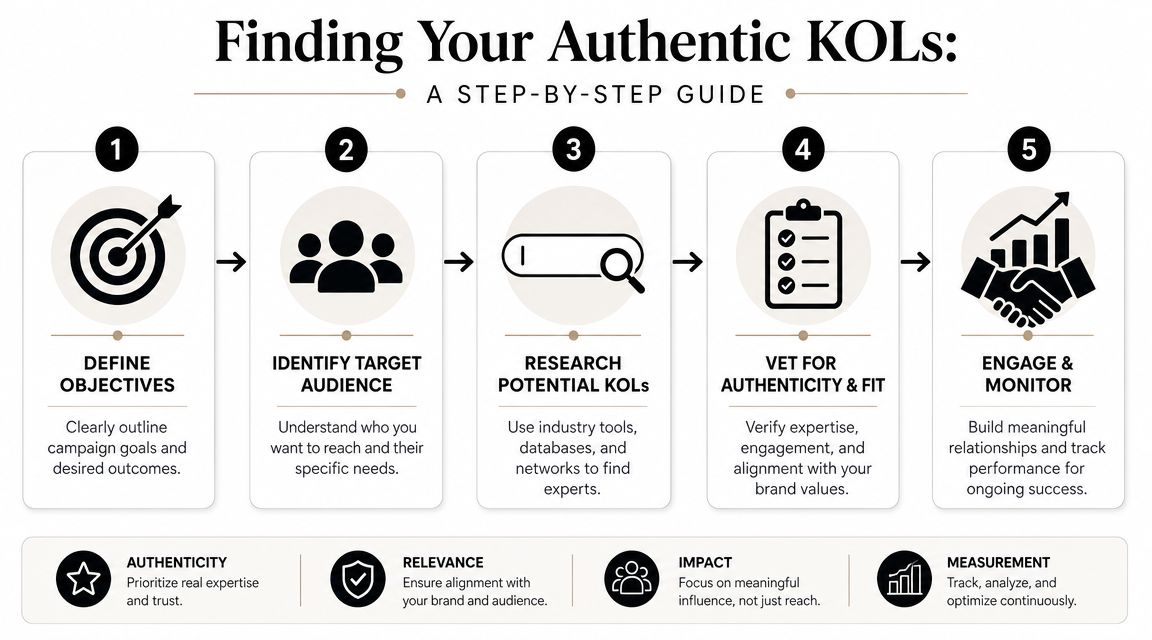
Too many teams build lists from hashtags, TikTok search, or whoever is already visible in their feed. That method tends to surface people who are good at self-promotion, not necessarily people who hold real authority with the audience you want.
In life sciences, KOLs are commonly identified through measurable signals such as publication output, speaking engagements, and network centrality. That evidence-led approach helps reduce uncertainty in complex decisions, as outlined in this guide to KOLs in life sciences. Even if you work in consumer categories, the logic travels well. Start with proof of influence, not just proof of activity.
Start with signals, not personalities
Good sourcing usually pulls from several places at once:
- Conference speaker lists: Useful for spotting recognised specialists in a field.
- LinkedIn and industry associations: Helpful for checking professional standing and topic authority.
- Podcast guests and webinar speakers: These often reveal who the market already trusts to explain hard subjects.
- Local search and review ecosystems: Essential for restaurants, beauty, fitness, and service businesses where neighbourhood relevance matters.
- Customer mentions: Ask your own customers who they already follow for advice in the category.
For local brands, this last point is underrated. The best micro-KOL is often already named in your reviews, DMs, or community comments. They may not look big on paper, but they already influence the exact audience you want.
Use a vetting checklist that reflects real trust
A practical screening process should include both authority and fit.
- Check expertiseLook for signs that the person knows the subject beyond surface-level content. That may mean credentials, a real operating background, specialist experience, or consistent, informed commentary over time.
- Review audience qualityRead the comments. Are people asking serious questions and taking advice, or just reacting to visuals?
- Assess commercial fitA strong KOL for one brand can be a weak fit for another. Look at tone, category overlap, existing brand relationships, and whether their audience would realistically care.
- Run a reputation screenBefore outreach, do basic due diligence. These actionable steps for online checks are a useful starting point for verifying identity, public records context, and consistency across platforms.
- Stress-test engagementDon't just look at likes. Look at saves, questions, replies, repeat interactions, and whether the audience seems local or niche in the way your campaign requires. This Instagram engagement calculator can help benchmark creator interaction before you move into negotiations.
Vet for the reason people trust them, not the fact that people notice them.
Red flags worth taking seriously
Some warning signs show up fast once you know what to look for:
- Thin expertise: Polished opinions with no real depth behind them.
- Audience mismatch: Strong engagement from the wrong geography or the wrong buyer type.
- Over-commercialisation: Constant promotions that weaken the weight of any recommendation.
- Reputation gaps: Inconsistent bios, unclear experience, or credibility claims that don't hold up.
The best KOL lists are usually shorter than teams expect. That's a good sign. You're not building a vanity roster. You're building a shortlist of people whose opinion can move a real outcome.
Structuring a Successful KOL Partnership
A KOL partnership should feel like a professional collaboration, not a gifted-product transaction dressed up as strategy.
That matters because experts protect their reputation carefully. If your process feels loose, generic, or overly controlling, strong KOLs usually disengage quickly. They know their value isn't just posting content. It's lending judgement, context, and trust.
Choose a structure that matches the work
Different KOL relationships need different commercial models. The right one depends on the stakes, the time involved, and how much intellectual input you need.
A few common approaches work well:
- Project fee: Best for clearly defined campaigns such as a launch, event, review cycle, or local opening.
- Retainer: Better when you want continuity, repeated mentions, advisory input, or a longer education cycle.
- Advisory arrangement: Useful when the KOL is shaping messaging, product feedback, or category positioning, not just publishing content.
- Performance-linked layer: Sometimes worth adding for commerce-led programmes, but it shouldn't replace fair compensation for expert time and brand risk.
The mistake many brands make is copying influencer mechanics. Product seeding can work with creators who trade on discovery and volume. It usually doesn't work with high-trust experts unless the product itself is part of a broader, respectful collaboration.
Brief for judgement, not compliance
A weak brief tries to script the KOL too tightly. That usually strips out the reason you hired them.
A strong brief gives enough structure to protect the campaign while leaving room for expert interpretation. It should cover:
- Business objective: Are you trying to drive bookings, explain a new product, support a launch, or build category trust?
- Audience definition: Who exactly should this message reach?
- Non-negotiables: Claims, regulatory boundaries, disclosure requirements, and brand safety issues.
- Proof points: What can the KOL credibly evaluate or demonstrate?
- Success signals: What outcomes matter most, such as qualified traffic, bookings, reviews, or conversion-assisting content.
Give the expert a clear problem to solve, not a rigid script to recite.
Put the agreement in writing
This sounds obvious, but many teams still rely on emails and informal DMs for partnerships that affect revenue, compliance, and public brand perception.
A proper agreement should cover deliverables, timing, approval flow, usage rights, exclusivity where relevant, payment terms, disclosure expectations, and what happens if timelines slip or content needs revisions. If you need a practical framework, this guide to influencer contracts and agreements is useful because many of the same commercial and legal basics apply.
Treat strong KOLs like long-term assets
The most effective partnerships usually get better over time. The expert learns the product. The brand learns how the expert communicates. The audience sees repeated, credible association instead of a one-off placement.
That's especially true for restaurants and niche DTC brands. Repetition builds memory, but only if it stays believable. One strong local KOL who authentically returns, recommends, and engages can be more valuable than a rotating cast of bigger creators who never establish real conviction.
KOL Strategies for Restaurants and DTC Brands
Practically, most brands don't need a famous authority with national reach. They need a micro-KOL whose credibility is concentrated where decisions happen.
Recent UK industry reporting points to growing brand use of smaller, local creators because of authenticity and their ability to drive footfall for restaurants and multi-location businesses. That matters because the key question for many operators isn't who has influence in general. It's whose influence converts locally, as noted in this industry view on local trust and KOL relevance.
For restaurants
A restaurant rarely benefits from abstract reach. It benefits from local trust.
The best micro-KOLs in hospitality are often people like:
- Respected neighbourhood food creators who already shape local dining choices
- Chefs or hospitality voices with industry credibility
- Community-led lifestyle creators whose audience overlaps with actual local diners
- Specialist reviewers in niches like vegan dining, wine, coffee, or family-friendly spots
The key is proximity. If the audience can realistically visit, book, review, and return, the partnership has commercial potential. If the audience is broad but dispersed, the content may look successful while doing very little for covers or footfall.
A practical restaurant brief often works best when it focuses on a few specific behaviours: visit, review, save, book, and recommend. Those are stronger signals than generic awareness.
For niche DTC brands
DTC brands should think in terms of category trust, not creator size.
A micro-KOL for a niche brand might be:
- A specialist practitioner who can explain why the product matters
- A respected hobbyist with deep audience trust in a narrow vertical
- A reviewer with technical literacy who can assess quality credibly
- A local expert if the product has regional demand or offline retail relevance
For example, a skincare product may benefit more from a credible esthetician with a tightly matched audience than a general beauty creator with broader reach. A cookware brand may get more durable value from chefs, food educators, or serious home cooks than from lifestyle creators who treat the product as set dressing.
Local and niche trust often beats scale because it reaches people who can act now, not just people who can notice.
The trade-off most teams miss
Macro authority can help with status. Micro-credibility often helps with action.
That trade-off is where good KOL strategy lives. If your goal is national brand signalling, broader authority may help. If your goal is bookings, reviews, repeatable local reach, or confident conversion in a narrow category, micro-KOLs usually deserve more budget than they get.
Scaling Your KOL Programme with Confidence
The strategy sounds straightforward until you try to run it at volume.
Finding the right people, checking credibility, managing outreach, negotiating terms, tracking links, collecting content, chasing approvals, and reporting results creates a lot of operational drag. That's why many KOL programmes stay small. The logic is strong, but the workflow is messy.

What scaling actually requires
A scalable KOL programme usually depends on a few basics:
- A clear partner model: Know when you want authority, when you want local relevance, and when you need both.
- Repeatable vetting: The screening process can't live in one person's head.
- Attribution discipline: Every partnership should have a measurable path to bookings, clicks, code use, reviews, or assisted conversions.
- Content reuse: The best KOL assets should keep working after the original post goes live.
Teams that get this right don't treat KOL marketing as a series of one-off deals. They build a system around trust. That system is what turns expert partnerships from an interesting channel into a repeatable growth lever.
The strongest programmes are rarely the flashiest. They're the ones that know exactly why each person was selected, what job they were hired to do, and how the business will measure whether the partnership worked.
If you want to turn KOL and micro-creator partnerships into a repeatable growth channel, Sup helps brands launch, manage, and attribute creator campaigns without relying on spreadsheets, manual DMs, or guesswork. It's built for restaurants, ecommerce brands, agencies, and multi-location teams that need local trust, clear tracking, and scalable execution.
More on insights
See how many creators post about you and your competitors
Type in your brand's Instagram handle and we count the creators who post about you and about your five closest competitors. It takes about a minute and it is free. Or request a demo and we will show you the creators in your niche and walk you through the dashboard.
 Book a call