12 April 2026
The Death of the Traditional Marketing Agency (and What's Replacing It)
The most repeated advice in marketing right now is also the least useful: agencies are dead, AI has won, and brands should replace retainers with software.
That framing misses the underlying shift. Traditional agencies aren't disappearing because brands suddenly hate outside expertise. They're losing ground because too many of their commercial models were built for a period when vague reporting, slow cycles, and soft promises could still survive a quarterly review.
What's replacing them isn't a single tool and it isn't pure automation. In the UK especially, the replacement is a set of narrower, more accountable operating models built around attribution, speed, and specialist execution. The brands moving first aren't chasing novelty. They're choosing structures that tie marketing activity to bookings, basket value, redemptions, and revenue rather than broad claims about awareness.
That distinction matters. Once a board, founder, or commercial lead can compare a generic retainer with a creator programme tracked through codes and UTMs, the old argument for bundled agency services gets much weaker. The Death of the Traditional Marketing Agency (and What's Replacing It) isn't a story about collapse. It's a story about unbundling, rebundling, and a new standard for proof.
The Great Unbundling Has Begun
The phrase "agencies are dead" sounds bold, but it's analytically sloppy.
What has begun is the great unbundling of the agency package. Strategy, media buying, creative production, reporting, influencer outreach, community management, and analytics used to sit inside one retainer because brands had limited alternatives. They bought convenience, not precision.
That trade-off is breaking down.
Brands no longer buy ambiguity so easily
A familiar pattern still shows up in many reviews. A brand pays a monthly fee, gets a polished slide deck, sees reach and engagement charts, and then asks the simplest possible question: did this generate customers? If the answer depends on interpretation, the relationship weakens.
The pressure isn't ideological. It's operational. Finance teams want cleaner attribution. Founders want faster feedback loops. Regional operators want proof that local activity drove local demand.
That is why creator commerce has moved from side experiment to boardroom topic. A local restaurant group doesn't need a twelve-week branding narrative if it can run geo-matched creator activity and track redemptions. An ecommerce brand doesn't need another awareness report if it can connect content, clicks, and conversions more directly.
For a useful overview of that broader shift, this explainer on creator-led commerce captures why brand marketing is moving closer to transaction logic.
The bundle is being broken into accountable parts
The old agency promise was breadth. The new buyer preference is clarity of function.
Instead of hiring one firm to do everything, brands increasingly separate work into pieces such as:
- Attribution-led creator partnerships that can be tracked at campaign level
- Performance creative production designed for paid and social reuse
- Embedded specialist support that sits closer to internal teams
- Platform-enabled execution that removes manual admin
Each piece can now be sourced differently. Some are handled in-house. Some go to specialist partners. Some run through software with human oversight.
The agency model didn't fail because expertise stopped mattering. It failed where expertise stayed expensive but proof stayed fuzzy.
This is an evolution in commercial logic
The strongest agencies won't vanish. They'll narrow their offer, plug into platforms, and price around outcomes, workflow ownership, or specialist knowledge. The weaker firms will keep pitching integrated retainers while buyers move budget into structures that are easier to measure and easier to replace if they underperform.
That is the fundamental market shift. Not extinction. Relevance under stricter terms.
Why the Traditional Agency Model Is Broken
Traditional agencies are not failing because brands suddenly stopped valuing expertise. They are failing because the commercial terms that once protected the model no longer match how growth is bought.
A retainer was built for an era when marketing was hard to track, media was less fragmented, and coordination itself carried premium value. That logic weakens once a finance team can ask a simple question. Which part of this monthly fee changed revenue, and which part kept the machine running?
That question exposes the fault line.
Retainers price labour better than they price impact
The traditional agency model monetises time, layers, and process. Strategy workshops, account management, reporting packs, creative revisions, and channel administration all have a place. The problem is that they are often bundled into one fee structure that makes overhead hard to separate from contribution.
For a UK ecommerce brand or multi-site restaurant group, that matters more than it did five years ago. These businesses operate on tighter margin logic. They do not just want marketing delivered. They want to know which inputs created bookings, orders, repeat visits, or first-party audience growth.
The same pressure is visible in adjacent production work. Brands that once tolerated long, bespoke content workflows increasingly prefer systems that produce usable assets faster and with less operational drag. Interest in resources such as this guide to a product photography studio reflects that shift. Buyers are rewarding repeatability and speed, not process theatre.
Reporting often breaks before the commercial question is answered
Many agencies still produce competent channel reporting. Fewer connect that reporting cleanly to transaction-level outcomes.
That gap is especially damaging in creator and local partnership programmes. A hospitality operator does not gain much from a post-campaign summary full of reach, engagement, and content screenshots if nobody can show which creator drove table bookings in Manchester versus voucher redemptions in Bristol. A DTC brand has the same problem if creator output cannot be tied back to SKU sales, new customer acquisition, or paid social performance after content reuse.
The issue is not a lack of tools. It is a mismatch between agency operating habits and what buyers now require. Traditional reporting structures were built to justify activity. Attribution-first buyers want reporting that supports budget allocation.
The workflow is too centralised for how UK growth now happens
The old agency operating model assumes that value comes from orchestrating campaigns from the centre. That works reasonably well for brand campaigns with long lead times and broad messages. It works badly for localised execution across dozens of locations, creators, offers, and trading periods.
Consider a restaurant group opening, promoting, or defending demand site by site. One national creative idea is rarely enough. Performance depends on local fit, speed of deployment, creator matching, offer timing, and the ability to repeat what works without rebuilding the process each time.
Traditional teams often struggle because their workflow is still organised around campaign development rather than operational throughput. The common failure points are predictable:
- slow outreach cycles across fragmented creator lists
- weak matching between creators, locations, and commercial goals
- approvals and assets spread across separate tools
- poor reuse of creator content across paid, organic, and CRM channels
Each issue looks manageable on its own. Together they make the model expensive, slow, and difficult to measure.
Full-service positioning creates blurred accountability
The classic promise of a full-service agency is convenience. One supplier. One relationship. One monthly line item.
For procurement and finance teams, that simplicity is often cosmetic. Broad scope makes accountability harder, not easier. If performance softens, the explanation can sit anywhere. Creative quality, media buying, timing, client delays, seasonality, platform shifts, or market conditions all become part of the same fog.
Specialisation changes that. If one partner owns creator sourcing and tracking, the brand can judge that function directly. If the in-house team owns conversion and merchandising, that can be measured separately. If paid amplification sits with another specialist, its contribution is visible too.
The buyer gains a cleaner operating model and lower replacement risk.
The UK shift is not "AI versus agencies"
That framing misses what is changing. In the UK, especially across ecommerce and hospitality, the winning model is increasingly hybrid and attribution-first.
Brands still need human judgement. They need people who can assess creator fit, shape offers, interpret local demand patterns, and protect brand standards. What they do not want is human time consumed by list building, manual follow-up, spreadsheet administration, or reporting that stops short of revenue.
That is why AI-managed creator programmes are gaining ground. They reduce admin, improve matching, standardise tracking, and give operators a better way to run high-volume local campaigns without accepting the opacity of a traditional retainer. The agencies adapting fastest are not pretending software replaces service. They are rebuilding service around measurable workflow ownership.
That is the break in the old model. The weakness is not creativity. It is a delivery structure that charges for coordination while buyers increasingly pay for proof.
Meet the Four New Models of Growth Marketing
The replacement for the traditional agency isn't one winner-takes-all structure. It's a portfolio of operating models, each suited to different budgets, team shapes, and measurement needs.
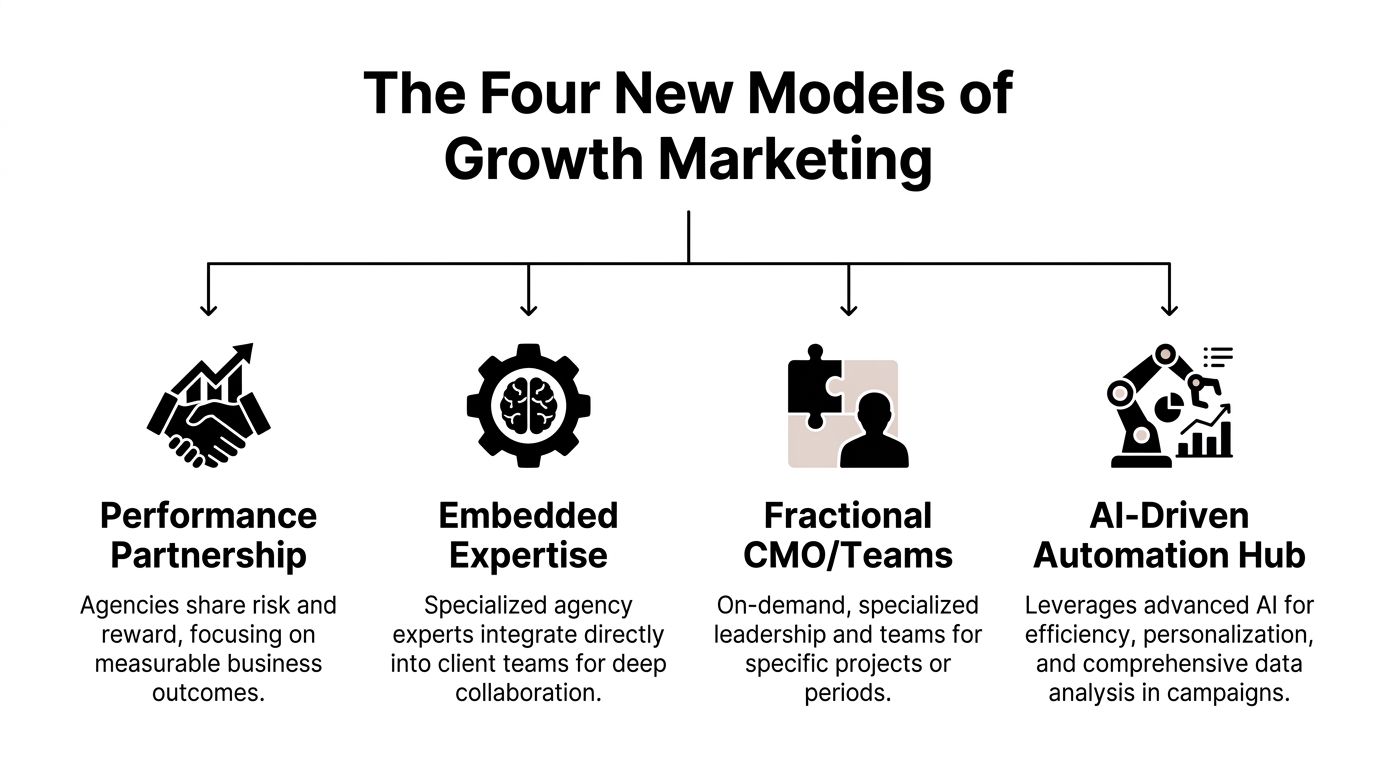
Performance partnerships
This is the closest descendant of the agency model, but the economics are different.
A performance partnership ties compensation more directly to commercial outputs or tightly defined delivery. The provider shares more risk and loses some of the comfort of a broad retainer. In exchange, the client gets cleaner accountability.
This model works best when the scope is narrow enough to track. Think creator-led product launches, local activation campaigns, or paid social creative systems with clear attribution logic.
Its strength is alignment. Its weakness is that not every business has the instrumentation or internal discipline to support it.
Embedded expertise
Some brands don't need an external department. They need a specialist who behaves like part of the team.
Embedded expertise places agency-side or independent specialists inside the client's rhythm. They attend internal planning, work from the same goals, and help operators execute rather than merely advise. This is often the right model for brands with internal marketers who need depth in one area such as creator strategy, paid creative testing, or hospitality launch planning.
The value here is proximity. Work moves faster when the specialist understands stock constraints, promotional calendars, and regional realities.
Embedded models win when context matters more than volume.
Fractional CMO and fractional teams
This model has expanded because many growth problems are leadership problems before they are execution problems.
A founder may not need a full-time senior marketing hire. A scale-up may need strategic oversight for a launch, repositioning effort, or budget reset. A hospitality group may need someone to design a reporting framework and partner roster, then hand the day-to-day over to internal staff.
Fractional leaders bring decision quality without requiring a permanent executive cost base. The better ones don't just write plans. They simplify channel choices, define measurement rules, and stop teams from overbuying services they don't need.
A fractional team can extend this further by pairing leadership with specialist execution in creative, lifecycle, paid social, or creator operations.
AI-driven automation hubs
This model is where most of the noise sits, but also where some of the strongest economics are emerging.
An AI-driven automation hub uses software to handle repeatable marketing operations such as creator discovery, workflow management, outreach support, scheduling, tracking setup, and reporting assembly. Humans still matter, but they focus on judgement calls, relationship management, and exception handling.
For UK ecommerce and hospitality brands, this model is particularly powerful when campaigns must run across many local creators or multiple outlets. Automation removes the manual drag that used to make these programmes hard to scale.
The mistake is to think this means "no humans". The better formulation is fewer humans doing lower-value tasks.
A practical comparison
| Attribute | Traditional Agency | Platform/Hybrid Model | In-House Team | Creator Marketplace |
|---|---|---|---|---|
| Commercial structure | Broad retainer | Service plus system support | Salary and tool stack | Per-project spend |
| Primary strength | Wide service coverage | Attribution and operational speed | Internal context | Fast access to creators |
| Primary weakness | Blurred accountability | Requires process discipline | Can lack specialist depth | Often transactional |
| Best for | Brands wanting one external partner | Brands needing measurable programmes | Brands with capable operators | Short-term tests and seeding |
| Reporting style | Often channel-led | Usually campaign and revenue-led | Depends on team maturity | Varies widely |
| Local scale | Often cumbersome | Strong when workflows are structured | Strong if resourced | Mixed |
Which model fits which buyer
A few patterns are becoming clear.
- Multi-location hospitality brands tend to benefit from platform or hybrid models because local creator matching and repeatability matter.
- Digitally mature ecommerce teams often prefer a mix of in-house ownership and embedded specialists.
- Smaller brands testing creator activity may begin with marketplaces, then move to structured programmes once they need measurement and asset reuse.
- Agencies in transition increasingly adopt a hybrid path. They keep client strategy and relationship ownership, while plugging into technology or specialist fulfilment underneath.
None of these models is universally best. But nearly all of them are better adapted to the current market than a generic retainer built around broad promises and delayed proof.
Case Studies From the New Frontier
The new models become clearer when you follow how they work in practice.
A restaurant group replaces centralised campaigns with local creator cells
A multi-location restaurant chain had a common problem. Head office wanted a unified brand presence, but individual sites needed demand in their own catchment areas. The incumbent agency kept producing central campaigns with strong visuals and weak local traction.
The team changed the operating model.
Instead of briefing one campaign for everyone, they organised creator activity by site cluster. Each location worked with nearby micro-creators on Instagram and TikTok, using a consistent offer structure, local booking windows, and trackable redemption mechanics. Internal marketers kept brand guardrails in place, but execution moved closer to each venue.
The result wasn't just more content. It was better operational fit.
Site managers could see which collaborations drove bookings and which generated attention. The social team gained a reusable library of creator assets. The commercial lead could compare activity across locations without relying on anecdotal feedback from franchise operators or front-of-house staff.
The key lesson wasn't that local creators beat agencies. It was that local creator programmes beat centralised ambiguity when restaurants need measurable footfall and reviews.
An ecommerce brand stops buying influence and starts buying attribution
A growing DTC brand had already experimented with influencers. The results felt inconsistent. Some posts looked good, a few creators became favourites inside the team, but no one could reliably say which partnerships generated sales.
The brand restructured the programme around attribution first.
Creators were selected not only for aesthetic fit but for audience alignment, posting consistency, and willingness to work within a trackable framework. Each collaboration used unique promo codes and UTM-linked landing paths. The brand's team reviewed performance at creator level, not just campaign level.
That changed behaviour quickly.
Creators who drove attention but no conversion stopped dominating the budget. Mid-sized names lost ground to smaller creators whose audiences purchased. The brand also began reusing top-performing creator assets in paid social, which closed the gap between influencer marketing and performance marketing.
The most important shift wasn't platform choice. It was moving from creator selection based on taste to creator selection based on evidence.
What both examples reveal
These aren't stories about flashy disruption. They're stories about operating design.
Both teams changed the unit of analysis. They stopped treating marketing as one broad service line and started treating it as a set of measurable systems:
- Who is responsible for execution
- How local or category fit is defined
- Where attribution is captured
- Which assets can be reused
- How weak performers are removed
That is what sits on the other side of the old agency model. Not chaos. Better structure.
Your Transition Playbook for Brands and Agencies
Most organisations don't need a dramatic overhaul. They need a controlled transition.
For brands
The first move isn't firing your agency. It's identifying where your current setup is least accountable.
Audit spend by proof, not by channel
Review every major line of spend and sort it into three buckets:
- Clearly attributable Activity tied to conversions, bookings, redemptions, or revenue.
- Directionally useful Activity that may support growth but lacks clean causal proof.
- Unclear Spend that survives mostly because it has always existed.
This exercise usually reveals a hard truth. Plenty of marketing cost is defended by effort, not outcome.
Pilot one narrow replacement model
Don't redesign the whole system at once. Run a contained test.
A hospitality group might pilot local creator activation for a few sites. An ecommerce brand might run a creator programme around one product category. The point is to define a pilot where attribution can be observed and operational burden can be assessed.
The best pilots answer three questions fast:
- Can this model launch faster than our current one?
- Can we measure contribution more cleanly?
- Can our team operate it without chaos?
Build an attribution stack before you scale
A new model without measurement becomes the old problem in new packaging.
At minimum, brands need a way to manage trackable links, creator-specific codes, asset storage, and reporting that ties activity to commercial outcomes. Some teams build this with a combination of analytics, spreadsheets, and social tools. Others prefer purpose-built systems.
If you're an agency exploring fulfilment options under your own client relationships, this guide to white-label influencer marketing for agencies is a useful reference for how service delivery can be restructured without rebuilding everything internally.
Scale the system, not just the spend
Once a pilot works, many teams make the same mistake. They add budget before they lock process.
Scale should mean stronger operating rules. Define creator selection criteria, approval flow, reporting cadence, asset rights, and underperformance triggers. If those rules stay vague, growth creates mess instead of operational advantage.
For agencies
Agencies can still win here, but not by defending the old model.
Narrow the promise
Generalist positioning is becoming expensive to maintain. Buyers don't trust broad claims unless you can show unusually strong proof.
Specialise in a category, operating model, or measurable channel. Attribution-led creator marketing for restaurants and DTC brands is one example. There are others. The common thread is that buyers need to know why you are harder to replace than a software subscription or freelancer network.
Productise around a workflow
The agencies keeping relevance are packaging repeatable systems, not just selling hours.
That means standardising onboarding, campaign setup, reporting logic, asset handling, and communication. Productisation doesn't make the work robotic. It removes waste and makes the service easier to trust.
Retrain account management into growth operations
The old account manager role often centred on updates, expectation management, and coordination.
The new version needs stronger commercial fluency. Teams should be able to discuss attribution logic, creator fit, content reuse, and budget allocation with confidence. Clients increasingly expect agency staff to think like operators, not intermediaries.
A useful mindset reset is below.
Operator test: if a client removed your slide deck tomorrow, would your team still know how to improve performance next week?
A quick readiness checklist
Use this before changing partners, platforms, or team shape.
- Measurement readiness Can you connect campaigns to bookings, sales, or redemptions with confidence?
- Process readiness Do you have a simple approval and reporting rhythm, or does every campaign become bespoke?
- Team readiness Who owns creator selection, asset review, and performance decisions?
- Tooling readiness Are your links, codes, content library, and analytics coordinated?
- Commercial readiness Are you willing to stop funding activity that looks busy but proves little?
Later in the transition, seeing another operator discuss the broader change can be helpful:
The winners in this shift won't be the loudest adopters of AI. They'll be the teams that redesign responsibility, measurement, and execution in the same move.
Measuring What Matters KPIs and Tooling for 2026
The teams outperforming in 2026 are not the ones with the largest dashboard stack. They are the ones that can trace spend to a sale, booking, or redeemed offer with enough confidence to reallocate budget quickly.
That distinction matters more in the UK than many agency leaders admit. In ecommerce and hospitality, creator activity increasingly sits inside a hybrid model that mixes paid, organic, affiliate, and local activation. Once campaigns are structured that way, impressions and engagement still have diagnostic value, but they stop being decision metrics.
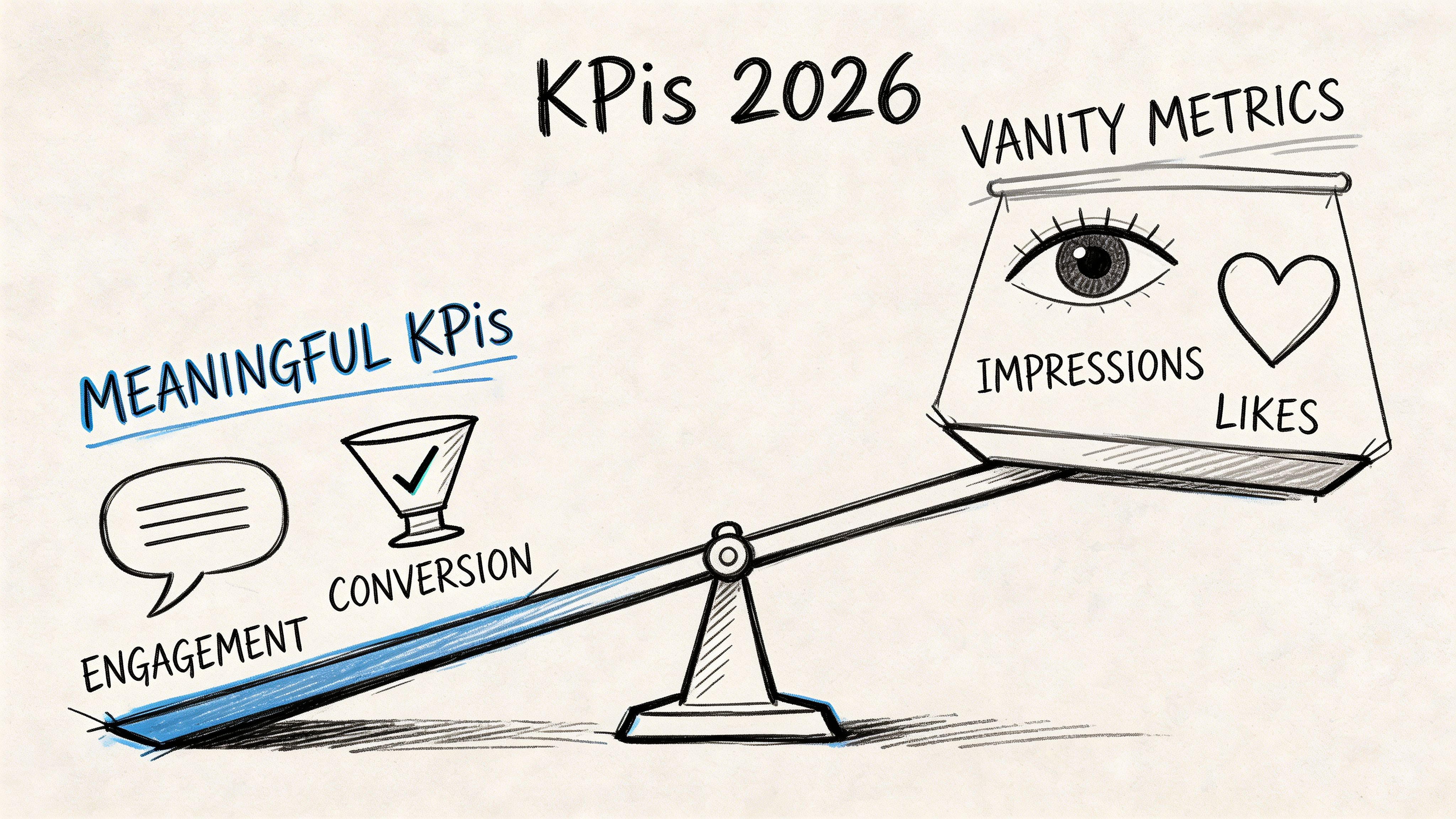
The KPI stack that matters now
As noted earlier, growth in creator and performance-led spend has raised the standard for proof. Boards and finance teams now expect creator programmes to be measured with the same discipline as paid acquisition, especially when those programmes are being proposed as an alternative to broad agency retainers.
A useful KPI stack separates diagnostic signals from commercial outcomes.
The commercial layer usually includes:
- Creator CPA The cost to acquire a customer from an individual creator, venue cluster, or creator cohort.
- ROAS Revenue returned relative to campaign spend. Best used when content is tied to paid support or direct-response offers.
- Redemption rate Particularly useful for hospitality, retail promotions, and creator-led offers that rely on codes, vouchers, or booking incentives.
- Attributed revenue The clearest link between creator activity and business results, whether the action is a purchase, booking, or qualified lead.
- Content reuse value Whether creator assets continue producing value in paid social, email, product pages, or location marketing after the original post goes live.
The diagnostic layer still matters, but it should sit underneath those metrics. Reach can show whether distribution was sufficient. Engagement can indicate message fit or creative relevance. Neither tells a UK ecommerce brand whether a creator should be renewed for the next quarter.
Tooling categories that support real attribution
Measurement works when the chain is simple enough to survive day-to-day operations.
For hybrid creator programmes, that usually means four connected layers rather than one oversized platform:
| Tool category | What it should do |
|---|---|
| Tracking infrastructure | Manage UTMs, creator links, codes, booking tags, and source-level attribution |
| Campaign operations | Organise outreach, approvals, scheduling, usage rights, and follow-up |
| Asset management | Store creator content in a searchable library that teams can reuse by audience, product, or location |
| Analytics layer | Connect clicks, redemptions, bookings, or purchases back to the creator, offer, and channel mix |
If your internal team is building its own reporting discipline, this guide on how to accurately measure marketing ROI is a good reference point for tightening attribution logic before scale creates confusion.
For creator-specific programmes, this resource on influencer marketing ROI measurement is also useful for deciding which signals belong on the executive scorecard and which should remain secondary.
What good looks like
A strong system does not answer every attribution question perfectly. It gives operators enough clarity to make the next budget decision with conviction.
In practice, that means a UK brand should be able to identify which creators drove purchases rather than attention, which offers generated redemptions, which content assets deserve paid amplification, and which locations or product categories respond best to specific creator profiles. Hospitality groups often need one further cut. They need to see whether a campaign drove weekday demand, not just total bookings. Ecommerce teams usually need the inverse. They need to know whether creator-led traffic converted efficiently enough to justify scaling paid support behind the best-performing assets.
When those answers are hard to produce, the problem is usually not creator performance. It is a reporting model built for campaign theatre rather than commercial action.
That is why attribution-first hybrids are gaining ground in the UK. They fit how modern buyer journeys work, and they let brands treat creator programmes as a measurable growth channel rather than a loosely managed awareness line item.
Frequently Asked Questions About the New Marketing Models
Is switching away from a traditional agency always cheaper
Not always.
It can be cheaper, but the primary benefit is usually cost clarity, not merely lower spend. Some brands spend less with hybrid or in-house models. Others spend about the same but get cleaner attribution, faster execution, and more reusable content. The better question is whether the model lets you see what your money is doing.
Should a small brand build an in-house team first
Usually not.
Small brands often benefit from a narrower external setup before hiring broadly. One specialist partner, a focused creator pilot, or a fractional lead can reveal what the business needs. Hiring too early can lock a small team into fixed costs before the channel strategy is proven.
How should brands vet a platform or hybrid provider
Ask operational questions, not branding questions.
Look for clear answers on creator sourcing, location matching, attribution method, reporting access, asset rights, approval workflow, and underperformance handling. If a provider can't explain those mechanics plainly, the service is probably relying on theatre.
Should agencies build their own technology
Most shouldn't.
Building software sounds strategic, but it creates product, support, and maintenance burdens that many agencies underestimate. Partnering with existing infrastructure is often the stronger move unless the agency has a highly specific operating advantage and the resources to sustain a real product function.
Are creator marketplaces enough on their own
They can be, for short-term seeding or simple one-off collaborations.
They are less effective when a brand needs repeatable local execution, clean attribution, approval discipline, and systematic content reuse. Marketplaces are often a starting point, not an end state.
What should hospitality and ecommerce leaders prioritise first
Measurement design.
These sectors move quickly and often operate across multiple offers, locations, or product lines. If attribution is weak, teams end up debating anecdotes. Once tracking is in place, decisions get easier. You can see which creators, offers, and formats deserve more budget and which should be cut.
Does AI make human expertise less important
No. It changes where humans add value.
The manual work shrinks. The judgement work grows. Teams still need people to define offers, approve creative, evaluate creator fit, handle exceptions, and make commercial calls. The strongest new models use AI to remove admin, then redeploy human attention to better decisions.
If you're rethinking how to run creator marketing without the drag of manual outreach, scattered spreadsheets, and fuzzy reporting, Sup is built for exactly that shift. It combines AI with a human team to help restaurants, ecommerce brands, agencies, and multi-location groups launch and attribute creator campaigns with trackable codes, UTMs, and a central dashboard tied to real business outcomes.
More on insights
See how many creators post about you and your competitors
Type in your brand's Instagram handle and we count the creators who post about you and about your five closest competitors. It takes about a minute and it is free. Or request a demo and we will show you the creators in your niche and walk you through the dashboard.
 Book a call