27 February 2026
White Label Influencer Marketing for Agencies: Scale Client Services in 2026

So, what exactly is white-label influencer marketing for agencies? Think of it as offering a complete, branded creator marketing service to your clients without having to build the technology or the team from scratch.
Instead, you partner with a specialised platform, rebrand its software and services as your own, and deliver expert results under your agency's name. It's the quickest and most efficient route to adding a high-demand, profitable service to your roster.
Why White Labelling Is Your Agency’s Next Smart Move
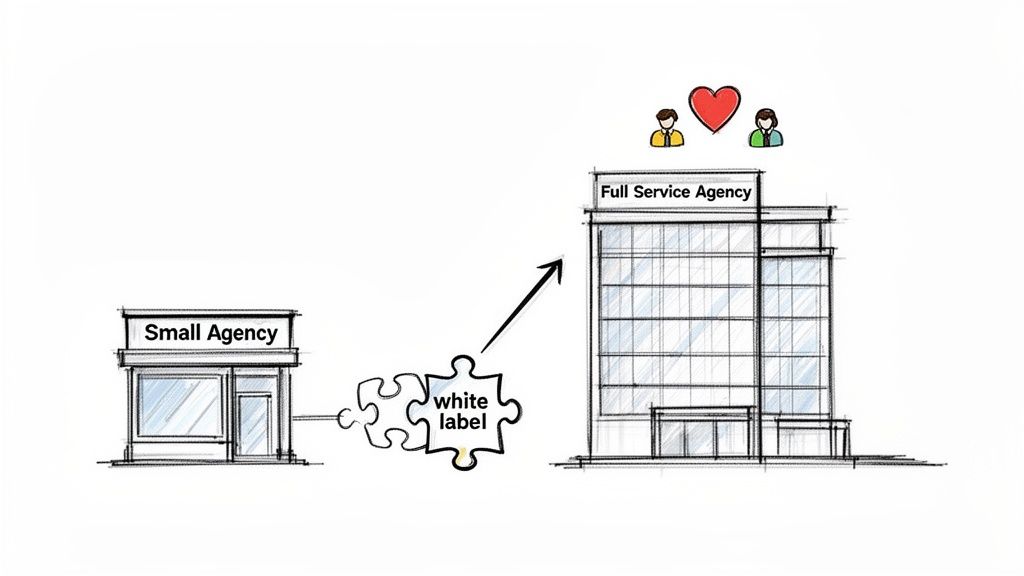
These days, clients are looking for integrated solutions, not just siloed services. When they come to you asking about influencer marketing, what happens if you have to send them elsewhere? It's more than just a missed opportunity; it's a genuine risk. You're effectively signalling that a vital part of modern marketing is outside your wheelhouse, which can weaken your position as their go-to strategic partner.
Bringing a white-label solution on board closes this gap instantly. It gives your agency the power to meet client demand for authentic creator collaborations right away. Better yet, you completely sidestep the immense investment of time and money (we're talking years and potentially millions of pounds) that building a proprietary platform from the ground up would require.
Instantly Expand Your Service Offerings
Imagine adding a fully staffed, expert department to your agency overnight. That's the power of this approach. You suddenly gain the ability to run sophisticated, ROI-focused campaigns that were previously out of your league. This immediately positions your agency as a more comprehensive, one-stop shop for everything your clients need.
This expansion has a few brilliant knock-on effects:
- Increased Client Stickiness: When you offer an in-demand service like influencer marketing, you become much more indispensable. Clients have far fewer reasons to look for another agency.
- New Revenue Streams: You unlock a significant and profitable new income source, capturing budget that might have easily gone to a competitor.
- Enhanced Agency Reputation: You're no longer just a "social media agency" or a "creative agency." You become a full-funnel marketing partner with some serious capabilities.
The real beauty of this model is strategic. It lets you focus on what you do best (client relationships and high-level strategy) while a dedicated partner handles the complex, resource-intensive backend of creator discovery, management, and reporting.
A Model Built for Scalability and Profit
The white-label model is inherently built for growth. As your client list gets longer, you can easily scale your influencer marketing services without the usual growing pains. There's no proportional jump in overheads from hiring more staff or building out more infrastructure; you simply run more campaigns through the existing platform.
To get a better sense of the possibilities, it's worth seeing how other businesses are using similar models. For instance, agencies are leveraging tools like a white label GPT chatbot to extend their offerings without any development work. The core principle is the same: maintain profitability and efficiency as you grow.
For any ambitious agency wanting to future-proof its business, this isn't just another option. It's a necessary evolution. By integrating a white-label influencer marketing service, you aren’t just adding a tool to your belt. You’re building a more resilient, competitive, and profitable agency. You can learn more about how Sup empowers agencies to scale their client services.
Choosing the Right White-Label Influencer Platform
Picking your technology partner is easily the biggest decision you’ll make when you decide to offer influencer marketing. This platform is going to be the engine for your entire service. Get it right, and you’re a hero. Get it wrong, and you’ll create endless headaches for your team and let your clients down.
You need to look past the slick sales demos and really dig into the features that will make or break your campaigns and your agency's efficiency. This isn’t just about slapping your logo on someone else’s software; it's about finding a genuinely robust tool that can grow with you.

First Up: How Good Is the Creator Database?
The success of any campaign comes down to the quality of the creators you work with. So, the platform's discovery and search tools are your first line of defence against a bad match. Don’t get wowed by a massive number of profiles; what you really need is depth and precision.
Think about your clients. If you’re working with local businesses like restaurants or retail shops, can you actually filter creators by postcode or within a specific radius of a city centre? For driving real footfall, granular location filtering is an absolute must-have.
Or what about a B2B tech client? You’ll be hunting for experts in super-specific niches, like "cybersecurity for fintech" or "AI in logistics". You need to be able to search by keywords, industry experience, and even see which brands they've worked with before to find those truly credible voices.
The real goal here is to find a platform that gets you beyond vanity metrics. A solid database should give you proper insights into audience demographics, the quality of their engagement, and even have tools to spot fake followers. This ensures your client's money is actually spent reaching real, relevant people.
Next, Scrutinise the Campaign Management and Automation Tools
Let's be honest, the manual grind of outreach, follow-ups, and content tracking is where most of the time disappears. The right platform should take these repetitive tasks off your plate, freeing up your team to focus on strategy and keeping clients happy.
Look for features that streamline the entire process from start to finish:
- Automated Outreach: Can you build and send personalised outreach messages at scale? Sending hundreds of DMs by hand is not a business model that will ever scale.
- Centralised Comms: A single inbox that tracks every conversation with every creator is non-negotiable. It stops messages from getting crossed and means any team member can jump in and know exactly what’s going on.
- Content Approval Workflows: Is there a simple way for you to review, request changes, and approve content before it goes live? This is crucial for protecting your client’s brand and making sure you get what you paid for.
- Payment Processing: A built-in system to handle creator payments is a lifesaver. It removes hours of admin work and financial faff every single month.
These are the tools that separate an agency managing five campaigns from one managing fifty with the same number of people. They are the key to making this a profitable service.
Finally, Demand Robust and Brandable Reporting
At the end of the day, your clients want to see results. Your chosen platform needs a powerful analytics dashboard that makes it simple to show them their return on investment (ROI). But for a white-label service, the data is only half the story.
The reporting must be fully brandable. You have to be able to add your agency’s logo, your colour palette, and even a custom domain to every client-facing dashboard and report. When you sit down to present the results, it needs to look and feel like it’s your own proprietary technology. This reinforces your agency's value and expertise.
Think from the client's perspective. An e-commerce brand will want to see hard sales data from unique discount codes and UTM links. A hotel client will care more about bookings. Your platform's reporting has to be flexible enough to track and display the key performance indicators (KPIs) that matter to each specific client. Things like a central User-Generated Content (UGC) library or a direct Shopify integration aren't just nice-to-haves; for many clients, they’re the reason they'll stay with you for the long haul.
Choosing a platform is a big commitment, so it pays to be thorough. Use the checklist below to compare your options and ask providers the tough questions before you sign on the dotted line.
Essential Platform Features Checklist
| Feature | Why It's Critical for Your Agency | Questions to Ask a Provider |
|---|---|---|
| Full White-Labelling | Your brand needs to be front and centre on all client-facing assets, from the login page to reports. This builds your agency's credibility. | Can we use our own custom domain (e.g., reports.myagency.com)? Can we customise logos, colours, and emails? |
| Creator Discovery & Vetting | The ability to find high-quality, relevant creators quickly is the foundation of your service. Poor discovery tools lead to poor results. | How many creators are in your database? What are your filtering options (location, niche, audience data)? Do you have a fake follower detection tool? |
| Campaign Automation | Automation saves time, reduces human error, and allows you to scale your services without scaling your headcount proportionally. | What parts of the outreach, follow-up, and content approval process are automated? Do you have templated messages? |
| Integrated Payments | Managing hundreds of individual creator payments manually is an administrative nightmare. An integrated system is essential for efficiency. | Can we pay creators directly through the platform? Do you support multiple currencies? What are the processing fees? |
| Brandable Reporting & Analytics | Clients need to see ROI. You need to present that data in a professional, agency-branded format that clearly shows your value. | Can reports be fully branded with our logo and colours? Can we track sales via discount codes or UTMs? Do you integrate with e-commerce platforms like Shopify? |
| Content & UGC Management | A central library for all creator content simplifies approvals and gives clients easy access to assets they can repurpose. | Is there a central library to collect and manage all UGC? Can clients access and download assets directly from the platform? |
This checklist isn't exhaustive, but it covers the core functionalities that will have the biggest impact on your day-to-day operations and your ability to deliver fantastic results for your clients.
Structuring Your Service and Pricing for Profitability
This is where the rubber meets the road. Turning your white-label influencer marketing offering from a smart idea into a genuinely profitable service hinges entirely on how you structure and price it. Get this right, and you’ll have a predictable, scalable revenue stream that’s easy to sell and manages client expectations from the get-go.
It’s about more than just pulling numbers out of thin air. You need to package your services in a way that clients instantly understand, showing them clear value at different price points. The goal is to build a structure that aligns with what they actually want to achieve, whether that's a big splash for a new product launch or a consistent, 'always-on' brand presence.
Building Your Pricing Models
Let's be clear: there’s no single, perfect way to price influencer marketing. The best model for your agency will really depend on your clients, the kind of campaigns you’re running, and your own costs. The trick is to find a framework that gives you predictability while offering your clients the flexibility they need.
Here are the models that we see work time and time again:
- Monthly Retainer: This is the gold standard for building a stable, recurring business. Clients pay a set fee each month for an agreed list of deliverables: maybe a certain number of creator activations, specific content pieces, or a set number of campaign management hours. It's perfect for those 'always-on' programmes designed to build steady brand awareness.
- Performance-Based Fees: This one really aligns your agency with client success. You tie your fee directly to results, like taking a percentage of sales from creator affiliate codes or earning a bonus for hitting lead generation targets. It’s a brilliant way to show clients you’ve got skin in the game, but you absolutely must have rock-solid tracking in place.
- Project-Based Pricing: Think of this as a one-off fee for a specific campaign, like a seasonal promotion or a big launch event. It’s a great entry point for new clients who want to try before they buy into a longer-term commitment. Just make sure you define the scope with military precision to avoid scope creep from eating into your profits.
The most successful agencies we work with often blend these models. A common approach is a modest monthly retainer that covers your team’s time and platform costs, topped with a performance bonus that rewards you for smashing targets. It gives you a financial safety net while incentivising everyone to go the extra mile.
Designing Tiered Service Packages
Creating a tiered structure is one of the smartest things you can do. It makes your services accessible to everyone, from a startup on a tight budget to a major enterprise ready to invest. It also massively simplifies your sales process by giving potential clients clear, distinct options and an obvious upgrade path as they grow.
A simple three-tiered approach often works best:
- Launch Package: This is your entry-level option, perfect for smaller businesses or those dipping their toes into influencer marketing for the first time. It might include finding 5-10 nano-influencers for a single campaign, handling basic content approvals, and providing a straightforward summary report.
- Growth Package: This should be your most popular choice, aimed at clients who are serious about getting results. You could bundle in monthly campaigns with 15-20 micro-influencers, full content management, detailed performance tracking, and the rights to repurpose all the brilliant user-generated content (UGC).
- Dominate Package: Your all-inclusive, premium service for top-tier clients. This is where you bring out the big guns: a mix of micro and mid-tier creators, campaigns running across multiple platforms like TikTok and Instagram, advanced ROI analysis, and strategic planning sessions every quarter.
This kind of system doesn't just spell out your value; it builds a natural upsell journey right into your client relationships.
Crafting Proposals That Convert
Your proposal is your final pitch. It has to do more than just list services and prices. It needs to tell a story about the strategic value you bring and build absolute confidence that your agency can deliver the goods.
A winning proposal is always built around the client's specific goals. Don't just say you'll "find influencers." Frame it in their terms. For example, explain how you'll "source and vet 15 local food creators with a proven history of driving restaurant bookings to support your Q3 reservation targets." See the difference?
The opportunity here in the UK is massive, and your proposals should reflect that. The UK influencer marketing platform market was valued at USD 629.9 million in 2022 and is projected to explode to USD 3,954.9 million by 2030. Your agency is effectively a gateway to this growth. To get a better handle on this acceleration, you can discover more influencer marketing statistics. Dropping in a stat like this helps justify your pricing by framing your service as a key investment in a booming market.
Finally, be obsessively clear on deliverables. Your proposal is a contract in waiting. It should spell out exactly what's included: creator sourcing, contract negotiations, content approvals, payment processing, reporting frequency, everything. Nailing these details upfront prevents any misunderstandings later and starts the partnership off on a professional, transparent footing.
Your Playbook for Launching Flawless Client Campaigns
Right, you’ve sorted out your services and your pricing is locked in. Now for the fun part: execution. This is where your white-label influencer marketing platform stops being a concept and becomes your team's command centre for every single campaign.
Launching a great campaign isn't about crossing your fingers and hoping for the best. It’s about having a repeatable, battle-tested process that covers all the bases.
A good platform automates the most soul-crushing parts of the job, like chasing creators for content or manually digging for post links. This kind of automation can genuinely slash manual admin time by over 90%. That frees your team from drudgery and lets them focus on what really matters: nurturing client relationships and dreaming up winning strategies.
This infographic gives you a sense of the journey you can take clients on, from their first campaign right through to total market dominance.

Think of it as a roadmap. It shows how you can use structured service tiers to grow with your clients, making it a natural conversation to upsell them from foundational campaigns to much bigger, market-leading strategies down the line.
The Client Kick-off and Goal Alignment Phase
Every single successful campaign starts with a crystal-clear understanding of what the client actually wants to achieve. Your kick-off meeting is the most critical moment to nail this down. Don't end that call without concrete, measurable objectives.
Your job is to translate a vague request like "we want more brand awareness" into specific Key Performance Indicators (KPIs).
- E-commerce client? Are they trying to shift a new product line? The main KPI is probably revenue, tracked with unique discount codes.
- New restaurant? Maybe the goal is to get more bums on seats during the quiet Tuesday-Thursday slot. In that case, you'd track table bookings that mention a creator’s campaign.
- B2B software company? If they're generating leads for a webinar, success is measured by sign-ups from tracked links in creator content.
This is also your chance to manage expectations on timelines, content approvals, and how you’ll communicate. Get it all documented in a shared brief that becomes the bible for the whole campaign.
Mastering Creator Sourcing and Outreach
With a solid brief, you can get stuck into your platform’s creator database. Vetting is everything here. Don't just look at follower counts; search for genuine alignment.
Check out their past collaborations. Does their content style fit the client's brand? Even more importantly, how did their audience react to previous sponsored posts? If their non-sponsored content gets massive engagement but their ads fall flat, that's a huge red flag.
A classic rookie error is blasting out generic, copy-pasted outreach messages. Good creators can spot those a mile off. Your platform’s outreach templates are a starting point, not the final script.
Personalise every single message. Reference a specific video of theirs you enjoyed, or explain exactly why you think they're a perfect fit for this particular brand. It seems simple, but this one step will make your response rates shoot up. For example, mentioning how a creator's recent trip to a local market is a perfect match for your client's farm-to-table restaurant shows you've actually paid attention.
Campaign Execution and Relationship Management
Once your creators are onboarded, the game shifts to making sure everything runs smoothly. Your platform should be the central hub for all comms, content submissions, and approvals. It stops crucial feedback from getting buried in a nightmare email thread or lost in DMs.
Give your creators a comprehensive but concise brief that includes:
- Key Messaging Points: The one or two things they absolutely have to say.
- Mandatory Elements: Required hashtags, handles to tag (@clientbrand), and calls-to-action.
- Content Do's and Don'ts: Clear brand safety guidelines to avoid any awkward moments.
This isn’t about stifling their creativity. It’s about giving them clear guardrails so they can produce amazing, on-brand content. Treat your creators like proper partners, not just names on a spreadsheet. Pay them promptly, communicate clearly, and give respectful feedback. You’ll not only get a brilliant campaign now, but you’ll also start building a network of creators who love working with your agency, an invaluable asset for future client work.
The UK market is moving incredibly fast, and agencies need this level of efficiency just to keep pace. A huge 84% of UK marketers plan to increase their spending on creator partnerships next year, a figure that's miles ahead of the rest of Europe. For e-commerce brands, these principles are doubly important; you can get a deeper look in our guide on influencer marketing for e-commerce. This massive appetite for growth means having a slick campaign playbook is non-negotiable for any agency serious about grabbing its share of the market.
Measuring ROI and Delivering Reports That Wow Clients
Handing over a simple list of likes and comments at the end of a campaign is the fastest way to see your client’s influencer marketing budget get slashed. If you want to keep clients and grow your accounts, you have to prove real business value.
This is where your white-label platform stops being just a management tool and becomes your engine for proving return on investment (ROI). Your ability to draw a straight line from a creator’s post to your client's bottom line is what will make your agency stand out. It’s all about building a compelling story backed by hard data, showing exactly how your work is driving sales or putting customers through their doors.
Moving Beyond Vanity Metrics
Let's be honest, clients are rightly sceptical of reports that only shout about engagement. While a big reach number and lots of comments look nice on a slide, they don't pay the bills. The real magic of a good white-label solution is its power to track the actions that actually impact revenue.
This means shifting the focus of your reports to what's happening at the bottom of the funnel. Your white-labelled dashboard should make it dead simple to pull these crucial data points, giving you everything you need to build an undeniable case for ROI.
Instead of just likes, focus on tracking:
- Conversions from Discount Codes: Giving each influencer a unique code (like SARAH15) is one of the cleanest ways to attribute sales directly back to their efforts.
- Website Traffic and Sign-ups via UTMs: With custom URL parameters, you can see exactly who clicked a link in a creator’s bio and trace their entire journey on the client's website.
- Lead Generation: For a B2B or service-based client, this is everything. You need to be tracking every form fill or demo request that came from an influencer campaign.
- In-store Redemptions: If you’re working with a restaurant or retailer, tracking how many people mention a creator's name to claim an offer gives you clear, tangible footfall data.
A critical part of delivering reports that truly wow clients is a clear understanding of how to measure social media engagement effectively across all campaigns. This knowledge helps you add context to the hard sales data, painting a complete picture of a campaign's impact.
Building the ROI Narrative for Your Client
A truly great report doesn’t just spit out data; it tells a story of success. Your job is to connect the dots for the client, turning raw numbers from your dashboard into a clear narrative that celebrates the wins and justifies every penny of their investment. This is where your agency’s strategic value really shines.
Always start by framing the results around the original campaign goals you agreed on in the kick-off meeting. If the main goal was to drive sales for a new product, lead with the total revenue generated through creator discount codes. Don't make them hunt for the headline.
And here’s a pro tip: don’t forget to assign a monetary value to all the User-Generated Content (UGC) you’ve collected. Think about what it would have cost the client to produce that many high-quality photos and videos with a traditional creative team. This Earned Media Value (EMV) is a powerful secondary ROI metric that shows the immense extra value you’re providing.
For many brands, a solid library of creator content is just as valuable as the direct sales it generates.
A Framework for Your Monthly Client Report
Structure your reports for maximum clarity and impact. Your white-label platform should let you export professional, branded reports that you can then layer your own strategic insights on top of.
Here’s a simple structure that we’ve seen work time and time again:
- The Executive Summary: Get straight to the point. Start with a high-level overview that states the main objective and immediately hits them with the top-line results. For example: "This month's campaign with 15 nano-influencers generated £12,500 in direct sales, achieving a 4.5x return on ad spend."
- Performance Against KPIs: Dedicate a section to each primary goal. Use clear charts and graphs exported straight from your platform to visualise performance for metrics like revenue, website clicks, and conversions.
- Top-Performing Creators and Content: Shine a spotlight on the creators and specific posts that knocked it out of the park. This not only proves your expertise in creator selection but also helps shape the strategy for the next campaign.
- UGC Showcase: This is the visual punch. Include a section with the best-looking content generated during the month. It’s a powerful reminder to the client of the valuable assets they now have for their own social channels and ads.
- Learnings and Next Steps: This is where you prove you’re a partner, not just a vendor. End with your strategic analysis. What did you learn this month? What tweaks are you going to make next time to get even better results?
This kind of structured approach turns a boring data dump into a strategic consultation, reinforcing your role as an essential part of their team. And for agencies looking to understand the impact of smaller creators, you might be interested in our deep dive on why nano-influencers can drive bigger ROI.
Got Questions About White-Label Influencer Marketing? We've Got Answers
Stepping into the world of white-label influencer marketing is a big move for any agency. It’s totally normal to have questions swirling around, from what your clients will think, to the nitty-gritty of tech support and costs. We hear the same queries time and again from agencies just like yours, so we’ve pulled them together to give you the clear answers you need.
Think of this as tackling the common hurdles and internal debates that pop up before taking the plunge. Getting these sorted will help you build a rock-solid case for adding this powerful service to your arsenal.
Just How Much Control Do We Get Over the Branding?
This is usually the first thing everyone asks, and for good reason. The short answer? You should have complete control. A genuine white-label solution is built to be a chameleon, seamlessly adopting your agency's identity. You're not just a reseller; you are the provider.
This means you can slap your logo on it, splash your brand colours across the entire interface, and even host it on a custom domain. When your client logs into their dashboard, it should look and feel like a proprietary piece of tech your agency built from the ground up. It’s a subtle but powerful way to reinforce your value at every single touchpoint.
The goal is a completely seamless client experience. From the login screen they first see to the final campaign report they download, every pixel should scream your agency's brand, not the platform provider's. This leaves no doubt about who is delivering the incredible results.
Will My Clients Realise We're Using a Third-Party Tool?
Honestly, no. That's the whole beauty of the white-label model. The platform is presented entirely under your agency's banner, so your clients only ever deal with your team and log into a system that has your name on it. As far as they're concerned, you've developed a sophisticated, in-house solution to manage their campaigns.
This does wonders for your agency’s reputation. It positions you as a forward-thinking partner with serious tech in your toolkit. It's not about outsourcing; it's about integrating a powerful engine into your own service delivery framework to get them better results.
How Does Technical Support Work for Our Clients?
You will always be the first and only point of contact for your clients. This is absolutely crucial for maintaining the relationship and the integrity of the white-label setup. If a client has a question or hits a technical snag, they come directly to you.
What happens behind the scenes is that your white-label partner provides dedicated support directly to your agency team. You simply pass the issue over to their experts, get a quick solution, and then relay it back to your client. This two-step process keeps you in the driver's seat of the client conversation, with expert backup on standby whenever you need it.
Is It Genuinely More Cost-Effective Than Building Our Own Platform?
Without a shadow of a doubt, yes. The investment needed to build a comparable influencer marketing platform from scratch is staggering. We're talking millions of pounds in software development, not to mention the ongoing costs for maintenance, data security, and a dedicated engineering team just to keep the lights on and the features fresh.
White-labelling completely sidesteps that financial black hole. For a predictable subscription fee, you get instant access to a feature-rich, market-tested platform. This means you can be profitable from your very first client, turning influencer marketing into a high-margin service almost overnight.
Ready to make influencer marketing your agency's most profitable service? Sup provides the engine to make it happen. Book a demo today and see how you can launch a fully branded, ROI-driven creator service in minutes, not years.
More on strategy
See how many creators post about you and your competitors
Type in your brand's Instagram handle and we count the creators who post about you and about your five closest competitors. It takes about a minute and it is free. Or request a demo and we will show you the creators in your niche and walk you through the dashboard.
 Book a call