2 June 2026
Social Media Influencer: A Guide to Driving Real ROI
You're probably staring at the same pattern commonly encountered in influencer marketing.
A spreadsheet with creator names. A DM thread that went cold. A few posts that looked good on Instagram or TikTok. Plenty of likes. Very little confidence about what any of it did for bookings, orders, or revenue.
That doesn't mean the channel is weak. It usually means the operating model is weak. Most brands still run influencer work like ad hoc PR, even when they expect performance outcomes from it.
For UK ecommerce brands, restaurant groups, agencies, and multi-location operators, that gap matters. You don't need more “buzz”. You need a repeatable way to source the right creators, brief them clearly, track what goes live, and prove which partnerships are worth repeating.
Why Influencer Marketing Feels Broken and How to Fix It
The usual workflow looks busy but fragile.
A marketer pulls together a list of creators manually. Someone on the team checks profiles late at night. Outreach happens through DMs, email, and comments. Rates get negotiated one by one. Content deadlines live in a spreadsheet. Promo codes get forgotten. Half the creators need chasing. Then the campaign ends and the only clean metric anyone can find is reach.
That's the point where teams say influencer marketing doesn't work. In most cases, what failed wasn't the channel. It was the system around it.
The market is bigger than the workflow
The UK audience is already there. The issue is operational execution. The UK had about 54.8 million social media user identities in January 2025, equal to 80.8% of the population, and those user identities grew 1.6% year on year, while people in Britain spent an average of 1 hour 49 minutes per day on social media according to DataReportal figures cited here. That's a commercial environment with repeated daily exposure, not a niche media experiment.
For local businesses, that matters even more. A restaurant in Manchester doesn't need national fame. It needs repeated, trusted visibility inside a specific radius. A skincare brand doesn't need vanity reach if the right niche creator can drive qualified visits and code redemptions.
Practical rule: If your campaign depends on screenshots, DMs, and memory, you're not running a channel. You're running a one-off project.
What fixes it in practice
The fix is less glamorous than expected. It's process discipline.
That usually means:
- Clear creator selection rules based on niche, location, and recent content fit.
- Standardised outreach and briefing so creators know the offer, the deadline, and the content requirements.
- Tracking infrastructure before content goes live, not after.
- Post-campaign review that compares creators on actual business outcomes, not just likes.
If that sounds familiar, why your influencer campaign failed and how to fix it gets into the common breakdowns in more detail.
The big shift is mental. Stop treating influencer marketing as a creative side task. Treat it like a media and acquisition channel with manual moving parts that need proper systems.
What Exactly Is a Social Media Influencer
A social media influencer is not just someone with an audience. The better definition is simpler. They are a trusted referral source at scale.
That trust is the core asset. The post, Reel, Story, TikTok, or review is just the delivery mechanism.
Influence is a relationship, not a follower count
A celebrity endorser borrows attention. An influencer builds attention over time through repeated contact with a specific community. That difference matters because people don't respond to creators the same way they respond to display ads or polished brand creative.
A good creator sits closer to a friend who always knows where to eat, what skincare to buy, or which local gym is worth trying. The recommendation feels earned because the audience has watched that person make choices in public for months or years.
That's why some creators with modest followings outperform bigger accounts on commercial outcomes. Their audience knows what they're about, who they're for, and whether a recommendation feels consistent with everything else they post.
What they actually do for a brand
In practical terms, a creator can do several jobs at once:
- Discovery by putting your product, venue, or offer in front of people who weren't actively searching
- Validation because the recommendation comes from a person the audience already follows voluntarily
- Content production through video, photos, testimonials, and user-generated assets
- Conversion support when the post includes an offer, code, or direct route to action
This is one reason a creator brief often needs more structure than teams expect. You're not just buying exposure. You're commissioning a hybrid of media placement, creative production, and social proof.
A useful creator isn't simply “someone who posts”. They're a distribution partner with a specific audience contract.
If your team works with key opinion leaders as well as lifestyle creators, this explanation of what a KOL is is a useful distinction to keep in mind.
Why format quality still matters
Trust can drop fast if the content is sloppy. Captions, voiceover, and on-screen speech all affect clarity, especially on short-form video. That's one reason many teams now put effort into optimizing content with accurate transcripts, particularly when they want creator content to be reused across paid social, landing pages, and organic channels.
A social media influencer, then, isn't defined by internet fame. They're defined by their ability to move a specific audience from passive attention to action. The strongest creators do that because their audience listens, not because their profile looks impressive at first glance.
The Four Tiers of Influence and Who to Hire
Most hiring mistakes happen because brands choose tier by ego instead of objective.
A local launch doesn't need the biggest account you can afford. It needs the creator tier most likely to produce action in the right place, with the right audience, at a cost structure you can repeat.
Research noted in this Emory summary shows that idealised creator content can trigger comparison and lower self-esteem, which helps explain why smaller, more relatable creators often feel more persuasive than celebrity-style posts when purchase decisions are involved.
Influencer tiers compared
| Tier | Follower Range | Typical Engagement | Best For |
|---|---|---|---|
| Nano | Small, local audience | Often stronger community interaction and direct replies | Local footfall, reviews, authentic UGC, neighbourhood discovery |
| Micro | Niche but broader than nano | Usually reliable if audience fit is strong | Ecommerce conversions, regional campaigns, category trust |
| Macro | Large audience with wider awareness | More variable, depends heavily on content fit | National launches, broader visibility, social proof at scale |
| Mega | Celebrity or near-celebrity reach | Often strongest for reach rather than precision | Big awareness pushes, prestige association, mainstream attention |
The exact follower cutoffs vary by platform and agency, so it's better to use these as operating categories rather than rigid rules.
Who tends to work best for different goals
For restaurants, cafés, clinics, salons, gyms, and multi-location retail, nano and micro creators usually make the most sense. They know the area, their followers often live nearby, and their recommendations feel grounded in real routines.
For DTC and ecommerce brands, micro creators are often the most balanced choice. They tend to be large enough to create distribution but still specific enough to stay credible inside a niche.
For broad awareness campaigns, macro or mega creators can still be useful. The trade-off is that you often buy more visibility and less certainty. Reach expands, but local relevance and conversion clarity can drop.
A practical hiring rule
Ask one question before choosing tier: what job is this creator being hired to do?
- Drive local visits? Start small and local.
- Generate reusable content? Prioritise creators whose style matches your brand and whose filming is consistent.
- Push a national launch? Layer wider-reach creators on top of smaller specialists.
- Test a new offer? Use several smaller creators rather than placing the whole bet on one large profile.
One of the clearest write-ups on this trade-off is why micro influencers outperform macro influencers.
The expensive mistake is assuming “bigger” means “safer”. In influencer marketing, bigger often means less precise. If you need measurable outcomes, precision usually beats prestige.
Choosing Your Platform Instagram vs TikTok
Platform choice changes the economics of the campaign.
Instagram and TikTok can both work. They just solve different problems. If you choose based on habit instead of user behaviour, you'll end up forcing creators into the wrong format.
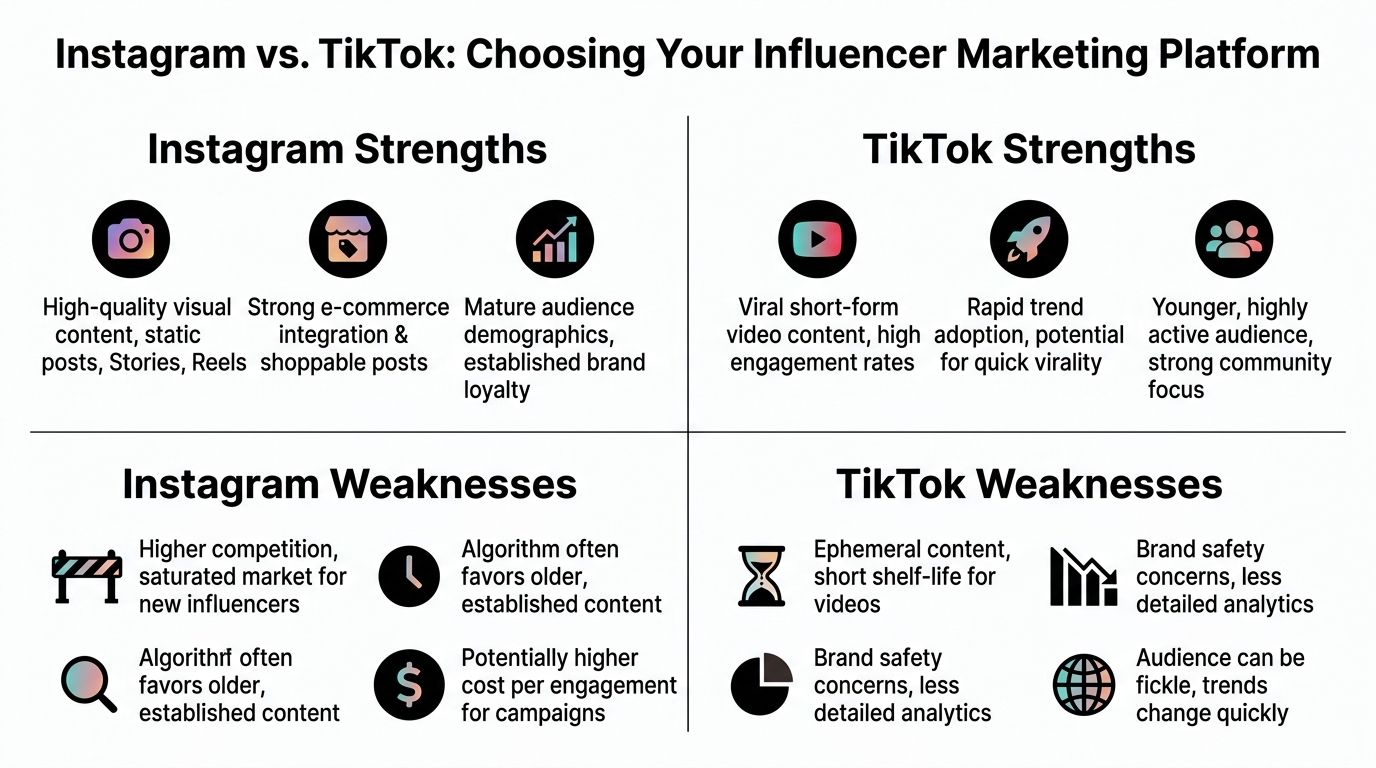
Here's the high-level comparison.
Where Instagram tends to win
Instagram is usually stronger when the buying journey benefits from visual polish, brand consistency, and easier browsing across a creator's profile. It works well for beauty, fashion, interiors, hospitality, food, travel, and products that need a more curated look.
It's also useful when you care about asset reuse. Good Reels, Stories, and static posts often slot neatly into paid social, product pages, highlight reels, and brand social feeds.
Instagram is generally the steadier option when you want:
- A branded look that feels controlled without looking corporate
- Ongoing community touchpoints through Stories, comments, and profile visits
- Shopping support through links, product tags, and content that fits ecommerce journeys
Where TikTok tends to win
TikTok is better at discovery when the creative is native to the platform. It rewards pace, relevance, hooks, and cultural timing more than visual perfection. If the product is demonstrable, surprising, satisfying, or easy to talk about, TikTok can move faster than Instagram.
That doesn't mean every brand should default there. TikTok punishes content that feels too scripted or too much like an ad. The creator usually needs more freedom in how they frame the message.
A solid short form video content guide is helpful if your team is still adapting briefs from static social into native vertical video.
Later in the campaign planning process, it helps to align the platform with how your creators already speak on camera. This video breaks down some of the practical differences in creator execution.
A simple decision filter
Choose Instagram when your product benefits from considered visuals, profile credibility, and content you can repurpose widely.
Choose TikTok when your goal is faster discovery, trend participation, or a looser creator-led style that can travel beyond the existing follower base.
Use both when each platform has a separate job. Instagram can carry trust and asset quality. TikTok can carry top-of-funnel discovery. Problems start when brands post the same creative to both and expect equal results.
How to Find and Vet the Right Influencers
Finding creators isn't hard anymore. Vetting them properly is the actual work.
The market is full of profiles that look useful at first glance. The mistake is choosing off follower count, aesthetics, or rate card before checking whether the audience is relevant to your offer.
According to Britopian's explanation of influencer intelligence, the right way to evaluate a creator is to combine audience-quality signals with content-performance signals. Follower count alone doesn't predict business impact. Audience geography and recent topic engagement matter more.
Start with audience quality
A creator can make strong content and still be wrong for the campaign if their audience doesn't match the intended buyer.
Check things like:
- Location fit. For local brands, this comes first. A London-heavy audience won't help a venue in Leeds.
- Niche fit. General lifestyle content can work, but category relevance usually beats generic popularity.
- Audience makeup. Look for whether the creator's audience resembles your target customer in broad demographic terms.
- Comment quality. Real communities leave specific comments. Weak audiences leave generic reactions or low-signal noise.
For multi-location brands, this usually means building a creator pool by geography, not one giant list for the whole country.
Then check content performance
Audience fit tells you who could convert. Content performance tells you whether their recent posts move people.
Look at:
- Recent engagement on relevant posts. Not all posts matter equally. A food creator's restaurant content is more useful than a random holiday dump.
- Topic consistency. If they only mention your category once every few months, the partnership may feel forced.
- Sentiment. Are people asking where to buy, how it tastes, whether it's worth visiting?
- Creative clarity. Can they explain the product or venue in a way that feels natural?
Don't ask, “Is this creator popular?” Ask, “Has this creator recently persuaded the kind of person we want to reach?”
A workable outreach standard
Good outreach is specific. Bad outreach is copied and pasted.
A decent first message usually includes the reason you chose them, the offer, the expected format, timing, and what success looks like. If you're vague, you'll attract vague replies and mismatched expectations.
A strong brief should cover:
- Deliverables such as Stories, Reels, TikToks, reviews, or usage rights
- Operational details like location, booking window, shipping, posting schedule, and who signs off
- Tracking setup including links, codes, or landing pages
- Brand constraints such as claims to avoid, disclosure wording, and must-show product details
The teams that scale this well don't rely on instinct. They turn creator selection into a repeatable filter and keep notes on who delivered cleanly, who needed chasing, and whose audience converted.
Common Influencer Marketing Pitfalls to Avoid
Most influencer problems aren't creative problems. They're execution problems.
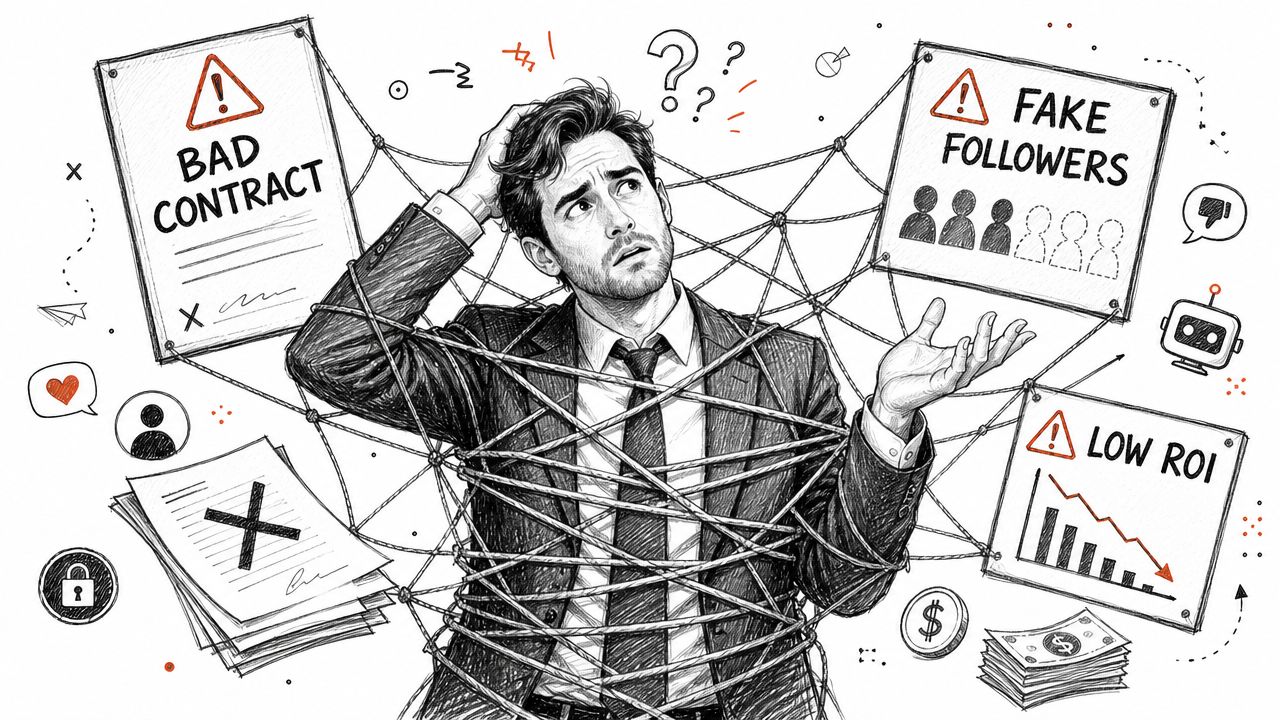
A campaign can fail even when the content looks good. The usual causes are poor screening, weak briefing, no disclosure discipline, and no operational owner once posts start going live.
The biggest mistakes brands keep repeating
Some issues show up over and over:
- Buying audience size instead of audience fit. The creator looks impressive, but their followers aren't in the right place or category.
- Sending a vague brief. The creator fills in the gaps, and the final post doesn't match the campaign goal.
- Treating likes as proof of performance. Engagement can signal interest, but it doesn't prove commercial impact.
- Ignoring workflow friction. Delayed shipping, unclear booking instructions, and late approvals ruin otherwise solid partnerships.
- Skipping usage rights conversations. The brand wants to reuse the content later and discovers the agreement never covered it.
Compliance is still a live issue
A lot of teams still behave as if disclosure is a minor detail. It isn't.
The UK's Advertising Standards Authority found in its 2024 monitoring that around 37% of influencer posts it reviewed did not make the commercial relationship clear enough, and the same guidance makes clear that the brand remains responsible for claims made in creator content, as cited in this summary of the ASA position.
That changes how you should run campaigns. You can't just send product out and hope the creator labels things properly. You need explicit instructions, review processes where appropriate, and a record of what was agreed.
If a creator publishes a non-compliant claim about your product, “they posted it” won't protect your brand.
What to tighten before launch
A simple pre-launch check saves a lot of pain:
- Disclosure wording must be stated plainly in the brief.
- Claim boundaries should be written down, especially in food, beauty, and health-adjacent categories.
- Tracking links and codes need to be live before any post goes up.
- Approval rules should be clear so nobody is guessing what requires sign-off.
- Payment triggers should be tied to agreed deliverables, not assumptions.
The brands that avoid messy campaigns are rarely the most creative. They're the most organised.
How to Actually Measure Influencer Marketing ROI
A creator post goes live on Friday. By Monday, the team can see views, comments, and a small spike in traffic. What they cannot see is the part that matters most. Which store visits, bookings, or orders came from that creator, and whether the partnership should be repeated.
That gap is why influencer marketing often feels harder to defend than paid search or paid social. The problem is rarely demand. It is instrumentation.
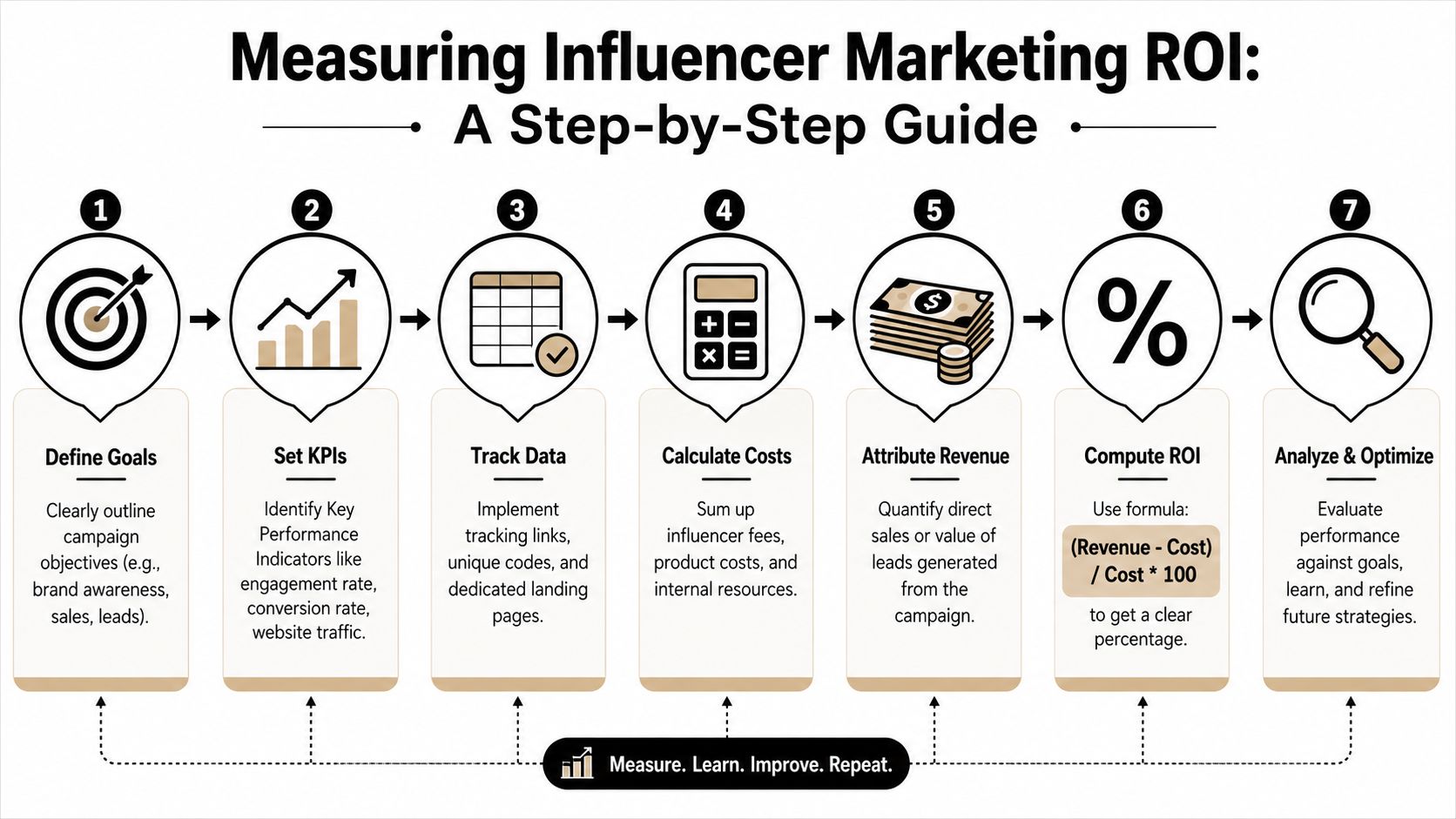
For UK ecommerce brands, restaurant groups, and multi-location operators, a workable setup is unique discount codes, UTM links, and website analytics. Used together, they connect creator activity to clicks, redemptions, purchases, and booking intent, as explained in this guide to influencer analytics.
What a usable attribution stack looks like
Each creator needs their own tracking setup. Without that, reporting turns into guesswork and post-campaign opinions.
A practical stack includes:
- Unique discount codes to capture direct purchase or booking influence
- UTM links to identify which creator and post drove the click
- Website analytics to track sessions, behaviour, and completed actions
- A clean campaign naming convention so reporting stays readable across locations, offers, and creators
This is the difference between “the campaign performed well” and “Creator A drove 42 bookings at a lower cost than Creator B, but Creator B produced stronger content for paid reuse.”
The metrics worth reviewing
Engagement still has a place. It helps explain reach and creative fit. It should not carry the ROI argument on its own.
Review performance against commercial metrics first:
| What to review | Why it matters |
|---|---|
| Code redemptions | Shows direct purchase or booking intent |
| Link clicks | Measures traffic generated by each creator |
| Conversion behaviour | Separates interest from action |
| Revenue by creator | Shows which partnerships can be repeated profitably |
| Performance by format | Identifies whether Stories, Reels, or TikToks are driving outcomes |
If your team also needs a way to value creator assets after the initial post, it helps to understand video content ROI, especially when those assets are reused in paid social, email, or product pages.
Where influencer measurement usually breaks
The first few campaigns can be managed in a spreadsheet. After that, the cracks show.
Codes are reused by mistake. UTM links are formatted differently by different team members. A restaurant franchise wants location-level reporting. An ecommerce team wants to separate first-order revenue from returning customer revenue. Someone has to reconcile creator payments against deliverables and results. None of this is difficult in isolation, but it adds up fast.
I have seen teams call influencer “unmeasurable” when the core issue was process drift. No tracking standard. No creator-by-creator reporting template. No single place to confirm what went live and what it produced.
The operating layer that makes ROI reporting credible
At scale, you need an operating layer. That can sit inside your team, with an agency, or in a managed platform such as Sup, which handles creator sourcing, campaign management, and attribution using promo codes, UTM links, and a central reporting view.
The tool matters less than the discipline behind it. Your process needs clear answers to five questions:
- Which creators were selected, and what commercial goal were they tied to?
- What did each creator agree to post?
- What tracking links and codes were assigned before launch?
- What traffic, bookings, or sales came from each creator?
- Which partnerships earned another test, a bigger budget, or a stop?
Once those answers are easy to pull, influencer stops sitting in the “awareness” bucket by default. It starts behaving like any other accountable growth channel, with trade-offs, benchmarks, and decisions you can defend.
More on strategy
See how many creators post about you and your competitors
Type in your brand's Instagram handle and we count the creators who post about you and about your five closest competitors. It takes about a minute and it is free. Or request a demo and we will show you the creators in your niche and walk you through the dashboard.
 Book a call