30 May 2026
Restaurant Influencer Marketing: Your 2026 Playbook
You've probably had this moment already. A local creator posts a slick Reel from a competing restaurant. The comments fill up with tags, saved plans, and “we're going this weekend”. Meanwhile, you're left asking the sensible question: is any of that turning into bookings, or is it just free food in exchange for likes?
That scepticism is healthy. A lot of restaurant influencer marketing is still run badly. Owners comp meals, hope for a strong post, and then judge success by views, comments, or whether the team felt busy that weekend. That isn't a marketing system. It's guesswork.
The fix is to treat creator campaigns like a local performance channel. Pick the right creators, brief them properly, give each one a trackable path to conversion, and measure what happened over a realistic window. When you do that, you stop asking whether influencer marketing “works” and start seeing which creators, offers, and formats drive revenue.
From Scepticism to Sales The New Reality of Social Discovery
A restaurant owner can ignore social discovery right up until the point a nearby competitor starts winning with it.
That usually doesn't look dramatic. It looks like a creator filming a cocktail pour, a table spread, or the room on a busy Friday night. Then local diners do what they always do. They save the post, send it to a friend, and decide that's where they're eating next. In the UK, 62% of diners check a restaurant's social media before deciding where to eat, 74% say social platforms guide their dining choices, and TikTok usage in restaurant marketing rose from 26% in 2023 to 48% in 2024 according to restaurant social media statistics.
That changes the role of creator content. It's not just upper-funnel awareness. It sits right inside the decision moment.
Why the old objection no longer holds
The usual objection is that social media creates noise, not sales. That was easier to argue when restaurant discovery lived mostly in search, maps, and word of mouth. Now discovery is visual, mobile, and local. Diners don't just ask “what's near me?” They ask “what looks worth going to tonight?”
Social proof works differently in restaurants than in many other categories. People don't need months of consideration. They need a reason to choose one place over another this week.
That's also why influencer activity can't sit in isolation. If a creator sends someone to your Instagram and your latest posts are stale, your menu is unclear, and your reviews look patchy, the campaign loses force. Strong creator content performs better when it sits beside a disciplined review strategy for local businesses and a profile that makes booking feel like the obvious next step.
What restaurant teams should take from this
The practical takeaway is simple. Restaurant influencer marketing now belongs in the same commercial conversation as paid social, search, and email. If you want a useful snapshot of how operators are thinking about it, this restaurant influencer marketing data is worth reviewing.
Don't buy the fantasy version of influencer marketing. A creator post won't rescue a weak offer, poor service, or an unmemorable menu. But if the product is good and the campaign is structured well, creator content can push diners from interest to action much faster than many restaurants expect.
Setting Goals That Actually Fill Tables
Most weak campaigns fail before outreach starts. The restaurant never decides what success means.
If your brief says “build awareness”, you'll get awareness-shaped reporting. Reach, views, saves, comments. All useful context, none of them enough on their own. If your brief says “fill Tuesday dinner covers for the next four weeks” or “move a high-margin sharing menu”, the campaign becomes operational. Staff can prepare for it. Finance can evaluate it. Marketing can optimise it.
Start with a commercial target
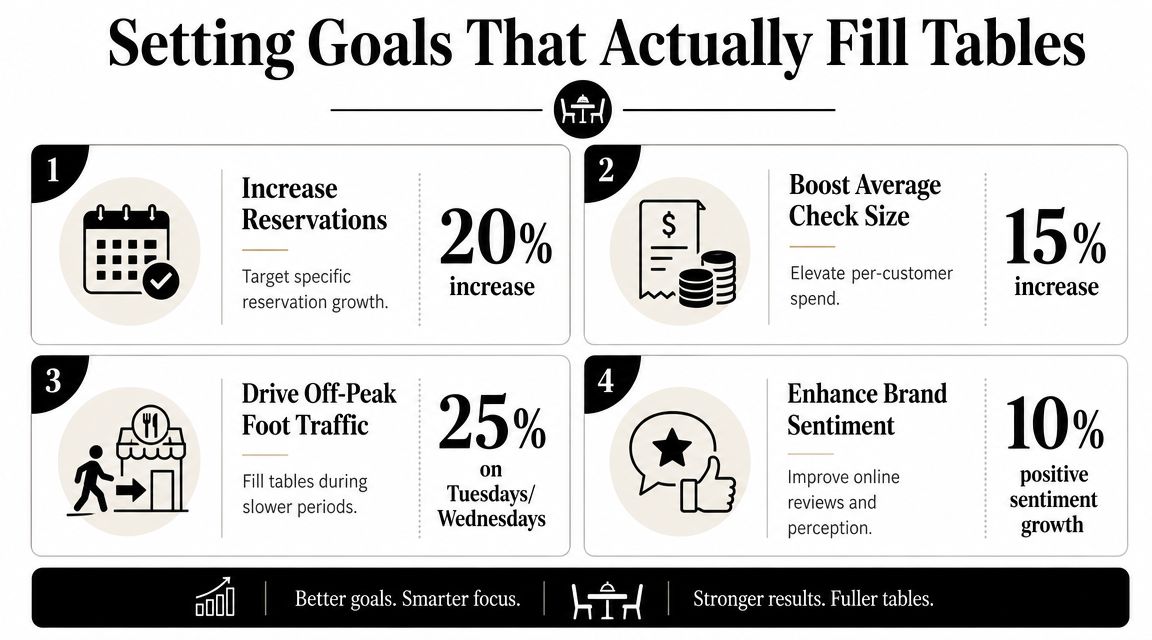
Good restaurant influencer marketing goals usually fit one of four buckets:
- Reservation growth: More bookings on specific days, dayparts, or service windows.
- Menu movement: More orders of a new launch, tasting menu, drinks flight, or dessert.
- Footfall in soft periods: More walk-ins during quieter lunch or midweek slots.
- Customer quality: More first-time diners, more repeat visits, or stronger local recall.
Those goals force better decisions. A creator with broad lifestyle reach may be fine for launch buzz, but a hyper-local food account is often stronger when you need people in the room next Wednesday.
Budget with ROI in mind
There's no point pretending creator spend is just a branding exercise anymore. Restaurant influencer campaigns have been shown to produce an average 8x ROI, with some benchmarks suggesting returns of £6.50 for every £1 spent and a 30% lift in reservations within a week of posting, based on influencer marketing statistics. Those aren't guarantees for your venue, but they are useful benchmarks for treating creator activity as a performance channel rather than a nice extra.
That means your budget should connect to one of three things:
- A revenue objective Tie spend to bookings, redemptions, covers, or order value.
- A test objective Compare two creator types, two offers, or two content angles and keep the winner.
- A rollout objective Prove one local model in a single site, then expand it.
Practical rule: If you can't explain how a campaign could pay back, you're not ready to brief creators yet.
For KPI planning, this guide to influencer KPIs that drive growth is a useful framework because it pushes you away from vanity metrics and towards outcomes you can defend.
What not to do
Restaurants waste money when they run creator campaigns with goals that are too vague, too broad, or impossible to attribute. Three common mistakes show up repeatedly:
- Chasing follower count: Big audiences don't help if the people watching live nowhere near the venue.
- Promoting everything at once: If the post tries to sell brunch, cocktails, private dining, and takeaway, nobody remembers the offer.
- Skipping the operational plan: If staff don't know the code, the booking team can't log the source, and the manager can't compare results, you won't learn anything.
The best campaigns are narrow. One audience. One offer. One action.
Finding Local Creators Who Your Customers Trust
The right creator isn't the one with the biggest audience. It's the one whose followers can realistically become your diners.
For local venues, that usually means micro-influencers, not macro accounts. According to Eat Marketing's practical guide for food and drink brands, micro-influencers can generate up to 60% more engagement than macro-influencers on comparable content. For a restaurant, that matters because local relevance beats broad reach.
How to find them without overcomplicating it
You don't need an expensive platform to start. Use the platforms your diners already use.
Search by:
- Location tags: Your town, postcode area, neighbourhood, or nearby landmarks.
- Local food hashtags: City plus “eats”, “food”, “brunch”, “cocktails”, or “date night”.
- Competitor tags: See who has already posted nearby venues and whether their audience is local.
- Your own mentions: Some of your best potential collaborators may already know the brand.
Then check whether the content fits the venue. A polished lifestyle creator who rarely posts food may still be useful, but for most restaurants the better bet is someone who already influences local dining decisions.
What to review before you reach out
A quick vetting pass should tell you whether the account is credible. Focus on signals that point to genuine local influence.
Look for:
- Comment quality: Real questions, recommendations, and local references beat strings of emojis.
- Audience fit: Comments from people in your city are more useful than generic international engagement.
- Content style: Can they show atmosphere, plating, and experience, or only selfie-led content?
- Posting consistency: A dormant or erratic account is harder to rely on for campaign timing.
Watch for red flags too:
- Sudden follower jumps with no matching improvement in comments.
- Generic engagement that looks copied across many posts.
- No clear niche because the account swings wildly between unrelated content types.
- Weak local signal where the audience appears broad but not geographically relevant.
If the comments read like a community, that's a stronger sign than a high follower count.
Micro versus macro in restaurant campaigns
| Characteristic | Micro-Influencers (1k-100k followers) | Macro-Influencers (100k+ followers) |
|---|---|---|
| Audience relevance | Usually tighter and more local | Often broader and less location-specific |
| Engagement quality | Often stronger for neighbourhood discovery | Can be weaker for local intent |
| Cost structure | Usually more flexible | Usually more expensive |
| Creative fit | Often feels more personal and believable | Can feel more like media inventory |
| Best use | Openings, local pushes, soft-night campaigns | Big launches or broad awareness |
If you're building from scratch, start with micro creators in your catchment. They're easier to test, easier to attribute, and usually more useful for moving actual covers.
Keep outreach details organised
One practical bottleneck is finding reliable contact details once you've shortlisted creators. If your team is doing manual prospecting, this breakdown of how marketers find creator emails can help you tidy up that step and avoid losing good prospects in a DM pile.
The trust question matters more than the audience-size question. Diners act on creators who feel familiar, specific, and local. That's the asset you're buying.
The Outreach and Brief That Get a 'Yes'
Once you've found strong local creators, the next failure point is the approach. Restaurants either send a vague message with no clear offer, or they send a rigid brief that turns the creator into a script reader. Both approaches underperform.

Write outreach like a professional, not a fan
The first message needs four things: relevance, clarity, value, and a next step.
A simple structure works well:
- Personal connection: Mention a recent post or the type of local content they make.
- Why them: Explain why their audience fits your venue.
- Offer: State whether this is a paid collaboration, a hosted visit, or a hybrid arrangement.
- Action: Ask whether they'd like the brief and available dates.
That's enough. You don't need a long brand story in the first message. You need enough credibility that they'll reply.
A useful reference point for tone and structure is this influencer outreach email guide. It's especially helpful if your team tends to sound either too corporate or too casual.
Build a brief with guardrails, not a script
The strongest creator briefs are clear on business requirements and light-handed on delivery. If you overcontrol the content, the audience can feel it immediately.
A workable brief should cover:
- The campaign goal Are you driving bookings, a menu launch, walk-ins, or code redemptions?
- The offer Spell out exactly what the creator is receiving and what the audience gets.
- Deliverables Reel, TikTok, Stories, stills, or a mix. Be specific.
- Must-include details Location, booking route, offer code, key menu item, and disclosure wording.
- Timing Visit date, posting window, and any blackout dates.
- Usage rights Say whether you want permission to repost or use content elsewhere.
What good control looks like
You do need essential elements. You don't need to dictate every line.
Good guardrails include:
- Brand facts: Correct venue name, address, offer terms, and tags.
- Operational details: Booking link, code format, and expiry.
- Compliance: Clear disclosure language.
- Creative direction: Mood, menu priorities, and service window.
Bad control looks like:
- Scripted praise
- Forced talking points
- Shot-by-shot instructions for every frame
- Banning the creator's normal style
The post should sound like the creator visited your restaurant, not like your restaurant borrowed the creator's account.
Make the exchange fair
Not every creator collaboration needs the same model. Some campaigns work as hosted visits. Others need a fee, content licensing, or a package tied to multiple deliverables. What matters is that expectations are written down before the visit.
For operators who want less manual admin, Sup is one option that handles creator sourcing, outreach, tracking codes, UTM links, and campaign management in one workflow. That's useful when a restaurant team wants structure without running everything in DMs and spreadsheets.
The outreach gets the reply. The brief gets the result.
Tracking What Matters From Post to Profit
Most restaurant influencer marketing often falters at this point. The post goes live, the team watches the likes roll in, yet nobody can say what the campaign truly produced.
If you want to know whether a creator drove revenue, you need attribution assets before the content is published.
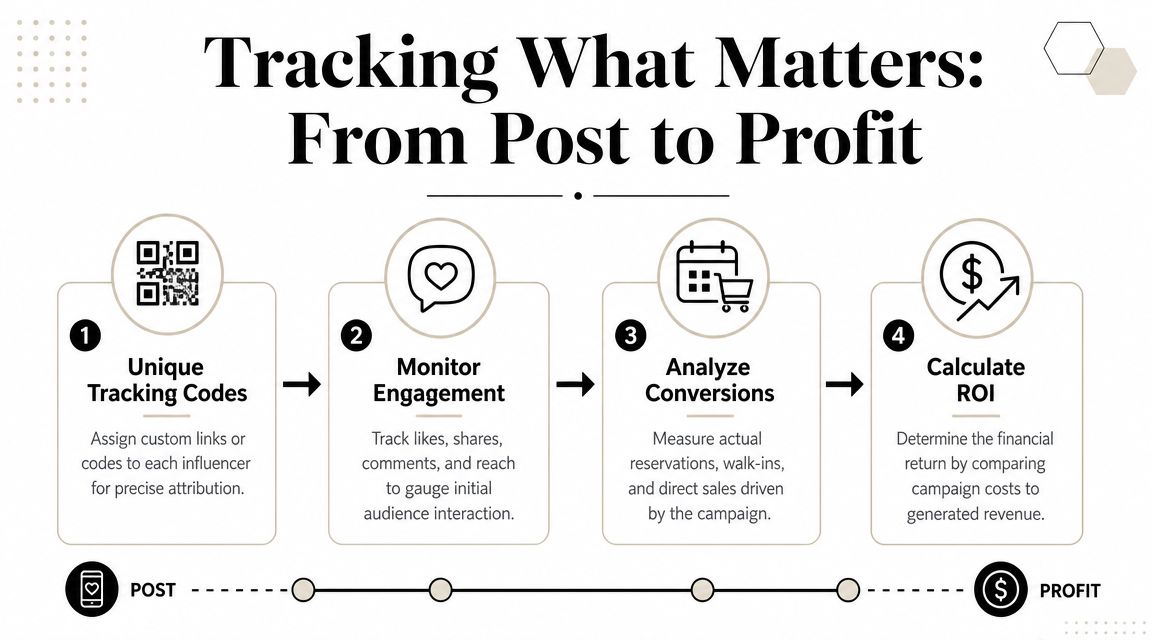
Give each creator a distinct path to conversion
The cleanest setup is one creator, one code, one link, one log.
Use:
- Promo codes for redemptions tied to orders or booking incentives
- UTM-tagged booking links for reservation tracking
- Dedicated QR codes for in-venue menus, offers, or event landing pages
- Booking notes or references if your reservation system allows source capture
A code like JESSDINES or BRUNCHWITHAMY is better than a generic campaign code shared across several creators. Shared codes destroy attribution.
A simple attribution setup
Here's the workflow that works in practice:
- Create a unique asset for each creator One promo code and one booking link per creator.
- Log the details before launch Record creator name, content URL, post date, offer, and cost.
- Train the front-of-house team If guests mention the creator but forget the code, staff should log that manually.
- Check reservation and POS data regularly Don't leave all reconciliation until the end.
- Review performance by creator, not by campaign total One post may produce all the return while another only generates noise.
A lot of operators find the mechanics easier when they can see the process visually:
Use a longer measurement window
One of the biggest reporting mistakes is measuring too quickly. Restaurant discovery often isn't instant. Someone sees a post on Thursday, saves it, and books for the following week.
Practitioners recommend tracking sales from custom promo codes or UTM links for up to 8 weeks after a campaign, because shorter attribution windows undercount delayed visits according to restaurant influencer tracking guidance.
That matters because restaurant behaviour is messy. Diners share links in group chats. One person sees the post, another makes the booking. A code gets screenshotted and used later. If you only check the first few days, you'll miss part of the value.
Revenue check: likes tell you whether people noticed. Redemptions and bookings tell you whether they acted.
What to include in your performance sheet
Keep the reporting simple enough that you'll maintain it. A basic sheet should include:
- Creator name and handle
- Platform and post URL
- Cost of collaboration
- Unique code or booking link
- Bookings or redemptions
- Estimated revenue from those bookings
- Any repeat signals such as later visits or follow-on content
That gives you enough to compare creators properly. It also lets you answer the only question that really matters: which collaboration made money, and which one didn't?
Optimising Your Strategy and Staying Compliant
A single creator campaign can be interesting. A repeatable programme is more valuable. That only happens when you review what performed, adjust the model, and keep the legal side clean.
Optimise using revenue data, not creator mythology
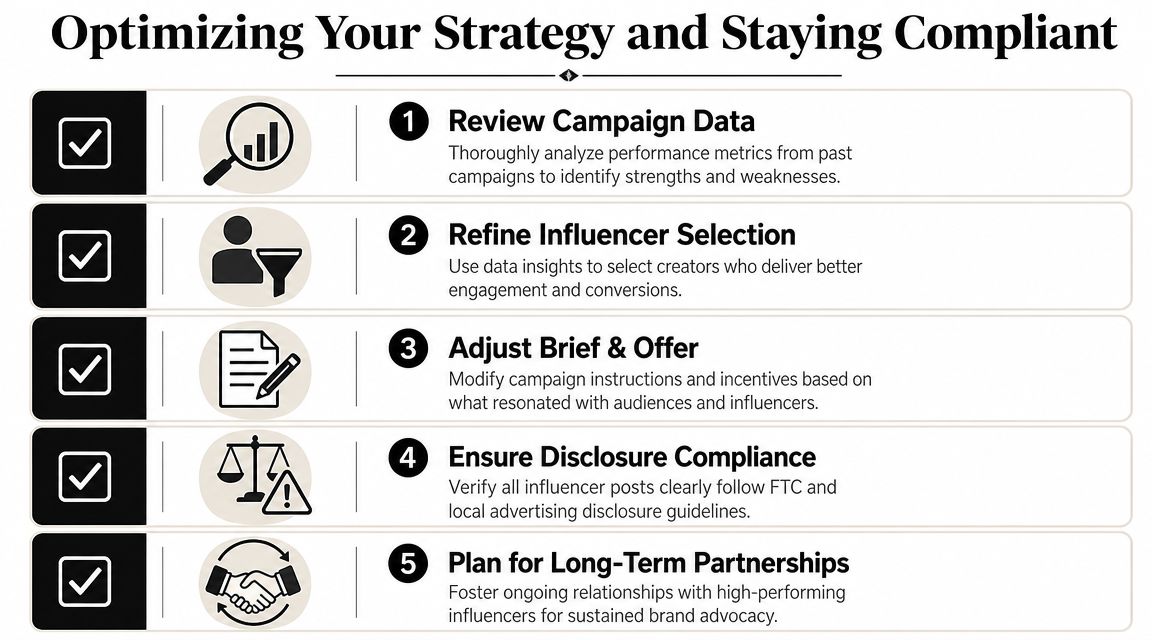
After a campaign ends, compare creators by commercial output. Not by who looked most polished. Not by who had the biggest audience. By who drove booked covers, redemptions, and profitable demand.
Then tighten the next round:
- Keep creators who converted
- Rewrite offers that got attention but weak action
- Adjust posting windows if the timing was off
- Secure reuse rights for content you want on your own channels
That last point matters. Some creator content will outperform your in-house social content because it feels more natural. If you want to repost it or use it in paid media, get that permission in writing.
Compliance is part of campaign quality
In the UK, the Competition and Markets Authority is actively enforcing disclosure standards, which means restaurant teams need to treat creator activity like paid media and not like casual word of mouth, as noted in this piece on influencer marketing for restaurant growth.
That means your brief should tell creators how to disclose properly when content is paid or gifted. Clear disclosure protects the creator, the restaurant, and the audience's trust.
For operators trying to improve the rest of their acquisition mix at the same time, these digital marketing insights for restaurant owners are a useful companion read because creator campaigns rarely perform best in isolation.
Strong restaurant influencer marketing is measured like performance media, managed like a partnership, and documented like a commercial activity.
When you run it that way, the channel gets easier to scale. You know who to rebook, which offers to repeat, what content to license, and how to explain the return internally without hand-waving.
If you want help turning restaurant influencer marketing into a tracked, repeatable system, Sup helps teams source local creators, manage outreach, generate unique promo codes and UTM links, and attribute bookings and revenue without relying on manual spreadsheets.
More on industries
See how many creators post about you and your competitors
Type in your brand's Instagram handle and we count the creators who post about you and about your five closest competitors. It takes about a minute and it is free. Or request a demo and we will show you the creators in your niche and walk you through the dashboard.
 Book a call