4 June 2026
Instagram Follower Count: KPIs & ROI Guide 2026
Most advice about Instagram follower count is still stuck in the wrong decade. It treats the number on a profile as the scoreboard. It isn't.
A follower count can tell you whether an account has built some level of audience access. That's useful. But if you're running creator marketing to drive revenue, bookings, reviews, or repeat purchases, the Instagram follower count is only the starting point. It tells you who might see the message, not who will click, buy, or turn up.
The shift that matters is simple. Stop using follower count as the primary KPI. Start using it as a filtering input inside an attribution model. That means shortlisting creators for relevance and audience quality, then measuring what happens after the post goes live: clicks, code redemptions, sales, bookings, and content reuse value.
That approach changes who you hire, how you brief them, and how you evaluate performance. It also makes micro and nano creators far more valuable than many brands assume.
Deconstructing the Instagram Follower Count
The Instagram follower count is the number of unique accounts following a profile. On the surface, it looks straightforward. Brands see the total on a creator's profile, often shortened into “K” or “M”, and use it as a shorthand for influence.
That shorthand causes problems fast.
In practice, the Instagram follower count is a lagging exposure metric. It shows accumulated audience access, not current business value. Guidance from audience tracking tools recommends reading the number alongside growth velocity and audience authenticity, because the count can climb while audience quality weakens. The same guidance gives a simple example: 100 followers per week is healthier than a spike of 500 followers in one week and then flat growth (InfluenceFlow guidance).
What the number actually tells you
Used properly, follower count helps with three things:
- Initial screening. You can quickly sort creators by rough audience size.
- Reach potential. A larger audience may support broader awareness, especially for launches.
- Category fit. In some niches, even a modest count can signal authority if the audience is tightly focused.
Used badly, it becomes the whole selection process.
Practical rule: Treat follower count as the cover of the book, not the book itself.
A lot of brands still ask, “How do we boost the follower count?” That's not a wrong question, but it is incomplete. If your aim is sustainable growth, resources on how to boost IG followers with Scheduler.social are most useful when they're paired with content quality, posting consistency, and audience fit rather than shortcuts that only inflate the headline number.
What a healthy count looks like
A healthy count isn't just “bigger”. It's stable, relevant, and believable.
Look for patterns such as:
- Consistent follower growth over time rather than abrupt jumps.
- Content alignment between what the creator posts and why people follow them.
- Audience response that suggests actual interest, not passive accumulation.
If a creator has added followers steadily and the comments still make sense for the niche, that's usually more promising than a larger account with erratic jumps and thin interaction.
The important mental reset is this. Instagram follower count measures stored attention. Performance marketers need evidence of activated attention.
Why Follower Counts Can Be Deceptive
A high follower count can make a weak creator look strong. That's why teams that buy solely on audience size keep overpaying.
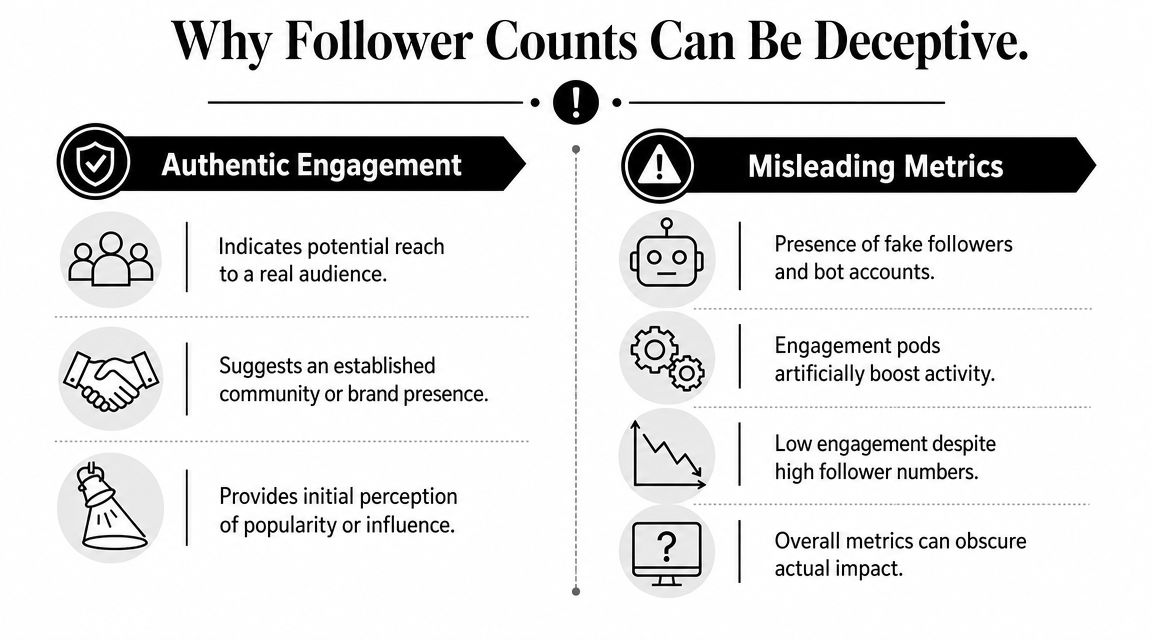
The deception usually doesn't come from one obvious problem. It comes from several smaller ones layered together: fake followers, inactive followers, engagement pods, giveaway-driven spikes, broad but irrelevant geography, and creator audiences that stopped caring months ago.
The count can be inflated without being useful
Some inflated counts are obvious. You'll see a big audience and comment sections full of generic replies. Others are harder to spot. A creator may have built a real audience, then lost relevance, changed niche, or attracted followers through tactics that don't translate into intent.
That matters because brands often confuse visibility with commercial readiness.
A restaurant in Manchester doesn't benefit from a creator whose audience is mostly elsewhere. A skincare brand launching one specific line doesn't need passive followers who liked one viral Reel six months ago. A multi-location chain needs local audiences that can visit.
UK regulation is a warning sign for marketers
This isn't just a platform-quality issue. It's a commercial and compliance issue.
The UK Advertising Standards Authority has repeatedly warned that influencer metrics can be misleading when follower counts are inflated, and the CMA has required clearer ad disclosures, which reinforces the point that audience quality and transparency matter more than headline numbers (UK-focused summary here).
If the audience isn't real, relevant, and responsive, the follower count is decoration.
That changes how you review creators. Instead of admiring the number, analyse the pattern around it. If your team needs a cleaner process for analyzing social media data, build reports that compare follower count with post-level behaviour, audience fit, and campaign outcomes rather than listing the count as a top-line success metric.
Red flags worth taking seriously
Here's where I get sceptical in creator vetting:
- Sudden spikes with no clear content reason. If the audience jumps but nothing in the content explains it, investigate.
- Thin comments on large accounts. Big follower totals with low-quality discussion often point to weak audience connection.
- Mismatched niche signals. If the profile claims expertise in one area but comments and collaborations suggest something else, the audience may be broad but commercially loose.
- Irrelevant geography. Strong engagement from the wrong market can still produce poor campaign results.
- Storytelling that doesn't sell. Some creators entertain well but don't move anyone to act.
Follower counts become dangerous when they create false confidence. The bigger the budget, the more expensive that false confidence gets.
Finding Context with Creator Tiers and Niche Benchmarks
Follower count becomes more useful once you stop asking, “Is this number good?” and start asking, “Good for what?”
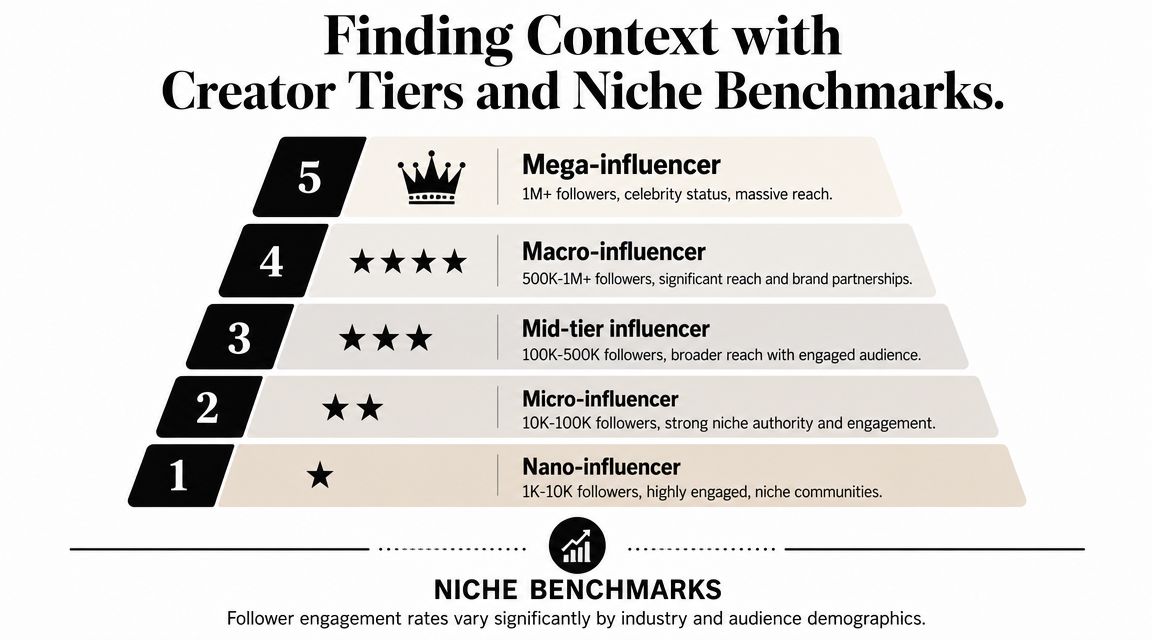
That's where creator tiers help. They're not a performance guarantee. They're a context tool. They tell you what kind of audience shape you're dealing with, how broad the creator's exposure might be, and how much niche concentration you might expect.
Standard tiers still need local interpretation
The common ranges used in creator marketing look like this:
| Tier | Typical range | Usual commercial use |
|---|---|---|
| Nano | 1K to 10K | Local trust, niche authority, community response |
| Micro | 10K to 100K | Targeted campaigns, product seeding, scalable creator programs |
| Mid-tier | 100K to 500K | Broader awareness with some niche focus retained |
| Macro | 500K to 1M+ | Large reach, higher brand visibility, usually higher cost |
| Mega | 1M+ | Celebrity-scale awareness and social proof |
Those ranges are helpful, but they're too generic on their own. A nano food creator with local credibility can be more commercially useful to a regional restaurant group than a macro lifestyle account with a diffuse audience.
What scale looks like in the UK
For UK brands, the market is large enough that local creator programs can scale without relying on celebrity-sized accounts. DataReportal's UK digital report for 2024 estimated 30.0 million Instagram users in the UK, equivalent to 43.8% of the population. That level of usage means a follower count can connect brands to an audience broad enough for national visibility and local discovery at the same time (UK Instagram audience context).
That's the part many brands miss. You don't need one massive creator to cover the UK. You can build a stronger programme with multiple smaller creators matched by location, niche, and purchase intent.
For teams comparing creator sizes, this perspective on why micro-influencers outperform macro-influencers with data is useful because it pushes the conversation away from raw audience size and towards practical campaign design.
Benchmarks should follow the niche, not ego
A beauty creator and a local fitness coach shouldn't be judged the same way. Neither should a London restaurant campaign and a national DTC launch.
Use follower count in context:
- Local services often benefit from concentrated regional audiences.
- DTC brands usually need a mix of niche credibility and scalable content output.
- Hospitality groups need creators whose followers can visit, book, or order.
- Agencies should compare creators within the same market and content format, not across unrelated categories.
A creator tier tells you how to frame expectations. The niche tells you whether those expectations are realistic.
The mistake isn't using follower count. The mistake is using it without context.
Shifting Focus from Followers to Engagement and Reach
Once a creator passes the first screen, follower count should move down your dashboard.
The next two metrics deserve more attention: engagement and reach. They're not perfect either, but they give you a closer view of whether the audience notices the content and responds to it.
Engagement shows whether the audience reacts
A practical engagement-rate formula is:
(likes + comments) / followers
That formula is simple on purpose. It won't capture every nuance, but it quickly exposes one common problem: large accounts with weak audience response.
If two creators charge similar fees and one has a smaller audience but stronger interaction relative to their size, that smaller creator often deserves the test budget first. They may have less theoretical exposure, but more active attention.
Here's how I usually interpret it:
- Strong comments matter more than empty volume. Real questions, product discussion, and local references usually signal a healthier audience.
- Consistency beats one-off spikes. One viral post doesn't prove repeatable campaign value.
- Format matters. Reels, Stories, and carousels can perform differently on the same account, so judge the creator across the formats you plan to buy.
Reach tells you who actually saw the post
Follower count is a stored audience. Reach is the number of people who saw the content.
That distinction matters because a creator can have a large following and still deliver weak distribution. If posts regularly fail to travel beyond a small fraction of the audience, the brand is paying for a promise the content doesn't fulfil.
A simple way to pressure-test this is to ask for recent post-level screenshots and compare:
| Metric | What it tells you | Why it matters |
|---|---|---|
| Followers | Potential audience size | Useful for first-pass filtering |
| Reach | Actual people who saw the content | Better indicator of current distribution |
| Engagement | Audience response | Shows whether the content gets attention |
If you want a cleaner way to calculate and compare post interaction, this Instagram engagement calculator can help standardise the review process.
Why these metrics still aren't enough
Engagement and reach are better than follower count, but they still sit inside the social layer. They tell you whether people saw and reacted. They don't tell you whether anyone bought.
That's why I'd never approve a creator programme based on social metrics alone. At best, they help you shortlist. At worst, they become another polished vanity layer.
A creator with modest follower count, credible engagement, and reliable reach is often a better commercial bet than an account that looks famous but moves nobody.
The practical shift is to stop asking, “How many followers do they have?” and start asking better questions:
- Who sees their posts?
- Does the audience respond in a way that suggests intent?
- Can we track what happens after exposure?
If the answer to the third question is no, you're still buying attention without accountability.
The Ultimate Goal Measuring Attributable Business Impact
A creator campaign shouldn't end with “the post performed well”. That statement is too vague to guide budget decisions.
The real test is whether the campaign produced business movement you can trace. For UK brands especially, the more useful question isn't whether a creator has a big audience. It's whether followers turn into local actions like clicks or purchases. That matters in a market where 88% of the UK public were using social media in 2024, because broad attention alone doesn't tell you who is in-market, nearby, or ready to buy (discussion here).
What to measure instead of applause metrics
If you want creator marketing to operate like a growth channel, tie every collaboration to a business action. In most programmes, that means some mix of:
- Tracked clicks from Story links, link-in-bio placements, or campaign landing pages
- Promo code redemptions tied to each creator
- Bookings or reservations for hospitality and service brands
- Purchases and first-order revenue for ecommerce
- Lead submissions for higher-consideration offers
- Review generation where creator traffic supports local reputation building
These metrics don't replace creative judgement. They sharpen it. You can still value good storytelling, but now you can tell the difference between storytelling that entertains and storytelling that converts.
Build attribution into the campaign before launch
Most attribution problems start before the content goes live.
Brands often brief the creator, approve the post, and only then realise there's no clean way to connect the content to outcomes. Fix that upstream. Every campaign should launch with its tracking baked in.
A workable setup usually includes:
- A unique UTM link for each creator or placement
- A unique promo code tied to that same creator
- A landing page aligned to the content angle
- A reporting window agreed before launch
- A success definition that goes beyond reach
If the campaign is for a local business, geo-relevance matters just as much as tracking. Someone can love the post and still be commercially irrelevant if they can't realistically visit, order, or book.
For teams refining how they talk about financial outcomes, Wideo's resources on understanding return on investment are useful because they keep the conversation centred on measurable outcomes instead of platform applause.
Move up the KPI ladder
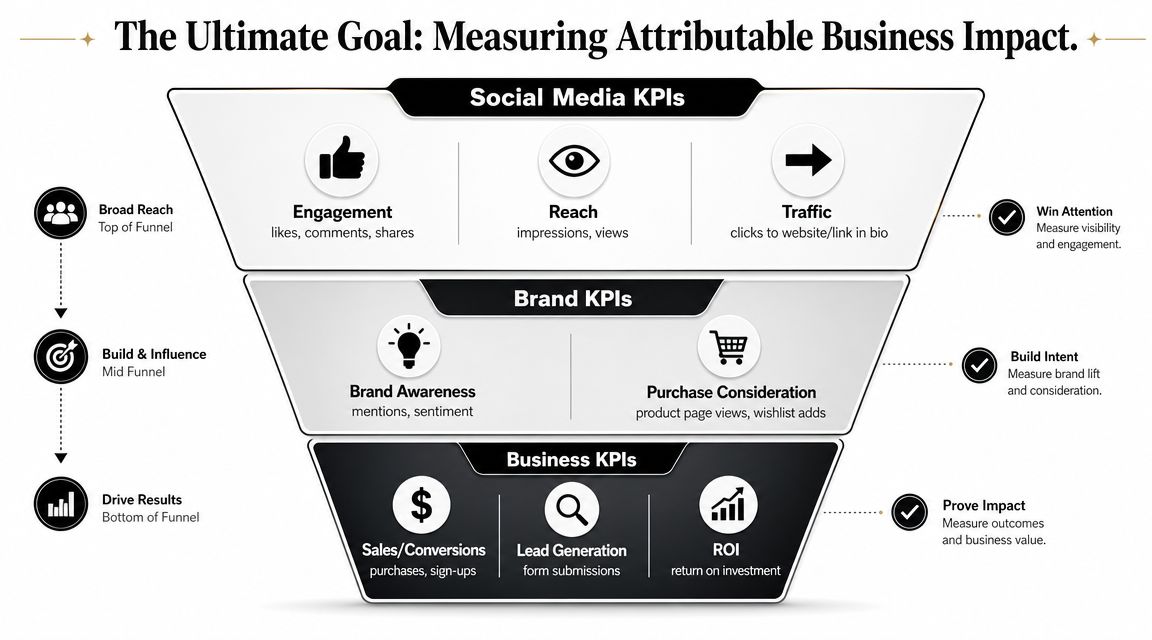
A simple way to organise creator reporting is to separate KPIs into layers:
| KPI layer | Examples | What it answers |
|---|---|---|
| Social | Likes, comments, views, reach | Did people notice the content? |
| Brand | Mentions, saves, sentiment, product interest | Did the content influence perception? |
| Business | Clicks, bookings, redemptions, purchases | Did it create measurable value? |
That hierarchy matters because teams often stop at the top layer. They report engagement, maybe reach, and call it success. But budget should follow the bottom layer.
If you're setting programme goals from scratch, this guide on how to set influencer marketing KPIs that drive growth is a strong reference point for building a reporting model that connects creator activity to commercial outcomes.
If you can't attribute a creator campaign to business impact, you haven't built a channel. You've bought exposure and hoped for the best.
That's fine for pure brand campaigns. It's not fine if revenue is the brief.
Your Framework for Vetting High-ROI Creators
High-ROI creator selection isn't about finding the biggest accounts. It's about reducing uncertainty before you spend.
A reliable vetting process starts with follower count, then gets stricter fast. For UK-focused influencer selection, follower count should be treated as a reach proxy, not a conversion guarantee. Audit tools such as HypeAuditor's checker are built around that logic by combining follower estimates with audience quality and engagement authenticity before anyone tries to estimate campaign impact (see the checker approach). Our HypeAuditor alternative page sets it beside a service that does that vetting for you.
A practical vetting sequence
I'd structure creator review in this order.
Start with fit
Before metrics, check whether the creator matches the offer.
- Niche fit. Does the content naturally connect to your product or venue?
- Geo fit. Can their audience buy, visit, or book?
- Format fit. Are they strong in the format you need, such as Reels, Stories, or testimonial-style posts?
A creator can have the right numbers and still be wrong for the campaign.
Then check audience quality
Follower count only matters if the audience is credible.
Review:
- Comment quality rather than comment volume alone
- Posting consistency and whether audience response still looks healthy
- Partnership relevance, especially whether sponsored content feels natural or forced
- Signs of inflated activity, such as odd spikes or low-quality engagement patterns
Many brand teams stop too early. They see “good enough” and move on. That's how weak creators slip into the roster.
Use test campaigns before scaling
Even after a creator passes qualitative review, don't assume they'll drive results. Run a small attributed test first.
A smart pilot usually asks one narrow question: can this creator move a defined audience to one defined action? That might be a booking, a code redemption, or a click to a product page.
Once you have that answer, scale based on evidence, not profile polish.
Here's a simple scorecard you can adapt:
| Check | What to look for | Pass standard |
|---|---|---|
| Audience fit | Niche and location relevance | Audience can realistically convert |
| Content quality | Clear, persuasive, on-brand delivery | Creator can sell without sounding scripted |
| Engagement signals | Credible interaction patterns | Audience appears active and relevant |
| Attribution readiness | UTMs, codes, tracking plan | Performance can be measured cleanly |
| Test result | Real business action | Creator proves commercial usefulness |
A short walkthrough helps if you're building a repeatable vetting workflow for your team:
What actually works
The creators that drive the best ROI are often the least flashy on paper. They know their audience, they speak in a way that feels credible, and they can motivate action without looking like they're reading ad copy.
What doesn't work is buying prestige metrics and trying to reverse-engineer performance after the fact.
Choose creators the way you'd choose paid media placements. Start with audience fit, demand proof of delivery, and keep funding what converts.
That's the discipline missing from most follower-count conversations.
If you want a faster way to run creator campaigns with attribution built in, Sup helps brands source verified micro and nano creators, launch campaigns with promo codes and UTM links, and track clicks, bookings, conversions, and ROI in one place. It's a practical option for teams that want creator marketing to behave like a measurable growth channel instead of a spreadsheet-heavy brand exercise.
More on tracking
See how many creators post about you and your competitors
Type in your brand's Instagram handle and we count the creators who post about you and about your five closest competitors. It takes about a minute and it is free. Or request a demo and we will show you the creators in your niche and walk you through the dashboard.
 Book a call