20 March 2026
Influencer Marketing for New Restaurant Openings: A Timeline - 2026 Playbook
Opening a new restaurant is one thing, but making sure it’s the talk of the town from day one is another challenge entirely. A great menu isn't enough to guarantee a full house. You need a solid plan to build real excitement, and that's where a well-timed influencer campaign comes in.
Starting eight weeks out, this is your blueprint for turning opening night buzz into sustained bookings.
An 8-Week Timeline for a Buzzworthy Restaurant Launch
Let's be honest: launching a new restaurant is a monumental effort. Cutting through the city's culinary noise to become the next go-to spot is your biggest marketing hurdle. The secret isn't just about sending a few random DMs to food bloggers; it's about building genuine hype that puts people in your seats.
This guide is an actionable, week-by-week playbook designed to get your restaurant on everyone’s radar. We’re moving beyond messy spreadsheets and guesswork to give you a clear path. You’ll learn exactly how to:
- Find the right local food creators who have a real, engaged following.
- Write outreach messages that feel personal and actually get a response.
- Set up simple tracking with promo codes and UTMs to prove your campaign worked.
A well-run influencer campaign isn’t just a ‘nice-to-have’ anymore. It’s a core part of any successful launch strategy, building the social proof you need to drive footfall when it matters most.
To give you a bird's-eye view, here's a quick summary of the key phases we'll be diving into. Think of this as your master plan for the next two months.
Restaurant Opening Influencer Campaign Timeline Overview
| Phase | Timeline (Pre-Opening) | Key Activities |
|---|---|---|
| Foundation & Planning | 8-6 Weeks | Define goals, set budget, create ideal creator profile. |
| Sourcing & Outreach | 6-4 Weeks | Find and vet influencers, send personalised outreach. |
| Briefing & Logistics | 4-2 Weeks | Send content briefs, confirm visit dates, finalise deliverables. |
| Launch & Go-Live | 2 Weeks - Launch Day | Host influencer visits, coordinate posting schedules. |
| Post-Launch & Analysis | 1-4 Weeks Post-Opening | Monitor results, track KPIs, repurpose best content. |
Each phase builds on the last, creating a wave of momentum that crescendos right on your opening week.
This timeline visualises how all the critical stages fit together, from initial planning right through to analysing your results after the doors open.
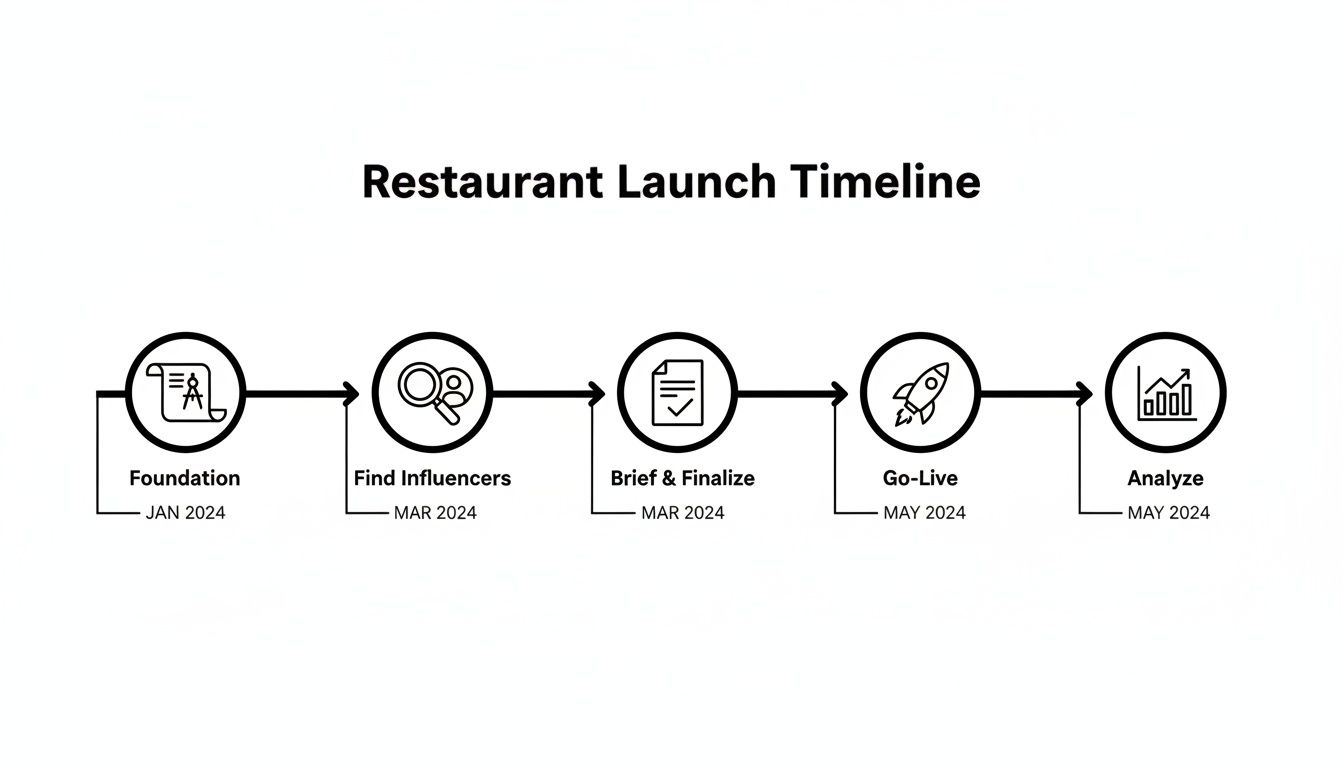
As you can see, starting this process early is absolutely essential. It gives you the breathing room needed to build relationships and coordinate a powerful, synchronised launch.
The move towards authentic, creator-led marketing is impossible to ignore. In fact, 74% of brands planned to increase their influencer collaborations by 2026, with many boosting their budgets specifically for this kind of authentic content. For city-based campaigns in the UK, nano-influencers on platforms like TikTok are proving incredibly effective, with some boasting 15.2% engagement rates. You can dig into more UK influencer marketing statistics to see how these trends can give your launch a serious advantage.
This entire guide is built to help you tap into that power, turning your opening from just another night into an unmissable event.
Weeks 8 to 6 Pre-Launch: Building Your Foundation
Believe it or not, the success of your restaurant's launch campaign is decided long before the first influencer even walks through your door. These two weeks are all about laying the groundwork. It's where you stop talking about ideas and start building a concrete, measurable plan.
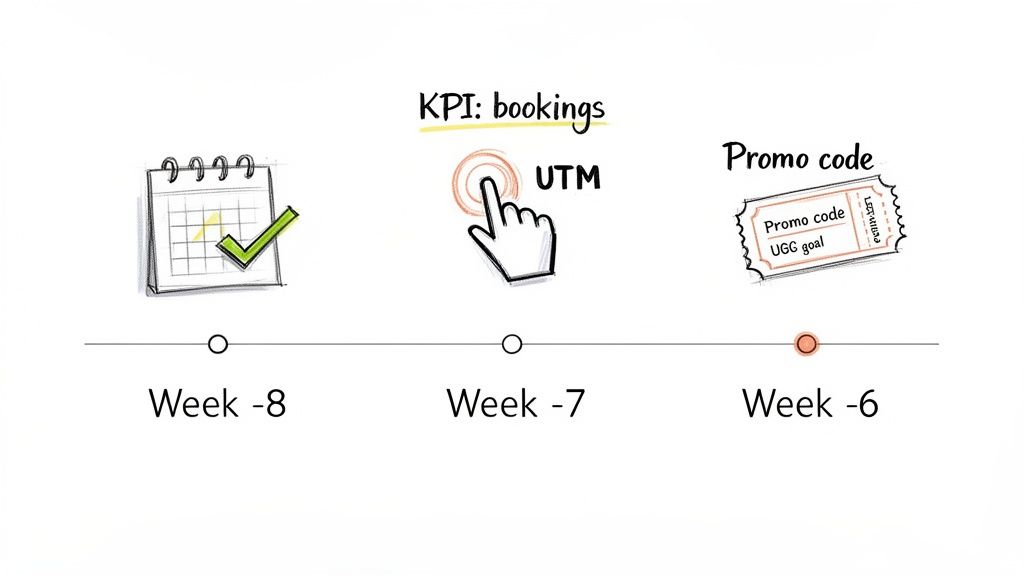
Your first, most crucial job is to decide what success actually looks like for you. A vague goal like "creating buzz" is a marketer's nightmare because you can't measure it. You need to set specific Key Performance Indicators (KPIs) that tie directly back to real business objectives. This is how you'll prove the campaign was worth it.
Defining Your Campaign KPIs
Think hard about what you need most when you open. Are you desperate for bums on seats from day one, or is it more valuable to build a library of authentic content you can reuse for months? There's no wrong answer, but you have to pick a lane.
Here are a few realistic KPIs you could aim for with a new restaurant launch:
- Bookings Goal: Generate 150 table bookings using unique influencer discount codes within the first month.
- Content Goal: Collect 50 high-quality, approved photos and videos from your creator partners to use on your own channels.
- Reach Goal: Hit a combined total of 500,000 impressions across all influencer posts in the first fortnight after opening.
My advice? Choose one primary KPI to be your North Star, and maybe one or two secondary ones. This simple decision will shape everything that follows, from the creators you choose to the details you put in their briefs.
Right now, it’s not just about what's happening online. While you’re deep in influencer strategy, remember that your in-house experience has to match the hype. Designing effective Menu Signs for Restaurants is a fundamental step. Your physical and digital branding should feel like part of the same story from the very beginning.
Establishing Your Tracking Toolkit
Once you know your goals, you need the right tools to measure them. I can't stress this enough: this part is non-negotiable. It’s the only way to know for certain which activities are driving results and what your return on investment is. Without it, you’re just guessing.
Get these sorted out now:
- Unique Promo Codes: Don't give everyone the same code. Create a distinct one for each influencer (e.g., ‘CHLOE15’). This is the easiest way for your Point of Sale (POS) system to track every booking or order, telling you exactly who sent that customer in.
- Custom UTM Links: For any online actions, like booking a table, you'll need UTMs. These are special tracking links that show you in Google Analytics where your website traffic is coming from. A link like yourrestaurant.co.uk/book?utm_source=instagram&utm_medium=influencer&utm_campaign=launch&utm_content=chloe tells you that Chloe’s Instagram post drove that specific booking.
Getting this technical setup done and dusted now means that the moment the content goes live, every click, booking, and sale is automatically tracked. This data is pure gold. It’s the proof you’ll need to show the campaign worked and to justify your next marketing budget.
Weeks 5 to 4: Finding Your Perfect Local Food Influencers
With your goals set, we’re now moving into what I consider the most critical phase of launching a new restaurant: finding the right creators to share your story. This isn't a numbers game about chasing the biggest follower counts. It’s about finding local nano and micro-influencers who have small but mighty communities that hang on their every word.
Let’s be real for a moment. A macro-influencer with 500,000 followers might give you a fleeting moment of broad awareness, but a local creator with 5,000 followers will actually get people through your door. Their audience lives and works nearby, and they see the creator as a trusted friend, not some distant celebrity. For a new restaurant, that kind of local trust is pure gold.
Where to Scout for Local Talent
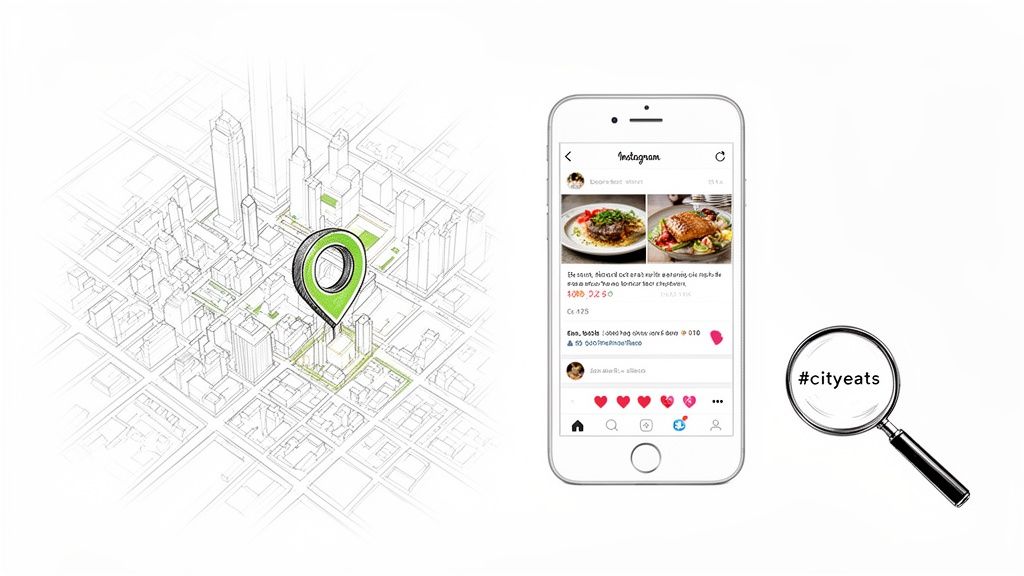
Your search should start where your customers are already looking for their next meal: Instagram and TikTok. But don't just scroll endlessly. You need a smart, targeted approach to find the creators who are already shaping the food scene in your city.
Here’s my go-to scouting toolkit:
- Hashtag Hunting: You need to dig deeper than the obvious tags. Get specific with location-based hashtags your ideal customer is already using, like #liverpoolfood, #manchesterbrunch, or #glasgoweats.
- Location Tag Spying: Check out the posts tagged at popular restaurants in your neighbourhood, especially ones with a similar vibe to yours. Who’s posting about them? This gives you a direct line to active local foodies.
- Competitor Recon: See which influencers your competitors are working with. It's a great way to build a list of potential partners and get a feel for the going rates in your area.
For a much deeper dive, our guide on how to find local food influencers in your city has even more advanced techniques. The goal here is to build a hand-picked team of genuinely passionate advocates, not just a random list of accounts.
Vetting Your Potential Partners
Once you've got a longlist of names, it’s time for some due diligence. You have to confirm their audience is actually local and that their engagement isn't just smoke and mirrors. Look for signs of a real community: thoughtful comments, genuine conversations, and not just a sea of fire emojis from bot accounts.
A key trend for UK restaurant openings is the shift to local micro-influencers, who often outperform macros in driving actual visits. Recent data shows that 72% of UK diners research eateries on social media before visiting, with 58% trying a spot after seeing it on TikTok. This timeline-based approach positions influencer marketing as the go-to strategy for packing new UK restaurants. You can find more data on the power of local influencers for restaurants on getsauce.com.
Crafting an Outreach Message That Works
Your first message is everything. Creators are bombarded with generic, copy-pasted templates, and they can spot them a mile off. If you want a response, you have to stand out.
Make sure every message you send is:
- Personalised: Mention something specific you loved about their content. Prove you’ve actually done your homework and aren’t just spamming.
- Clear and Concise: Get straight to the point. Introduce your new restaurant and what you’re offering (e.g., a complimentary tasting menu for them and a guest).
- Genuinely Exciting: Explain why you think they’re the perfect fit for your brand and what makes your restaurant a must-visit. Share your passion!
This personal approach shows you respect their craft and massively boosts your chance of getting a 'yes'. It’s the first step in building the kind of authentic partnerships that will make your launch a roaring success.
Weeks 3 to 2: Briefing Creators and Finalising Details
You’ve found your crew of local food influencers. Great stuff. Now, the real work begins. Your focus needs to shift from finding creators to empowering them to tell your story brilliantly.
This is where a well-thought-out creative brief comes in. Honestly, it's the most crucial document you'll create during this phase. It acts as the bridge between your restaurant's vision and the authentic, compelling content they'll produce. Think of it not as a script, but as a source of inspiration that gives them direction without stifling their unique voice. Get this wrong, and you risk a wave of bland, generic posts that just don't hit the mark.
Crafting the Perfect Creative Brief
Your brief should be concise, visually appealing, and packed with only the essential details. You want it to feel like a friendly guide, not a list of rigid demands.
Here’s what I always make sure to include:
- Your Restaurant's Story: What's the soul of your restaurant? Are you a family-run Italian spot bringing generations-old recipes to the neighbourhood, or a modern, plant-based kitchen with a mission for sustainability? Share that passion.
- The Vibe and Atmosphere: Give them a few keywords to capture the feeling you're going for. Is the space "cosy and romantic," "energetic and social," or "casual and family-friendly"? Paint a picture for them.
- Key Dishes to Feature: Gently guide them towards your most photogenic or signature dishes. Mentioning your "flame-grilled ribeye with truffle mash" is far more helpful than just saying "any main course." Be specific.
- Must-Have Campaign Elements: Lay out the absolute non-negotiables clearly. This means specifying your official Instagram handle for tagging, the campaign hashtag (like #OakwoodGrillOpening), and of course, the grand opening date.
This level of detail is especially important in the UK, where influencers have become a go-to source for diners. With 84% of Gen Z and 67% of millennials following creators for recommendations, your brief is what helps turn their content into actual footfall, especially since 69% of this audience trusts those recommendations. You can find more on this in the latest insights about how UK food brands are investing in influencers on cmotech.uk.
Finalising Logistics and Value Exchange
With the briefs out, it's time to nail down the logistics. Getting this right prevents any last-minute chaos and makes the entire experience smooth and professional for everyone involved. As you plan the content, you might also consider tools like Remotion Claude for Marketers to help streamline video editing and get a more polished final cut.
Here are the practical details to sort out now:
- Scheduling Visits: Propose a few date and time options for their "sneak peek" tasting. This could be a dedicated event just for influencers or individual bookings during your soft-opening period.
- Confirming the "Plus One": Most food creators bring a guest. This isn't just for company; it helps them create more natural-looking content. Confirm this with them upfront.
- Handling Dietary Needs: When you confirm their attendance, always ask about any allergies or dietary restrictions. It’s a simple, professional touch that shows you care and ensures they have an amazing experience they'll want to share.
Finally, be crystal clear about the value exchange. State exactly what is being offered, whether it's a complimentary three-course meal for two, a set tasting menu, or a hybrid model that includes a fee. This transparency builds trust and sets professional expectations from the start.
Week 1 to Launch Day: Executing the Go-Live Plan
Alright, this is it. The final stretch. All that planning and outreach now shifts into pure execution mode. This is where your strategy comes to life, and you start building that crucial pre-launch buzz that can make or break an opening.
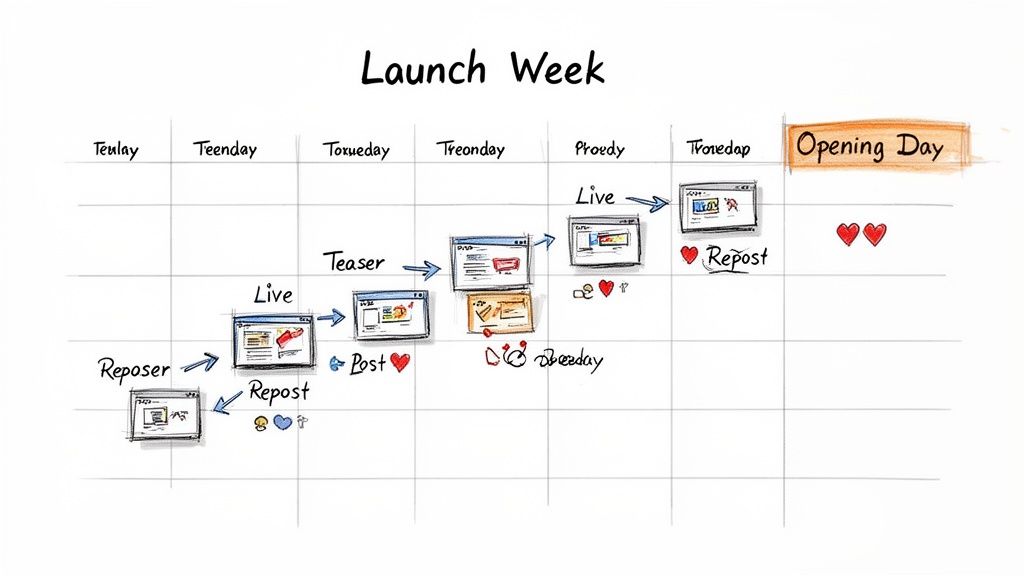
The secret isn't getting everyone to post at the exact same time. That just creates a flash in the pan. Instead, you want to orchestrate a staggered schedule, a slow burn that builds into a grand finale. Think of it as creating a wave of anticipation that makes your restaurant the only place people are talking about.
Coordinating the Launch Sequence
Your main job this week is communication. You're the conductor, and your influencers are the orchestra. It’s time to send out those final friendly reminders, double-checking everyone’s visit times and confirming they have everything they need from the brief.
A simple staggered schedule that I’ve seen work wonders looks something like this:
- 7-4 Days Before Opening: A select few creators start dropping "coming soon" teasers. This isn't the big reveal; it’s a quick Reel showing a sneak peek of the décor or a close-up of the menu design. The goal is to plant the seed of curiosity.
- 1-2 Days Before Opening: The next wave of influencers posts content from their preview visits. Now we see the food, the cocktails, the atmosphere. These posts build genuine desire and a sense of "I need to go there."
- Opening Day: Your final group of creators goes live, hitting social media feeds right as your doors open. This creates a massive surge of social proof and FOMO, driving immediate footfall.
This approach builds a narrative and keeps your restaurant top-of-mind for a full week, not just one day. We dive much deeper into timing strategies in our complete guide to running a restaurant grand opening with influencers.
Managing Real-Time Engagement
On launch day itself, your role flips from planner to community manager. You or your social media lead needs to be on your phone, ready to engage with every single piece of content as it appears. This is not a passive task. It's how you pour petrol on the fire.
Your active engagement does two things. First, it shows your audience that you’re present and excited. Second, it demonstrates to your creator partners that you value their work, which is essential for building long-term relationships.
Here’s your checklist for launch week engagement:
- Share and Repost: The second an influencer post goes up, share it to your restaurant’s Instagram Stories. No delays.
- Engage with Comments: Don’t just stay on your own page. Jump into the comments on the influencer’s post to thank them and answer questions from their followers. It shows you're part of the conversation.
- Celebrate Your Partners: Give each creator a public shout-out on your feed or Stories, thanking them for their amazing content and for being part of the launch.
When you actively participate like this, you tie all the individual posts together into one powerful, unified campaign. It tells everyone (from potential customers to the influencers themselves) that you're all-in and ready to welcome them.
Alright, the launch week whirlwind is over. The doors are open, the first wave of customers has come and gone, and the initial buzz is starting to settle. Now for the most important part: figuring out what actually worked and making that content work harder for you.
This is where all that groundwork with tracking pays off. It’s time to move past the vanity metrics and get into the data that shows who really drove business for your new opening.
Analysing What Actually Moved the Needle
Let's get straight to it. Your job now is to connect the dots between the influencer content and the cold, hard results in your till. Open up your booking system, your POS data, and your Google Analytics. We're looking for clear lines between a creator's post and a customer's visit.
Focus on the metrics that translate directly to revenue:
- Promo Code Redemptions: How many people actually used 'CHLOE15' at checkout? This is your clearest indicator of ROI, tying a specific creator directly to sales. No ambiguity here.
- UTM Link Performance: In Google Analytics, filter by your utm_content tags. Did 'chloe-story' outperform 'james-reel'? This tells you not just who, but which format sparked the most interest and drove traffic to your booking page.
- Engagement That Matters: Likes are nice, but shares and saves are golden. A high number of saves is a massive buying signal. It means people are bookmarking your restaurant for a future visit. Don't overlook it.
This analysis is your blueprint for the next campaign. You’ll quickly identify which influencers don't just create pretty pictures, but genuinely put bums on seats. For a much deeper dive, our full guide on measuring influencer marketing ROI will show you how to get forensic with your data.
Turning Great Content Into Long-Term Assets
Beyond the immediate sales data, you’re now sitting on a fantastic library of user-generated content (UGC). This isn't just a collection of nice photos; it's a powerful portfolio of social proof. You have authentic, vibrant shots of real people enjoying your venue, your food, and your atmosphere.
Don't just let that brilliant content die on the influencer's feed. Repurposing it across your own marketing channels is the single best way to extend the life and value of your campaign.
Make sure you've got those usage rights sorted (as you should have in your contract!), and then put that content to work. It’s far more believable than any staged photoshoot you could commission.
Feature the best shots on your website's homepage. Create a gallery of customer photos. Use a stunning reel in your next paid social ad. Compile a few clips for a "Spotted at [Your Restaurant]" feature in your email newsletter. This constant stream of real-life validation builds incredible trust and will keep driving growth long after the launch-week confetti has been swept away.
Common Questions About Restaurant Influencer Launches
Even with the most organised timeline, launching an influencer campaign for a new restaurant can throw a few curveballs your way. It’s completely normal for questions to pop up. Based on my experience, here are the most common ones that restaurant marketers grapple with.
The first question is always about money: "How much should we actually budget for this?" Creator fees can be all over the place. For a new opening, you'll get the best bang for your buck by focusing on nano-influencers (1,000-10,000 followers) and micro-influencers (10,000-50,000 followers).
A gifted experience (say, a complimentary meal for two) is often a great starting point for creators with smaller, but highly engaged, local followings. But once you start talking about specific deliverables like a dedicated Reel or working with influencers who have a proven track record, you're looking at paid collaborations. In the UK market, a fee can range from £150 to over £750 per post. It’s vital to be clear from the start whether the arrangement is gifted, paid, or a mix of both.
How to Handle Negative Feedback
So, what do you do if an influencer has a bad time and shares a negative review? The first step: don't panic. If the feedback is legitimate (maybe the service really was slow or a dish arrived cold), your best move is to respond publicly with grace. Thank them for their honesty, apologise for the slip-up, and offer to make it right.
This kind of transparency can build far more trust than a feed full of nothing but glowing five-star reviews. Behind the scenes, treat it as a crucial learning moment for your kitchen and front-of-house teams. Of course, if the feedback feels unfair or breaches your agreement, that's a different conversation to have with them privately and professionally.
The question of content ownership is vital. Who gets to use the photos and videos after the campaign is over? You have to be absolutely explicit about this in your initial agreement. Always negotiate usage rights so you can repurpose their fantastic content on your own social channels, your website, and even in digital ads. I'd recommend securing these rights for a set period, like six or 12 months. This is how you turn a one-off post into a marketing asset that keeps giving back.
And finally, what's a realistic return on investment? This all comes back to the goals you set in the first place. If your main goal was getting bums on seats, then track how many bookings came through their unique promo codes. If it was more about generating buzz and beautiful content, then your ROI is the library of high-quality assets you now have permission to use.
Remember, influencer marketing for new restaurant openings isn't just about the immediate sales. It’s about building credible, long-lasting social proof that will attract customers for months to come.
Ready to turn influencer marketing from a headache into your most powerful growth channel? Sup combines smart technology with a human team to help you find local creators, manage campaigns, and track every booking and sale in real-time. Ditch the spreadsheets and DMs: launch a campaign that delivers measurable ROI at https://sup.co.
More on industries
See how many creators post about you and your competitors
Type in your brand's Instagram handle and we count the creators who post about you and about your five closest competitors. It takes about a minute and it is free. Or request a demo and we will show you the creators in your niche and walk you through the dashboard.
 Book a call