17 April 2026
Influencer Marketing For Museums: Grow Your Reach
You open the dashboard, compare this month’s sales with the same period last year, and the pattern is familiar. Your exhibitions are strong. Your programming is thoughtful. Your social channels are active. But the same audiences keep coming, and the visitors you need next, younger locals, occasional tourists, and people who don’t already think of museums as part of their weekend, aren’t moving from passive awareness to booked tickets.
That’s where most museum teams get stuck with influencer marketing. They know creators can help, but they don’t want another soft campaign report full of reach, likes, and vague “buzz”. They need evidence that creator work can drive visits, memberships, and revenue.
For UK museums, that shift is already happening. Influencer marketing is no longer just a consumer brand tactic or a celebrity play. It’s becoming a practical channel for cultural institutions that need targeted local discovery, authentic storytelling, and better attribution.
Why Influencer Marketing is Reshaping Museum Outreach
Traditional museum marketing still matters. Outdoor, press, email, partnerships, and organic social all have a role. But they don’t solve the same problem.
The harder challenge is trust and relevance. A person who scrolls past your paid ad may still visit if someone they already follow shows what the museum feels like, not just what it is. That difference matters because creators translate the visit into lived experience. They make the gallery less formal, the exhibition less intimidating, and the decision to go feel immediate.
UK museums have increasingly adopted influencer marketing to boost visitor numbers, and that trend was underscored by the 2025 unveiling of the blooloop 50 Museum Influencer List. The same source notes that creators on Instagram and TikTok are key to reaching younger demographics, with over 50% of Gen Z and Millennials considering influencer recommendations for visits.
What museums often get wrong
Many teams still frame Influencer Marketing for Museums as a brand awareness experiment. That usually leads to weak creator selection, fuzzy briefs, and no proper tracking. Then the campaign “performs” on social but doesn’t show up in ticketing.
The deeper issue is that museums often borrow a consumer playbook without adjusting it for local cultural behaviour. A museum doesn’t need broad national visibility for every campaign. It often needs local intent. It needs someone who can persuade a nearby audience to come this weekend, book a late opening, bring a friend, or finally visit the exhibition they’ve been meaning to see.
Museums don’t need the loudest voice. They need the most believable local one.
Why local creators fit the museum brief
Museums sell more than admission. They sell context, atmosphere, and confidence. A local creator can show the café, the route from the station, the family experience, the quiet corners, the exhibition highlights, and the reason to visit now.
That’s why creator marketing works especially well for museums when it’s treated as community media rather than celebrity endorsement. The strongest partners are often the ones already documenting city life, family activities, architecture, heritage, books, food, design, or weekend ideas. Their audiences don’t just consume content. They act on it.
This isn’t about replacing curatorial voice. It’s about extending it through trusted intermediaries who know how to make a museum visit feel socially legible to people who haven’t yet built the habit.
Build Your Campaign Foundation for Measurable Success
A campaign usually fails long before the first post goes live. It fails when the team starts with “let’s find some influencers” instead of deciding what result the campaign must produce.
Start with a conversion goal, not a content wish list
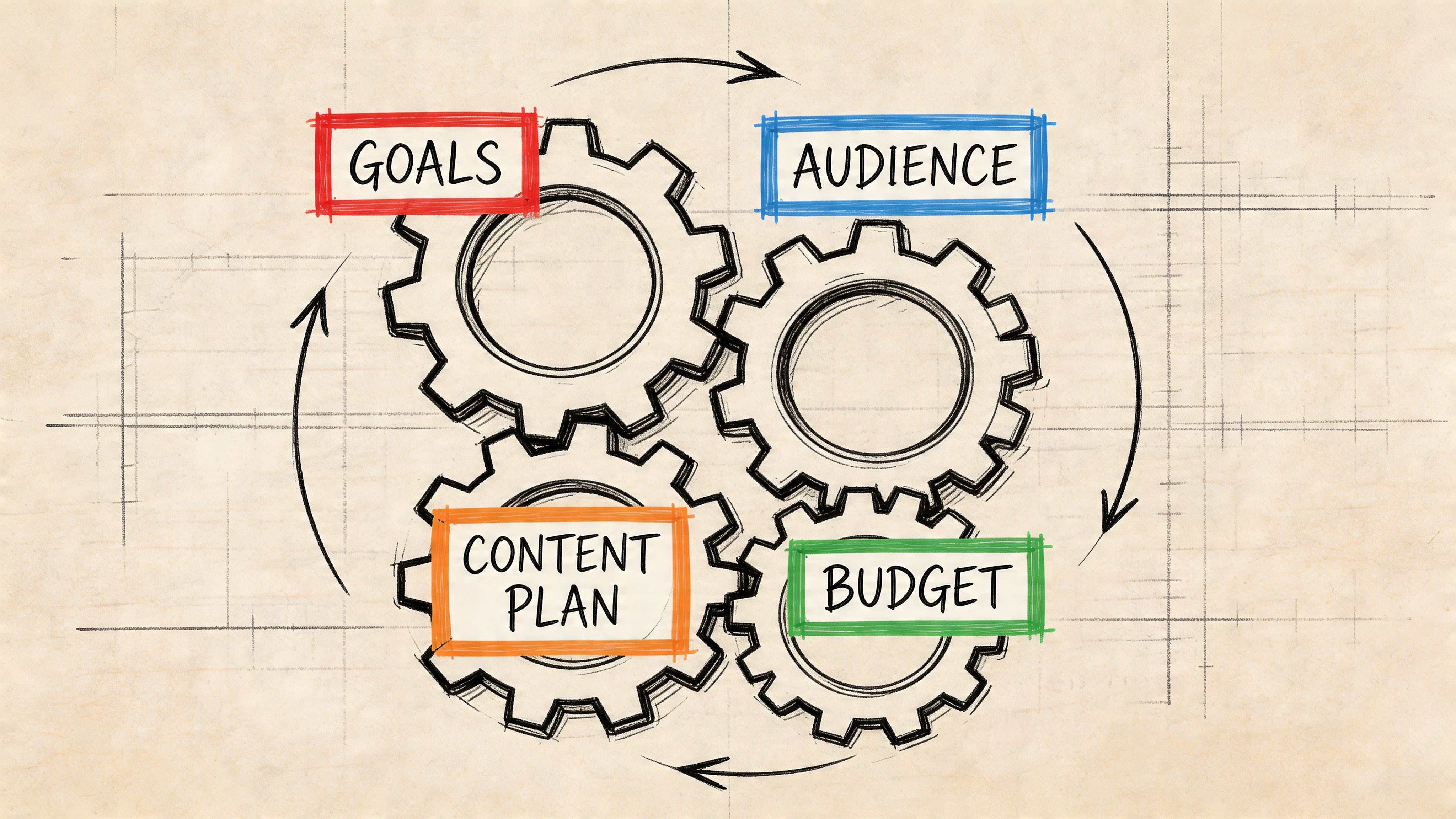
The cleanest museum campaigns are built around one commercial objective. That might be ticket sales for a temporary exhibition, attendance for a late event, family bookings during school holidays, or membership sign-ups. Once the goal is clear, every decision gets easier. Creator type, platform, brief, timing, and tracking all follow.
If you skip this step, the campaign becomes content production by committee. The result is usually polished, safe, and forgettable.
A useful planning sequence looks like this:
- Choose the business outcome. Decide whether you want ticket revenue, footfall, memberships, or another defined action.
- Identify the audience segment. Focus on who’s least likely to respond to your usual channels but most likely to convert with the right social proof.
- Set the action window. Give the campaign a clear booking or visit period so attribution is possible.
- Agree the measurement method. Before outreach, decide whether success will be tracked through codes, UTMs, ticketing data, or all three.
Budget for outcomes, not vanity
Museum teams often hesitate on creator budgets because they compare them with organic social or PR outreach, not with paid channels that have similar acquisition goals. That leads to underfunded tests, poor creator matches, and disappointing results.
The stronger view is simpler. If a creator campaign is supposed to generate measurable footfall, budget it like a performance channel with a content bonus.
According to a 2024 Museums Association UK report, step-by-step campaigns with micro-influencers achieve 25 to 40% higher footfall conversion rates than macro-influencer campaigns, and successful campaigns drive an average of £4.50 in revenue for every £1 spent in the cited museum marketing findings.
That doesn’t mean every museum should only work with micro-creators. It means your default assumption should be that relevance, locality, and audience trust usually outperform scale alone.
Planning rule: If the budget only covers one high-follower creator or several tightly matched local creators, museums usually get more useful learning and stronger attribution from the local mix.
Define audience using data you already have
Most museums already hold enough information to sharpen creator selection. You don’t need a complex data stack to begin. Use your ticketing patterns, email segmentation, Google Analytics, social insights, front-of-house feedback, and previous campaign performance.
Look for clues such as:
- Visit motive. Are people coming for family activities, design interest, local history, architecture, or a social day out?
- Travel radius. Is the campaign aimed at city residents, nearby towns, or destination visitors?
- Timing behaviour. Are audiences more likely to convert for weekends, evenings, school breaks, or member previews?
- Content triggers. Do your strongest-performing posts centre on objects, stories, behind-the-scenes access, or practical visit planning?
This work sounds basic, but it prevents the most common waste in Influencer Marketing for Museums. Teams choose creators whose aesthetic looks right, while their audience intent is wrong.
Build a content plan before outreach
A creator should never have to guess what kind of story the museum wants to tell. At the same time, the museum shouldn’t script every frame.
Your internal content plan should answer four things:
| Decision area | What to define internally |
|---|---|
| Audience | Who the campaign needs to reach and why they’re likely to visit |
| Offer | What the creator is actually inviting people to do |
| Story angle | The human hook, not just the exhibition title |
| Attribution | How visits and revenue will be traced back to each creator |
If this foundation is strong, outreach becomes selective rather than desperate. That changes campaign quality immediately.
Discover and Vet Your Ideal Local Creators
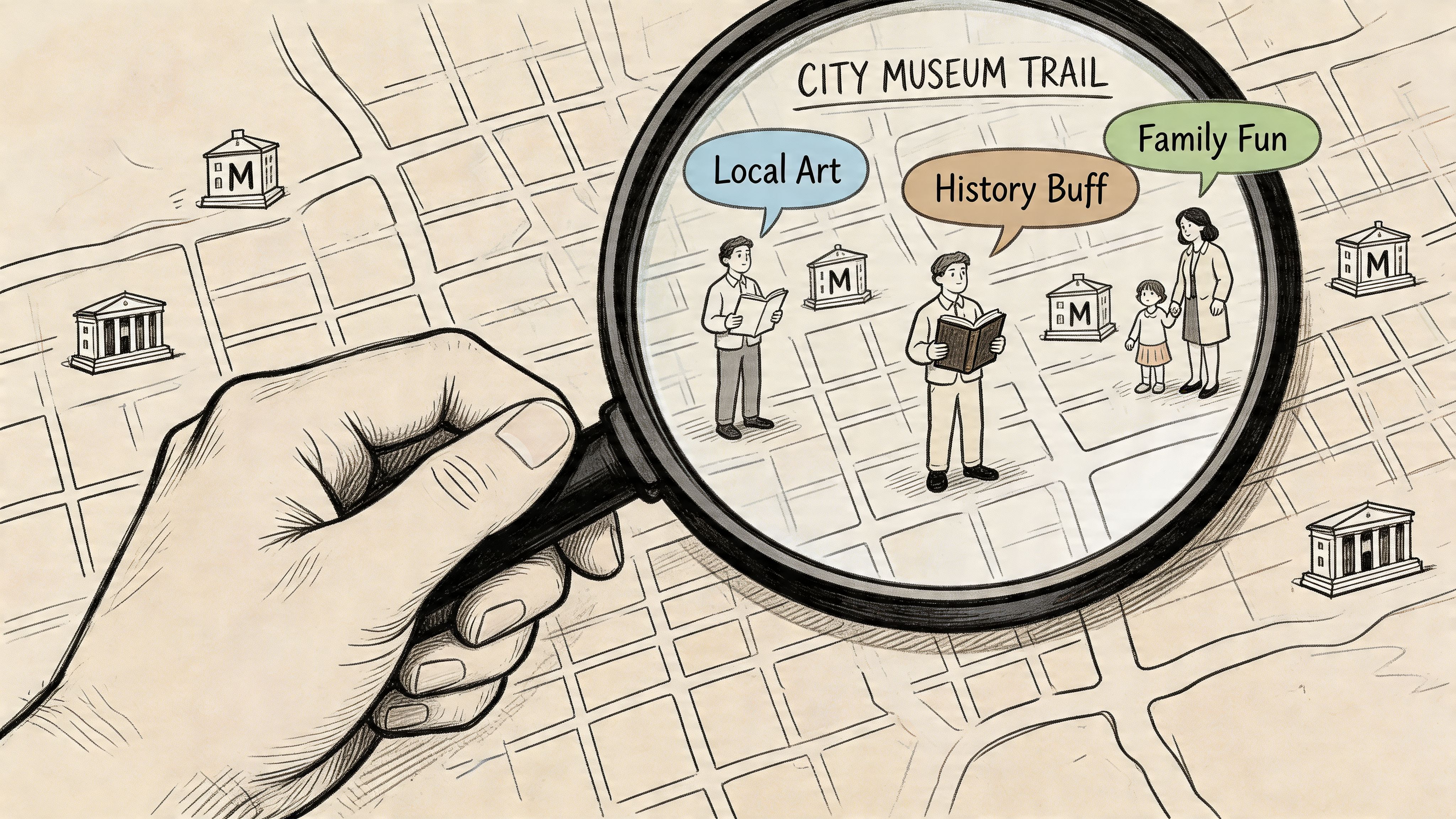
The best museum creators are often hiding in plain sight. They may not call themselves influencers at all. They might be city guides, architecture enthusiasts, family activity accounts, arts commentators, bookish locals, accessibility advocates, or food and culture reviewers who happen to have highly responsive audiences nearby.
Search where local intent is visible
Hashtags alone won’t get you far. They surface people who know how to optimise discovery, not always people who can drive visits. For museums, local intent shows up more clearly in location tags, recurring city-based content themes, comment quality, and the kinds of practical questions followers ask.
Good discovery routes include:
- Instagram location tags for your museum, nearby landmarks, cafés, train stations, and neighbourhoods.
- TikTok search for city-specific “things to do”, date ideas, family day out content, and local reviews.
- Existing mention mining across your own tagged content and visitor posts.
- Partner referrals from universities, tourism bodies, city guides, and local venues.
- Creator platforms and calculators that help sense-check audience quality. For a quick benchmark, tools like this Instagram engagement calculator can help you compare creators before you shortlist them.
The pattern in the sector is moving towards smaller, local creators. Data from a 2026 DCMS cultural marketing audit shows a 35% rise in TikTok micro-creator partnerships by UK heritage sites to drive hyper-local footfall, with geo-fenced promotions yielding 22% higher redemption rates than general campaigns in the cited audit summary.
What to check before you contact anyone
A creator can look ideal on the surface and still be wrong for a museum brief. Follower count is the easiest metric to see and the least useful on its own.
Vet with a practical checklist:
- Audience fit. Do their followers look local, culturally engaged, and likely to visit?
- Comment depth. Are people asking where places are, whether something is worth visiting, and how to book?
- Content behaviour. Do they make recommendation content that drives action, or mostly lifestyle posts that gather passive likes?
- On-camera credibility. Can they explain a place naturally, without sounding like an advert?
- Consistency. Have they posted regularly enough for their audience to trust their recommendations?
- Brand safety. Does their tone align with the institution without feeling over-polished or forced?
A museum creator doesn’t need to look like your brand team. They need to make your museum feel relevant to their audience.
A useful red flag is mismatch between visible engagement and meaningful response. If a creator has lots of reactions but very few comments that suggest intent, the audience may not act. Another warning sign is when every collaboration sounds identical. If they swap one venue name for another and keep the same script, they’re unlikely to produce content that feels grounded in your museum.
Here’s a quick visual on how creators think about social storytelling and platform-native output:
Favour category match over polished aesthetics
Some of the highest-converting museum creators don’t have immaculate feeds. They have useful feeds. Their content helps people decide where to go and what to do.
That distinction matters. A slick lifestyle account can make your institution look good. A local recommender can make people book.
Compare these creator types side by side:
| Creator type | Usually good for | Common risk |
|---|---|---|
| Local city guide | Footfall, neighbourhood relevance, weekend visits | Can over-index on novelty rather than depth |
| Family activity account | School holiday traffic, practical visit planning | Needs clear guidance on filming around children |
| Arts and design commentator | Exhibition credibility, thoughtful storytelling | May be better for awareness than immediate bookings |
| Broad lifestyle creator | High reach and visual polish | Audience may be too dispersed to convert locally |
Build a living shortlist
Don’t build a one-off spreadsheet and abandon it after the campaign. Build a rolling local creator bank.
For each creator, store:
- primary platform
- city or catchment area
- likely audience segment
- past collaboration style
- notes on comment quality
- whether they’re best for awareness, conversion, or UGC generation
That approach makes repeat campaigns faster and helps you spot emerging creators before everyone else does.
Craft Outreach and Creative Briefs That Inspire
Most museum outreach fails because it sounds like procurement. It reads as if the institution wants a deliverable, not a collaboration. Creators can tell in one message whether the team values their perspective or just wants access to their audience.
The bad message and the better one
The bad version usually sounds like this in spirit: “Hi, we love your content. We’re launching an exhibition. Please share one Reel, three Stories, and one TikTok. Let us know your rate.”
Nothing in that note explains why the creator was chosen. Nothing suggests the museum understands their audience. It also jumps straight to outputs before establishing fit.
A stronger message is shorter and more specific. It references an actual post, explains the visitor group the museum is trying to reach, and gives the creator room to respond with ideas. Something like this works far better in practice:
We liked how you covered local weekend activities in a way that felt useful rather than promotional. We’re opening a new exhibition that we think would suit your audience, especially people looking for a city-based cultural day out. If it’s of interest, we’d love to explore a paid collaboration and hear how you’d approach it in your own style.
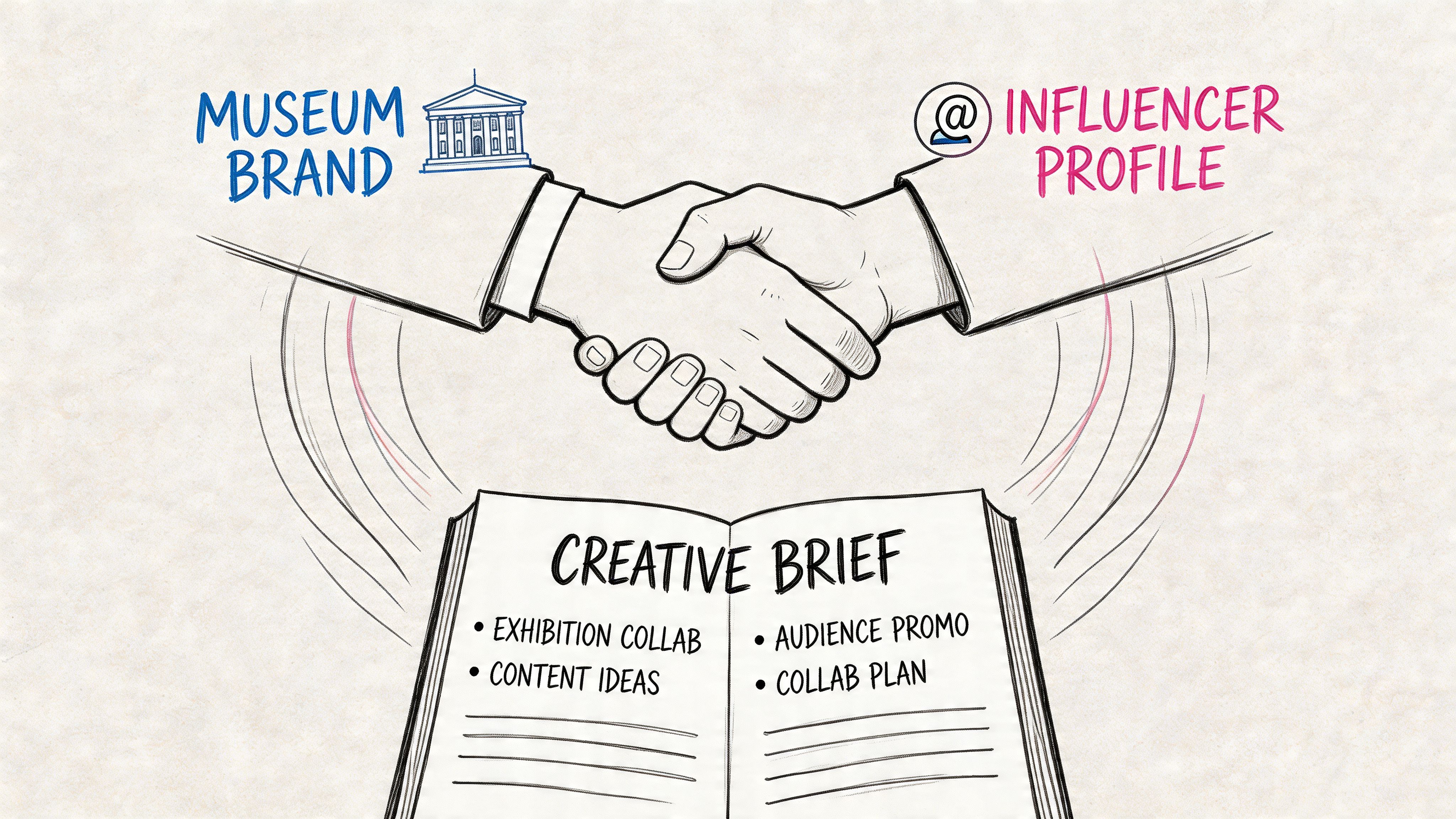
That one change shifts the relationship. The creator is no longer being handed a task list. They’re being invited into a brief.
What a useful brief actually includes
Museums often make one of two mistakes with briefs. They either send almost nothing and hope for the best, or they send a document so prescriptive that the creator can’t sound like themselves.
Your brief should be a guardrail, not a cage.
A workable museum brief should cover:
- The campaign objective. Ticket sales, membership interest, event attendance, or local awareness.
- The audience. Not everyone. The specific segment you want this creator to move.
- The core story. Why now, why this exhibition, and why this museum matters to that audience.
- Mandatory practical details. Dates, access times, booking links, disclosures, filming restrictions, and any object-handling or gallery rules.
- Deliverables and timings. What content is required and when it needs to go live.
- Usage rights. Whether the museum can repost organically, use paid amplification, place content on its website, or include it in printed materials.
- Attribution setup. Which UTM links, codes, or landing pages belong to that creator.
- Points of contact. One named museum contact who can solve issues quickly.
Leave room for the creator’s craft
The highest-performing museum content rarely reads like approved copy. It feels observed. A creator notices the queue, the light in a gallery, the café order, the child who loved one display, the surprising object in the final room. Those details are what make people trust the recommendation.
This is also where practical production support matters. If a creator works on TikTok or Reels, they may want flexibility on shot length, captions, hooks, and edit style. If your team needs help understanding platform-native formats, a resource like these best TikTok editing apps is useful because it shows the kinds of tools creators use to make short-form video feel native rather than repurposed.
A brief review process that doesn’t kill performance
Approval can easily become the slowest and most damaging part of the campaign. Long review chains flatten the content. Legal rewrites the caption. Curatorial adds dense interpretation. Marketing asks for the logo. The creator’s voice disappears.
A better review process keeps the museum’s core principles tight:
| Keep under review | Leave to the creator |
|---|---|
| Accuracy of key exhibition details | Hook, pacing, and opening lines |
| Access, safety, and filming rules | Tone of voice |
| Disclosure and rights language | Shot selection and edit rhythm |
| Ticketing or event information | Personal reactions and narrative framing |
If your team can’t trust a creator with any freedom, they’re the wrong creator. If the creator can’t work within basic institutional guardrails, they’re also the wrong creator.
Launch and Manage Different Campaign Types
Once briefs are approved, campaign management becomes operational. At this stage, strong plans survive contact with reality. Access issues appear. Timings shift. Galleries are busier than expected. A creator misses a slot. A rights question comes up after the post is live.
The easiest way to stay in control is to choose campaign types deliberately rather than improvising around whatever creators suggest.
Preview visits versus public event coverage
A creator preview works well when the exhibition is visually strong, the route is clear, and you want clean storytelling before the public rush starts. It gives creators space to film, ask questions, and notice details. It also produces better UGC because they’re not competing with crowds.
The trade-off is that preview content can feel staged if every creator captures the same moments. Give each person a different angle. One focuses on objects. Another covers the visitor experience. Another explains who the exhibition is for.
Public event coverage is stronger when atmosphere is the sell. Late openings, live programmes, talks, and seasonal events benefit from social proof in the moment. The downside is operational unpredictability. Noise, crowd density, and limited filming positions all affect output.
Membership and repeat-visit campaigns
Museums often overlook creators for membership because they assume memberships need a more rational sell. In practice, creators can be effective here if the value is experiential. Priority booking, repeat access, café routines, member previews, and a sense of belonging are easier to communicate through lived content than through static brochure copy.
These campaigns need more briefing discipline. The creator has to explain why someone would return, not just why they should visit once.
The strongest museum creator campaigns don’t just say “come here”. They answer “why now”, “why this”, and “why again”.
Behind-the-scenes content and specialist storytelling
Conservation work, install periods, archive access, object handling, and curator conversations can produce excellent content when you want depth instead of broad appeal. This format is particularly useful for institutions with strong specialist collections or audiences that value expertise.
The risk is overestimating public interest in process. If the content becomes too internal, it can lose casual visitors. Pair specialist access with a clear visitor takeaway. Why should someone care enough to book?
The permissions and rights checklist
Museum teams usually think about rights too late. By then the content exists, the creator has posted, and someone in paid social asks whether the clip can be reused in ads.
Cover these points before launch:
- Creator contract. Payment terms, deliverables, review expectations, disclosure, cancellation, and usage rights.
- Filming permissions. Which galleries, exhibitions, or objects can be filmed, and under what conditions.
- Visitor privacy. What happens if members of the public appear recognisably in footage.
- Talent releases. Whether staff, speakers, or invited guests need written permission.
- UGC usage scope. Organic reposting only, or broader use across web, paid media, email, and print.
- Archive terms. How long the museum may keep and use the content.
Keep campaign operations centralised
One contact should own schedules, creator access, links, codes, rights, and approvals. Split ownership creates friction fast.
Operationally, a shared campaign sheet should include:
- creator arrival details
- filming windows
- live dates
- links and code assignments
- content status
- invoice and usage status
The practical work isn’t glamorous, but this is what protects campaign performance. Good creators notice when a museum is organised. It affects how willing they are to work with you again.
Measure True ROI From Views to Ticket Sales
Influencer Marketing for Museums either becomes a repeatable growth channel or remains an interesting side project.
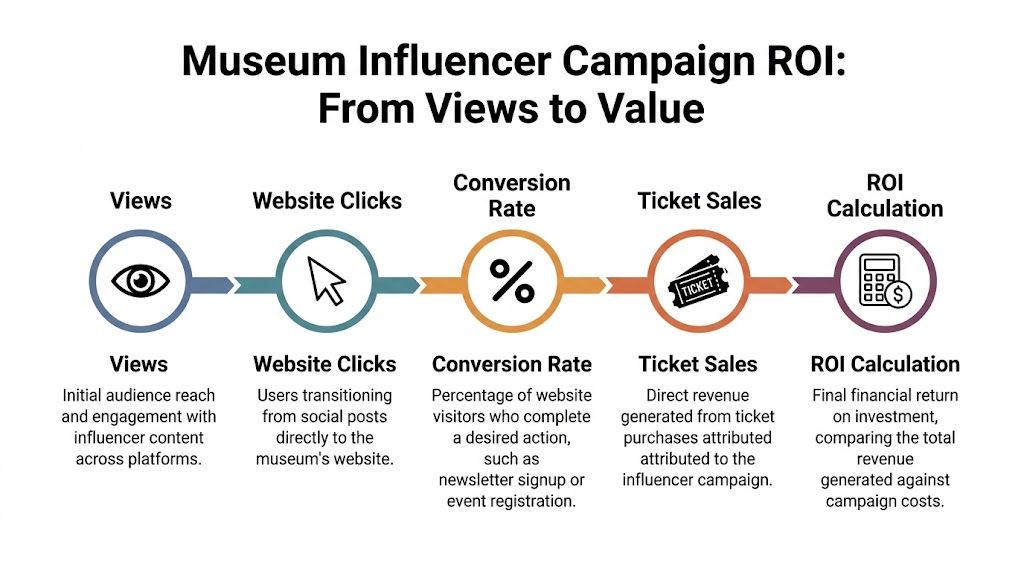
A creator campaign can generate beautiful content and strong engagement while still underperforming commercially. That’s why museums need to stop treating views as the finish line. Views are the first signal. The essential task is connecting exposure to click, click to booking, and booking to revenue.
Build attribution before content goes live
Attribution doesn’t start in reporting. It starts in setup.
A technical ROI framework benchmarked by Arts Council England in 2025 shows a return of £3.20 to £6.80 per £1 invested in museum influencer campaigns, achieved by embedding UTM parameters and promo codes to track views, clicks, 18% CTR, and 8 to 15% code usage in the Arts Council benchmarked framework.
That’s the model to follow. Every creator should have a unique way to be credited for traffic and conversions.
Use UTMs properly
A UTM link is a tagged URL that tells your analytics where the visitor came from. For museums, each creator should receive their own destination link to the relevant page. That might be a ticket page, event landing page, membership page, or exhibition overview.
A clean naming convention matters. Keep it readable and consistent:
- source = creator name
- medium = influencer
- campaign = exhibition or event name
Don’t let different team members invent their own naming style. If one creator is tagged “tiktok”, another “TikTok”, and a third “social_creator”, your reporting becomes messy fast.
Pair links with unique promo codes
UTMs tell you who clicked. Promo codes tell you who converted, especially when someone doesn’t book immediately or lands on the page another way later.
For museum campaigns, codes work best when they are:
- easy to remember
- unique to each creator
- tied to a real action in the ticketing system
- valid within a clear campaign window
Codes also help when front-of-house or commercial teams want a simpler view of creator performance. It’s easier to discuss redeemed codes than abstract social analytics.
Measurement rule: If a campaign has no unique links and no creator-level codes, you’re not measuring ROI. You’re estimating it.
Track the full path, not one metric
A good reporting dashboard doesn’t need to be complex. It does need to show the chain from content to value.
Use a simple table like this:
Sample KPIs for Museum Influencer Campaigns
| KPI | What it Measures | How to Track It |
|---|---|---|
| Views | How many times creator content was seen | Platform reporting from Instagram or TikTok |
| Clicks | Traffic driven from content to museum pages | UTM-tagged links in analytics |
| Conversion rate | Share of visitors who completed the desired action | Ticketing or web analytics tied to landing pages |
| Ticket sales | Attributed bookings and revenue | Promo codes and ticketing platform records |
| ROI | Return compared with campaign spend | Revenue minus costs, tracked in a central reporting sheet |
This is also where teams benefit from broader performance thinking. If you want a useful primer on the mechanics behind attribution, assisted conversion, and reporting discipline, this guide on how to measure social media ROI gives a sensible framework that maps well to museum campaigns.
For a creator-specific measurement lens, this breakdown of influencer marketing ROI and what actually works is also useful when you need to pressure-test whether a campaign should be judged on traffic, redemptions, or revenue.
Read the data like an operator
The most common reporting mistake is stopping at the first positive metric. A creator has high views, so the team calls the campaign a success. But high views with weak clicks tells you the content entertained people without driving intent. Strong clicks with weak bookings suggests a landing page, ticket flow, or offer problem. Moderate views with excellent code usage usually signals a highly qualified local audience.
That distinction matters more than headline reach.
Look for patterns such as:
- creators with lower scale but stronger booking intent
- content angles that produce clicks but not visits
- ticket pages with unnecessary friction
- event types that convert better from creator content than from standard paid social
- creators whose UGC performs well after reposting on owned channels
Don’t isolate creator data from museum data
Creator reporting should sit next to your wider museum performance. Compare it against:
- paid social traffic
- email-driven conversions
- organic social referral
- event attendance by date
- postcode or region patterns where available
That’s how you decide whether a creator campaign deserves more budget, a different audience focus, or a different campaign type.
The true win isn’t proving that one influencer post “worked”. It’s building a measurement model your team can repeat without starting from zero every time.
Beyond the Campaign Turning Content into a Lasting Asset
The campaign shouldn’t end when the final post goes live. That’s when the second layer of value starts.
A 2024 UK Arts Council report notes that only 15% of cultural institutions track influencer ROI beyond engagement metrics, which creates a clear advantage for museums that adopt stronger attribution and content reuse through the Museums Next discussion of influencer potential.
Reuse what already proved it could hold attention
The strongest creator assets usually have a longer shelf life than the original posting window. A short TikTok can become website content for an exhibition page. A Story sequence can inform email creative. A Reel hook can be adapted for paid social. A useful visitor-perspective clip can support school holiday promotion later in the year.
What matters is organising the content properly. Tag assets by creator, campaign, rights status, audience type, and performance notes. If your team wants a practical model for doing that, a structured creator content library for your brand is the right direction.
Turn good creators into repeat partners
Museums get better returns when they stop treating every campaign as a fresh search. If a creator has already shown they can bring the right audience through the door, keep the relationship warm. Invite them back for a new exhibition, a member event, or a seasonal activation. The content becomes more credible as their familiarity with the institution grows.
Long-term creator relationships also improve briefing speed, reduce approval friction, and give the museum a reliable bank of trusted local advocates.
The practical lesson is simple. Don’t build influencer campaigns for applause. Build them for attributable visits, reusable content, and repeatable local growth.
If your team wants a faster way to find local creators, launch tracked campaigns, and tie content back to real bookings and revenue, Sup helps you do that without managing the whole process in spreadsheets and DMs.
More on industries
See how many creators post about you and your competitors
Type in your brand's Instagram handle and we count the creators who post about you and about your five closest competitors. It takes about a minute and it is free. Or request a demo and we will show you the creators in your niche and walk you through the dashboard.
 Book a call