13 March 2026
A Guide to Influencer Marketing for Fashion and Apparel Brands
Forget the glossy magazine ads and celebrity billboards of yesterday. Modern influencer marketing for fashion and apparel brands isn’t happening in a studio; it’s unfolding in the social media feeds of real people, where creators turn everyday style into measurable sales and build genuine brand loyalty. This isn’t about aspirational advertising anymore. It’s about achievable inspiration.
Why Relatability Now Sells More Than Runways
The old fashion marketing rulebook is officially out of date. High-fashion magazines used to be the sole arbiters of style, but influence now bubbles up from the ground, not down from the top. Today's shoppers, especially younger ones, want to see more than just clothes on a runway. They want to know how that pair of jeans, dress, or jacket actually looks and fits on a person they can relate to, in a real-life setting.
This is where the real work of influencer marketing begins. It’s a strategic pivot away from polished, impersonal ads and towards building authentic connections. A "get ready with me" video or an honest try-on haul from a trusted creator resonates far more deeply because it feels less like an advertisement and more like a recommendation from a friend.
Authenticity Is Your New Competitive Edge
The most successful fashion brands have caught on to this. They understand that authenticity is the real currency in today's market. Instead of pouring their budgets into one-off campaigns with mega-stars, they’re building long-term partnerships with micro and nano-influencers. These creators may have smaller followings, but their communities are often hyper-engaged and hang on their every word.
The power of a micro-influencer isn't in their follower count; it’s in the trust they’ve painstakingly built. When they recommend a product, their audience listens because the endorsement feels earned and genuine, not simply transactional.
Working with these creators allows your brand to achieve what larger-scale advertising just can't:
- Generate an endless stream of authentic content: Get a constant flow of user-generated content (UGC) that showcases your products being worn by different people in diverse, real-world situations.
- Reach highly specific niche audiences: Directly connect with passionate style communities, whether they’re into vintage fashion, sustainable clothing, or streetwear.
- Drive results you can actually measure: Use unique promo codes and tracking links to attribute sales directly back to specific creators, giving you a crystal-clear view of your ROI.
The Numbers Don't Lie
This isn't just a hunch; it's a strategic shift backed by some serious money. In the UK alone, direct ad spend on influencer marketing is on track to jump from £930 million in 2024 to a projected £1.3 billion by 2029.
This explosive growth is a direct reaction to how people shop now. A staggering 69% of UK shoppers have bought a product after seeing a creator promote it. Fashion and apparel brands are leading this charge, realising that creator collaborations are no longer a "nice-to-have" but a critical channel for driving revenue. For a closer look at these figures, you can explore the latest UK influencer marketing statistics. It's clear proof that investing in a scalable, ongoing influencer programme is a proven path to growth.
Building Your Campaign Blueprint
A successful influencer campaign isn't born from a spontaneous DM slide. It all starts with a solid plan. Before you even begin shortlisting creators, your first job is to get crystal clear on what you actually want to achieve. Forget vague goals like "boosting brand awareness". That’s not a strategy. You need to focus on tangible results that will move the needle for your business.
Are you trying to sell out a new limited-edition drop? Maybe you're desperate for a bank of authentic user-generated content (UGC) to liven up your social feeds and ad creative. Or perhaps the goal is to get your brand in front of a whole new crowd, like university students in Manchester or sustainable fashion advocates in London. Each of these goals demands a completely different playbook.
Think of your campaign goals as the destination you plug into your sat nav. Without a clear endpoint, you're just driving aimlessly, burning through fuel and budget. Getting specific is what turns a hopeful idea into a plan you can actually measure.
Matching Your Goals with the Right Creators
Once your objectives are nailed down, you can start thinking about who to partner with. It's not about chasing the biggest follower counts; it's about matching the right type of creator to the job at hand.
This simple diagram shows how the game has changed. Fashion marketing has moved away from just shouting with ads and now relies on creators to build a bridge to actual sales.
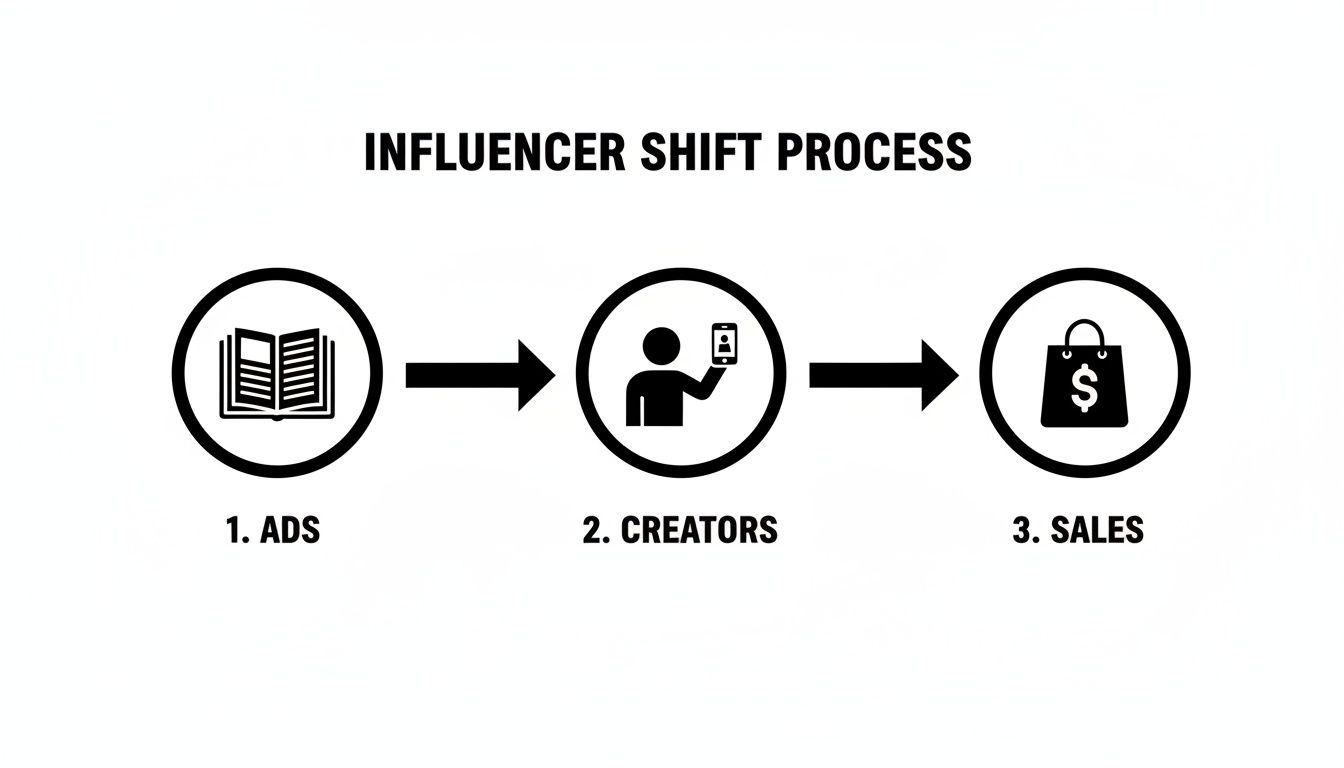
The takeaway here is that creators aren’t just billboards. They translate what your brand is about into content that feels genuine and gets people to actually pull out their wallets.
Here’s a quick way to think about which creators to use for your fashion brand:
- Nano-Influencers (1k to 10k followers): These are your on-the-ground advocates. They're perfect for creating a local buzz for a new shop opening or for seeding products to get that initial, super-authentic UGC. Their communities are small but mighty, and their word carries a lot of trust.
- Micro-Influencers (10k to 100k followers): This is often the sweet spot for driving real e-commerce traffic and sales. Micro-influencers have carved out a specific niche (think '90s streetwear or minimalist capsule wardrobes) and their followers hang on their every word. This leads to fantastic conversion rates.
- Macro-Influencers & Beyond (100k+ followers): Bring in the big guns for major announcements. Think a huge new collection launch, a landmark brand partnership, or a massive seasonal sale. Their power is in making a big splash and getting your brand in front of tons of people, fast.
Pinpointing Your Audience and Setting the Budget
Just matching a creator’s follower count to your goal isn’t enough. The absolute key to successful influencer marketing for fashion and apparel brands is making sure their audience is your audience. You have to look past the vanity metrics and really dig into their audience demographics. Check out the engagement: are people having real conversations in the comments, or is it just a sea of fire emojis?
A creator with 15,000 highly engaged followers who geek out over vintage denim is infinitely more valuable to a sustainable jeans brand than one with 150,000 followers who couldn't care less.
With a picture of your ideal creator taking shape, you can now build a sensible budget. The payment model you choose will hinge on your campaign goals and the type of creator you're working with.
There are three main ways to structure this:
- Product Seeding (Gifting): This is your best bet for nano-influencers and for testing the waters with new relationships. The cost is simply your product and shipping, but remember, a post isn't guaranteed.
- Affiliate Commissions: A pure performance model that's brilliant for driving sales. Creators get a cut of every sale they generate through their unique link or promo code. It's low-risk and incredibly easy to track.
- Flat Fees: This means a fixed payment for a specific set of deliverables (e.g., one Instagram post and three Stories). It’s the standard for most micro and macro-influencers and gives you predictable costs.
From my experience, a hybrid model often works wonders. Combining a modest flat fee with a performance-based commission gives creators a reason to produce great content and an incentive to drive sales. For a deeper dive, our complete guide to influencer marketing for ecommerce has more detailed strategies on this.
Getting this blueprint right from the start ensures every pound you spend is tied directly to a clear objective and a measurable result.
Finding and Vetting the Right Fashion Creators
Once your strategy is locked in, it's time to start the search. This is where the real magic happens, or doesn't. A campaign’s success rests almost entirely on finding creators who feel like a natural extension of your brand’s DNA. Too many brands get this wrong by chasing big follower numbers instead of genuine alignment.
Think of it like casting a film. You don't just want a famous face; you need an actor who embodies the character. The right creator speaks your brand's language fluently to an audience that’s already leaning in, ready to listen. The wrong one just reads the lines, and the message falls flat.
Look Beyond the Follower Count
That big number at the top of a creator's profile? It's mostly a vanity metric. The real story is always in the engagement. To find partners who will actually move the needle for your brand, you have to dig a little deeper.
First, check their engagement rate. A million followers with only a handful of likes and comments on each post is a huge red flag. For micro-influencers, you want to see a healthy rate, typically above 2-3%. This proves their audience is paying attention, not just scrolling by.
Next, spend some time in the comments section. Is it filled with bot-like "Nice pic!" comments, or are people having real conversations? Look for followers asking about the fit of a jacket, where to buy the shoes, or tagging friends to share the look. That's the gold you're looking for.
A creator’s real value isn’t just in the content they post, but in the conversations that content sparks. A buzzing, authentic comments section is one of the clearest signs you've found a high-quality partner.
Spotting Red Flags and Ensuring Authenticity
As you start shortlisting creators, you need to keep an eye out for inauthenticity. Purchased followers and fake engagement can burn through your budget, leaving you with nothing to show for it because you were marketing to an audience that doesn't even exist.
Here are a few tell-tale signs that something's off:
- Sudden follower spikes: Use an analytics tool to check their growth history. Sharp, unnatural jumps are often a dead giveaway of bought followers.
- Generic comments: A wall of single-word comments from accounts with no profile pictures is a clear warning sign.
- Weird follower-to-following ratio: An account that follows thousands more people than follow it back might be using aggressive "follow/unfollow" tactics to inflate their numbers.
It's also useful to think about how influencers fit into your bigger marketing picture. When you're planning a new collection launch, for instance, you'll be thinking about all sorts of visual assets. Understanding the different types of models, including influencers, for photo shoots can provide valuable context and help you decide where to best allocate your creative budget.
From Manual Searches to Smart Discovery
So, how do you actually find these people? There are two routes: the old-fashioned manual grind or using a creator discovery platform.
Sifting through hashtags like #UKStreetStyle or #SustainableFashionUK on Instagram and TikTok is certainly one way to do it. It's free, but it's a monumental time sink. You’ll spend hours scrolling through profiles, and most of them just won't be the right fit.
Creator discovery platforms, on the other hand, offer a much smarter and faster way to build your shortlist. These tools let you get incredibly specific with your search. You can filter by:
- Niche & Aesthetic: Find creators whose personal style (be it vintage, Scandi-minimalist, or streetwear) perfectly mirrors your own.
- Audience Demographics: Make sure their followers are your target customers by filtering for age, location, and interests.
- Verified Metrics: Get instant access to reliable data on engagement and audience authenticity, so you can skip the detective work.
While our in-depth guide to creator marketing for beauty brands focuses on another industry, the principles for finding authentic partners are universal and apply directly to fashion.
After you've narrowed down your list of prospects, the final step is reaching out. Ditch the generic, copy-pasted templates. Your first message should feel personal. Mention a recent post of theirs you genuinely loved or explain exactly why you feel their style would be a fantastic match for your upcoming collection. Starting with a real, human connection is the first step in building a partnership that lasts.
Designing and Executing Compelling Campaigns
You’ve found your perfect creators and they’re excited to work with you. Fantastic. But a great partnership can still go sideways without a solid plan. Now it’s time to move from strategy to execution, turning your goals into content that actually gets seen and drives results.
This all starts with the creative brief. Honestly, a well-crafted brief is the single most important document in any campaign. It’s your North Star, guiding the creator while still giving them the freedom to do what they do best. It’s a delicate balance. You need to provide enough direction to hit your key messages, but not so much that you kill the creator's authentic voice. That’s why you hired them, after all.
Forget being overly prescriptive. A strong brief doesn't dictate exact poses or hand over a rigid script. Instead, focus on the why. Share your brand's story, the inspiration behind the new collection, and the feeling you want the content to evoke. This context empowers creators to produce something that feels true to both your brand and their audience.
The Power of a Balanced Creative Brief
Think of your brief as a source of inspiration, not a rulebook. It's the difference between asking a creator to "take a photo wearing our new trench coat" and inviting them to "style our classic trench for a rainy spring day in London, showing how it makes you feel chic and protected from the elements." The second prompt invites storytelling, and storytelling sells.
Here’s what your brief absolutely must include to set your campaign up for success:
- Campaign Objectives: What does a win look like? Be specific. Is it about driving clicks to a product page, generating high-quality user-generated content (UGC), or promoting a new discount code?
- Key Messages: Pinpoint 2-3 core ideas you need the creator to communicate. This could be anything from the sustainable materials you use to the unique fit or the versatility of a piece.
- Deliverables and Deadlines: Spell out the exact number of posts, formats (e.g., 1 Reel, 3 Stories), and all the key dates. Crystal-clear expectations prevent misunderstandings down the line.
- Mandatory Elements: List any required tags (@YourBrand), campaign hashtags (#YourCampaign), and specific calls to action (e.g., "Shop the link in my bio!").
The best creative briefs feel like a collaboration from the start. They set clear guardrails for the brand's needs while leaving a wide-open field for the creator's artistry to flourish. This mutual respect is the secret ingredient to content that performs.
Choosing the Right Campaign Model for Fashion
Different campaign types deliver different results. For fashion and apparel brands, where visual storytelling is paramount, choosing the right format is crucial for showcasing your products in a compelling way.
To help you decide, here’s a quick breakdown of the most common and effective campaign models we see in the fashion space.
Fashion Influencer Campaign Type Comparison
| Campaign Type | Primary Goal | Best For | Key KPIs |
|---|---|---|---|
| UGC / Product Seeding | Content Generation, Awareness | Building a library of authentic assets. Great for nano and micro-creators. | Cost per post, content volume, usage rights acquired |
| Try-On Haul | Consideration, Sales | Showcasing product fit, fabric, and range. Works well with all creator tiers. | Click-through rate (CTR), conversion rate, engagement |
| Affiliate / Promo Code | Direct Sales, ROI Tracking | Driving immediate revenue and measuring direct impact. Best with established creators. | Sales, revenue, return on ad spend (ROAS), code usage |
| Styling Challenge | Engagement, Product Versatility | Demonstrating a hero product's value. Fantastic for micro-influencers. | Engagement rate, shares, saves, audience comments |
| "Get Ready With Me" (GRWM) | Brand Integration, Authenticity | Naturally weaving a product into a creator's daily life. Ideal for all tiers. | Views, watch time, brand mentions, audience sentiment |
Ultimately, the best approach often involves a mix of these. You might use product seeding to generate a steady stream of UGC while running targeted affiliate campaigns with a few key partners to drive sales.
These formats are especially brilliant for generating valuable UGC. If you want to dive deeper, our guide on how to get UGC for ecommerce that converts is packed with more tactical advice.
Nailing the Logistics and Tracking
With the creative direction sorted, the final piece of the puzzle is logistics. This is the operational side of influencer marketing, and frankly, it’s where many brands stumble. Managing product shipments, coordinating posting schedules, and tracking results requires serious organisation.
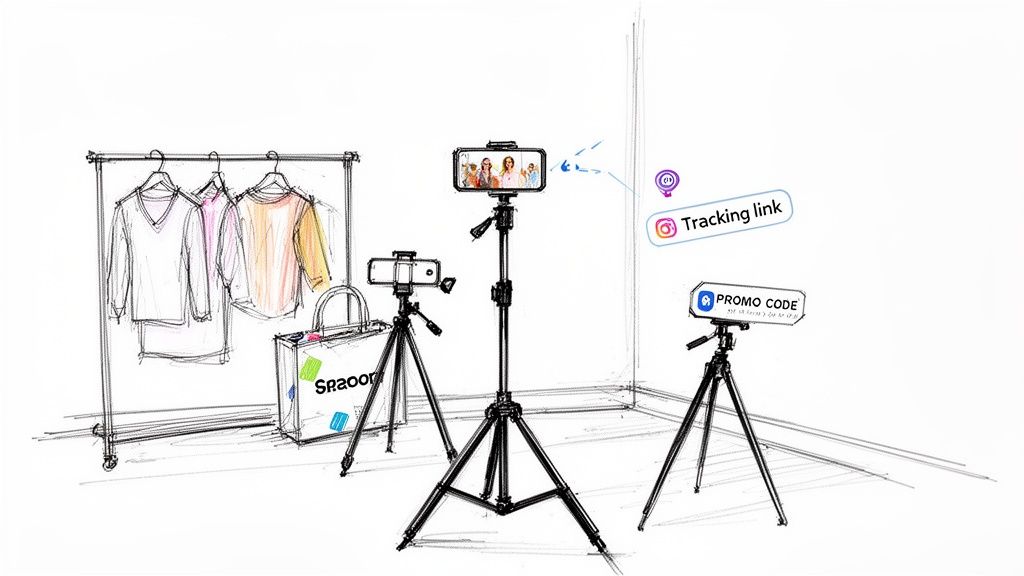
Here’s a non-negotiable first step: create unique UTM tracking links and promo codes for every single creator. This is the only way to prove your ROI. A UTM link lets you see exactly how much traffic a specific creator sends to your site through Google Analytics. A unique promo code directly attributes sales to their efforts, leaving no room for guesswork.
For brands looking to scale their content output, it's worth exploring the best AI tools for social media content creation to gain an edge. These can help streamline workflows, giving you and your creators more time to focus on what matters. By embedding attribution from the very beginning and optimising your processes, you ensure every post is a measurable step toward your business goals.
Measuring Campaign Success and Proving ROI
Alright, the content is out in the wild. The posts look great, comments are flooding in, and the likes are climbing. It’s easy to feel good about this, but let's be honest: vanity metrics are just that. They don't pay the bills.
The real question is, did it actually move the needle? For fashion and apparel brands, success is ultimately measured in sales. Proving that return on investment (ROI) is what turns a one-off campaign into a repeatable, scalable part of your marketing engine.
Without a solid tracking system, you're flying blind. You can't tell your boss what worked, you can't justify the budget for next quarter, and you certainly can't optimise your strategy. Tying every piece of content back to a commercial outcome is non-negotiable if you're serious about growth.
Getting Your KPIs Straight
To get a real sense of performance, you have to look beyond the surface. A huge brand like Ralph Lauren might track the "Media Impact Value" of a celebrity wearing their clothes at Wimbledon, but your goals are probably much more direct. You need to connect inspiring content to actual checkouts.
Let's focus on the key performance indicators (KPIs) that really paint the picture of your campaign’s success.
These are the essentials you should be watching like a hawk:
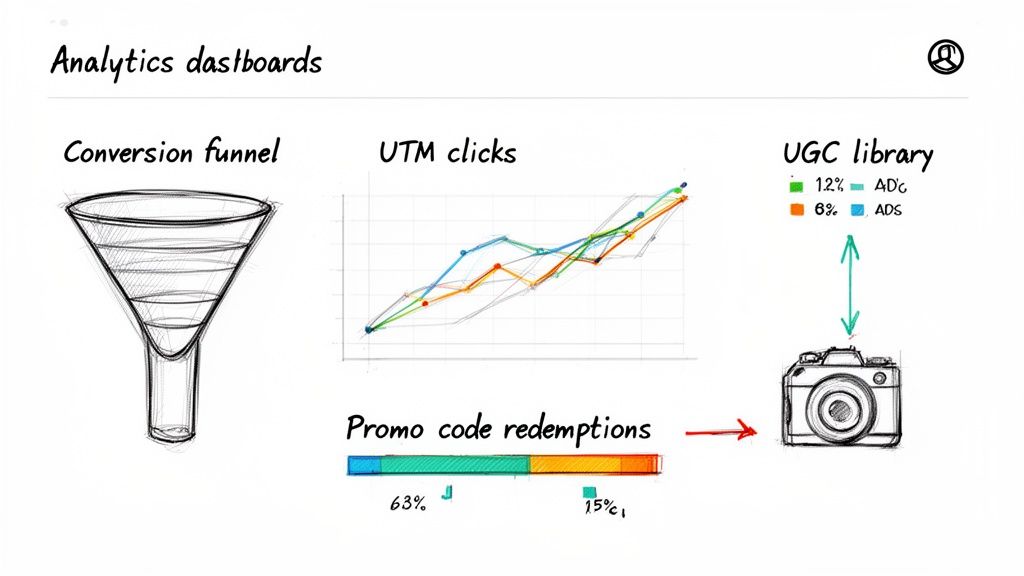
- Conversion Rate: Of all the people who clicked a creator's unique link, what percentage actually bought something? This is your acid test. It tells you if the content was genuinely persuasive.
- Click-Through Rate (CTR): How many people tapped on that specific link in the creator’s bio or story? A strong CTR means their call to action hit the mark and their audience was paying attention.
- Promo Code Redemptions: This is your cleanest, most direct line to attribution. Tracking how many times a code like SARAH15 was used gives you undeniable proof of the revenue that creator generated.
- Cost Per Acquisition (CPA): How much did it cost to win a new customer through this influencer? Simply divide your total spend on the creator (fee, product cost, etc.) by the number of new customers they brought in.
Don't get bogged down in a spreadsheet of a hundred different metrics. Your main job is to answer one question: for every pound we put into this collaboration, how many pounds did we get back in sales? That's your ROI.
Your Measurement Toolkit
You don't need an expensive, overly complicated analytics platform to do this well. The most important thing is being organised right from the start. As we’ve mentioned, giving every single creator their own UTM tracking link and unique promo code is the absolute foundation.
A UTM link is just a normal URL with a few extra bits of information tacked on the end. When a customer clicks it, those details get passed straight into your Google Analytics account, telling you:
- Source: Where the click came from (e.g., instagram).
- Medium: The channel type (e.g., influencer).
- Campaign: The name of your specific campaign (e.g., autumn-jacket-launch).
- Content: The individual creator who drove the click (e.g., sarah-styles).
This simple setup lets you build a dashboard in Google Analytics (or even just a well-organised spreadsheet) to see exactly who is driving traffic and, more importantly, who is driving sales.
Maximising the Value of Your New Content
The ROI of influencer marketing for fashion and apparel brands doesn't stop once the initial campaign is over. One of the most valuable outputs, and one that brands often forget to properly account for, is the library of amazing user-generated content (UGC) you now own. This is a goldmine.
Every try-on haul, styling Reel, and "outfit of the day" photo is a powerful asset you can repurpose across your own marketing. Why? Because it’s authentic social proof. Content from a real person often outperforms polished brand creative in paid ads because it’s simply more relatable.
Think about it. That video from a micro-influencer that got fantastic engagement can be turned into a top-performing ad on TikTok or Instagram. Those beautiful shots of your dress can be added to your product pages to show how it fits on different body types, which is proven to boost conversion rates. By reusing this content, you massively extend the value of your initial investment and give your overall ROI a serious lift.
Right, so your first influencer campaign was a hit. The sales are in, the engagement was great, and you’re feeling pretty good about it. But what now?
A single successful campaign is a great start, but the real magic happens when you turn those one-off wins into a reliable part of your marketing machine. This is where you move from running campaigns to building a proper, scalable programme.
Scaling isn’t just about throwing more money at more creators, though. It’s about being strategic. One of the best ways to grow is by nurturing the relationships you already have. Identify your top-performing micro-influencers and graduate them to long-term brand ambassadors. Give them first dibs on new collections, more creative control, and make them feel like a true extension of your brand. Their genuine, long-term advocacy builds a level of trust with an audience that you just can't buy.
Another way to scale is by expanding your footprint. If your London-based creators are smashing their targets, that’s your cue to replicate that model elsewhere. Use your campaign data to find similar creators in Manchester, Glasgow, or Bristol and test the waters. It's all about using what you've learned to make smarter bets on where to go next.
Staying on the Right Side of the Law
As your influencer programme gets bigger and more sophisticated, so does the need to keep everything above board. In the UK, the Advertising Standards Authority (ASA) is the governing body that ensures advertising is transparent and fair. Getting this wrong isn't just a slap on the wrist; it can seriously tarnish the trust you've worked so hard to build.
The fundamental rule is straightforward: if a creator has been paid or gifted anything in return for content, it’s an advertisement. This must be disclosed clearly and without ambiguity. Vague little tags like #sp or #gifted buried at the end of a caption just won't cut it anymore.
The ASA’s rules aren't there to catch you out. They exist to protect customers and maintain the integrity of the industry. For a brand, being transparent isn't just about ticking a legal box. It shows respect for your audience and becomes a cornerstone of your reputation.
To keep everyone protected (your brand, the creator, and their audience), you have to insist on crystal-clear disclosures from the very beginning.
Practical Steps for ASA Compliance
Making sure your sponsored content is properly labelled is simple when you build it into your process. These requirements should be a non-negotiable part of your creative brief.
Here are the clearest ways to ensure compliance:
- Use Obvious Hashtags: The gold standard is using unambiguous labels like #ad or #advert. There’s no room for confusion.
- Put It Front and Centre: Disclosures need to be seen immediately. For platforms like Instagram, this means placing the hashtag right at the start of the caption, well before the 'see more' cutoff. Don't let it get lost.
- Use Platform Tools: Instagram and TikTok have built-in "Paid Partnership" features for a reason. Using them adds a standardised label to the content, which is a clear signal to the audience and an extra layer of compliance for you.
By making these steps a standard part of your campaign workflow, you create a foundation of trust and professionalism. It protects your brand’s good name and ensures your influencer marketing can grow without any nasty surprises down the line.
Answering Your Biggest Fashion Influencer Questions
Once you get into the nitty-gritty of planning a campaign, the same practical questions tend to pop up. Let's get you some clear, straightforward answers based on what we see working for brands right now.
What’s the Going Rate for a UK Fashion Influencer?
This is always the first question, and the honest answer is: it varies massively. An influencer's rate depends on everything from their follower count and engagement metrics to the exact scope of your campaign.
For a rough idea, a nano-influencer (1k-10k followers) might be happy to collaborate in exchange for gifted products. Once you move into the micro-influencer tier (10k-100k), you can expect to pay anywhere from £100 to over £1,000 per post.
Lately, we’ve seen a big shift towards a hybrid model that combines a base fee with a sales commission. This approach is a win-win: it gives creators some financial security while properly motivating them to drive real, trackable sales for your brand. The ultimate goal is always a fair value exchange, so be prepared to track your ROI and adjust your payment strategy as you go.
Should I Go for One Mega-Influencer or a Team of Micros?
For most fashion brands, a well-managed network of micro-influencers consistently delivers a much stronger return on investment. It's all about their audience. Micro-influencers have built genuine communities that trust their recommendations, which translates into much better conversion rates.
While a mega-influencer can give you a massive, immediate splash for a major product launch, a consistent strategy built around micro-influencers cultivates a more authentic community and drives predictable, long-term growth.
How Do I Correctly Disclose a Paid Partnership in the UK?
Getting this wrong can land you and the creator in hot water, so it's crucial to be clear. The UK’s Advertising Standards Authority (ASA) has strict rules requiring unambiguous disclosure.
The best practice is to place a clear label like #ad right at the beginning of the post's caption. Don't bury it in a sea of other hashtags. For video content like Stories or Reels, a prominent text overlay works well. You should also encourage creators to use the platform’s built-in ‘Paid Partnership’ tool, which adds another layer of transparency.
Ready to turn influencer collaborations into a measurable growth engine? Sup combines AI and a human team to find verified creators, manage campaigns, and track ROI in real-time. Get started with Sup and save up to 95% of your time.
More on industries
See how many creators post about you and your competitors
Type in your brand's Instagram handle and we count the creators who post about you and about your five closest competitors. It takes about a minute and it is free. Or request a demo and we will show you the creators in your niche and walk you through the dashboard.
 Book a call