26 February 2026
UGC for Ecommerce: How to Get Creator Content That Converts - A Proven Guide
Getting creator content that genuinely sells your products means you have to think beyond just another influencer post. It's about building a proper performance-driven system. This means finding creators whose audience actually trusts them, giving them crystal-clear creative briefs focused on conversions, and tracking every single sale with unique codes and links. When you do this, UGC stops being a fluffy awareness play and becomes one of your sharpest sales tools.
Sup runs this as a service. Our UGC campaigns page lists the deliverables and the usage rights brands bought in 2026.
Why High-Converting UGC Is No Longer Optional for E-commerce
Let’s be honest: the e-commerce world is a battlefield. The old playbook of relying on glossy, studio-shot ads just doesn't cut it anymore. Your customers are exhausted by slick brand messages and have a built-in radar for anything that feels fake. They trust people, not logos. This is exactly why content from creators isn't just a nice-to-have; it's a critical part of your growth engine.
This shift is all part of a bigger trend: the need for an e-commerce advertisement that actually converts in an incredibly crowded online space. Creator content works because it slices through the noise. It feels real, relatable, and trustworthy, like getting a recommendation from a mate, which has always been the most powerful marketing there is.
The Power of Authentic Social Proof
Picture this: a potential customer lands on your product page. They're looking for proof, for a reason to believe. They want to see real people, in their real lives, using and loving your product. Your professional brand photos are fine, but they don't answer the one question that really matters: "Will this actually work for someone like me?"
Creator-led UGC answers that question in a heartbeat. It’s tangible social proof that ticks several crucial boxes:
- Builds Instant Trust: It proves that real people have put their money (or their reputation) on the line for your product.
- Reduces Buyer Hesitation: Seeing a product in a normal, everyday setting helps customers imagine it in their own lives, knocking down those last-minute doubts.
- Increases Perceived Value: When a creator they trust features your product, some of that trust naturally rubs off on your brand.
This isn’t just about making your feed look good; it’s about a real, measurable impact on your bottom line. The numbers don't lie. For UK e-commerce brands, creator campaigns and UGC deliver a fantastic return. Recent analysis shows an average ROI of around £5.78 for every £1 spent. Some brands, especially those using tight attribution tracking, are seeing returns as high as 10x.
Plus, with a staggering 79% of UK consumers saying they've bought something based on an influencer's recommendation, it's undeniable that this content directly drives sales.
From Vanity Metric to Revenue Driver
For far too long, brands treated UGC as a bit of fluff for their social media feeds: something to rack up likes and comments. But the smartest e-commerce businesses have flipped the script. They now see it as a primary revenue driver. They know that a single, authentic video from the right creator can easily outperform an expensive, highly-produced ad campaign, simply because it connects on a human level.
The core job of high-converting UGC is to de-risk the purchase for the consumer. It answers their silent questions and gives them the peer validation they need to confidently hit "Add to Basket".
At the end of the day, using creator content isn't just another marketing tactic. It's a fundamental change in how you talk to your audience. You stop broadcasting a one-way message and start hosting a conversation. This playbook will give you the practical, actionable steps to build and scale a creator programme that doesn't just make content, but consistently makes you money.
How to Find and Vet Creators Who Genuinely Drive Sales
Anyone can find a creator. The real skill is finding one whose content actually convinces people to click ‘buy’. In the world of ecommerce, a huge follower count can often be a vanity metric. Real conversion power sits with smaller creators who've built authentic, high-trust relationships with a very specific audience.
Your mission isn't to chase the biggest names; it's to find the right voices. This means shifting your focus from follower numbers to the actual quality of a creator's community and the relevance of their content.
Look Beyond Follower Counts to Find Sales Drivers
The creators who will actually move the needle for your brand probably don't look like polished, professional influencers. They’re the trusted sources within tight-knit communities. Think of the rock-climbing enthusiast with 2,000 hyper-engaged followers, or the new mum sharing brutally honest reviews with 5,000 other parents. These are your people.
But to find them, you need to dig deeper than a quick hashtag search.
- Become a Comment Section Detective: Look at the conversations happening on their posts. Are they just generic "Great post!" comments, or are they genuine discussions? Engaged followers ask specific questions and share their own experiences. That's a huge green flag for a healthy, trusting community.
- Check the Audience Demographics: Most creators can pull a report on their audience's age, location, and interests. Make sure it lines up perfectly with your ideal customer. If there's a mismatch, you're just paying to reach the wrong people.
- Review Their Past Partnerships: Scrutinise their previous sponsored posts. Does the content feel forced and clunky, or is it seamlessly woven into their usual style? You want to see creators who clearly believe in the products they promote and can talk about the benefits naturally.
When you find the right creator, the impact on your bottom line can be massive. The return on investment from well-run UGC campaigns speaks for itself.
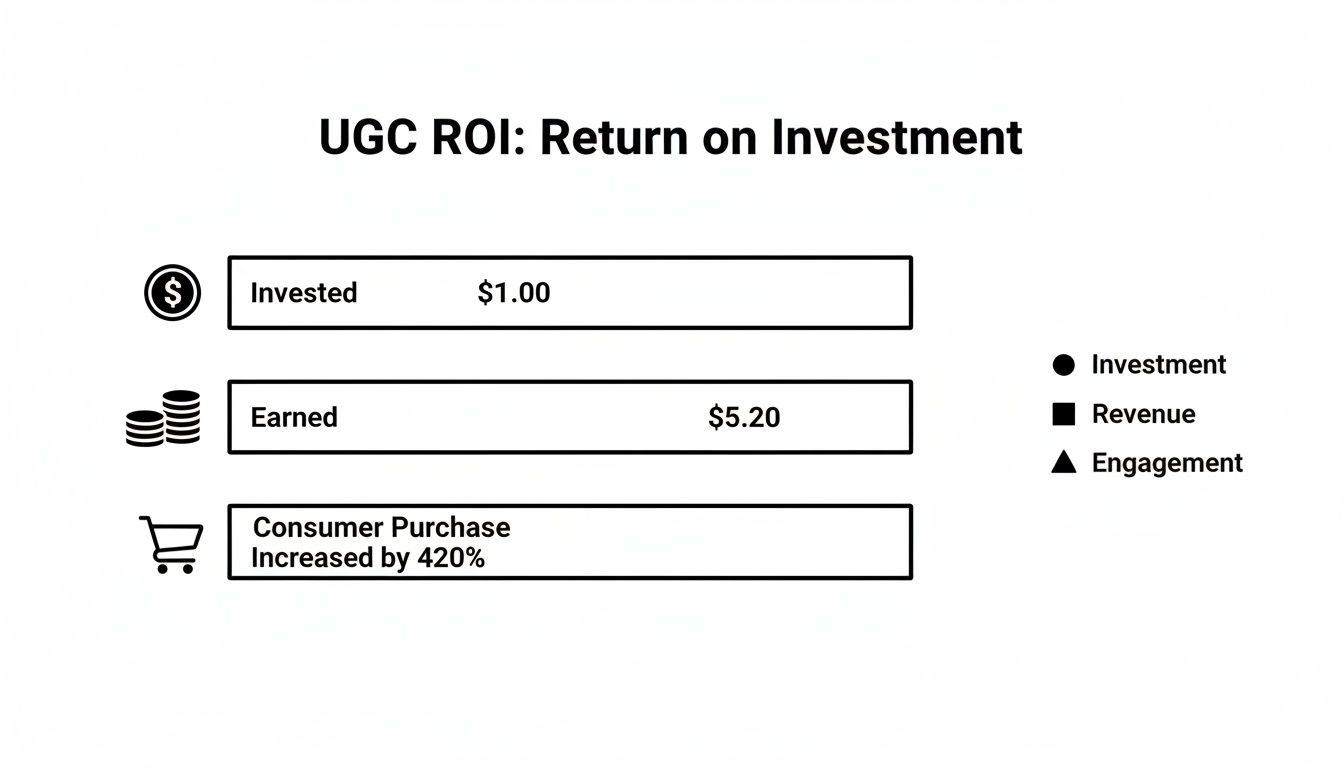
The data here shows that every pound invested can bring back more than five in return. That's the power of authentic creator content.
Prioritise Nano and Micro-Creators for Better ROI
While macro-influencers have the reach, it’s the micro (10k-100k followers) and nano-creators (1k-10k followers) who consistently punch above their weight for ecommerce brands. Their smaller, more dedicated communities mean higher engagement and recommendations that feel like they're coming from a friend.
Don't mistake a small audience for a small impact. A nano-creator with 3,000 highly engaged followers in your niche is infinitely more valuable than a macro-influencer with 300,000 disinterested ones.
Data from the UK market backs this up completely. Nano-creators on TikTok, for instance, are seeing incredible engagement rates of 15.2%. That absolutely dwarfs the 1-2% that larger accounts typically get.
What's more, 40% of consumers say they now prefer getting recommendations from these smaller creators. It just makes more sense financially, too. Their median CPM hovers around £119, compared to over £300 for macro-influencers. For the same budget, you could build a whole squad of diverse creators instead of betting on just one big name.
For brands focusing on direct sales, the choice between creator tiers is a critical one. This table breaks down the key differences.
Creator Tier Comparison for Ecommerce Conversions
| Metric | Nano-Creators (1k-10k) | Micro-Creators (10k-100k) | Macro-Creators (100k-1M) |
|---|---|---|---|
| Average Engagement Rate | Very High (8-15%+) | High (3-6%) | Low (1-2%) |
| Audience Trust & Niche | Extremely High / Very Niche | High / Niche | Moderate / Broad |
| Content Authenticity | Feels like a friend's recommendation | Polished but relatable | Often highly produced / aspirational |
| Cost to Partner (CPM) | Low (avg. £119) | Moderate (avg. £150-£250) | High (avg. £300+) |
| Conversion Impact | Highest potential for direct sales | Strong sales & brand awareness | Best for brand awareness, lower direct sales |
| Scalability | Requires managing multiple creators | Good balance of reach and management | Easy to manage one large campaign |
As you can see, if your primary goal is driving conversions, nano- and micro-creators offer the best combination of trust, engagement, and cost-efficiency. To really get into the weeds on this, it's worth learning more about nano-influencer marketing and why it drives bigger ROI.
Crafting Outreach That Gets a Response
Okay, so you've found a few promising creators. Now you need to reach out. Remember, they get dozens of generic, copy-pasted DMs every single day. Yours has to be different. Personalisation is everything.
Here’s a simple, human way to approach your first message:
- Start with a genuine, specific compliment. Mention something recent they posted. "Hi [Creator Name], I loved your video last week on [specific topic]. That tip you shared about [specific detail] was brilliant." This immediately shows you're a real fan.
- Introduce your brand and find common ground. Briefly explain who you are and why it's a good fit. "I'm with [Your Brand], and we make [your product]. Since your community is so passionate about [shared interest], I thought our [product name] might be right up their street."
- Make a clear and easy ask. Propose a simple, no-strings-attached next step. Gifting your product is the perfect way to start. "We'd love to send you one to try out, no obligation to post at all. If you end up loving it, maybe we could chat about a more formal partnership?"
This approach is respectful of their time, proves you’ve done your homework, and frames the potential partnership as a mutual win, not just a transaction. It's the first step to building a real, long-term relationship that actually drives sales.
Crafting Creative Briefs That Get High-Converting Content
Right, you’ve found some brilliant creators. Now comes the most critical part of the entire process: the creative brief. Get this wrong, and you’re signing up for generic, uninspired content that falls flat. A vague brief is a one-way ticket to disappointment.
But get it right? You empower creators to become a genuine extension of your sales team, producing UGC that actually persuades people and, most importantly, converts.

The goal here isn't to micromanage every second of their video. Far from it. The trick is to provide a clear framework that balances your essential brand guardrails with the creator's unique voice and style. Think of it as giving them the key ingredients for a high-converting video without dictating the exact recipe.
Start with One Clear Campaign Goal
Before you even think about writing, you need to be crystal clear on the one single action you want viewers to take. Is it to click a link? Use a discount code? Or maybe just to finally understand a key product feature? Every single part of your brief needs to point back to this one objective.
For instance, asking for a generic "product review" is far too broad and will likely get you a bland, unhelpful video. Instead, zero in on a specific, conversion-driven angle. A much better request would be for a video that shows "how our noise-cancelling headphones make my commute 10x more peaceful." That immediately frames the product as a solution to a real, relatable problem.
How to Structure Your Brief for Clarity and Impact
A messy, disorganised brief leads to confused creators and off-brand content. It’s that simple. Your document needs to be scannable, clear, and laser-focused. I’ve found the best way is to break it down into logical sections that walk the creator through the entire process.
Here are the absolute essentials to include:
- Campaign Objective: Nail the primary goal in a single sentence. For example, "To drive sales for our new skincare serum using your unique discount code."
- Key Message: Outline the one or two non-negotiable talking points. This might be a unique selling proposition (USP), a core benefit, or details of a specific offer.
- Content Hooks & Angles: This is where you get strategic. Provide a few clear, conversion-focused concepts to get their creative juices flowing.
- Visual Guidelines: Lay out your simple 'do's and don'ts' for aesthetics. This ensures brand consistency without killing their creativity.
- Call to Action (CTA): Be precise. Specify exactly what you want the creator to say or show to get viewers to act.
This structure provides the "what" and the "why," leaving the "how" up to the creator's expertise.
Go from Vague Ideas to Specific Content Hooks
This is where I see most brands fall short. Asking for an "unboxing video" is lazy. You need to provide specific, conversion-optimised hooks that help tell a story. This is the secret to getting creator content that actually converts.
Your brief should inspire, not just instruct. Give creators a starting point that sparks their own ideas, rather than a rigid script that boxes them in. The best UGC feels like a genuine discovery, not a forced advertisement.
Here’s a look at how to transform those common, vague requests into powerful content hooks that get results.
| Vague Request | High-Converting Hook | Why It Works |
|---|---|---|
| "Unboxing Video" | "First Impressions & Setup" showing the unboxing, assembly, and immediate use of the product to solve a problem. | It shifts the focus from the packaging to the immediate value and benefit. |
| "Product Review" | "My 3 Favourite Things About..." highlighting specific features that make the product a game-changer. | It guides the creator to talk about tangible benefits and makes the content super digestible for the viewer. |
| "A 'Day in the Life' Post" | "How [Product] Saves Me 30 Minutes on My Morning Routine" showing the product integrated into their actual daily life. | This positions the product as a practical, must-have solution to a common pain point. |
Giving creators specific hooks like these provides a clear narrative direction and ensures the final content is focused on driving the outcome you need.
Don’t Forget Visuals and Non-Negotiables
While creative freedom is vital, you still need to protect your brand. This is where a simple "Do's and Don'ts" section comes in. Think of it as your safety net. The key is to keep it concise and visual.
Do's (Examples):
- Shoot in bright, natural light.
- Ensure our product logo is clearly visible at some point.
- Show the product in a clean, uncluttered environment.
Don'ts (Examples):
- Please don't include competitor products in the frame.
- Avoid using filters that change the product's true colour.
- Don't add distracting background music over your voice when you're talking about the product.
Finally, be explicit about the call to action. Don't leave it to chance. Tell the creator precisely where to place the link (e.g., "in the first line of the caption and as a link in your bio") and exactly what to say (e.g., "Use my code SARAH15 to get 15% off your first order!"). This final piece of direction is what turns a great video into a measurable sale.
Building a Campaign Structure That Tracks Every Dollar
If you can't measure it, you can't prove it works.
It’s a simple truth, but it’s what separates brands treating creator content as a nice-to-have from those who see it as a powerful, reliable revenue channel. Building a campaign structure that tracks every pound spent and earned isn't just good practice; it's non-negotiable.
What we're talking about here is creating a closed-loop system. You need to be able to draw a straight line from a creator's post directly to a sale in your Shopify or BigCommerce dashboard. Honestly, it's the only way you can justify your budget, fine-tune your strategy, and scale your creator programme with any real confidence.
There’s a reason the UK influencer marketing sector is booming, with brands investing around £930 million in 2024. This isn't just speculative spending; it’s a strategic move driven by a demand for clear, tangible results. With 76% of executives increasing their budgets for these programmes, the pressure to prove ROI has never been higher. You can learn more about the growth of influencer marketing budgets on mabo.co.uk.
Core Tracking Mechanisms for Every Creator
To get attribution right, every single creator you partner with needs their own unique tracking assets. This isn't complicated to set up, but it does require discipline. The two pillars of this system are unique discount codes and UTM-tagged links.
- Creator-Specific Discount Codes: This is the easiest one. Assign a unique code to each creator (think SARAH15 or TOM10). It's the most direct way to track sales, as your ecommerce platform logs every redemption. You can see at a glance who is driving the most revenue.
- UTM-Tagged Links: A UTM (Urchin Tracking Module) is just a bit of code you add to the end of a URL. It tells your analytics tools, like Google Analytics, exactly where a visitor came from. You can specify the source (instagram), medium (ugc), and creator name (sarah-jones).
When you give each creator both a unique code and a unique link, you've created a powerful dual-tracking system. This is how you capture the full picture of their impact, from the very first click all the way through to the final purchase.
Choosing the Right Compensation Model
How you decide to pay creators will directly influence the kind of content you get back and the results you can expect. There's no single "best" model here: the right choice really depends on your campaign goals, your budget, and what the creator themselves prefers.
Your compensation structure should align with your primary objective. If you're focused purely on sales, a commission-based model makes sense. If you need specific, high-quality content for ads, a flat fee is more appropriate.
Let’s break down the most common structures I see used effectively.
The table below outlines the most common tracking methods, helping you decide which approach, or combination of approaches, will give you the clearest picture of your campaign's performance.
Attribution Methods for Creator Campaigns
| Tracking Method | How It Works | Best For | Pros | Cons |
|---|---|---|---|---|
| Discount Codes | Each creator gets a unique code (e.g., CHLOE20). Sales are tracked when the code is used at checkout. | Directly tracking sales and measuring creator-specific revenue. | Simple for both the creator and the customer. Provides hard data on conversions. | Misses sales from customers who saw the content but forgot or didn't use the code. |
| UTM Links | Unique, trackable links are created for each creator's bio or stories. | Tracking clicks, traffic sources, and user journeys through your site analytics. | Excellent for measuring top-of-funnel metrics like traffic and engagement. | Doesn't directly attribute sales unless the purchase happens in the same session. |
| Post-Purchase Surveys | A "How did you hear about us?" survey is shown to customers immediately after they check out. | Capturing attribution for customers influenced by multiple touchpoints or word-of-mouth. | Catches data that codes and links miss. Great for understanding the customer journey. | Relies on customer memory, which can be inaccurate. Response rates can be low. |
| Lift Studies | Comparing sales data from a control group to a group exposed to the creator campaign. | Brands with larger budgets looking for a scientifically rigorous measure of campaign impact. | The "gold standard" for proving causal impact on sales. | Expensive, complex to set up, and often requires a third-party platform. |
By combining a few of these methods, like discount codes and UTM links, you can build a much more robust and accurate picture of how creator content is really impacting your bottom line.
How Should I Pay Creators?
The compensation conversation is crucial. Let's look at the main options.
| Compensation Model | How It Works | Best For |
|---|---|---|
| Gifting Only | You send free products to creators with no obligation to post. | New brands or those testing partnerships with nano-creators. It's a low-risk way to get your product into the right hands. |
| Flat Fee | A one-time payment is made for specific deliverables (e.g., two TikTok videos and one Instagram story). | Securing high-quality content you can repurpose for ads. It guarantees you get the assets you need. |
| Commission-Based | Creators earn a percentage of the sales they generate through their unique code or link. | Performance-focused campaigns where the main goal is driving direct revenue. It's a low-risk, high-reward model. |
| Hybrid Model | This combines a smaller flat fee with a commission on sales. | The most balanced approach. It fairly compensates creators for their time while also incentivising them to drive sales. |
From my experience, the hybrid model is often the sweet spot for building strong, long-term relationships. It shows you value the creator's work upfront while also giving them a stake in the success they help create.
For a much deeper dive into building out your entire strategy, check out our complete 2026 guide to influencer marketing for ecommerce. By getting a solid tracking framework and a fair compensation model in place, you’ll turn your creator programme from an expense into a measurable, scalable investment.
How to Repurpose and Scale Your Top-Performing UGC
Getting a fantastic piece of UGC from a creator is a great start, but its journey shouldn’t end there. The real magic happens when you stop seeing it as a one-off post and start treating it like a versatile marketing asset that can power your entire funnel. Repurposing your best content is how you turn that single investment into a sales-driving machine that works for you across every channel.
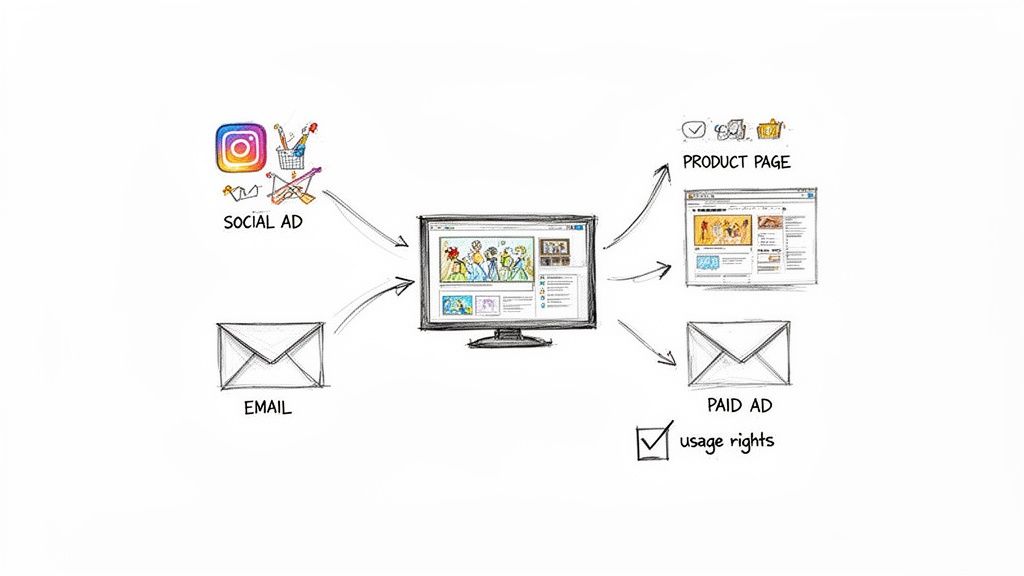
Before you even think about repurposing, though, let's talk about usage rights. This is the non-negotiable first step. A standard creator agreement might only cover the initial post on their channels. If you want to legally use their content in your ads, on your website, or in your emails, you need explicit, written permission. Your contracts must clearly spell out where, for how long, and how you can use their content. Get this sorted from the outset.
Turn Organic Wins into Paid Social Powerhouses
Your best-performing organic UGC is the low-hanging fruit for your paid social strategy. Why? Because it’s already proven to connect with an audience. This content feels right at home in social feeds, neatly sidestepping the ad fatigue that so many polished, high-production brand creatives suffer from.
Think about it: a raw, authentic video from a creator just feels more trustworthy than a slick studio ad. When you put ad spend behind content that’s already a proven winner, you’re not just gambling; you're amplifying a message that you know works.
Your organic UGC feed is your best testing ground for paid ads. The posts with the highest engagement and positive comments are sending you a clear signal: "This message works. Put a budget behind me."
The results from this approach speak for themselves. Brands incorporating UGC into their retargeting ads have seen a 35% higher click-through rate and an incredible 60% lower cost per click. It's just a smarter way to spend your advertising budget. If you're looking to build out your network, you can find more tips in our guide to micro-influencer marketing for small businesses.
Embed UGC Directly on Your Product and Landing Pages
One of the most effective places to put UGC is right on your product pages. When a potential customer is on the fence, seeing a real person using and loving your product can be the final nudge of social proof they need to hit "Add to Basket".
This tactic works because it answers the customer's silent question: "Yeah, but will this work for someone like me?" Here are a few simple ways to bring this to life:
- Build a Customer Gallery: Embed a live feed of tagged Instagram photos directly on your product page.
- Feature Video Testimonials: Place short, punchy video clips from creators right next to your product description.
- Showcase "How-To" Content: Use creator videos to show your product in action, solving a real-world problem.
Embedding this content directly on the page reduces that last-minute hesitation and builds the confidence shoppers need to commit to a purchase.
Supercharge Your Email and SMS Campaigns
The people on your email and SMS lists are warm leads; they’ve already signalled their interest in your brand. Using UGC in these channels is a fantastic way to nurture that relationship and encourage repeat business. Instead of another generic promo email, why not feature a creator's story or review?
This subtle shift changes your communication from a sales pitch into a helpful, friendly recommendation. You could send an email with the subject line, "See how [Creator's Name] styles our new jacket," featuring their photos and a direct link to shop the look. It feels far more personal and provides genuine value, leading to much higher engagement and click-through rates.
As you start to gather more and more assets, staying organised is key. To handle and scale all the content you’re getting, you'll need a solid system. It’s worth exploring the benefits of marketing asset management software to keep everything in order. This ensures your best content is always at your fingertips, ready to be deployed across any channel. By systematically repurposing your best UGC, you create a feedback loop where great content constantly fuels every part of your marketing, dramatically improving your ROI.
Answering Your Top Questions About Conversion-Focused UGC
Diving into UGC that’s designed to sell always brings up a few key questions. It's completely normal. Getting these details right from the start is what separates a programme that just produces nice-looking content from one that delivers a real, measurable return on investment. Let's get into the most common queries we see from ecommerce brands.
The big one, naturally, is always about the money. What's the right amount to spend on creators to get content that actually converts?
How Much Should I Be Paying for UGC?
Honestly, there’s no single price tag. The right figure really hinges on who the creator is, what you're asking them to do, and the ultimate goal of your campaign. A nano-creator with a small but engaged following might be thrilled with a free product, whereas a more seasoned micro-creator will (and should) expect a flat fee for their time and skill.
A better way to approach this is to think about the value of the content to you. Is it just for a single organic post on their feed? Or are you getting the rights to slice and dice that video for your paid ads over the next six months? The second scenario is infinitely more valuable, and the compensation needs to reflect that.
Don't view creator fees as a cost. See them as an investment in high-performing creative assets. Paying £200 for a video that you can turn into an ad generating £2,000 in sales is a no-brainer.
We've found a hybrid model often works best. This involves a fair, modest flat fee (which respects the creator's effort) paired with a commission on any sales they drive. This structure shows you value their work upfront while giving them a powerful incentive to create content that genuinely persuades people to buy.
What if I Get Negative Feedback or Just... Bad Content?
This is a totally valid worry, but in reality, it's rarely the headache you might imagine. If you've done your homework by vetting creators properly and providing a crystal-clear brief, you've already sidestepped most potential issues.
But things happen. If a piece of content just doesn't hit the mark, the first step is always to have a conversation.
Was something lost in translation with the brief? More often than not, a quick, friendly chat can clear things up and lead to a simple revision. And if the creator gives you negative feedback about the product itself? That's not a failure; that's incredibly valuable, free product research highlighting something you might need to fix.
Remember, you're never obligated to post or use every single piece of content you receive. As long as you secured the usage rights from the beginning, you have full control over which assets get the spotlight on your channels.
How Many Creators Should I Start With?
Our advice is always to start small and be deliberate. It’s much more effective to run a tight, successful pilot campaign with three to five carefully chosen creators than to stretch your budget and attention across twenty. A smaller, focused group gives you the space to test everything (your brief, your tracking, your payment model) without a massive upfront commitment.
Once you see who and what is actually driving sales, that's when you scale. You’ll have a proven formula to build on. The data from that first small group will tell you exactly what a great partner looks like for your brand, making it much faster and easier to find more of them.
The aim isn't to rack up the highest number of collaborators. It’s to build solid, repeatable, and profitable partnerships with the right creators. When it comes to conversion, quality will beat quantity every single time.
Ready to turn creator marketing into a measurable, scalable growth channel? Sup combines AI-powered sourcing with a human team to launch and manage creator campaigns that drive real results. Ditch the spreadsheets and endless DMs, and start building a high-ROI creator programme in minutes. Learn more about Sup and book a demo today.
More on content & ugc
See how many creators post about you and your competitors
Type in your brand's Instagram handle and we count the creators who post about you and about your five closest competitors. It takes about a minute and it is free. Or request a demo and we will show you the creators in your niche and walk you through the dashboard.
 Book a call